
Life, 1914-03-05 · page 20 of 60
Life — March 5, 1914 — page 20: what you’re looking at
What you’re looking at
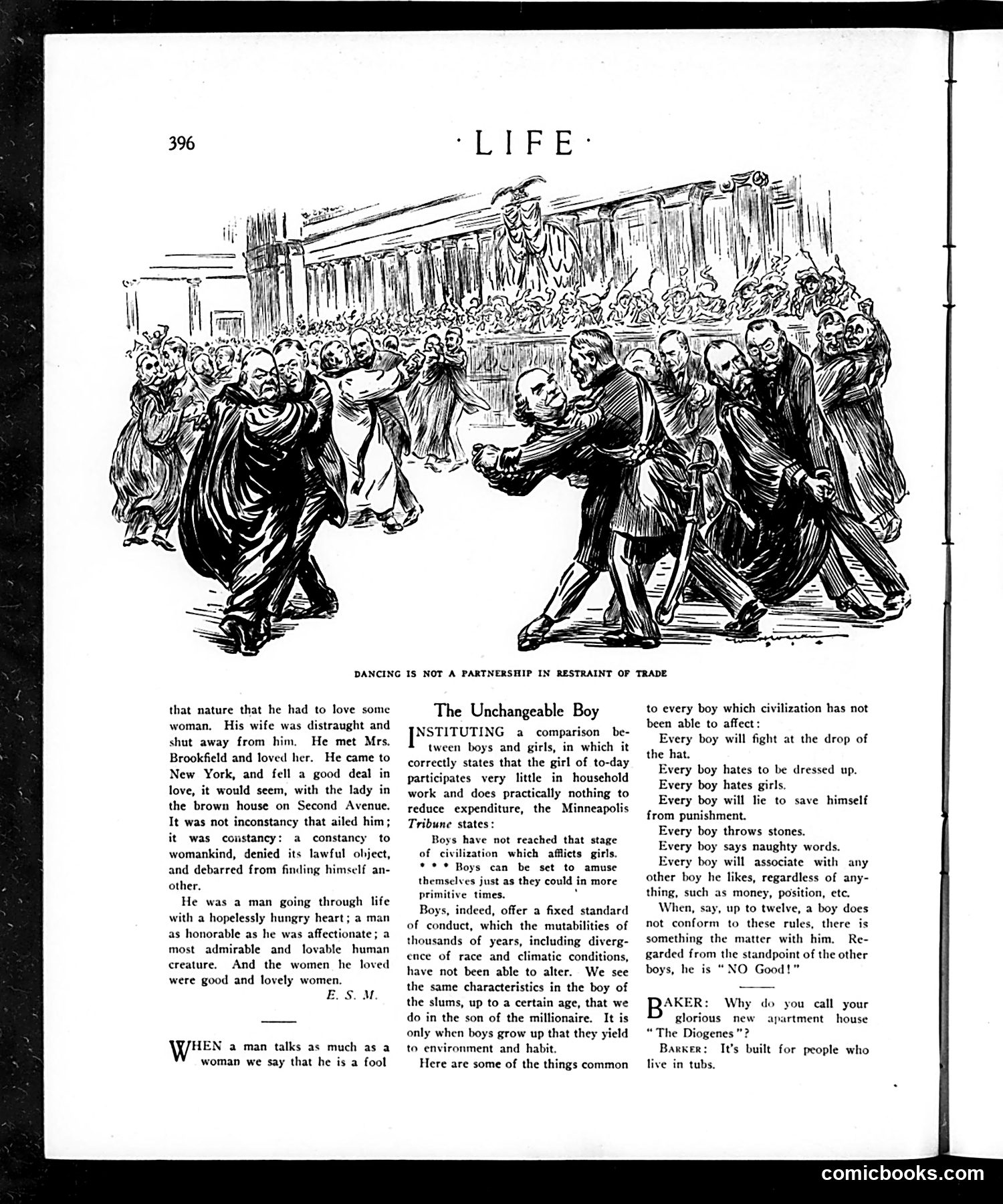
The page contains two distinct pieces of satire: **Top Illustration**: "Dancing Is Not a Partnership in Restraint of Trade" depicts a formal ballroom scene with couples dancing. The caption suggests satire about social propriety and business/trade regulations—likely mocking either overly strict social conventions around dance partnerships or regulatory language intruding into social life. The specific historical reference is unclear without additional context. **"The Unchangeable Boy"**: This article satirizes a Minneapolis Tribune piece claiming boys remain unchanging across class and geography, listing immutable boy behaviors (fighting, hating dressing up, lying to avoid punishment, throwing stones, saying naughty words). The satire critiques the Tribune's claim that boys are immune to civilization's influence—implying the Tribune's list actually proves boys *are* shaped by their environment, contradicting its own argument. **"The Diogenes" Joke**: A brief exchange mocking a pretentious apartment building name. Diogenes was an ancient Greek philosopher who famously lived in a barrel/tub to reject materialism—so naming a fancy building after him is absurdly contradictory.
📄 Transcribed text from this page (OCR, searchable)
Machine-transcribed from the original scan — historical spelling and the odd misread are preserved.
DANCING IS NOT A PARTNERSHIP IN RESTRAINT OF TRADE that nature that he had to love some woman. His wife was distraught and shut away from him. He met Mrs. Brookfield and loved her. He came to New York, and fell a good deal in love, it would seem, with the lady in the brown house on Second Avenue. It was not inconstancy that ailed him; it was constancy: a constancy to womankind, denied its lawful object, and debarred from finding himself an- other, He was a man going through life with a hopelessly hungry heart; a man as honorable as he was affectionate; a most admirable and lovable human creature. And the women he loved were good and lovely women. EB. S.M. HEN a man talks as much as a woman we say that he is a fool The Unchangeable Boy NSTITUTING a comparison be- tween boys and girls, in which it correctly states that the girl of to-day participates very little in household work and does practically nothing to reduce expenditure, the Minneapolis Tribune states: Boys have not reached that stage of civilization which afflicts girls. * * * Boys can be set to amuse themselves just as they could in more primitive times. . Boys, indeed, offer a fixed standard of conduct, which the mutabilities of thousands of years, including diverg- ence of race and climatic conditions, have not been able to alter. We see the same characteristics in the boy of the slums, up to a certain age, that we do in the son of the millionaire. It is only when boys grow up that they yield to environment and habit. Here are some of the things common to every boy which civilization has not been able to affect: Every boy will fight at the drop of the hat. Every boy hates to be dressed up. Every boy hates girls. Every boy will lie to save himself from punishment. Every boy throws stones. Every boy says naughty words. Every boy will associate with any other boy he likes, regardless of any- thing, such as money, position, etc. When, say, up to twelve, a boy does not conform to these rules, there is something the matter with him, Re- garded from the standpoint of the other boys, he is “NO Good!" AKER: Why do you call your glorious new apartment house “The Diogenes”? Barker: It’s built for people who live in tubs. comicbooks.com