
Life, 1914-03-05 · page 33 of 60
Life — March 5, 1914 — page 33: what you’re looking at
What you’re looking at
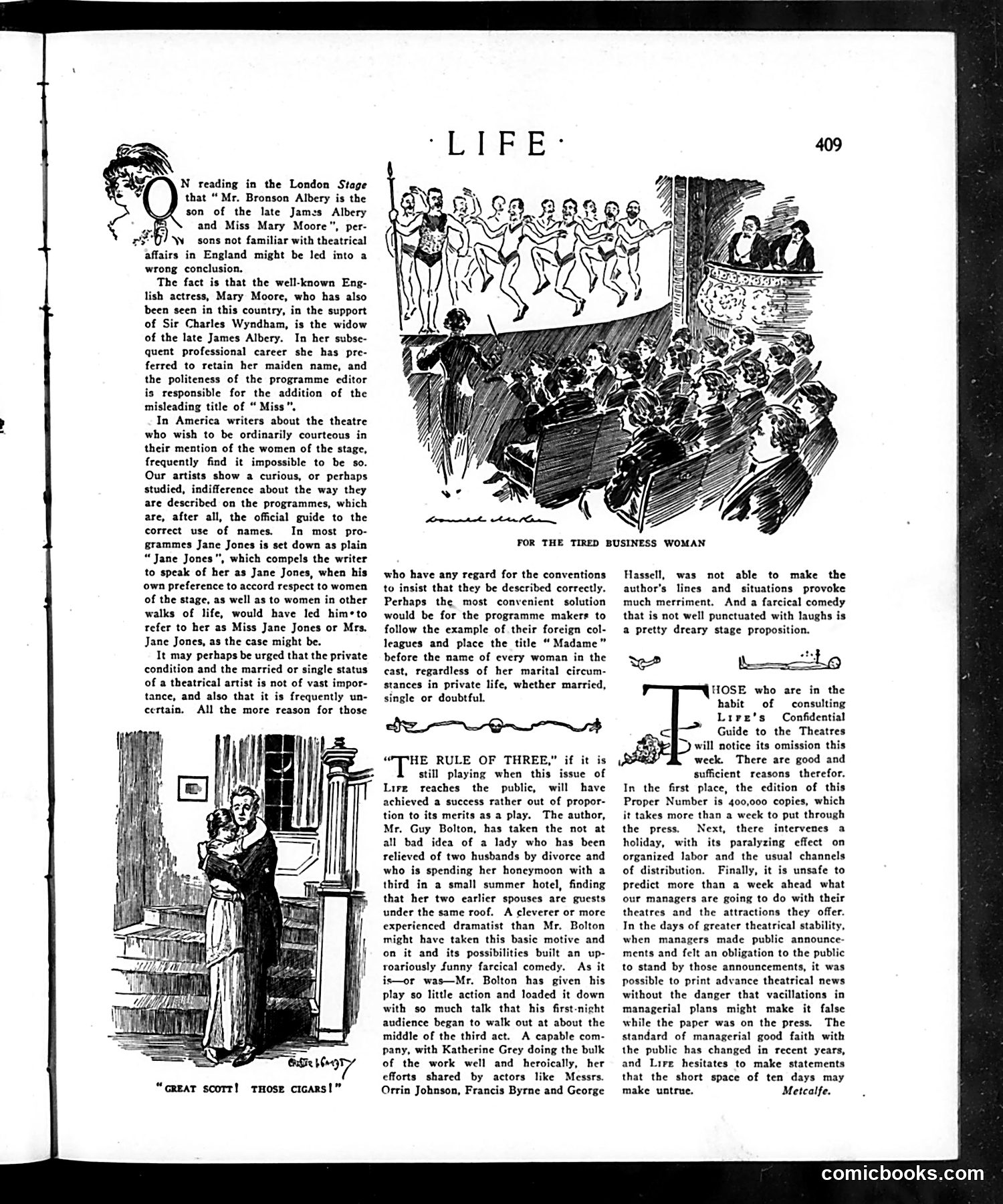
This page contains theater criticism and editorial commentary, not political cartoons. The content addresses professional theater conventions: **Main Article**: Criticizes British and American theater programs for inconsistent naming of female performers. The example concerns actress Mary Moore, widow of playwright James Albery—programs incorrectly listed her as "Miss Mary Moore" rather than acknowledging her married status or allowing her professional name choice. The piece argues theater programs should adopt the European convention of using "Madame" for all women performers, regardless of marital status, to avoid confusion and show respect. **Play Review**: "The Rule of Three" by Guy Bolton receives negative criticism. The plot involves a woman honeymooning with her third husband while her two ex-husbands (from divorces) happen to be guests at the same hotel. The reviewer faults Bolton for insufficient action and excessive dialogue, causing first-night audiences to leave mid-performance. **Side Note**: Announces omission of the theater guide this week due to printing delays, holiday disruptions, and distribution challenges. The small illustration captioned "Great Scott! Those cigars!" appears unrelated to main text.
📄 Transcribed text from this page (OCR, searchable)
Machine-transcribed from the original scan — historical spelling and the odd misread are preserved.
N reading in the London Stage that “ Mr. Bronson Albery is the son of the late James Albery and Miss Mary Moore”, per- /\\ sons not familiar with theatrical affairs in England might be led into a wrong conclusion. The fact is that the well-known Eng- lish actress, Mary Moore, who has also been seen in this country, in the support of Sir Charles Wyndham, is the widow of the late James Albery. In her subse- quent professional career she has pre- ferred to retain her maiden name, and the politeness of the programme editor is responsible for the addition of the misleading title of “ Miss”. In America writers about the theatre who wish to be ordinarily courteous in their mention of the women of the stage, frequently find it impossible to be so. Our artists show a curious, or perhaps studied, indifference about the way they are described on the programmes, which are, after all, the official guide to the correct use of names. In most pro- grammes Jane Jones is set down as plain “Jane Jones", which compels the writer to speak of her as Jane Jones, when his own preference to accord respect to women. of the stage, as well as to women in other walks of life, would have led himeto refer to her as Miss Jane Jones or Mrs. Jane Jones, as the case might be. It may perhaps be urged that the private condition and the married or single status of a theatrical artist is not of vast impor- tance, and also that it is frequently un- certain, All the more reason for those “peat scorr! THOSE cicars!” FOR THE TIRED BUSINESS WOMAN who have any regard for the conventions to insist that they be described correctly. Perhaps the most convenient solution would be for the programme makers to follow the example of their foreign col- leagues and place the title “ Madame” before the name of every woman in the cast, regardless of her marital circum- stances in private life, whether married, single or doubtful. ee Ot ““THE RULE OF THREE,” if it is still playing when this issue of Lire reaches the public, will have achieved a success rather out of propor- tion to its merits as a play. The author, Mr. Guy Bolton, has taken the not at all bad idea of a lady who has been relieved of two husbands by divorce and who is spending her honeymoon with a third in a small summer hotel, finding that her two earlier spouses are guests under the same roof. A cleverer or more experienced dramat than Mr. Bolton might have taken this basic motive and on it and its possibilities built an up- roariously funny farcical comedy. As is—or was—Mr. Bolton has given his play so little action and loaded it down with so much talk that his first-night audience began to walk out at about the middle of the third act. A capable com- pany, with Katherine Grey doing the bulk of the work well and heroically, her efforts shared by actors like Messrs. Orrin Johnson, Francis Byrne and George Hassell, was not able to make the author’s lines and situations provoke much merriment. And a farcical comedy that is not well punctuated with laughs is a pretty dreary stage proposition. HOSE who are in the habit of consulting Lire’s Confidential "Guide to the Theatres >) will notice its omission this week. There are good and sufficient reasons therefor. In the first place, the edition of this Proper Number is 400,000 copies, which it takes more than a week to put through the press. Next, there intervenes a holiday, with its paralyzing effect on organized labor and the usual channels of distribution. Finally, it is unsafe to predict more than a week ahead what our managers are going to do with their theatres and the attractions they offer. In the days of greater theatrical stability, when managers made public announce- ments and felt an obligation to the public to stand by those announcements, it was possible to print advance theatrical news without the danger that vacillations in managerial plans might make it false while the paper was on the press. The standard of managerial good faith with the public has changed in recent years, and Lire hesitates to make statements that the short space of ten days may make untrue. Metcalfe. comicbooks.com