
Life, 1914-03-05 · page 32 of 60
Life — March 5, 1914 — page 32: what you’re looking at
What you’re looking at
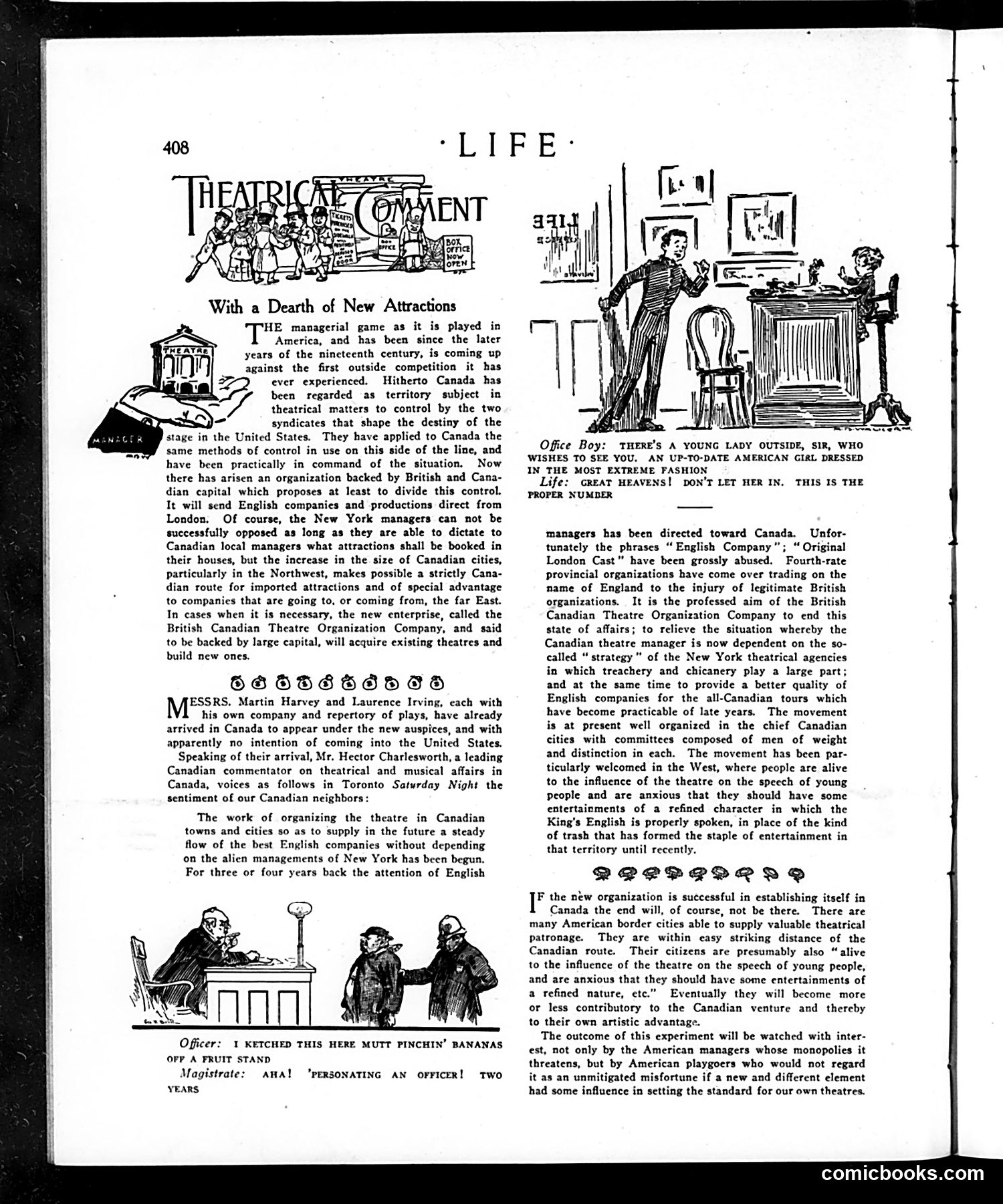
This page discusses the **theatrical monopoly** American companies held over Canadian theatre. The article announces a challenge to this control: a new British-Canadian Theatre Organization Company backed by British and Canadian capital, which will import English productions directly from London rather than through American New York managers. The satirical point: American theatrical syndicates had treated Canada as their exclusive territory, dictating which shows played in Canadian theatres. Now, growing Canadian cities—particularly in the Northwest—make competition feasible. The article emphasizes that Canadian theatre managers seek independence from what they call the "treachery and chicanery" of New York theatrical agencies, and desire "refined" English entertainment (with proper "King's English") for young Canadians. The three small cartoons at bottom appear to be unrelated humorous vignettes about mistaken identity and fashion, typical of *Life* magazine's satirical style.
📄 Transcribed text from this page (OCR, searchable)
Machine-transcribed from the original scan — historical spelling and the odd misread are preserved.
With a Dearth of New Attractions ‘HE managerial game as it is played in America, and has been since the later years of the nineteenth century, is coming up against the first outside competition it has ever experienced. Hitherto Canada has been regarded as territory subject in theatrical matters to control by the two syndicates that shape the destiny of the stage in the United States. They have applied to Canada the same methods of control in use on thi ide of the line, and have been practically in command of the situation. Now there has arisen an organization backed by British and Cana- dian capital which proposes at least to divide this control. It will send English companies and productions direct from London. Of course, the New York managers can not be successfully opposed as long as they are able to dictate to Canadian local managers what attractions shall be booked in their houses, but the increase in the size of Canadian cities, particularly in the Northwest, makes possible a strictly Cana- dian route for imported attractions and of special advantage to companies that are going to, or coming from, the far East. In cases when it is necessary, the new enterprise, called the British Canadian Theatre Organization Company, and said to be backed by large capital, will acquire existing theatres and build new ones. 66 5BESSDSSH ESSRS. Martin Harvey and Laurence Irving, each with his own company and repertory of plays, have already arrived in Canada to appear under the new auspices, and with apparently no intention of coming into the United States. Speaking of their arrival, Mr. Hector Charlesworth, a leading Canadian commentator on theatrical and musical affairs in Canada, voices as follows in Toronto Saturday Night the sentiment of our Canadian neighbors: The work of organizing the theatre in Canadian towns and cities so as to supply in the future a steady flow of the best English companies without depending on the alien managements of New York has been begun. For three or four years back the attention of English Officer: 1 KETCHED THIS HERE MUTT PINCHIN’ BANANAS. OFF A FRUIT STAND Magistrate: anal YEARS "PERSONATING AN OFFICER! TWO tt Office Boy: THERE'S A YOUNG LADY OUTSIDE, SIR, WHO WISHES TO SEE YOU. AN UP-TO-DATE AMERICAN GIRL DRESSED IN THE MOST EXTREME FASHION Life: GREAT HEAVENS! DON’T LET HER IN. THIS IS THE PROPER NUMBER managers has been directed toward Canada. Unfor- tunately the phrases “ English Company”; “ Original London Cast” have been grossly abused. Fourth-rate provincial organizations have come over trading on the name of England to the injury of legitimate British organizations. It is the professed aim of the British Canadian Theatre Organization Company to end this state of affairs; to relieve the situation whereby the Canadian theatre manager is now dependent on the so- called “ strategy” of the New York theatrical agencies in which treachery and chicanery play a large part; and at the same time to provide a better quality of English companies for the all-Canadian tours which have become practicable of late years. The movement is at present well organized in the chief Canadian cities with committees composed of men of weight and distinction in each. The movement has been par- ticularly welcomed in the West, where people are alive to the influence of the theatre on the speech of young people and are anxious that they should have some entertainments of a refined character in which the King’s English is properly spoken, in place of the kind of trash that has formed the staple of entertainment in that territory until recently. Q@RPEBR~®RRLNS F the new organization is successful in establishing itself in Canada the end will, of course, not be there. There are many American border cities able to supply valuable theatrical patronage. Thcy are within easy striking distance of the Canadian route. Their citizens are presumably also “alive to the influence of the theatre on the speech of young people, and are anxious that they should have some entertainments of a refined nature, etc.” Eventually they will become more or less contributory to the Canadian venture and thereby to their own artistic advantage. The outcome of this experiment will be watched with inter- est, not only by the American managers whose monopolies it threatens, but by American playgoers who would not regard it as an unmitigated misfortune if a new and different element had some influence in setting the standard for our own theatres. comicbooks.com