
Life, 1914-03-05 · page 23 of 60
Life — March 5, 1914 — page 23: what you’re looking at
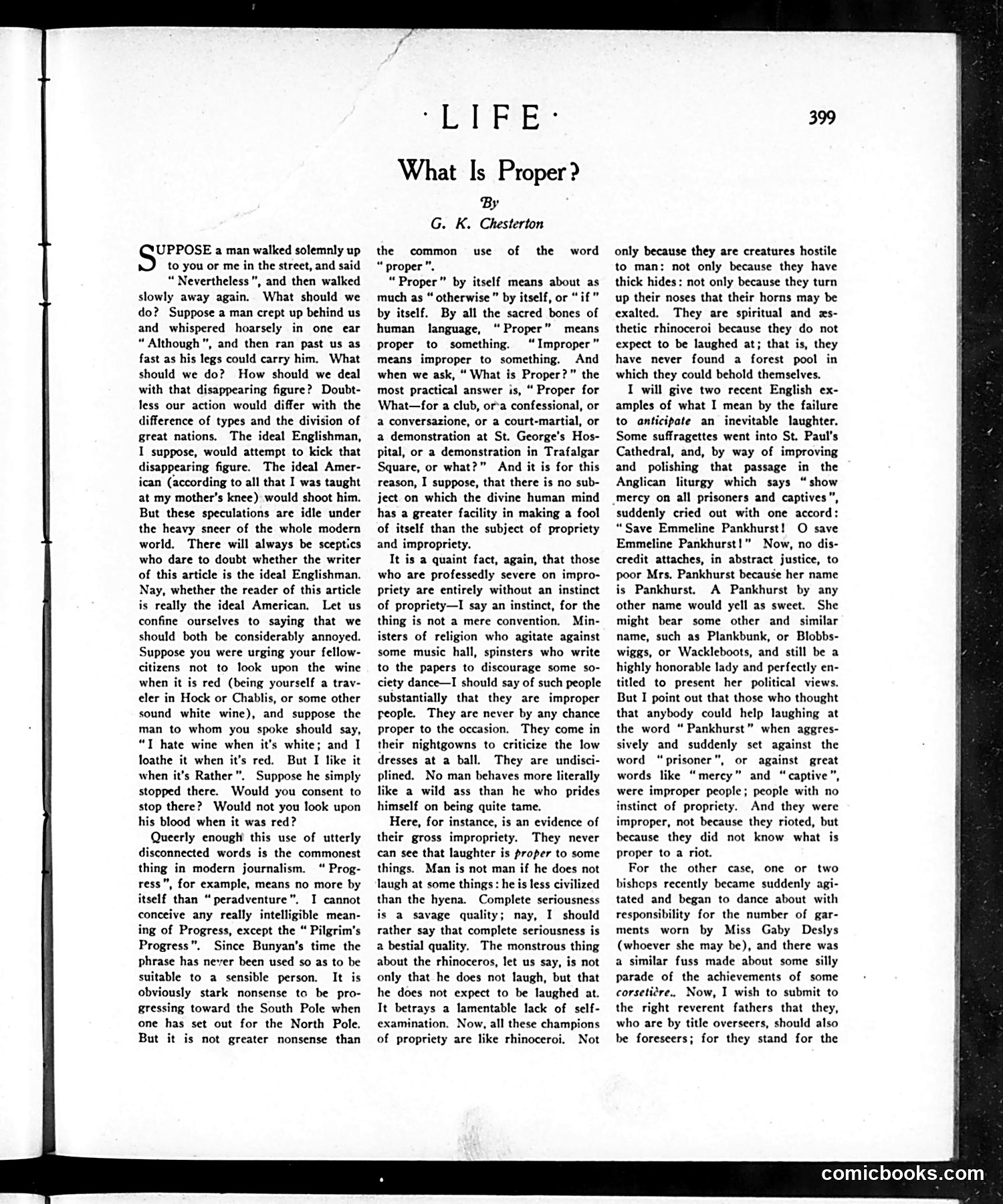
What you’re looking at
This is a satirical essay, not a cartoon. Chesterton critiques modern misuse of the word "proper" and attacks self-righteous moralists who police social behavior. His main argument: "proper" is meaningless without context—something is proper *for* a specific occasion or setting. Yet modern journalism uses such words carelessly. Chesterton targets pious activists—particularly religious ministers and prudish women ("spinsters who write to papers")—who crusade against music halls and society dances. He argues these self-appointed morality enforcers are themselves *improper* because they lack social instinct; they behave inappropriately to occasions, like wearing nightgowns to criticize low necklines at balls. His central joke: people obsessed with propriety are often the least proper in behavior—like "a wild ass" plumed on being tame. They fail to recognize that laughter and human joy are themselves proper to many situations. The satire targets early-20th-century moral crusaders and journalistic cant.
📄 Transcribed text from this page (OCR, searchable)
Machine-transcribed from the original scan — historical spelling and the odd misread are preserved.
UPPOSE a man walked solemnly up to you or me in the street, and said “ Nevertheless”, and then walked slowly away again. What should we do? Suppose a man crept up behind us and whispered hoarsely in one ear “ Although”, and then ran past us as fast as his legs could carry him. What should we do? How should we deal with that disappearing figure? Doubt- less our action would differ with the difference of types and the division of great nations. The ideal Englishman, I suppose, would attempt to kick that disappearing figure. The ideal Amer- ican (according to all that I was taught at my mother’s knee) would shoot him. But these speculations are idle under the heavy sneer of the whole modern world. There will always be sceptics who dare to doubt whether the writer of this article is the ideal Englishman. Nay, whether the reader of this article is really the ideal American. Let us confine ourselves to saying that we should both be considerably annoyed. Suppose you were urging your fellow- citizens not to look upon the wine when it is red (being yourself a trav- eler in Hock or Chablis, or some other sound white wine), and suppose the man to whom you spoke should say, “T hate wine when it’s white; and I loathe it when it’s red. But I like it when it’s Rather”. Suppose he simply stopped there. Would you consent to stop there? Would not you look upon his blood when it was red? Queerly enough this use of utterly disconnected words is the commonest thing in modern journalism. “ Prog- ress”, for example, means no more by itself than “peradventure”. I cannot conceive any really intelligible mean- ing of Progress, except the “ Pilgrim's Progress”. Since Bunyan’s time the phrase has never been used so as to be suitable to a sensible person. It is obviously stark nonsense to be pro- gressing toward the South Pole when one has set out for the North Pole. But it is not greater nonsense than SEV REEs: What Is Proper? By G. K. Chesterton the common use of the word “ proper”. “Proper” by itself means about as much as “ otherwise” by itself, or “if” by itself. By all the sacred bones of human language, “Proper” means proper to something. “Improper” means improper to something. And when we ask, “ What is Proper?” the most practical answer is, “ Proper for What—for a club, or*a confessional, or a conversazione, or a court-martial, or a demonstration at St. George's Hos- pital, or a demonstration in Trafalgar Square, or what?” And it is for this reason, I suppose, that there is no sub- ject on which the divine human mind has a greater facility in making a fool of itself than the subject of propriety and impropriety. It is a quaint fact, again, that those who are professedly severe on impro- priety are entirely without an instinct of propriety—I say an instinct, for the thing is not a mere convention. Min- isters of religion who agitate against some music hall, spinsters who write to the papers to discourage some so- ciety dance—I should say of such people substantially that they are improper people. They are never by any chance proper to the occasion. They come in their nightgowns to criticize the low dresses at a ball. They are undisci- plined. No man behaves more literally like a wild ass than he who prides himself on being quite tame. Here, for instance, is an evidence of their gross impropriety. They never can see that laughter is proper to some things. Man is not man if he does not laugh at some things: he is less civilized than the hyena. Complete seriousness is a savage quality; nay, I should rather say that complete seriousness is a bestial quality, The monstrous thing about the rhinoceros, let us say, is not only that he does not laugh, but that he does not expect to be laughed at. It betrays a lamentable lack of self- examination. Now, all these champions of propriety are like rhinoceroi. Not only because they are creatures hostile to man: not only because they have thick hides: not only because they turn up their noses that their horns may be exalted. They are spiritual and zxs- thetic rhinoceroi because they do not expect to be laughed at; that is, they have never found a forest pool in which they could behold themselves. I will give two recent English ex- amples of what I mean by the failure to anticipate an inevitable laughter. Some suffragettes went into St. Paul's Cathedral, and, by way of improving and polishing that passage in the Anglican liturgy which says “show _mercy on all prisoners and captives”, suddenly cried out with one accord: “Save Emmeline Pankhurst! O save Emmeline Pankhurst!" Now, no dis- credit attaches, in abstract justice, to poor Mrs. Pankhurst because her name is Pankhurst. A Pankhurst by any other name would yell as sweet. She might bear some other and similar name, such as Plankbunk, or Blobbs- wiggs, or Wackleboots, and still be a highly honorable lady and perfectly en- titled to present her political views. But I point out that those who thought that anybody could help laughing at the word “ Pankhurst” when aggres- sively and suddenly set against the word “prisoner”, or against great words like “mercy” and “captive”, were improper people; people with no instinct of propriety. And they were improper, not because they rioted, but because they did not know what is proper to a riot. For the other case, one or two bishops recently became suddenly agi- tated and began to dance about with responsibility for the number of gar- ments worn by Miss Gaby Deslys (whoever she may be), and there was a similar fuss made about some silly parade of the achievements of some corsetiére.. Now, I wish to submit to the right reverent fathers that they, who are by title overseers, should also be foreseers; for they stand for the comicbooks.com