
Life, 1914-03-05 · page 28 of 60
Life — March 5, 1914 — page 28: what you’re looking at
What you’re looking at
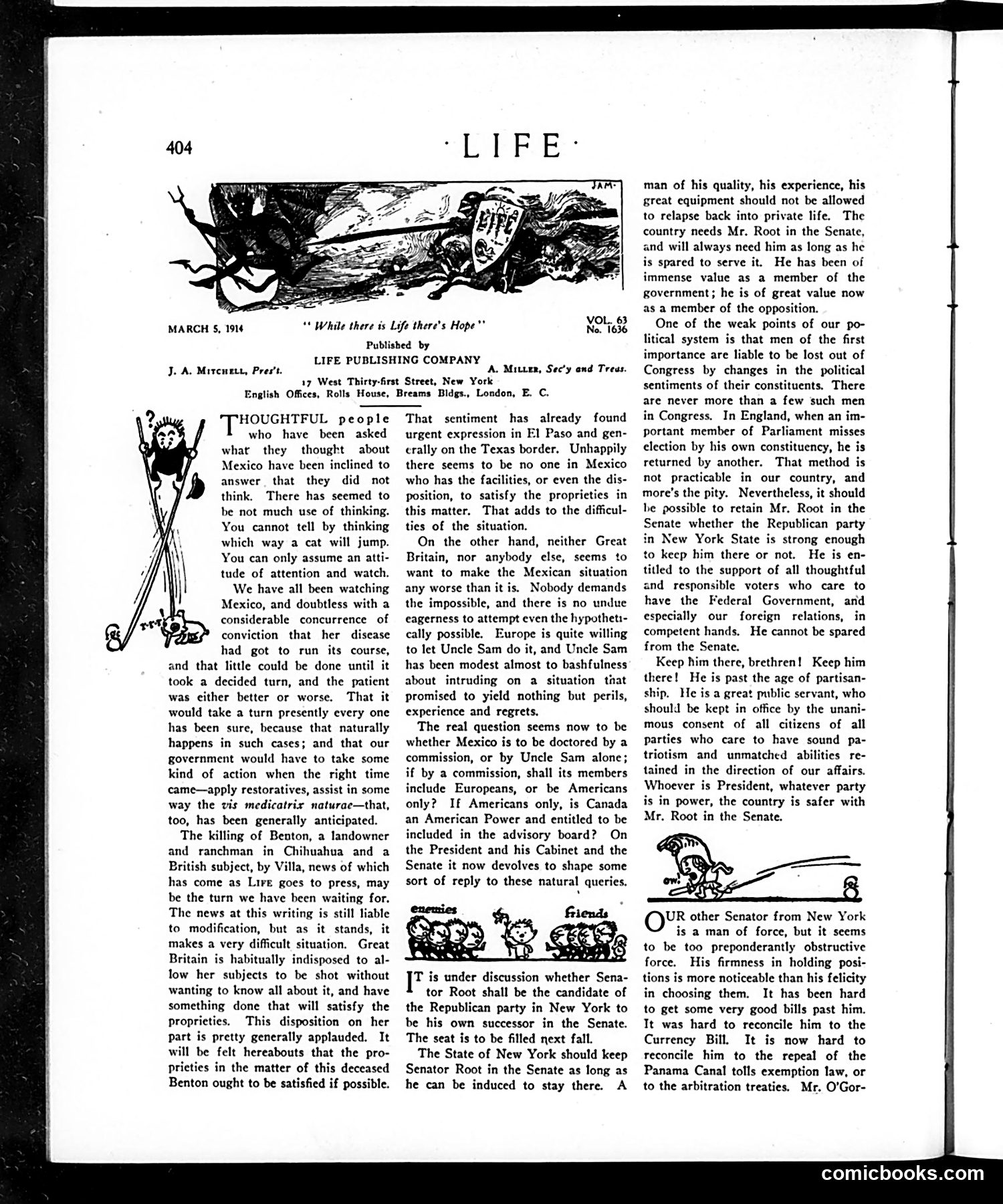
This page addresses two contemporary crises. The main article discusses the Mexican Revolution's instability, sparked by the recent killing of British rancher Benton by Pancho Villa's forces. The piece wrestles with whether the U.S. should intervene alone or through an international commission, and whether Canada should participate in advisory decisions. The secondary editorial advocates retaining Senator Elihu Root in the U.S. Senate. Root, a prominent Republican and former Secretary of State, was apparently considering retiring. The author argues his experience and abilities are too valuable to lose to private life, regardless of party affiliation—a notable appeal to transcendent national interest over partisanship during polarized times. The illustrated header ("While there is Life there's Hope") appears decorative rather than directly commenting on these pieces.
📄 Transcribed text from this page (OCR, searchable)
Machine-transcribed from the original scan — historical spelling and the odd misread are preserved.
MARCH S§, 1914 “* While there is Life there's Hope"’ No. 1636 Published by LIFE PUBLISHING COMPANY J. A. Mivcmete, Pres’t. A. Miturs, Sec’y and Treas. 17 West Thirty-first Street, New York English Offices, Rolls House, Breams Bidgs., London, E. C. HOUGHTFUL people who have been asked what they thought about Mexico have been inclined to answer. that they did not think. There has seemed to be not much use of thinking. You cannot tell by thinking which way a cat will jump. You can only assume an atti- tude of attention and watch. We have all been watching Mexico, and doubtless with a considerable concurrence of conviction that her disease had got to run its course, and that little could be done until it took a decided turn, and the patient was either better or worse. That it would take a turn presently every one has been sure, because that naturally happens in such cases; and that our government would have to take some kind of action when the right time came—apply restoratives, assist in some way the vis medicatrix naturae—that, too, has been generally anticipated. The killing of Benton, a landowner and ranchman in Chihuahua and a British subject, by Villa, news of which has come as Lire goes to press, may be the turn we have been waiting for. The news at this writing is still liable to modification, but as it stands, it makes a very difficult situation. Great Britain is habitually indisposed to al- low her subjects to be shot without wanting to know all about it, and have something done that will satisfy the Propricties. This disposition on her Part is pretty generally applauded. It will be felt hereabouts that the pro- prieties in the matter of this deceased Benton ought to be satisfied if possible. That sentiment has already found urgent expression in El Paso and gen- erally on the Texas border. Unhappily there seems to be no one in Mexico who has the facilities, or even the dis- position, to satisfy the proprieties in this matter. That adds to the difficul- ties of the situation. On the other hand, neither Great Britain, nor anybody else, seems to want to make the Mexican situation any worse than it is. Nobody demands the impossible, and there is no undue eagerness to attempt even the hypotheti- cally possible. Europe is quite willing to let Uncle Sam do it, and Uncle Sam has been modest almost to bashfulness about intruding on a situation that promised to yield nothing but perils, experience and regrets. The real question seems now to be whether Mexico is to be doctored by a commission, or by Uncle Sam alone; if by a commission, shall its members include Europeans, or be Americans only? If Americans only, is Canada an American Power and entitled to be included in the advisory board? On the President and his Cabinet and the Senate it now devolves to shape some sort of reply to these natural queries. T is under discussion whether Sena- tor Root shall be the candidate of the Republican party in New York to be his own successor in the Senate. The seat is to be filled next fall. The State of New York should keep Senator Root in the Senate as long as he can be induced to stay there. A man of his quality, his experience, his great equipment should not be allowed to relapse back into private life. The country needs Mr. Root in the Senate, and will always need him as long as he is spared to serve it. He has been of immense value as a member of the government; he is of great value now as a member of the opposition. One of the weak points of our po- litical system is that men of the first importance are liable to be lost out of Congress by changes in the political sentiments of their constituents, There are never more than a few such men in Congress, In England, when an im- portant member of Parliament misses election by his own constituency, he is returned by another. That method is not practicable in our country, and more'’s the pity. Nevertheless, it should he possible to retain Mr. Root in the Senate whether the Republican party in New York State is strong enough to keep him there or not. He is en- titled to the support of all thoughtful and responsible voters who care to have the Federal Government, and especially our foreign relations, in competent hands. He cannot be spared from the Senate. Keep him there, brethren! Keep him there! He is past the age of partisan- ship. He is a great public servant, who should be kept in office by the unani- mous consent of all citizens of all parties who care to have sound pa- triotism and unmatched abilities re- tained in the direction of our affairs. Whoever is President, whatever party is in power, the country is safer with Mr. Root in the Senate. UR other Senator from New York is a man of force, but it seems to be too preponderantly obstructive force. His firmness in holding posi- tions is more noticeable than his felicity in choosing them. It has been hard to get some very good bills past him. It was hard to reconcile him to the Currency Bill. It is now hard to reconcile him to the repeal of the Panama Canal tolls exemption law, or to the arbitration treaties. Mr. O’Gor- comicbooks.com