
A complete issue · 44 pages · 1914
Life — January 8, 1914
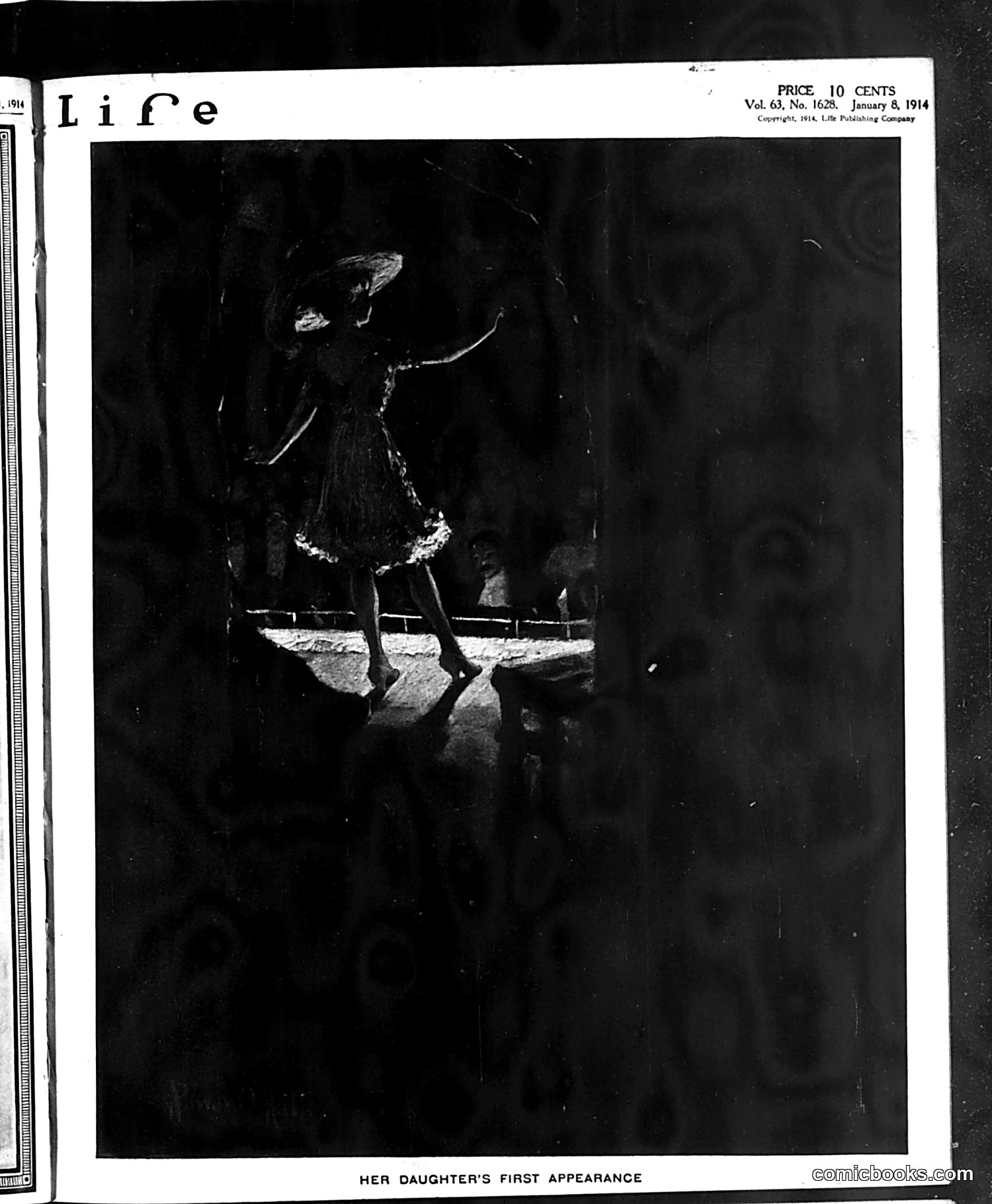
This appears to be a theatrical or performance photograph rather than a political cartoon. The image shows a silhouetted figure on stage under dramatic lighting, positioned at what looks like a piano or musical instrument. The caption reads "HER DAUGHTER'S FIRST APPEARANCE." The photograph's dramatic lighting and composition suggest this documents a debut performance, likely theatrical or musical in nature. The high contrast black-and-white image emphasizes the stage setting and spotlight effect. Without additional context from the magazine issue, I cannot definitively identify the specific performer or event being referenced. The image appears designed to create a humorous or poignant moment around a young person's first public performance, a relatable human-interest story that *Life* magazine frequently featured alongside its satirical content.
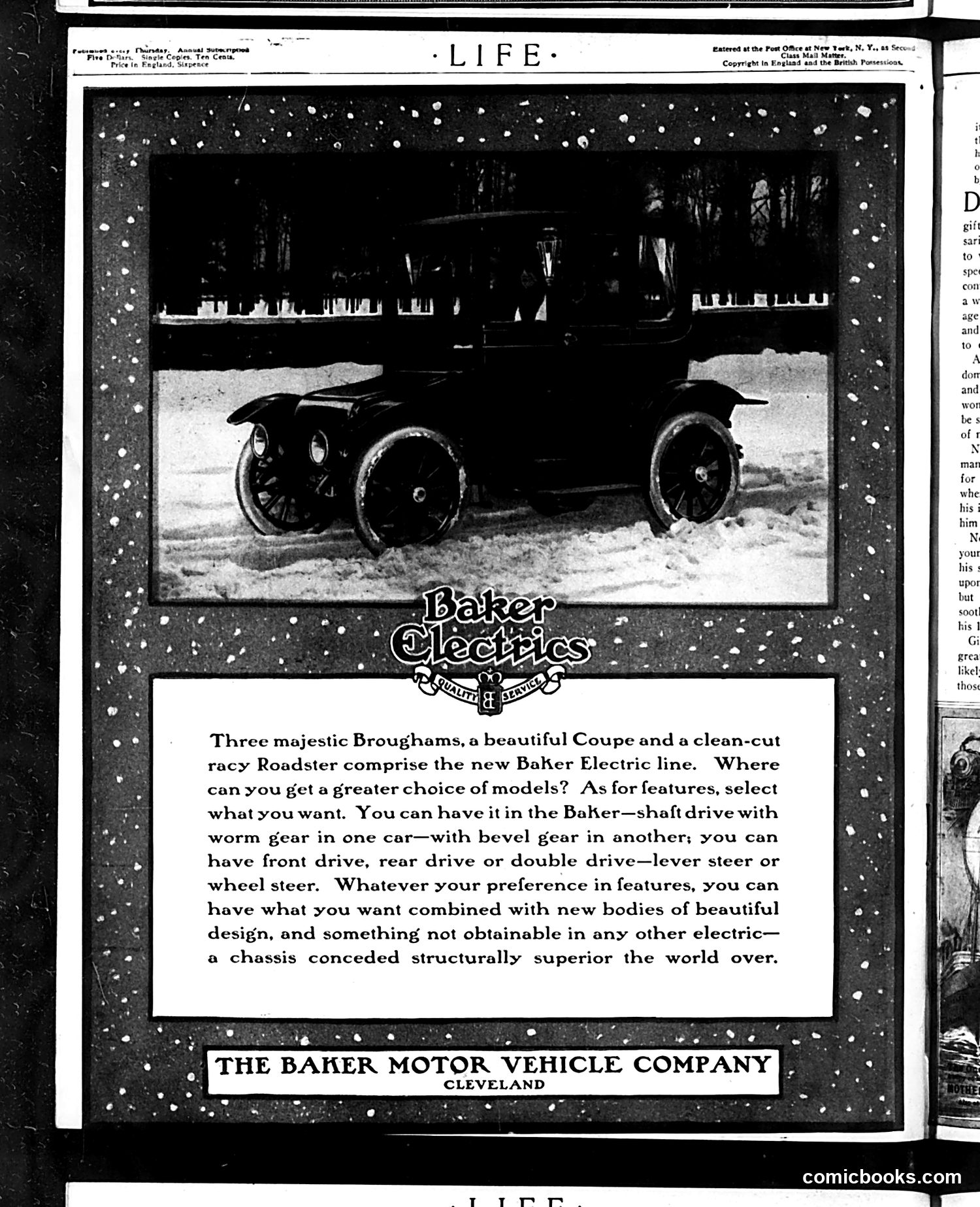
This page is primarily **advertising, not satire or political commentary**. It's a Baker Motor Vehicle Company advertisement from Cleveland promoting their electric automobile line. The ad highlights three Baker Electric models: Broughams, a Coupe, and a Roadster. The text emphasizes customization options—buyers could choose shaft drive with worm gear or bevel gear, front or rear drive, and steering preferences. The advertisement stresses the chassis's structural superiority and the vehicles' beautiful design. This reflects early 1900s automotive marketing when electric cars competed seriously with gasoline vehicles, before gasoline engines became dominant. The emphasis on options and technical features was typical sales rhetoric of that era.
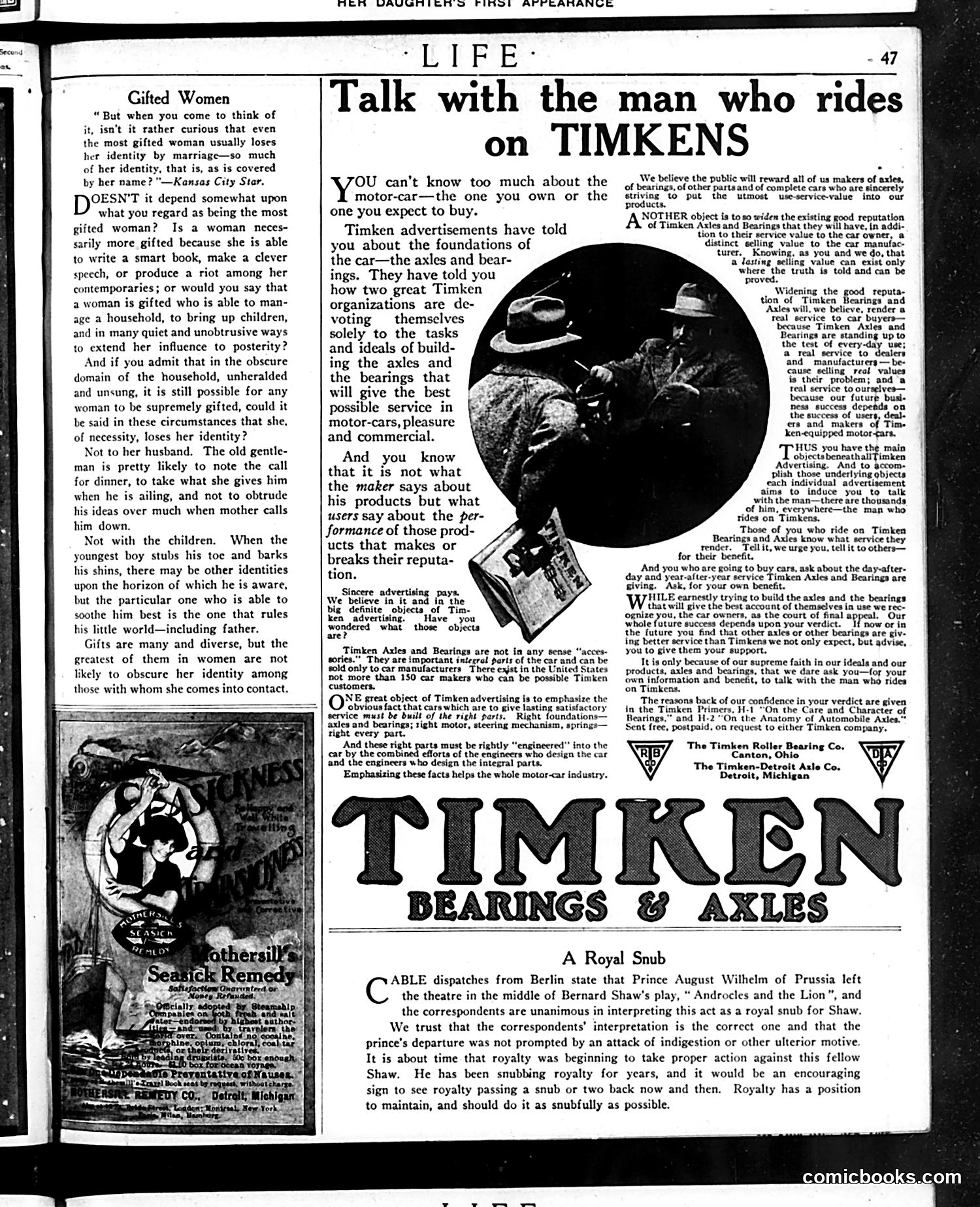
This page is predominantly a **Timken Bearings & Axles advertisement** (occupying roughly 60% of the space), featuring two photographs of men examining automotive parts. The ad uses testimonial-style marketing, emphasizing product quality and reliability. The left column contains an essay titled **"Gifted Women,"** discussing whether married women who manage households constitute "gifted" individuals. The author argues that domestic work is undervalued and questions whether such women lose their identity through marriage. At the bottom, a brief article titled **"A Royal Snub"** references Prince August Wilhelm of Prussia allegedly leaving a theater during a Bernard Shaw play ("Andracles and the Lion"), interpreting it as a snub to Shaw rather than a health issue—suggesting royalty should handle disagreements discreetly. The page is primarily commercial rather than satirical.
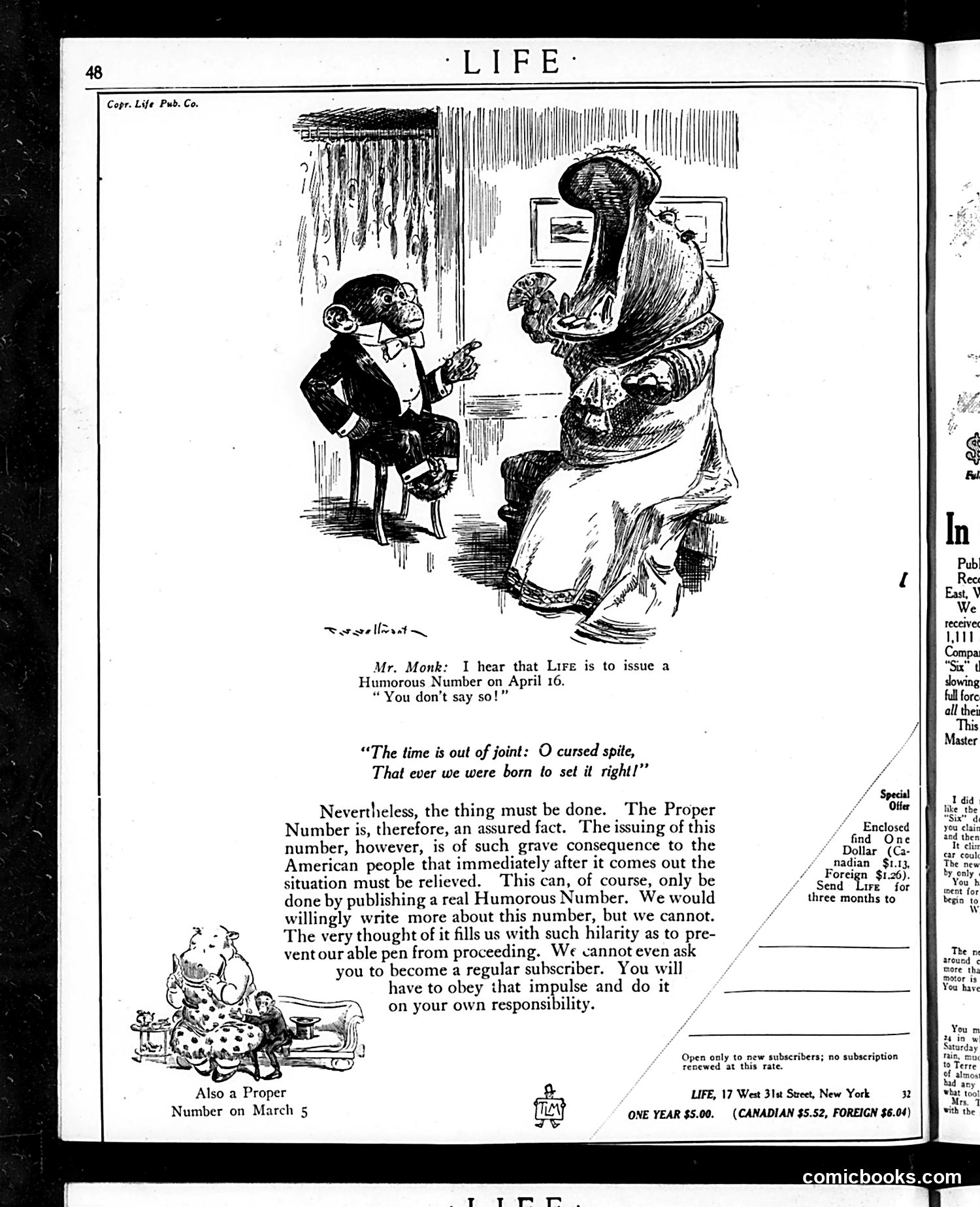
This page features a satirical cartoon about Life magazine's upcoming "Humorous Number" (April 16). The main illustration shows a small, formally-dressed man (labeled "Mr. Monk") confronting a grotesque, corpulent figure in elaborate dress—likely representing editorial chaos or bureaucratic obstruction. The joke centers on the irony that Life wants to publish a humorous special issue but finds it impossible to proceed. The text explains that publishing such an issue is considered so consequential that the thought paralyzes their writing staff with hilarity, preventing them from actually working. This is meta-satire: a humorous magazine joking about its inability to create humor due to overthinking the gravity of the task. The cartoonish figures appear generic rather than depicting specific public figures.
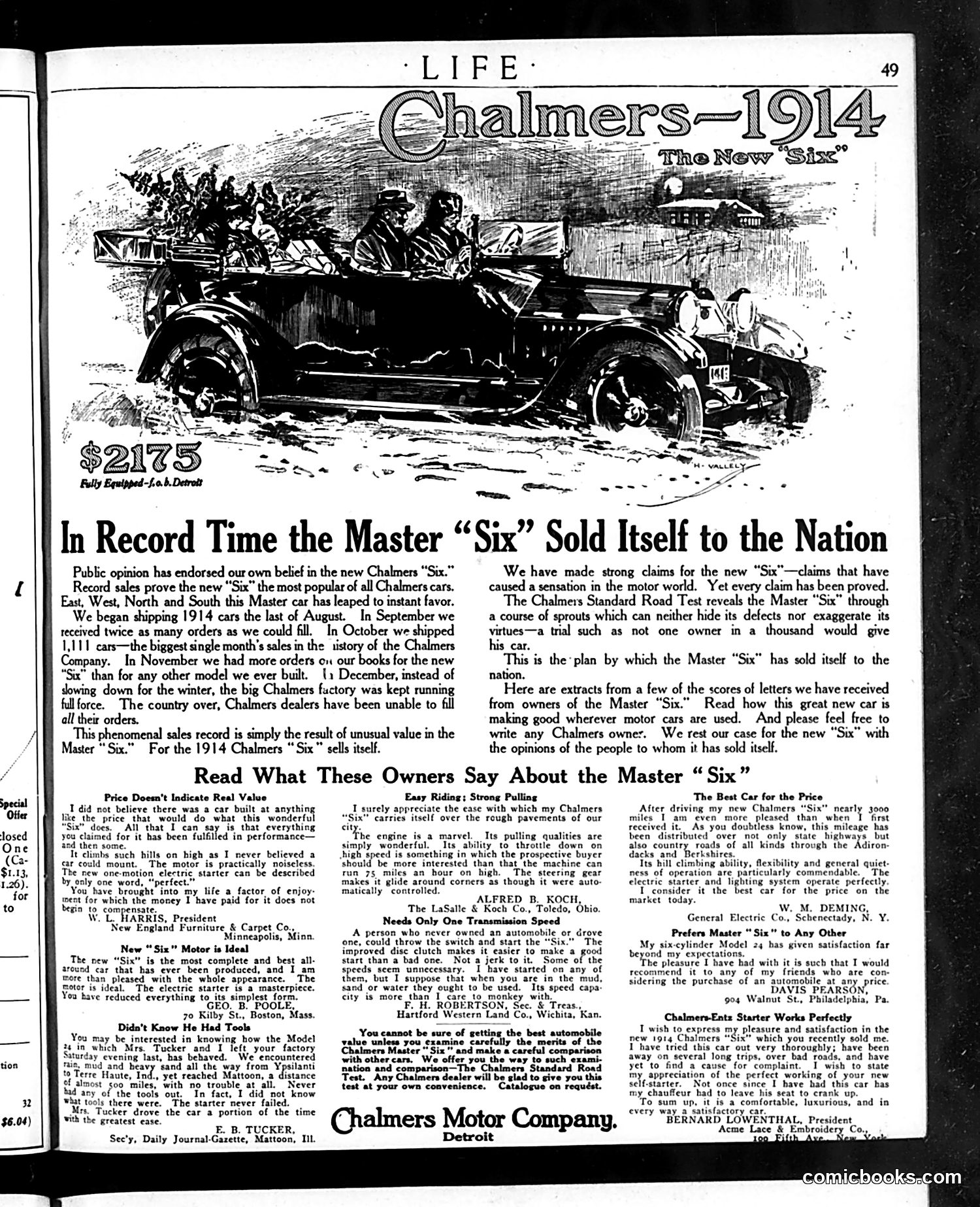
This page is primarily a **automobile advertisement**, not political satire. It promotes the Chalmers "Six" car (priced at $2175) with the headline claiming it "Sold Itself to the Nation." The illustration shows a crowded touring car filled with passengers, emphasizing the vehicle's popularity and appeal. The ad cites record sales figures and includes testimonial letters from satisfied owners praising its reliability, power, and smooth riding. The "satire" here is gentle corporate boasting—the company humorously suggests their car's quality speaks for itself without aggressive marketing. The testimonials highlight practical features like the electric starter and strong performance on rough roads, typical selling points for early automobiles. This reflects 1914 American consumer culture celebrating industrial achievement and automotive innovation.
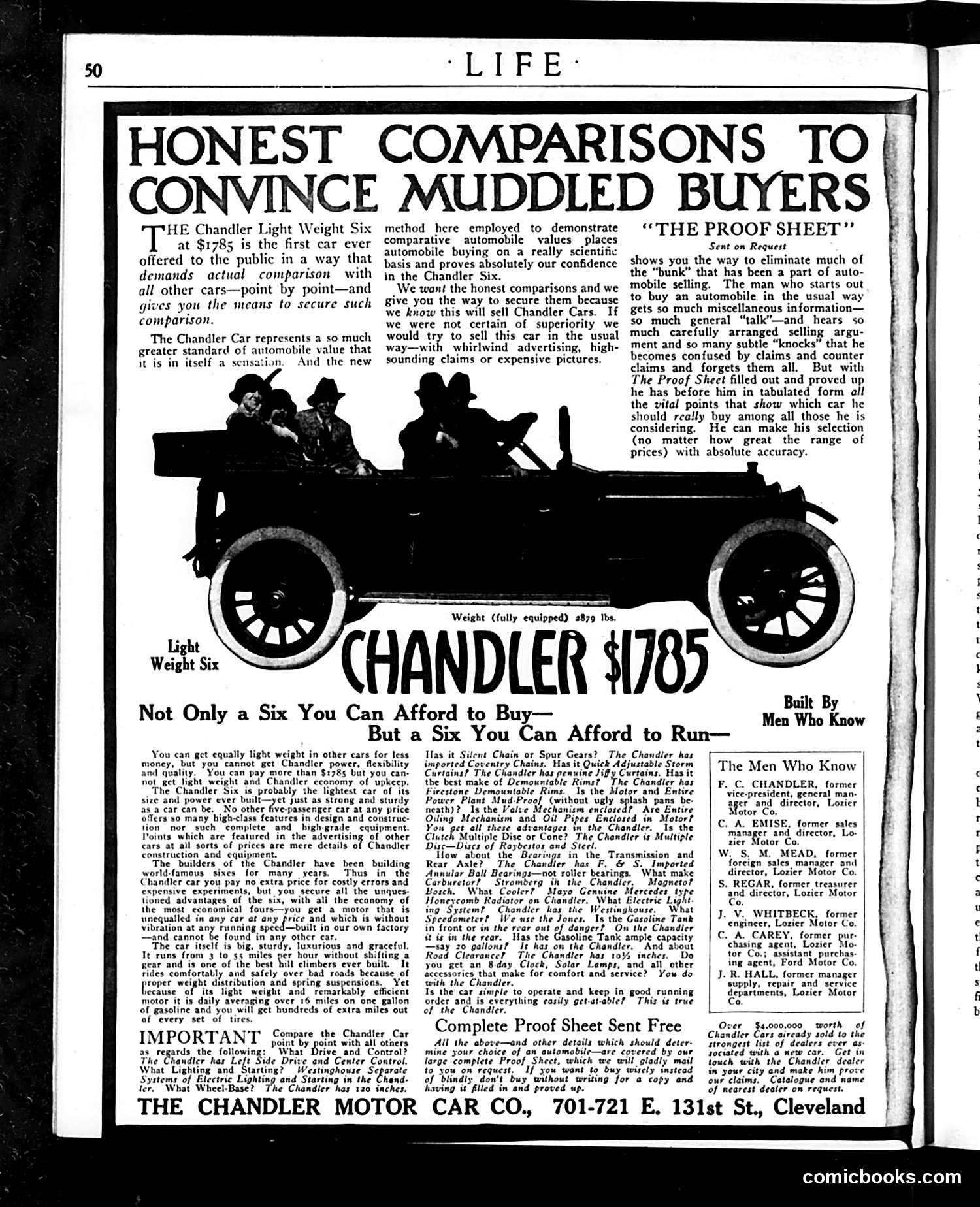
This page is **primarily an advertisement**, not satire or political commentary. It's a Chandler Motor Car Company ad from the early automotive era, placed in Life magazine. The ad's headline claims "Honest Comparisons to Convince Muddled Buyers," targeting consumers uncertain about automobile purchases. The silhouette illustration shows three men examining a Chandler Six priced at $1,785. The satire is subtle and self-directed: the ad *itself* mocks car-buying confusion by promising that buyers faced "so many subtle 'knocks'" and conflicting claims that they need a "Proof Sheet" to make rational decisions. It positions the Chandler as the logical choice through comparative data rather than marketing hype. This reflects early-1900s automotive market competition and emerging consumer skepticism toward advertising claims.
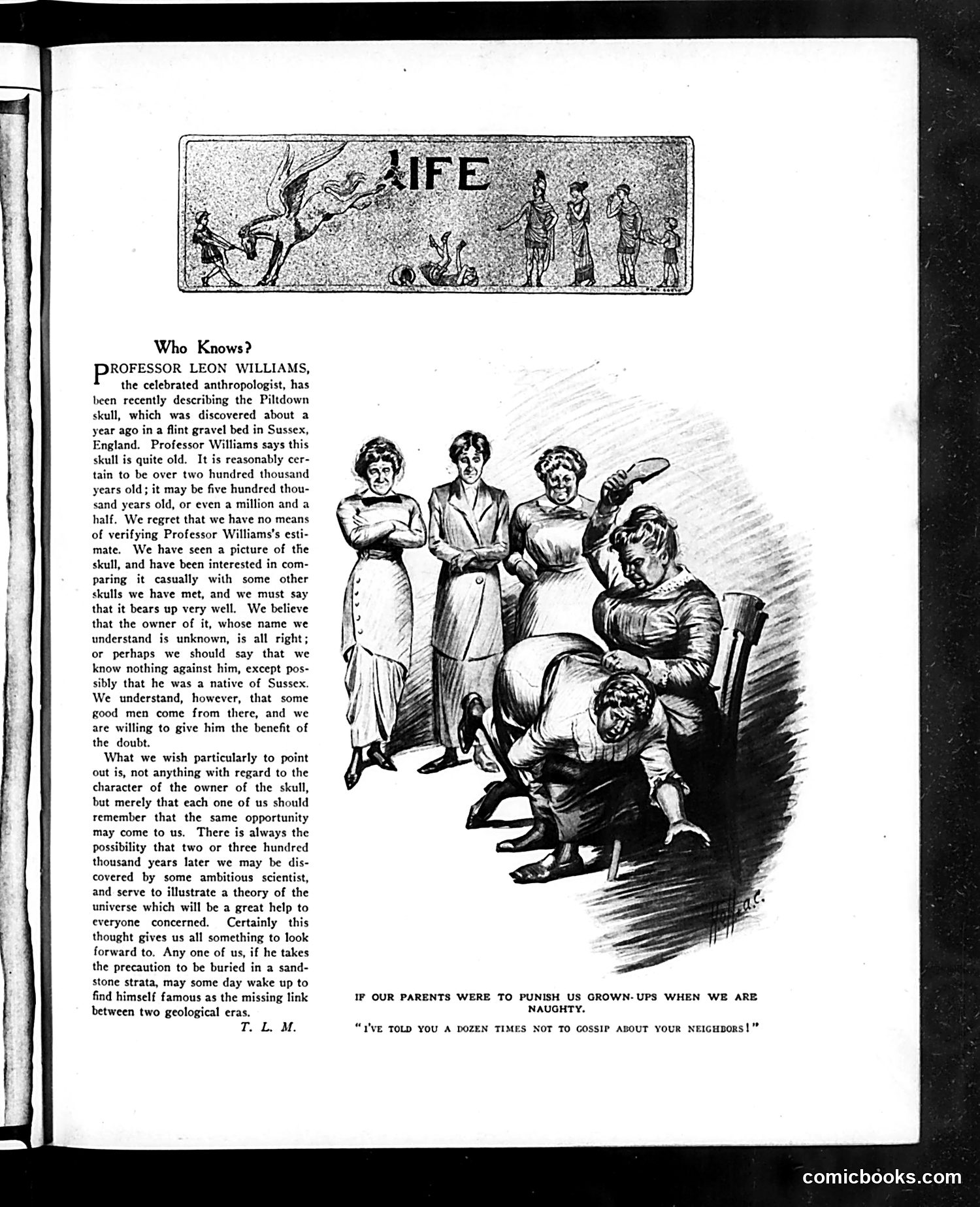
This page presents a satirical commentary on the Piltdown skull discovery. The text discusses Professor Leon Williams, a celebrated anthropologist who recently described the "Piltdown skull," discovered in a flint gravel bed in Sussex, England—estimated to be 200,000 to 1 million years old. The cartoon illustrates the humorous irony: children are being punished for gossiping about neighbors, with the caption sarcastically suggesting that if parents disciplined grown-ups similarly, those adults might one day become famous as "the missing link" between geological eras—a reference to evolutionary theory. The satire mocks both scientific ambition and parental hypocrisy, suggesting that future archaeologists might discover the skeletons of present-day gossips as evolutionary evidence.
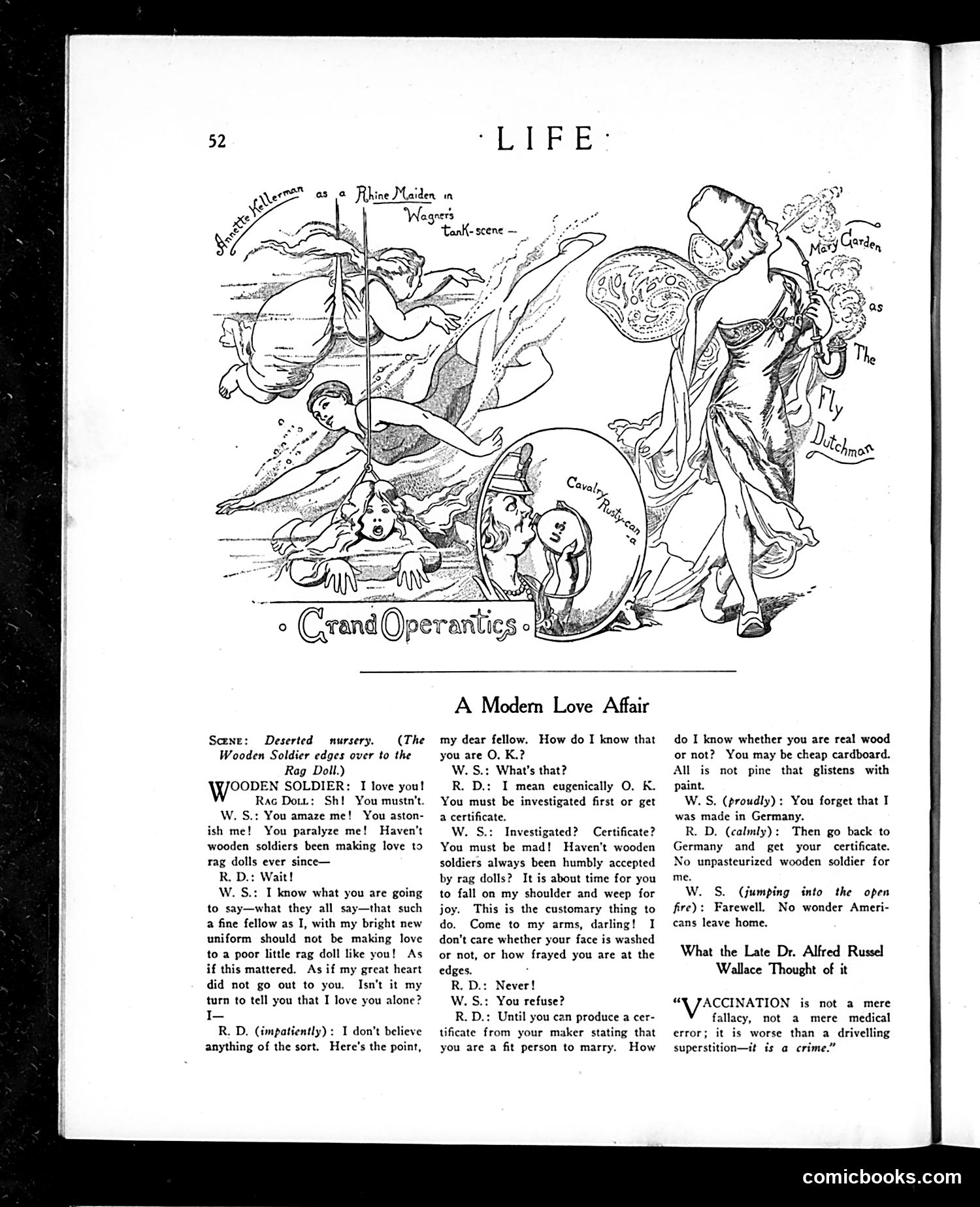
This satirical sketch mocks operatic melodrama by depicting a domestic dispute between a Wooden Soldier and his beloved, set in a nursery. The humor lies in treating cheap toy soldiers as tragic operatic characters—absurdly elevating trivial domestic conflict to the level of grand opera. The dialogue parodies operatic conventions: emotional declarations ("I love you!"), demands for proof and certificates of authenticity, and references to German manufacture. The Wooden Soldier's beloved questions whether he's "real wood or not" and demands documentation, reducing romantic sincerity to commercial authenticity concerns. The satire targets both operatic excess and early 20th-century consumerism's obsession with certified quality and origin, treating love as a commodity requiring verification.
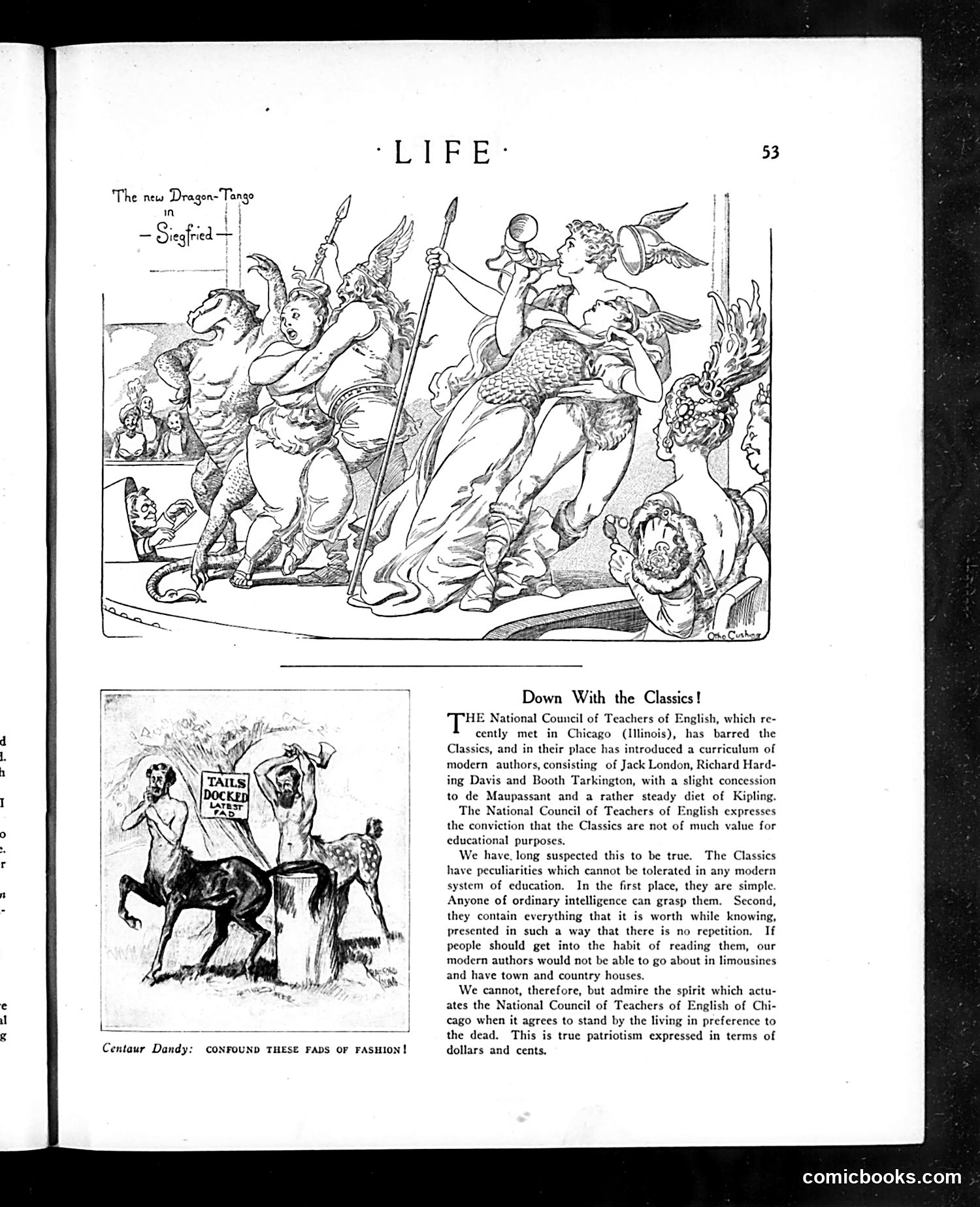
**Top Cartoon: "The New Dragon-Tango in Siegfried"** This appears to be a satirical take on Wagner's opera *Siegfried*, reimagined as a modern dance scene. Winged figures and mythological characters perform an exaggerated tango, mocking both classical opera and contemporary dance crazes. **Bottom Cartoon & Article: "Down With the Classics!"** The article mocks the National Council of Teachers of English for banning classical literature in favor of modern authors (Jack London, Richard Harding Davis, Booth Tarkington, Kipling). The accompanying cartoon shows a centaur labeled "Centaur Dandy" rejecting classical education ("Confound these fads of fashion!"). The satire criticizes this educational policy shift as misguided modernism that discards valuable literary tradition for trendy contemporary writing.
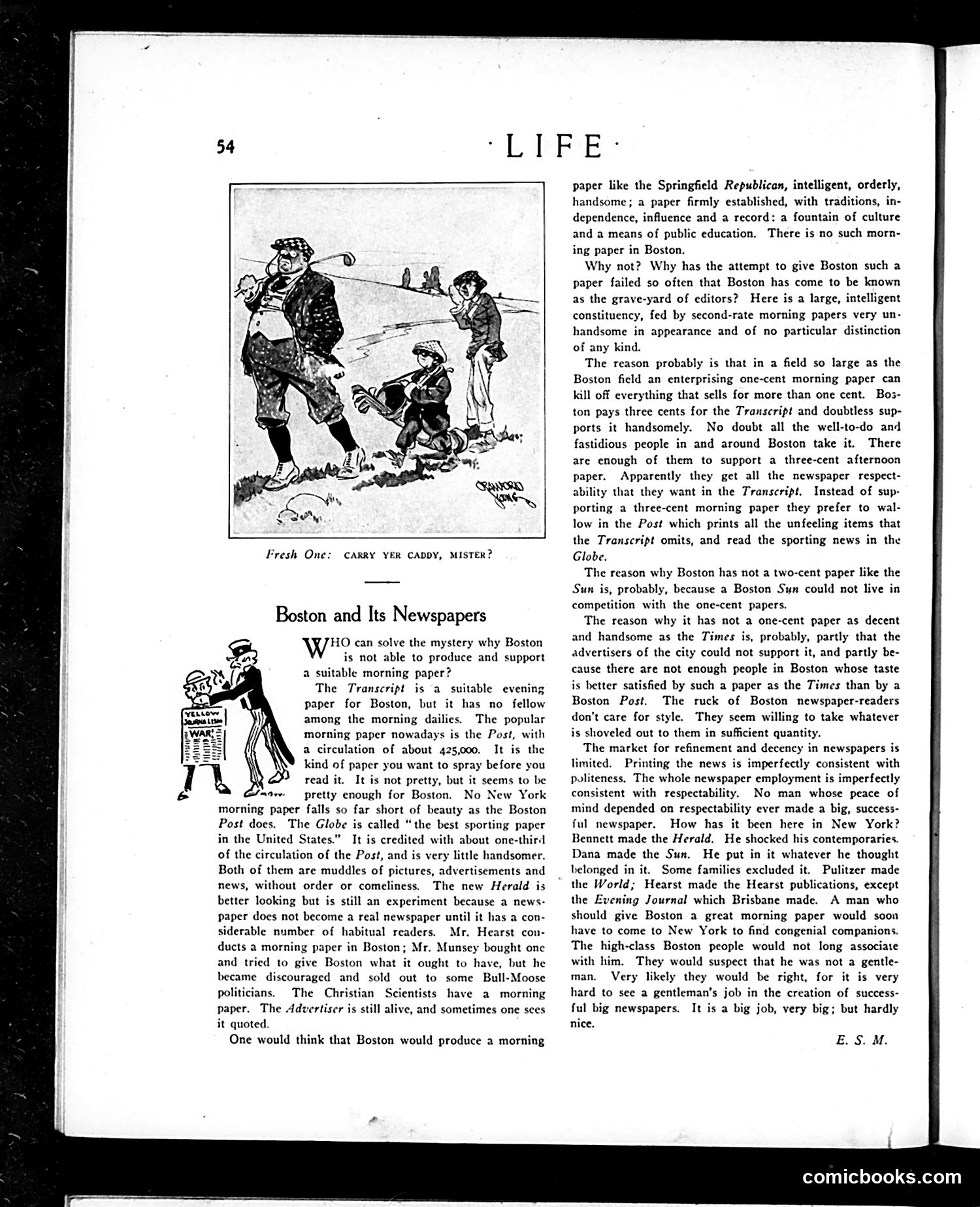
The cartoon depicts an adult man in old-fashioned dress fishing, with children watching nearby. The caption reads "Fresh One: CARRY YER CADDY, MISTER?" The satire concerns Boston's newspaper market. The article critiques Boston's lack of a truly distinguished morning paper comparable to New York's offerings. It argues that while Boston has the *Transcript* (a three-cent paper) and the *Post*, neither achieves the quality or style of New York papers like the *Times* or *Herald*. The fishing metaphor in the cartoon likely suggests how Boston's newspapers are "fishing" or competing for readers in a limited market, with limited success. The overall piece satirizes Boston's inability to support a genuinely excellent newspaper despite its cultural prominence.
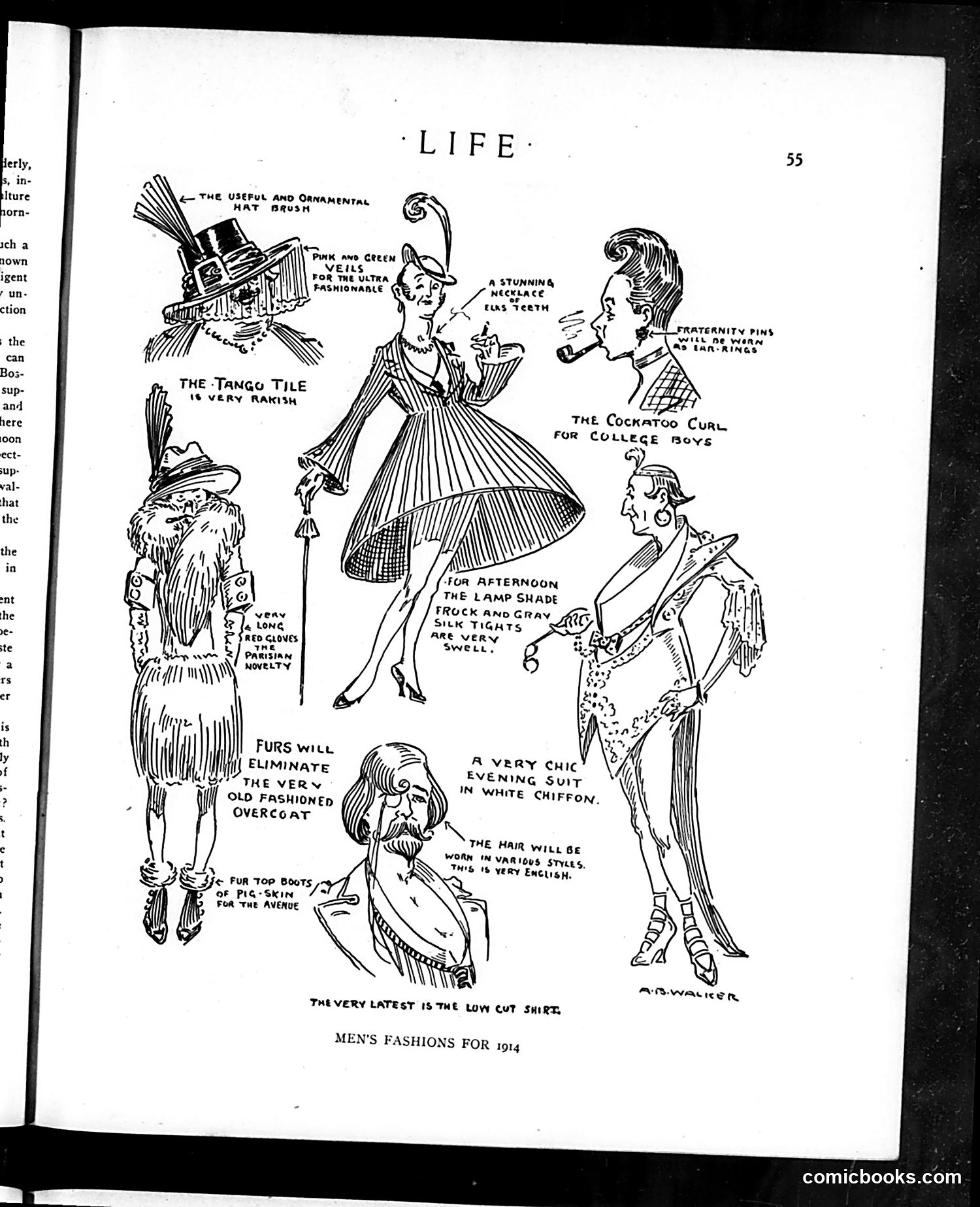
This satirical illustration mocks emerging men's fashion trends of 1914. The cartoon shows exaggerated male figures displaying various contemporary style elements presented as ridiculous affectations: - A "Tango Tile" (hat inspired by the then-trendy tango dance) - "Pink and Green Veils" and "Elk Teeth" accessories - A "Cockatoo Curl" hairstyle for college boys - Fur-trimmed overcoats and "Fur Top Boots" - A "Low Cut Shirt" and "Evening Suit in White Chiffon" The satire targets the perceived feminization of men's fashion—the adoption of decorative, ornamental styles (veils, curls, fur trim) traditionally associated with women's dress. By presenting these fashions on deliberately awkward, ungainly male figures with exaggerated features, the cartoonist ridicules what he views as an unmanly, overly precious approach to men's clothing in 1914.
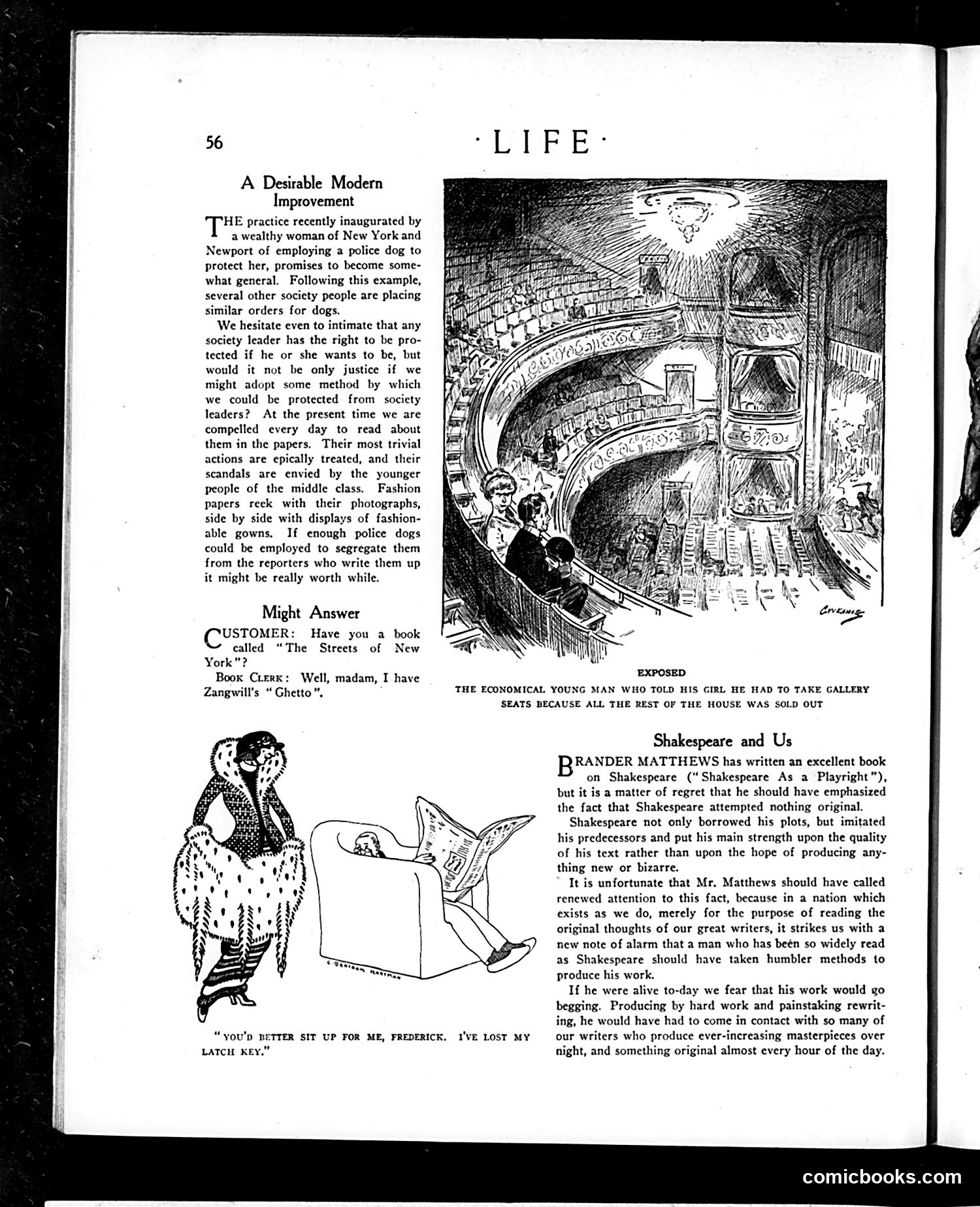
**Top Section - "A Desirable Modern Improvement":** This satirical article critiques wealthy New York society women who employ police dogs for personal protection. The piece argues these women are excessively concerned with their own safety while their "most trivial actions" are scandalized by the press and envied by middle-class youth. The suggested solution—using police dogs to protect society leaders from reporters—is presented as satire on the absurdity of their self-importance and desire to control their public image. **Bottom Section - "Shakespeare and Us":** Brander Matthews' book review critiques Shakespeare's lack of originality, noting he borrowed plots and imitated predecessors. The article argues modern writers would be considered plagiarists for similar practices, suggesting standards have changed. The accompanying cartoon mocks a man who has "lost [his] latch key," illustrating how trivial modern concerns are compared to Shakespeare's dramatic ambitions.
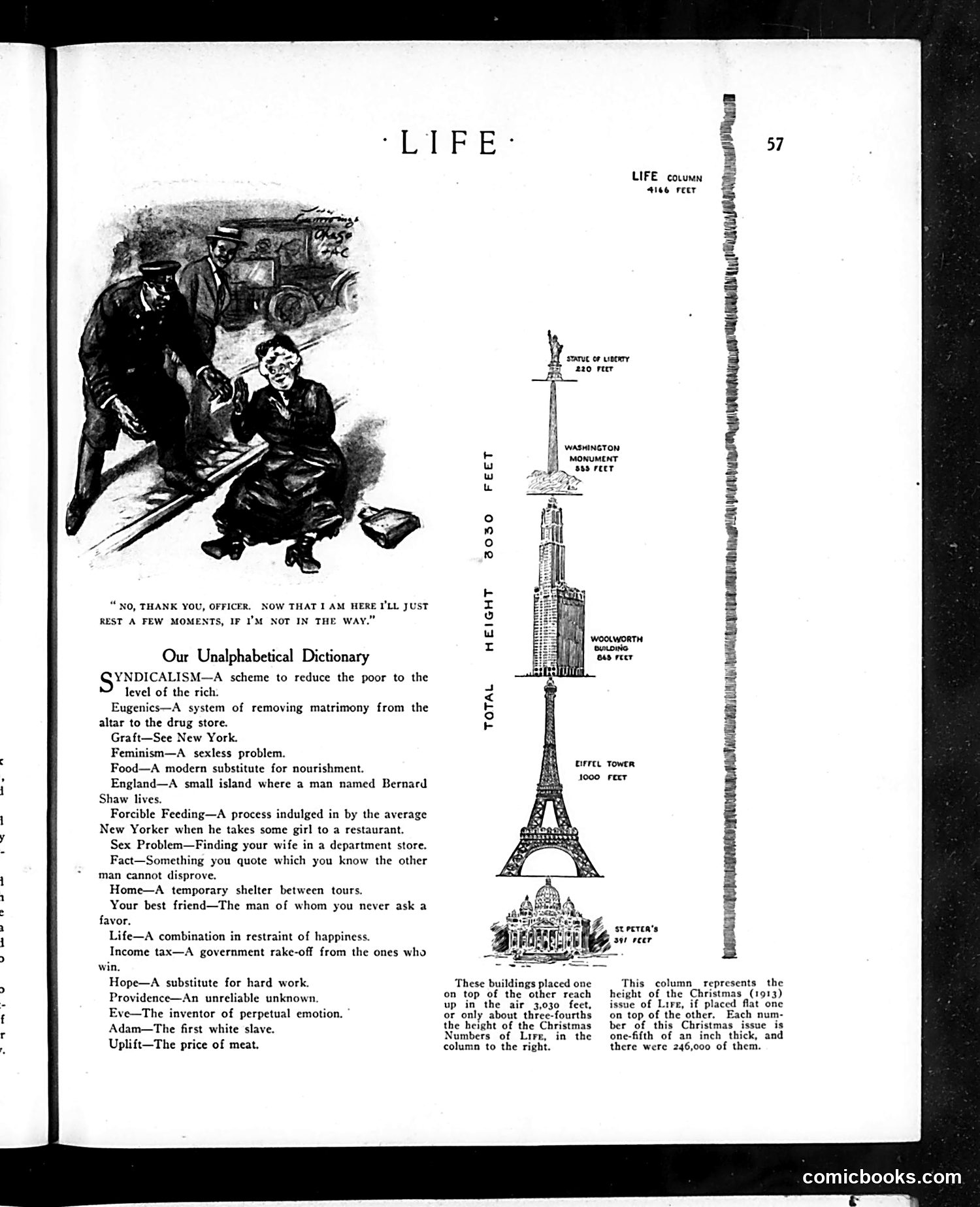
This page contains satirical definitions in "Our Unalphabetical Dictionary," a recurring Life magazine feature mocking contemporary society. The cartoon at top shows two figures (appearing to be a police officer and a vagrant) with cynical humor about homelessness and poverty. The dictionary entries use dark humor to critique early 20th-century American life: "Syndicalism" attacks labor movements, "Eugenics" mocks pseudo-scientific social engineering, "Feminism" dismisses women's rights as "sexless," and "Income tax" cynically defines government taxation. "Sex Problem" jokes about finding one's spouse in a department store—reflecting anxieties about consumer culture and marriage. The right side shows a height comparison of famous buildings and structures, apparently unrelated to the satire. Overall, the page reflects Life's conservative satirical stance toward progressive movements and modern social changes of the era.
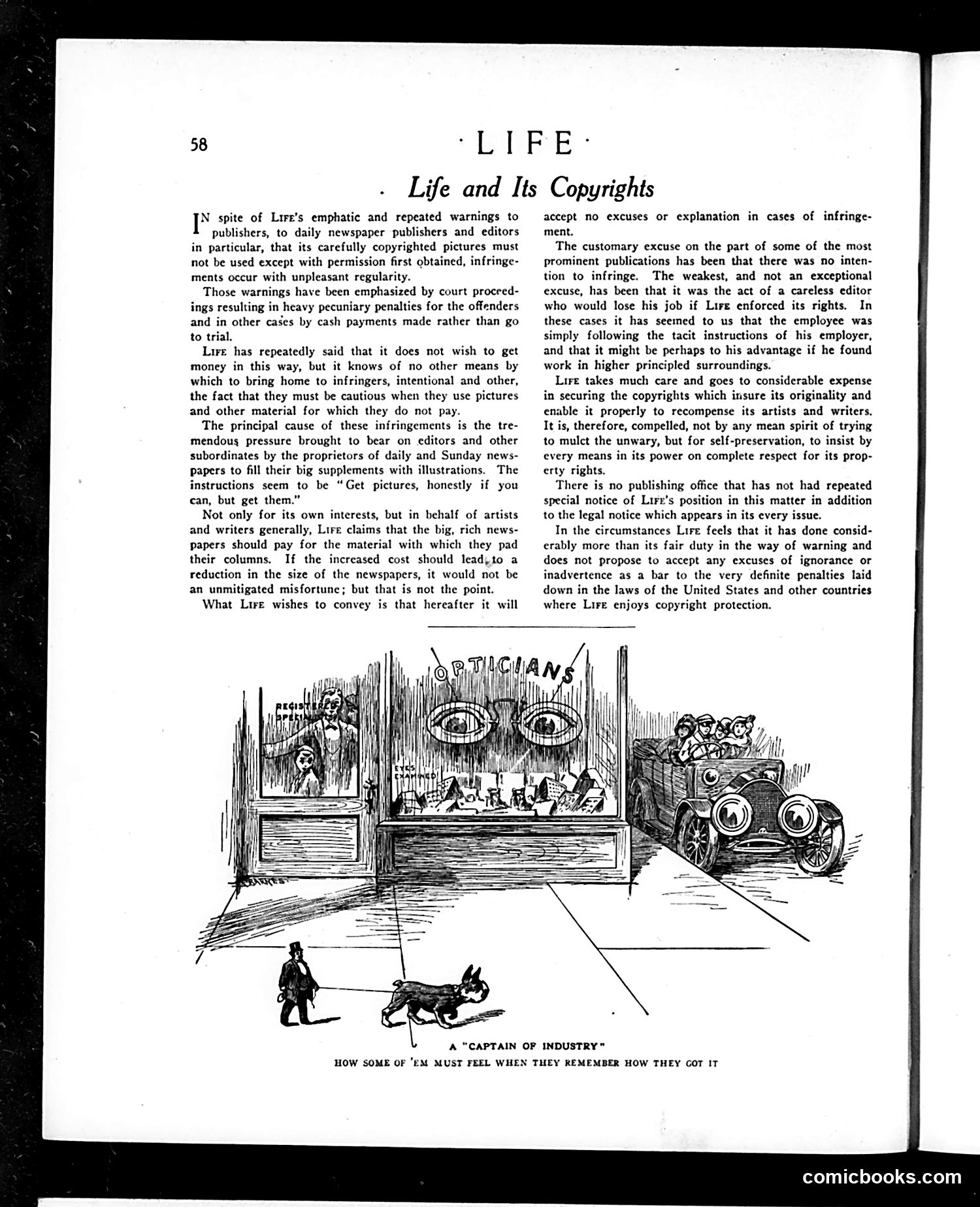
This page discusses **Life magazine's ongoing copyright disputes** with newspapers and publishers who reproduced its illustrations without permission or payment. The text details how Life repeatedly warned publishers about infringements, pursued legal action, and struggled to protect artists' and writers' work from unauthorized use. The accompanying cartoon, titled **"A 'Captain of Industry'"**, satirizes this problem. It shows a man with a dog outside an optician's shop labeled "Opticians," with an automobile nearby. The caption reads: "How some of 'em must feel when they remember how they got it"—suggesting that some industrialists obtained their success through questionable means, possibly including theft of intellectual property or uncredited material. The cartoon critiques unethical business practices of the era.
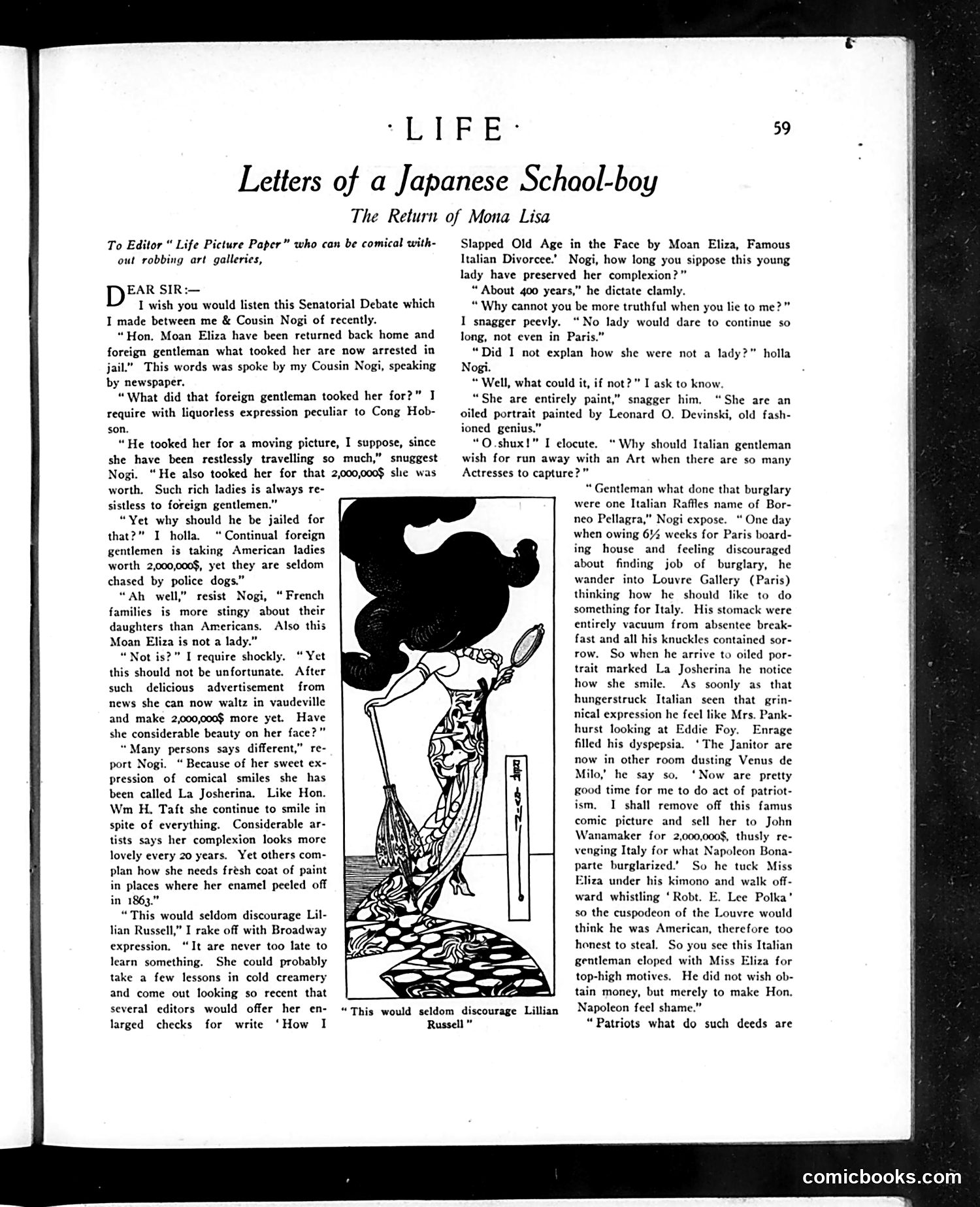
This satirical piece mocks the 1913 theft of the Mona Lisa from the Louvre by Italian handyman Vincenzo Peruggia. The humor comes from a deliberately fractured dialogue between a Japanese schoolboy and his "Cousin Nogi," written in exaggerated, grammatically mangled English that parodies how Westerners stereotyped non-English speakers. The cartoon illustrates the theft's absurdity: an Italian burglar, destitute and hungry, steals Leonardo's masterpiece intending to sell it, imagining he's committing patriotic theft for Italy. The joke satirizes both the criminal's delusions and American sensationalism—particularly references to "Moan Eliza" (Mona Lisa) appearing in vaudeville shows and generating tabloid buzz. The illustration shows the painting being removed, while the text mocks how this famous artwork became entertainment fodder. The satire targets American consumer culture's trivialization of high art and the era's crude racial humor through its deliberately broken English device.
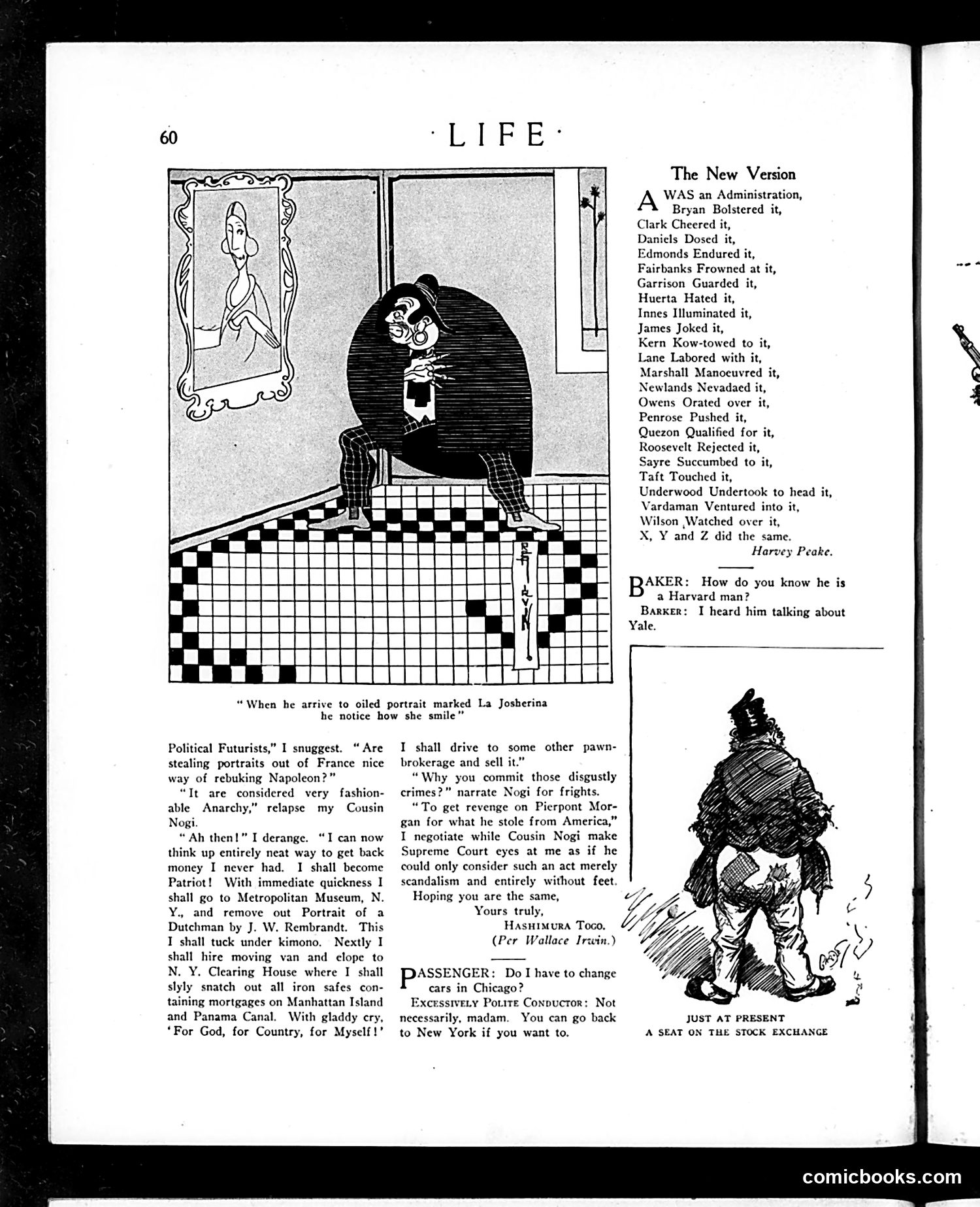
This page contains multiple humorous pieces satirizing American politics and society: **The main cartoon** shows a figure in a bathtub, likely mocking contemporary political figures through exaggerated caricature. **"The New Version"** is an alphabetical joke listing government officials (Bryan, Taft, Roosevelt, Wilson, etc.) each performing actions beginning with their initials regarding "an Administration"—satirizing how different politicians handled (or bungled) governance. **The "Cousin Nogi" dialogue** parodies immigrant stereotypes and anarchist hysteria of the era, with broken English mocking both anarchists stealing French art and the narrator's absurd revenge scheme against banker J.P. Morgan. **Other jokes** include a conductor's wisecracks about train routes and a Harvard/Yale college rivalry quip. The overall tone reflects Life's style: political mockery of the Wilson administration, immigrant caricatures (standard for the period), and satirical commentary on wealth inequality and art theft—contemporary concerns wrapped in period humor.
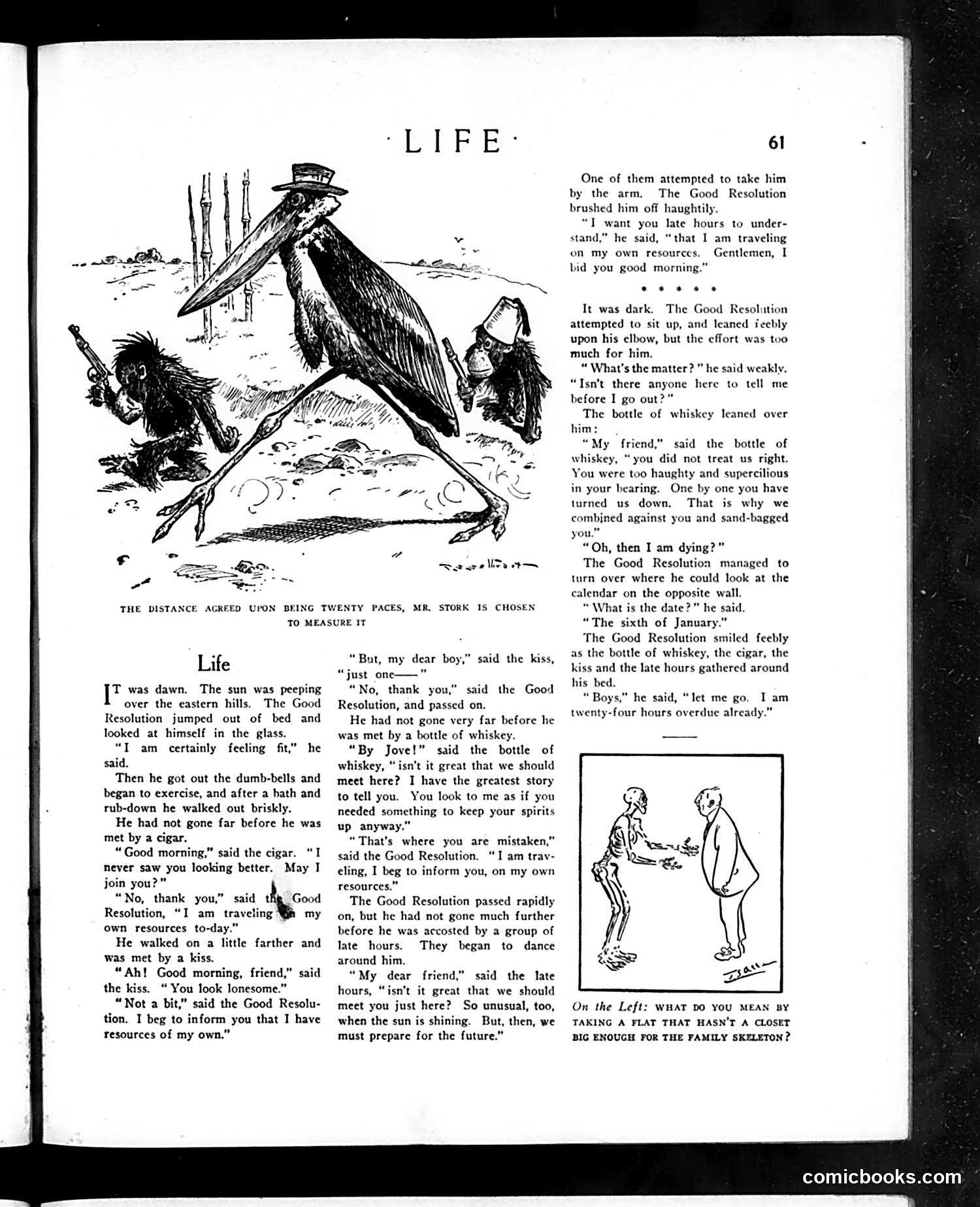
This is an allegorical story mocking the failure of New Year's resolutions. "The Good Resolution"—personified as a character—attempts to maintain self-discipline on January 1st by rejecting temptations: cigars, romantic encounters, alcohol, and late nights. Each vice is anthropomorphized and tries to seduce him with flattery. The joke's irony: by January 6th, he's collapsed in bed, defeated. The vices reveal they "sand-bagged" him—conspired against him. His weakly humorous response ("I am twenty-four hours overdue already") suggests he's died, having failed his resolution almost immediately. The cartoon illustrates the common human experience of breaking New Year's promises within days. The stork measuring "twenty paces" (duel distance) suggests these vices are his adversaries in a battle he loses. The bottom cartoon about a "family skeleton" reinforces the satirical theme: people hide shameful secrets, much like broken resolutions.
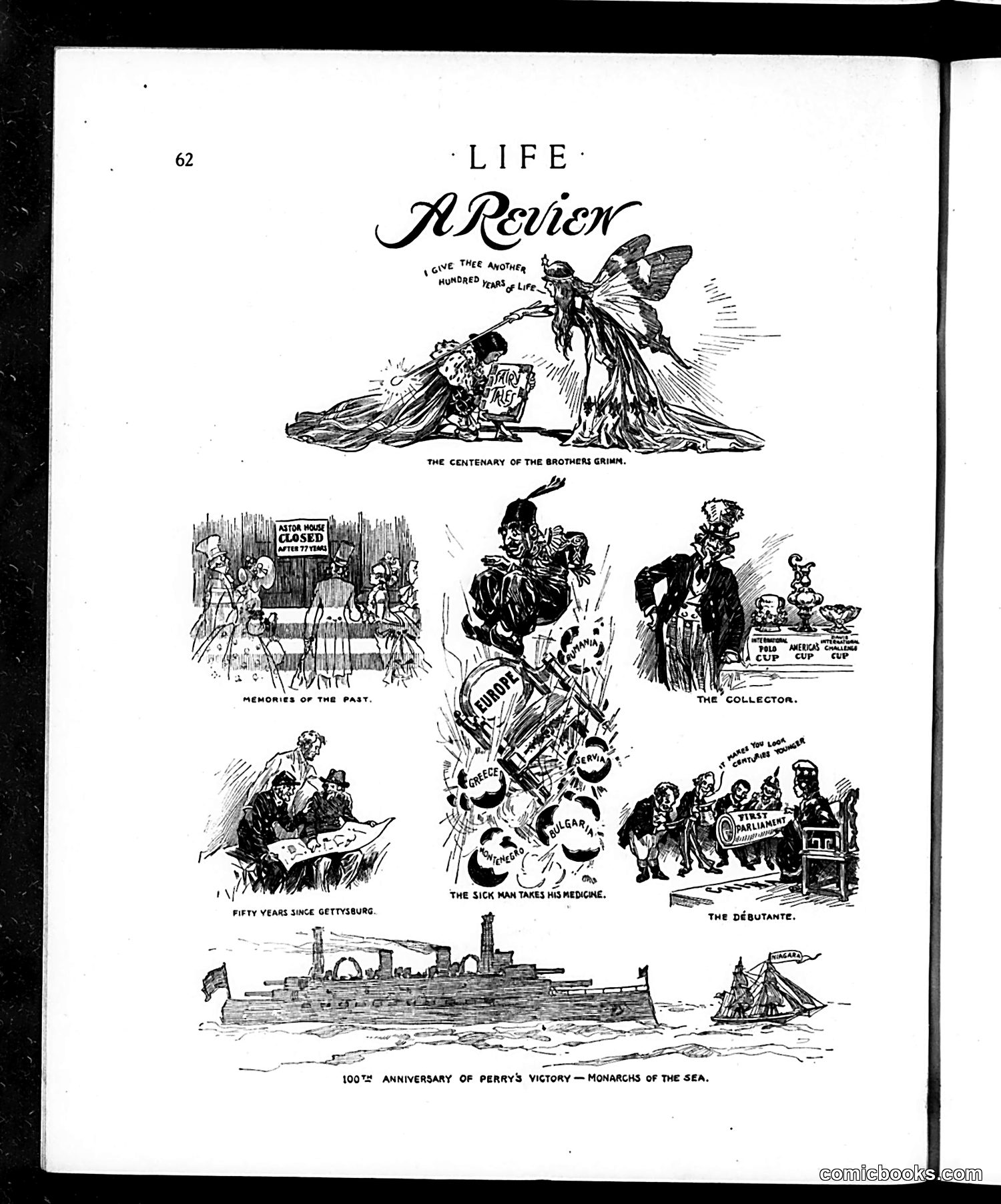
This satirical page commemorates the 100th anniversary of Commodore Perry's 1813 naval victory (War of 1812). The top panel shows a fairy granting "another hundred years of life" to Uncle Sam, suggesting American longevity. Below are six vignettes satirizing contemporary issues: - **"Memories of the Past"**: A closed theater, mocking nostalgia - **"The Centenary of the Brothers Grimm"**: A dark political reference (unclear specifics) - **"The Collector"**: Wealthy figure accumulating trophies - **"Fifty Years Since Gettysburg"**: Civil War commemoration - **"The Sick Man Takes His Medicine"**: Figures administering remedies, likely political commentary - **"The Debutante"**: Society debut scene The bottom shows naval vessels (Perry's era warship and modern sailing ship), contrasting military progress. The cartoons collectively comment on American history, wealth inequality, and national identity around 1913.
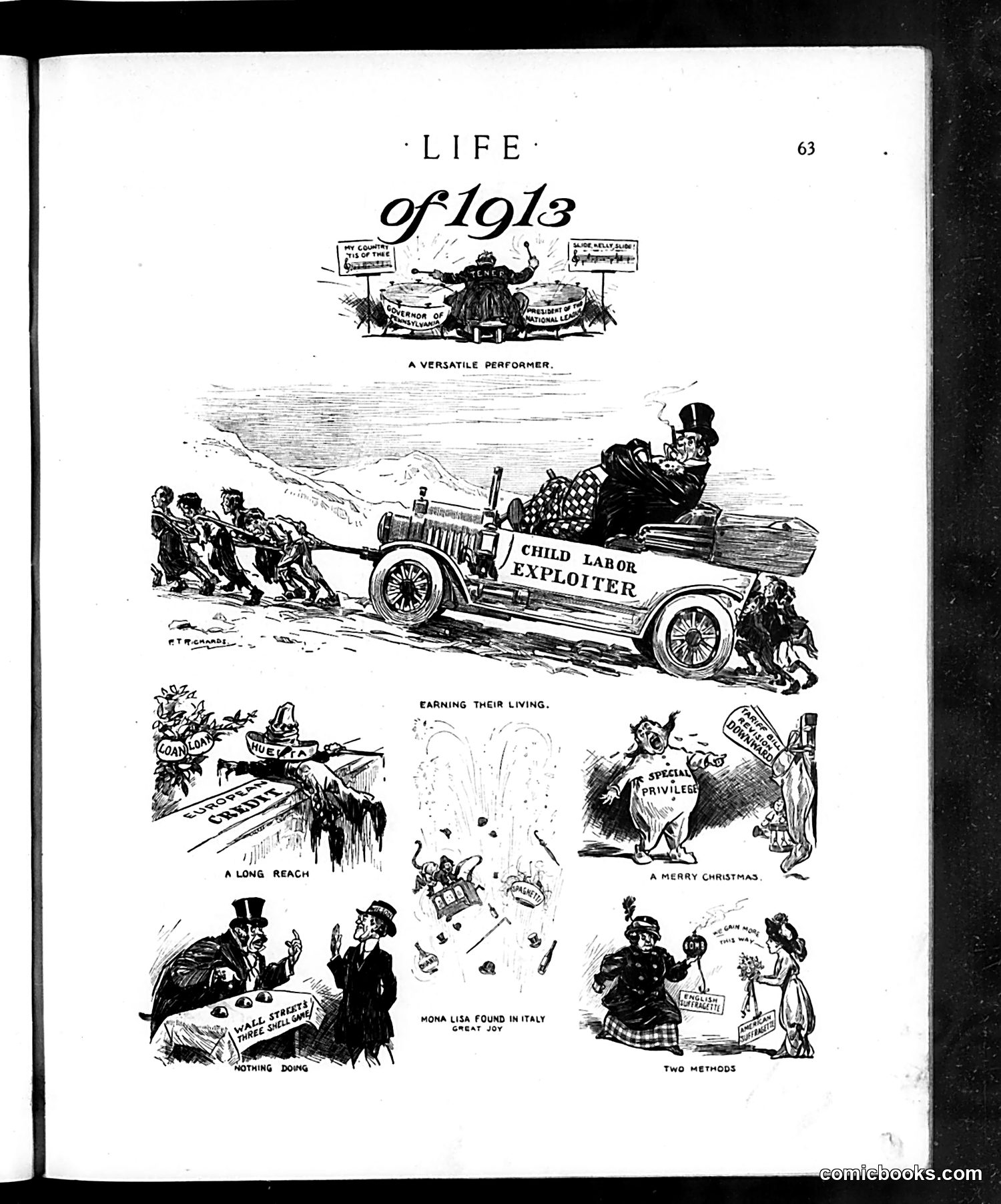
This page satirizes economic disparity during the Progressive Era. The central cartoon, "Child Labor Exploiter," depicts a wealthy capitalist (top hat, money bags) being pulled by child laborers—mocking how industrialists profited from child exploitation, a major reform issue of 1913. The surrounding vignettes ("A Long Reach," "A Merry Christmas," "Two Methods," "Nothing Doing," "Mona Lisa Found in Italy") use allegorical characters—anthropomorphized figures representing concepts like greed, corruption, and inequality—to critique corporate malfeasance and unequal wealth distribution. The "Mona Lisa Found in Italy Great Joy" caption likely references art world news while sarcastically contrasting fine-art appreciation among the wealthy with the grim realities of working-class poverty depicted elsewhere on the page.
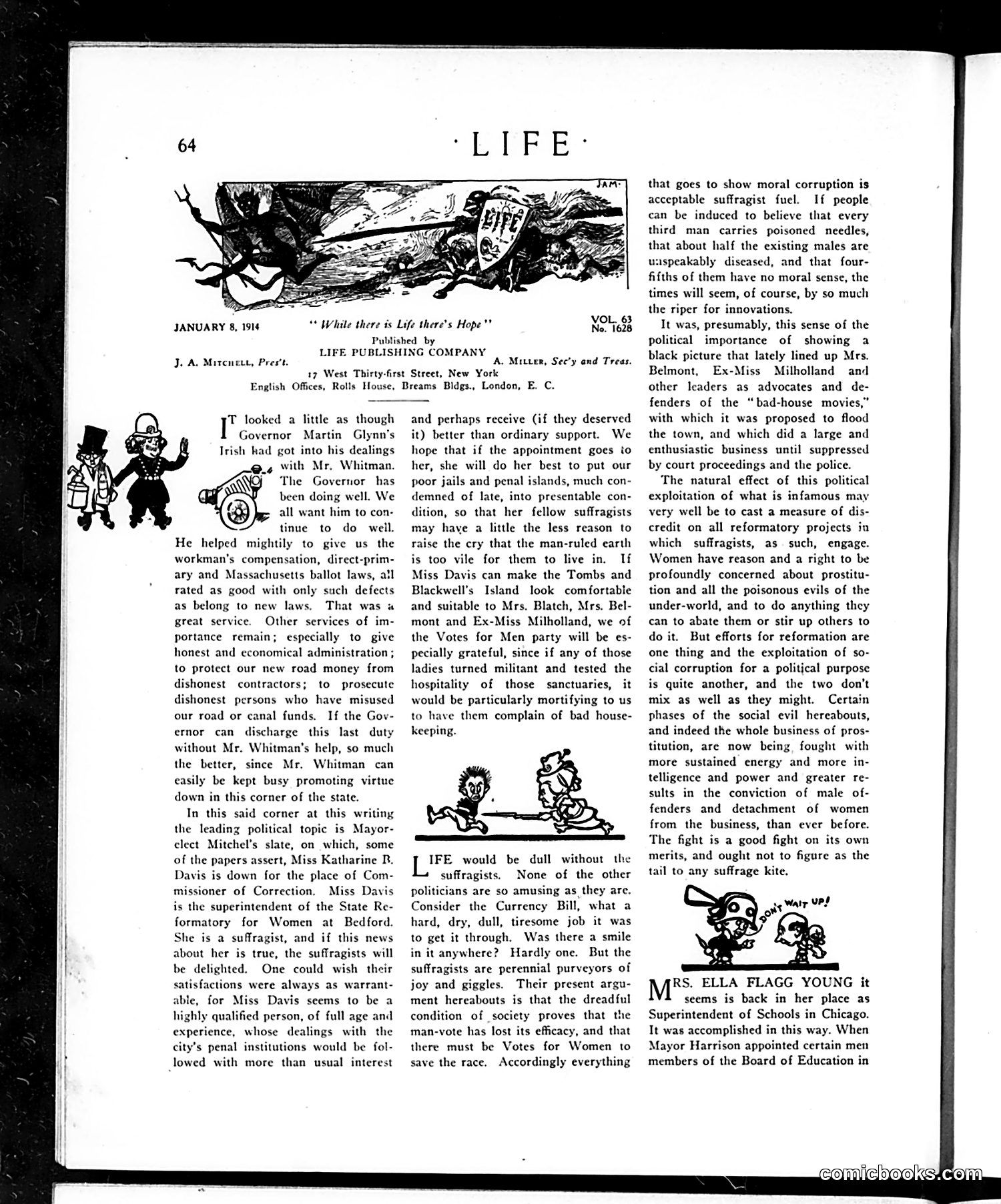
This page satirizes the women's suffrage movement through anti-suffragist commentary. The text mockingly celebrates the possible appointment of Katharine B. Davis—a suffragist and superintendent of the State Reformatory for Women at Bedford—as Commissioner of Correction under Mayor-elect Mitchel. The satire operates through false praise: the writer suggests that if Davis improves conditions at the Tombs and Blackwell's Island prisons, suffragists like Mrs. Blatch, Mrs. Belmont, and "Ex-Miss Milholland" (likely Alice Paul or similar activist) won't have grounds to complain about conditions if arrested for militant action. The second section ridicules suffragist arguments more directly, claiming suffragists exploit social problems—disease, moral corruption, "bad-house movies"—as propaganda to justify women's votes. The author dismisses these concerns as exaggerated "fuel" for the suffrage cause, characterizing suffragists as entertainingly absurd rather than serious reformers. The cartoons (small illustrated figures) appear decorative rather than central to the argument.
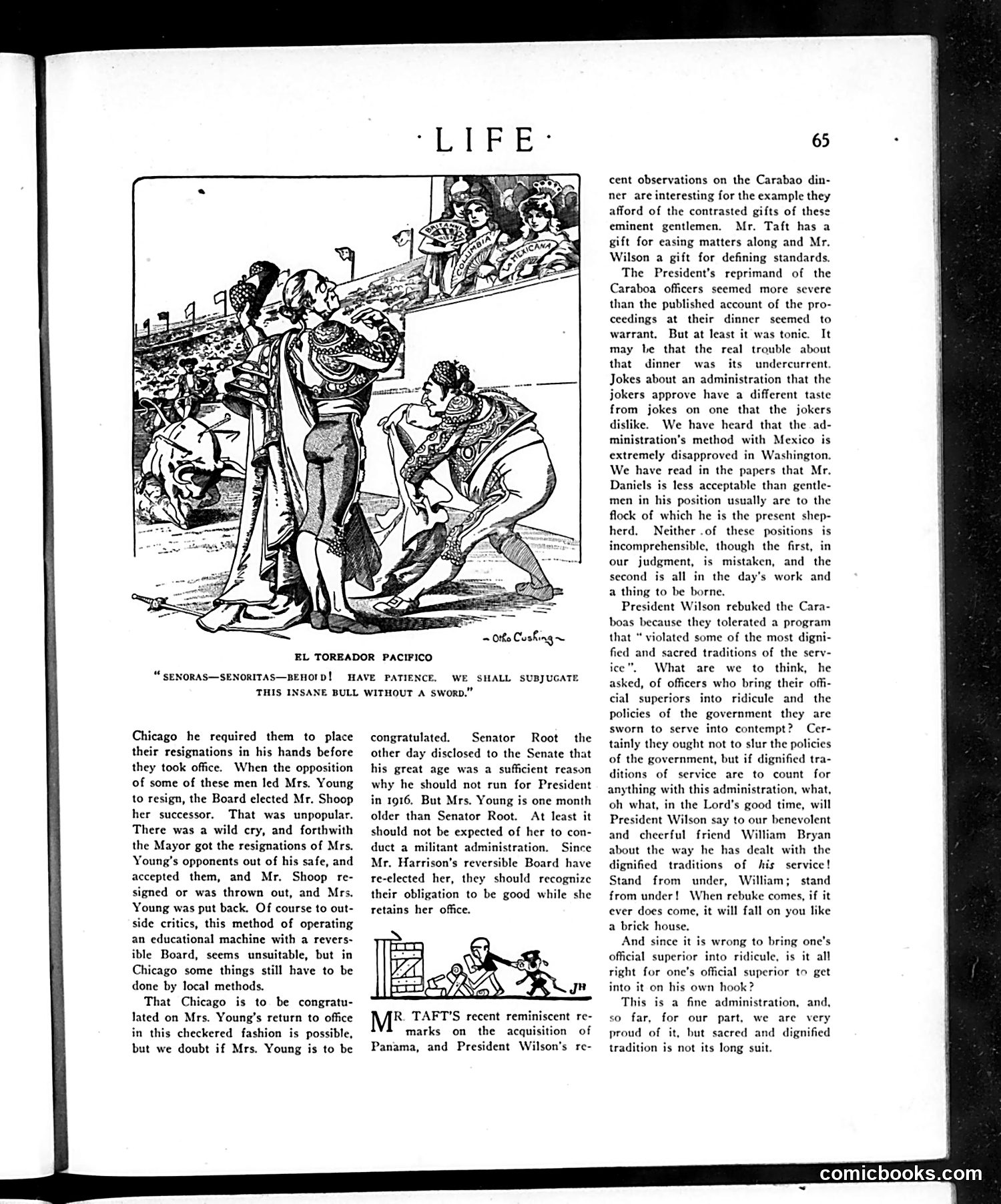
**The Cartoon:** Otho Cushing's illustration depicts President Wilson as a matador, calmly subduing a raging bull (labeled the situation) with a cape, telling onlookers he'll "subjugate this insane bull without a sword." **The Satire:** The text explains Wilson recently rebuked military officers at a Carabao dinner for mocking their superiors and government policies, calling this a violation of "dignified traditions." Life's editors sarcastically praise this rebuke as "fine administration" while pointing out the hypocrisy: Wilson's ally William Bryan has routinely disrespected government traditions and dignity without similar censure. **The Point:** The cartoon mocks Wilson's selective moral standards—he calmly corrects junior officers for minor transgressions while ignoring his friend Bryan's far more serious affronts to governmental dignity. The matador imagery suggests Wilson's posturing as a composed leader managing chaos, when he's actually applying rules inconsistently.
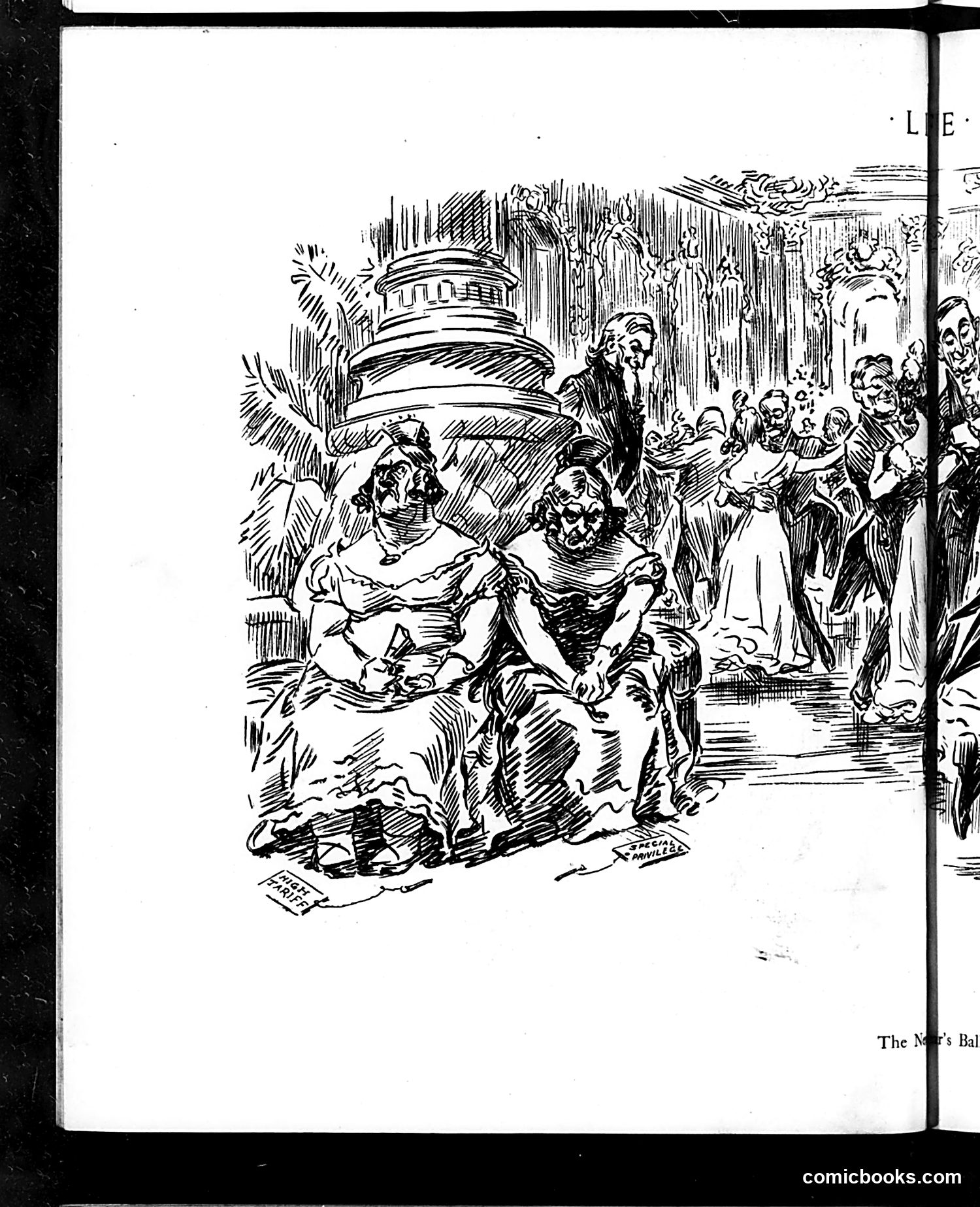
This appears to be an illustration for a piece titled "The Nett's Bal" (possibly "The Neit's Ball" or similar—the OCR is unclear). The sketch depicts an elegant indoor social gathering, likely a formal ball or reception, with well-dressed figures in 19th-century attire. A distinctive domed or tiered architectural structure dominates the background. Without clearer text or caption, the specific satirical target is uncertain. However, Life magazine was known for mocking high society events, political gatherings, and social pretension. The crowded, animated scene with exaggerated character expressions suggests satire of either aristocratic excess, a specific fashionable event, or possibly a political occasion. The style and composition are consistent with late 19th-century American satirical illustration, but the exact subject requires additional context to identify definitively.
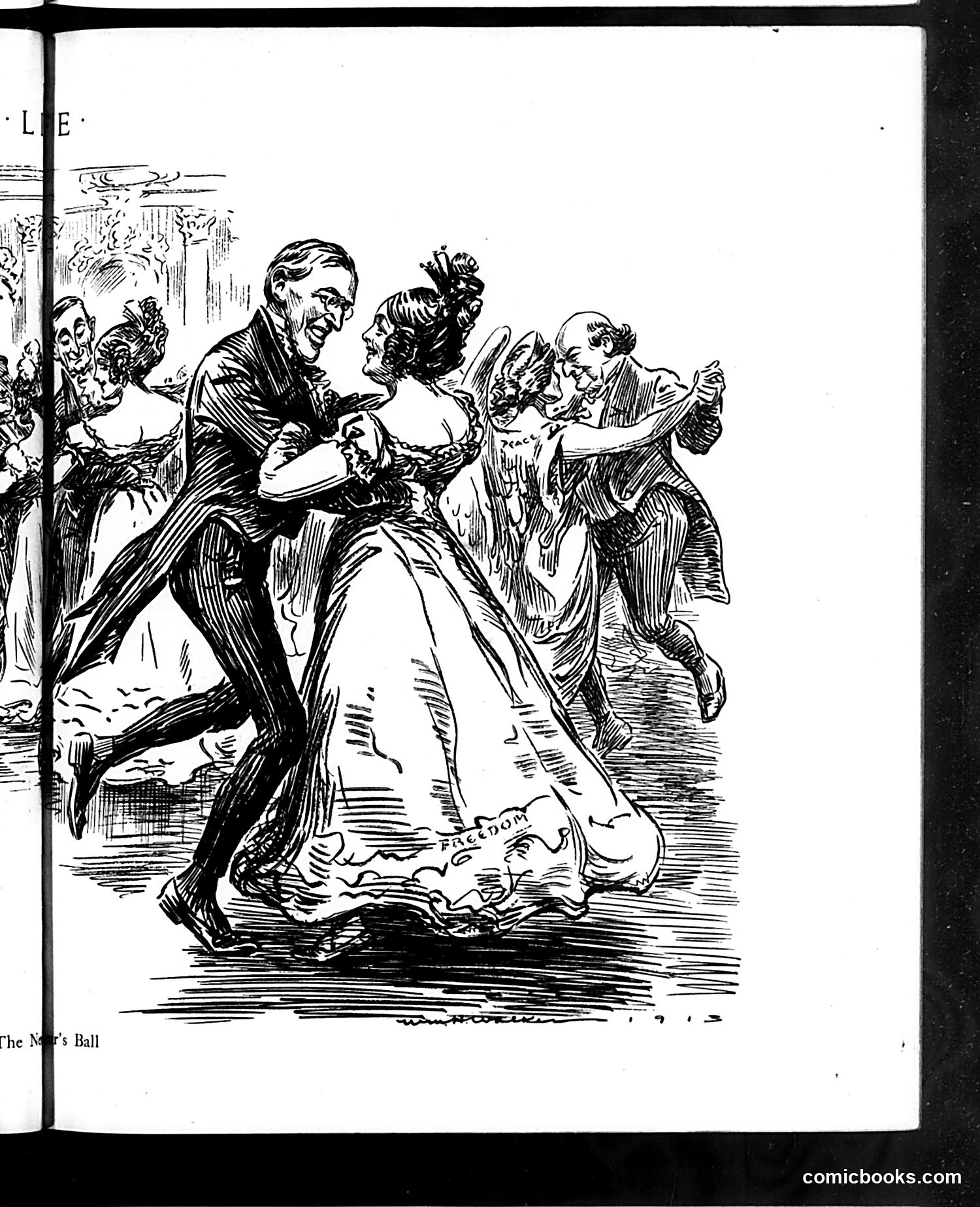
This satirical cartoon depicts what appears to be a social gathering where a woman labeled "FREEDOM" is being pulled and jostled by several men in formal dress. The sketch uses physical comedy to comment on social dynamics: the woman (representing freedom or women's autonomy) is literally being handled and controlled by multiple male figures who compete for dominance over her. The title "The Maid's Ball" suggests this portrays a servants' social event, possibly satirizing how working-class women had little agency even in their own social spaces. The exaggerated, rough treatment in the illustration critiques how women's freedom and autonomy were contested, controlled, or denied by men in power. This reflects broader 19th-century concerns about women's rights and social status.
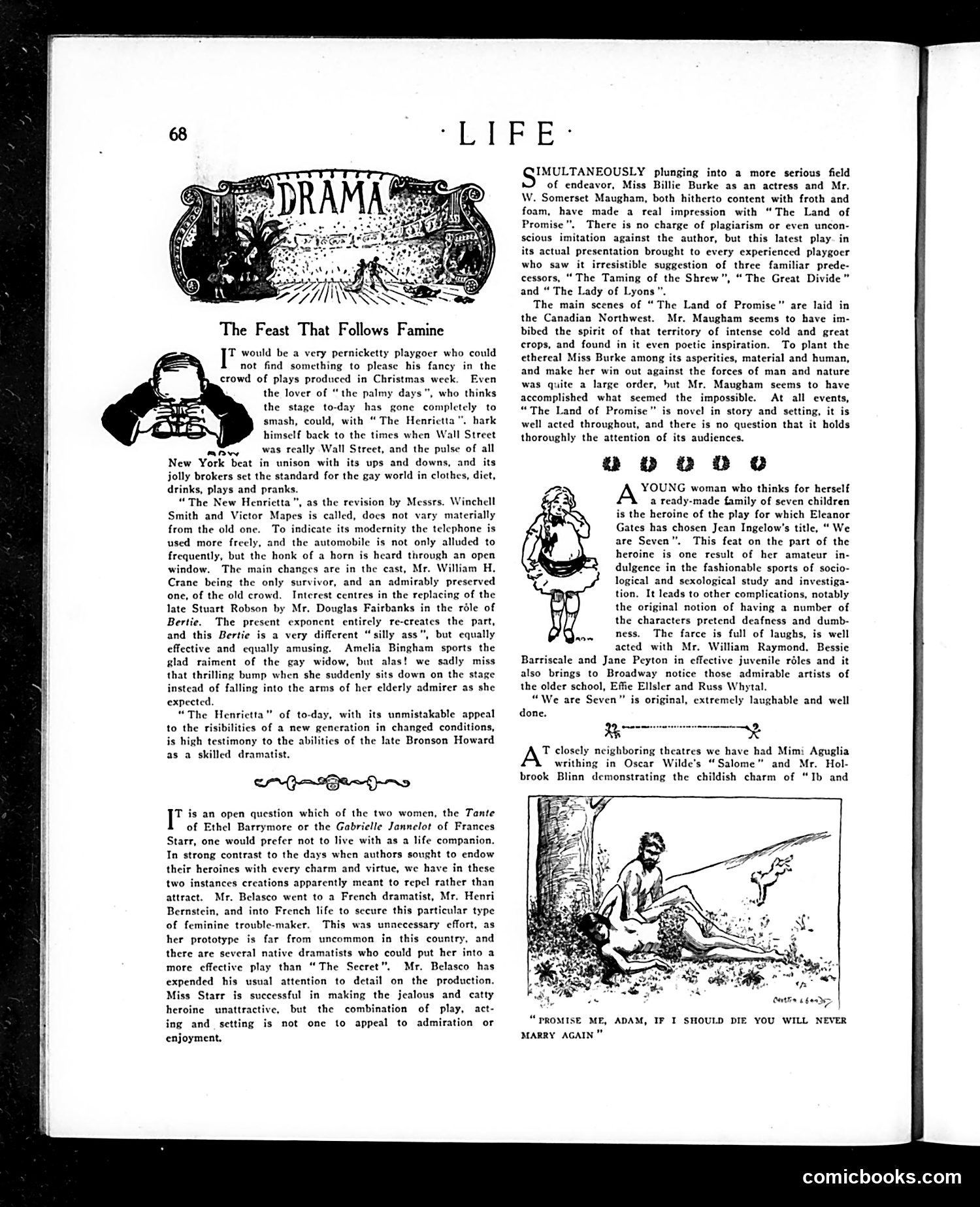
This page reviews Christmas week theatrical productions (circa 1909). The main points: **"The Feast That Follows Famine"** discusses "The New Henrietta," a revival of Bronson Howard's play about Wall Street. The satire notes that while modernity is suggested through telephones and automobiles, the play essentially unchanged from the original. Douglas Fairbanks replaces deceased actor Stuart Robson. The reviewer praises its appeal to a new generation despite being dated material. **Other reviews** discuss Ethel Barrymore and Frances Starr in plays featuring deliberately unattractive, troublemaking female characters—a contrast to the era's typical heroines. The critic notes this character type is common in America, making the French source unnecessary. **"The Land of Promise"** stars Billie Burke in a Canadian Northwest setting, suggesting familiar plays like "The Taming of the Shrew." The reviewer finds it ambitious to place the "ethereal Miss Burke" against harsh frontier realities. The bottom illustration shows a romantic scene with the caption "Promise me, Adam, if I should die you will never marry again"—comedic melodrama typical of the period.
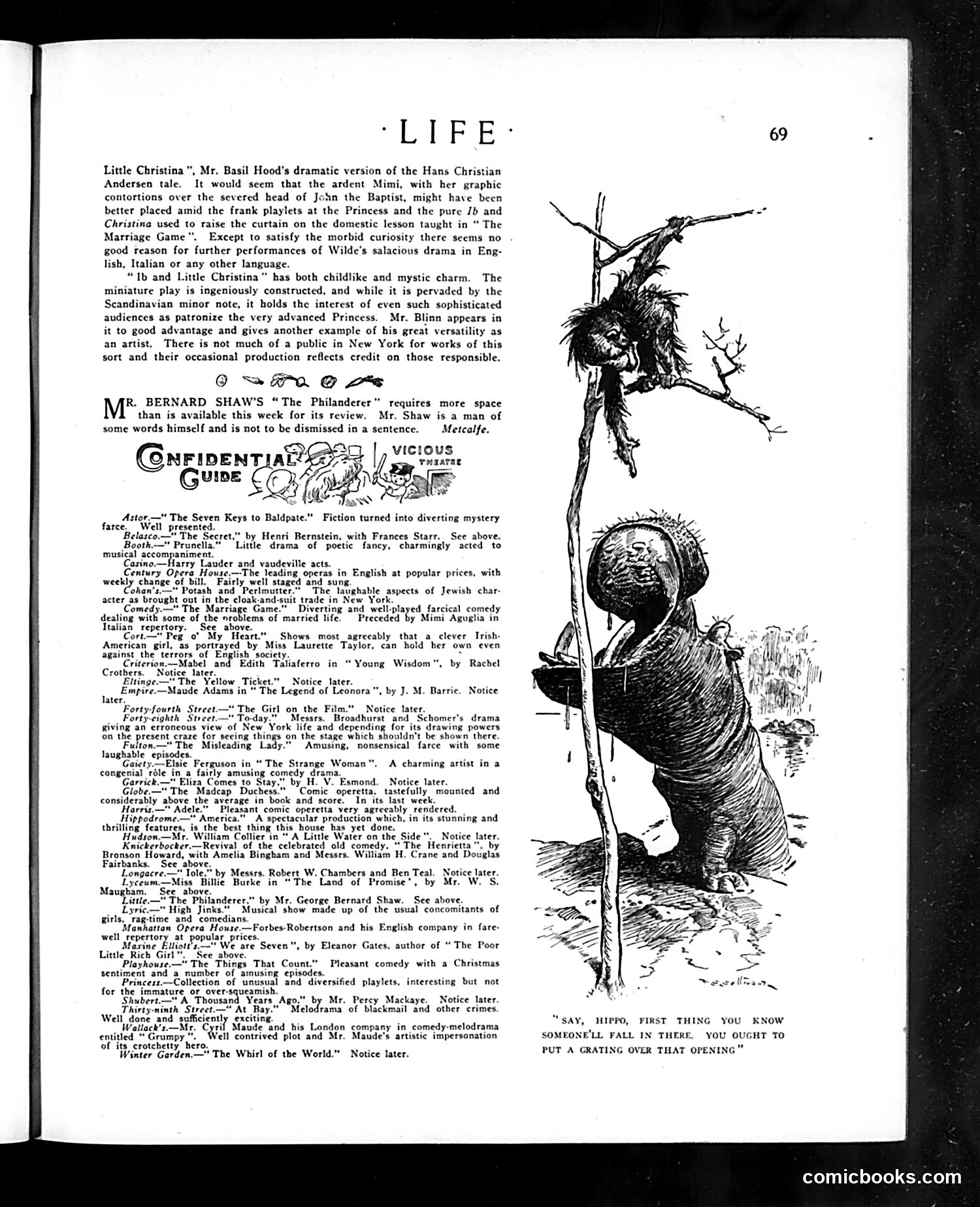
This page from Life magazine (appears to be early 1900s) is primarily a **theater review section**, not a political cartoon page. The illustration on the right—a skeletal figure perched on a gnarled tree branch—appears to be decorative artwork accompanying the theatrical criticism, likely meant to evoke a gothic or darkly humorous tone fitting the magazine's satirical style. The text reviews various Broadway productions, with critic Metcalfe offering opinions on plays including works by Oscar Wilde and George Bernard Shaw. The reviews are frankly critical: Wilde's "The Marriage Game" is called "salacious," while productions like "Prunella" and "Peg o' My Heart" are praised for charm and clever acting. The caption beneath the illustration—about a hippo falling and needing a grating—appears unrelated to the reviews, suggesting it may reference another article or advertisement not fully visible on this page. The overall content reflects early 20th-century theatrical culture and critical tastes rather than political satire.
This is primarily a **book review section**, not a political cartoon page. The content consists of two parts: **Upper section**: Brief reviews of contemporary books (circa 1913-1914), including works by Edith Wharton, John Galsworthy, and Theodore Dreiser. The tone is witty and sardonic—typical of Life's satirical approach to literature. Reviews mock pretension while acknowledging artistic merit. **Lower section** ("The Latest Books"): An extended essay by J.B. Kerfoot using a Civil War-era monetary metaphor. He compares intellectual currency to Civil War tokens—brass discs that circulated as substitutes for real coins. His point: during times of intellectual scarcity, people accept convenient abstract ideas the way they once accepted worthless tokens. He's critiquing readers' and thinkers' tendency to accept superficial or questionable ideas as legitimate currency during periods of cultural "stringency." The satire targets both authors who produce shallow work and audiences who accept it uncritically.
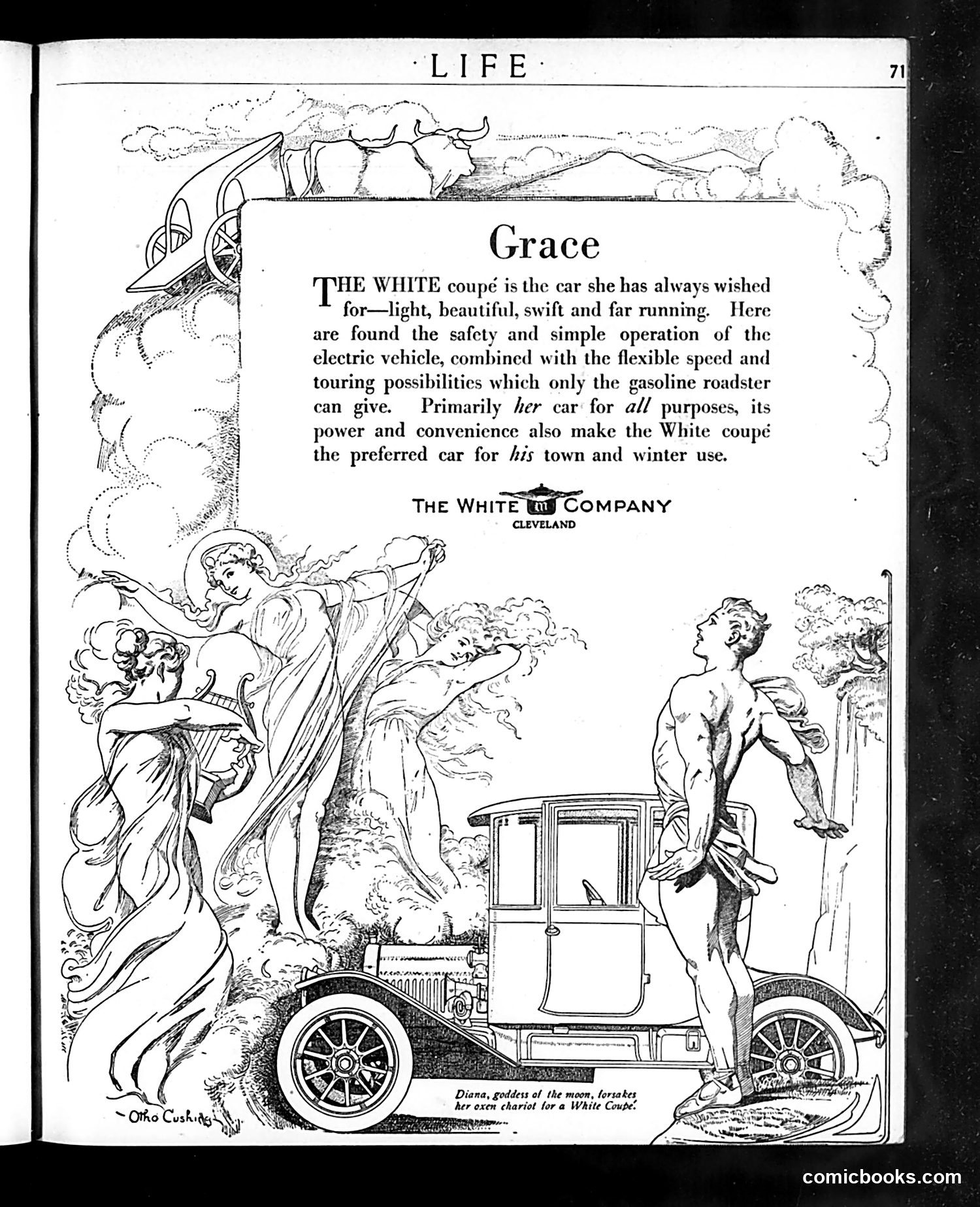
This is primarily a **car advertisement**, not political satire. The page advertises the White Company's coupé automobile, marketed as ideal for women ("her car for all purposes") while also appealing to men for "town and winter use." The artistic framing employs classical mythology: Diana, the Roman goddess of the moon and hunting, is depicted forsaking her traditional ox-drawn chariot to ride in a modern White coupé. The cherubs and allegorical figures reinforce luxury and elegance. The joke/appeal is gentle wordplay on "grace"—the title and the goddess Diana represent elegance, while the car promises graceful, swift performance combining electric vehicle safety with gasoline engine power and range. This reflects early-1900s automotive marketing positioning cars as modern replacements for horse-drawn carriages, emphasizing both practicality and aspirational status.
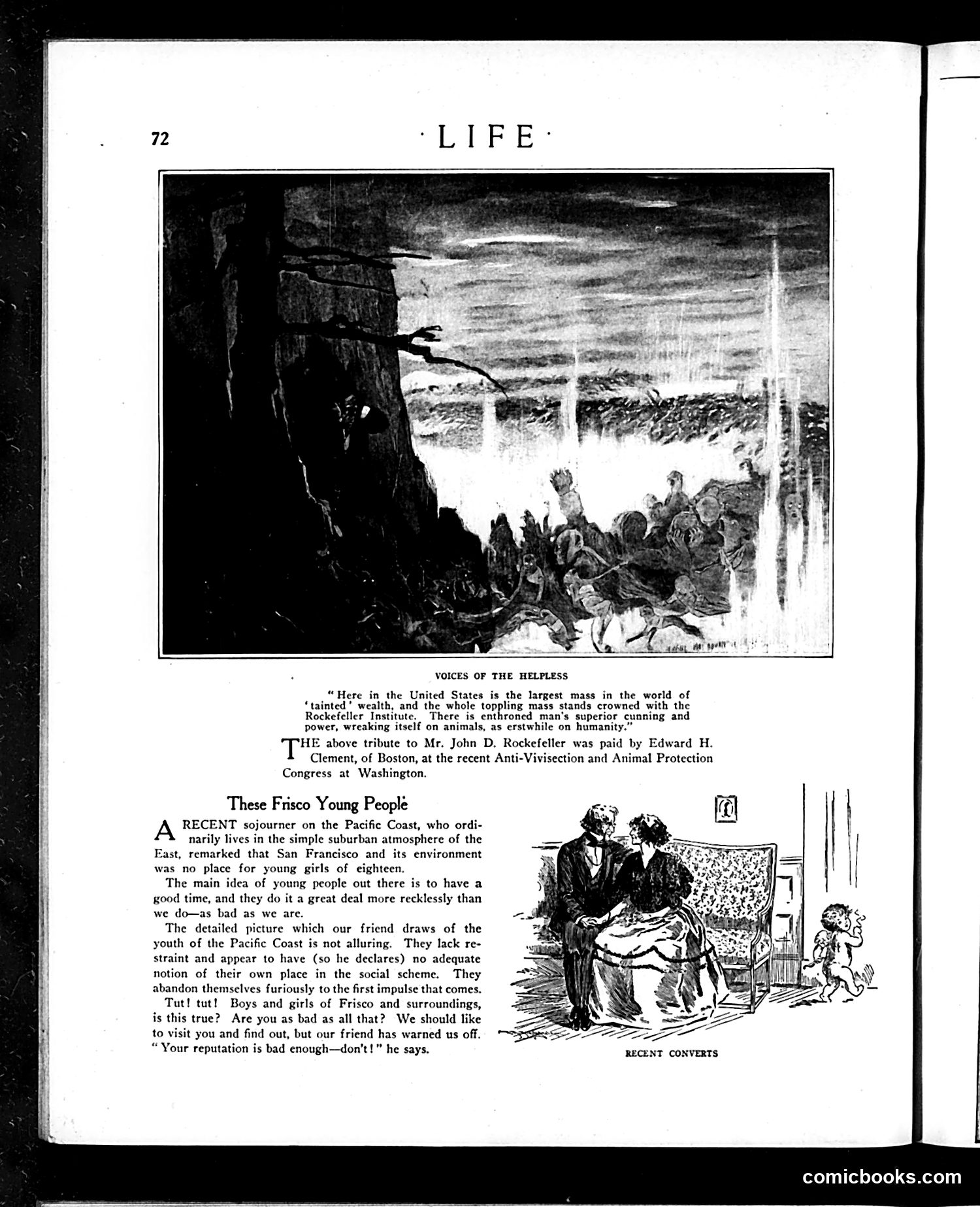
**Top Section ("Voices of the Helpless")**: This is social criticism targeting **John D. Rockefeller** and wealthy industrialists. Edward H. Clement, speaking at an Anti-Vivisection Congress, attacks Rockefeller's "tainted wealth" and the Rockefeller Institute, sarcastically equating their use of animals in research with historical atrocities against humanity. The accompanying dark illustration appears to show masses of suffering people or animals. This reflects Progressive-era criticism of monopoly wealth used for scientific purposes many viewed as cruel. **Bottom Section ("These Frisco Young People")**: A satirical commentary on San Francisco's youth culture, contrasting Eastern propriety with Western recklessness. The piece mocks a visitor's prudish warnings about young women's behavior and lack of "restraint" in the city. The accompanying sketch shows adults (likely converts to morality) appearing disapproving. Life magazine uses this to gently satirize both Eastern provincial attitudes and the actual libertine reputation San Francisco was gaining.
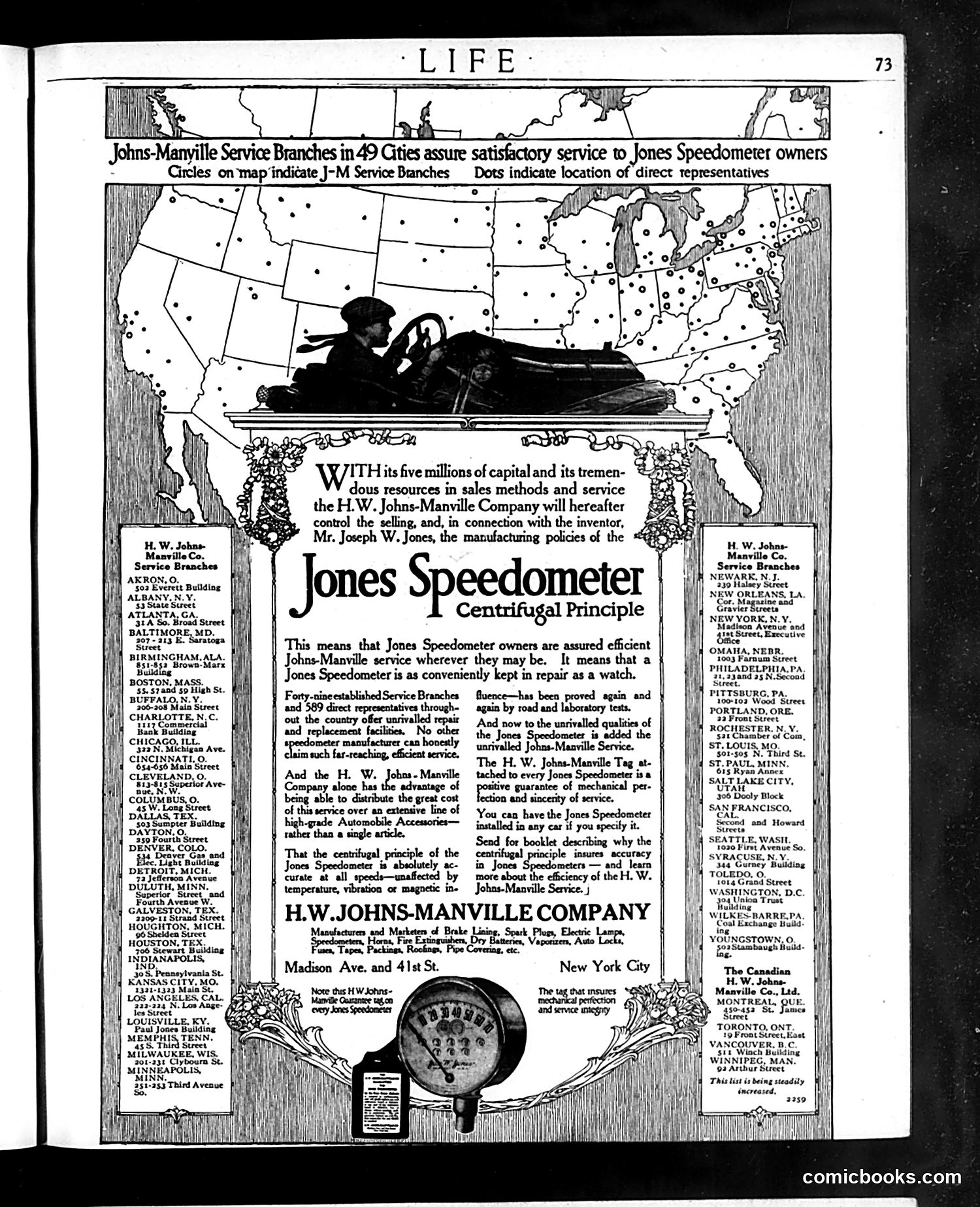
This is primarily a **product advertisement**, not satire. The H.W. Johns-Manville Company announces it is acquiring control of Jones Speedometer manufacturing and sales from inventor Joseph W. Jones. The page uses a map showing 49 service branches across North America to convince potential buyers that speedometer repairs will be convenient and reliable—"as conveniently kept in repair as a watch." The centrifugal principle is emphasized as technically superior. The silhouette illustration of a man in a car (top center) and the large close-up of a speedometer gauge (bottom) are product visualizations meant to appeal to automobile owners. This reflects the early automotive era when speedometers were still relatively novel accessories. There is **no political satire** here—it's straightforward early 20th-century advertising emphasizing national distribution networks and service reliability to justify a product merger.
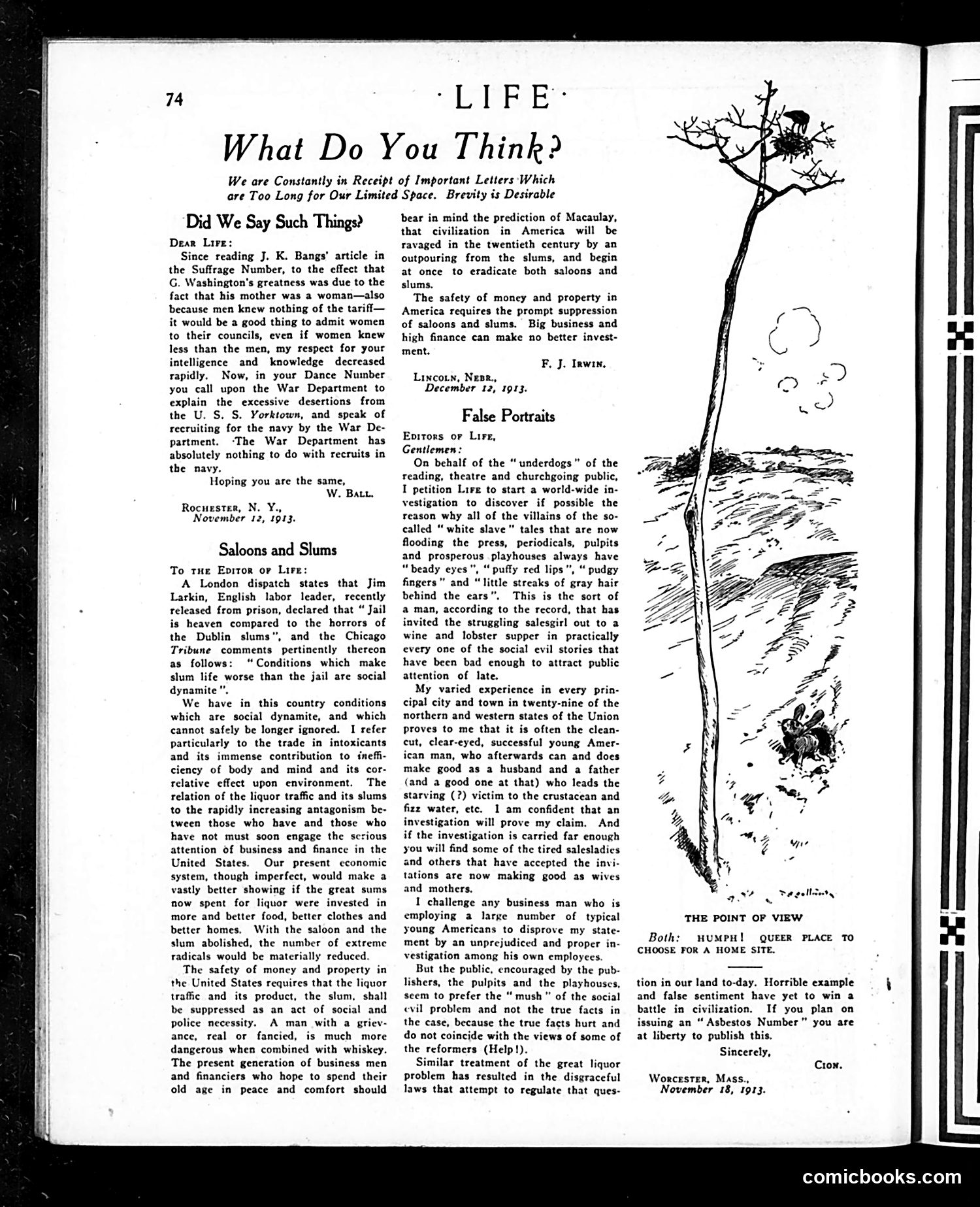
This page presents reader responses to Life magazine articles. The content addresses three topics: **"Did We Say Such Things?"** – A reader (W. Batt) corrects Life's editorial errors: the magazine incorrectly attributed navy recruitment to the War Department (actually the Navy Department's role) and had made a suffrage argument he found intellectually weak. **"Saloons and Slums"** – F.J. Irwin argues that liquor trafficking and resulting slums create social unrest dangerous to business interests. He invokes Macaulay's prediction that American civilization will be ravaged by slum populations, urging wealthy businessmen to suppress saloons as self-protection—framing social reform as an investment in property safety. **"False Portraits"** – A reader protests the stock villainy tropes in "white slave" narratives flooding newspapers and theaters—the stereotypical seducer with "beady eyes," "puffy red lips," and gray hair. The writer implies these formulaic portrayals misrepresent actual predators. The small accompanying illustration appears decorative rather than editorial commentary.
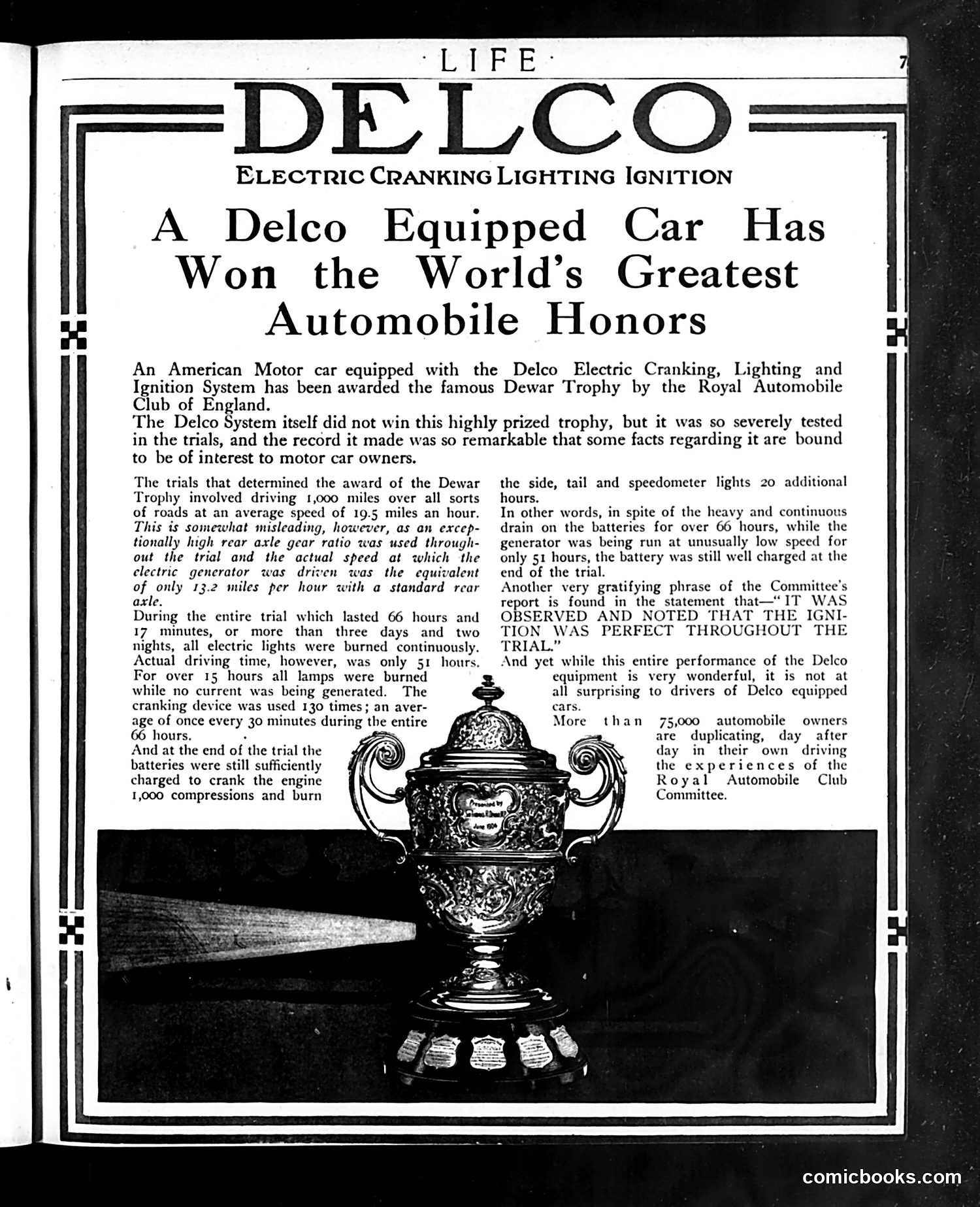
This is **not a cartoon or satire**—it's a straightforward automobile advertisement disguised as editorial content, a common practice in early 20th-century magazines. The page promotes **Delco** (electric cranking, lighting, and ignition systems) by reporting that an American car equipped with this technology won the prestigious Dewar Trophy from England's Royal Automobile Club. The advertisement emphasizes the system's reliability through grueling 66-hour trials: lights burned continuously, the starter was used 130 times, yet batteries remained sufficiently charged afterward. The ornate trophy photograph serves as visual proof of achievement. The text argues that 75,000 owners now replicate these results daily, implying Delco is both proven and accessible. **For modern readers**: This represents early automotive advertising that leveraged competitive testing and prestigious endorsements to build consumer confidence in emerging electric vehicle technology—a strategy still used today.
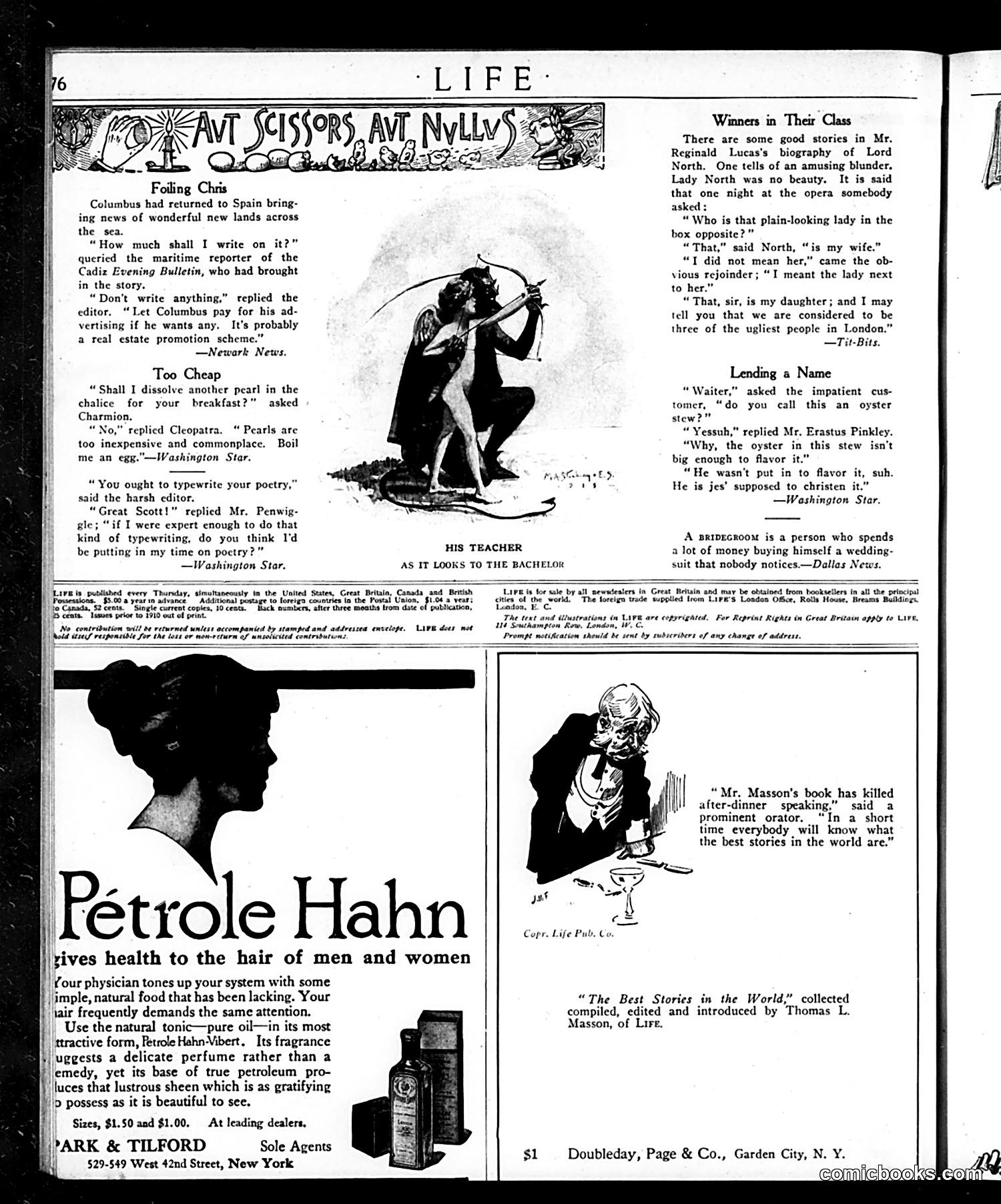
This page from *Life* magazine contains several short humorous items satirizing early 1900s society and journalism. The main cartoon depicts a man (labeled "His Teacher") gesturing at what appears to be a bachelor observing women—the joke being that real-world experience teaches lessons differently than formal instruction. The text jokes mock contemporary attitudes: editors dismissing Columbus's discovery as a real estate scheme; Cleopatra finding pearls too commonplace (satirizing wealth excess); and a newspaper editor suggesting a poet should typewrite rather than write poetry. A society anecdote involves Lord North's family being considered among London's ugliest people—humor based on aristocratic bluntness. Other quips target restaurant service and wedding expenses. The *Petrole Hahn* advertisement promotes a petroleum-based hair tonic, reflecting early 20th-century patent medicine marketing. A final joke references Thomas L. Masson's book *"The Best Stories in the World,"* suggesting it will monopolize after-dinner conversation. Overall, the page reflects *Life's* satirical focus on journalism, manners, social pretension, and consumer culture of the era.
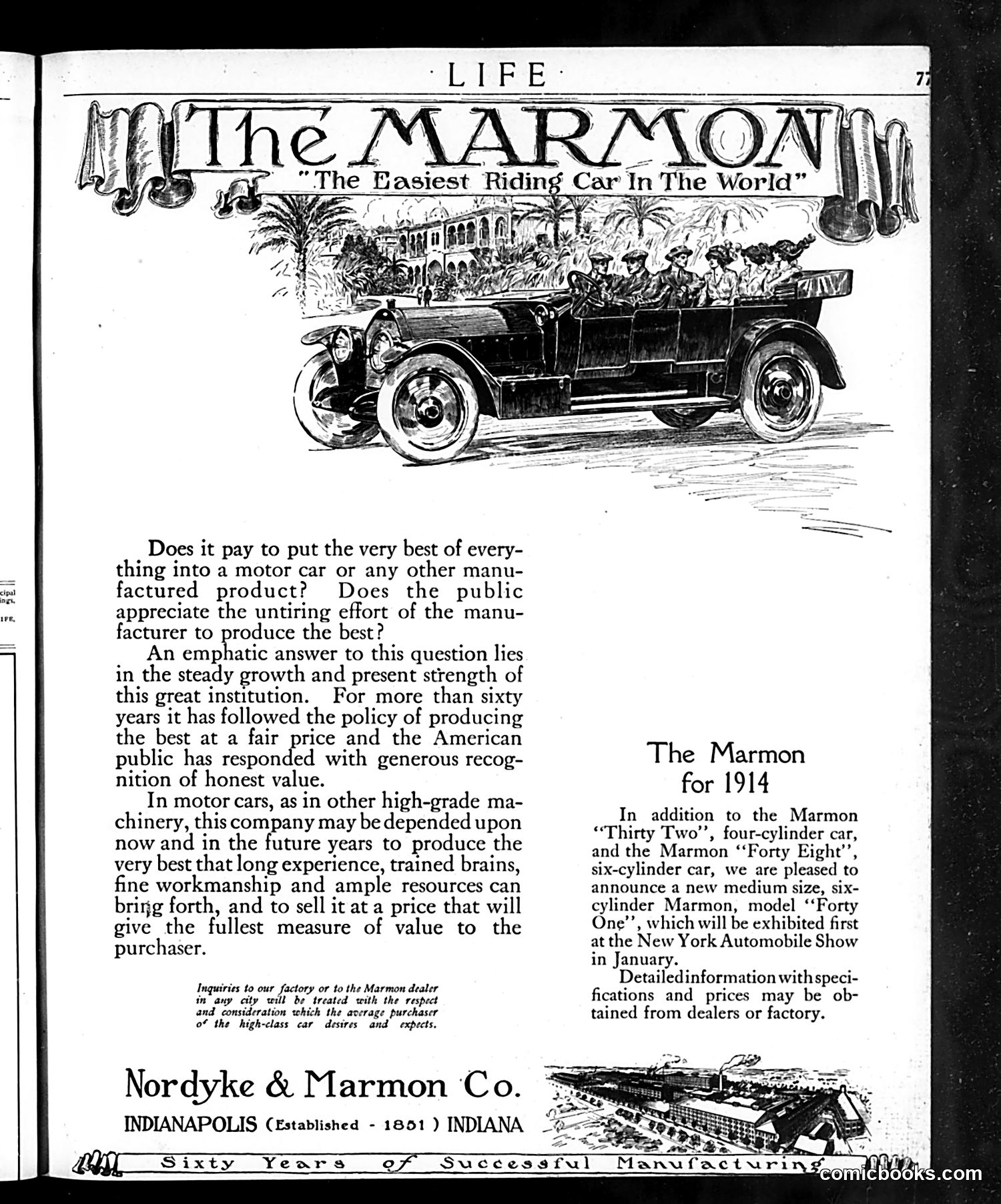
This page is **primarily an advertisement**, not satire. It's a 1914 Marmon automobile ad from *Life* magazine, promoting the Marmon as "The Easiest Riding Car In The World." The ad uses rhetorical persuasion rather than humor or political commentary. It argues that consumers *do* appreciate quality manufacturing, citing the company's 60-year track record (since 1851) as evidence. The text emphasizes that Marmon produces "the best at a fair price"—positioning the brand as offering premium quality without premium pricing. The illustration shows an open touring car with well-dressed passengers in an exotic locale (palm trees visible), suggesting luxury and aspirational lifestyle. This represents early 20th-century automotive marketing: emphasizing craftsmanship, heritage, and value as selling points. There is no cartoon, caricature, or political satire present—this is straightforward product promotion typical of the era's magazine advertising.
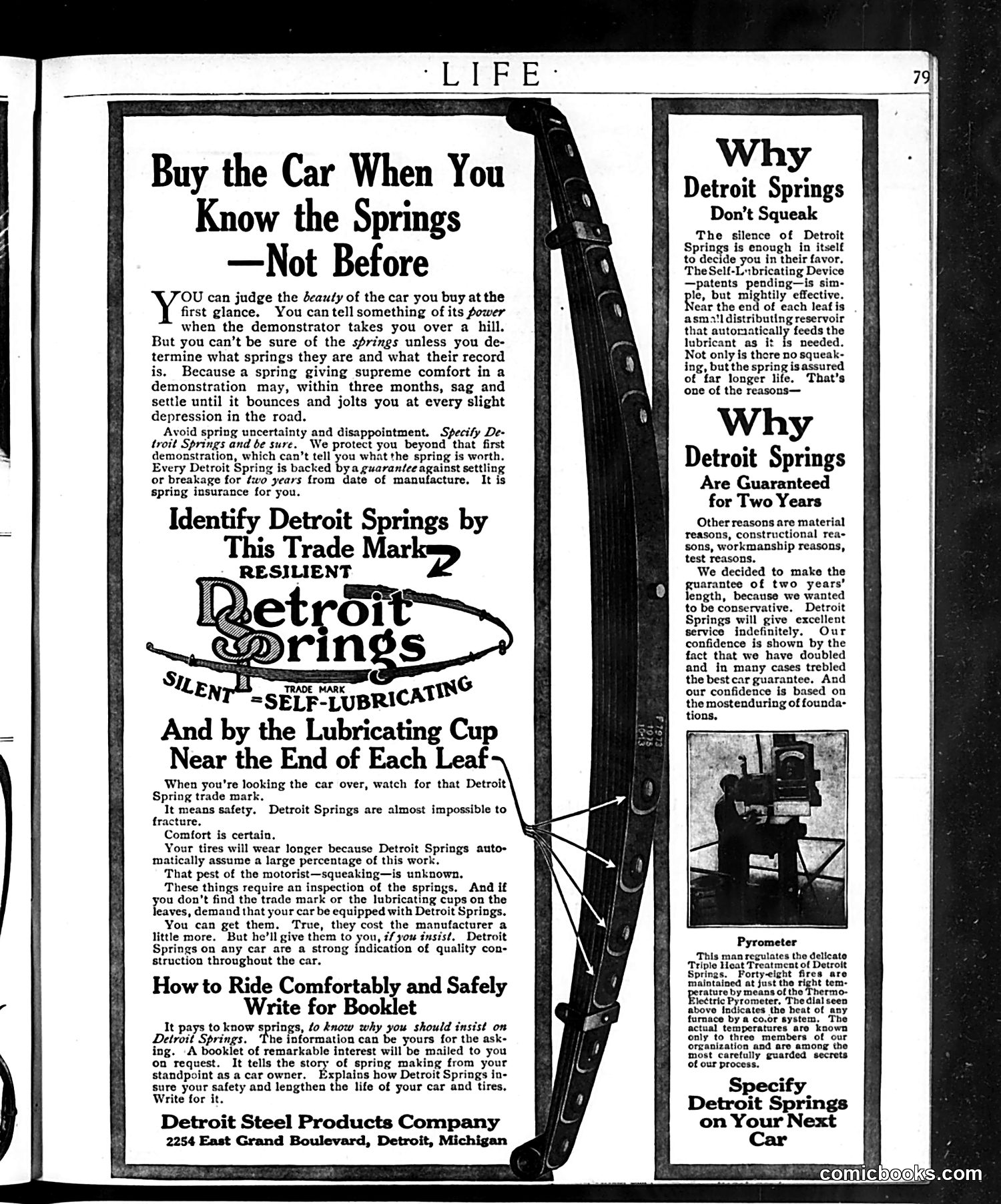
This full page from *Life* magazine is a commercial advertisement for Detroit Springs, an automobile suspension component manufactured by the Detroit Steel Products Company. There are no cartoons or satirical content to analyze. The ad promotes Detroit Springs' superiority through several claims: they're identifiable by a trade mark, they don't squeak (due to a self-lubricating device), they provide comfort and safety, they're backed by a two-year guarantee, and they extend tire life. The right column includes testimonials about quality control, featuring a "Pyrometer" operator who regulates heat treatment—presented as evidence of manufacturing precision and care. The appeal is straightforward product marketing aimed at car buyers of the era, emphasizing durability and comfort as purchasing criteria.
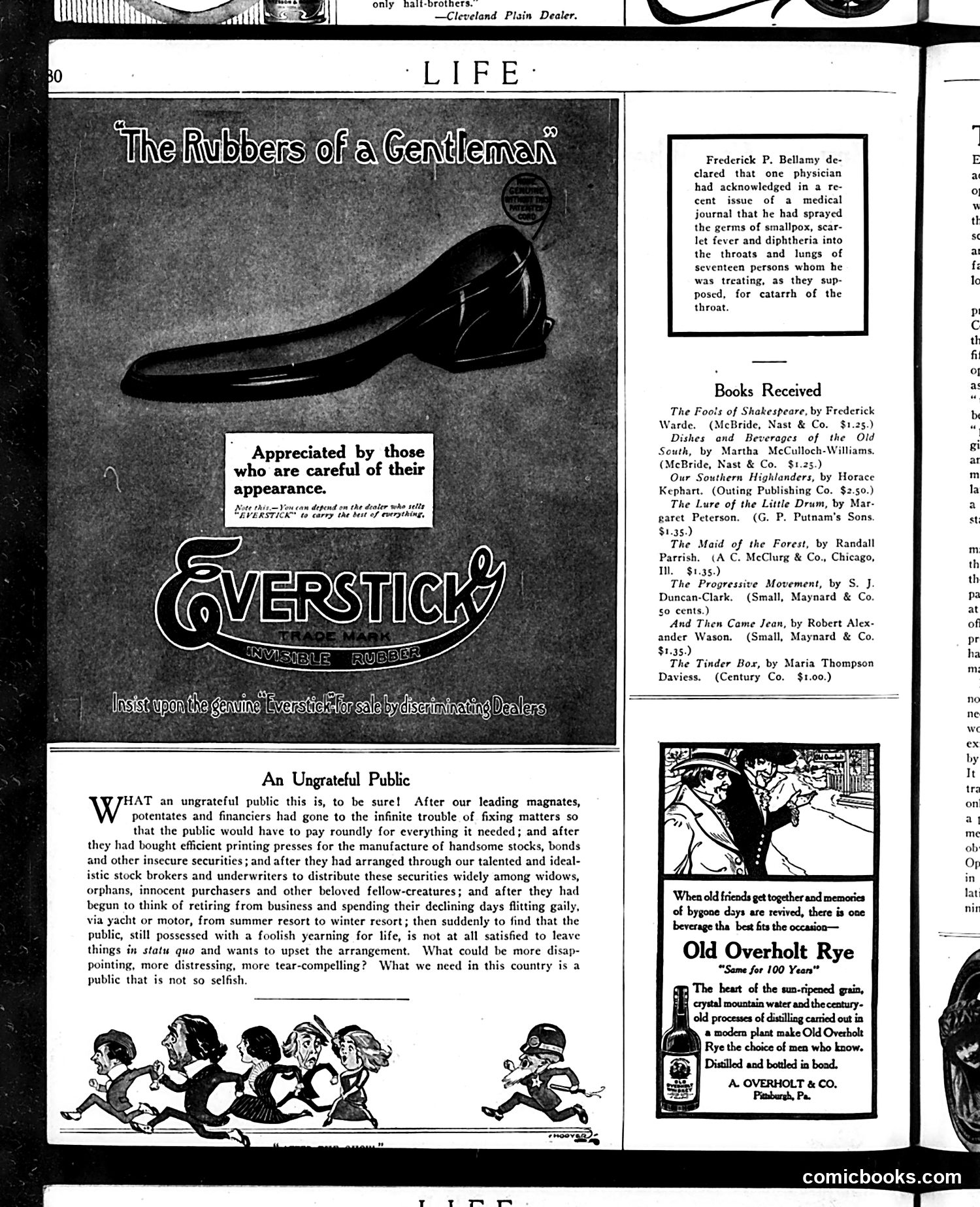
This page contains a scathing political cartoon attacking wealthy financiers and stock manipulators. The text sarcastically describes how the rich had orchestrated a system to profit from ordinary people—manufacturing securities (stocks and bonds) and selling them to widows, orphans, and unsuspecting investors through corrupt brokers. The cartoon depicts these financiers as parasites upset that the public refuses to accept their exploitation passively. Life's satire argues these tycoons deserve criticism for their greed, not sympathy. The point: wealthy elites had rigged the financial system for personal gain, then acted victimized when common people objected. This reflects Progressive Era skepticism toward Wall Street manipulation and unregulated capitalism—a major political issue of the early 20th century. The cartoon at top about Everstick razors is unrelated advertising; below are book reviews and a whiskey ad.
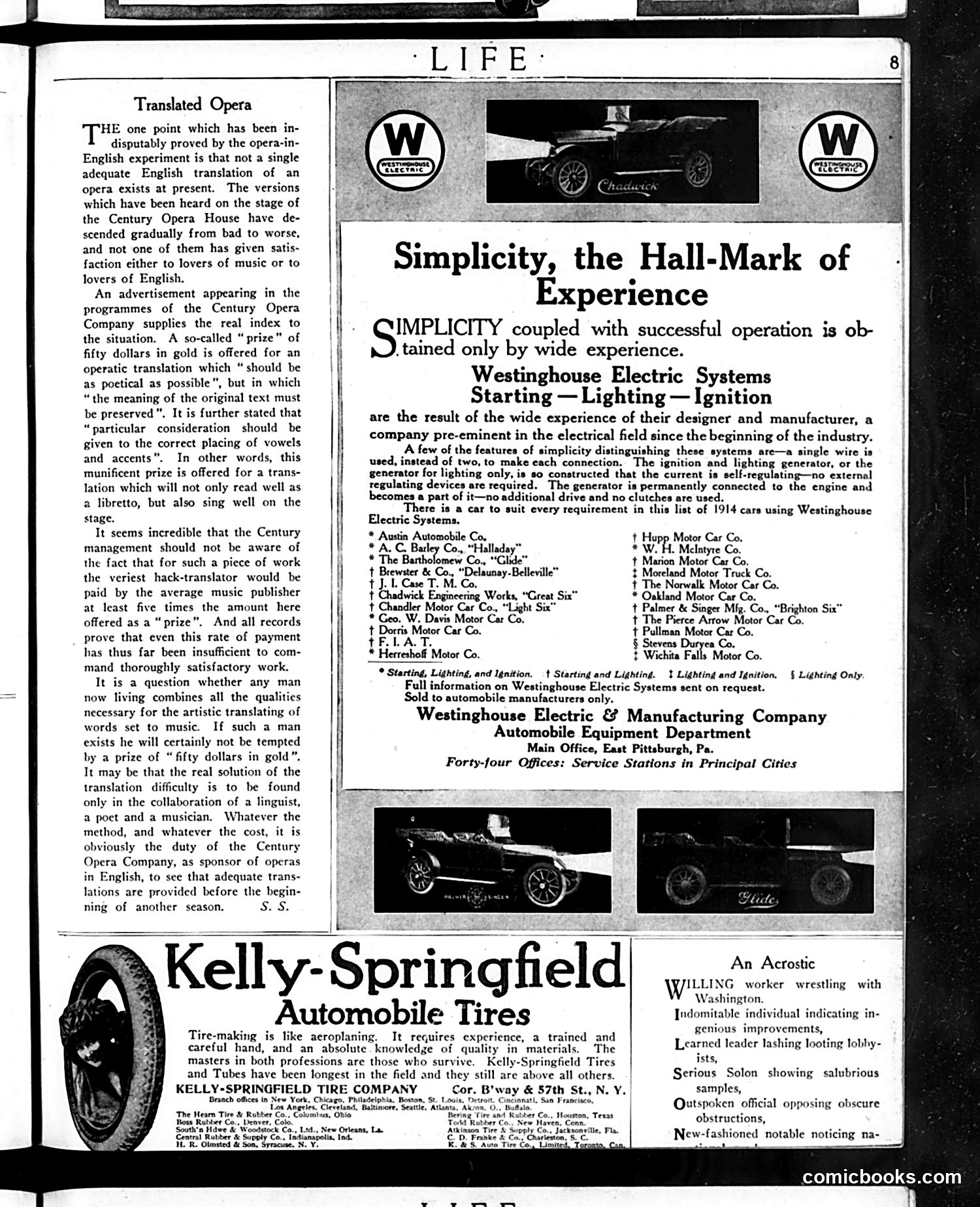
This page is primarily **advertising** with a secondary editorial column about opera translation. ## The Editorial ("Translated Opera") The article criticizes the Century Opera Company for offering only $50 in gold for a high-quality English opera translation—work that professional translators would charge far more to complete. The writer argues this is inadequate compensation and questions whether any living person could simultaneously meet all requirements (linguistic accuracy, poetic quality, and singability). The piece sarcastically notes the "prize" is insultingly low given the complexity of the task, and calls on the Opera Company to properly fund translations before the next season. ## The Advertising The bulk of the page contains two major advertisements: **Westinghouse Electric Systems** (automotive electrical equipment) and **Kelly-Springfield Automobile Tires**. Both emphasize experience, reliability, and simplicity of design. The ads list numerous 1914 automobile manufacturers using these components. There is no political satire or caricature on this page—it's a straightforward mix of editorial commentary and commercial advertising typical of *Life* magazine's format.
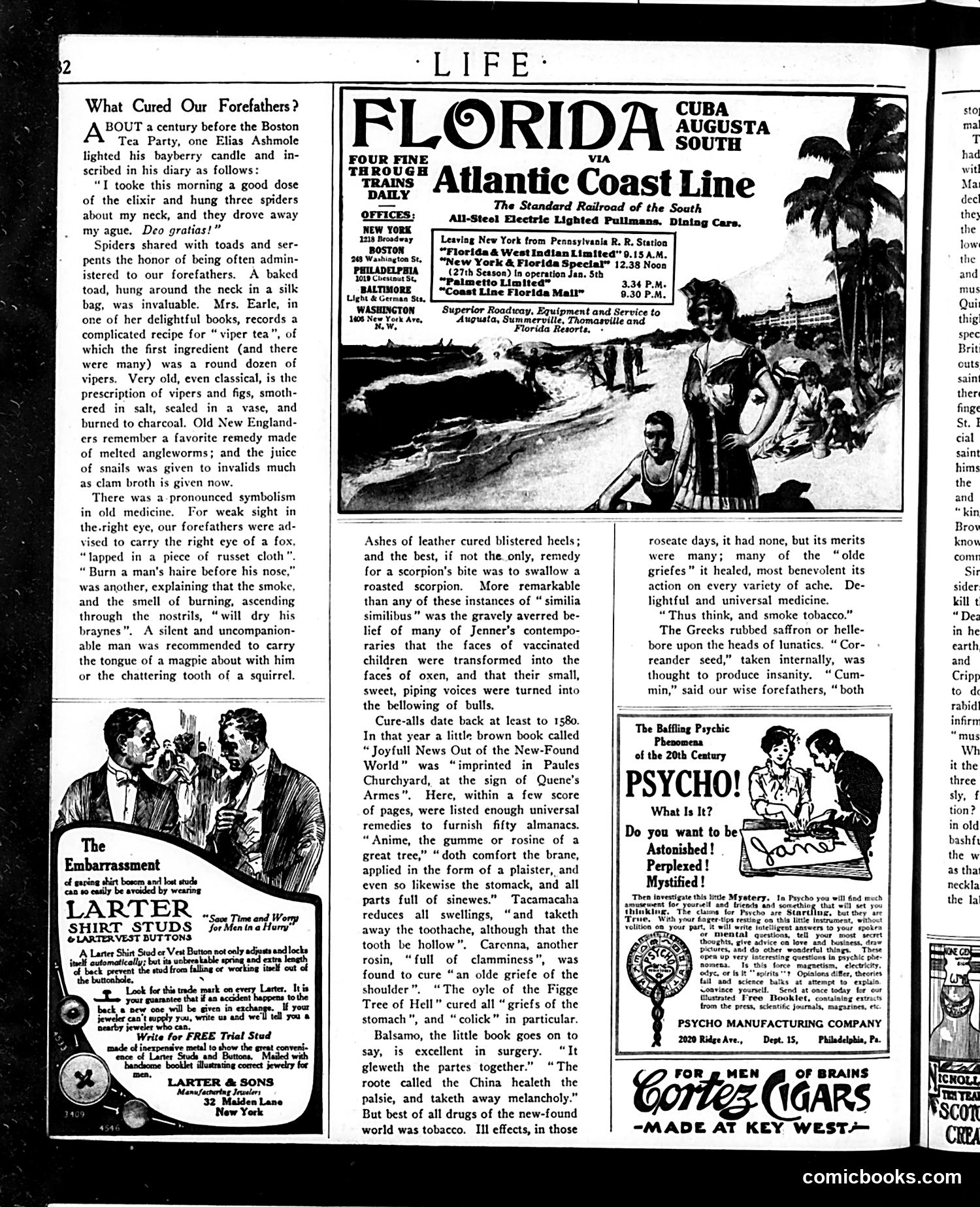
This page showcases early 18th-century folk medicine remedies through historical anecdote and satire. The main article "What Cured Our Forefathers?" chronicles bizarre medical practices—carrying fox eyes, hanging spiders and toads around necks, ingesting viper tea—to mock the credulity of previous generations. The satire's point: highlighting how absurd and ineffective these treatments were, implicitly contrasting "superstitious" past medicine with the article's contemporary (1920s) "enlightened" era. References to Edward Jenner's vaccination work acknowledge medical progress, while mocking fears that vaccinated children would transform into oxen—showing how even scientific advancement faced irrational resistance. The page juxtaposes this historical mockery with modern advertisements (railroad travel, shirt studs, cigars, psychic services), creating ironic commentary: while ridiculing ancestors' gullibility, contemporary readers are simultaneously marketed dubious products and paranormal claims.
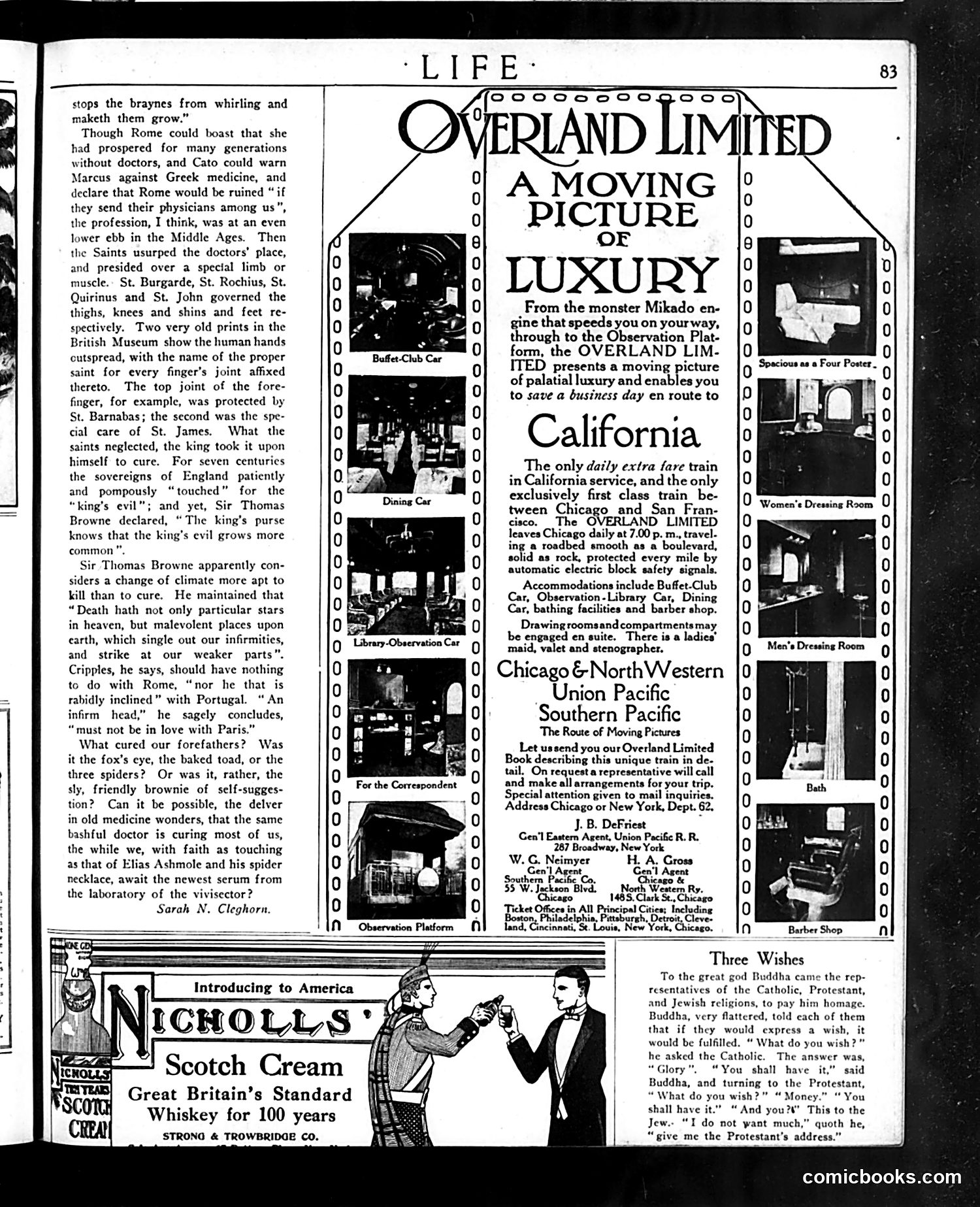
This page is primarily **advertising and editorial content** rather than political cartoons. The main feature is a full-page advertisement for the **Overland Limited train**, promoting luxury rail travel from Chicago to California. The ad uses photographs of train amenities (dining car, observation platform, sleeping quarters) to emphasize comfort and efficiency—it promises to "save a business day" on the journey. Below is a smaller advertisement for **Nicholls Scotch Cream whisky**, showing two men in period dress with the tagline "Introducing to America" and promoting it as "Great Britain's Standard Whiskey for 100 years." The left column contains a lengthy essay (by Sarah N. Cleghorn) discussing the **history of medicine**, comparing medieval reliance on saints and superstition to modern medical practice. It's a satirical reflection on how past generations cured ailments through folk remedies and faith rather than scientific medicine. At bottom right is a short humorous piece titled **"Three Wishes"** about religious representatives (Catholic, Protestant, Jewish) asking for wishes—appears to be gentle interfaith satire.
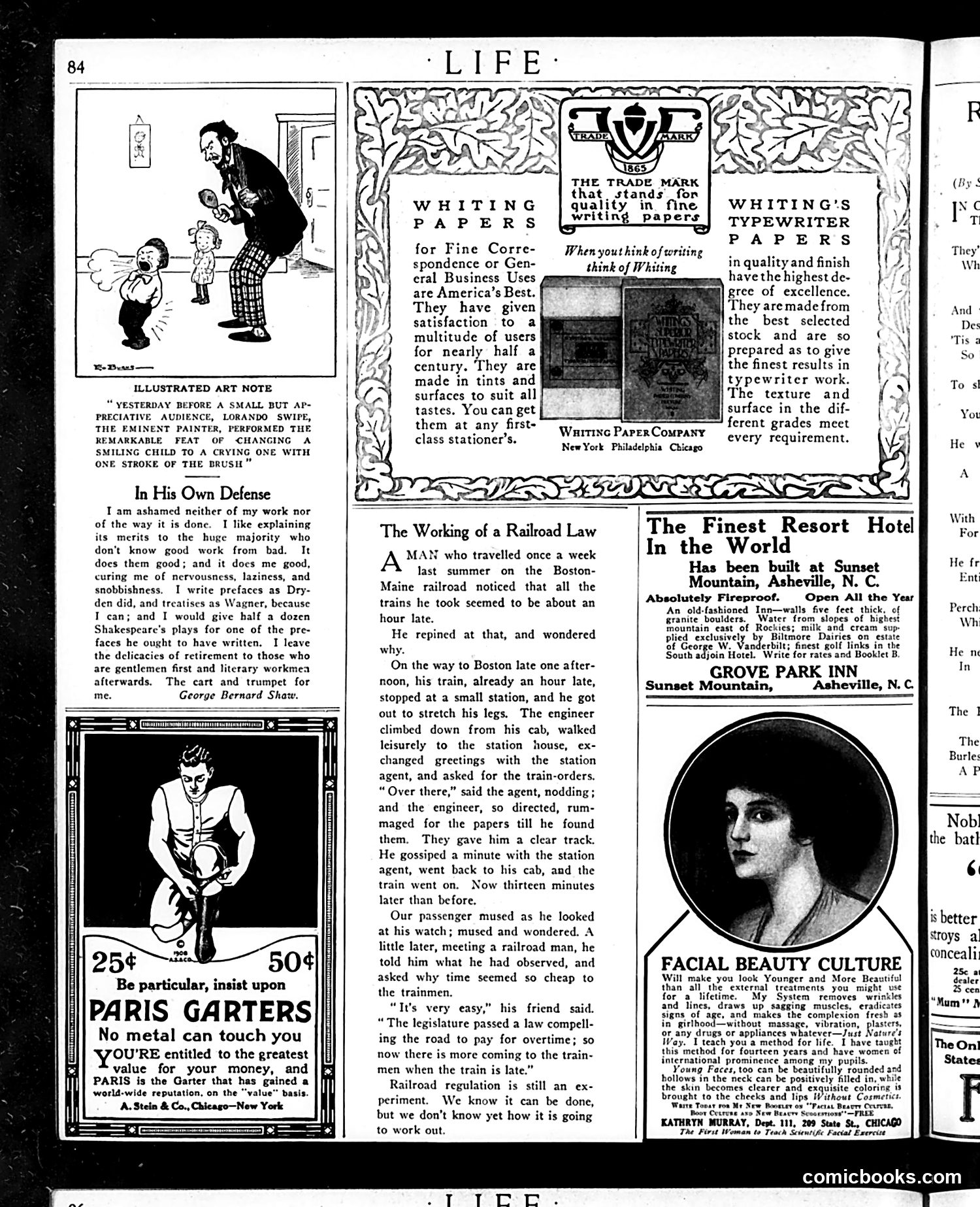
This page mixes satirical editorial content with advertisements typical of early 20th-century American magazines. **The main satirical piece**, "The Working of a Railroad Law," critiques railroad regulation unintentionally backfiring. A passenger notices trains are consistently late and learns why: a new law requiring railroads to pay workers overtime for delays has perversely incentivized trainmen to run behind schedule—they earn more money that way. The satire targets poorly-designed legislation that produces the opposite of intended effects, suggesting regulatory experimentation can have absurd consequences. **The "Illustrated Art Note"** above is a brief joke about painter "Lorando Swipe" (a fictional character) performing the "remarkable feat" of making a smiling child cry with one brush stroke—likely mocking pretentious modern art. **"In His Own Defense"** appears to be an essay excerpt, possibly by George Bernard Shaw (mentioned at the end), defending artistic explanation and prefaces against claims of snobbishness. The remainder consists of period advertisements for writing papers, typewriter papers, garters, and a resort hotel.
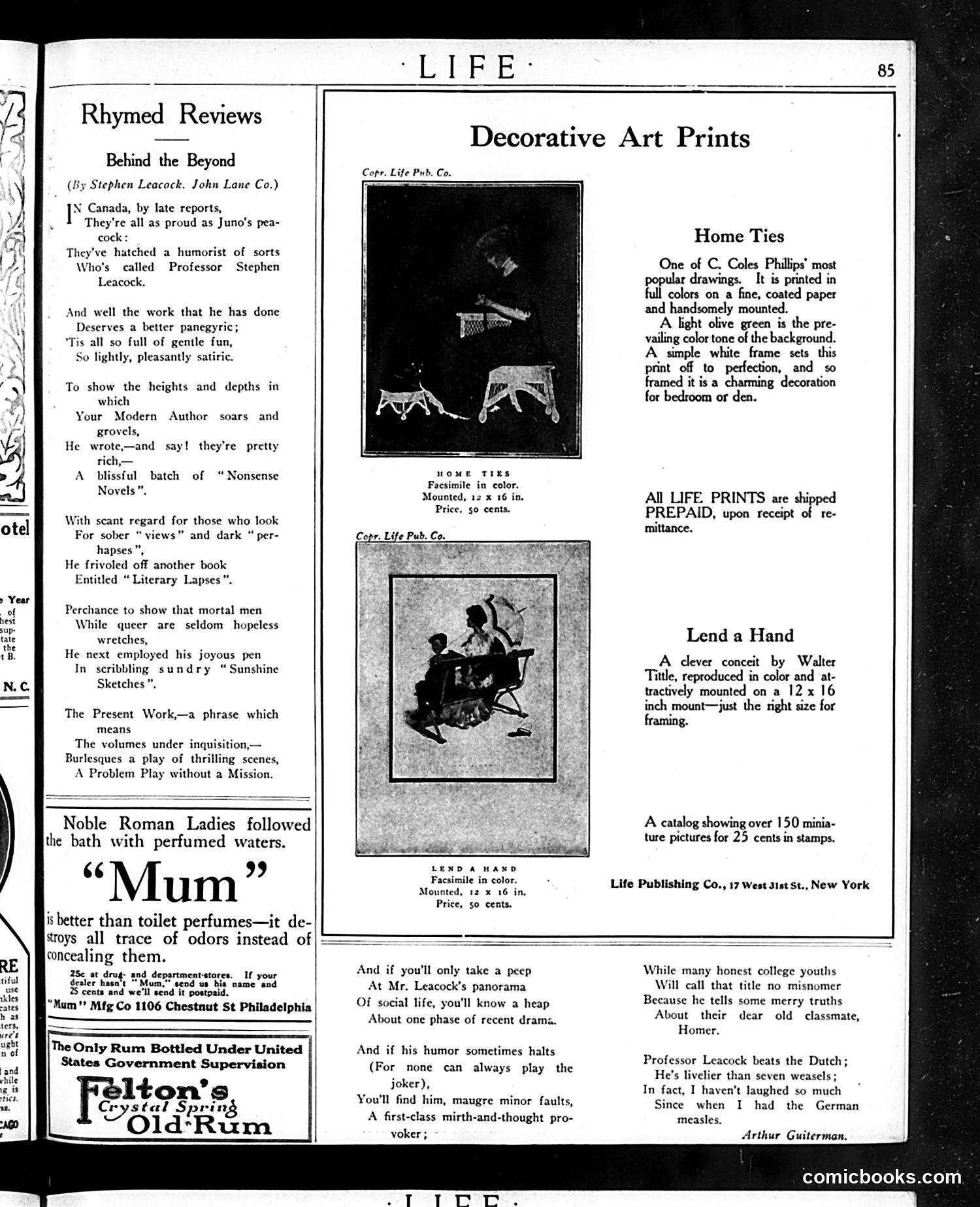
This page consists primarily of a **book review in verse** of Stephen Leacock's *Behind the Beyond*, written by Arthur Guiterman. Leacock was a Canadian humorist and author; the review praises his comic writing across multiple works (*Nonsense Novels*, *Literary Lapses*, *Sunshine Sketches*). The review celebrates Leacock's ability to blend gentle satire with humor, particularly his satirical treatment of college life and classical literature. The final stanza's reference to "German measles" is a topical joke—likely from the pre-WWI era when German cultural references were common fodder for American humor. The page also contains **advertisements and decorative art prints** for sale through Life Publishing, unrelated to the literary content. No political cartoon appears on this page—it's primarily a literary review with commercial advertisements, typical of *Life* magazine's mixed-content format.
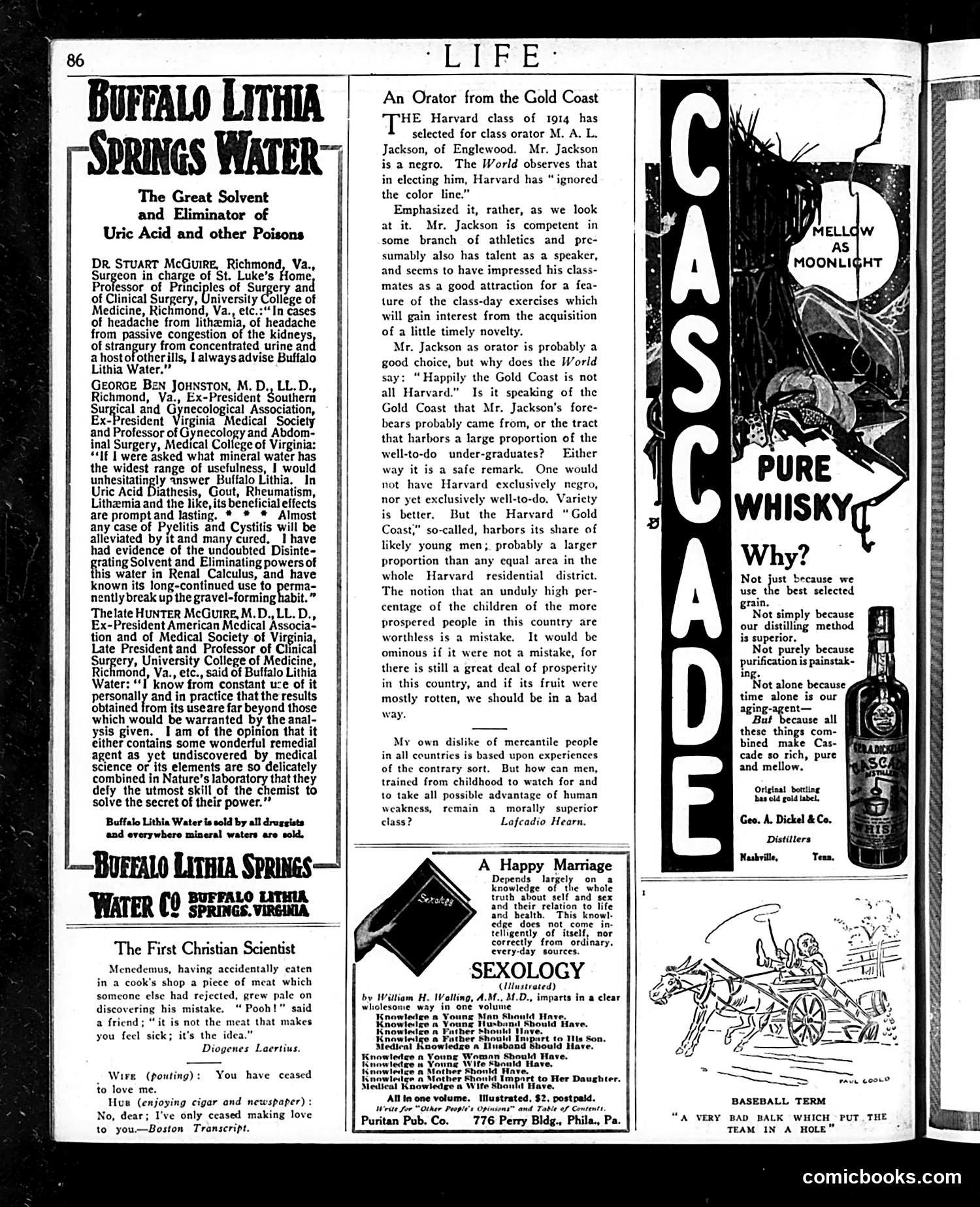
This editorial satirizes *The World* newspaper's response to Harvard selecting M.A.L. Jackson, a Black student, as class orator for 1914. **The Satire:** Life's editors accuse *The World* of false progressivism. While *The World* claims Harvard "ignored the color line," Life argues it actually emphasized race by calling attention to Jackson's selection as a "timely novelty"—treating his competence as secondary to his race. **The "Gold Coast" Reference:** This refers to Harvard's wealthy residential area housing affluent undergraduates. Life sarcastically quotes *The World*'s remark that "the Gold Coast is not all Harvard," interpreting it as either: (1) a dig at Jackson's African ancestry, or (2) a jab at wealthy students. **The Point:** Life critiques the patronizing, performative nature of tolerating diversity while highlighting race as exotic or unusual. The editorial suggests Jackson should be valued for actual merit, not as a diversifying attraction.
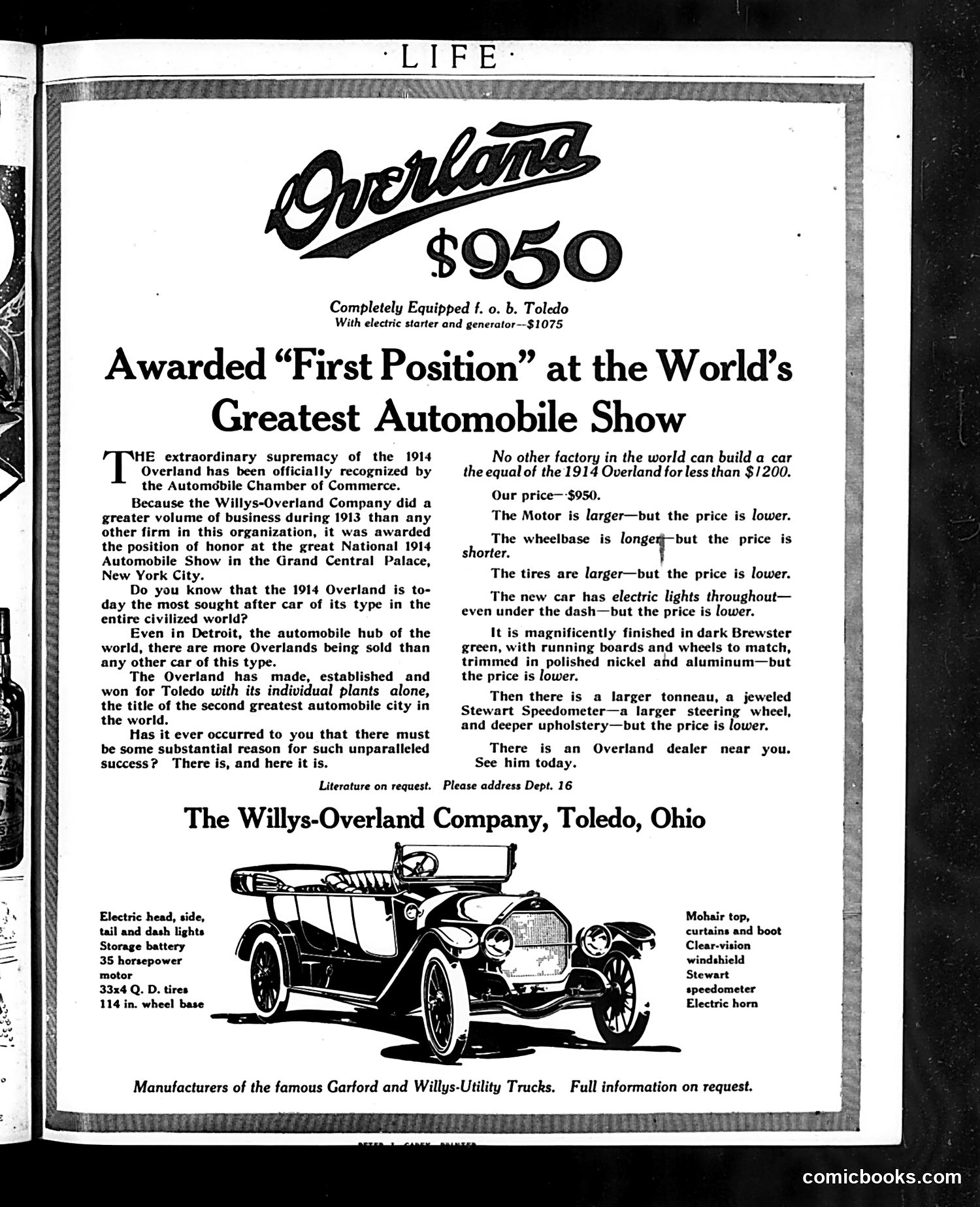
This is a **full-page automobile advertisement**, not a political cartoon or satire. It promotes the 1914 Overland car by the Willys-Overland Company of Toledo, Ohio. The ad's rhetorical strategy uses repetitive contrast: it claims the Overland offers superior features (larger motor, longer wheelbase, larger tires, electric lights, finer finishes, better upholstery) at a lower price ($950) than competitors. The repeated phrase "but the price is lower" drives home the value proposition. The ad also emphasizes the car's official prestige—it won "First Position" at the National 1914 Automobile Show and helped Toledo become "the second greatest automobile city in the world." For modern readers: this represents early automotive marketing emphasizing affordability and feature-richness as competitive advantages. The *Life* magazine context suggests this appealed to educated, middle-class consumers interested in new technology. The detailed technical specs (horsepower, tire size, wheelbase) reflect how car specs were marketed as selling points in this era.
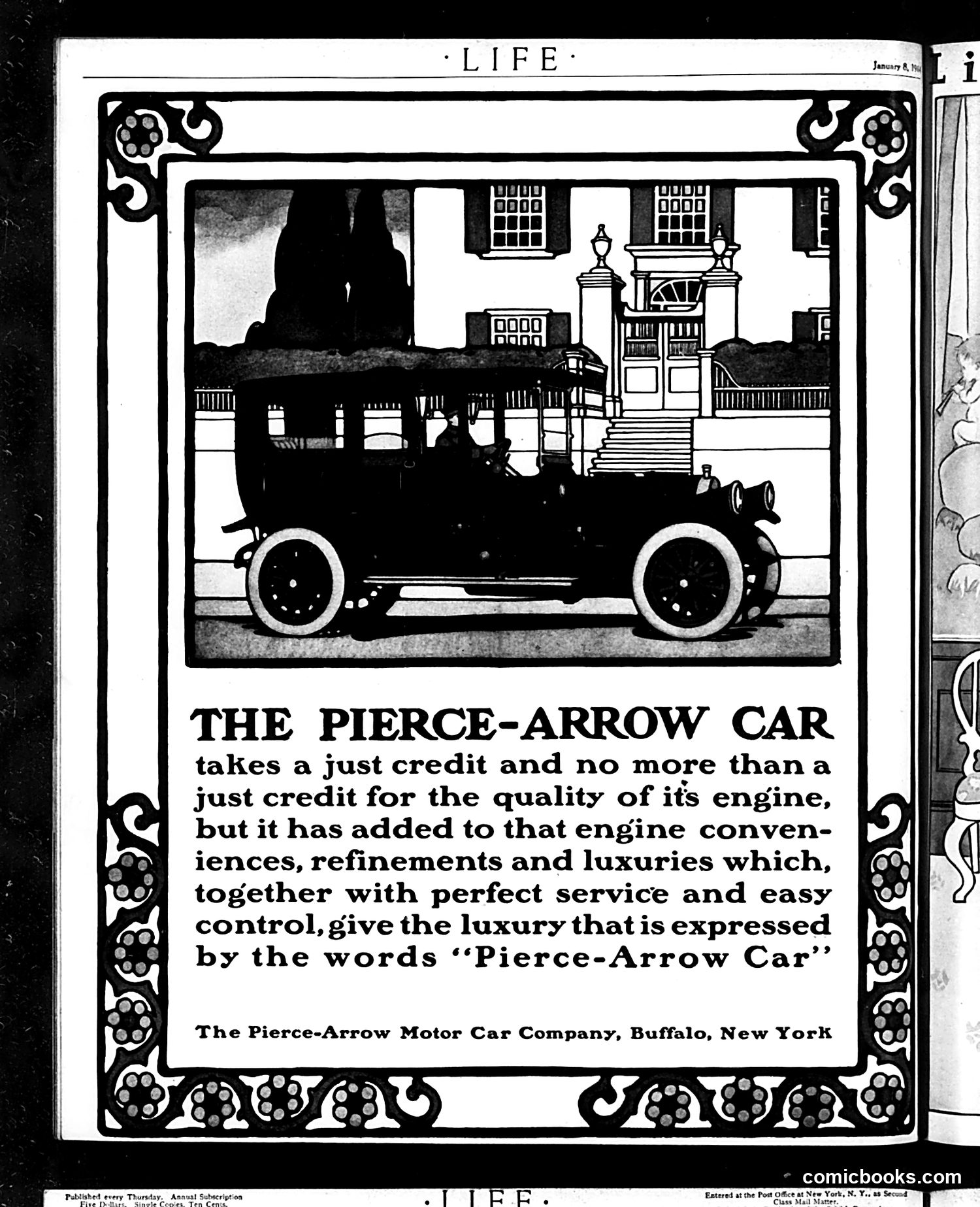
This is a **full-page advertisement**, not political satire. It promotes the Pierce-Arrow automobile, a luxury car manufactured in Buffalo, New York. The image shows a stylized black silhouette of an early 1910s touring car driving past an impressive civic building (likely a courthouse or government edifice), establishing the vehicle's association with prestige and success. The advertisement's copy claims the Pierce-Arrow deserves credit not merely for engine quality, but for added "conveniences, refinements and luxuries" that collectively define luxury automotive experience. The decorative border with Art Deco elements emphasizes elegance and sophistication aimed at wealthy readers of *Life* magazine. This represents early automotive marketing targeting the affluent class during the era when automobiles were luxury goods rather than mass commodities.