
Life, 1914-01-08 · page 28 of 44
Life — January 8, 1914 — page 28: what you’re looking at
What you’re looking at
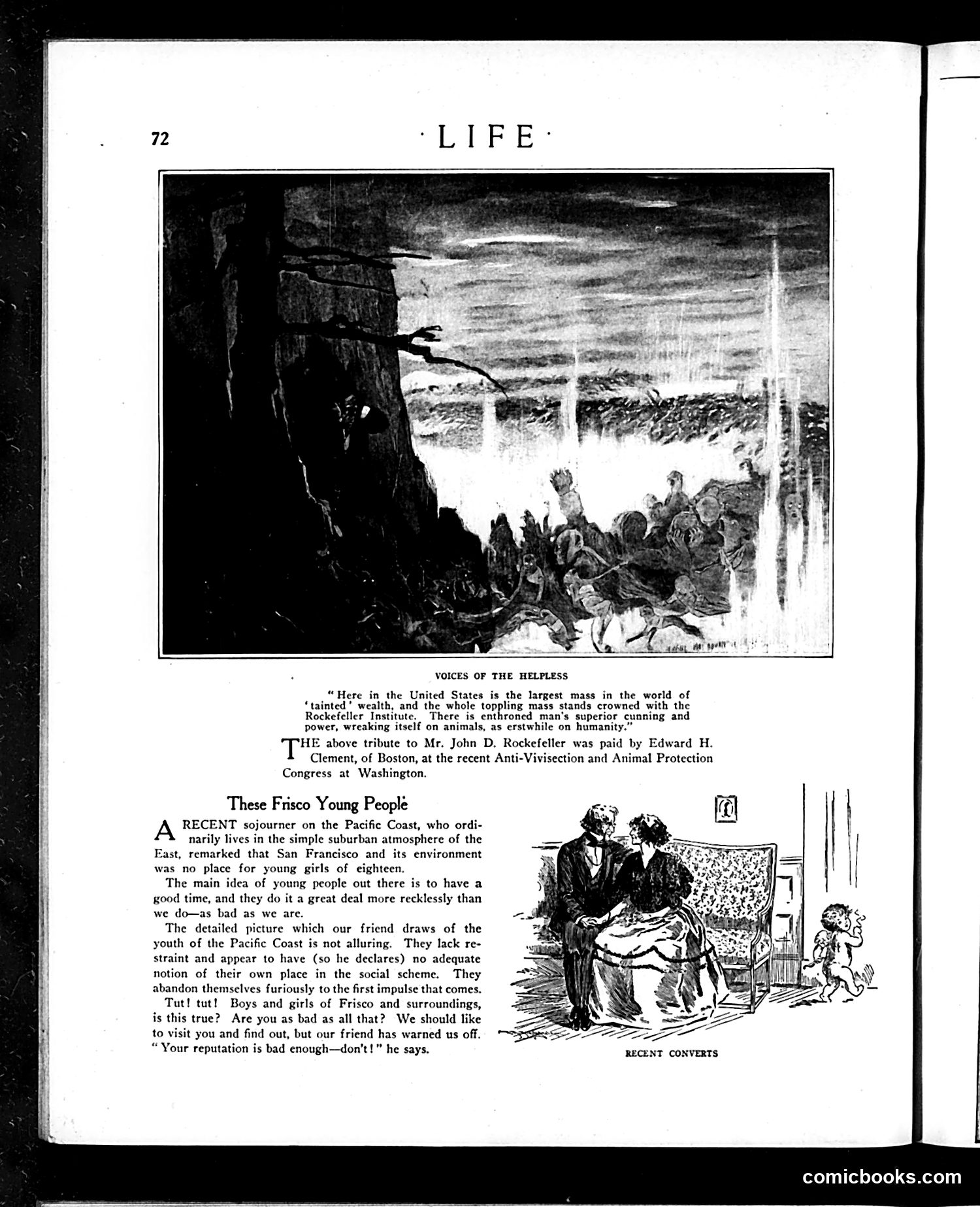
**Top Section ("Voices of the Helpless")**: This is social criticism targeting **John D. Rockefeller** and wealthy industrialists. Edward H. Clement, speaking at an Anti-Vivisection Congress, attacks Rockefeller's "tainted wealth" and the Rockefeller Institute, sarcastically equating their use of animals in research with historical atrocities against humanity. The accompanying dark illustration appears to show masses of suffering people or animals. This reflects Progressive-era criticism of monopoly wealth used for scientific purposes many viewed as cruel. **Bottom Section ("These Frisco Young People")**: A satirical commentary on San Francisco's youth culture, contrasting Eastern propriety with Western recklessness. The piece mocks a visitor's prudish warnings about young women's behavior and lack of "restraint" in the city. The accompanying sketch shows adults (likely converts to morality) appearing disapproving. Life magazine uses this to gently satirize both Eastern provincial attitudes and the actual libertine reputation San Francisco was gaining.
📄 Transcribed text from this page (OCR, searchable)
Machine-transcribed from the original scan — historical spelling and the odd misread are preserved.
VOICES OF THE HELPLESS “Here in the United States is the largest mass in the world of ‘tainted ' wealth, and the whole toppling mass stands crowned with the Rockefeller Institute. There is enthroned man's superior cunning and power, wreaking itself on animals, as erstwhile on humanity.” THe above tribute to Mr. John D. Rockefeller was paid by Edward H. Clement, of Boston, at the recent Anti-Vivisection and Animal Protection Congress at Washington. These Frisco Young People RECENT sojourner on the Pacific Coast, who ordi- narily lives in the simple suburban atmosphere of the East, remarked that San Francisco and its environment was no place for young girls of eighteen, The main idea of young people out there is to have a good time, and they do it a great deal more recklessly than we do—as bad as we are. The detailed picture which our friend draws of the youth of the Pacific Coast is not alluring. They lack re- straint and appear to have (so he declares) no adequate notion of their own place in the social scheme. They abandon themselves furiously to the first impulse that comes. Tut! tut! Boys and girls of Frisco and surroundings, is this true? Are you as bad as all that? We should like A om to visit you and find out, but our friend has warned us off. “Spee aa “Your reputation is bad enough—don’t!” he says. RECENT CONVERTS comicbooks.com