
Life, 1914-01-08 · page 24 of 44
Life — January 8, 1914 — page 24: what you’re looking at
What you’re looking at
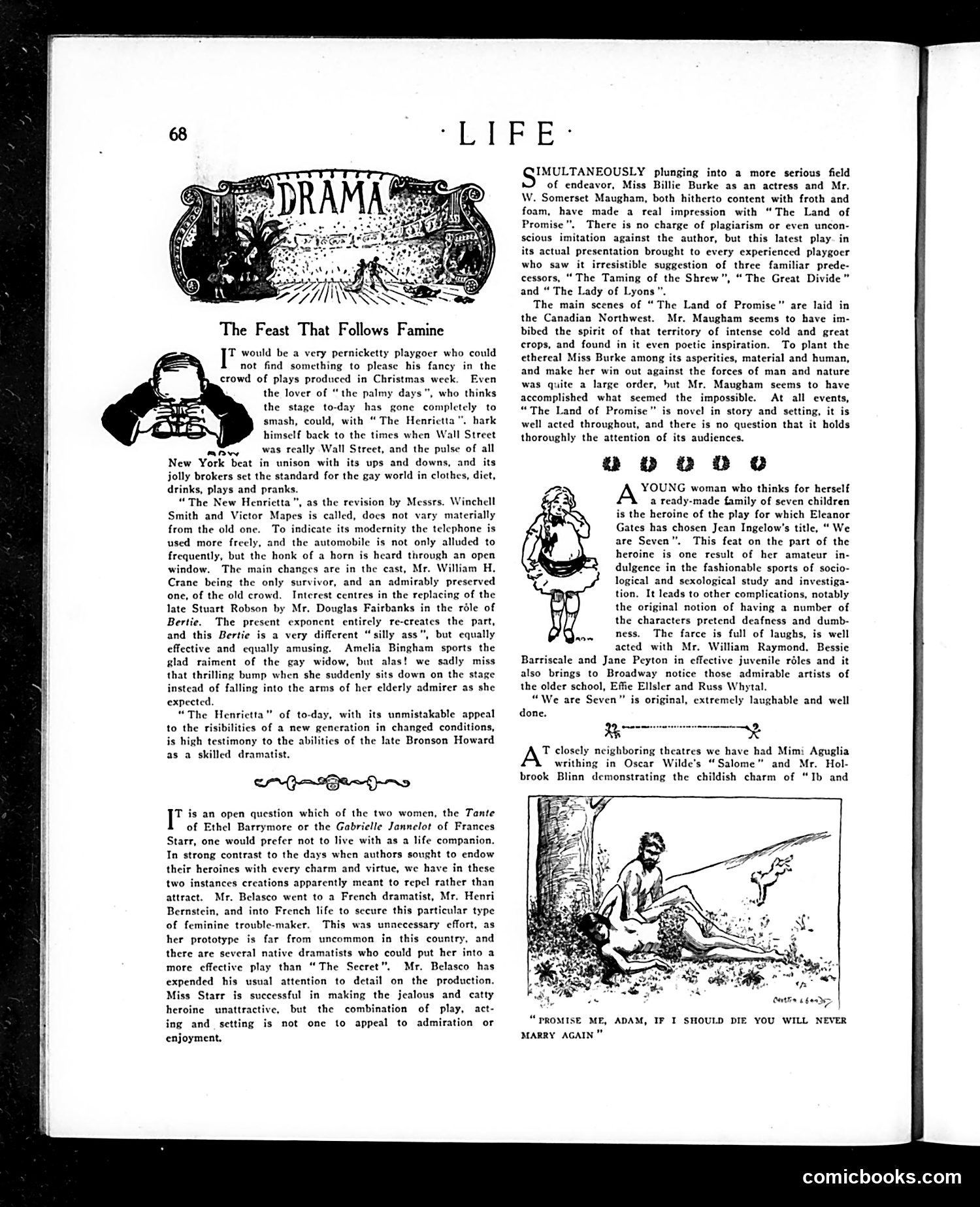
This page reviews Christmas week theatrical productions (circa 1909). The main points: **"The Feast That Follows Famine"** discusses "The New Henrietta," a revival of Bronson Howard's play about Wall Street. The satire notes that while modernity is suggested through telephones and automobiles, the play essentially unchanged from the original. Douglas Fairbanks replaces deceased actor Stuart Robson. The reviewer praises its appeal to a new generation despite being dated material. **Other reviews** discuss Ethel Barrymore and Frances Starr in plays featuring deliberately unattractive, troublemaking female characters—a contrast to the era's typical heroines. The critic notes this character type is common in America, making the French source unnecessary. **"The Land of Promise"** stars Billie Burke in a Canadian Northwest setting, suggesting familiar plays like "The Taming of the Shrew." The reviewer finds it ambitious to place the "ethereal Miss Burke" against harsh frontier realities. The bottom illustration shows a romantic scene with the caption "Promise me, Adam, if I should die you will never marry again"—comedic melodrama typical of the period.
📄 Transcribed text from this page (OCR, searchable)
Machine-transcribed from the original scan — historical spelling and the odd misread are preserved.
bie The Feast That Follows Famine T would be a very pernicketty playgoer who could not find something to please his fancy in the crowd of plays produced in Christmas week. Even the lover of “the palmy days", who thinks the stage to-day has gone completely to smash, could, with “ The Henrietta”. hark himself back to the times when Wall Street was really Wall Street, and the pulse of all New Yorke “eat in unison with its ups and downs, and its jolly brokers set the standard for the gay world in clothes, dict, drinks, plays and pranks. “The New Henrietta”, as the revision by Messrs. Winchell Smith and Victor Mapes is called, does not vary materially from the old one. To indicate its modernity the telephone is used more freely, and the automobile is not only alluded to frequently, but the honk of a horn is heard through an open window. The main changes are in the cast, Mr. William H. Crane being the only survivor, and an admirably preserved one, of the old crowd. Interest centres in the replacing of the late Stuart Robson by Mr. Douglas Fairbanks in the réle of Bertie. The present exponent entirely re-creates the part, and this Bertie is a very different ly ass", but equally effective and equally amusing. Amelia Bingham sports the glad raiment of the gay widow, but alas! we sadly miss that thrilling bump when she suddenly sits down on the stage instead of falling into the arms of her elderly admirer as she expected. “The Henrietta” of to-day, with its unmistakable appeal to the risibilities of a new generation in changed conditions, is high testimony to the abilities of the late Bronson Howard as a skilled dramatist. Er GaGe~{ > T is an open question which of the two women, the Tante of Ethel Barrymore or the Gabrielle Jannelot of Frances Starr, one would prefer not to live with as a life companion. In strong contrast to the days when authors sought to endow their heroines with every charm and virtue, we have in these two instances creations apparently meant to repel rather than attract. Mr. Belasco went to a French dramatist, Mr. Henri Bernstein, and into French life to sccure this particular type of feminine trouble-maker. This was unnecessary effort, as her prototype is far from uncommon in this country, and there are several native dramatists who could put her into a more effective play than “The Secret”. Mr. Belasco has expended his usual attention to detail on the production. Miss Starr is successful in making the jealous and catty heroine unattractive, but the combination of play, act- ing and setting is not one to appeal to admiration or enjoyment. MULTANEOUSLY plunging into a more serious ficld of endeavor, Miss Billie Burke as an actress and Mr. W. Somerset Maugham, both hitherto content with froth and foam, have made a real impression with “The Land of Promise”. There is no charge of plagiarism or even uncon- scious imitation against the author, but this latest play. in its actual presentation brought to every experienced playgoer who saw it irresistible suggestion of three familiar prede- cessors, “The Taming of the Shrew”, “The Great Divide” and “ The Lady of Lyons ”. The main scenes of “The Land of Promise” are laid in the Canadian Northwest. Mr. Maugham scems to have im- bibed the spirit of that territory of intense cold and great crops, and found in it even poetic inspiration. To plant the ethereal Miss Burke among its asperities, material and human, and make her win out against the forces of man and nature ite a large order, but Mr. Maugham seems to have accomplished what seemed the impomsible At all events, “The Land of Promise” is novel in story and setting, it is well acted throughout, and there is no question that it holds thoroughly the attention of its audiences. ®@ oo DB @ YOUNG woman who thinks for herself a ready-made family of seven children is the heroine of the play for which Eleanor Gates has chosen Jean Ingelow’s title, “ We are Seven". This feat on the part of the heroine is one result of her amateur in- dulgence in the fashionable sports of socio- logical and sexological study and investiga- tion, It leads to other complications, notably the original notion of having a number of the characters pretend deafness and dumb- ness. The farce is full of laughs, is well acted with Mr. William Raymond, Bessie Barriscale and Jane Peyton in effective juvenile réles and it also brings to Broadway notice those admirable artists of the older school, Effie Ellsler and Russ Whytal. “We are Seven” is original, extremely laughable and well done. T closely neighboring theatres we have had Mimi Aguglia writhing in Oscar Wilde's “Salome” and Mr. Hol- brook Blinn demonstrating the childish charm of “Ib and <“ cathe obese “PROMISE ME, ADAM, IF I SHOULD DIE YOU WILL NEVER MARRY AGAIN comicbooks.com