
Life, 1914-01-08 · page 10 of 44
Life — January 8, 1914 — page 10: what you’re looking at
What you’re looking at
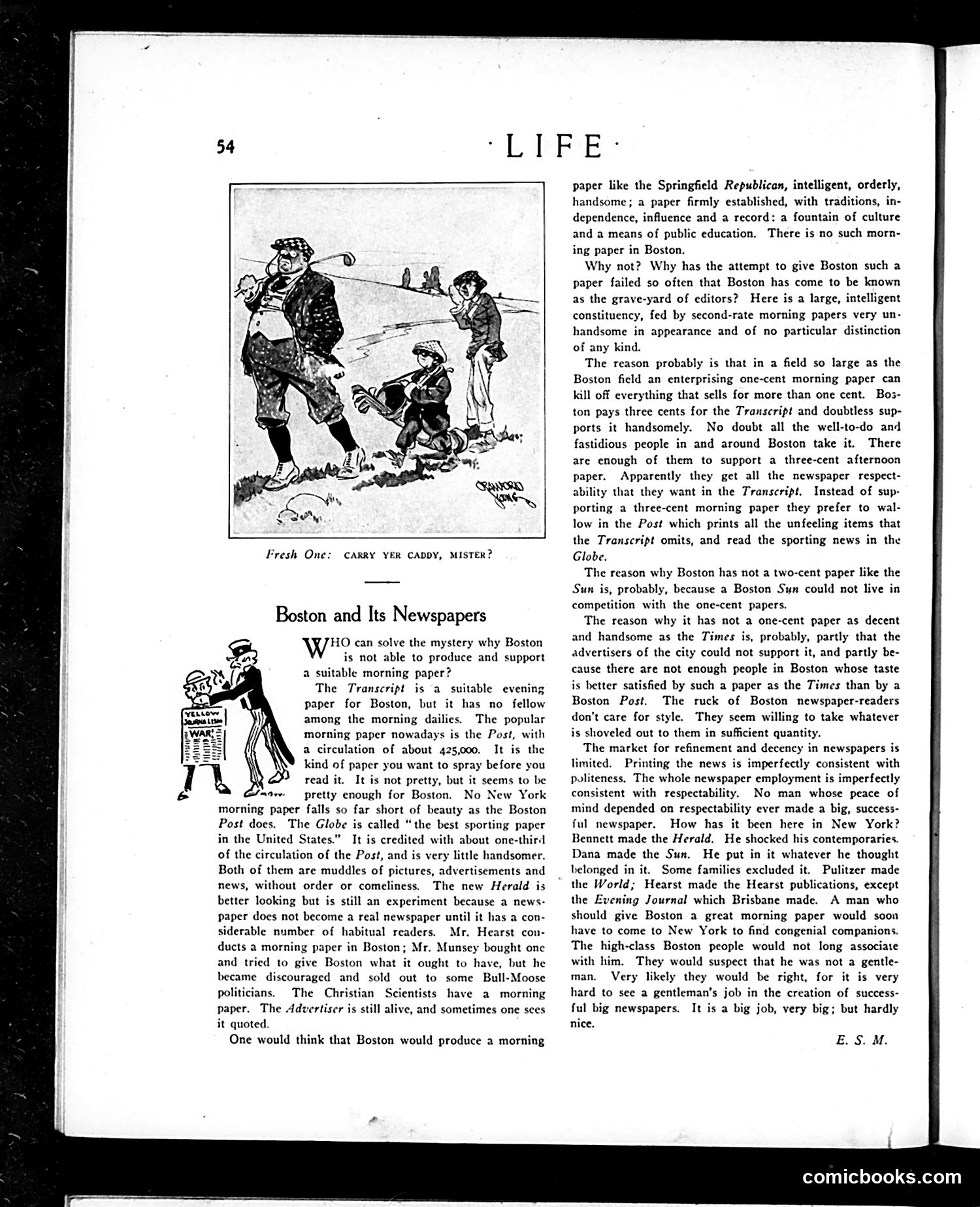
The cartoon depicts an adult man in old-fashioned dress fishing, with children watching nearby. The caption reads "Fresh One: CARRY YER CADDY, MISTER?" The satire concerns Boston's newspaper market. The article critiques Boston's lack of a truly distinguished morning paper comparable to New York's offerings. It argues that while Boston has the *Transcript* (a three-cent paper) and the *Post*, neither achieves the quality or style of New York papers like the *Times* or *Herald*. The fishing metaphor in the cartoon likely suggests how Boston's newspapers are "fishing" or competing for readers in a limited market, with limited success. The overall piece satirizes Boston's inability to support a genuinely excellent newspaper despite its cultural prominence.
📄 Transcribed text from this page (OCR, searchable)
Machine-transcribed from the original scan — historical spelling and the odd misread are preserved.
“L.ERE: Fresh One: CARRY YER CADDY, MISTER? Boston and Its Newspapers HO can solve the mystery why Boston is not able to produce and support a suitable morning paper? The Transcript is a suitable evening paper for Boston, but it has no fellow among the morning dailies. The popular morning paper nowadays is the Post, with a circulation of about 425,000. It is the kind of paper you want to spray before you read it. It is not pretty, but it seems to be pretty enough for Boston. No New York morning paper falls so far short of beauty as the Boston Post does. The Globe is called “the best sporting paper in the United States.” It is credited with about one-third of the circulation of the Post, and is very little handsomer. Both of them are muddles of pictures, advertisements and news, without order or comeliness. The new Herald is better looking but is still an experiment because a news- paper does not become a real newspaper until it has a con- siderable number of habitual readers. Mr. Hearst con- ducts a morning paper in Boston; Mr. Munsey bought onc and tried to give Boston what it ought to have, but he became discouraged and sold out to some Bull-Moose politicians. The Christian Scientists have a morning paper. The Advertiser is still alive, and sometimes one sces it quoted. One would think that Boston would produce a morning paper like the Springfield Republican, intelligent, orderly, handsome; a paper firmly established, with traditions, in- dependence, influence and a record: a fountain of culture and a means of public education. There is no such morn- ing paper in Boston. Why not? Why has the attempt to give Boston such a paper failed so often that Boston has come to be known as the grave-yard of editors? Here is a large, intelligent constituency, fed by second-rate morning papers very un- handsome in appearance and of no particular distinction of any kind. The reason probably is that in a field so large as the Boston ficld an enterprising one-cent morning paper can kill off everything that sells for more than one cent. Bos- ton pays three cents for the Transcript and doubtless sup- ports it handsomely. No doubt all the well-to-do and fastidious people in and around Boston take it. There are enough of them to support a three-cent afternoon paper. Apparently they get all the newspaper respect- ability that they want in the Transcript. Instead of sup- porting a three-cent morning paper they prefer to wal- low in the Post which prints all the unfeeling items that the Transcript omits, and read the sporting news in the Globe. The reason why Boston has not a two-cent paper like the Sun is, probably, because a Boston Syn could not live in competition with the one-cent papers. The reason why it has not a one-cent paper as decent and handsome as the Times is, probably, partly that the advertisers of the city could not support it, and partly be- cause there are not enough people in Boston whose taste is better satisfied by such a paper as the Times than by a Boston Post. The ruck of Boston newspaper-readers don't care for style. They seem willing to take whatever is shoveled out to them in sufficient quantity. The market for refinement and decency in newspapers is limited. Printing the news is imperfectly consistent with politeness, The whole newspaper employment is imperfectly consistent with respectability. No man whose peace of mind depended on respectability ever made a big, success- ful newspaper. How has it been here in New York? Bennett made the Herald. He shocked his contemporaries. Dana made the Sun. He put in it whatever he thought belonged in it. Some families excluded it. Pulitzer made the World; Hearst made the Hearst publications, except the Evening Journal which Brisbane made. A man who should give Boston a great morning paper would soon have to come to New York to find congenial companions. The high-class Boston people would not long associate with him. They would suspect that he was not a gentle- man. Very likely they would be right, for it is very hard to see a gentleman's job in the creation of success- ful big newspapers. It is a big job, very big; but hardly nice, E. S. M. comicbooks.com