
Life, 1914-01-08 · page 30 of 44
Life — January 8, 1914 — page 30: what you’re looking at
What you’re looking at
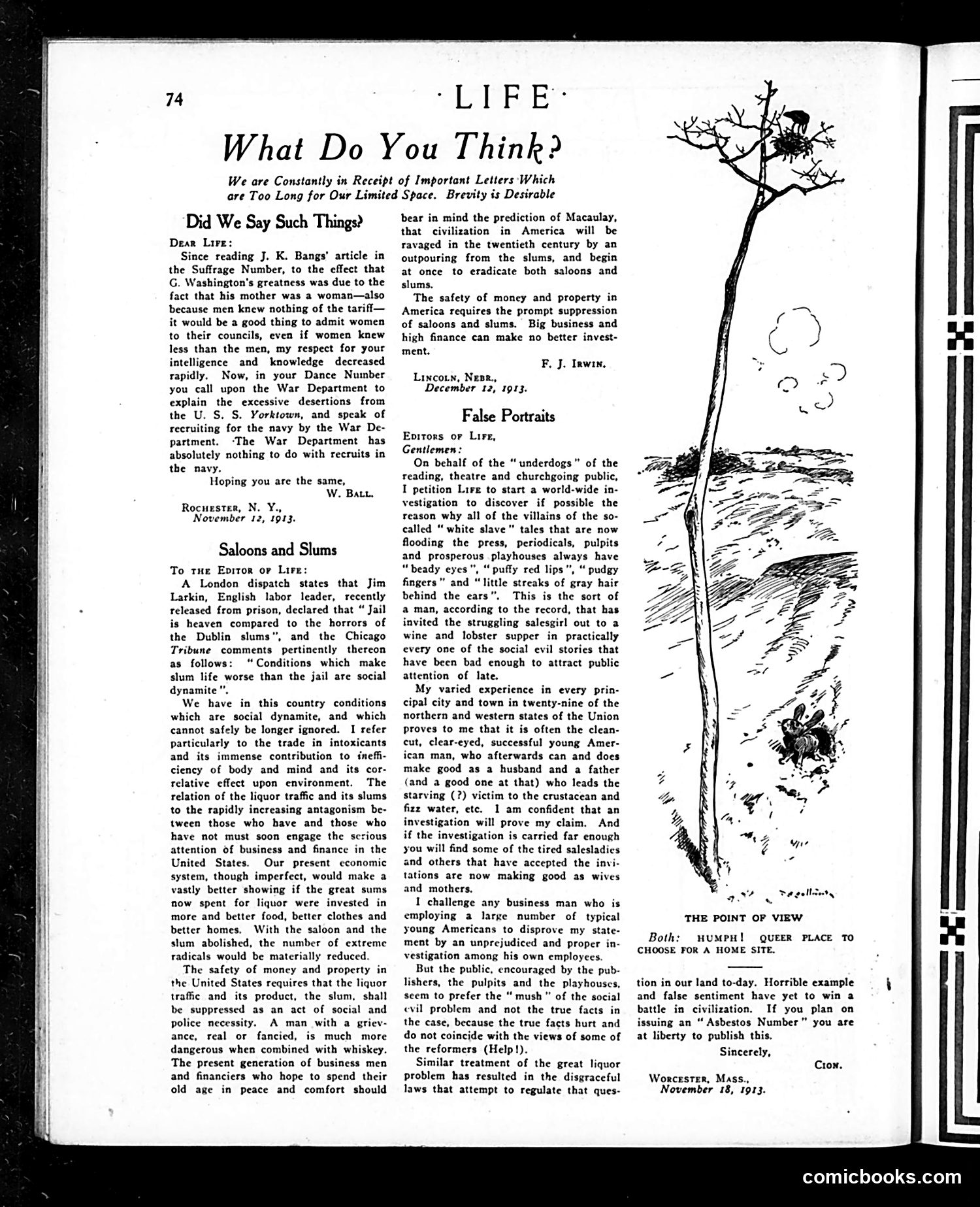
This page presents reader responses to Life magazine articles. The content addresses three topics: **"Did We Say Such Things?"** – A reader (W. Batt) corrects Life's editorial errors: the magazine incorrectly attributed navy recruitment to the War Department (actually the Navy Department's role) and had made a suffrage argument he found intellectually weak. **"Saloons and Slums"** – F.J. Irwin argues that liquor trafficking and resulting slums create social unrest dangerous to business interests. He invokes Macaulay's prediction that American civilization will be ravaged by slum populations, urging wealthy businessmen to suppress saloons as self-protection—framing social reform as an investment in property safety. **"False Portraits"** – A reader protests the stock villainy tropes in "white slave" narratives flooding newspapers and theaters—the stereotypical seducer with "beady eyes," "puffy red lips," and gray hair. The writer implies these formulaic portrayals misrepresent actual predators. The small accompanying illustration appears decorative rather than editorial commentary.
📄 Transcribed text from this page (OCR, searchable)
Machine-transcribed from the original scan — historical spelling and the odd misread are preserved.
What Do You Think: We are Constantly in Receipt of Important Letters Which are Too Long for Our Limited Space. Brevity is Desirable Did We Say Such Things? Dear Lire: Since reading J. K. Bangs’ article in the Suffrage Number, to the effect that G. Washington's greatness was due to the fact that his mother was a woman—also because men knew nothing of the tariff— it would be a good thing to admit women to their councils, even if women knew less than the men, my respect for your intelligence and knowledge decreased rapidly. Now, in your Dance Number you call upon the War Department to explain the excessive desertions from the U. S. S. Yorktown, and speak of recruiting for the navy by the War De- partment. ‘The War Department has absolutely nothing to do with recruits in the navy. Hoping you are the same, W. Batt. Rocurster, N. Y., November 12, 1913. Saloons and Slums To tHe Eprtor or Lire: A London dispatch states that Jim Larkin, English labor leader, recently released from prison, declared that “ Jail is heaven compared to the horrors of the Dublin slums”, and the Chicago Tribune comments pertinently thereon as follows: “Conditions which make slum life worse than the jail are social dynamite". We have in this country conditions which are social dynamite, and which cannot safely be longer ignored. I refer particularly to the trade in intoxicants and its immense contribution to ineffi- ciency of body and mind and its cor- relative effect upon environment. The relation of the liquor traffic and its slums to the rapidly increasing antagonism be- tween those who have and those who have not must soon engage the scrious attention of business and finance in the United States. Our present economic system, though imperfect, would make a vastly better showing if the great sums now spent for liquor were invested in more and better food, better clothes and better homes. With the saloon and the slum abolished, the number of extreme radicals would be materially reduced. The safety of money and property in the United States requires that the liquor traffic and its product, the slum, shall be suppressed as an act of social and police necessity. A man with a griev- ance, real or fancied, is much more dangerous when combined with whiskey. The present generation of business men and financiers who hope to spend their old age in peace and comfort should bear in mind the prediction of Macaulay, that civilization in America will be ravaged the twentieth century by an outpouring from the slums, and begin at once to eradicate both saloons and slums. The safety of moncy and property in America requires the prompt suppression of saloons and slums. Big business and high finance can make no better invest- ment. F, J. Irwin, Lincotn, Nese, December 12, 1913. False Portraits Epitors or Lire, Gentlemen: On behalf of the “underdogs” of the reading, theatre and churchgoing public, I petition Lire to start a world-wide in- vestigation to discover if possible the reason why all of the villains of the so- called “white slave" tales that are now flooding the press, periodicals, pulpits and prosperous playhouses always have “beady eyes puffy red lips”, “ pudgy fingers” and “little streaks of gray hair behind the ears”. This is the sort of a man, according to the record, that has invited the struggling salesgirl out to a wine and lobster supper in practically every one of the social evil stories that have been bad enough to attract public attention of late. My varied experience in every prin- cipal city and town in twenty-nine of the northern and western states of the Union Proves to me that it is often the clean- cut, clear-eyed, successful young Amer- ican man, who afterwards can and does make good as a husband and a father (and a good one at that) who leads the starving (?) victim to the crustacean and fizz water, etc. 1 am confident that an investigation will prove my claim, And if the investigation is carried far enough you will find some of the tired salesladics and others that have accepted the invi- tations are now making good as wives and mothers. I challenge any business man who is employing a large number of typical young Americans to disprove my state- ment by an unprejudiced and proper in- vestigation among his own employees. But the public, encouraged by the pub- lishers, the pulpits and the playhouses, seem to prefer the “ mush" of the social evil problem and not the true facts in the case, because the true facts hurt and do not coincide with the views of some of the reformers (Help!). Similar treatment of the great liquor problem has resulted in the disgraceful laws that attempt to regulate that ques- De gellsnry . THE POINT OF VIEW Both: wuMpH! QUEER PLACE TO CHOOSE FOR A HOME SITE. tion in our land to-day. Horrible example and false sentiment have yet to win a battle in civilization. If you plan on issuing an ‘Asbestos Number” you are at liberty to publish this. Sincerely, Crom. Worcester, Mass., November 18, 1913. = comicbooks.com