
Life, 1914-01-08 · page 12 of 44
Life — January 8, 1914 — page 12: what you’re looking at
What you’re looking at
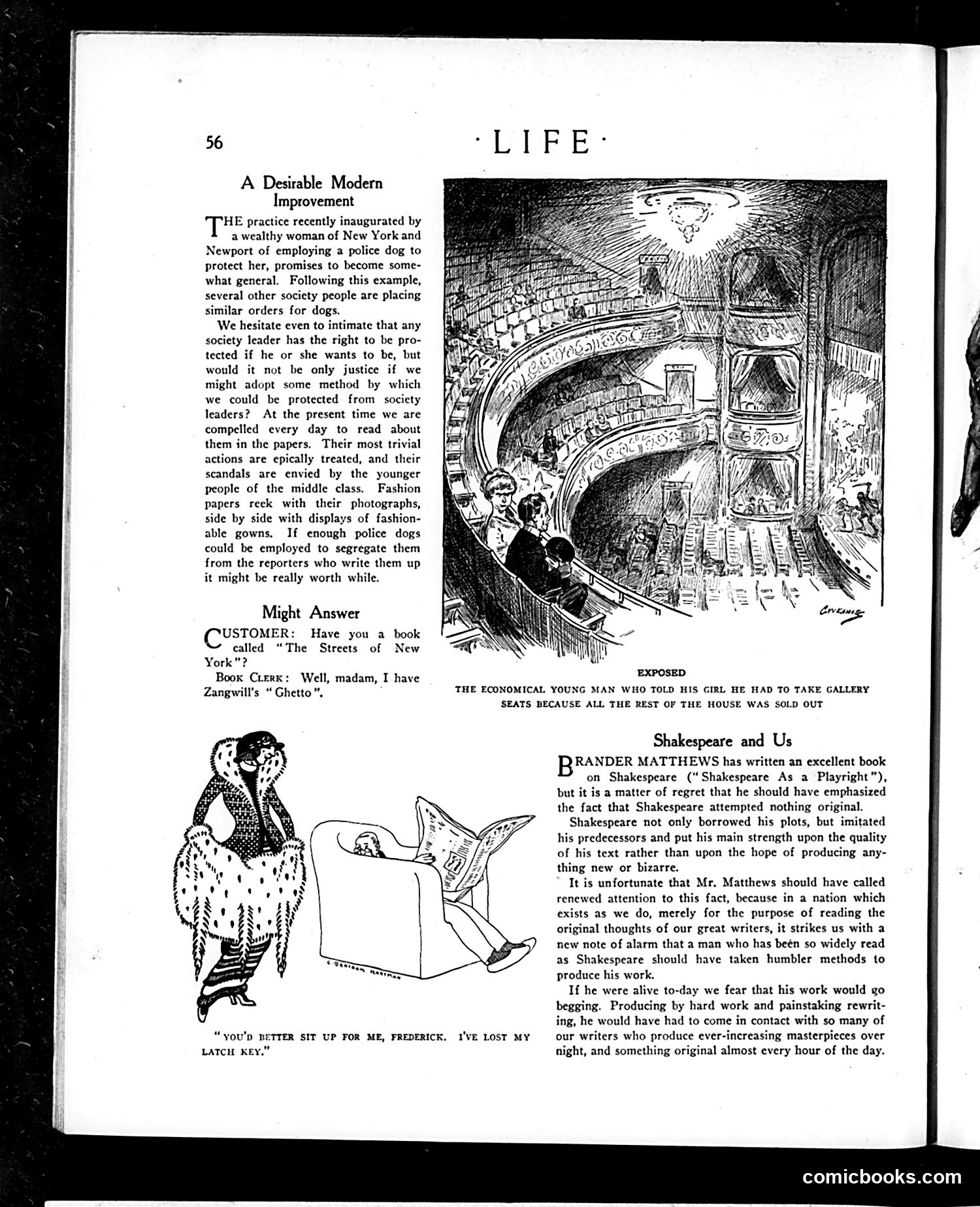
**Top Section - "A Desirable Modern Improvement":** This satirical article critiques wealthy New York society women who employ police dogs for personal protection. The piece argues these women are excessively concerned with their own safety while their "most trivial actions" are scandalized by the press and envied by middle-class youth. The suggested solution—using police dogs to protect society leaders from reporters—is presented as satire on the absurdity of their self-importance and desire to control their public image. **Bottom Section - "Shakespeare and Us":** Brander Matthews' book review critiques Shakespeare's lack of originality, noting he borrowed plots and imitated predecessors. The article argues modern writers would be considered plagiarists for similar practices, suggesting standards have changed. The accompanying cartoon mocks a man who has "lost [his] latch key," illustrating how trivial modern concerns are compared to Shakespeare's dramatic ambitions.
📄 Transcribed text from this page (OCR, searchable)
Machine-transcribed from the original scan — historical spelling and the odd misread are preserved.
A Desirable Modern Improvement HE practice recently inaugurated by a wealthy woman of New York and Newport of employing a police dog to protect her, promises to become some- what general. Following this example, several other society people are placing similar orders for dogs. We hesitate even to intimate that any society leader has the right to be pro- tected if he or she wants to be, but would it not be only justice if we might adopt some method by which we could be protected from society leaders? At the present time we are compelled every day to read about them in the papers. Their most trivial actions are epically treated, and their scandals are envied by the younger people of the middle class. Fashion papers reck with their photographs, side by side with displays of fashion- able gowns. If enough police dogs could be employed to segregate them from the reporters who write them up it might be really worth while. Might Answer USTOMER: Have you a book called “The Streets of New York"? Boox Crerk: Well, madam, I have Zangwill’s “Ghetto”. THE ECONOMICAL YOUNG MAN WHO TOLD HIS GIRL HE HAD TO TAKE GALLERY SEATS BECAUSE ALL THE REST OF THE HOUSE WAS SOLD OUT Shakespeare and Us RANDER MATTHEWS has written an excellent book on Shakespeare (“Shakespeare As a Playright”), but it is a matter of regret that he should have emphasized the fact that Shakespeare attempted nothing original. Shakespeare not only borrowed his plots, but imitated his predecessors and put his main strength upon the quality of his text rather than upon the hope of producing any- thing new or bizarre. It is unfortunate that Mr. Matthews should have called renewed attention to this fact, because in a nation which exists as we do, merely for the purpose of reading the original thoughts of our great writers, it strikes us with a new note of alarm that a man who has beén so widely read as Shakespeare should have taken humbler methods to produce his work. If he were alive to-day we fear that his work would go begging. Producing by hard work and painstaking rewrit- ing, he would have had to come in contact with so many of “you'D BETTER SIT UP FOR ME, FREDERICK. I'VE LOST MY our writers who produce ever-increasing masterpieces over LATCH KEY.” night, and something original almost every hour of the day. Se 2 en wes “_ wks comicbooks.com