
Life, 1914-01-08 · page 25 of 44
Life — January 8, 1914 — page 25: what you’re looking at
What you’re looking at
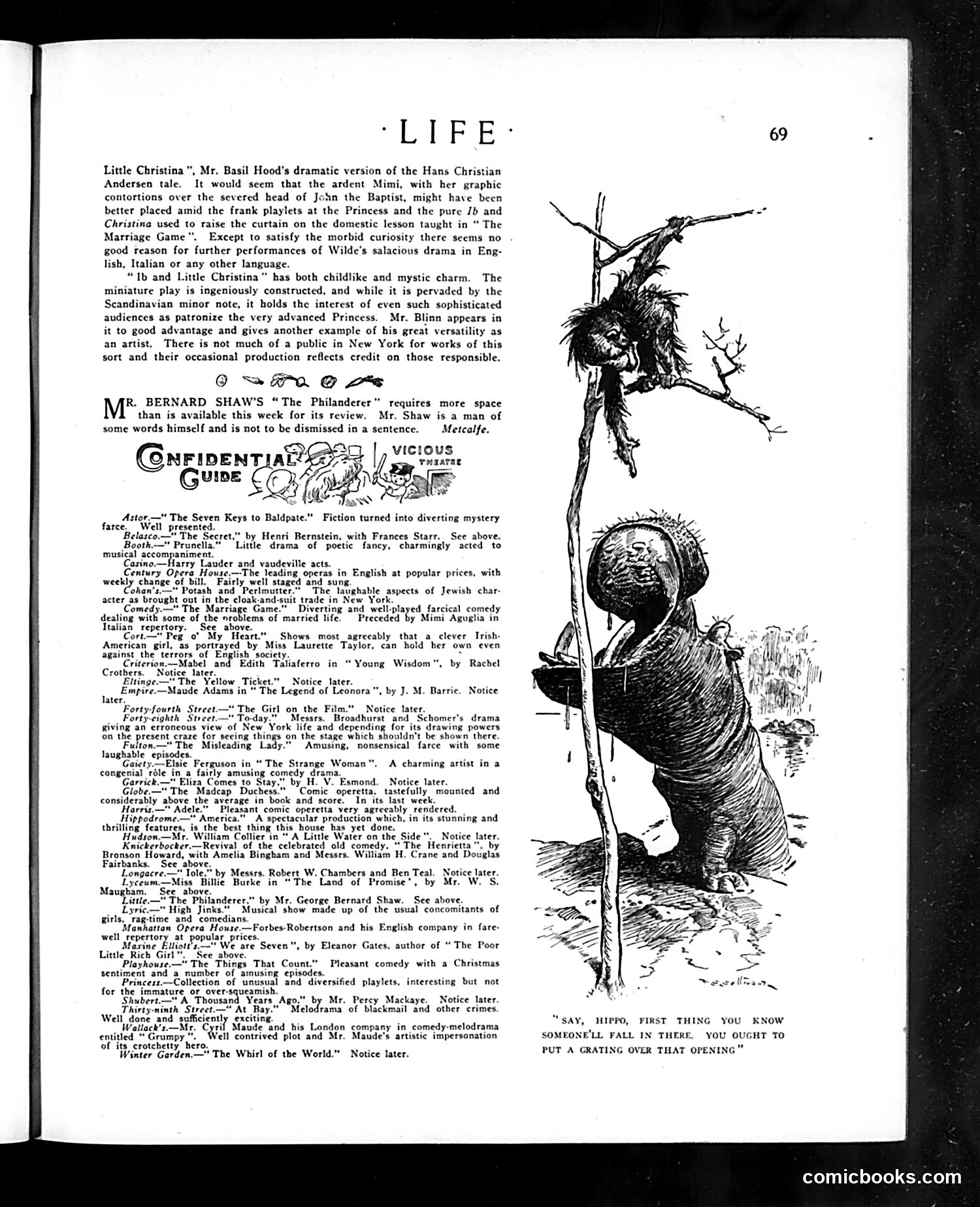
This page from Life magazine (appears to be early 1900s) is primarily a **theater review section**, not a political cartoon page. The illustration on the right—a skeletal figure perched on a gnarled tree branch—appears to be decorative artwork accompanying the theatrical criticism, likely meant to evoke a gothic or darkly humorous tone fitting the magazine's satirical style. The text reviews various Broadway productions, with critic Metcalfe offering opinions on plays including works by Oscar Wilde and George Bernard Shaw. The reviews are frankly critical: Wilde's "The Marriage Game" is called "salacious," while productions like "Prunella" and "Peg o' My Heart" are praised for charm and clever acting. The caption beneath the illustration—about a hippo falling and needing a grating—appears unrelated to the reviews, suggesting it may reference another article or advertisement not fully visible on this page. The overall content reflects early 20th-century theatrical culture and critical tastes rather than political satire.
📄 Transcribed text from this page (OCR, searchable)
Machine-transcribed from the original scan — historical spelling and the odd misread are preserved.
‘LIFE* Little Christina", Mr. Basil Hood's dramatic version of the Hans Christian Andersen tale. It would seem that the ardent Mimi, with her graphic contortions over the severed head of John the Baptist, might have been better placed amid the frank playlets at the Princess and the pure /b and Christina used to raise the curtain on the domestic lesson taught in “ The Marriage Game", Except to satisfy the morbid curiosity there seems no good reason for further performances of Wilde's salacious drama in Eng- lish, Italian or any other language. “Tb and Little Christina” has both childlike and mystic charm. The miniature play is ingeniously constructed, and while it is pervaded by the Scandinavian minor note, it holds the interest of even such sophisticated audiences as patronize the very advanced Princess. Mr. Blinn appears in it to good advantage and gives another example of his great versatility as an artist. There is not much of a public in New York for works of this sort and their occasional production reflects credit on those responsible. 9? OO aX*s R. BERNARD SHAW’S “The Philanderer” requires more space than is available this weck for its review. Mr. Shaw is a man of some words himself and is not to be dismissed in a sentence. Metcalfe. Cnripentiat vette Guiwe Q ) = Astor.— The Seven Keys to Baldpate.” Fiction turned into diverting mystery farce. Well presented. Belasco.—" The Secret,” by Henri Bernstein, with Frances Starr. See above. Booth.—* Prunella.” Little drama of poetic fancy, charmingly acted to musical accompaniment. Casino.—Harry Lauder and vaudeville acts. . Century Opera House.—The leading operas in English at popular prices, with weekly change of bill. Fairly well staged and sui ‘ohan's.—" Potash and Perlmutter.” The laughable aspects of Jewish char- acter as brought out in the cloak-and-suit trade in New York. Comedy.—" The Marriage Game.” Diverting and well. layed, farcical comedy dealing with some of the nroblems of married life. Preceded by Mimi Aguglia in Italian repertory. See above. Cort.—" Peg o' My Heart." Shows most_agreeably that a clever Irish- American girl, as portrayed by Miss Laurette Taylor, can hold her own even against the terrors of English society. . Criterion.—Mabel_ and Edith Taliaferro in “Young Wisdom", by Rachel Crothers. Notice later. Eltinge.—"' The Yellow Ticket.” Notice later. sare Mire —Maude Adams in" The Legend of Leonora, by J. M. Barrie. Notice ater. Forty-fourth Street.— The Girl on the Film.” Notice later. Forty-cighth Street.—" Today." Messrs. Broadhurst and Schomer's drama giving an erroneous view of New York life and depending for its drawing powers on the present craze for secing things on the stage which shouldn't be shown there. Fulton.—" The Misleading Lady.” Amusing, nonsensical farce with some laughable episodes. Gaicty.—-Elsie Ferguson in “The Strange Woman. A charming artist in a congenial réle in a fairly amusing comedy drama. Garrick.—"* Eliza Comes to Stay," by H. V. Esmond. Notice later. Globe—" The Madcap Duchess.". “Comic operetta, tastefully mounted and considerably above the average in book and score. In its last week. Harris,—" Adele.” Pleasant comic operetta very agreeably rendered. Hippodrome.—" America.” A spectacular production which, in its stunning and thrilling features, is the best thing this house has yet done. Hudzon.—Mr. William Collier in “A Little Water on the Side". Notice later. Knickerbocker.—Revival of the celebrated old comedy, “The Henrietta”, by Bronson Howard, with Amelia Bingham and Messrs. William H. Crane and Douglas Fairbanks. See above, Tole.” by Messrs. Robert W. Chambers and Ben Teal. Notice later. Billie Burke in The Land of Promise’, by Mr. W. S. ‘See. above. “The Philanderer.” by Mr. George Bernard Shaw. See above. Lyric.— High Jinks.” Musical show made up of the usual concomitants of girls, ragtime and ‘comedians ‘Manhattan Opera House.——Forbes-Robertson and his English company in fare- well repertory. at popular prices. Marine Elliott's" We are Seven", by Eleanor Gates, author of “The Poor Little Rich Girl, | See above. (aia Playhouse—" The Things That Count.” Pleasant comedy with a Christmas sentiment and a number of ainusing episodes. j Princess.—Collection of unusual and diversified playlets, interesting but not for the immature or over-squeamish. . “A Thousand Years Ago.” by Mr. Percy Mackaye. Notice later. At Bay.” Melodrama’ of blackmail and other crimes exciting. “Sy; itrO,. FiRs ie Ea Cyril Maude and his London company in comedy-melodrama SAY, HIFFO,, FIRST’ THING YOU KNOW Well contrived plot and Mr. Maude's artistic impersonation SOMEONELL FALL IN THERE, YOU OUGHT TO ‘The Whirl of the World.” Notice later. PUT A GRATING OVER THAT OPENING comicbooks.com