
Life, 1914-01-08 · page 26 of 44
Life — January 8, 1914 — page 26: what you’re looking at
What you’re looking at
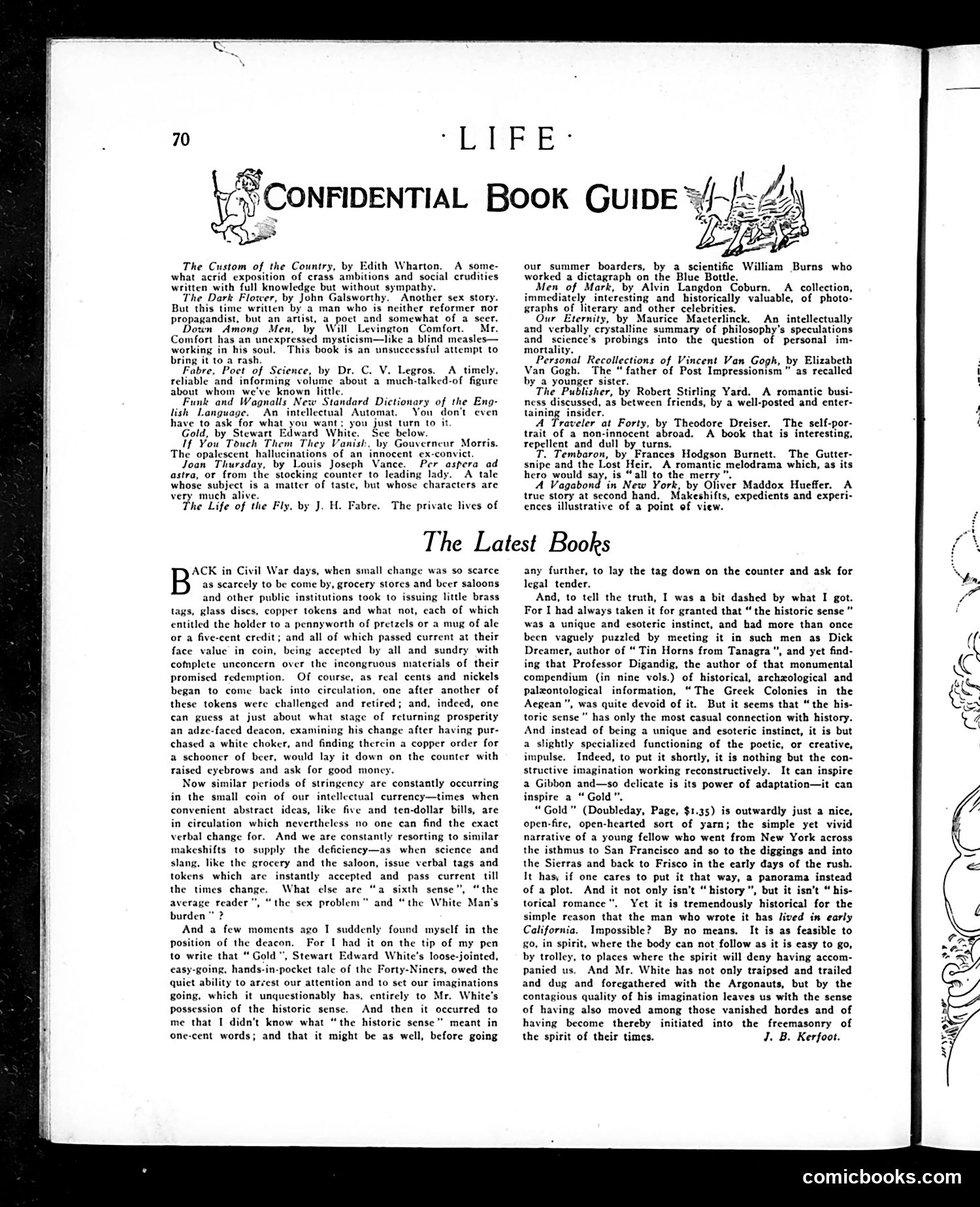
This is primarily a **book review section**, not a political cartoon page. The content consists of two parts: **Upper section**: Brief reviews of contemporary books (circa 1913-1914), including works by Edith Wharton, John Galsworthy, and Theodore Dreiser. The tone is witty and sardonic—typical of Life's satirical approach to literature. Reviews mock pretension while acknowledging artistic merit. **Lower section** ("The Latest Books"): An extended essay by J.B. Kerfoot using a Civil War-era monetary metaphor. He compares intellectual currency to Civil War tokens—brass discs that circulated as substitutes for real coins. His point: during times of intellectual scarcity, people accept convenient abstract ideas the way they once accepted worthless tokens. He's critiquing readers' and thinkers' tendency to accept superficial or questionable ideas as legitimate currency during periods of cultural "stringency." The satire targets both authors who produce shallow work and audiences who accept it uncritically.
📄 Transcribed text from this page (OCR, searchable)
Machine-transcribed from the original scan — historical spelling and the odd misread are preserved.
The Custom of the Country, by Edith Wharton. A some- what acrid exposition of crass ambitions and social crudities written with full knowledge but without sympathy. The Dark Flower, by John Galsworthy. Another sex story. But this time written by a man who is neither reformer nor propagandist, but an artist, a poct and somewhat of a seer. Down Among Men, by. Will Levington Comfort. Mr. Comfort has an unexpressed mysticism—like a blind measles— working in his soul. This book is an unsuccessful attempt to bring it to a rash. abre, Poct of Science, by Dr. C. V. Legros. A timely, reliable ‘and informing volume about a much-talked-of figure about whom we've known little Funk and Wagnalls New Standard Dictionary of the Eng- lish Language. An intellectual Automat. You don't even have to ask for what you want; you Gold, by Stewart Edward White. Sce below. If You Touch Them They Vanish. by Gouverneur Morris. The opalescent hallucinations of an innocent ex-convict. Joan Thursday, by Louis Joseph Vance. Per aspera ad asira, or from the stocking counter to leading lady. A tale whose subject is a matter of taste, but whose characters are very much alive. he Life of the Fly, by J. H. Fabre. The private lives of our summer boarders, by a scientific William Burns who worked a dictagraph on the Blue Bottle. Men of Mark, by Alvin Langdon Coburn. A collection, immediately interesting and historically valuable, of photo- graphs of literary and other celebrities. Our Eternity, by Maurice Maeterlinck. An intellectually and verbally crystalline summary of philosophy’s speculations and science's probings into the question of personal im- mortality. Personal Recollections of Vincent Van Gogh, by Elizabeth Van Gogh. The “ father of Post Impressionism” as recalled by_a younger sister. The Publisher, by Robert Stirling Yard. A romantic busi ness discussed, as between friends, by a well-posted and enter- uly insider. ‘A Traveler at Forty, by Theodore Dreiser. The self-por- trait of a non-innocent abroad. A book that is interesting, repellent and dull by turns. T. Tembaron, by Frances Hodgson Burnett. The Gutter- snipe and the Lost Heir. A romantic melodrama which, as its hero would say, is “all to the merry”. A Vagabond in New York, by Oliver Maddox Hueffer. A true story at second hand. Makeshifts, expedients and experi- ences illustrative of a point ef view. The Latest Books ACK in Civil War days, when small change was so scarce as scarcely to be come by, grocery stores and beer saloons and other public institutions took to issuing little brass ags, glass discs, copper tokens and what not, each of which entitled the holder to a pennyworth of pretzels or a mug of ale or a five-cent credit; and all of which passed current at their face value in coin, being accepted by all and sundry with complete unconcern over the incongruous materials of their promised redemption. Of course, as real cents and nickels began to come back into circulation, one after another of these tokens were challenged and retired; and, indeed, one can guess at just about what stage of returning prosperity an adze-faced deacon, examining his change after having pur- chased a white choker, and finding therein a copper order for a schooner of beer, would lay it down on the counter with raised eyebrows and ask for good mone Now similar periods of stringency are constantly occurring in the small coin of our intellectual currency—times when convenient abstract ideas, like five and ten-dollar bills, are in circulation which nevertheless no one can find the exact verbal change for. And we are constantly resorting to similar makeshifts to supply the deficiency—as when science and slang, like the grocery and the saloon, issue verbal tags and tokens which are instantly accepted and pass current till the times change, What else are “a sixth sense”, “the average reader”, “the sex problem” and “the White Man's burden ” ? And a few moments ago I suddenly found myself in the position of the deacon, For I had it on the tip of my pen to write that “Gold”, Stewart Edward White's loose-jointed, easy-going, hands-in-pocket tale of the Forty-Niners, owed the quiet ability to arcest our attention and to set our imaginations going, which it unquestionably has, entirely to Mr. White’s possession of the historic sense. And then it occurred to me that I didn't know what “the historic sense” meant in one-cent words; and that it might be as well, before going any further, to lay the tag down on the counter and ask for legal tender. And, to tell the truth, I was a bit dashed by what I got. For I had always taken it for granted that “ the historic sense" was a unique and esoteric instinct, and had more than once becn vaguely puzzled by meeting it in such men as Dick Dreamer, author of “ Tin Horns from Tanagra", and yet find- ing that Professor Digandig, the author of that monumental compendium (in nine vols.) of historical, archeological and palzontological information, “The Greek Colonies in the Aegean”, was quite devoid of it. But it seems that “ the his- toric sense" has only the most casual connection with history. And instead of being a unique and esoteric instinct, it is but a slightly specialized functioning of the poetic, or creative, impulse. Indeed, to put it shortly, it is nothing but the con- structive imagination working reconstructively. It can inspire a Gibbon and—so delicate is its power of adaptation—it can inspire a “Gold”. “Gold” (Doubleday, Page, $1.35) is outwardly just a nice, open-fire, open-hearted sort of yarn; the simple yet vivid narrative of a young fellow who went from New York across the isthmus to San Francisco and so to the diggings and into the Sierras and back to Frisco in the early days of the rush. It has, if one cares to put it that way, a panorama instead of a plot. And it not only isn’t “history”, but it isn’t “ his- torical romance". Yet it is tremendously historical for the simple reason that the man who wrote it has lived in early California. Impossible? By no means. It is as feasible to go, in spirit, where the body can not follow as it is easy to go, by trolley, to places where the spirit will deny having accom- panied us. And Mr. White has not only traipsed and trailed and dug and foregathered with the Argonauts, but by the contagious quality of his imagination leaves us with the sense of having also moved among those vanished hordes and of having become thereby initiated into the freemasonry of the spirit of their times. J. B. Kerfoot. comicbooks.com