
Life, 1914-01-08 · page 20 of 44
Life — January 8, 1914 — page 20: what you’re looking at
What you’re looking at
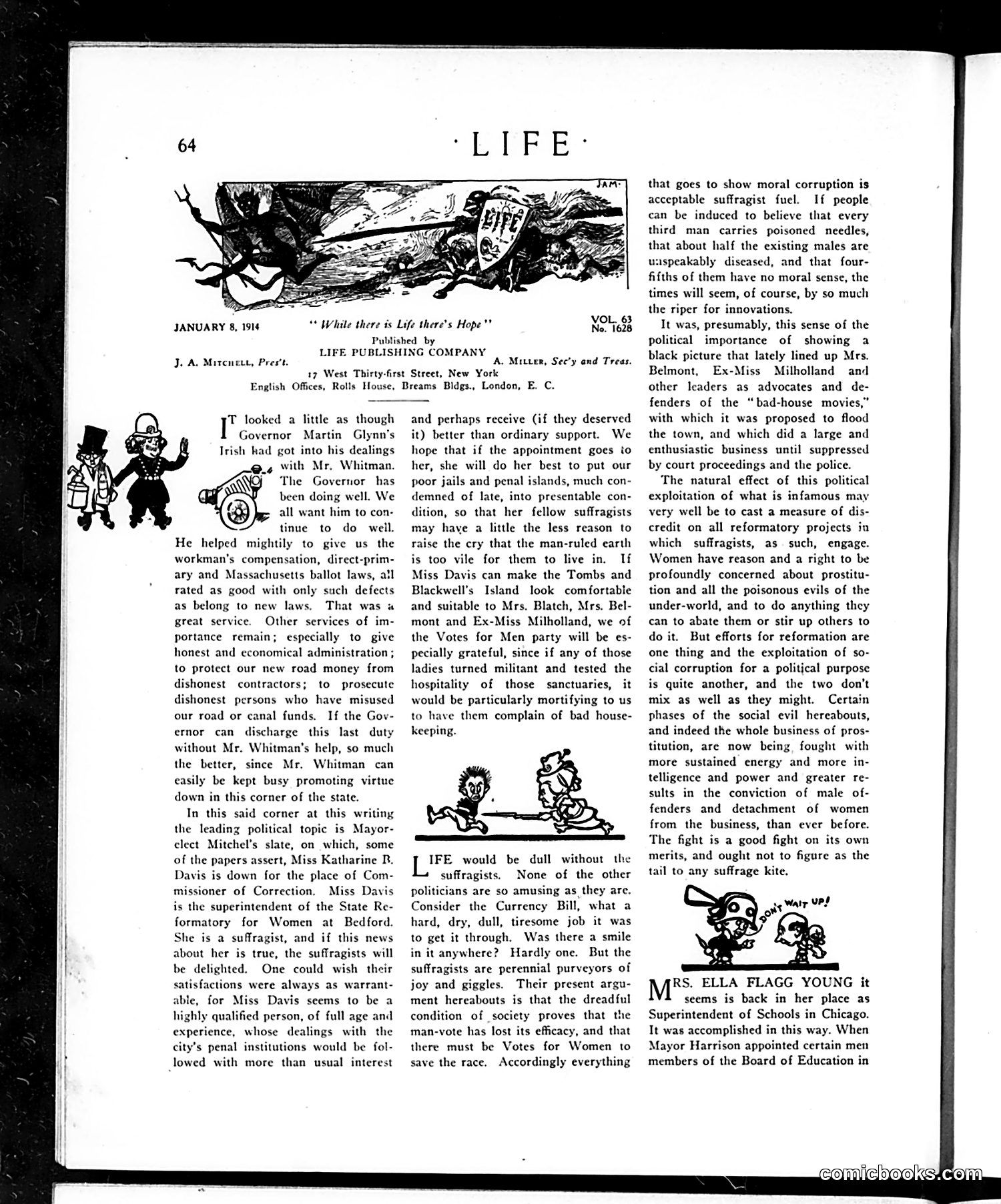
This page satirizes the women's suffrage movement through anti-suffragist commentary. The text mockingly celebrates the possible appointment of Katharine B. Davis—a suffragist and superintendent of the State Reformatory for Women at Bedford—as Commissioner of Correction under Mayor-elect Mitchel. The satire operates through false praise: the writer suggests that if Davis improves conditions at the Tombs and Blackwell's Island prisons, suffragists like Mrs. Blatch, Mrs. Belmont, and "Ex-Miss Milholland" (likely Alice Paul or similar activist) won't have grounds to complain about conditions if arrested for militant action. The second section ridicules suffragist arguments more directly, claiming suffragists exploit social problems—disease, moral corruption, "bad-house movies"—as propaganda to justify women's votes. The author dismisses these concerns as exaggerated "fuel" for the suffrage cause, characterizing suffragists as entertainingly absurd rather than serious reformers. The cartoons (small illustrated figures) appear decorative rather than central to the argument.
📄 Transcribed text from this page (OCR, searchable)
Machine-transcribed from the original scan — historical spelling and the odd misread are preserved.
JANUARY 8, 1914 ‘* While there is Life there's Hope" No. 1628 Published by LIFE PUBLISHING COMPANY J. A. Mitcnete, Pres’t. A. Miter, Sec’y and Treas. 17 West Thirty-first Street, New York English Offices, Rolls House, 'T looked a little as though Governor Martin Glynn's Irish had got into his dealings @.. with Mr, Whitman, y The Governor has been doing well. We all want him to con- tinue to do well. He helped mightily to give us the workman's compensation, direct-prim- ary and Massachusetts ballot laws, ail rated as good with only such defects as belong to new laws. That was a great service. Other services of im- portance remain; especially to give honest and economical administration ; to protect our new road money from dishonest prosecute dishonest persons who have misused our road or canal funds. If the Gov- discharge this last duty without Mr. Whitman's help, so much the better, since Mr. Whitman can easily be kept busy promoting virtue down in this corner of the state. In this said corner at this writing the leading political topic is Mayor- elect Mitchel’s slate, on which, some of the papers assert, Miss Katharine B. Davis is down for the place of Com- missioner of Correction. Miss Davis is the superintendent of the State Re- formatory for Women at Bedford. She is a suffragist, and if this news about her is true, the suffragists will be delighted. One could wish their satisfactions were always as warrant- able, for Miss Davis seems to be a highly qualified person, of full age and experience, whose dealings with the city’s penal institutions would be fol- lowed with more than usual interest contractors; to ernor can Breams Bldgs., London, E. C. and perhaps receive (if they deserved it) better than ordinary support. We hope that if the appointment goes to her, she will do her best to put our poor jails and penal islands, much con- demned of late, into presentable con- dition, so that her fellow suffragists may have a little the less reason to raise the cry that the man-ruled earth is too vile for them to live in. If Miss Davis can make the Tombs and Blackwell's Island look comfortable and suitable to Mrs. Blatch, Mrs. Bel- mont and Ex-Miss Milholland, we of the Votes for Men party will be es- pecially grateful, since if any of those ladies turned militant and tested the hospitality of those sanctuaries, it would be particularly mortifying to us to have them complain of bad house- keeping. IFE would be dull without the suffragists. None of the other politicians are so amusing as, they are. Consider the Currency Bill, what a hard, dry, dull, tiresome job it was to get it through. Was there a smile in it anywhere? Hardly one. But the suffragists are perennial purveyors of joy and giggles. Their present argu- ment hereabouts is that the dreadful condition of society proves that the man-vote has lost its efficacy, and that there must be Votes for Women to save the race. Accordingly everything that goes to show moral corruption is acceptable suffragist fuel. If people can be induced to believe that every third man carries poisoned needles, that about half the existing males are uaspeakably diseased, and that four- fifths of them have no moral sense, the times will seem, of course, by so much the riper for innovations. It was, presumably, this sense of the political importance of showing a black picture that lately lined up Mrs. Belmont, Ex-Miss Milholland and other leaders as advocates and de- fenders of the “bad-house movies,” with which it was proposed to flood the town, and which did a large and enthusiastic business until suppressed by court proceedings and the police. The natural effect of this political exploitation of what is infamous may very well be to cast a measure of dis- credit on all reformatory projects in which suffragists, as such, engage. Women have reason and a right to be profoundly concerned about prostitu- tion and all the poisonous evils of the under-world, and to do anything they can to abate them or stir up others to do it. But efforts for reformation are one thing and the exploitation of so- cial corruption for a political purpose is quite another, and the two don't mix as well as they might. Certain phases of the social evil hereabouts, and indeed the whole business of pros- titution, are now being fought with more sustained energy and more in- telligence and power and greater re- sults in the conviction of male of- fenders and detachment of women from the business, than ever before. The fight is a good fight on its own merits, and ought not to figure as the tail to any suffrage kite, RS. ELLA FLAGG YOUNG it seems is back in her place as Superintendent of Schools in Chicago. It was accomplished in this way. When Mayor Harrison appointed certain men members of the Board of Education in