
A complete issue · 41 pages · 1913
Life — December 25, 1913
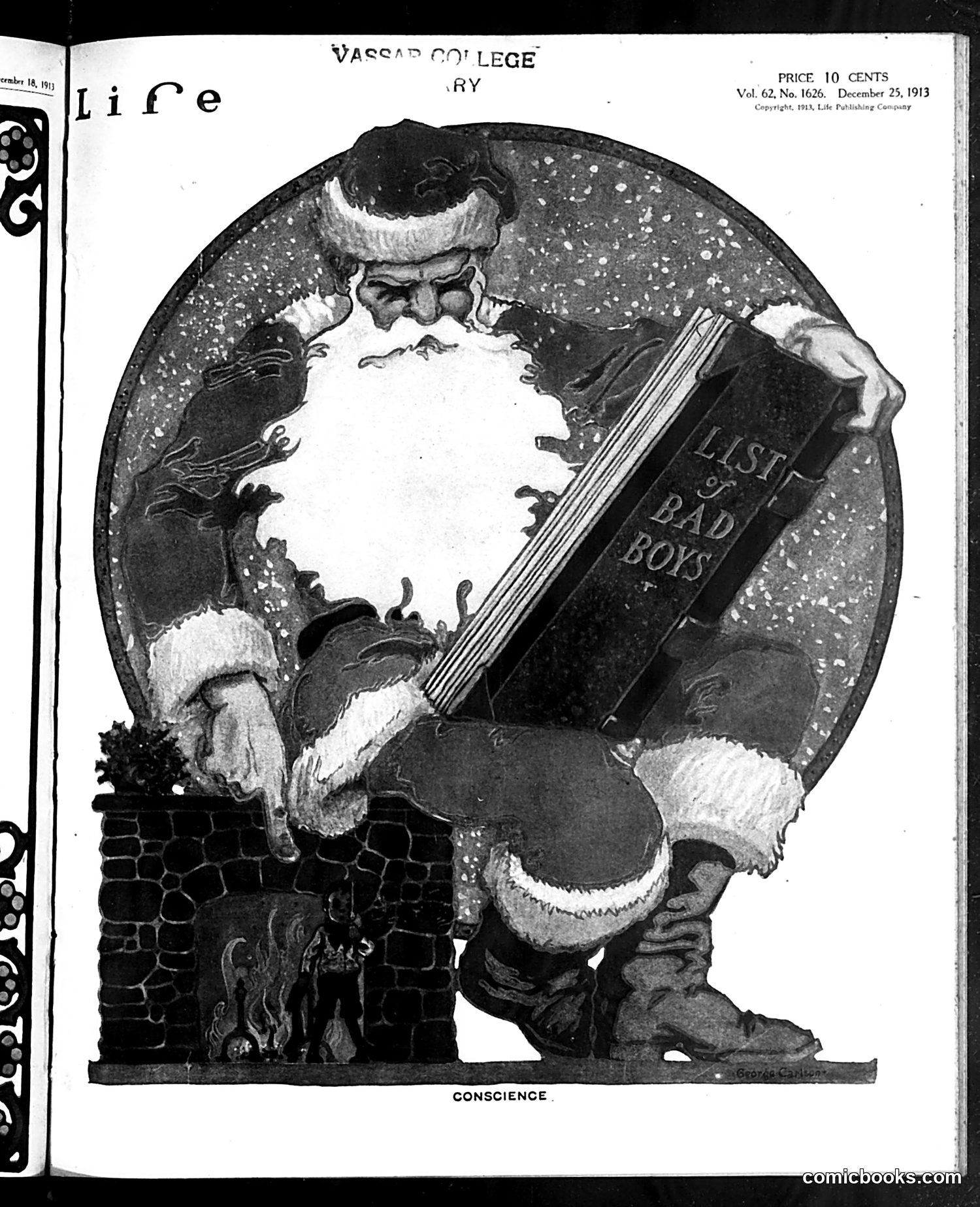
This December 1913 *Life* magazine cartoon depicts Santa Claus holding a book titled "LIST OF BAD BOYS" while standing at a chimney with a fire below. The work is titled "Conscience." The satire operates on multiple levels: Santa, traditionally a figure of generosity and moral judgment, clutches a ledger of misbehavior. The "bad boys" reference suggests the cartoon comments on childhood misbehavior and moral accountability, though the specific historical context remains unclear without additional information about 1913 current events. The image likely uses Santa's traditional role as moral arbiter—rewarding the good and punishing the bad—to satirize contemporary social or political judgment, though the exact target is ambiguous from the image alone.
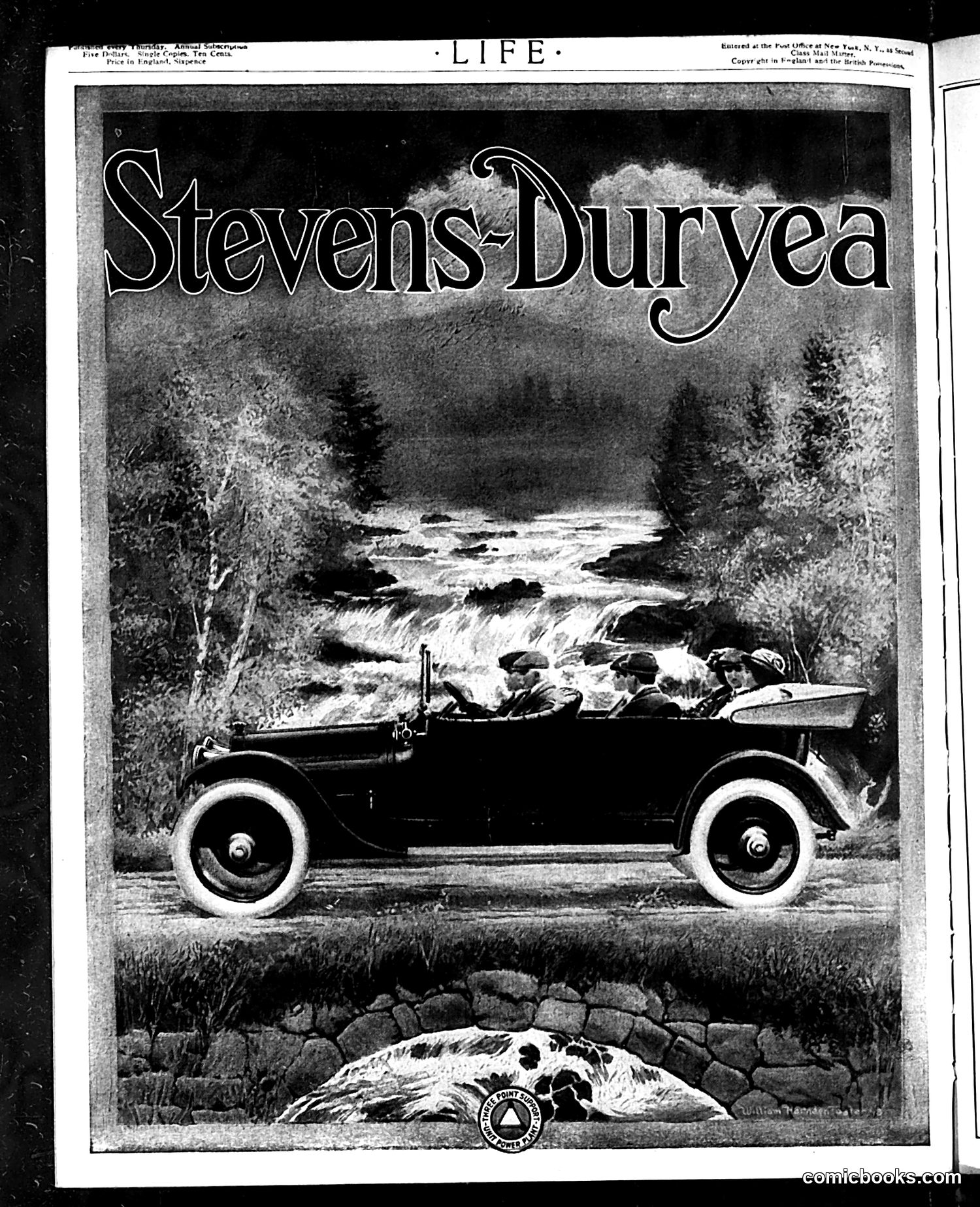
This is a **car advertisement**, not political satire. The Stevens-Duryea was an early automobile brand (operating roughly 1901-1915). The ad depicts an idealized recreational scene: a convertible touring car with fashionably dressed passengers driving through a scenic landscape with a river, forest, and rock formations. The composition suggests leisure, luxury, and freedom—key selling points for automobiles in the early 1900s. The ad targets affluent consumers by emphasizing the car's utility for outdoor excursions and social status. The pastoral setting contrasts with urban industrial life, positioning the automobile as an escape vehicle. The detailed landscape artwork suggests reliability and capability for extended journeys. No political content is evident—this is straightforward automotive marketing from Life magazine's commercial pages.
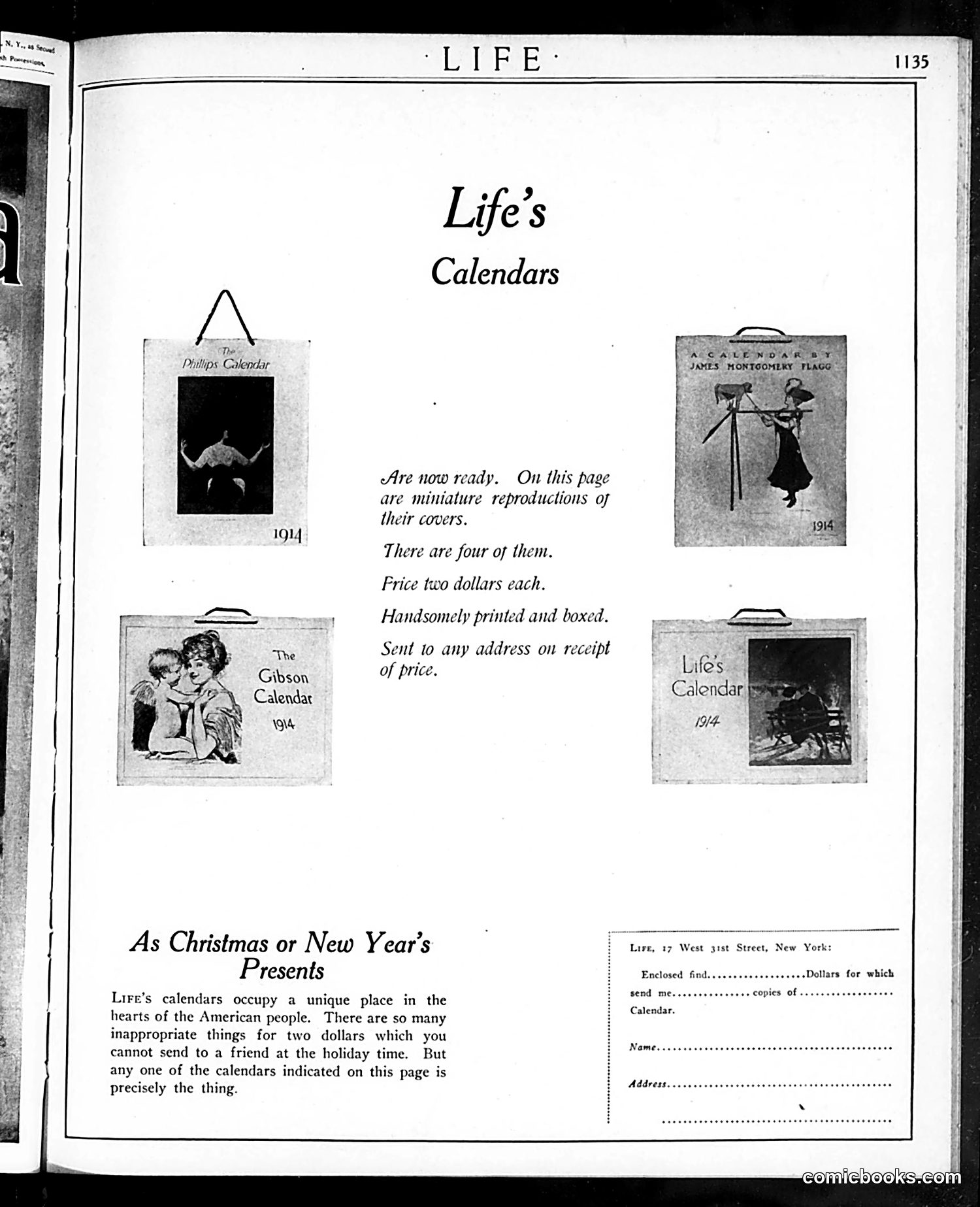
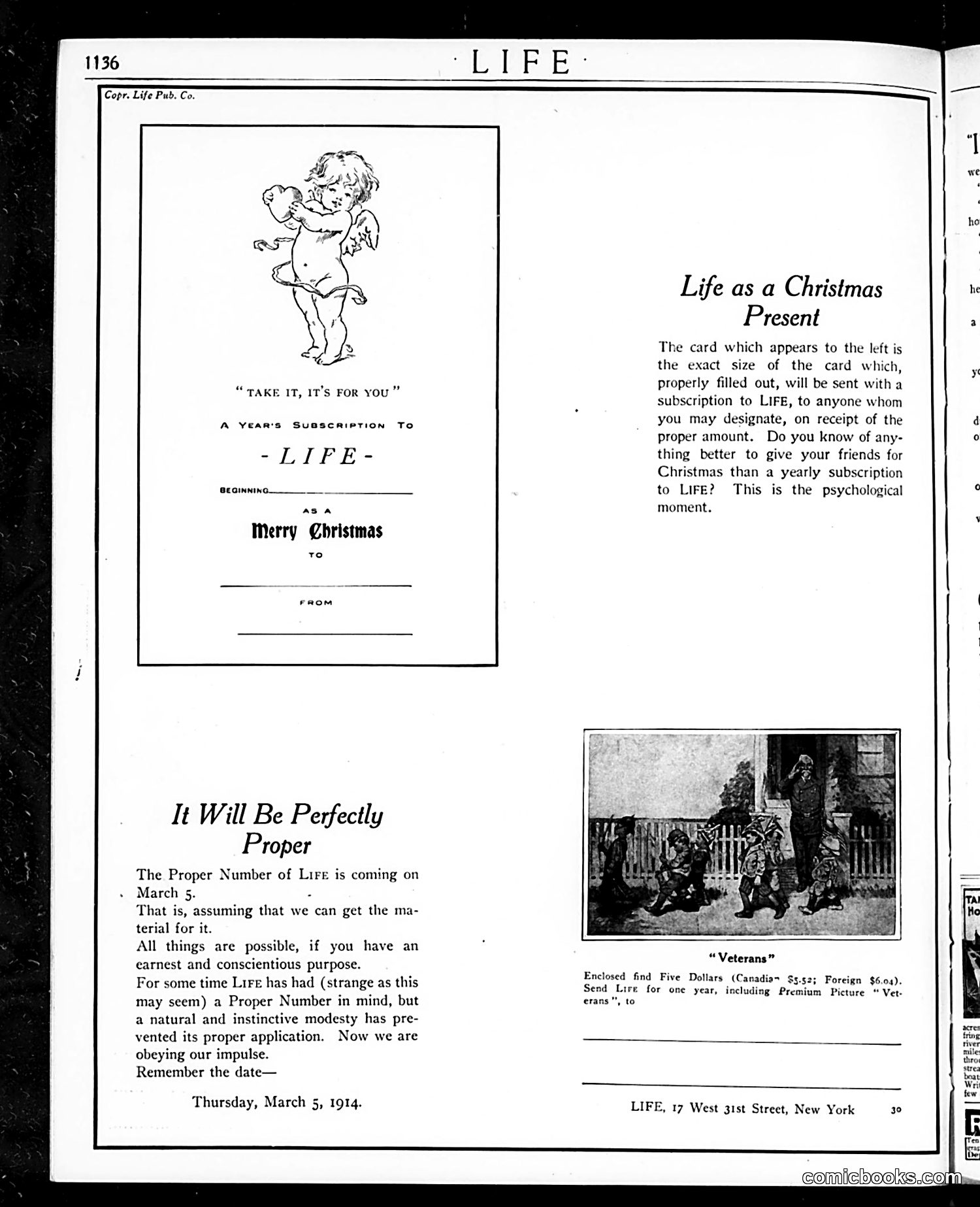
This page is primarily **advertising content** for Life magazine subscriptions, presented as Christmas gift suggestions. The left side features a **gift card design** showing a cherub with the phrase "Take it, it's for you" — promoting a year's subscription to Life as a present. The copy emphasizes this as an ideal Christmas gift for friends. The right section announces an upcoming "Proper Number" of Life arriving March 5, 1914, promising material of high quality. Below is a photograph labeled **"Veterans"** showing what appears to be elderly men and children, likely accompanying a story about Civil War veterans or similar subjects. The content reflects early 20th-century magazine promotion strategies and Life's positioning as quality entertainment suitable for gift-giving.
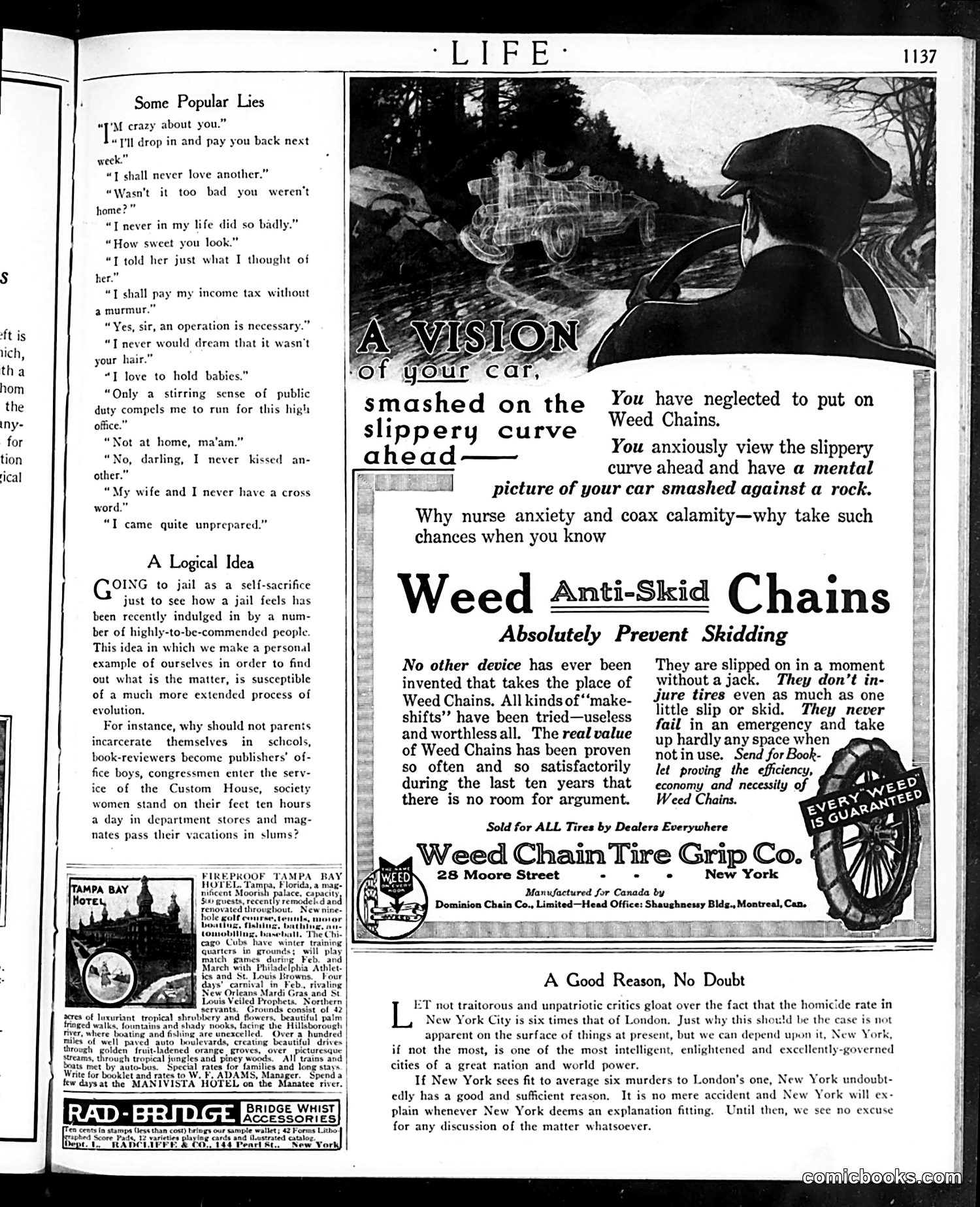
This page is primarily **commercial advertising**, not political satire. The dominant content is a large advertisement for Weed Anti-Skid Chains, automobile tire safety devices designed to prevent skidding on slippery winter roads. The ad features an illustration of a concerned driver viewing a dangerous road curve ahead, presenting a scenario meant to create urgency: without chains, your car might skid and crash. The copywriting uses anxiety as a sales tactic—"Why nurse anxiety...why take such chances?" The left column contains minor satirical pieces titled "Some Popular Lies" and "A Logical Idea," but these are brief, unrelated commentary on everyday social absurdities, not references to specific political events or figures. The page reflects early-20th-century advertising strategies prioritizing fear-based persuasion for automotive safety products.
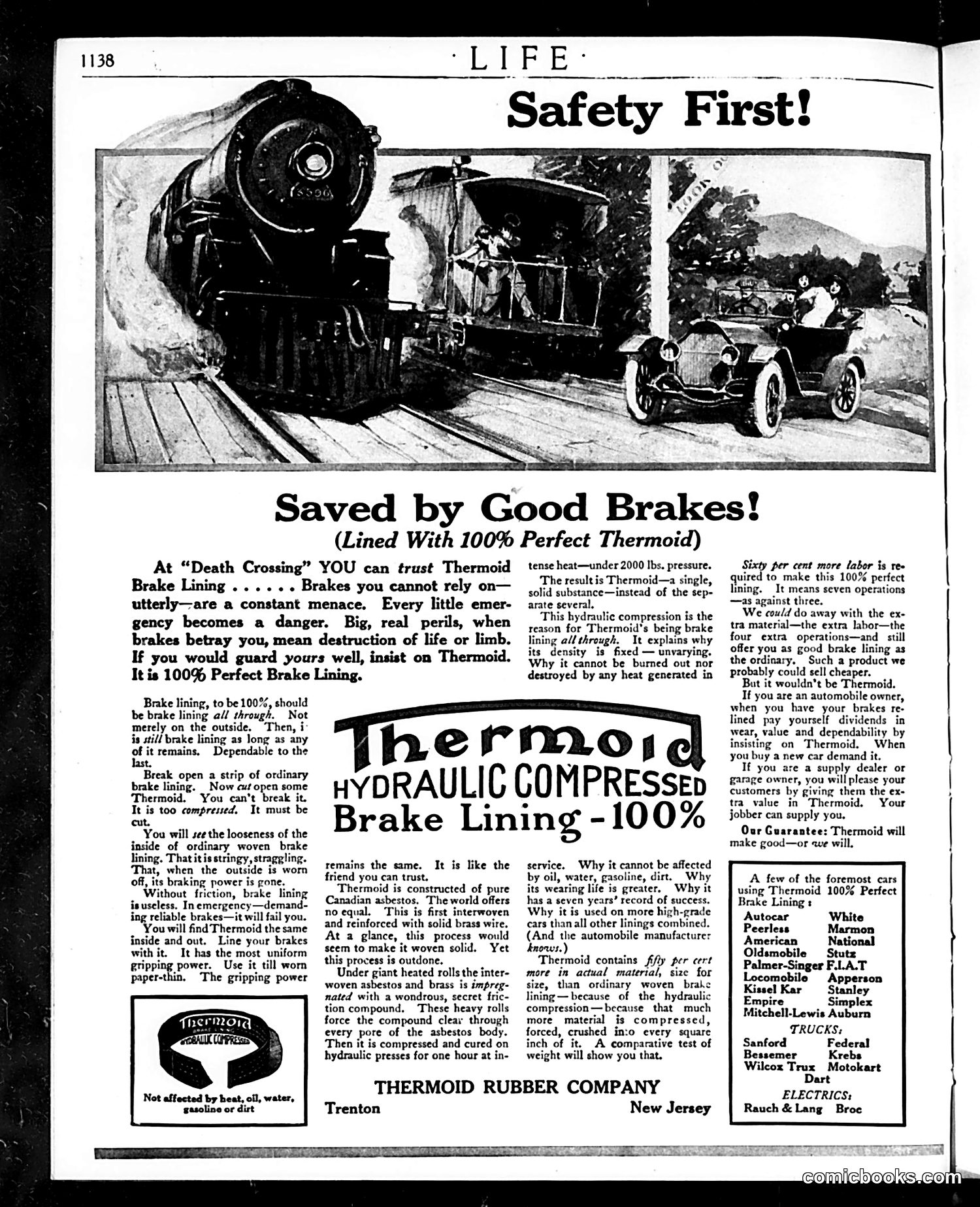
This is **not a political cartoon or satire**—it's a straightforward **advertisement for Thermoid brake lining**, placed in Life magazine (page 1138). The page uses a dramatic "Safety First" theme featuring three images: a steam locomotive, a railway crossing scene, and an early automobile. These represent different transportation modes relying on dependable brakes. The ad emphasizes that Thermoid's hydraulic-compressed brake lining is "100% Perfect" and won't fail under pressure—crucial in an era when brake failure meant real danger. It lists numerous car manufacturers using the product as endorsement. This reflects early 20th-century safety consciousness, when automobile and train accidents were frequent public concerns. The ad appeals to buyers' anxieties about mechanical reliability during a period of rapid transportation growth.
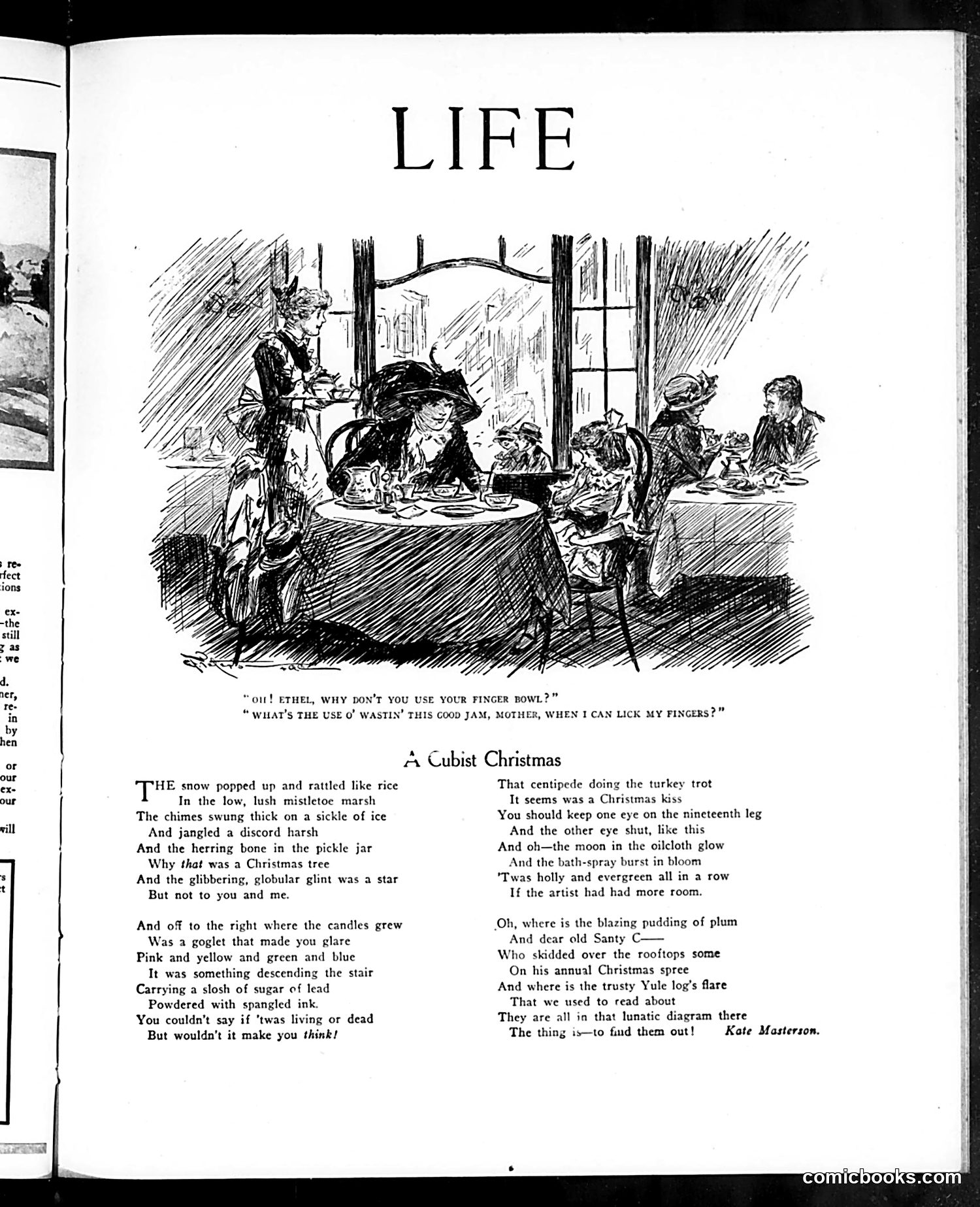
This page satirizes modernist "Cubist" art through a Christmas dinner scene. The cartoon above shows a family meal where a child asks why mother doesn't use her "finger bowl" while eating jam—she responds by asking why he can't lick his fingers instead. The accompanying poem parodies Cubist art's fragmented, abstract style by describing Christmas imagery in deliberately disjointed, nonsensical terms: "the herring bone in the pickle jar," candles of "pink yellow and green and blue," and moon imagery in "oilcloth glow." The satire mocks Cubism as incomprehensible and impractical—suggesting modernist art abandons sense and beauty for pretentious abstraction. The comparison to a chaotic, illogical Christmas dinner emphasizes the joke that Cubism makes "living" experiences confusing and unrecognizable.
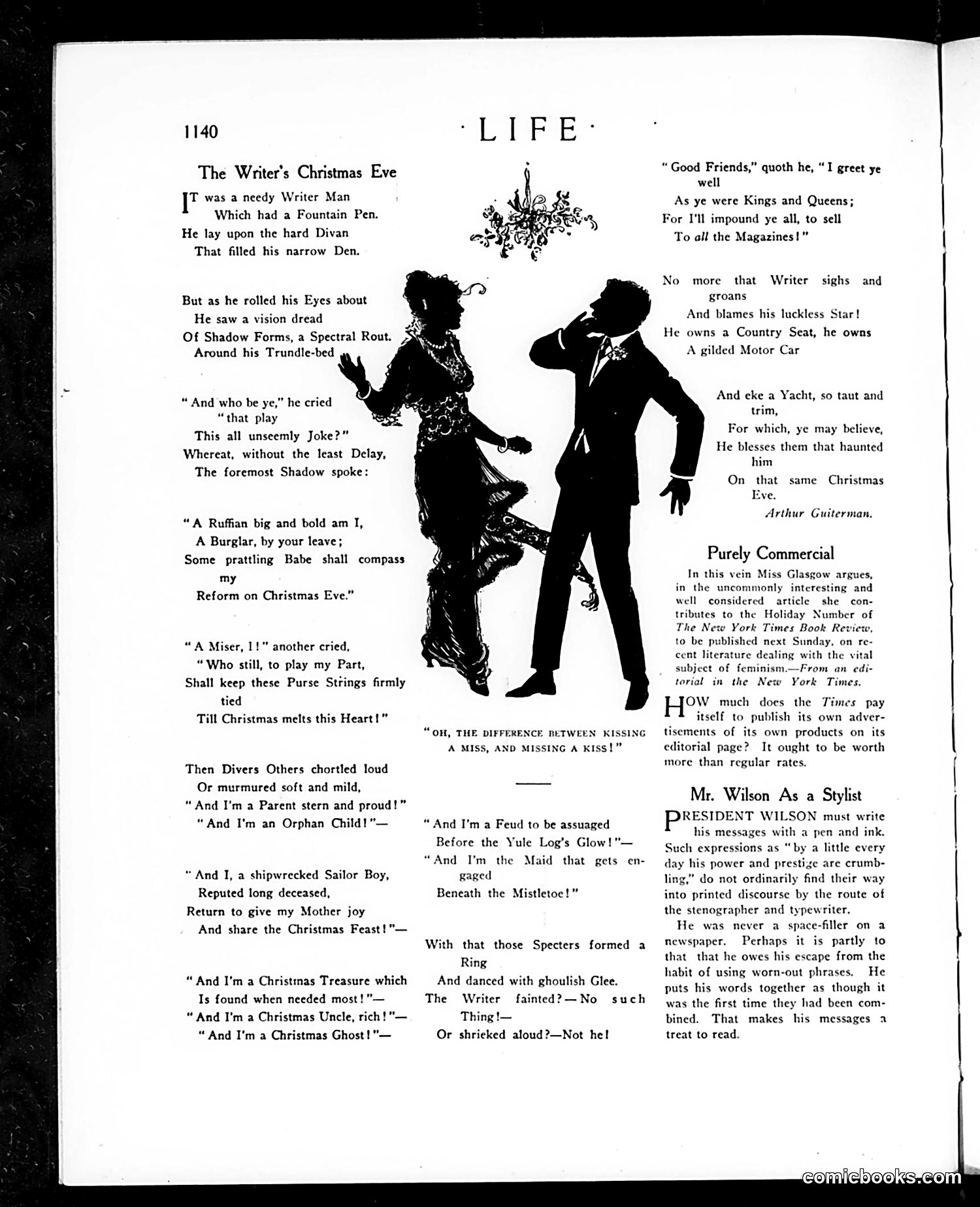
This is a satirical poem by Arthur Guiterman about a struggling writer on Christmas Eve. The illustration shows silhouettes of two well-dressed figures dancing or socializing. The satire contrasts the writer's poverty (he has only a "Fountain Pen" and narrow "Den") with visions of wealthy lifestyles. Shadow-form characters—described as "A Ruffian," "A Miser," "An Orphan Child," "A Sailor Boy," and "A Christmas Ghost"—taunt him with their Christmas wishes and possessions. The joke is that the needy writer fantasizes about his characters achieving prosperity while he remains impoverished. By poem's end, the writer faints from the emotional toll, leaving the punchline ambiguous: "Or shrieked aloud?—Not he!" It's gentle satirical commentary on the romantic struggling-artist trope and the gap between literary imagination and economic reality.
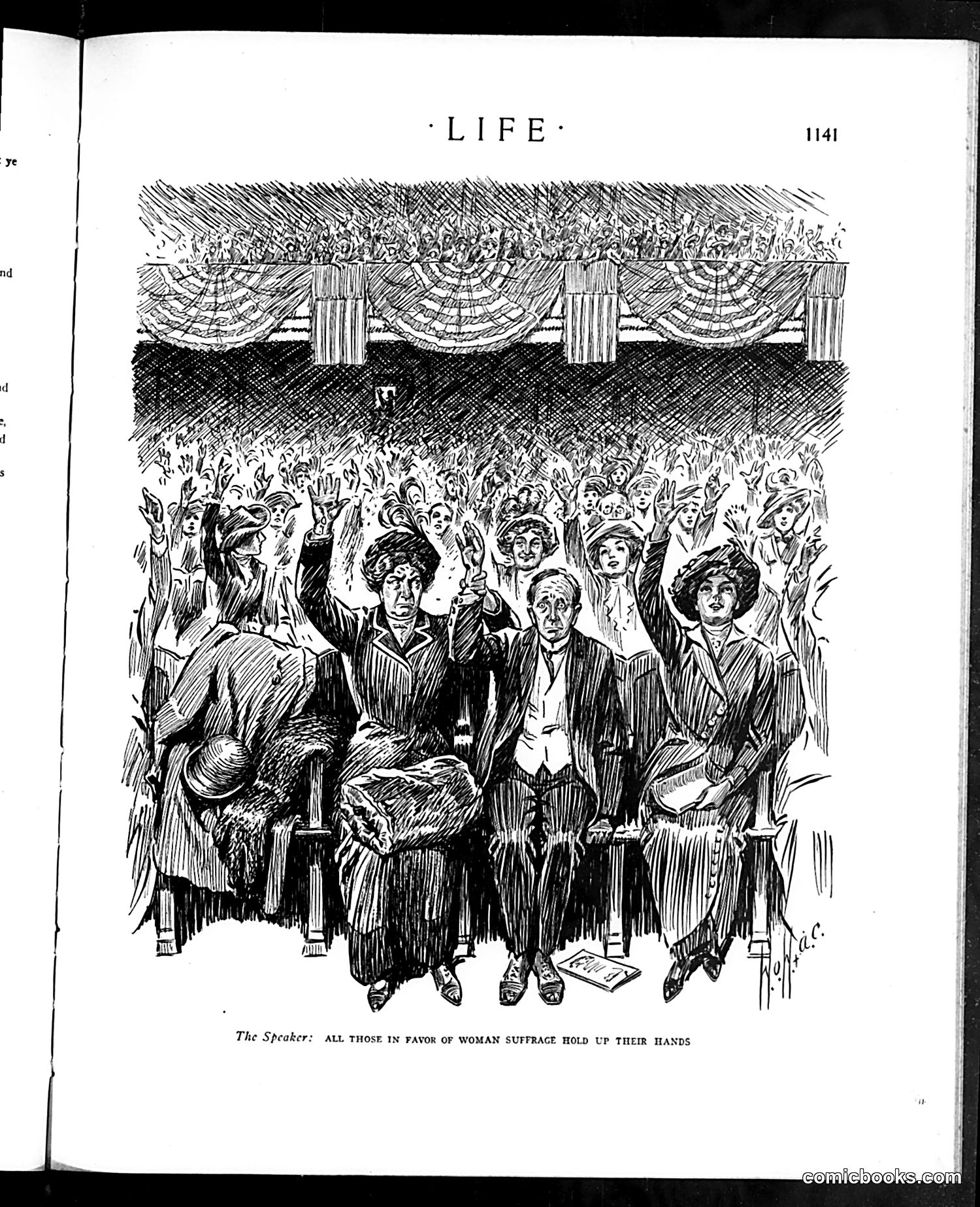
This is a satirical cartoon from *Life* magazine about women's suffrage. The caption reads: "The Speaker: ALL THOSE IN FAVOR OF WOMAN SUFFRAGE HOLD UP THEIR HANDS." The image shows a crowded assembly hall with elaborate decoration (draped curtains, ornate railings). In the foreground, four men in formal dress are seated, appearing reluctant or unmoved. Behind them, a large crowd of people (representing supporters) has their hands raised enthusiastically. **The satire:** Despite overwhelming public support for women's voting rights, the seated male figures—likely politicians or lawmakers—remain unmoved or opposed. The cartoon criticizes the disconnect between popular opinion and political action on suffrage, mocking the male leadership's resistance to extending voting rights to women despite demonstrated mass support for the cause.
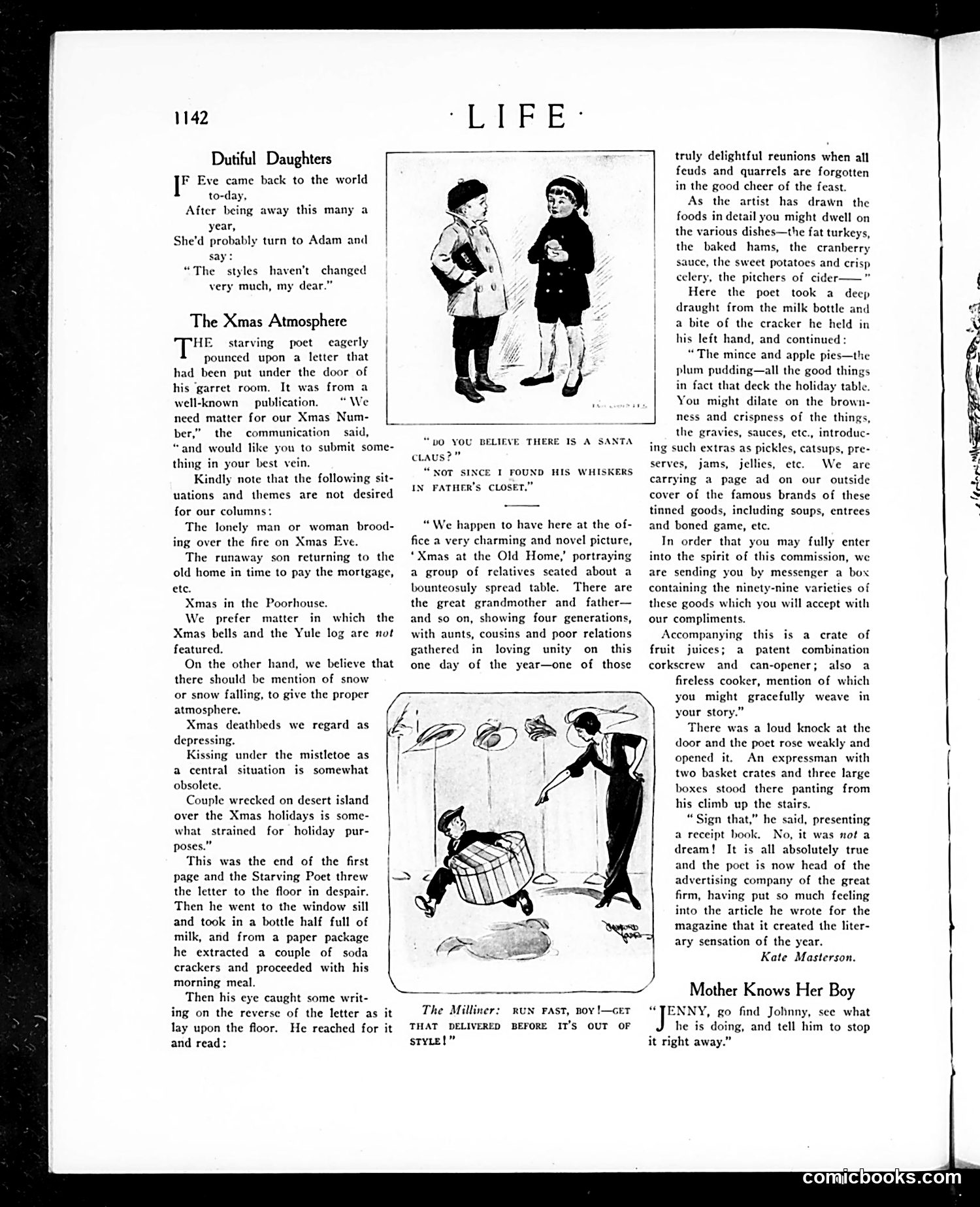
This page contains three separate humorous pieces from *Life* magazine (a satirical publication): 1. **"Dutiful Daughters"** - A brief joke about Eve returning to Adam after many years, suggesting wives don't change much. 2. **"The Xmas Atmosphere"** - A longer satirical piece about Christmas, critiquing sentimental holiday stories. It mocks the "starving poet" trope—where impoverished writers pitch Christmas stories to magazines. The narrative follows such a poet pitching an idealized family gathering scene. The accompanying cartoon shows delivery workers struggling with oversized food crates, satirizing the contrast between sentimental holiday imagery and commercial excess. 3. **"Mother Knows Her Boy"** - A brief humorous domestic scene about a mother managing her mischievous son. The satire targets middle-class sentimentality and commercial holiday culture, mocking both struggling writers exploiting holiday nostalgia and the manufactured abundance associated with Christmas marketing.
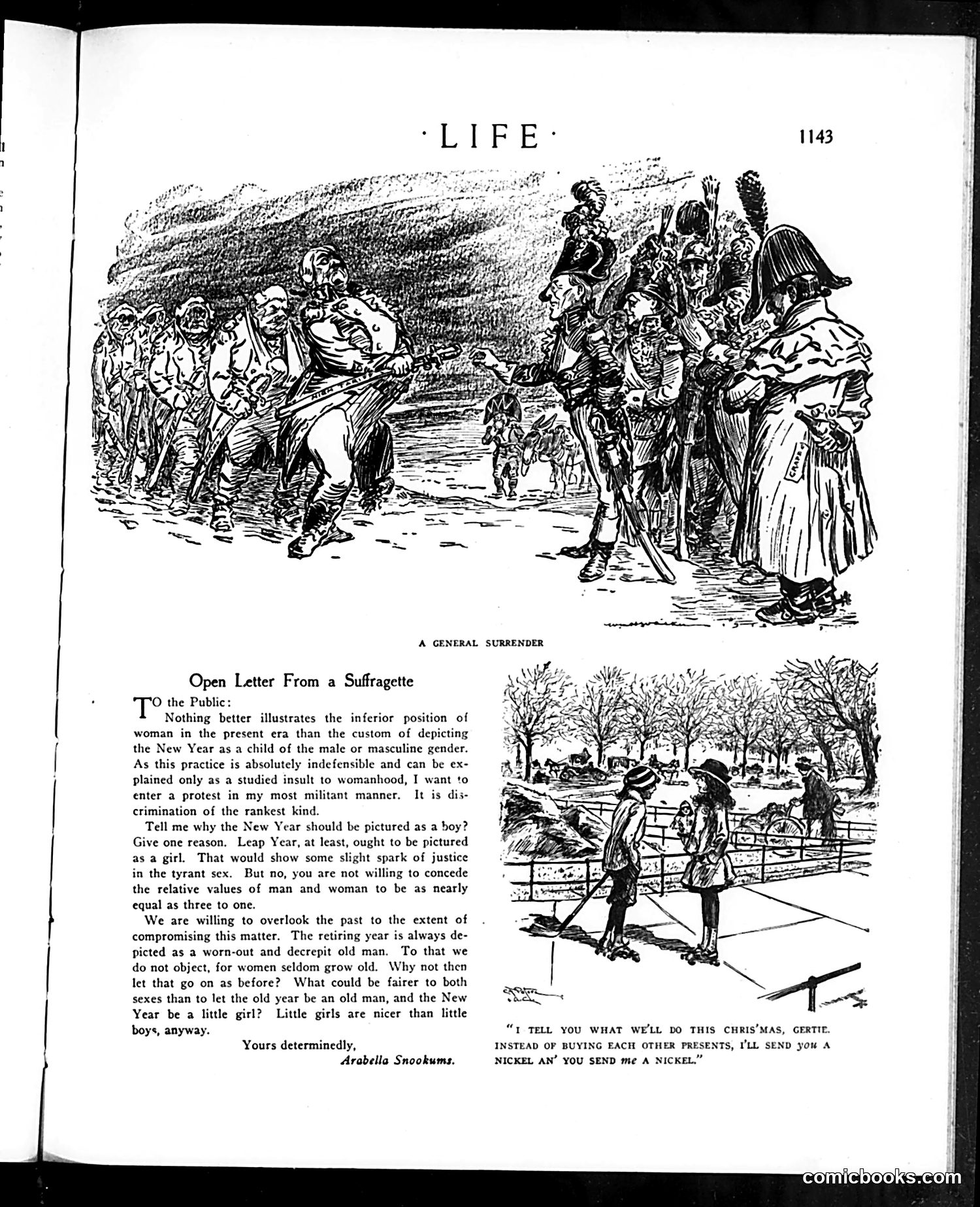
This *Life* magazine page contains two satirical cartoons addressing gender and social issues: **"A General Surrender" (top):** Depicts military figures surrendering to what appears to be suffragettes or women's rights advocates, satirizing the suffrage movement's perceived threat to male authority. **"Open Letter From a Suffragette":** The accompanying letter by "Arabella Snockume" protests the tradition of depicting New Year's personifications as male or masculine. The author argues women should be represented equally, criticizing the "discrimination of the rankest kind." She proposes the New Year be depicted as a girl instead, noting this would be "fairer to both sexes." **The skating cartoon (bottom):** Humorously depicts children discussing Christmas gift exchanges, with one suggesting sending money ("a nickel") rather than physical presents—unrelated to the suffrage content above. The page satirizes both suffragists and traditional gender conventions of the era.
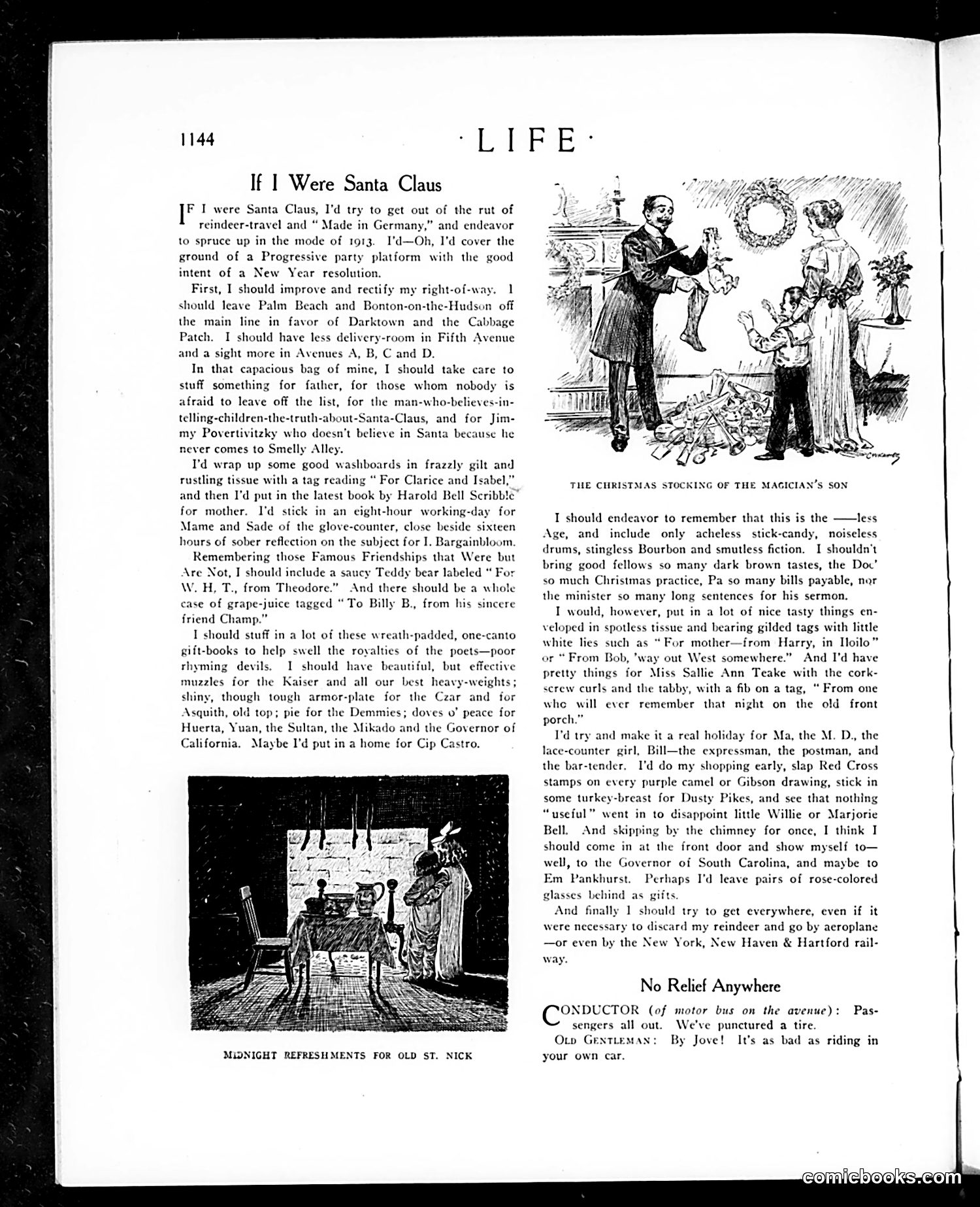
This page contains two satirical pieces. "If I Were Santa Claus" is a humorous essay imagining the author as Santa, proposing impractical Christmas gifts for various public figures and social types—including Theodore Roosevelt and references to contemporary celebrities and politicians. The two illustrations support this: "The Christmas Stocking of the Magician's Son" (top) shows Santa delivering gifts to children, while "Midnight Refreshments for Old St. Nick" (bottom) depicts Santa resting during his rounds. The "No Relief Anywhere" section at bottom is a brief comic dialogue between a bus conductor and passenger complaining about a punctured tire—a relatable modern inconvenience presented as equally frustrating to Santa's legendary travels. The humor relies on recognizing contemporary 1910s-era figures and understanding period social anxieties about commercialism and gift-giving excess.
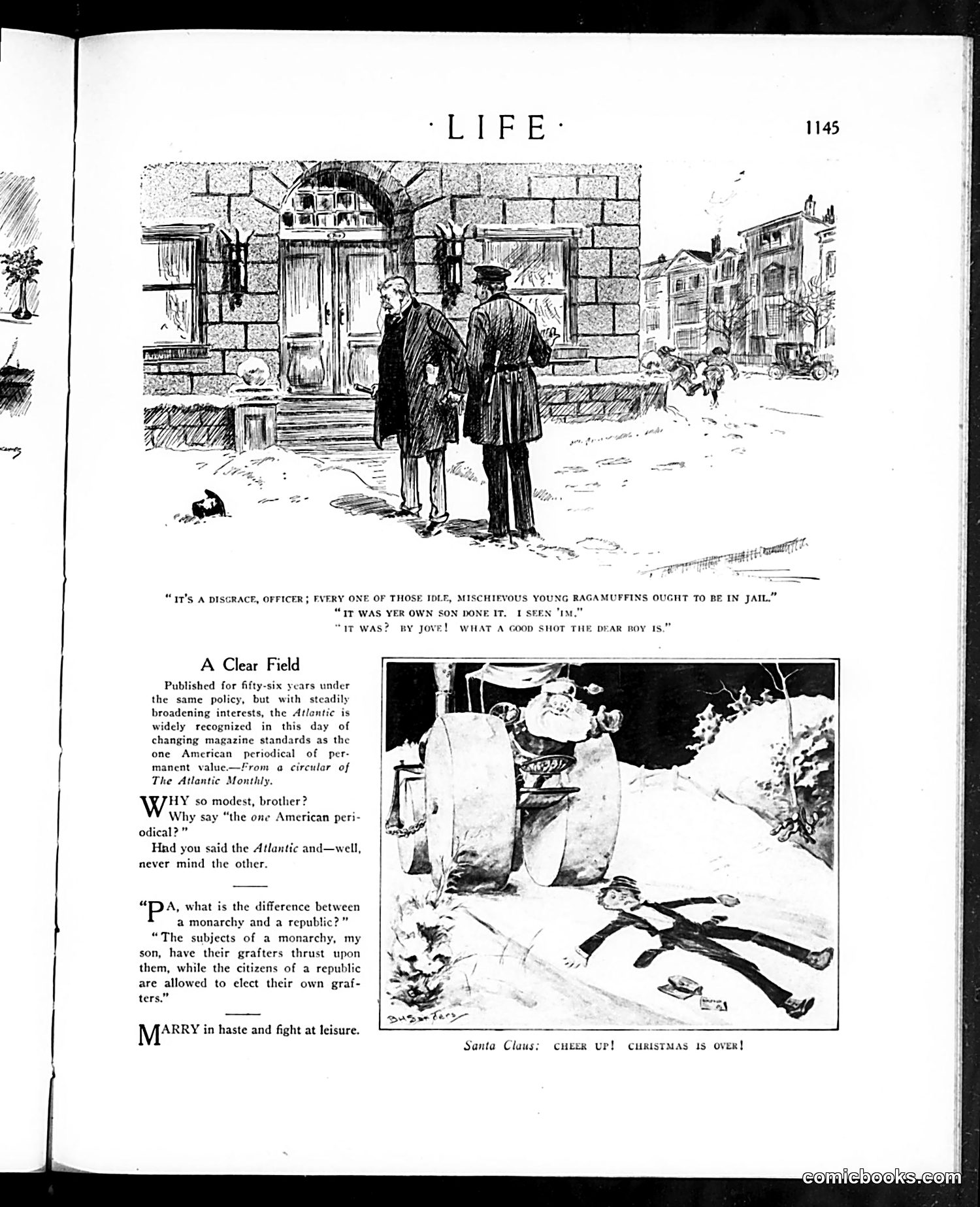
This page contains two distinct satirical pieces: **Top cartoon**: Officers encounter young vagrants, with dialogue mocking their criminalization. One officer calls them "idle, mischievous young ragamuffins" deserving jail, while another notes "it was we own son done it" — suggesting class hypocrisy in how poverty-stricken youth are treated versus wealthy children committing similar acts. **"A Clear Field" section**: Promotes *The Atlantic Monthly* magazine's fifty-six-year publishing history, contrasting it favorably with *The Atlantic* (likely a competitor). **Bottom cartoon**: Titled "Santa Claus: Cheer up! Christmas is over!" Shows what appears to be an exhausted, overweight Santa collapsed with empty bottles nearby — satirizing the commercialization and excess of Christmas festivities and their aftermath.
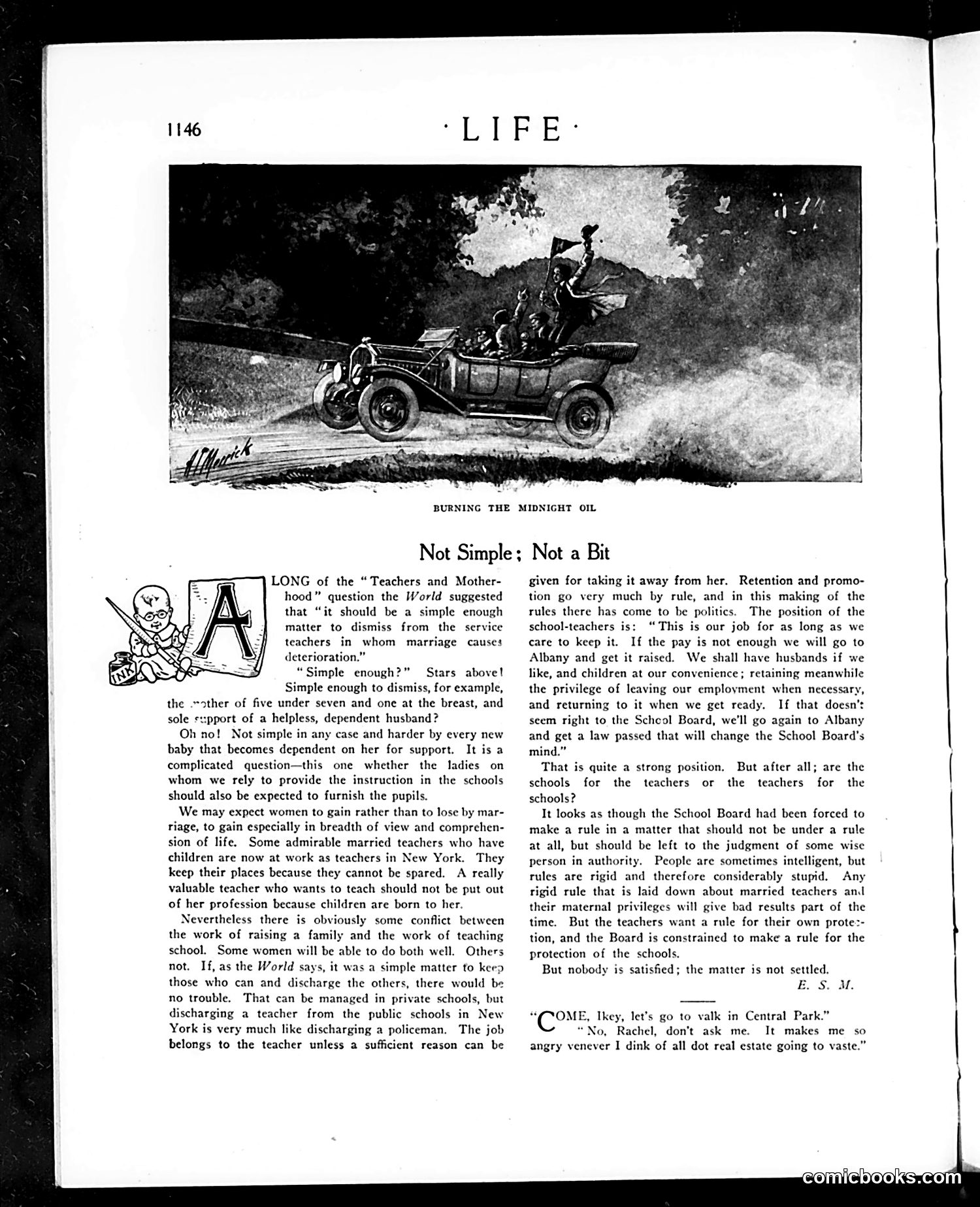
**Main Illustration:** An early automobile speeds along a road with passengers waving a flag, "burning the midnight oil" (working late into the night). This appears to be a generic satirical image about modern life's pace. **Article Focus:** "Not Simple; Not a Bit" debates whether female teachers should be allowed to keep their jobs after marriage. The text presents competing arguments: some claim married teachers should resign to avoid financial burden on families, while others argue valuable educators shouldn't be forced out simply for having children. **Historical Context:** This reflects early 20th-century employment discrimination against married women, particularly in teaching. The piece questions rigid institutional rules while acknowledging genuine conflicts between motherhood and professional work—a tension unresolved in this era.
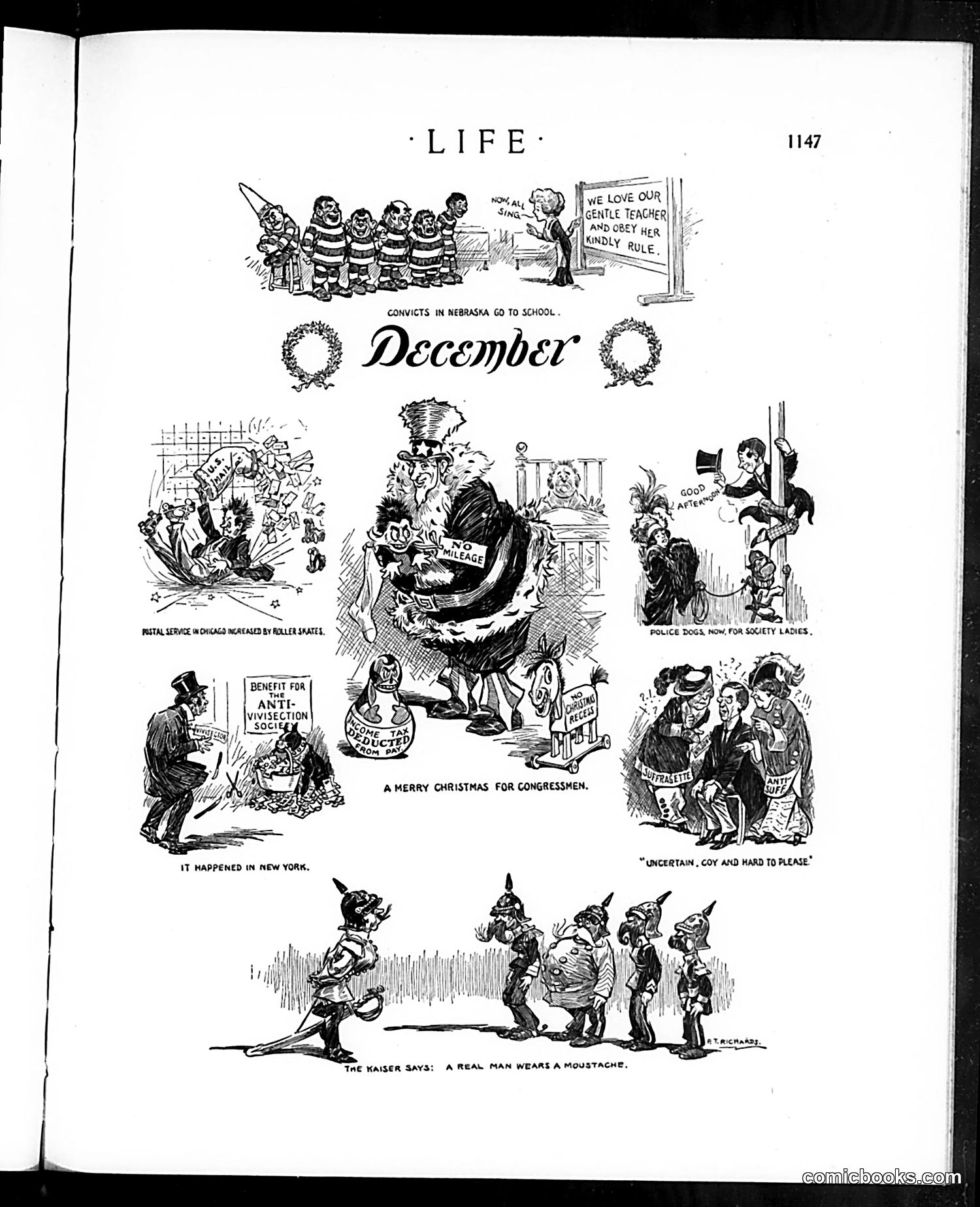
This page presents satirical cartoons mocking contemporary American political and social issues. The top panel shows Nebraska convicts attending school—likely critiquing criminal justice reform. Multiple vignettes address holiday politics: congressmen's Christmas wishes appear uncertain ("Uncertain, coy and hard to please"), while another section references anti-vivisection debates in New York. The central figure labeled "No Billion" appears to reference government spending debates. The bottom cartoon mocks the Kaiser's militaristic pronouncements about manhood and mustaches—typical wartime satire directed at German leadership. Police dogs and society ladies appear in separate panels, suggesting commentary on class divisions and urban issues. Overall, the page combines domestic political criticism with anti-German wartime sentiment typical of this publication's satirical approach.
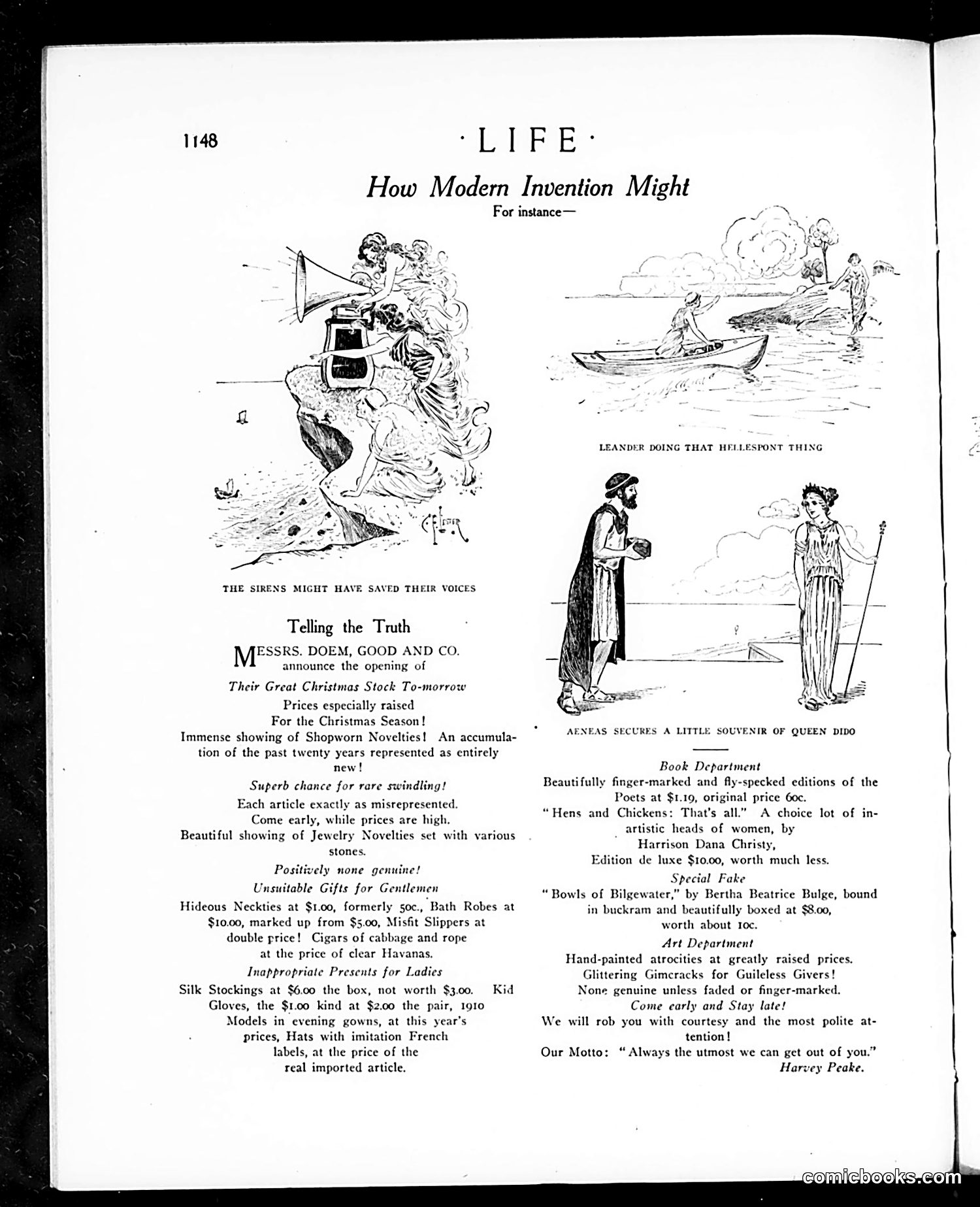
This is a mock advertisement for a fictional department store ("Doem, Good and Co.") that brazenly advertises dishonest Christmas shopping practices. The satire works by having the store openly boast about what retailers typically do *covertly*: marking up shopworn goods as new, misrepresenting merchandise quality, charging inflated holiday prices, and selling counterfeit items (fake French labels, non-genuine jewelry). The joke targets pre-holiday consumer culture and merchant dishonesty. By having the store's motto be "Always the utmost we can get out of you," Life reveals the cynical gap between retailers' politeness and their actual intent to defraud customers. The accompanying cartoons showing "how modern invention might" (depicting classical scenes like Aeneas and Dido) appear to be separate satirical sketches on the same page, unrelated to the main advertisement parody.
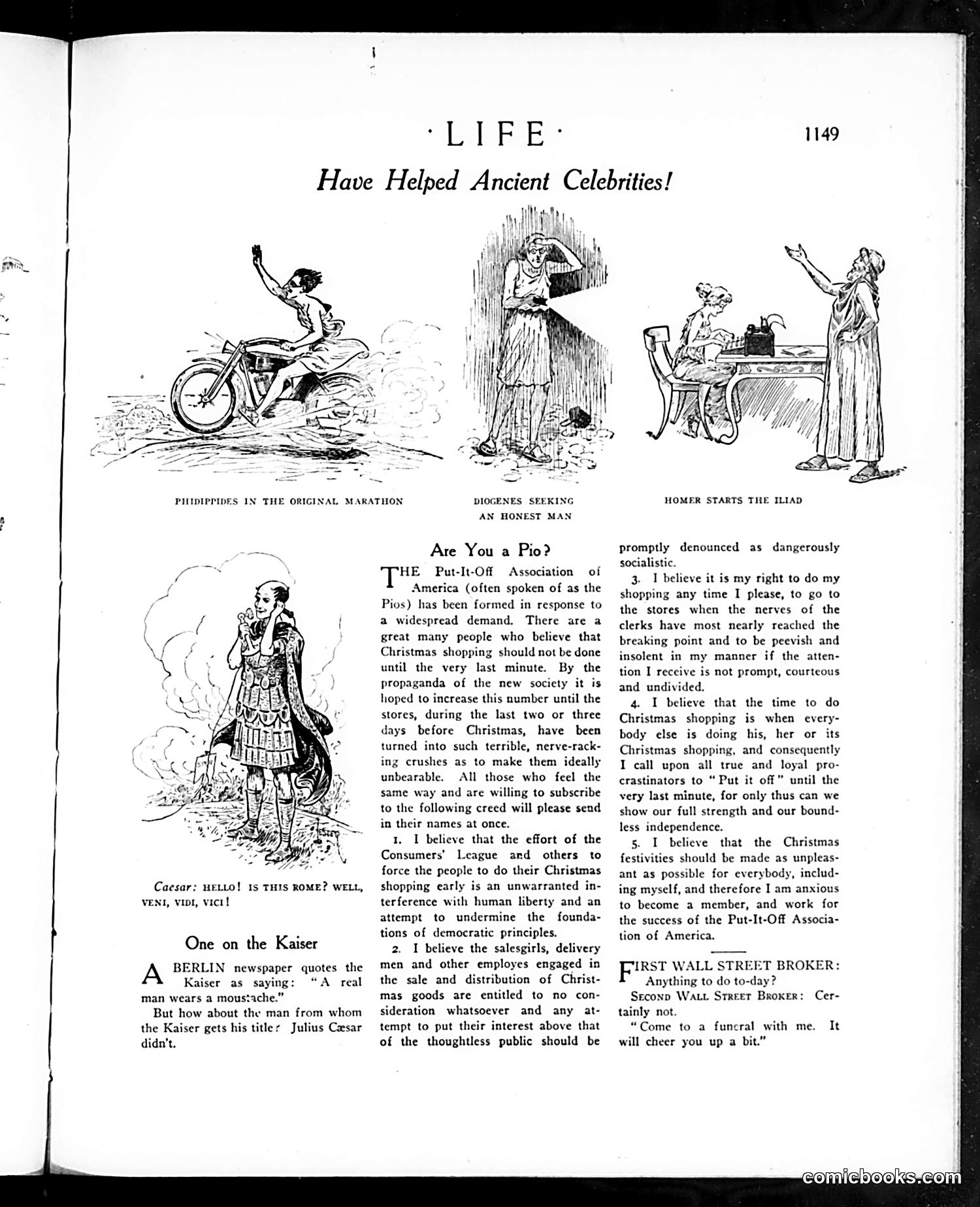
This page satirizes Christmas shopping habits and labor conditions. The top cartoons humorously reference historical figures (Phidippides, Diogenes, Homer, Caesar) who "procrastinated," establishing a mock-serious tone. The main content attacks the "Put-It-Off Association"—a fictional organization promoting last-minute Christmas shopping. The satire targets procrastinators' selfishness: their five-point "creed" explicitly prioritizes personal convenience over retail workers' wellbeing, calling labor-friendly shopping practices "dangerously socialistic." The piece mocks how procrastinators rationalize their behavior as defending "human liberty" and "independence," while actually creating deliberate chaos and exhaustion for sales clerks and delivery workers during the final pre-Christmas rush. The final joke about Wall Street brokers attending funerals reflects broader economic anxiety during this period. The satire advocates for *early* Christmas shopping as a form of worker consideration—a progressive position for the era.
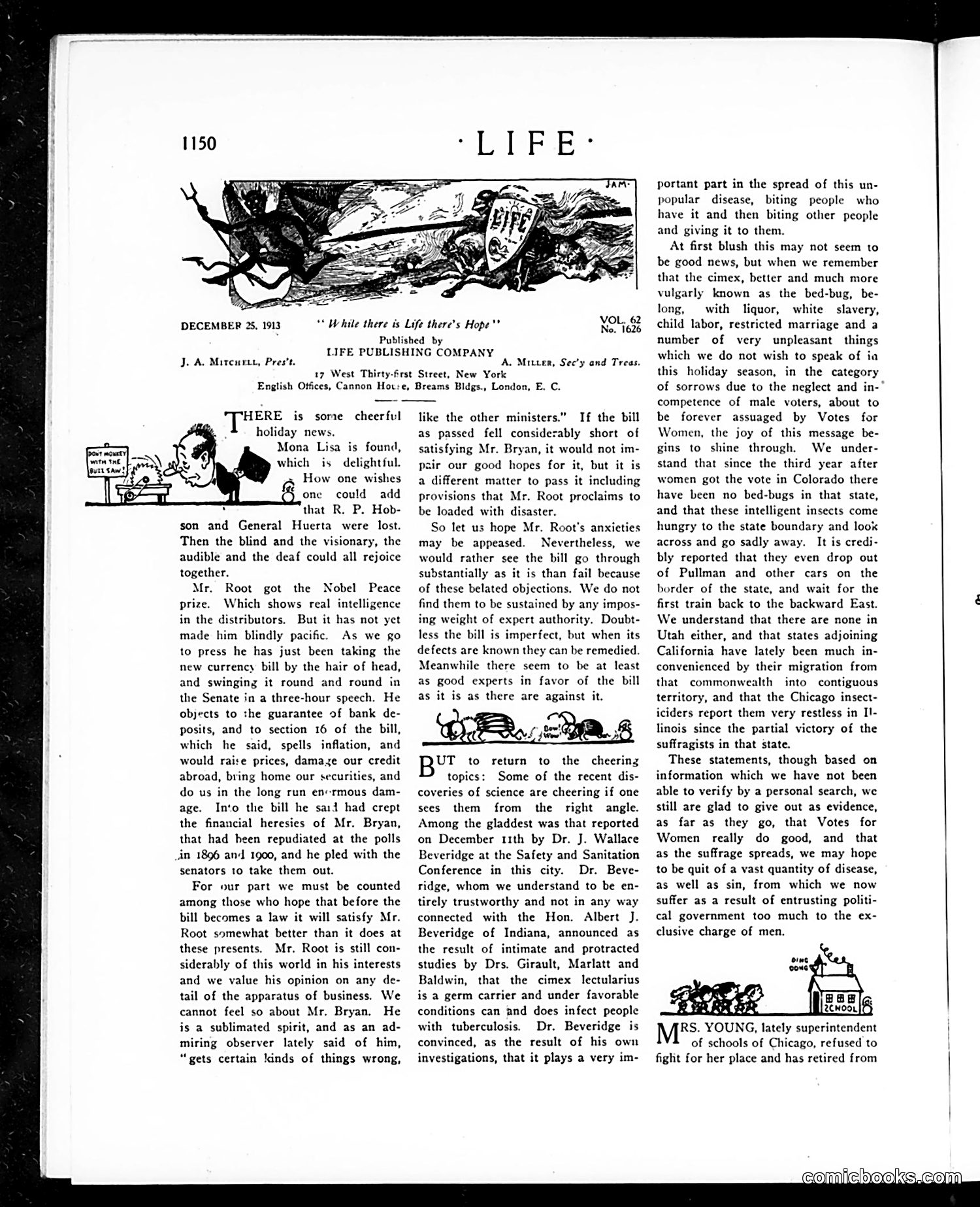
This editorial page discusses recent news and political matters. The main cartoon (top left) appears to depict a figure in bed, likely satirizing the discovery that bed bugs transmit tuberculosis—presented as darkly "cheerful" holiday news. The text praises the recovery of the Mona Lisa but sarcastically wishes that politicians R.P. Hobson and Mexican General Huerta were also "lost." The bulk addresses Senator Elihu Root's opposition to the new Federal Reserve currency bill, which Root believes contains inflationary "heresies" from William Jennings Bryan's earlier rejected policies. Life supports the bill despite its imperfections, valuing Root's business expertise but dismissing Bryan as an impractical "sublimated spirit." The piece concludes by mockingly celebrating Dr. Beveridge's discovery that bed bugs (cimex lectularius) spread tuberculosis—grouping this pest with liquor, white slavery, and child labor as societal evils. The satire suggests bed bugs join other disreputable problems of the era.
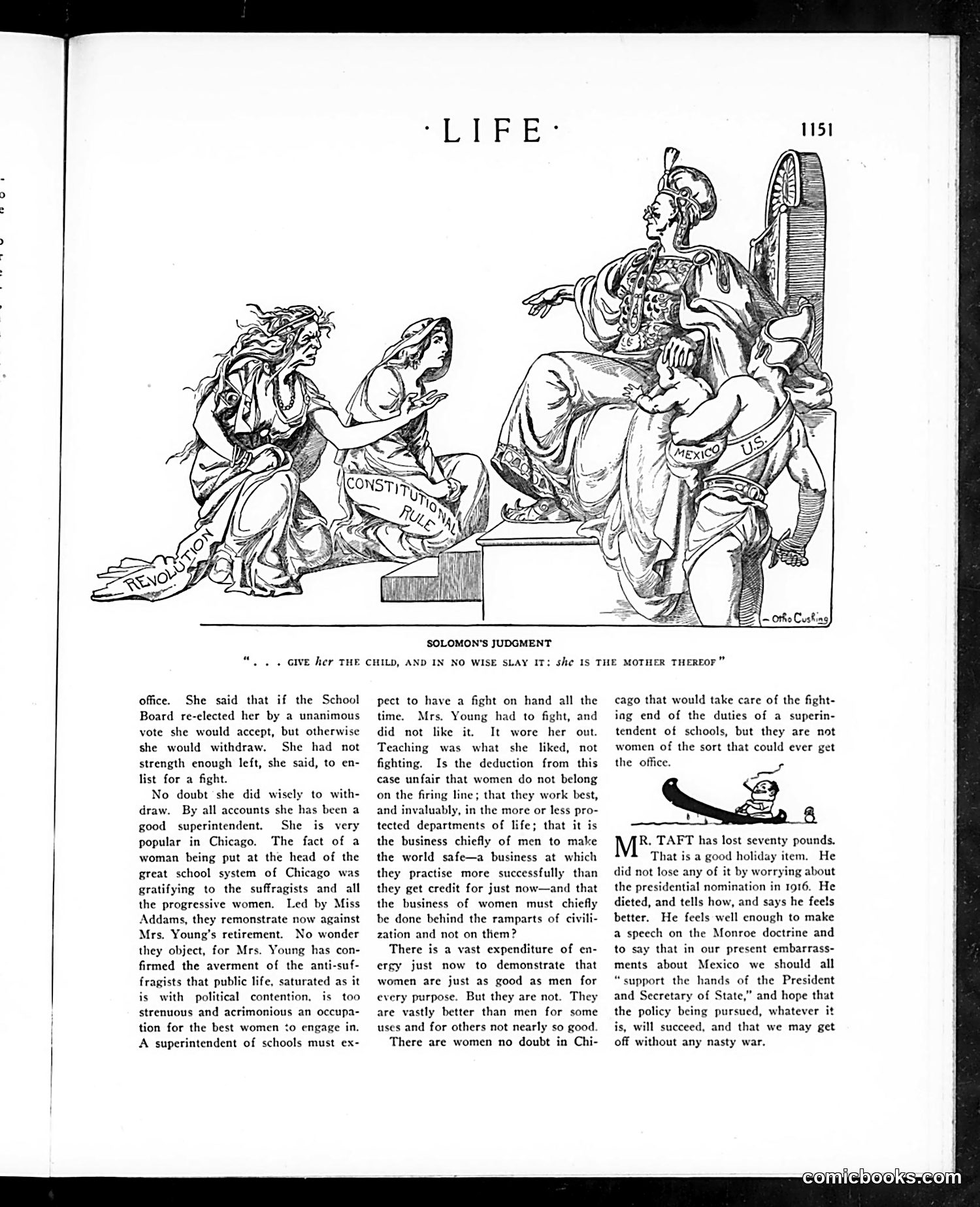
The main cartoon, titled "Solomon's Judgment," uses the biblical reference to King Solomon's famous wisdom to satirize the case of Mrs. Young, Chicago's school superintendent who resigned from her position. The article discusses whether women belong in high-level public office. It argues that while Mrs. Young was popular and competent, she withdrew because the contentious, combative nature of the role exhausted her—suggesting women lack the stamina for "the firing line" of public life. The satire cuts both ways: it mocks anti-suffragists' claims that women can't handle politics, while also critiquing those who claim women are equally suited to all roles as men. The cartoon depicts competing female figures (representing "Constitutional Rule" and other concepts, likely suffragists) before a crowned judge, invoking Solomon's wisdom to suggest the difficulty of fairly dividing authority and capability between men and women in civic life. The secondary item about President Taft losing weight provides lighter political commentary, noting his avoidance of nomination anxieties while still offering patriotic support for presidential Mexico policy.
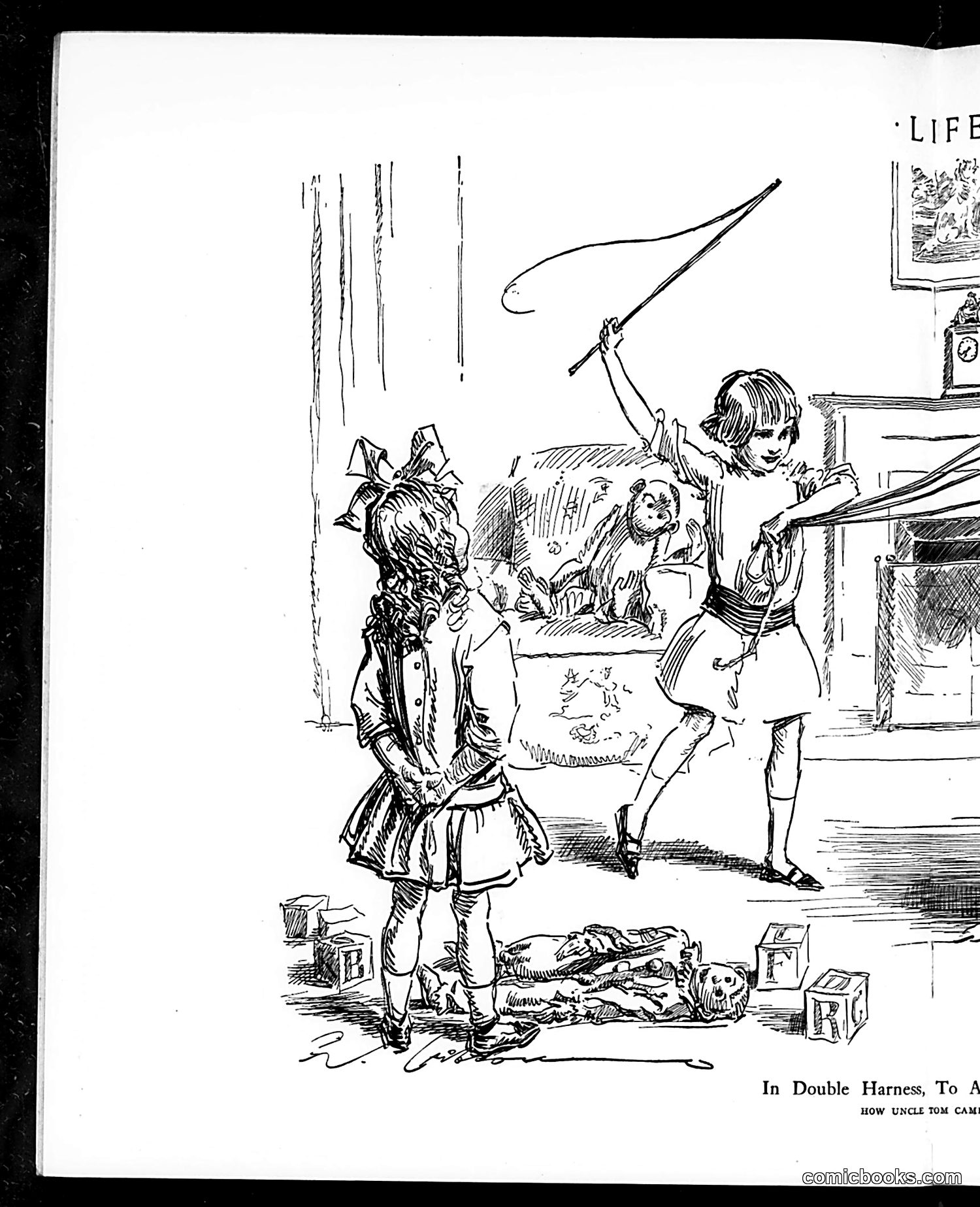
This illustration depicts children playing indoors with toys and a small animal. The caption references "Uncle Tom" and "Double Harness," likely alluding to *Uncle Tom's Cabin*, Harriet Beecher Stowe's famous anti-slavery novel. The phrase "double harness" was period slang for marriage. The incomplete caption suggests this is promoting a theatrical production—possibly a stage adaptation of the novel or a play with similar themes about servitude and constraint. The domestic scene with children suggests the satire concerns how such serious literary works about bondage were being trivialized or domesticated for genteel audiences through theatrical adaptation. The exact meaning remains unclear without the full text, but it appears to mock how weighty moral literature was reduced to entertainment.
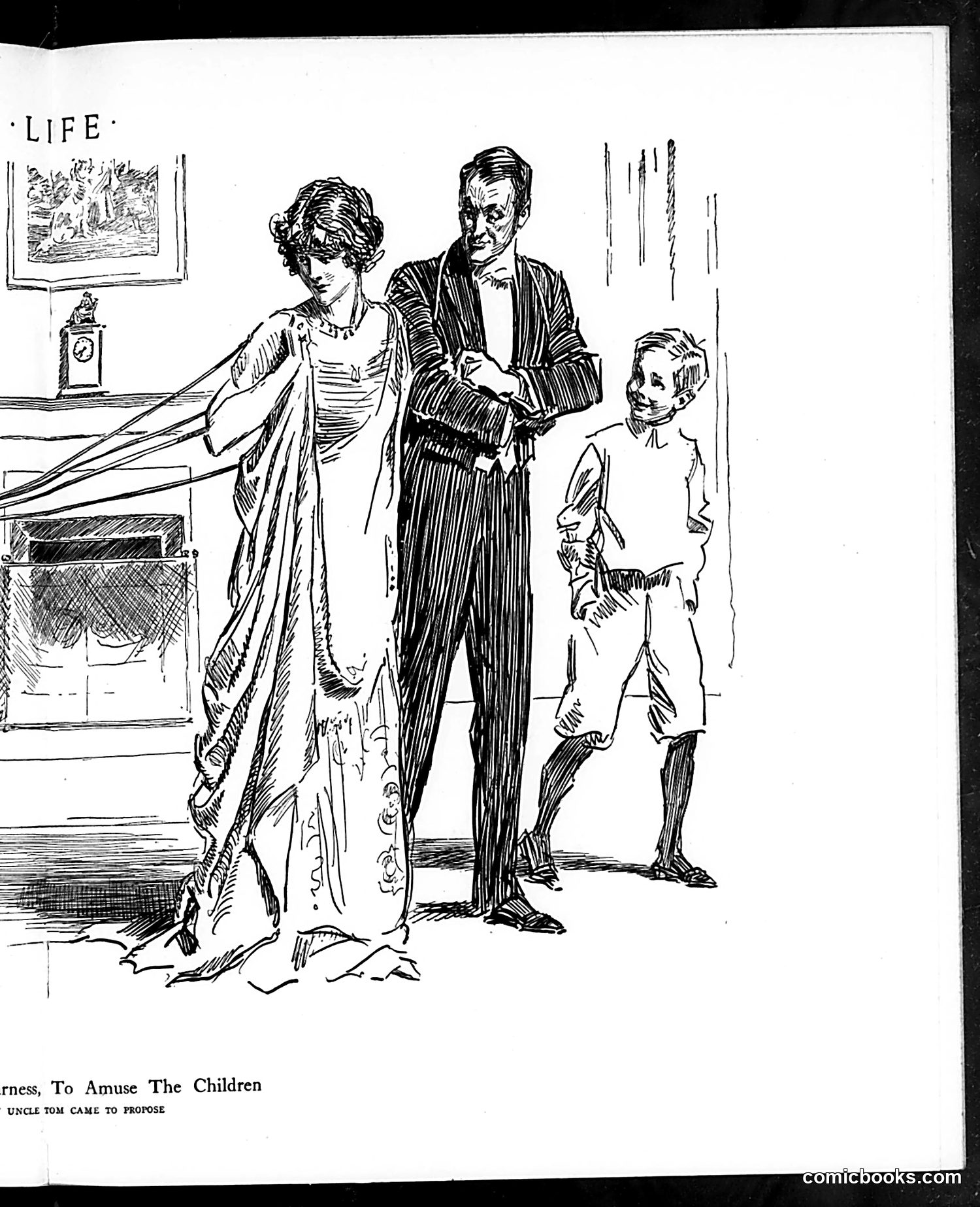
This *Life* magazine cartoon depicts a domestic scene where an older man in formal attire stands with a woman and child. The caption references "Uncle Tom" coming "to propose" and mentions he "came to amuse the children." The satire likely plays on the cultural figure of "Uncle Tom"—a stock character in 19th-century American entertainment and literature. The joke appears to center on domestic courtship rituals or the awkwardness of an older suitor attempting to win over both the woman and her children with entertainment or proposals. Without the publication date visible, the precise social commentary remains unclear, though it reflects period attitudes toward marriage, class, and family dynamics that *Life* magazine typically satirized for its educated readership.
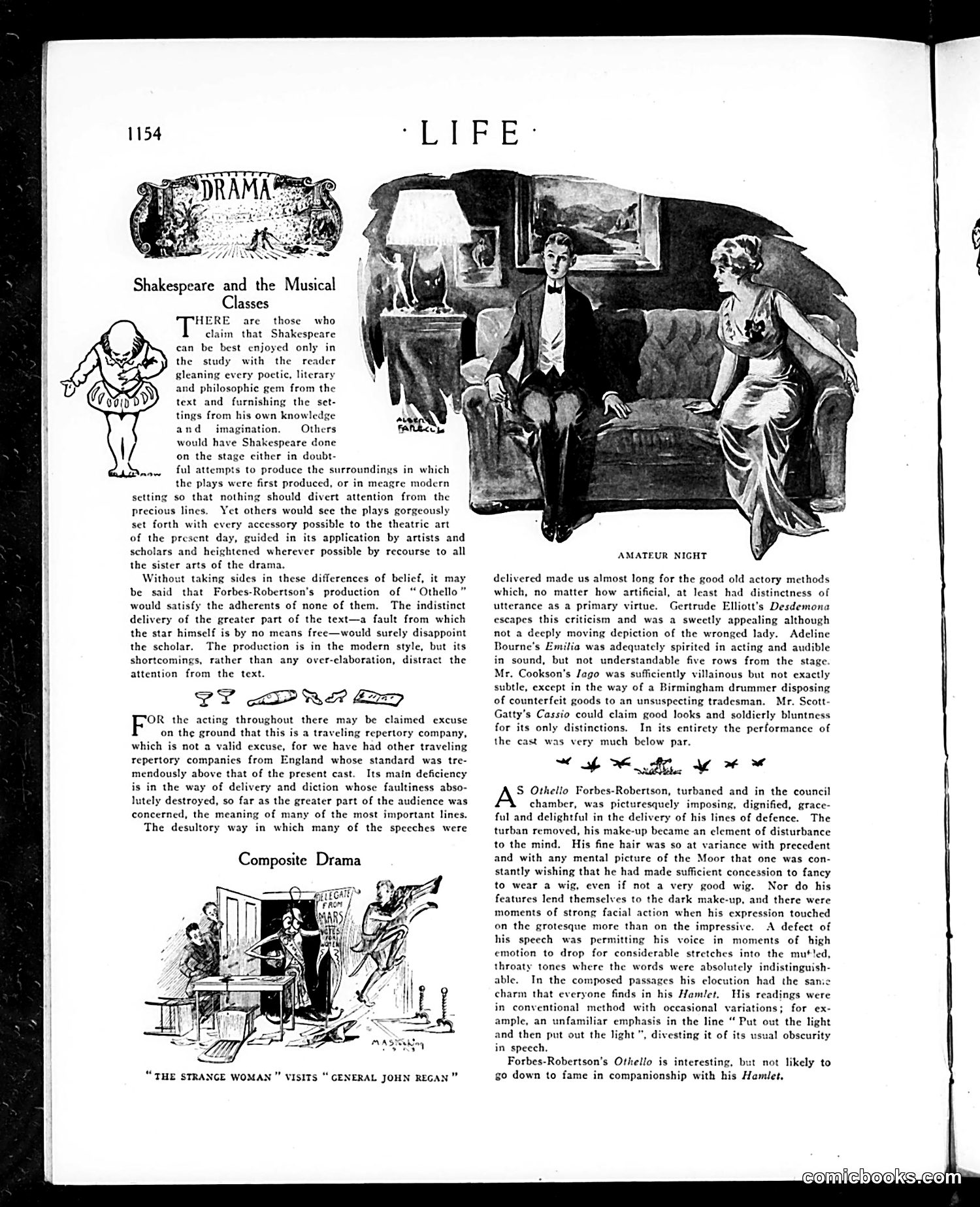
This page reviews Forbes-Robertson's traveling production of Shakespeare's *Othello*. The critic praises Robertson's dignified stage presence and delivery in formal scenes, but faults his casting choices and the company's overall performance quality. **Key criticisms:** - Robertson's makeup as Othello (darkened face without a wig) looks unconvincing and distracting rather than impressive - Other cast members deliver their lines indistinctly and inaudibly, destroying the meaning of important passages - The traveling repertory company's standard is poor compared to other English companies **The satirical cartoons** illustrate contrasting theatrical philosophies: one showing "The Strange Woman" visiting "General John Regan"—likely referencing how the traveling company performs multiple plays poorly rather than focusing on quality productions. The piece essentially argues that while some debate how Shakespeare *should* be staged, this particular production fails because its actors cannot be heard or understood—a fundamental failure regardless of production philosophy.
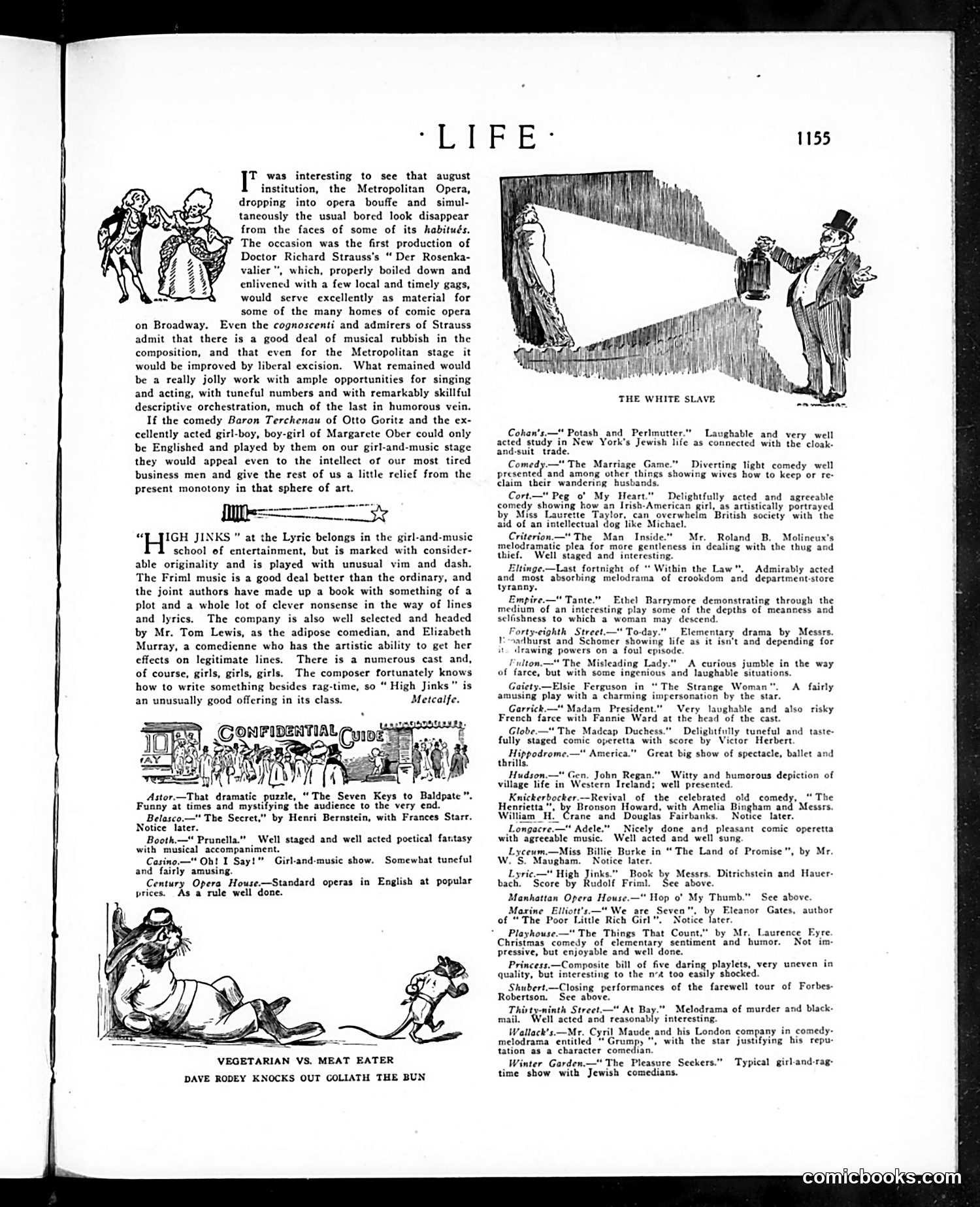
This page surveys New York theatrical productions, primarily comedies and operettas. The text critiques Richard Strauss's opera *Der Rosenkavalier* at the Metropolitan Opera, arguing it contains "musical rubbish" but could work as comedy if adapted for Broadway with English dialogue and local jokes. The two cartoons illustrate contrasting theatrical subjects: "The White Slave" (top right, showing melodramatic figures) and "Dave Rodey Knocks Out Goliath the Bun" (bottom, depicting a vegetarian vs. meat-eater conflict). Both are likely references to Broadway productions or popular entertainment themes of the era. The reviews emphasize that successful theater required skilled comedians like Tom Lewis and Elizabeth Murray, with *High Jinks* praised for originality. The tone suggests Life's editors valued entertainment value and humor over artistic pretension—championing accessible comedy over elitist opera.
This is a book review section, not a political cartoon. The page discusses three new publications about or by the naturalist Jean-Henri Fabre and a photography collection called "Men of Mark" by Alvin Langdon Coburn. The reviews praise Fabre's scientific yet poetic approach to studying insects, note the difficulty of translating his work into English, and highlight Coburn's photographic portraits of celebrities including Shaw, Wells, Masefield, Roosevelt, and Rodin. There's an embedded advertisement for a "Confidential Book Guide." The tone is appreciative of Fabre's work bridging science and literature, and celebrates his growing recognition among American readers. This reflects early 20th-century intellectual enthusiasm for naturalist writing and artistic photography as serious cultural pursuits.
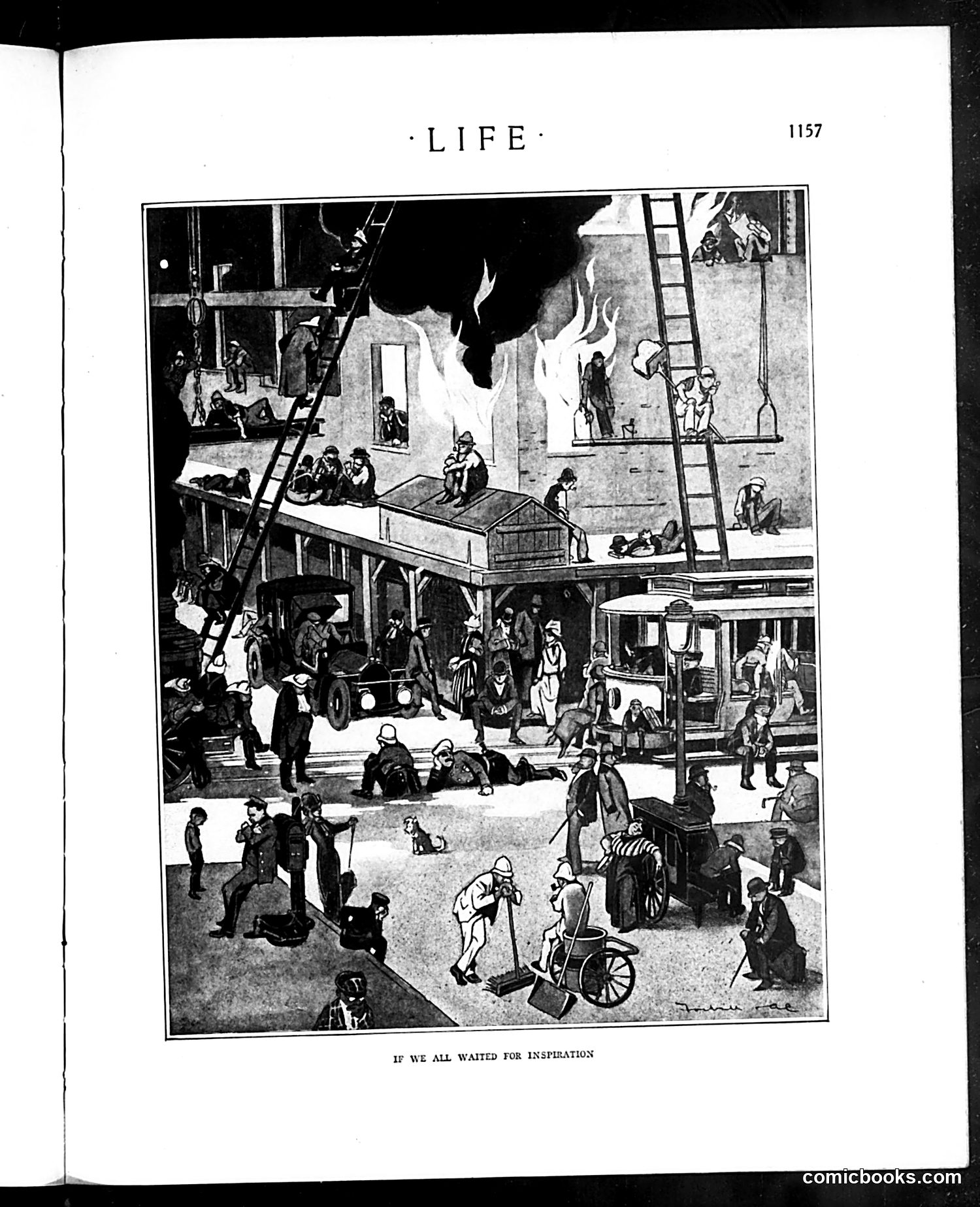
This satirical illustration depicts a chaotic urban scene where construction and renovation work has halted because workers are idle, waiting for "inspiration" rather than working. The caption "If We All Waited for Inspiration" critiques procrastination and lack of motivation. The scene shows multiple levels of a building under construction with ladders, flames, and numerous people standing around doing nothing—some sitting, some gesturing, none actively laboring. A street below shows similarly idle figures, including someone with a wheelbarrow and cart. The satire suggests that if everyone postponed work until feeling inspired, society would collapse into chaos and nothing would get accomplished. It's a commentary on work ethic and the impracticality of waiting for motivation rather than simply performing one's duties. The humor lies in the absurd consequences of universal procrastination.
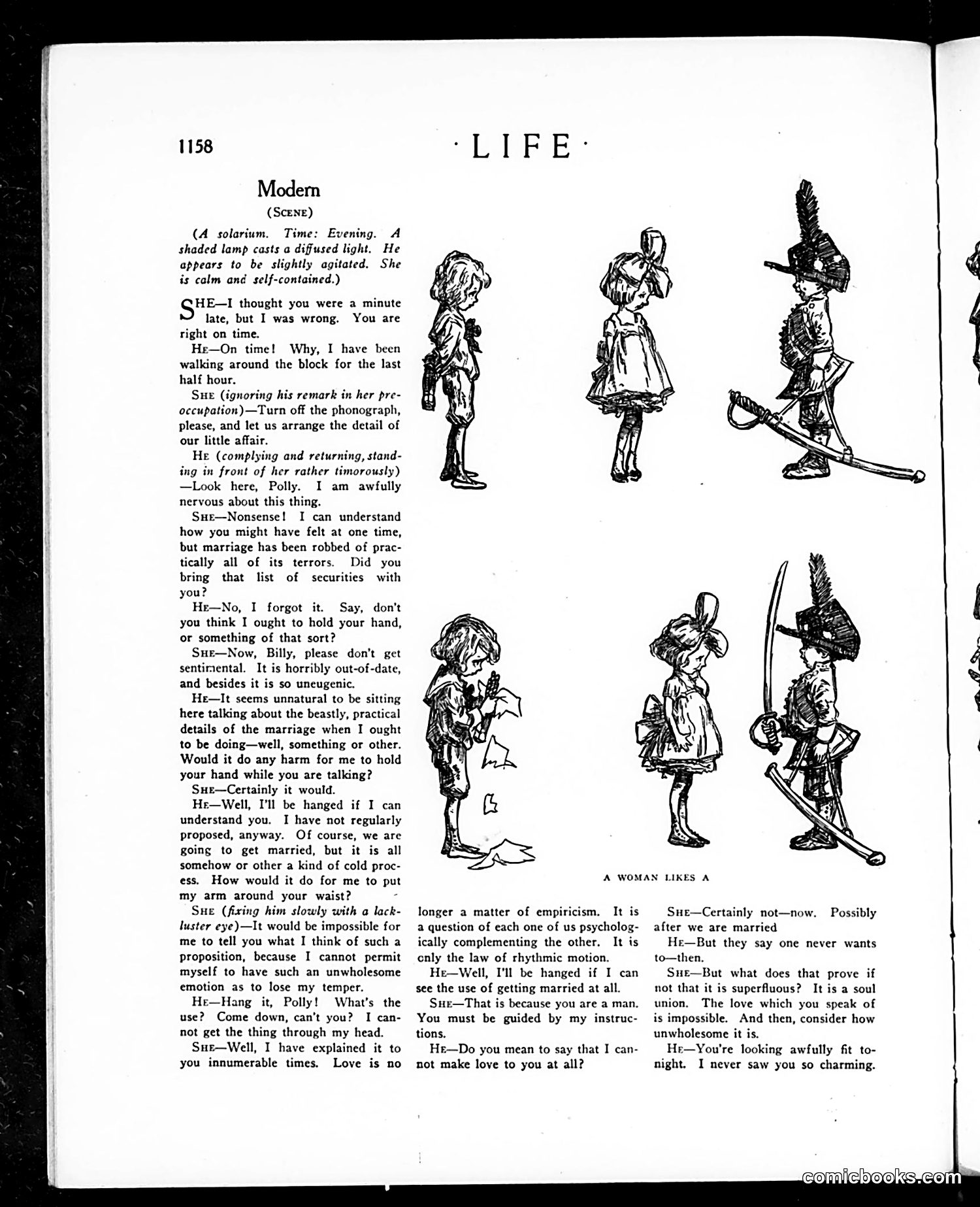
This is a satirical scene mocking early 20th-century "modern" courtship among the educated classes. The humor centers on a couple—identified only as "He/Billy" and "She/Polly"—negotiating marriage in coldly rational, emotionally sterile terms. The satire targets **Progressive Era intellectualism**: the woman dismisses romantic gestures (hand-holding, arm around waist) as "out-of-date" and "uneugenic" (a reference to eugenics pseudoscience). She treats marriage as a contractual "soul union" based on "psychological complementing" and "rhythmic motion"—jargon-heavy abstractions stripped of passion. The man represents conventional sentiment, bewildered by her rejection of romance and physical affection. He can't "get the thing through [his] head." The cartoon's point: by adopting pseudo-scientific rationalism, modern educated women have made courtship absurdly bloodless. The title implies this goes against what women actually want. The joke is that intellectualized "modernity" has destroyed the natural emotional basis of romance.
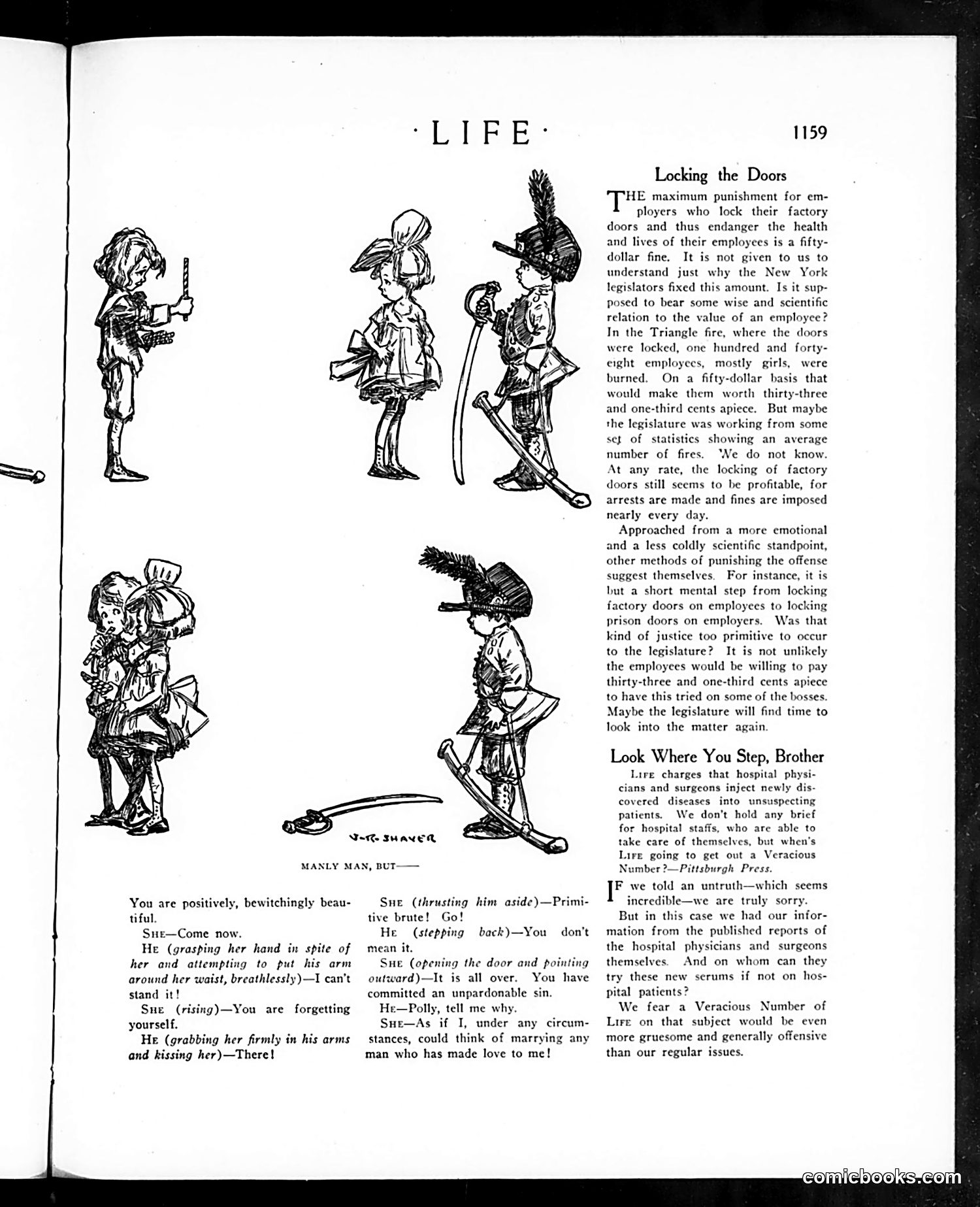
This page contains two distinct pieces. The top features a romantic comedy sketch where a man aggressively kisses a woman ("Sue") without consent, then is shocked when she rejects him for "making love" to her uninvited—satirizing the disconnect between aggressive masculine behavior and social acceptability. The main article, "Locking the Doors," references the **Triangle Shirtwaist Factory Fire** (1911), where locked factory doors trapped workers, killing 148 people, mostly young women. Life criticizes New York's fifty-dollar maximum fine as absurdly inadequate—calculating it values each victim at thirty-three cents. The piece sarcastically suggests employers might find prison time more appropriately punishing than fines, implying the law is toothless against workplace negligence causing mass death. The bottom section defends Life's earlier claim that hospitals inject untested diseases into patients, dismissing a Pittsburgh newspaper's challenge about accuracy.
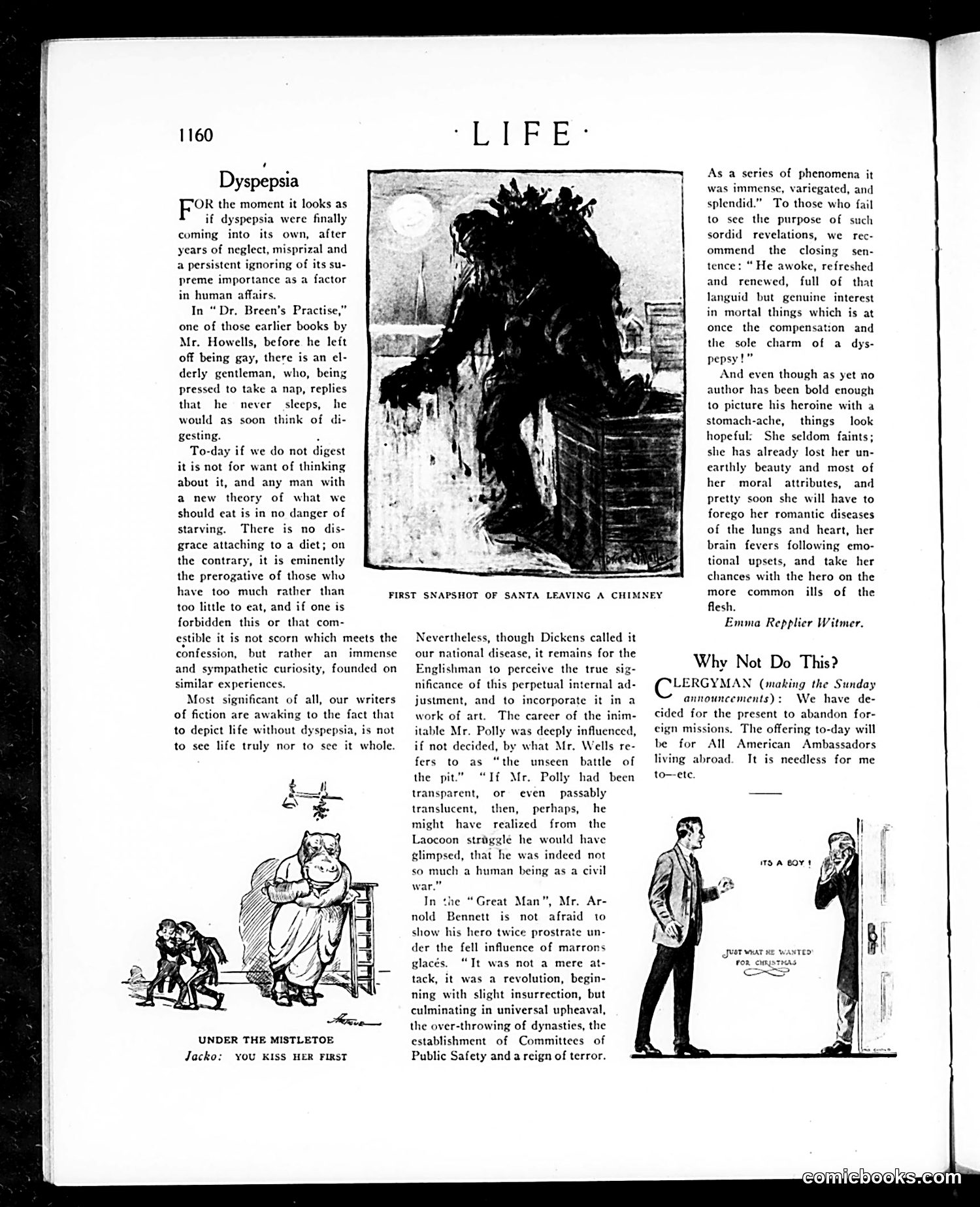
This page from *Life* magazine satirizes the cultural obsession with dyspepsia (indigestion/stomach ailments) in early 20th-century literature and society. The main essay argues that prominent novelists—Dickens, H.G. Wells, and Arnold Bennett—have elevated stomach troubles to dramatic significance in their works, treating digestive distress as a metaphor for internal moral and social conflict. The cartoon "Why Not Do This?" mocks institutional priorities: a clergyman announces the church has abandoned foreign missions to instead collect offerings for American ambassadors abroad—a satirical jab at misplaced charitable focus. The smaller cartoon "Under the Mistletoe" appears to be a humorous domestic sketch about kissing customs. The page reflects early-1900s anxieties about health, consumerism, and changing literary realism that depicted unglamorous bodily functions rather than Victorian sentimentality.
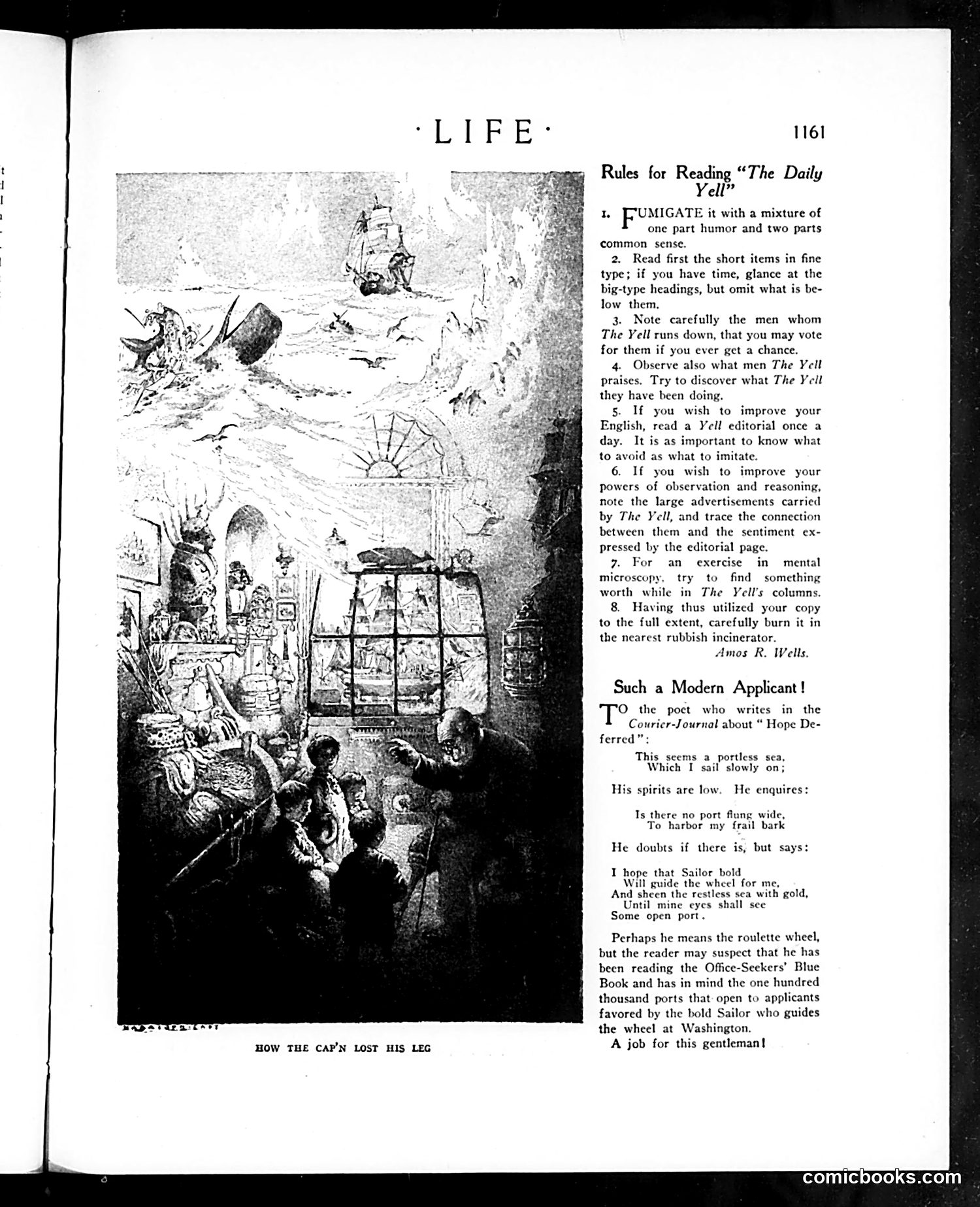
This Life magazine page satirizes American political patronage and office-seeking, particularly targeting the "bold Sailor who guides the wheel at Washington"—likely referring to the sitting President or a prominent political figure who controls federal appointments. The text mocks a poem about hope and harbor, reinterpreting the poet's plea for guidance as a veiled request for a government job. The satire hinges on "ports"—the poem uses this metaphorically, but the article suggests the writer is actually referencing the "one hundred thousand ports that open to applicants" through political favor, implying a vast spoils system of federal positions distributed as patronage rewards. The accompanying illustration ("How the Cap'n Lost His Leg") appears to depict maritime disaster, possibly as a visual metaphor for the chaos or moral injury caused by this patronage system. The "Rules for Reading" mock *The Daily Yell*, suggesting a sensationalist publication whose editorial bias can be discovered by studying its advertisements—implying corrupt financial relationships between media outlets and political interests.
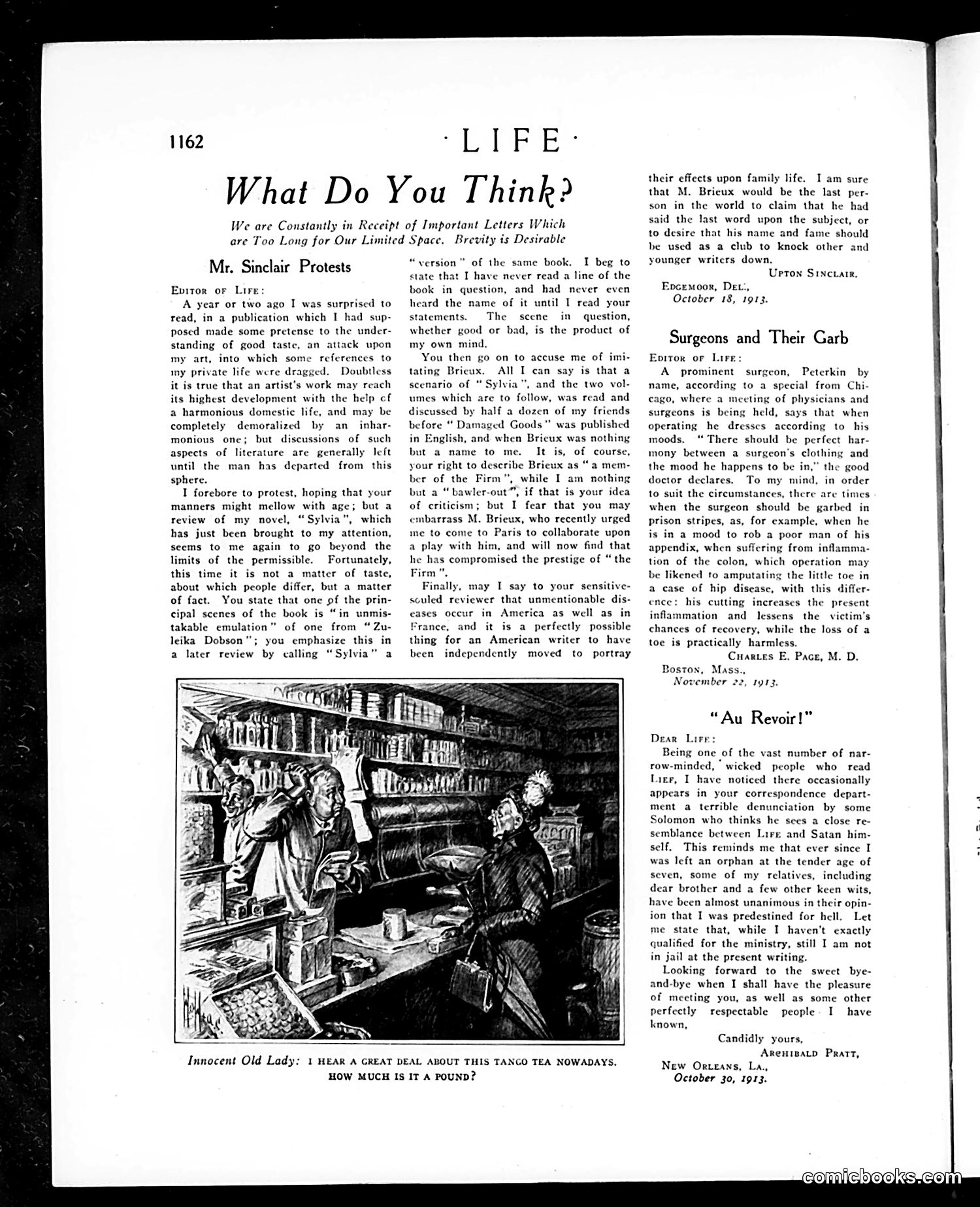
This is a "Letters to the Editor" page from Life magazine (October 1913). The main cartoon depicts an innocent elderly woman asking about "tango tea," confusing the modern dance craze with an actual purchasable commodity—a joke about how bewildered older generations were by contemporary fads. The letters address literary disputes. Upton Sinclair protests that Life accused him of imitating both "Zuleika Dobson" and French playwright Brieux's "Damaged Goods" in his novel "Sylvia." Sinclair claims he never read the former and had written his work before encountering the latter, resenting the magazine's insinuation of plagiarism. He also criticizes Life for dismissing him as a mere "bawler-out" compared to the established Brieux. A second letter sarcastically critiques a surgeon who claims to dress "according to his moods," suggesting this leads to unnecessary operations performed recklessly—mocking medical arrogance and profit-driven healthcare.
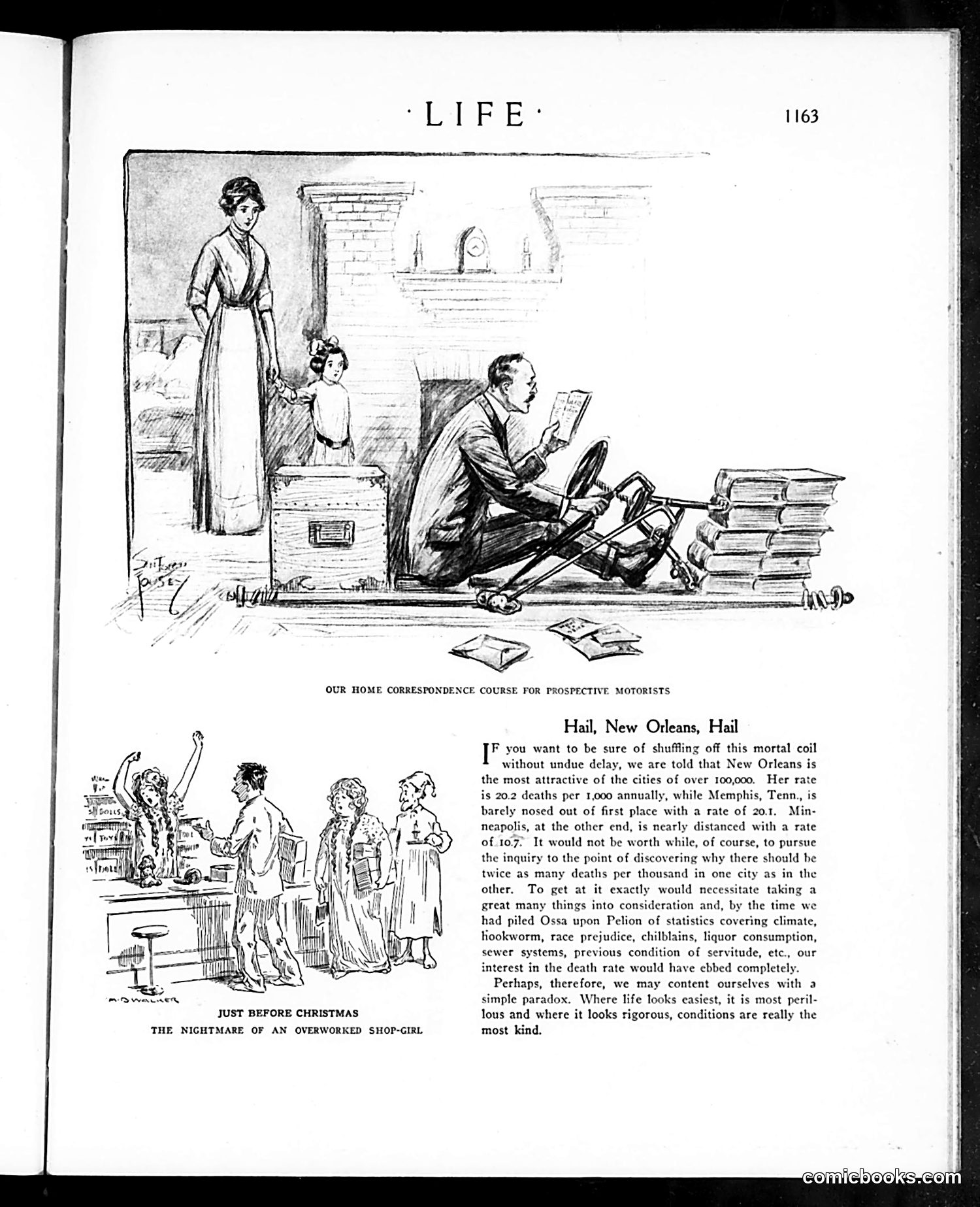
This Life magazine page contains satirical commentary on American mortality rates, particularly targeting New Orleans's high death rate (20.2 per 1,000 annually) compared to other cities like Memphis and Minneapolis. **The Text's Satire:** The article mockingly suggests that if you want to die quickly, move to New Orleans. It then ironically abandons investigating *why* death rates vary so dramatically between cities, dismissing the complexity of factors (climate, disease, sanitation, racial conditions, alcohol consumption) as too tedious to examine. The satire criticizes this willful ignorance—the refusal to address serious public health disparities. The closing paradox suggests that where life appears easiest, it's actually most dangerous; where conditions look harsh, they're actually safest. **The Cartoons:** The top cartoon shows a motorist surrounded by instruction manuals, satirizing amateur drivers. The bottom cartoon depicts an overworked shop-girl before Christmas, illustrating labor exploitation during the holiday season. Both connect to the article's theme: societal problems people ignore or accept without investigation.
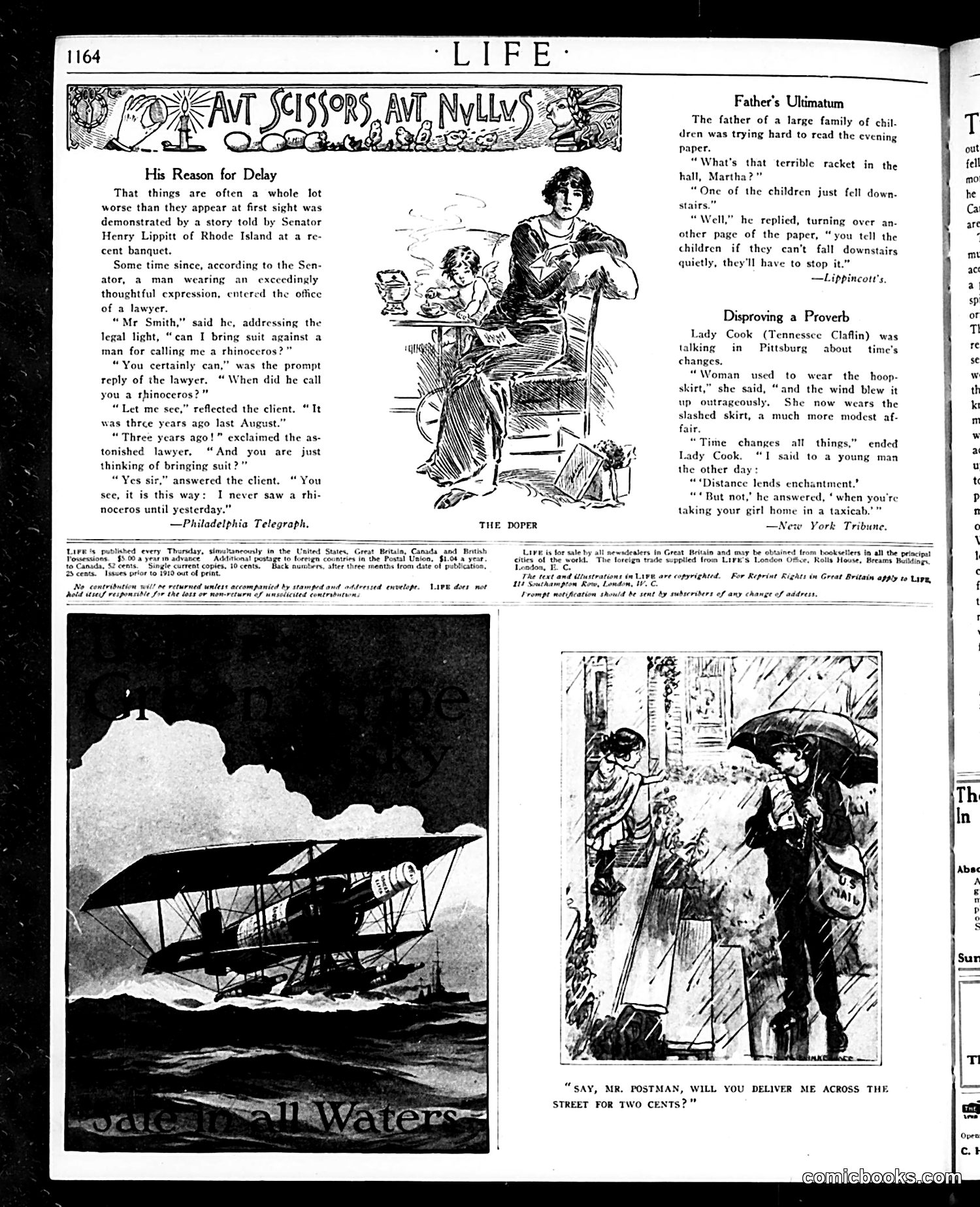
This page contains three separate humorous anecdotes typical of Life's satirical content: **"His Reason for Delay"**: A lawyer story where a client delays three years before suing someone who called him a rhinoceros. The joke's absurdity lies in the client finally deciding to act only after *seeing an actual rhinoceros*, suggesting he needed proof the insult was even possible. **"Father's Ultimatum"**: A domestic humor piece where a father, absorbed in his newspaper, tells his wife to instruct the children to fall downstairs *quietly* rather than stop the noise—prioritizing his reading comfort over parental concern. **"Disproving a Proverb"**: Lady Cook discusses how fashion changes (hoopskirts to slashed skirts), then cites a young man's witty retort: while "distance lends enchantment," it doesn't when riding home in a taxicab with one's date—a reference to early automobile dating culture and cramped intimacy. The page also features an aviation illustration (appears to be early aircraft over water) and a street scene. These are light, domestic satires targeting everyday social pretensions and behaviors.
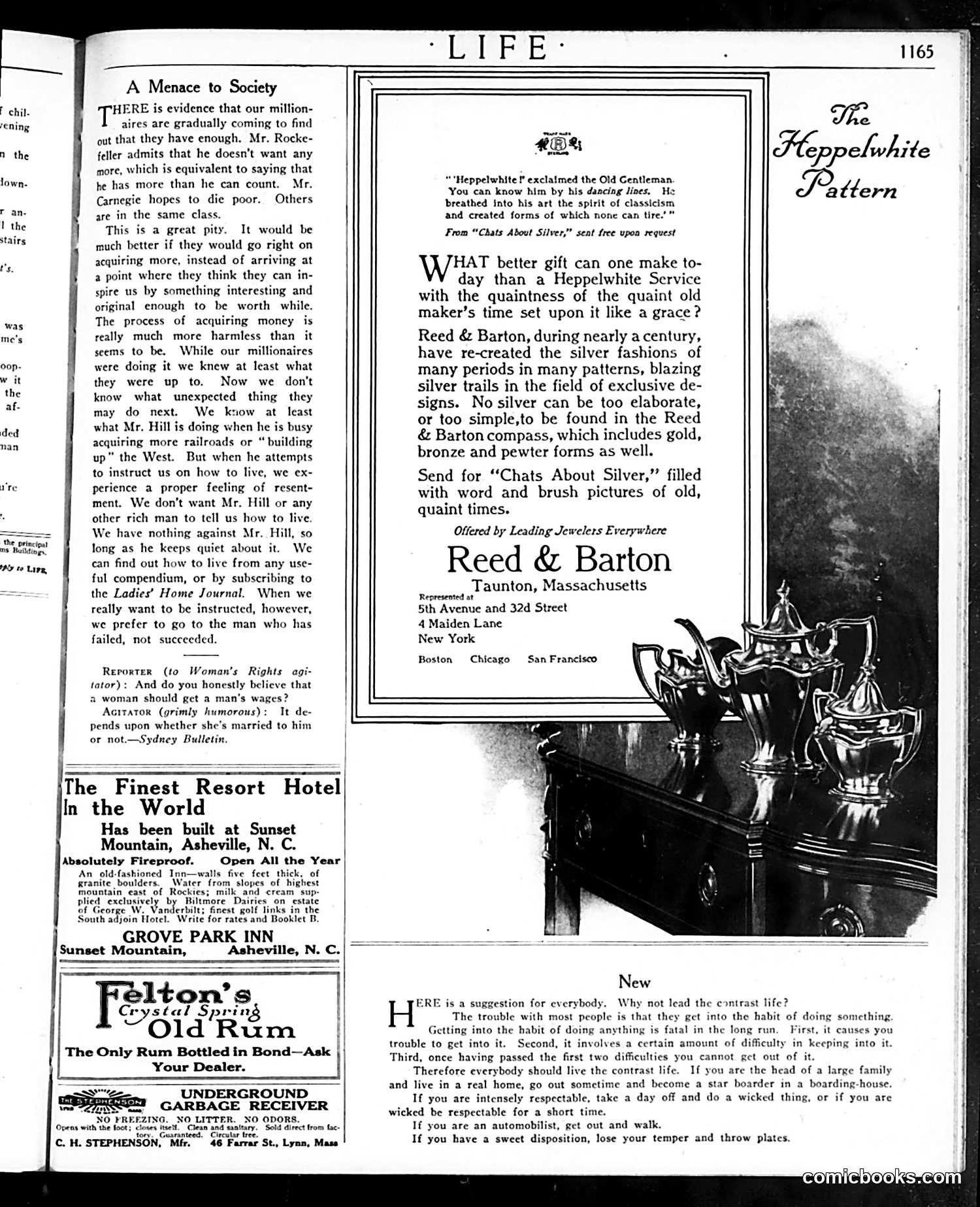
This page contains social satire and period advertising. The main editorial piece "A Menace to Society" critiques wealthy industrialists (Rockefeller, Carnegie, and railroad magnate James J. Hill) who've begun dispensing life advice to the public. The author argues that while accumulating wealth kept the rich predictably occupied, now they're offering unsolicited moral instruction—which the writer finds presumptuous. The satire suggests the public should take life advice from "the man who has failed, not succeeded." A brief humor item jokes about equal pay: a woman's rights activist says a woman deserves a man's wages "depending on whether she's married to him or not"—implying wives should earn differently than other workers, a darkly comic jab at both traditional marriage economics and the women's suffrage movement. The remainder comprises advertisements for luxury goods (silver service, resort hotel, rum) and household products—typical of Life's mixed editorial-advertising format of this era.
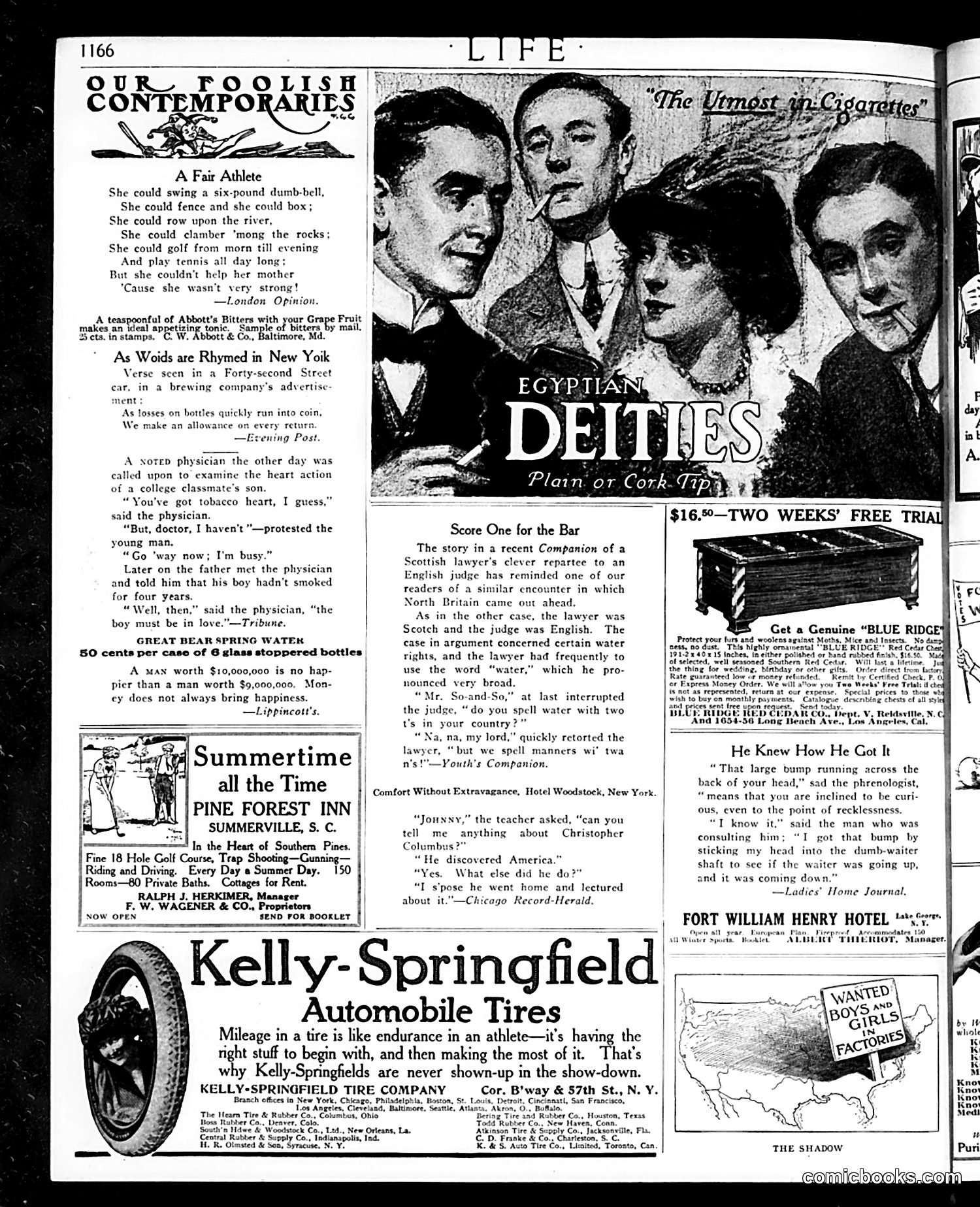
This page from *Life* magazine contains mostly **advertisements and humorous satirical verses** rather than political cartoons. The satirical content mocks contemporary social contradictions through short verses: "A Fair Athlete" ridicules the "New Woman" phenomenon—a young woman athletic enough for boxing, tennis, and golf, yet "wasn't very strong" to help her mother, satirizing the perceived superficiality of women's athletic pursuits. "Score One for the Bar" presents a Scottish lawyer outwitting an English judge through wordplay about Scottish pronunciation. A physician joke suggests a young man "must be in love" based on heart palpitations rather than tobacco use. The **Egyptian Deities** advertisement in the center appears unrelated to satire—it advertises cork-tipped cigarettes. Overall, this reflects early-20th-century American humor targeting gender roles, national stereotypes (Scottish-English rivalry), and romantic sentimentality, alongside heavy advertising content typical of *Life*'s format.
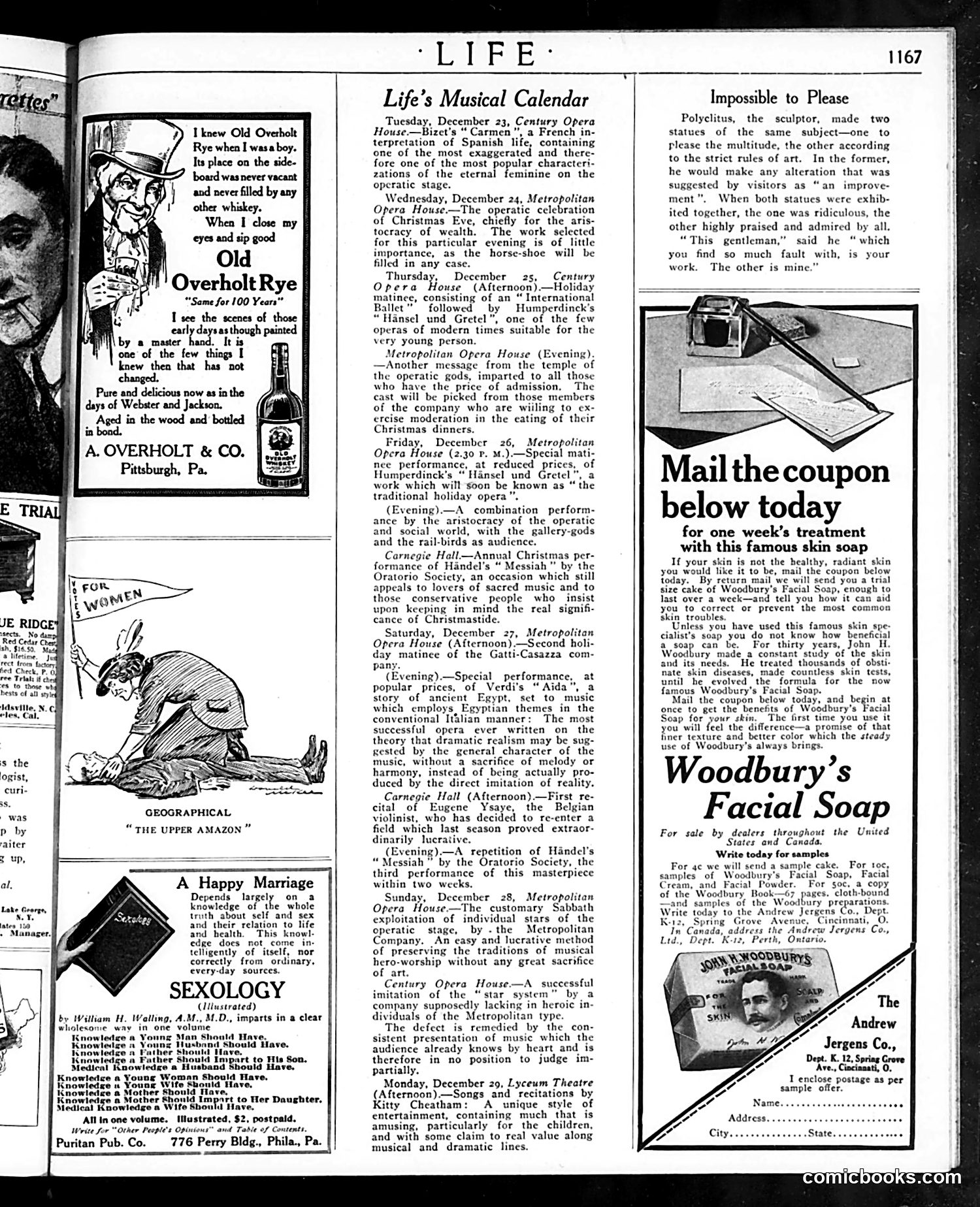
This page is primarily **advertising and entertainment listings**, not political satire. **Content identified:** 1. **Old Overholt Rye whiskey ad** (left): Nostalgic appeal claiming the product is "Pure and delicious now as in the days of Webster and Jackson"—referencing early American statesmen to suggest timeless quality. 2. **"A Happy Marriage" / Sexology book ad** (bottom left): Promotes an illustrated guide to sexual and marital knowledge by William H. Walling, M.D.—typical of early 20th-century "medical" sex education literature. 3. **Life's Musical Calendar** (center): Lists Metropolitan Opera House and other venues' December performances, with satirical commentary mocking opera's appeal to wealthy audiences ("aristocracy of wealth") and society's predictable attendance. 4. **"Impossible to Please"** (right): Retells Polyclitus's classical parable about sculptor's dilemma—one statue pleases the public, one satisfies artistic standards—a timeless commentary on populism versus artistic merit. 5. **Woodbury's Facial Soap ad** (right): Period beauty product advertisement.
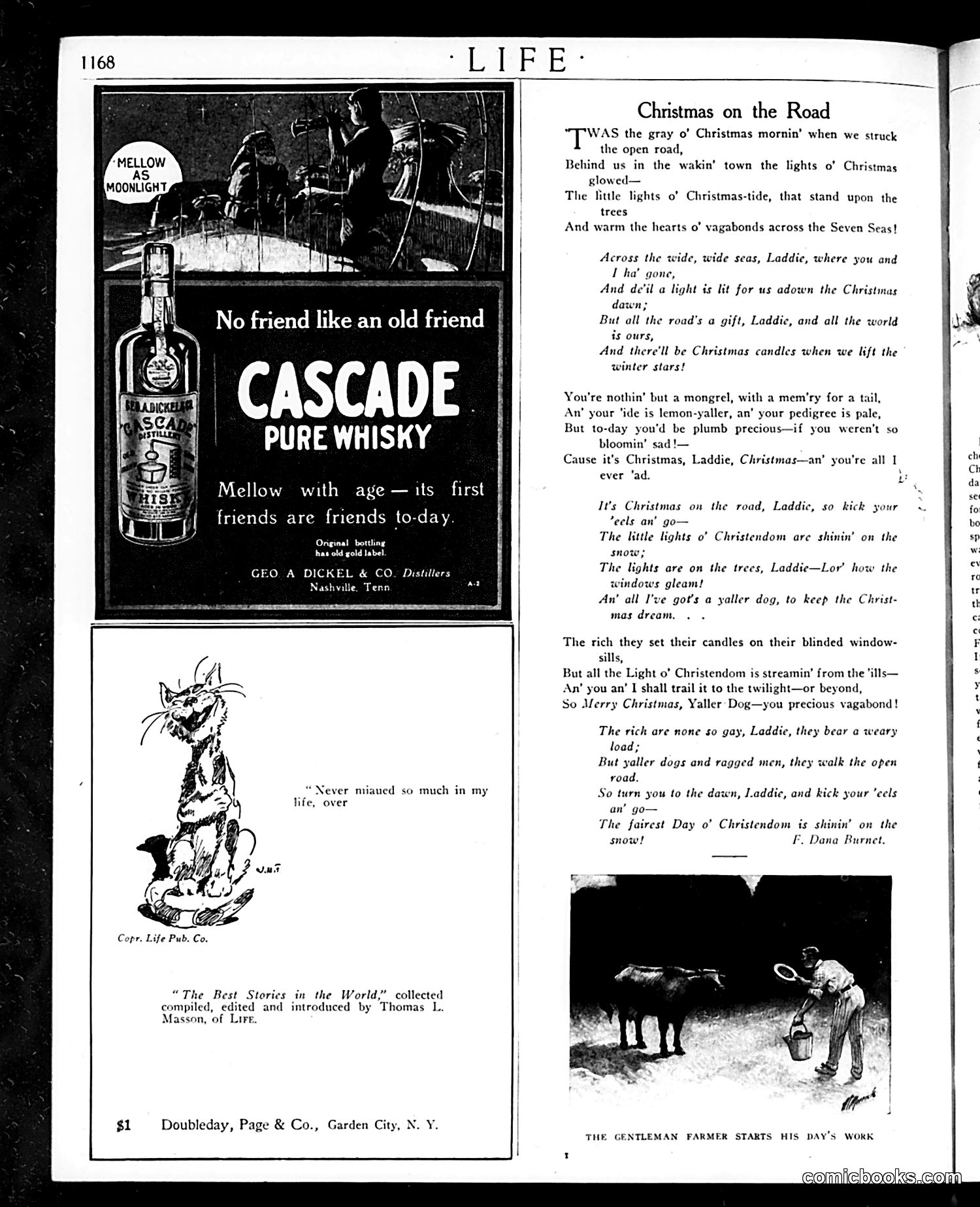
This page combines a whiskey advertisement with a sentimental poem about Christmas experienced by homeless vagabonds and their dog. **The Advertisement** (left): Cascade Pure Whisky uses the phrase "No friend like an old friend" and "Mellow with age—its first friends are friends to-day," featuring a bottle and vintage imagery. This is straightforward product marketing. **The Poem** (right): "Christmas on the Road" by F. Dana Burnet romanticizes the Christmas experience of poor traveling men ("vagabonds") and a stray yellow dog. The speaker contrasts the wealthy's candlelit homes with the "Light o' Christendom" visible in nature and accessible to the poor. The poem's sentiment—that the homeless and their companion dog possess spiritual richness despite material poverty—reflects early 20th-century sentimental attitudes toward the underclass. Rather than satirical, this appears intended as touching social commentary, suggesting that Christmas's true meaning transcends wealth.
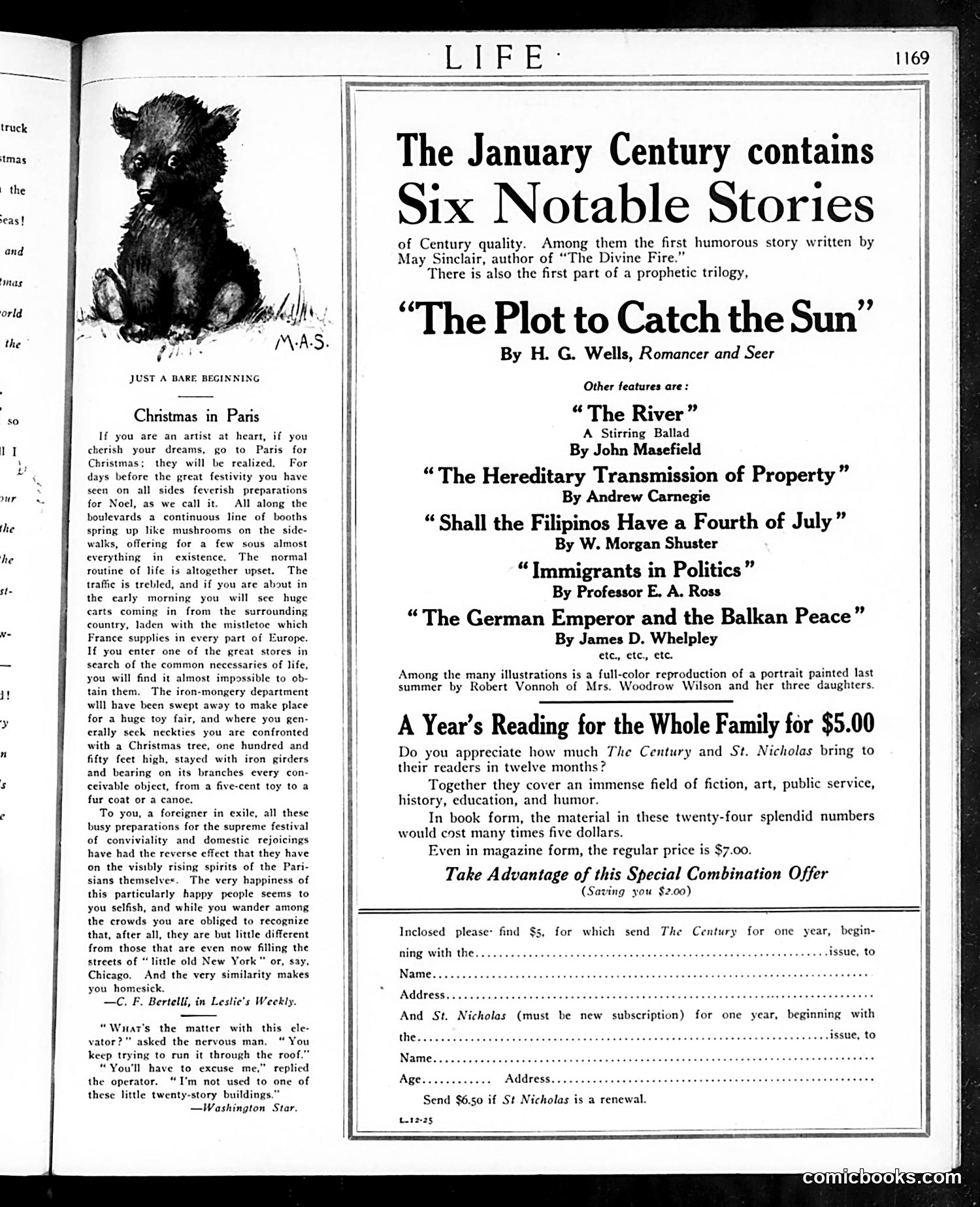
This page is primarily **advertising and editorial promotion** rather than satirical content. The main elements are: **Left side:** Two brief humorous anecdotes—one about Christmas preparations in Paris (describing the festive chaos of holiday shopping), and one joke about an elevator operator unfamiliar with tall buildings, reflecting early 20th-century urban growth. **Right side:** A full-page advertisement for *The Century* magazine's January issue, promoting six notable stories and articles by prestigious authors including H.G. Wells, Andrew Carnegie, and James D. Whelpley. It advertises a subscription bundle offer combining *The Century* and *St. Nicholas* magazines for $5.00 annually. **Small illustration:** "Just a Bare Beginning"—a sketch of a young bear cub, likely decorative. The page reflects *Life*'s dual function as both satirical publication and vehicle for advertising quality magazines and cultural products to educated, affluent readers of the era.
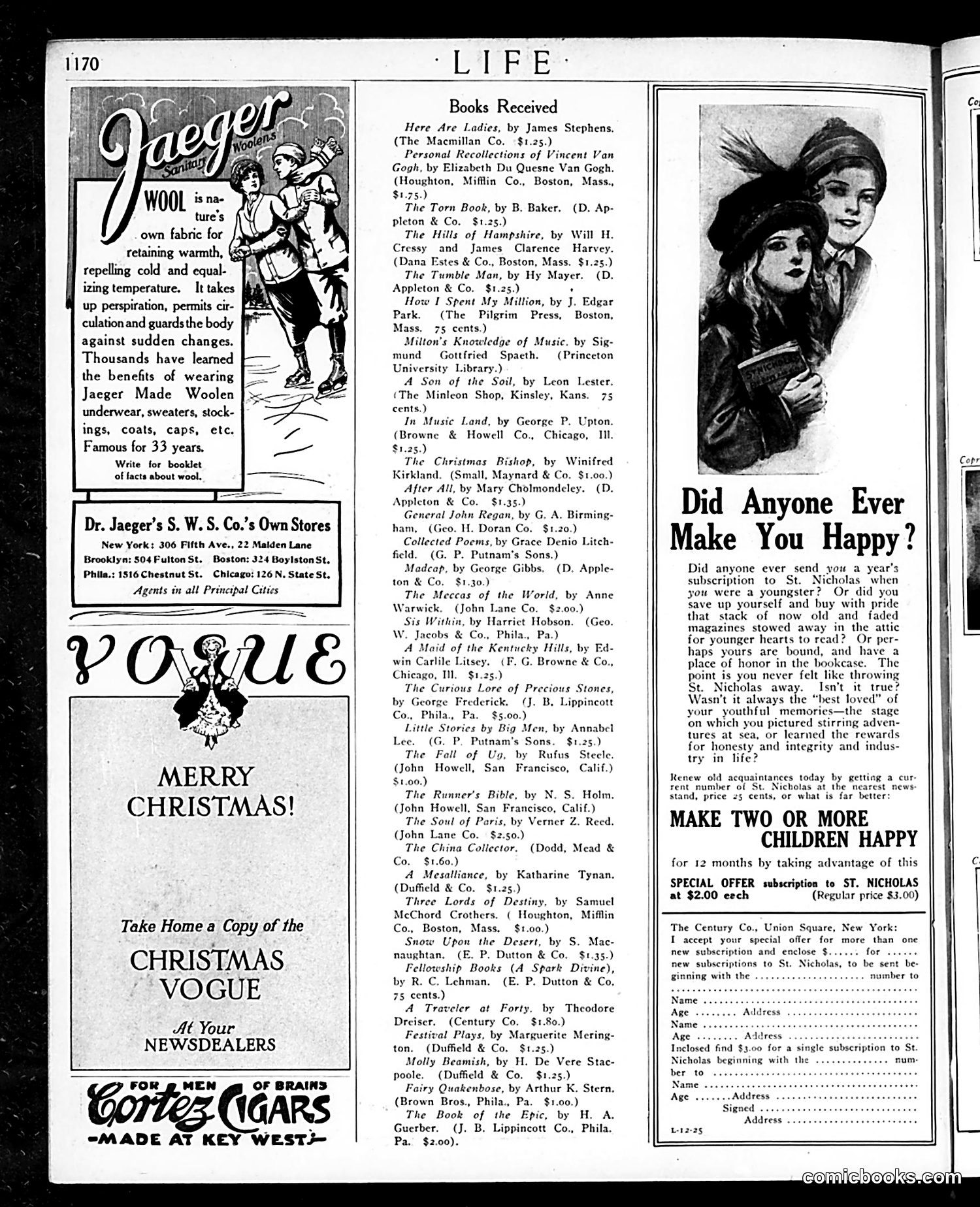
This page is primarily **advertising and book listings**, not satirical content. The left side features ads for Jaeger wool products and Cortez cigars, with a generic "Merry Christmas" greeting promoting *Christmas Vogue* magazine. The main editorial content is a "Books Received" column listing recently published titles with publishers and prices—typical literary coverage for the era. The notable feature is a right-side advertisement for **St. Nicholas magazine subscriptions**, which uses nostalgic appeal ("Did anyone ever make you happy?") to market annual subscriptions to children at $2.00. It references the magazine as a cherished childhood memory, encouraging adults to gift subscriptions to make children happy. This page contains **no political cartoons or satire**—it's a straightforward mix of holiday advertising and book reviews typical of *Life* magazine's commercial content from this period (appears to be early 1900s based on typography and style).
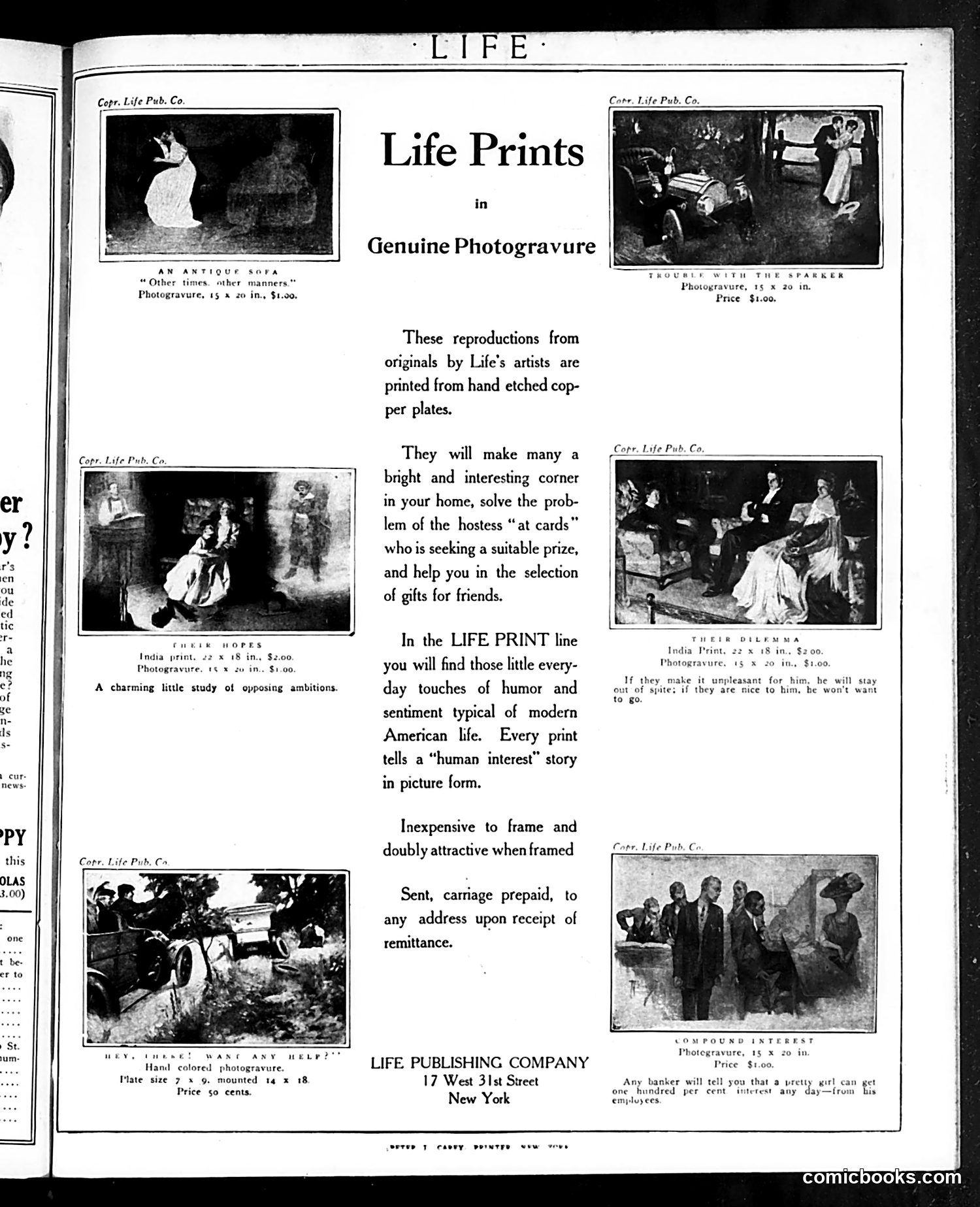
This is primarily an **advertising page**, not a political cartoon. Life Publishing Company markets reproductions of humorous genre scenes from Life magazine's artists, printed via photogravure (a printing technique). The six small illustrations shown depict everyday domestic and social situations with titles like "An Antique Sofa," "Trouble with the Sparker," "Their Dilemma," and "Compound Interest." These appear to illustrate minor comedic scenarios of modern American life—a couple on a sofa, romantic/courtship situations, and office dynamics. The page emphasizes these prints as affordable home décor and gift solutions, priced between 50 cents and $2.00. The humor targets middle-class audiences with references to "hostess at cards" seeking prizes and workplace interactions. The final caption about a "pretty girl" attracting bank employee interest reflects early-20th-century workplace social attitudes. This is essentially a **mail-order catalog page** selling sentimental, humorous domestic scenes to contemporary readers.
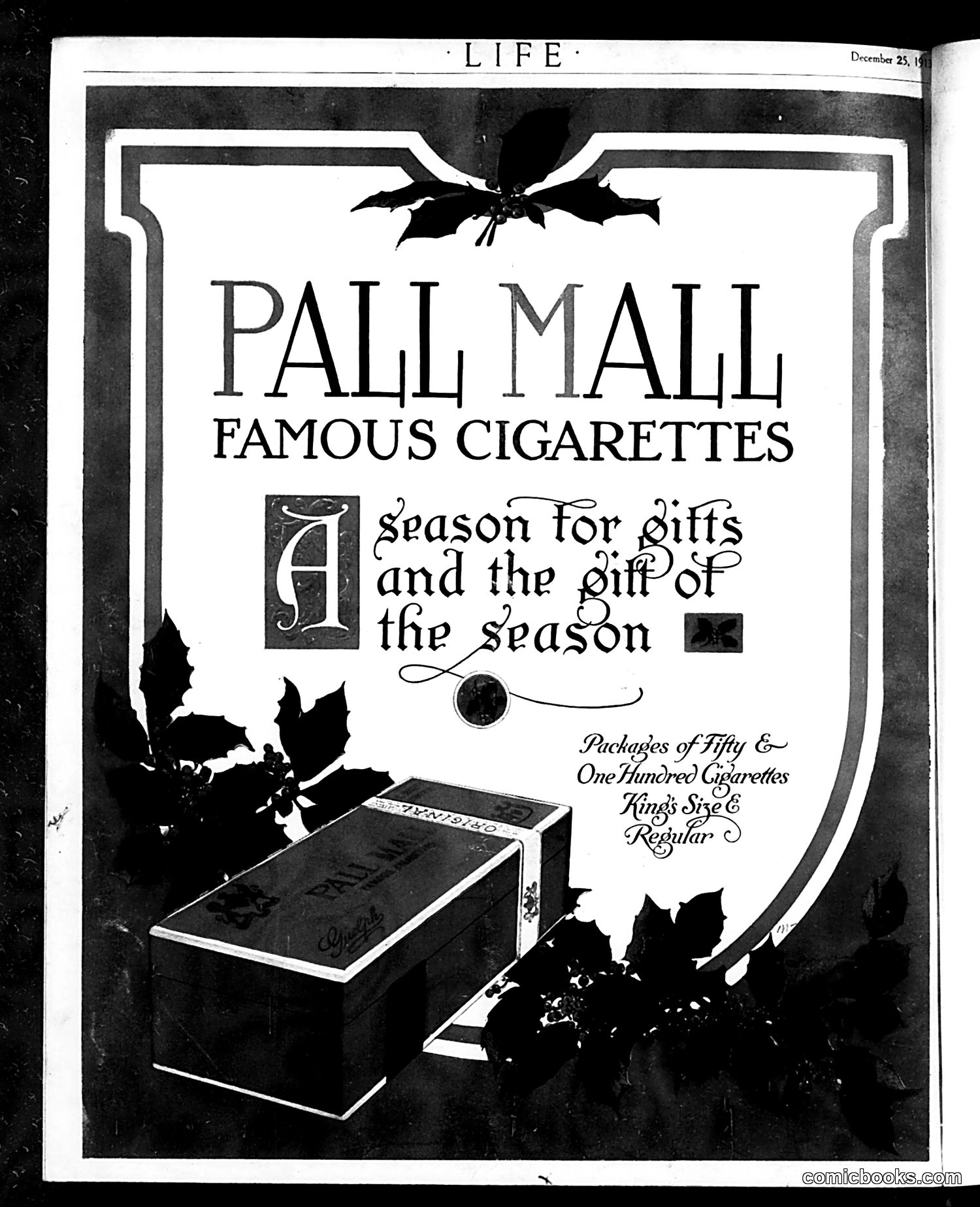
This is a full-page advertisement for Pall Mall cigarettes from *Life* magazine (dated December 23, based on the header). The ad promotes cigarette packages as holiday gifts, specifically targeting the Christmas season ("season for gifts and the gift of the season"). The design features decorative holly leaves and an ornate border framing a product display showing a Pall Mall cigarette package. Text indicates availability in two sizes: "Kings Size & Regular," in packages of fifty and one hundred cigarettes. This is straightforward commercial advertising rather than editorial satire or political commentary. It reflects the historical period when cigarette advertising was legal and commonplace in American magazines, and when gifting cigarettes was considered an acceptable holiday present.
This page appears to be blank or nearly blank, containing only a watermark reading "comicbooks.com" at the bottom. There is no visible cartoon, illustration, text content, or satirical material to analyze. The page may be a blank interior page from a Life magazine issue, a title page, or an advertising page. Without visible content—whether political cartoons, satirical illustrations, or accompanying text describing social or political commentary—I cannot identify any figures, caricatures, references, or satirical points for a modern reader to understand. If this is meant to contain editorial material, the image quality or scanning may have resulted in the content being imperceptible.