
Life, 1913-12-25 · page 18 of 41
Life — December 25, 1913 — page 18: what you’re looking at
What you’re looking at
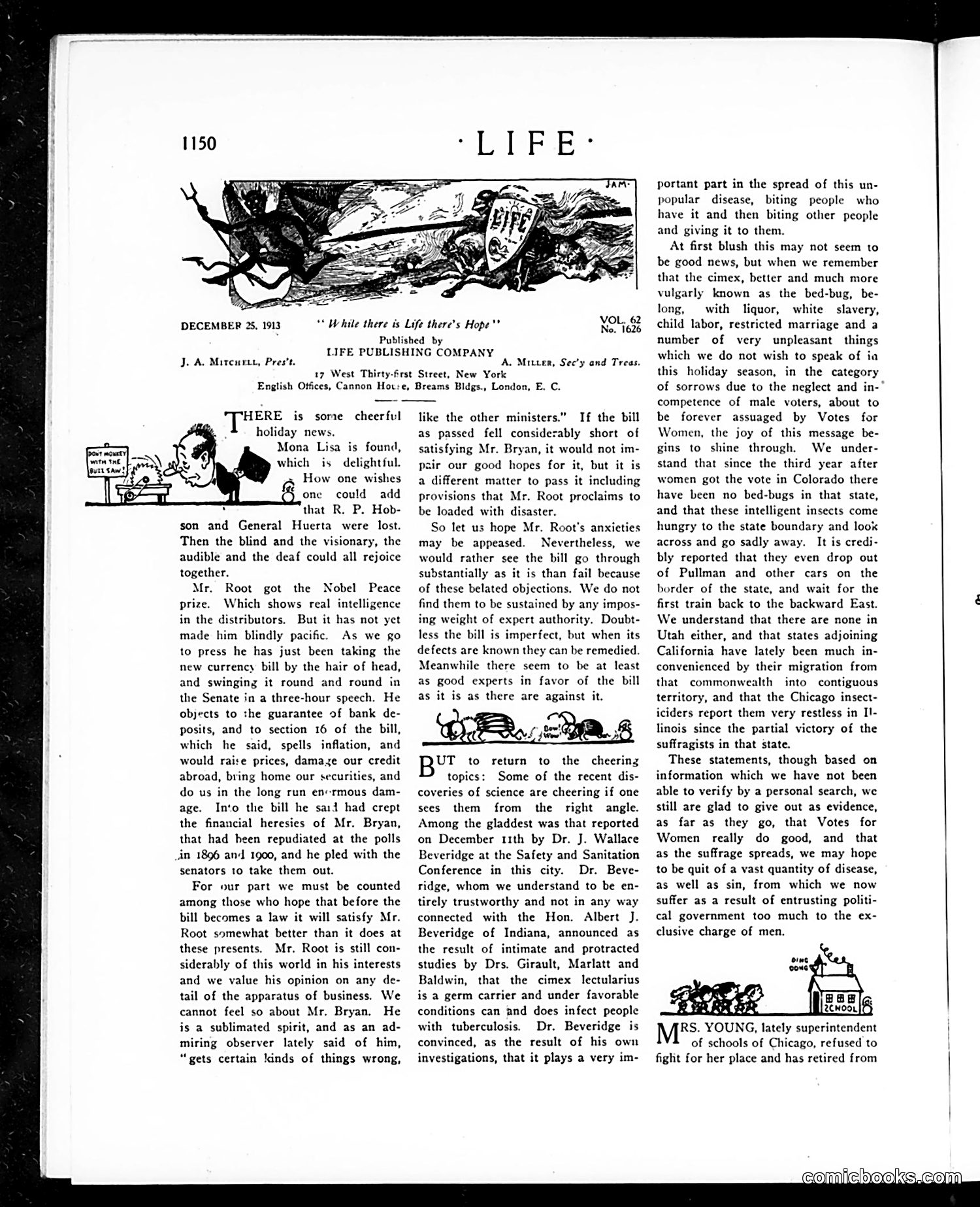
This editorial page discusses recent news and political matters. The main cartoon (top left) appears to depict a figure in bed, likely satirizing the discovery that bed bugs transmit tuberculosis—presented as darkly "cheerful" holiday news. The text praises the recovery of the Mona Lisa but sarcastically wishes that politicians R.P. Hobson and Mexican General Huerta were also "lost." The bulk addresses Senator Elihu Root's opposition to the new Federal Reserve currency bill, which Root believes contains inflationary "heresies" from William Jennings Bryan's earlier rejected policies. Life supports the bill despite its imperfections, valuing Root's business expertise but dismissing Bryan as an impractical "sublimated spirit." The piece concludes by mockingly celebrating Dr. Beveridge's discovery that bed bugs (cimex lectularius) spread tuberculosis—grouping this pest with liquor, white slavery, and child labor as societal evils. The satire suggests bed bugs join other disreputable problems of the era.
📄 Transcribed text from this page (OCR, searchable)
Machine-transcribed from the original scan — historical spelling and the odd misread are preserved.
DECEMBER 25, 1913 J. A. Mitcurit, Pres’t. “* While there is Life there's Hope" Published by LIFE PUBLISHING COMPANY VOL. 62 No. 1626 A. Mutter, Sec’y and Treas. 17 West Thirty-first Street, New York English Offices, Cannon Hot:e, Breams Bldgs., London, E. C. 'HERE is some cheerful holiday news. Mona Lisa is found, which is delightful. x How one wishes one could add s that R. P. Hob- son and General Huerta were lost. Then the blind and the visionary, the audible and the deaf could all rejoice together. Mr. Root got the Nobel prize. Which shows real intelligence in the distributors. But it has not yet made him blindly pacific. As we go to press he has just been taking the new currency bill by the hair of head, and swinging it round and round in the Senate in a three-hour speech. He objects to the guarantee of bank de- posits, and to section 16 of the bill, which he said, spells inflation, and would raise prices, damage our credit abroad, bring home our securities, and do us in the long run en-rmous dam- age. Into the bill he said had crept the financial heresies of Mr. Bryan, that had heen repudiated at the polls in 1896 and 1900, and he pled with the senators to take them out. For our part we must be counted among those who hope that before the bill becomes a law it will satisfy Mr. Root somewhat better than it does at these presents. Mr. Root is still con- siderably of this world in his interests and we value his opinion on any de- tail of the apparatus of business. We cannot feel so about Mr. Bryan. He is a sublimated spirit, and as an ad- miring observer lately said of him, “gets certain Idnds of things wrong, Peace like the other ministers.” If the bill as passed fell considerably short of satisfying Mr. Bryan, it would not im- pair our good hopes for it, but it is a different matter to pass it including provisions that Mr. Root proclaims to be loaded with disaster. So let us hope Mr. Root's anxieties may be appeased. Nevertheless, we would rather see the bill go through substantially as it is than fail because of these belated objections. We do not find them to be sustained by any impos- ing weight of expert authority. Doubt- less the bill is imperfect, but when its defects are known they can be remedied. Meanwhile there seem to be at least as good experts in favor of the bill as it is as there are against it. C2 BB UT to return to the cheering topics: Some of the recent dis- coveries of science are cheering if one sees them from the right angle. Among the gladdest was that reported on December 11th by Dr. J. Wallace Beveridge at the Safety and Sanitation Conference in this city. Dr. Beve- ridge, whom we understand to be en- tirely trustworthy and not in any way connected with the Hon. Albert J. Beveridge of Indiana, announced as the result of intimate and protracted studies by Drs. Girault, Marlatt and Baldwin, that the cimex lectularius is a germ carrier and under favorable conditions can and does infect people with tuberculosis. Dr. Beveridge is convinced, as the result of his own investigations, that it plays a very im- portant part in the spread of this un- popular disease, biting people who have it and then biting other people and giving it to them. At first blush this may not seem to be good news, but when we remember that the cimex, better and much more vulgarly known as the bed-bug, be- long, with liquor, white slavery, child labor, restricted marriage and a number of very unpleasant things which we do not wish to speak of ia this holiday season, in the category of sorrows due to the neglect and in-" competence of male voters, about to be forever assuaged by Votes for Women, the joy of this message be- gins to shine through. We under- stand that since the third year after women got the vote in Colorado there have been no bed-bugs in that state, and that these intelligent insects come hungry to the state boundary and look across and go sadly away. It is credi- bly reported that they even drop out of Pullman and other cars on the border of the state, and wait for the first train back to the backward East. We understand that there are none in Utah either, and that states adjoining California have lately been much in- convenienced by their migration from that commonwealth into contiguous territory, and that the Chicago insect- iciders report them very restless in I!- linois since the partial victory of the suffragists in that state. These statements, though based on information which we have not been able to verify by a personal search, we still are glad to give out as evidence, as far as they go, that Votes for Women really do good, and that as the suffrage spreads, we may hope to be quit of a vast quantity of disease, as well as sin, from which we now suffer as a result of entrusting politi- cal government too much to the ex- clusive charge of men. COCO eS G08: RS. YOUNG, lately superintendent of schools of Chicago, refused to fight for her place and has retired from