
Life, 1913-12-25 · page 26 of 41
Life — December 25, 1913 — page 26: what you’re looking at
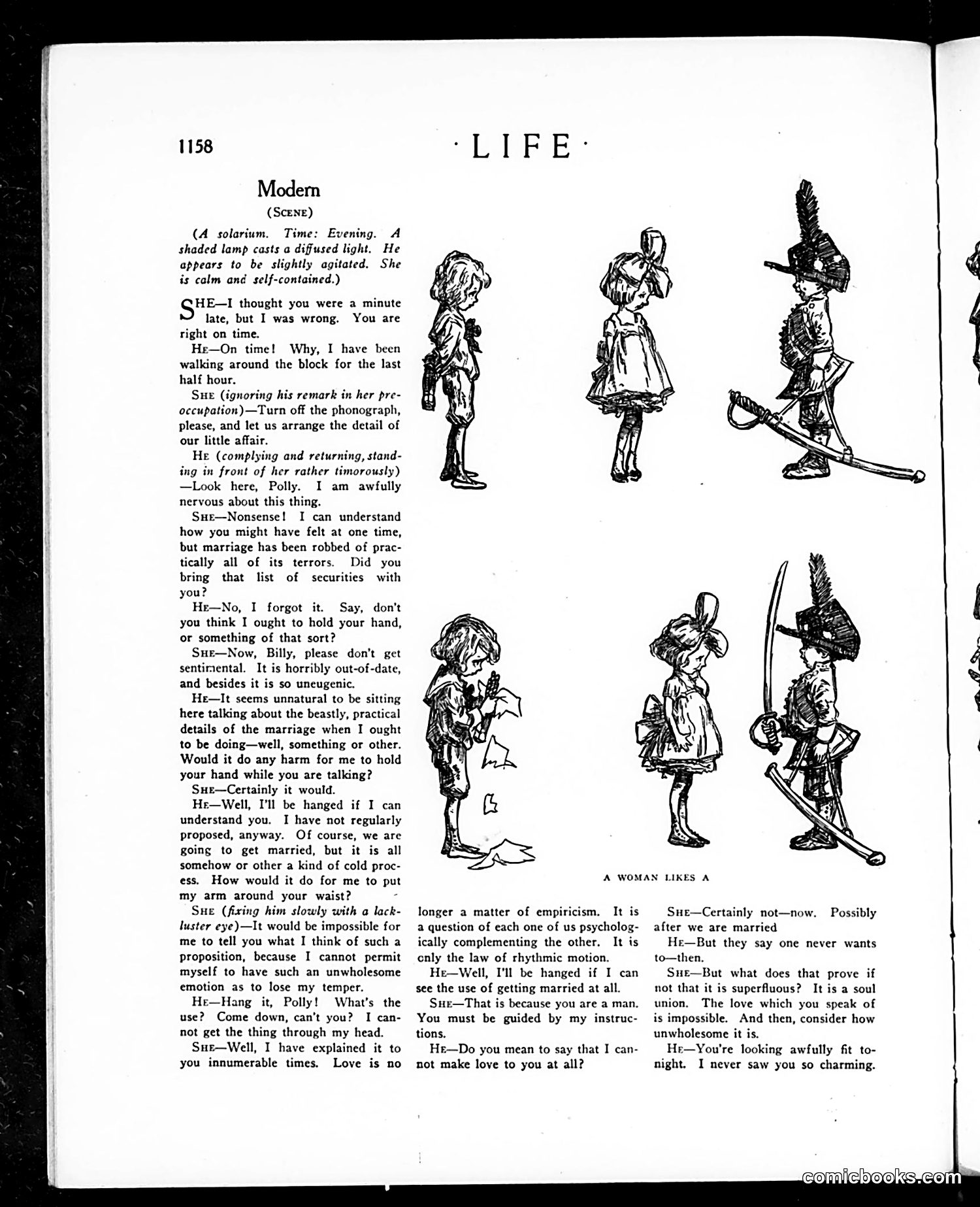
What you’re looking at
This is a satirical scene mocking early 20th-century "modern" courtship among the educated classes. The humor centers on a couple—identified only as "He/Billy" and "She/Polly"—negotiating marriage in coldly rational, emotionally sterile terms. The satire targets **Progressive Era intellectualism**: the woman dismisses romantic gestures (hand-holding, arm around waist) as "out-of-date" and "uneugenic" (a reference to eugenics pseudoscience). She treats marriage as a contractual "soul union" based on "psychological complementing" and "rhythmic motion"—jargon-heavy abstractions stripped of passion. The man represents conventional sentiment, bewildered by her rejection of romance and physical affection. He can't "get the thing through [his] head." The cartoon's point: by adopting pseudo-scientific rationalism, modern educated women have made courtship absurdly bloodless. The title implies this goes against what women actually want. The joke is that intellectualized "modernity" has destroyed the natural emotional basis of romance.
📄 Transcribed text from this page (OCR, searchable)
Machine-transcribed from the original scan — historical spelling and the odd misread are preserved.
Modem (Scene) (A solarium. Time: Evening. A shaded lamp casts a diffused light. He appears to be slightly agitated. She is calm and self-contained.) HE —I thought you were a minute late, but I was wrong. You are right on time. He—On time! Why, I have been walking around the block for the last half hour. Sue (ignoring his remark in her pre- occupation) —Turn off the phonograph, please, and let us arrange the detail of our little affair. HE (complying and returning, stand- ing in front of her rather timorously) —Look here, Polly. I am awfully nervous about this thing. Sue—Nonsense! I can understand how you might have felt at one time, but marriage has been robbed of prac- tically all of its terrors. Did you bring that list of securities with you? He—No, I forgot it. Say, don't you think I ought to hold your hand, or something of that sort? Sue—Now, Billy, please don’t get sentimental. It is horribly out-of-date, and besides it is so uneugenic. He—It seems unnatural to be sitting here talking about the beastly, practical details of the marriage when I ought to be doing—well, something or other. Would it do any harm for me to hold your hand while you are talking? Sue—Certainly it would. He—Well, I'll be hanged if I can understand you. I have not regularly proposed, anyway. Of course, we are going to get married, but it is all somehow or other a kind of cold proc- ess. How would it do for me to put my arm around your waist? 2 Sue (fixing him slowly with a lack- luster eye)—It would be impossible for me to tell you what I think of such a Proposition, because I cannot permit myself to have such an unwholesome emotion as to lose my temper. He—Hang it, Polly! What's the use? Come down, can’t you? I can- not get the thing through my head. Sue—Well, I have explained it to you innumerable times. Love is no A WOMAN LIKES A It is longer a matter of empiricism. a question of each one of us psycholog- ically complementing the other. It is enly the law of rhythmic motion. He—Well, I'll be hanged if I can see the use of getting married at all. Sue—That is because you are a man. You must be guided by my instruc- tions. He—Do you mean to say that I can- not make love to you at all? Sue—Certainly not—now. after we are married He—But they say one never wants to—then, Sue—But what does that prove if not that it is superfluous? It is a soul union. The love which you speak of is impossible. And then, consider how unwholesome it is. He—You're looking awfully fit to- night. I never saw you so charming. Possibly