
Life, 1913-12-25 · page 23 of 41
Life — December 25, 1913 — page 23: what you’re looking at
What you’re looking at
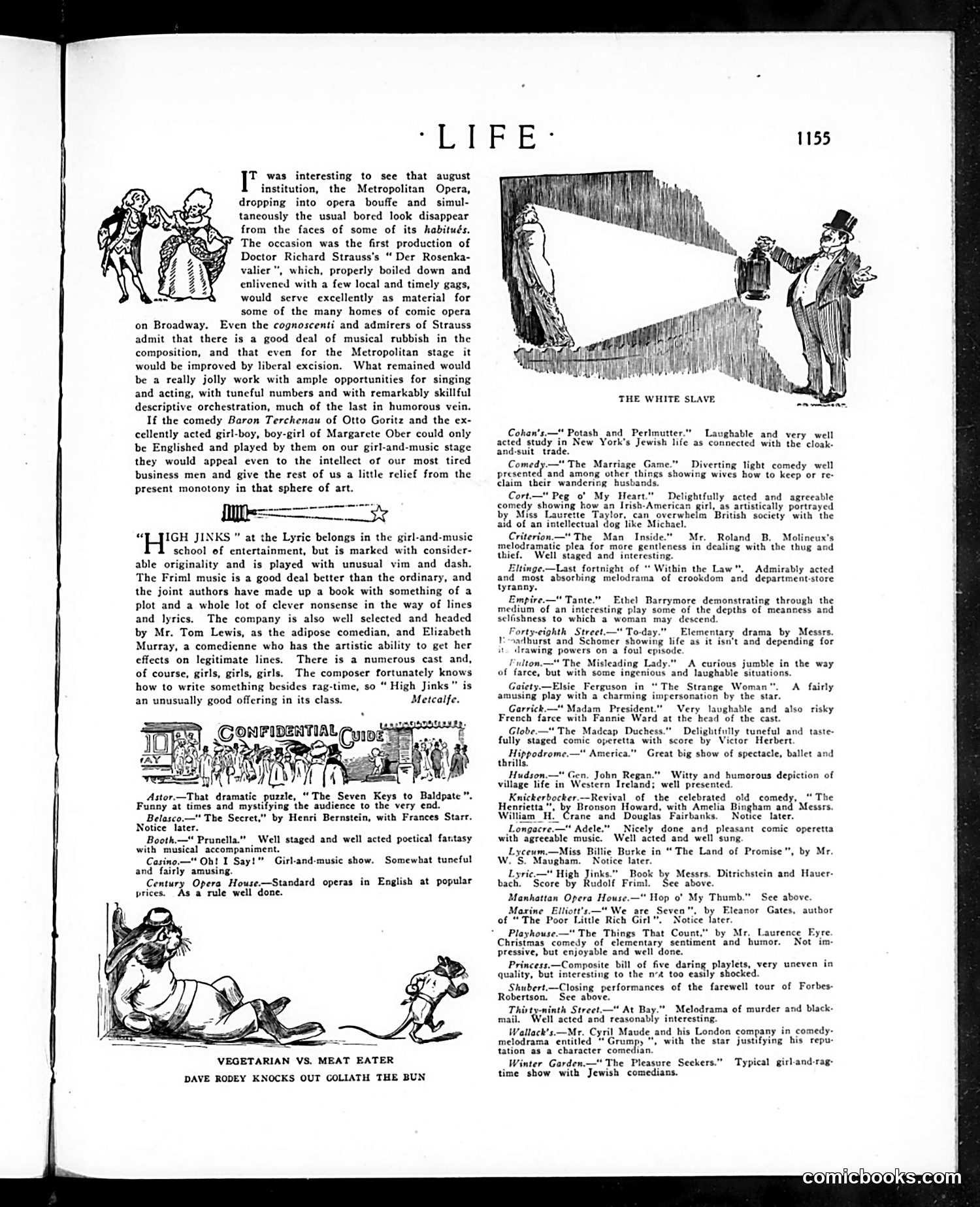
This page surveys New York theatrical productions, primarily comedies and operettas. The text critiques Richard Strauss's opera *Der Rosenkavalier* at the Metropolitan Opera, arguing it contains "musical rubbish" but could work as comedy if adapted for Broadway with English dialogue and local jokes. The two cartoons illustrate contrasting theatrical subjects: "The White Slave" (top right, showing melodramatic figures) and "Dave Rodey Knocks Out Goliath the Bun" (bottom, depicting a vegetarian vs. meat-eater conflict). Both are likely references to Broadway productions or popular entertainment themes of the era. The reviews emphasize that successful theater required skilled comedians like Tom Lewis and Elizabeth Murray, with *High Jinks* praised for originality. The tone suggests Life's editors valued entertainment value and humor over artistic pretension—championing accessible comedy over elitist opera.
📄 Transcribed text from this page (OCR, searchable)
Machine-transcribed from the original scan — historical spelling and the odd misread are preserved.
“ALBEE T was interesting to see that august ins! mn, the Metropolitan Opera, dropping into opera bouffe and simul- taneously the usual bored look disappear from the faces of some of its habitués. The occasion was the first production of Doctor Richard Strauss’s “ Der Rosenka- valier ", which, properly d down and enlivened with a few local and timely gags, would serve excellently as material for some of the many homes of comic opera on Broadway. Even the cognoscenti and admirers of Strauss admit that there is a good deal of musical rubbish in the composition, and that even for the Metropolitan stage it would be improved by liberal excision. What remained would be a really jolly work with ample opportunities for singing and acting, with tuneful numbers and with remarkably skillful descriptive orchestration, much of the last in humorous vein. If the comedy Baron Terchenau of Otto Goritz and the ex- cellently acted girl-boy, boy-girl of Margarete Ober could only be Englished and played by them on our girl-and-music stage they would appeal even to the intellect of our most tired business men and give the rest of us a little relief from the present monotony in that sphere of art. “L_JIGH JINKS ” at the Lyric belongs in the girl-and-music school of entertainment, but is marked with consider- able originality and is played with unusual vim and dash. The Friml music is a good deal better than the ordinary, and the joint authors have made up a book with something of a plot and a whole lot of clever nonsense in the way of lines and lyrics. The company is also well selected and headed by Mr. Tom Lewis, as the adipose comedian, and Elizabeth Murray, a comedienne who has the artistic ability to get her effects on legitimate lines. There is a numerous cast and, of course, girls, girls, girls. The composer fortunately knows how to write something besides rag-time, so “ High Jinks” is an unusually good offering in its class. Metcalfe. Astor.—That dramatic puzzle, “The Seven Keys to Baldpate”. Funny at times and mystifying the audience to the very end. Belasco.—" The Secret,” by Henri Bernstein, with Frances Starr. Notice later. Booth.— Prunella." Well staged and well acted poetical fantasy with musical accompaniment. Casino.—" Ob! I Say!” Girl-and-music show. Somewhat tuneful and fairly amusing. Century Opera House.—Standard operas in English at popular prices. As a rule well done. VEGETARIAN VS. MEAT EATER DAVE RODEY KNOCKS OUT GOLIATH THE BUN THE WHITE SLA’ Cohan’s—" Potash and Perlmutter.” Laughable and very well acted study in New York's Jewish life as connected with the cloak: and-suit trade. Comedy.—" The Marriage Game.” presented and among other thi claim their wandering husbands. Cort.—" Peg o' My Heart.” Delightfully acted and agreeable comedy showing how an Irish-American girl, as artistically portrayed by Miss Laurette Taylor, can overwhelm British society with the aid of an intellectual dog like Michael. Criterion.—" The Man Inside." Mr. Roland B, | Molineux’s melodramatic plea for more gentleness in dealing with the thug and thief. Well staged and interesting. Eltinge.—Last fortnight of “ Within the Law". Admirably acted and most absorbing melodrama of crookdom and department-store tyranny. Empire—" Tante." Ethel Barrymore demonstrating through the medium of an interesting play some of the depths of meanness and selfishness to which a woman may descend. Forty-eighth Street.—" To-day.” Elementary drama by Messrs. Inadburst and Schomer showing life as it isn't and depending for drawing powers on a foul episode. ulton.—" The Misleading Lady.” A curious jumble in the way of farce, but with some ingenious and laughable situations. Gaiety.—Elsie. Ferguson in “The Strange Woman". amusing play with a charming impersonation by the star. Garrick.—" Madam President.” Very laughable and also risky French farce with Fannie Ward at the head of the cast. Globe-—" The Madcap Duchess.” Delightfully tuneful and taste- fully staged comic operetta with score by Victor Herbert yifipodrome.— America.” Great big show of spectacle, ballet and thrills. Hudson.—" Gen. John Regan."" Witty and humorous depiction of village life in Western Ireland; well presented. Knickerbocker.—Revival_ of the celebrated old comedy, “ The Henrietta", by Bronson Howard, with Amelia Bingham and’ Messrs. William “Hi Crane and Douglas Fairbanks. Notice later. Longacre.—" Adele.” Nicely done and pleasant comic operetta with agreeable music. Well acted and well sung. Lyceum.—Miss Billie Burke in “ The Land of Promise", by Mr. W.'S. Maugham. Notice later. Ly “High Jinks.” Book by Messrs. Ditrichstein and Hauer- bach. Score by Rudolf Friml. See above. Manhattan Opera House.—" Hop o' My Thumb." See above. Maxine Elliott's—" We are Seven”, by Eleanor Gates, author of “The Poor Little Rich Girl". Notice later. Playhouse.—"" The Things That Count," by Mr, Laurenc Christmas comedy of elementary sentiment and humor. pressive, but enjoyable and well done. Princess.—Composite bill of five daring playlets, very uneven in quality, but interesting to the n°t too easily shocked. Shubert.—Closing performances of the farewell tour of Forbes- Robertson. See above. Thivteninth Strect—" At Bay." Melodrama of murder and black- mail. Well acted and reasonably interesting. Wallack’s.—Mr. Cyril Maude and his London company in comedy: melodrama entitled “Grumpy, with the star justifying his repu- tation as a character comedian. Winter Garden.— The Pleasure Seekers.” time show with Jewish comedians. Diverting light comedy well Ss showing wives how to keep or re- A fairly Typical girl-and-rag-