
Life, 1913-12-25 · page 27 of 41
Life — December 25, 1913 — page 27: what you’re looking at
What you’re looking at
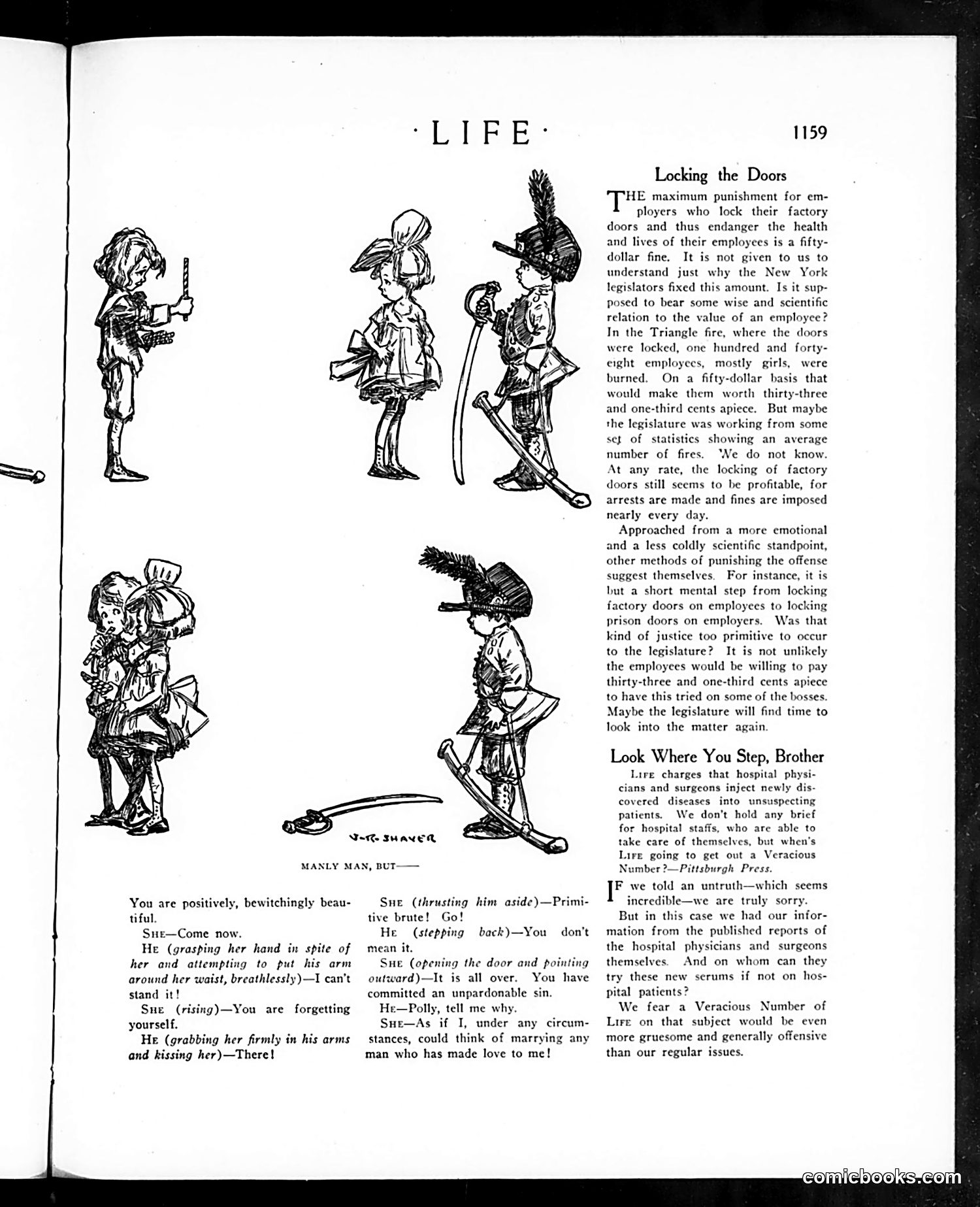
This page contains two distinct pieces. The top features a romantic comedy sketch where a man aggressively kisses a woman ("Sue") without consent, then is shocked when she rejects him for "making love" to her uninvited—satirizing the disconnect between aggressive masculine behavior and social acceptability. The main article, "Locking the Doors," references the **Triangle Shirtwaist Factory Fire** (1911), where locked factory doors trapped workers, killing 148 people, mostly young women. Life criticizes New York's fifty-dollar maximum fine as absurdly inadequate—calculating it values each victim at thirty-three cents. The piece sarcastically suggests employers might find prison time more appropriately punishing than fines, implying the law is toothless against workplace negligence causing mass death. The bottom section defends Life's earlier claim that hospitals inject untested diseases into patients, dismissing a Pittsburgh newspaper's challenge about accuracy.
📄 Transcribed text from this page (OCR, searchable)
Machine-transcribed from the original scan — historical spelling and the odd misread are preserved.
No SHAVER MANLY MAN, BUT—— You are positively, bewitchingly beau- tiful, Sue—Come now. He (grasping her hand in spite of her and attempting to put his arm around her waist, breathlessly) —I can't stand it! Sue (rising)—You are forgetting yourself. He (grabbing her firmly in his arms and kissing her)—There! Sue (thrusting him aside)—Primi- tive brute! Go! He (stepping mean it. Sue (opening the door and pointing outward)—It is all over. You have committed an unpardonable sin. He—Polly, tell me why. Sue—As if I, under any circum- stances, could think of marrying any man who has made love to me! back)—You don’t 1159 Locking the Doors HE maximum punishment for em- ployers who lock their factory doors and thus endanger the health and lives of their employees is a fifty- dollar fine. It is not given to us to understand just why the New York legislators fixed this amount. Is it sup- posed to bear some wise and scientific relation to the value of an employee? In the Triangle fire, where the doors were locked, one hundred and forty- eight employees, mostly girls, were burned. On a fifty-dollar basis that would make them worth thirty-three and one-third cents apiece. But maybe the legislature was working from some set of statistics showing an average number of fires. ‘Ve do not know. At any rate, the locking of factory doors still seems to be profitable, for arrests are made and fines are imposed nearly every day. Approached from a more emotional and a less coldly scientific standpoint, other methods of punishing the offense suggest themselves. For instance, it is but a short mental step from locking factory doors on employees to locking prison doors on employers. Was that kind of justice too primitive to occur to the legislature? It is not unlikely the employees would be willing to pay thirty-three and one-third cents apiece to have this tried on some of the bosses. Maybe the legislature will find time to look into the matter again. Look Where You Step, Brother Lire charges that hospital physi- cians and surgeons inject newly dis- covered diseases into unsuspecting patients. We don't hold any brief for hospital staffs, who are able to take care of themselves, but when's Lire going to get out a Veracious Number ?—Pittsburgh Press. F we told an untruth—which seems incredible—we are truly sorry. But in this case we had our infor- mation from the published reports of the hospital physicians and surgeons themselves. And on whom can they try these new serums if not on hos- pital patients We fear a Veracious Number of Lire on that subject would be even more gruesome and generally offensive than our regular issues.