
Life, 1913-12-25 · page 24 of 41
Life — December 25, 1913 — page 24: what you’re looking at
What you’re looking at
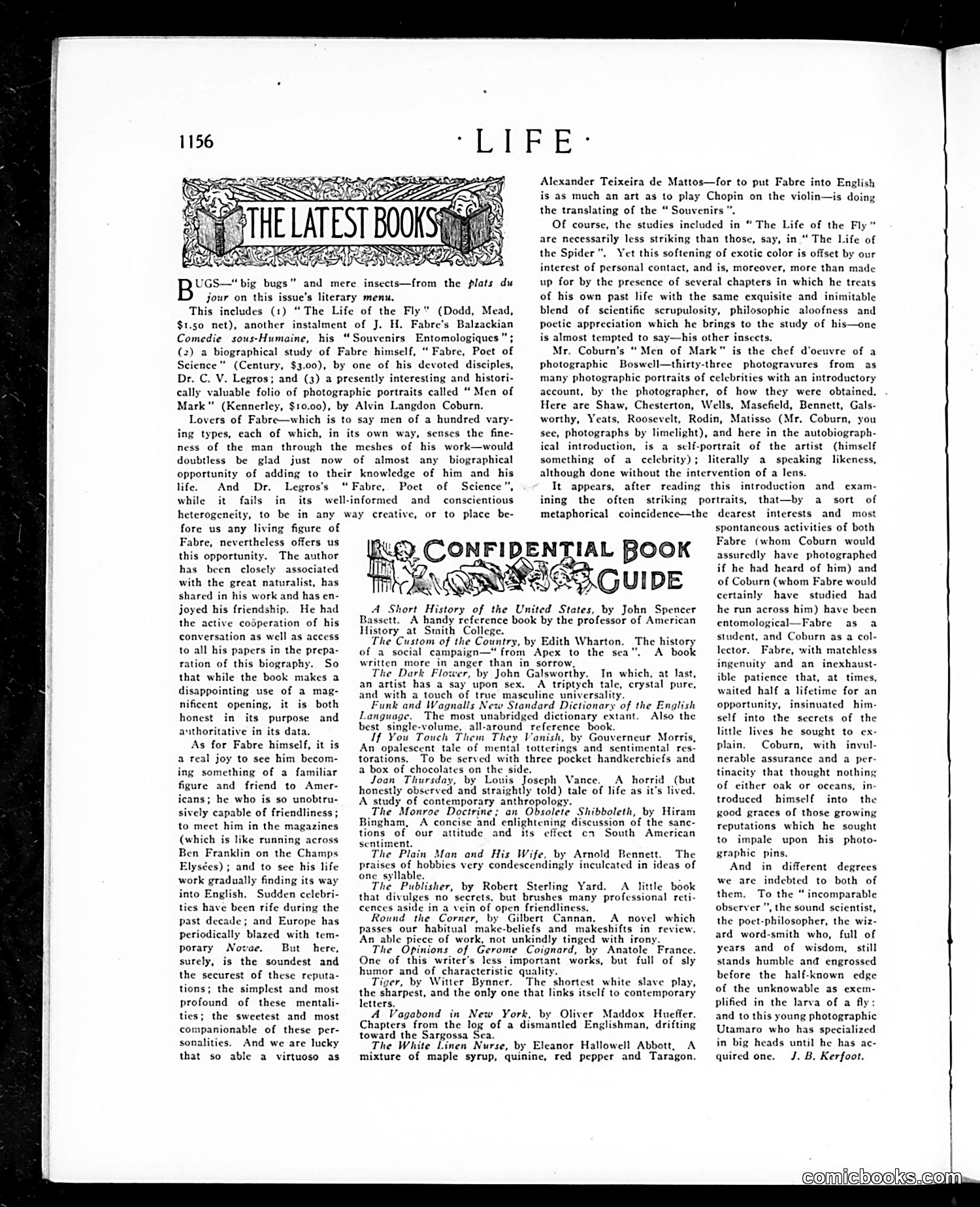
This is a book review section, not a political cartoon. The page discusses three new publications about or by the naturalist Jean-Henri Fabre and a photography collection called "Men of Mark" by Alvin Langdon Coburn. The reviews praise Fabre's scientific yet poetic approach to studying insects, note the difficulty of translating his work into English, and highlight Coburn's photographic portraits of celebrities including Shaw, Wells, Masefield, Roosevelt, and Rodin. There's an embedded advertisement for a "Confidential Book Guide." The tone is appreciative of Fabre's work bridging science and literature, and celebrates his growing recognition among American readers. This reflects early 20th-century intellectual enthusiasm for naturalist writing and artistic photography as serious cultural pursuits.
📄 Transcribed text from this page (OCR, searchable)
Machine-transcribed from the original scan — historical spelling and the odd misread are preserved.
UGS—" big bugs” and mere insects—from the plats du jour on this issue's literary menu. This includes (1) “The Life of the Fly” (Dodd, Mead, $1.50 net), another instalment of J. H. Fabre’s Balzackian Comedie sous-Humaine, his “Souvenirs Entomologiques ”; (2) a biographical study of Fabre himself, “ Fabre, Poet of Science” (Century, $3.00), by one of his devoted disciples, Dr. C. V. Legros; and (3) a presently interesting and histor cally valuable folio of photographic portraits called “ Men of Mark" (Kennerley, $10.00), by Alvin Langdon Coburn. Lovers of Fabre—which is to say men of a hundred vary- ing types, each of which, in its own way, senses the fine- ness of the man through the meshes of his work—would doubtless be glad just now of almost any biographical opportunity of adding to their knowledge of him and his life. And Dr. Legros’s “Fabre, Poet of Science”, while it fails in its well-informed and conscientious heterogeneity, to be in any way creative, or to place be- fore us any living figure of Fabre, nevertheless offers us this opportunity, The author has been closely associated with the great naturalist, has shared in his work and has en- CONFIDENTIAL BOOK % Kaas X GUIDE Alexander Teixeira de Mattos—for to put Fabre into English is as much an art as to play Chopin on the vi the translating of the “ Souvenirs". Of course, the studies included in “ The Life of the Fly” are necessarily less striking than those, say, in “‘ The Life of the Spider". Yet this softening of exotic color is offset by our interest of personal contact, and is, moreover, more than made up for by the presence of several chapters in which he treats of his own past life with the same exquisite and inimitable blend of scientific scrupulosity, philosophic aloofness and poetic appreciation which he brings to the study of his—one is almost tempted to say—his other insects. Mr. Coburn’s “ Men of Mark” is the chef d’oeuvre of a photographic Boswell—thirty-three photogravures from as many photographic portraits of celebrities with an introductory account, by the photographer, of how they were obtained, Here are Shaw, Chesterton, Wells, Masefield, Bennett, Gals- worthy, Yeats, Roosevelt, Rodin, Matisse (Mr. Coburn, you see, photographs by limelight), and here in the autobiograph- ical introduction, is a self-portrait of the artist (himself something of a celebrity); literally a speaking likeness, although done without the intervention of a lens. It appears, after reading this introduction and ining the often striking portraits, that—by a sort of metaphorical coincidence—the dearest interests and most spontancous activities of both Fabre (whom Coburn would assuredly have photographed if he had heard of him) and of Coburn (whom Fabre would certainly have studied had lin—is doing exam- joyed his friendship. He had the active codperation of his conversation as well as access to all his papers in the prepa- ration of this biography. So that while the book makes a disappointing use of a mag- nificent opening, it is both honest in purpose and anthoritative in its data. As for Fabre himself, it is a real joy to see him becom- ing something of a familiar figure and friend to Amer- icans; he who is so unobtru- sively capable of friendliness; to mect him in the magazines (which is like running across Ben Franklin on the Champs Elysées) ; and to sce his life work gradually finding its way into English. Sudden celebri- ties have been rife during the past decade; and Europe has periodically blazed with tem- porary Novae. But here, surely, is the soundest and the securest of these reputa- tions; the simplest and most profound of these mentali- ties; the sweetest and most companionable of these per- sonalities. And we are lucky that so able a virtuoso as A Short pais of the United States, by John Spencer Bassett. A handy reference book by the professor of American History_at Stith College. The Custom of the Country, by Edith Wharton. The history of a social campaign—“ from Apex to the sea”. A book written more in anger than in_sorrow, The Dark Flower, by John Galsworthy. In which, at last, an artist has a say upon sex. A triptych tale, crystal pure, and with a touch of true masculine universality. Funk and Wagnalls New Standard Dictionary of the English Language. The most unabridged dictionary extant. Also the best single-volume, all-around reference book. If You Touch Them They Vanish, by Gouverneur Morri An opalescent tale of mental totterings and sentimental res torations. To be served with three pocket handkerchiefs and a box of chocolates on the side. Joan Thursday, by Louis Joseph Vance. A horrid (but honestly observed and straightly told) tale of life as it’s lived. A study of contemporary anthropology. The Monroe Doctrine; an Obsolete Shibboleth, by Hiram Bingham, A concise and enlightening discussion of the sanc- tions of our attitude and its effect cn South American sentiment. The Plain Man and His Wife, by Arnold Bennett. The praises of hobbies very condescendingly inculcated in ideas of one. syllable. The Publisher, by Robert Sterling Yard. A little book that divulges no’ secrets, but brushes many professional reti- cences aside in a vein of open friendliness, Round the Corner, by Gilbert Cannan. A novel which passes our habitual make-beliefs and makeshifts in review. An able piece of work, not unkindly tinged with irony. The Opinions of Gerome Coignard, by Anatole France ¢ of this writer's less important works, but full of sly or and of characteristic qualit r, by Witter Bynner. The shortest white slave play, the sharpest, and the only one that links itself to contemporary letters. A Vagabond in New York, by Oliver Maddox Hueffer. Chapters from the log of a dismantled Englishman, drifting toward the Sargossa S The White Linen Nurse, bj mixture of maple syrup, qui anor Hallowell Abbott, A , red pepper and Taragon. he run across him) have been entomological—Fabre as a student, and Coburn as a col- lector, Fabre, with matchless ingenuity and an inexhaust- ible patience that, at times, waited half a lifetime for an opportunity, insinuated him- self into the secrets of the ittle lives he sought to e: plain. Coburn, with invul- nerable assurance and a per- tinacity that thought nothing of either oak or oceans, in- troduced himself into the good graces of those growing reputations which he sought to impale upon his photo- graphic pins. And in different degrees we are indebted to both of them. To the “incomparable observer ", the sound scientist, the poct-philosopher, the wiz- ard word-smith who, full of years and of wisdom, still stands humble and engrossed before the half-known edge of the unknowable as exem- plified in the larva of a fly: and to this young photographic Utamaro who has specialized in big heads until he has ac- quired one. J. B. Kerfoot. comichooks. comps.