
Life, 1913-12-25 · page 19 of 41
Life — December 25, 1913 — page 19: what you’re looking at
What you’re looking at
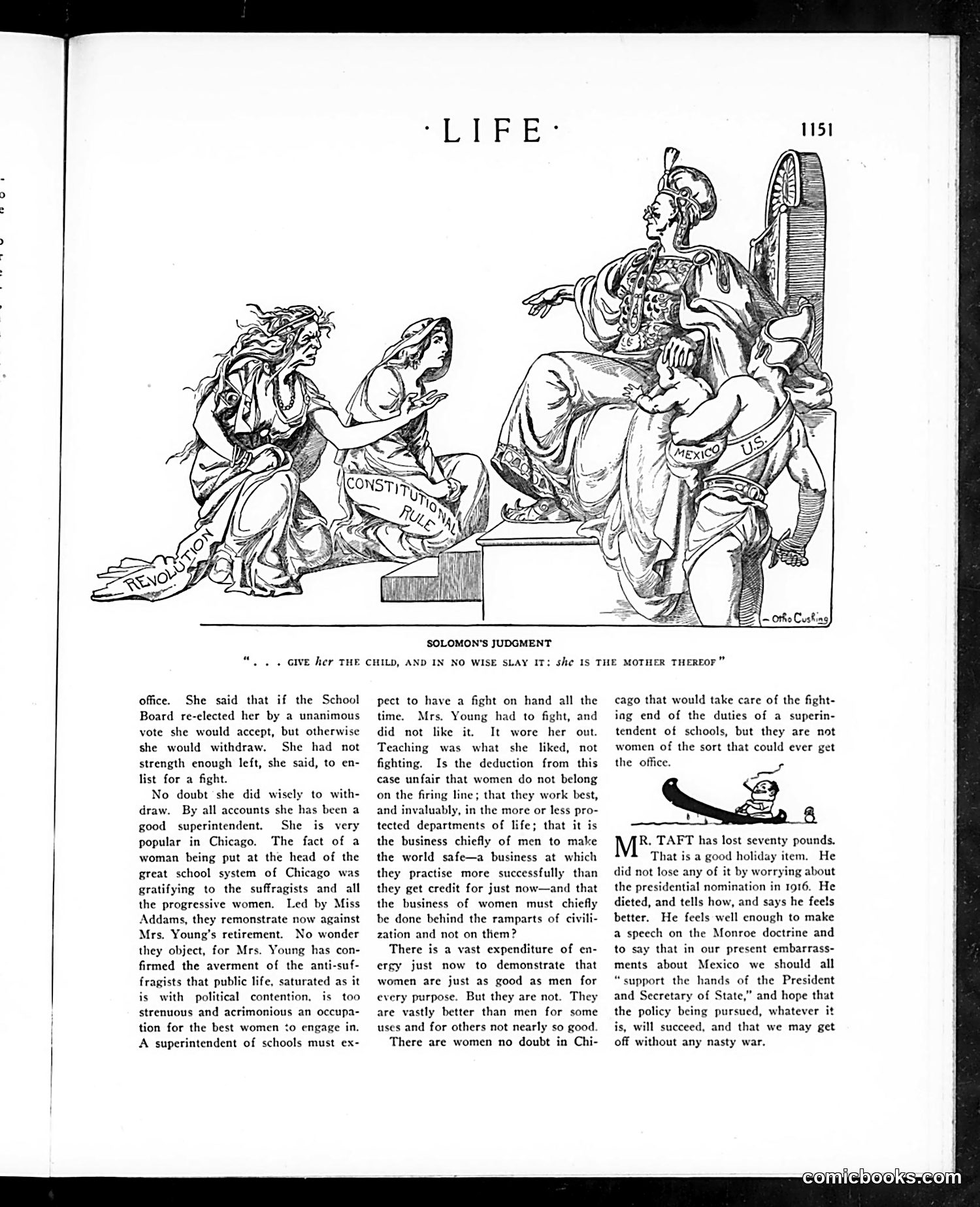
The main cartoon, titled "Solomon's Judgment," uses the biblical reference to King Solomon's famous wisdom to satirize the case of Mrs. Young, Chicago's school superintendent who resigned from her position. The article discusses whether women belong in high-level public office. It argues that while Mrs. Young was popular and competent, she withdrew because the contentious, combative nature of the role exhausted her—suggesting women lack the stamina for "the firing line" of public life. The satire cuts both ways: it mocks anti-suffragists' claims that women can't handle politics, while also critiquing those who claim women are equally suited to all roles as men. The cartoon depicts competing female figures (representing "Constitutional Rule" and other concepts, likely suffragists) before a crowned judge, invoking Solomon's wisdom to suggest the difficulty of fairly dividing authority and capability between men and women in civic life. The secondary item about President Taft losing weight provides lighter political commentary, noting his avoidance of nomination anxieties while still offering patriotic support for presidential Mexico policy.
📄 Transcribed text from this page (OCR, searchable)
Machine-transcribed from the original scan — historical spelling and the odd misread are preserved.
office. She said that if the School Board re-elected her by a unanimous vote she would accept, but otherwise she would withdraw. She had not strength enough left, she said, to en- list for a fight. No doubt she did wisely to with- draw. By all accounts she has been a good superintendent. She is very popular in Chicago. The fact of a woman being put at the head of the great school system of Chicago was gratifying to the suffragists and all the progressive women. Led by Miss Addams, they remonstrate now against Mrs, Young’s retirement. No wonder they object, for Mrs. Young has con- firmed the averment of the anti-suf- fragists that public life, saturated as it is with political contention, is too strenuous and acrimonious an occupa- tion for the best women ‘to engage in. A superintendent of schools must ex- SOLOMON’S JUDGMENT pect to have a fight on hand all the time. Mrs. Young had to fight, and did not like it. It wore her out. Teaching what she liked, not fighting. Is the deduction from this case unfair that women do not belong on the firing line; that they work best, and invaluably, in the more or less pro- tected departments of life; that it is the business chiefly of men to make the world safe—a business at which they practise more successfully than they get credit for just now—and that the business of women must chiefly be done behind the ramparts of civili- zation and not on them? There is a vast expenditure of en- ergy just now to demonstrate that women are just as good as men for every purpose. But they are not. They are vastly better than men for some uses and for others not nearly so good. There are women no doubt in Chi- was + + + GIVE her THE CHILD, AND IN NO WISE SLAY IT: she 1s THE MOTHER THEREOF” cago that would take care of the fight- ing end of the duties of a superin- tendent of schools, but they are not women of the sort that could ever get the office. ee —— R. TAFT has lost seventy pounds. That is a good holiday item. He did not lose any of it by worrying about the presidential nomination in 1916. He dieted, and tells how, and says he feels better. He feels well enough to make a speech on the Monroe doctrine and to say that in our present embarrass- ments about Mexico we should all “support the hands of the President and Secretary of State,” and hope that the policy being pursued, whatever it is, will succeed, and that we may get off without any nasty war.