
Life, 1913-12-25 · page 14 of 41
Life — December 25, 1913 — page 14: what you’re looking at
What you’re looking at
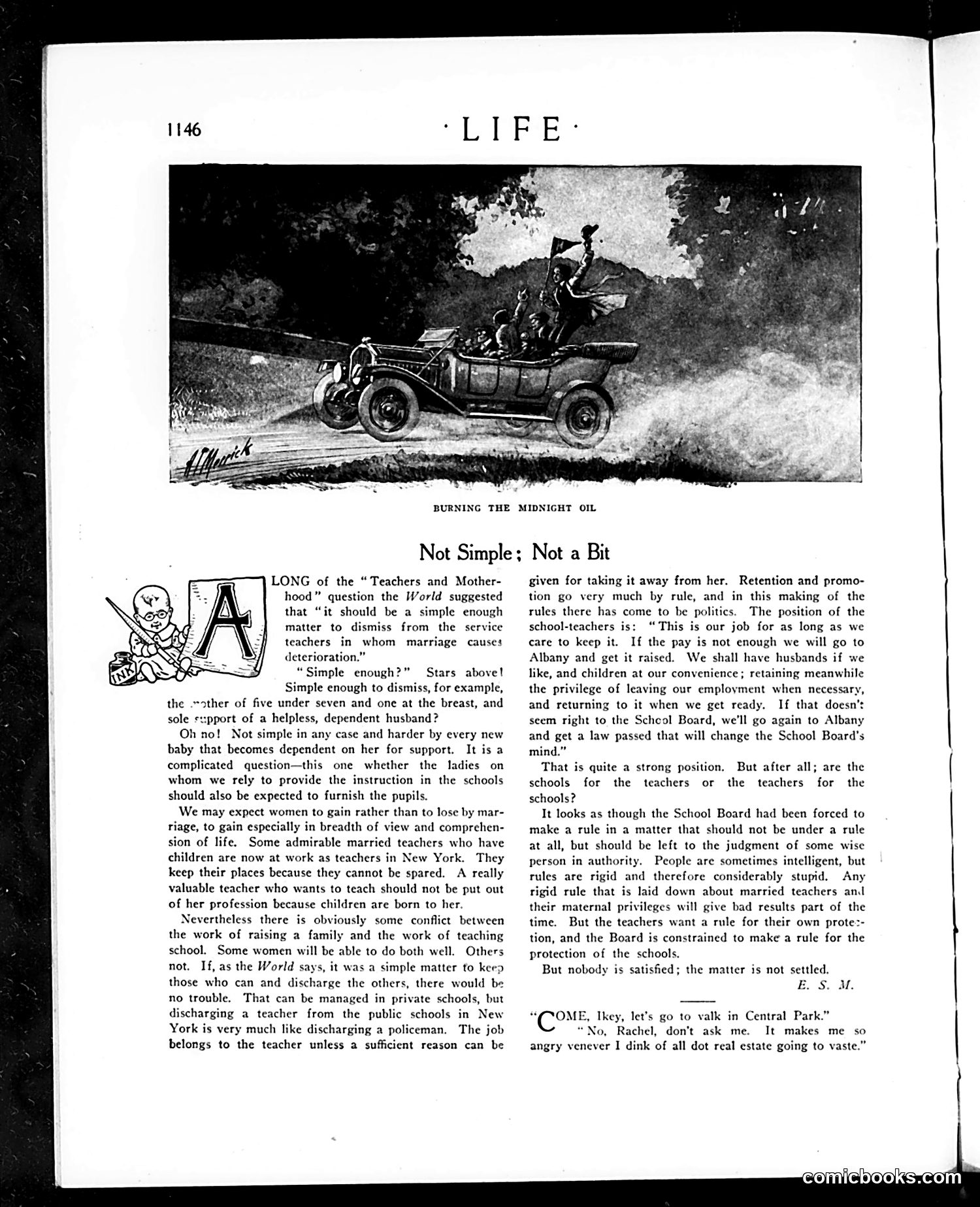
**Main Illustration:** An early automobile speeds along a road with passengers waving a flag, "burning the midnight oil" (working late into the night). This appears to be a generic satirical image about modern life's pace. **Article Focus:** "Not Simple; Not a Bit" debates whether female teachers should be allowed to keep their jobs after marriage. The text presents competing arguments: some claim married teachers should resign to avoid financial burden on families, while others argue valuable educators shouldn't be forced out simply for having children. **Historical Context:** This reflects early 20th-century employment discrimination against married women, particularly in teaching. The piece questions rigid institutional rules while acknowledging genuine conflicts between motherhood and professional work—a tension unresolved in this era.
📄 Transcribed text from this page (OCR, searchable)
Machine-transcribed from the original scan — historical spelling and the odd misread are preserved.
BURNING THE MIDNIGHT OIL Not Simple LONG of the “Teachers and Mother- hood” question the World suggested that “it should be a simple enough matter to dismiss from the service teachers in whom marriage causes deterioration.” “Simple enough?” Simple enough to dismiss, for example, the other of five under seven and one at the breast, and Stars above! port of a helpless, dependent husband? h no! Not simple in any case and harder by every new baby that becomes dependent on her for support. It is a complicated question—this one whether the ladies on whom we rely to provide the instruction in the schools should also be expected to furnish the pupils. We may expect women to gain rather than to lose by mar- riage, to gain especially in breadth of view and comprehen- sion of life. Some admirable married teachers who have children are now at work as teachers in New York. They keep their places because they cannot be spared. A really valuable teacher who wants to teach should not be put out of her profession because children are born to her. Nevertheless there is obviously some conflict. between the work of raising a family and the work of teaching school. Some women will be able to do both well. Others not. If, as the World says, it was a simple matter to keep those who can and discharge the others, there would be no trouble. That can be managed in private schools, but discharging a teacher from the public schools in New York is very much like discharging a policeman. The job belongs to the teacher unless a sufficient reason can be sole Not a Bit given for taking it away from her. Retention and promo- tion go very much by rule, and in this making of the rules there has come to be politics. The position of the school-teachers is: ‘This is our job for as long as we care to keep it. If the pay is not enough we will go to Albany and get it raised. We shall have husbands if we like, and children at our convenience; retaining meanwhi the privilege of leaving our employment when necessar; and returning to it when we get ready. If that doesn’t seem right to the Schcol Board, we'll go again to Albany and get a law passed that will change the School Board’s mind.” That is quite a strong position. schools for the teachers or schools? It looks as though the School Board had been forced to make a rule in a matter that should not be under a rule at all, but should be left to the judgment of some wise person in authority. People are sometimes intelligent, but rules are rigid and therefore considerably stupid. Any rigid rule that is laid down about married teachers and their maternal privileges will give bad results part of the time. But the teachers want a rule for their own prote:- tion, and the Board is constrained to make a rule for the protection of the schools. But nobody is satisfied; the matter is not settled. B. S. MM. But after all; are the the teachers for the “(OME, Ikey, let’s go to valk in Central Park.” “No, Rachel, don't ask me. It makes me so angry venever I dink of all dot real estate going to vaste.”