
Life, 1913-12-25 · page 22 of 41
Life — December 25, 1913 — page 22: what you’re looking at
What you’re looking at
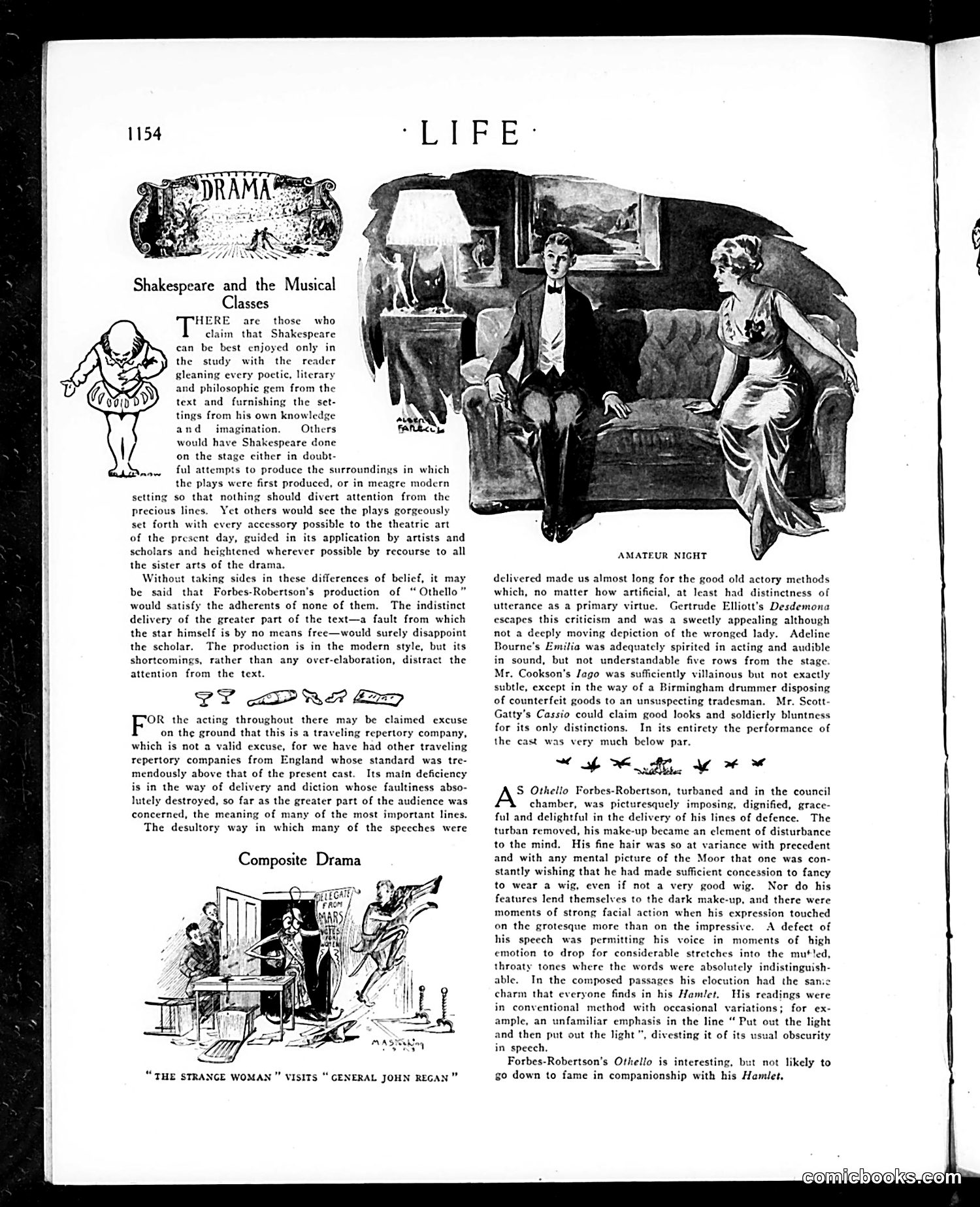
This page reviews Forbes-Robertson's traveling production of Shakespeare's *Othello*. The critic praises Robertson's dignified stage presence and delivery in formal scenes, but faults his casting choices and the company's overall performance quality. **Key criticisms:** - Robertson's makeup as Othello (darkened face without a wig) looks unconvincing and distracting rather than impressive - Other cast members deliver their lines indistinctly and inaudibly, destroying the meaning of important passages - The traveling repertory company's standard is poor compared to other English companies **The satirical cartoons** illustrate contrasting theatrical philosophies: one showing "The Strange Woman" visiting "General John Regan"—likely referencing how the traveling company performs multiple plays poorly rather than focusing on quality productions. The piece essentially argues that while some debate how Shakespeare *should* be staged, this particular production fails because its actors cannot be heard or understood—a fundamental failure regardless of production philosophy.
📄 Transcribed text from this page (OCR, searchable)
Machine-transcribed from the original scan — historical spelling and the odd misread are preserved.
Shakespeare and the Musical Classes HERE are those who claim that Shakespeare can be best enjoyed only in the study with the reader gleaning every poctic, literary and philosophic gem from the text and furnishing the set- tings from his own knowledge and imagination. Others would have Shakespeare done on the stage cither in doubt- ful attempts to produce the surroundings in which the plays were first produced, or in meagre modern setting so that nothing should divert attention from the precious lines. Yet others would sce the plays gorgeously set forth with every accessory possible to the theatric art of the present day, guided in its application by artists and scholars and heightened wherever possible by recourse to all the sister arts of the drama. Without taking sides in these differences of belief, it may be said that Forbes-Robertson's production of “Othello” would satisfy the adherents of none of them. The indistinct delivery of the greater part of the text—a fault from which the star himself is by no means free—would surely disappoint the scholar, The production is in the modern style, but its shortcomings, rather than any over-claboration, distract the attention from the text. PY aera? Bp ‘OR the acting throughout there may be claimed excuse on the ground that this is a traveling repertory company, which is not a valid excuse, for we have had other traveling repertory companies from England whose standard was tre- mendously above that of the present cast. Its main deficiency is in the way of delivery and diction whose faultiness abso- lutely destroyed, so far as the greater part of the audience was concerned, the meaning of many of the most important lines. The desultory way in which many of the specches were Composite Drama “THE STRANGE WOMAN ” VISITS “ GENERAL JOHN REGAN” AMATEUR NIGHT delivered made us almost long for the good old actory methods which, no matter how artificial, at least had distinctness of utterance as a primary virtue. Gertrude Elliott's Desdemona escapes this criticism and was a sweetly appealing although not a deeply moving depiction of the wronged lady. Adeline Bourne's Emilia was adequately spirited in acting and audible in sound, but not understandable five rows from the stage. Mr. Cookson’s Jago was sufficiently villainous but not exactly subtle, except in the way of a Birmingham drummer disposing of counterfeit goods to an unsuspecting tradesman. Mr. Scott- Gatty’s Cassio could claim good looks and soldierly bluntness for its only distinctions. In its entirety the performance of the cast was very much below par. “Ot oth we S Othello Forbes-Robertson, turbaned and in the council chamber, was picturesquely imposing, dignified, grace- ful and delightful in the delivery of his lines of defence. The turban removed, his make-up became an element of disturbance to the mind, His fine hair was so at variance with precedent and with any mental picture of the Moor that one was con- stantly wishing that he had made sufficient concession to fancy to wear a wig, even if not a very good wig. Nor do his features lend themselves to the dark make-up, and there were moments of strong facial action when his expression touched on the grotesque more than on the impressive. A defect of his speech was permitting his voice in moments of high emotion to drop for considerable stretches into the mutled, throaty tones where the words were absolutely indistinguish- able. In the composed passages his clocution had the sanic charm that everyone finds in his Hamlet, His readings were in conventional method with occasional variations; for ex- ample, an unfamiliar emphasis in the line “ Put out the light and then put out the light”, divesting it of its usual obscurity in speech. Forbes-Robertson’s Othello is interesting, but not likely to go down to fame in companionship with his Hamlet.