
Life, 1913-12-25 · page 28 of 41
Life — December 25, 1913 — page 28: what you’re looking at
What you’re looking at
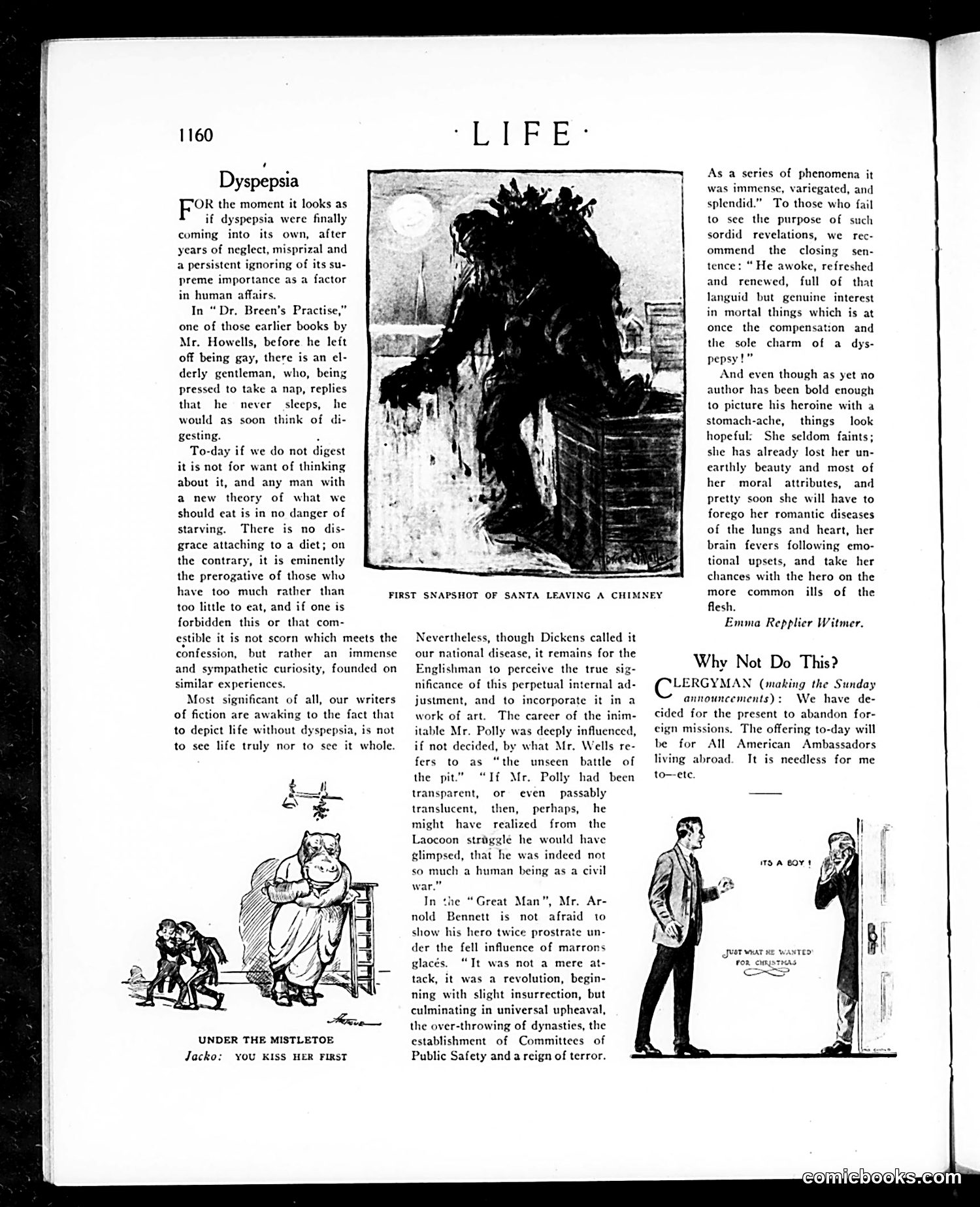
This page from *Life* magazine satirizes the cultural obsession with dyspepsia (indigestion/stomach ailments) in early 20th-century literature and society. The main essay argues that prominent novelists—Dickens, H.G. Wells, and Arnold Bennett—have elevated stomach troubles to dramatic significance in their works, treating digestive distress as a metaphor for internal moral and social conflict. The cartoon "Why Not Do This?" mocks institutional priorities: a clergyman announces the church has abandoned foreign missions to instead collect offerings for American ambassadors abroad—a satirical jab at misplaced charitable focus. The smaller cartoon "Under the Mistletoe" appears to be a humorous domestic sketch about kissing customs. The page reflects early-1900s anxieties about health, consumerism, and changing literary realism that depicted unglamorous bodily functions rather than Victorian sentimentality.
📄 Transcribed text from this page (OCR, searchable)
Machine-transcribed from the original scan — historical spelling and the odd misread are preserved.
1160 ' Dyspepsia 'OR the moment it looks as if dyspepsia were finally coming into its own, after years of neglect, misprizal and a persistent ignoring of it preme importance as a in human affairs. In “Dr, Breen’s Practise,” one of those earlier books by Mr. Howells, before he left off being gay, there is an el- derly gentleman, who, being pressed to take a nap, replies that he never sleeps, he would as soon think of di- gesting. 2 To-day if we do not digest it is not for want of thinking about it, and any man with a new theory of what we should eat is in no danger of starving. There is no dis- grace attaching to a diet; on the contrary, it is eminently the prerogative of those who have too much rather than too little to eat, and if one is forbidden this or that com- estible it is not scorn which meets the confession, but rather an immense and sympathetic curiosity, founded on similar experiences. Most significant of all, our writers of fiction are awaking to the fact that to depict life without dyspepsia, is not to see life truly nor to sce it whole. UNDER THE MISTLETOE. YOU KISS HER FIRST Jacko: FIRST SNAPSHOT OF SANTA LEAVING A CHIMNEY Nevertheless, though Dickens called it our national disease, it remains for the Englishman to perceive the true sig- nificance of this perpetual internal ad- justment, and to incorporate it in a work of art. The career of the inim- itable Mr. Polly was deeply influenced, if not decided, by what Mr. Wells re- fers to as “the unseen battle of the pit.” “If Mr. Polly had been transparent, or even passably translucent, then, perhaps, he might have realized from the Laocoon striggle he would have glimpsed, that he was indeed not so much a human being as a civil war.” In the “Great Man”, Mr. Ar- nold Bennett is not afraid to show his hero twice prostrate un- der the fell influence of marrons glacés. “It was not a mere at- tack, it was a revolution, begin- ning with slight insurrection, but culminating in universal upheaval, the over-throwing of dynasties, the establishment of Committees of Public Safety and a reign of terror. As a series of phenomena it was immense, variegated, and splendid.” To those who fail to sce the purpose of such sordid revelations, we rec- ommend the sen- tence: “ He awoke, refreshed and renewed, full of that languid but genuine interest in mortal things which is at once the compensation and the sole charm of a dys- pepsy!” And even though as yet no author has been bold enough to picture his heroine with a stomach-ache, things look hopeful; She seldom faints; she has already lost her un- earthly beauty and most of her moral attributes, and pretty soon she will have to forego her romantic diseases of the lungs and heart, her brain fevers following emo- tional upsets, and take her chances with the hero on the more common ills of the flesh. Emma Repplier Witmer. closing Why Not Do This? LERGYMAN (making the Sunday announcements): We have de- cided for the present to abandon for- cign missions. The offering to-day will be for All American Ambassadors living abroad. It is needless for me to—ete. i139. A BOY! Jat wat KE FOR cu