
Life, 1913-12-25 · page 30 of 41
Life — December 25, 1913 — page 30: what you’re looking at
What you’re looking at
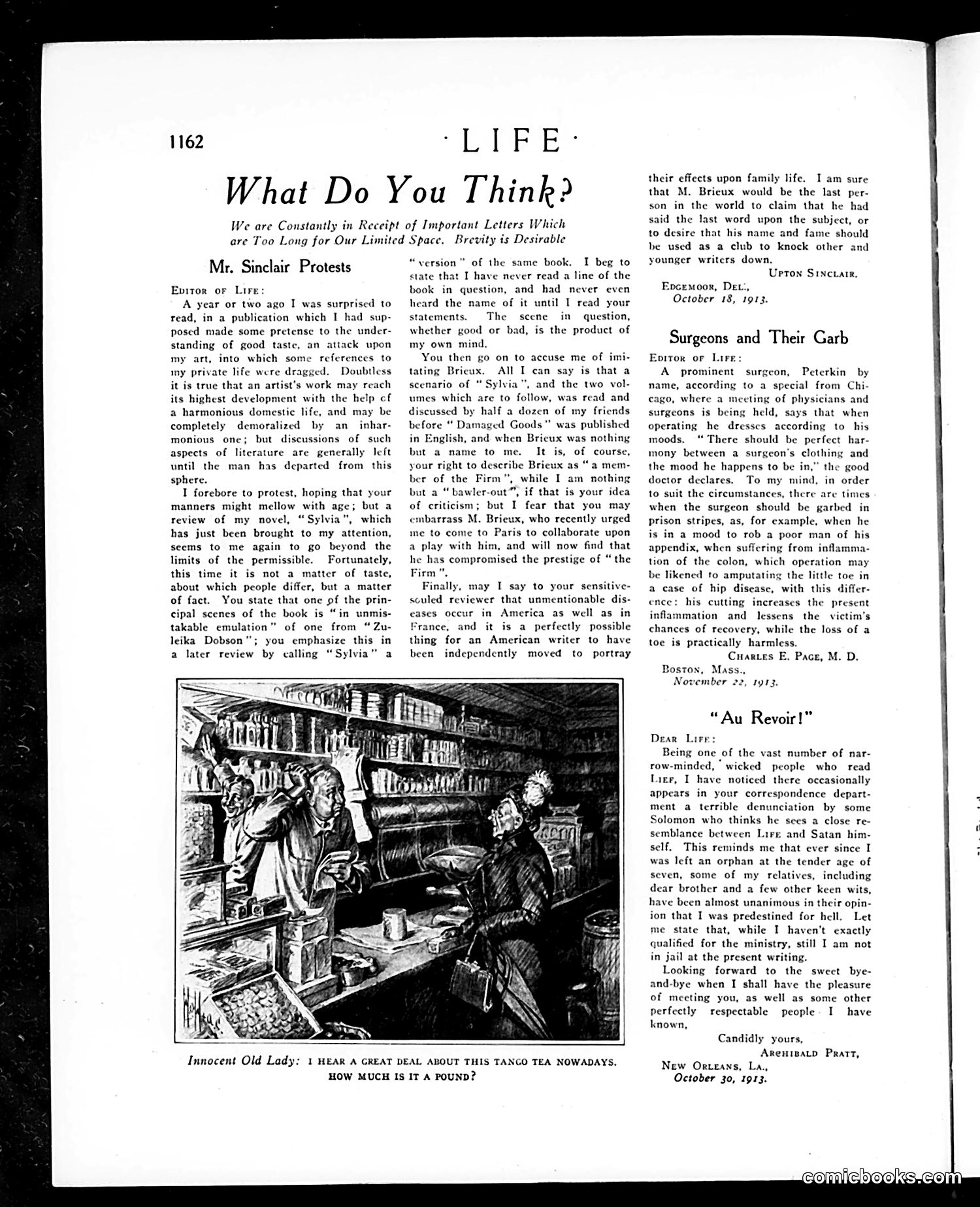
This is a "Letters to the Editor" page from Life magazine (October 1913). The main cartoon depicts an innocent elderly woman asking about "tango tea," confusing the modern dance craze with an actual purchasable commodity—a joke about how bewildered older generations were by contemporary fads. The letters address literary disputes. Upton Sinclair protests that Life accused him of imitating both "Zuleika Dobson" and French playwright Brieux's "Damaged Goods" in his novel "Sylvia." Sinclair claims he never read the former and had written his work before encountering the latter, resenting the magazine's insinuation of plagiarism. He also criticizes Life for dismissing him as a mere "bawler-out" compared to the established Brieux. A second letter sarcastically critiques a surgeon who claims to dress "according to his moods," suggesting this leads to unnecessary operations performed recklessly—mocking medical arrogance and profit-driven healthcare.
📄 Transcribed text from this page (OCR, searchable)
Machine-transcribed from the original scan — historical spelling and the odd misread are preserved.
“LE What Do You Think? We are Constantly in Receipt of Important Letters Which are Too Long for Our Limited Space. Brevity is Desirable Mr. Sinclair Protests Epvitor oF Lire: A year or two ago I was surprised to read, in a publication which I had sup- posed made some pretense to the under- standing of good taste, an attack upon my art, into which some references to iny private life were dragged. Doubtless it is true that an artist's work may reach its highest development with the help cf a harmonious domestic life, and may be completely demoralized by an inhar- monious one; but discussions of such aspects of literature are generally left until the man has departed from this sphere. I forebore to protest, hoping that your manners might mellow with age; but a review of my novel, “ Sylvia", which has just been brought to my attention, seems to me again to go beyond the limits of the permissible. Fortunately, this time it is not a matter of taste, about which people differ, but a matter of fact. You state that one pf the prin- cipal scenes of the book is “in unmis- takable emulation” of one from “ Zu- leika Dobson you emphasize t in a later review by calling “Sylvia” a “version” of the same book. I beg to state that I have never read a line of the book in question, and had never even heard the name of it until I read your statement: The scene in question, whether good or bad, is the product of my own mind. You then go on to accuse me of i i tating Bricux. All I can say is that a scenario of “ Sylvia", and the two vol- umes which are to follow, was read and discussed by half a dozen of my friends before “ Damaged Goods” was published in English, and when Bricux was nothing but a name to me. It is, of course, your right to describe Bricux as “a mem- ber of the Firm”, while I nothing but a “bawler-out”, if that is your idea of criticism; but I fear that you may embarrass M. Brieux, who recently urged me to come to Paris to collaborate upon a play with him, and will now find that he has compromised the prestige of “the rm Finally, may I say to your sensitive- souled reviewer that unmentionable dis- eases occur in America as well as in ance, and it is a perfectly possible thing for an American writer to have been independently moved to portray 7 Innocent Old Lady: 1 HEAR A GREAT DEAL ABOUT THIS TANGO TEA NOWADAYS. HOW MUCH IS IT A POUND? their effects upon family life. I am sure that M. Bricux would be the last per- son in the world to claim that he had said the last word upon the subject, or to desire that his name and fame should be used as a club to knock other and younger writers down. Upton Sinctair, Encesoox, Det:, October 18, 1913. Surgeons and Their Garb Epitor of Lir A prominent surgeon, Peterkin by name, according to a special from Chi- cago, where a meeting of physicians and surgeons is being held, says that when operating he dresses according to his moods. “There should be perfect har- mony between a surgeon's clothing and the mood he happens to be in,” the good doctor declares. To my mind, in order to suit the circumstances, there are times when the surgeon should be garbed in prison stripes, as, for example, when he is in a mood to rob a poor man of his appendix, when suffering from inflamma- tion of the colon, which operation may be likened to amputating the little toe in a case of hip disease, with this differ- ence: his cutting increases the present inflammation and lessens the victim's chances of recovery, while the loss of a toe is practically harmless. Cartes E. Pace, M. D. stoN, Mas November 1913. “Au Revoir!” Dear Lire: Being one of the vast number of nar- row-minded, ‘wicked people who read Lire, I have noticed there occasionally appears in your correspondence depart- ment a terrible denunciation by some Solomon who thinks he sees a close re- semblance between Lire and Satan him- self. This reminds me that ever since I was left an orphan at the tender age of seven, some of my relatives, including dear brother and a few other keen wits, have been almost unanimous in their opin- ion that I was predestined for hell, Let me state that, while I haven't exactly qualified for the ministry, still I am not in jail at the present writing. Looking forward to the sweet bye- and-bye when I shall have the pleasure of meeting you, as well as some other perfectly respectable people. I have known, Candidly yours, Arenipacp Pratt, New Orteans, La., October 30, 1913.