
Life, 1913-12-25 · page 8 of 41
Life — December 25, 1913 — page 8: what you’re looking at
What you’re looking at
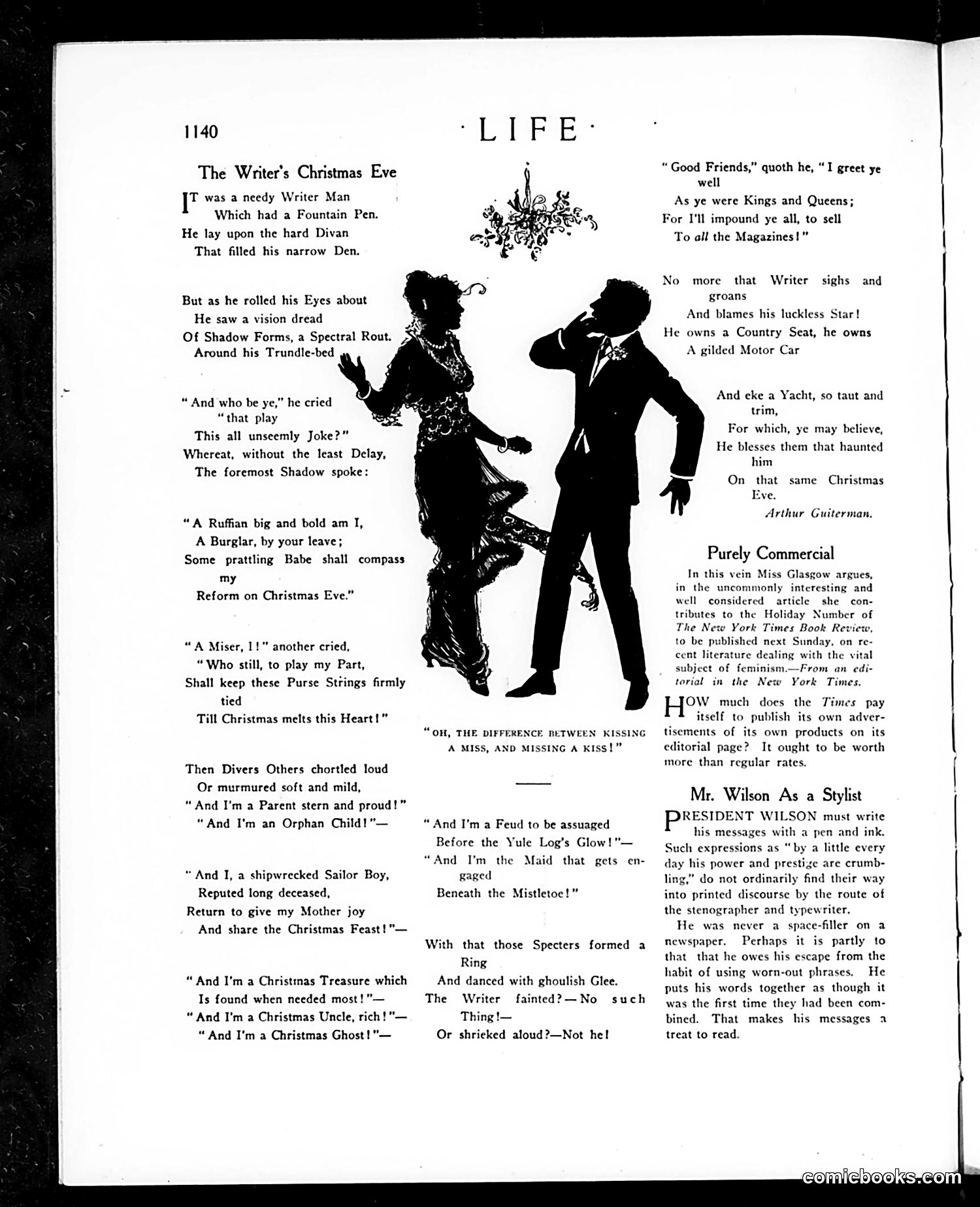
This is a satirical poem by Arthur Guiterman about a struggling writer on Christmas Eve. The illustration shows silhouettes of two well-dressed figures dancing or socializing. The satire contrasts the writer's poverty (he has only a "Fountain Pen" and narrow "Den") with visions of wealthy lifestyles. Shadow-form characters—described as "A Ruffian," "A Miser," "An Orphan Child," "A Sailor Boy," and "A Christmas Ghost"—taunt him with their Christmas wishes and possessions. The joke is that the needy writer fantasizes about his characters achieving prosperity while he remains impoverished. By poem's end, the writer faints from the emotional toll, leaving the punchline ambiguous: "Or shrieked aloud?—Not he!" It's gentle satirical commentary on the romantic struggling-artist trope and the gap between literary imagination and economic reality.
📄 Transcribed text from this page (OCR, searchable)
Machine-transcribed from the original scan — historical spelling and the odd misread are preserved.
1140 The Writer's Christmas Eve T was a needy Writer Man Which had a Fountain Pen. He lay upon the hard Divan That filled his narrow Den. But as he rolled his Eyes about He saw a vision dread Around his Trundle-bed “ And who be ye,” he cried “that play This all unseemly Joke?” Whereat, without the least Delay, The foremost Shadow spoke: “A Ruffian big and bold am I, A Burglar, by your leave; Some prattling Babe shall compass my Reform on Christmas Eve.” “A Miser, 1!" another cried, “Who still, to play my Part, Shall keep these Purse Strings firmly tied Till Christmas melts this Heart!” Then Divers Others chortled loud Or murmured soft and mild, “And I'm a Parent stern and proud!” “And I'm an Orphan Child! "— “ And I, a shipwrecked Sailor Boy, Reputed long deceased, Return to give my Mother joy And share the Christmas Feast!"— “And I'm a Christmas Treasure which Is found when needed most!"— “ And I'm a Christmas Uncle, rich !"— “And I'm a Christmas Ghost !"— “OH, THE DIFFERENCE BETWEEN KISSING A MISS, AND MISSING A kiss!” “And I'm a Feud to be assuaged Before the Yule Log’s Glow! "— “And I'm gaged Beneath the Mistletoe!” the Maid that gets en- With that those Specters formed a Ring And danced with ghoulish Glee. The Writer fainted? —No Thing !— Or shrieked aloud?—Not hel such “Good Friends,” quoth he, “I greet ye well As ye were Kings and Queens; For I'll impound ye all, to sell To all the Magazines!" No more that Writer groans sighs and And blames his luckless Star! He owns a Country Seat, he owns A gilded Motor Car And eke a Yacht, so taut and trim, For which, ye may believe, He blesses them that haunted him On that Eve. same Christmas Arthur Guiterman, Purely Commercial In this vein Miss Glasgow argues, in the uncommonly interesting and well considered article she con- tributes to the Holiday Number of The New York Times Book Review, to be published next Sunday, on re- cent literature dealing with the vital subject of feminism.—From an edi- torial in the New York Times. OW much does the Times pay itself to publish its own adver- tisements of its own products on its editorial page? It ought to be worth more than regular rates. Mr. Wilson As a Stylist RESIDENT WILSON must write his messages with a pen and ink. Such expressions as “by a little every day his power and prestige are crumb- ling,” do not ordinarily find their way into printed discourse by the route of the stenographer and typewriter. He was never a space-filler on a newspaper. Perhaps it is partly to that that he owes his escape from the habit of using worn-out phrases. He puts his words together as though it was the first time they had been com- bined. That makes his messages 2 treat to read.