
A complete issue · 48 pages · 1913
Life — October 2, 1913
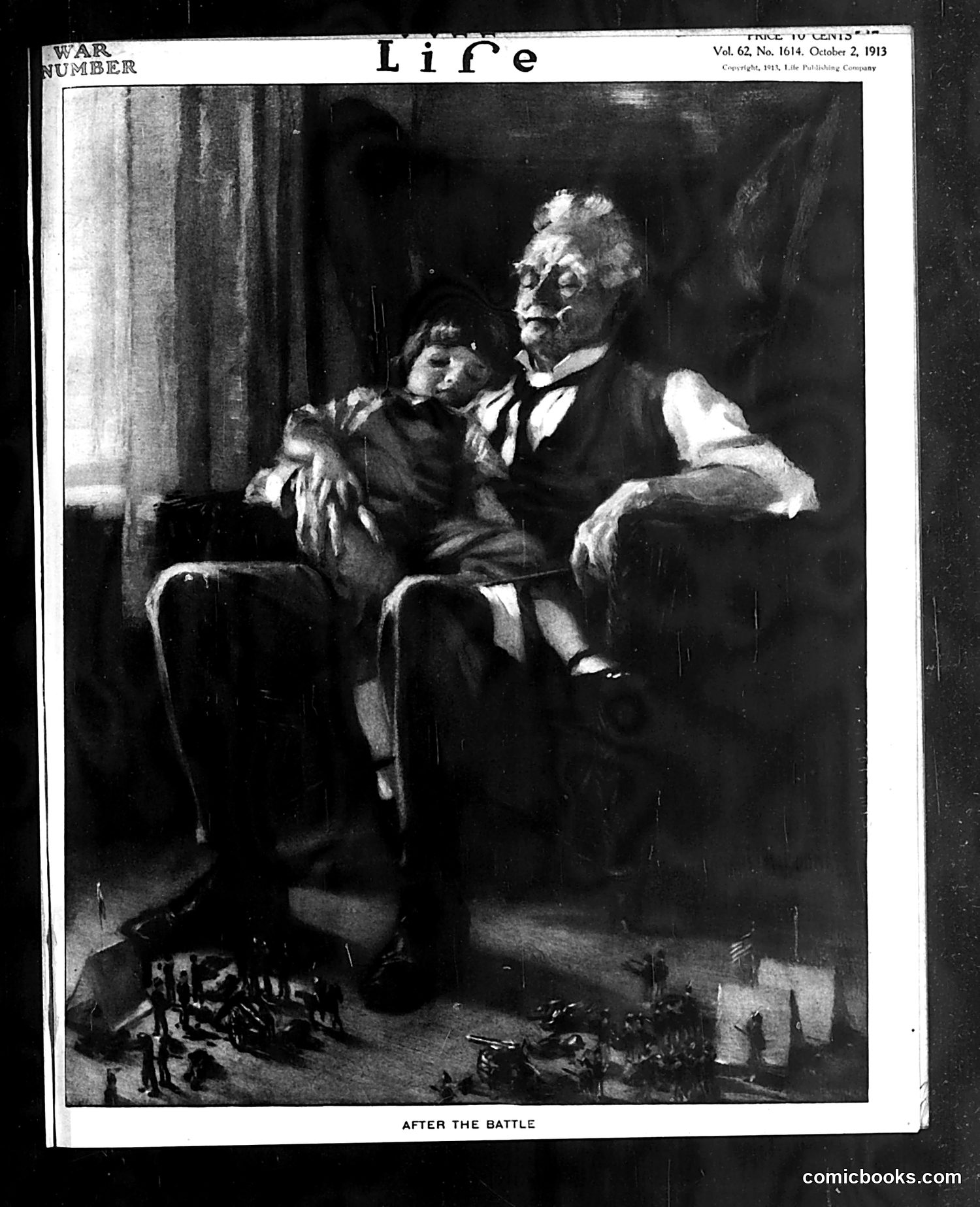
This is a Life magazine cover from October 2, 1913, titled "After the Battle." The image depicts an older man in formal attire (vest, white shirt) seated with a younger boy, both appearing weary or distressed. The scene suggests a domestic conflict aftermath. Without additional context or captions identifying the specific figures, I cannot definitively state who these individuals represent or what particular political/social event this satirizes. The composition and title suggest commentary on conflict—possibly labor disputes, political disagreements, or family discord that reflected contemporary concerns—but determining the precise reference requires more information than the image alone provides. The somber black-and-white illustration technique emphasizes the serious, melancholic mood rather than typical satirical humor.
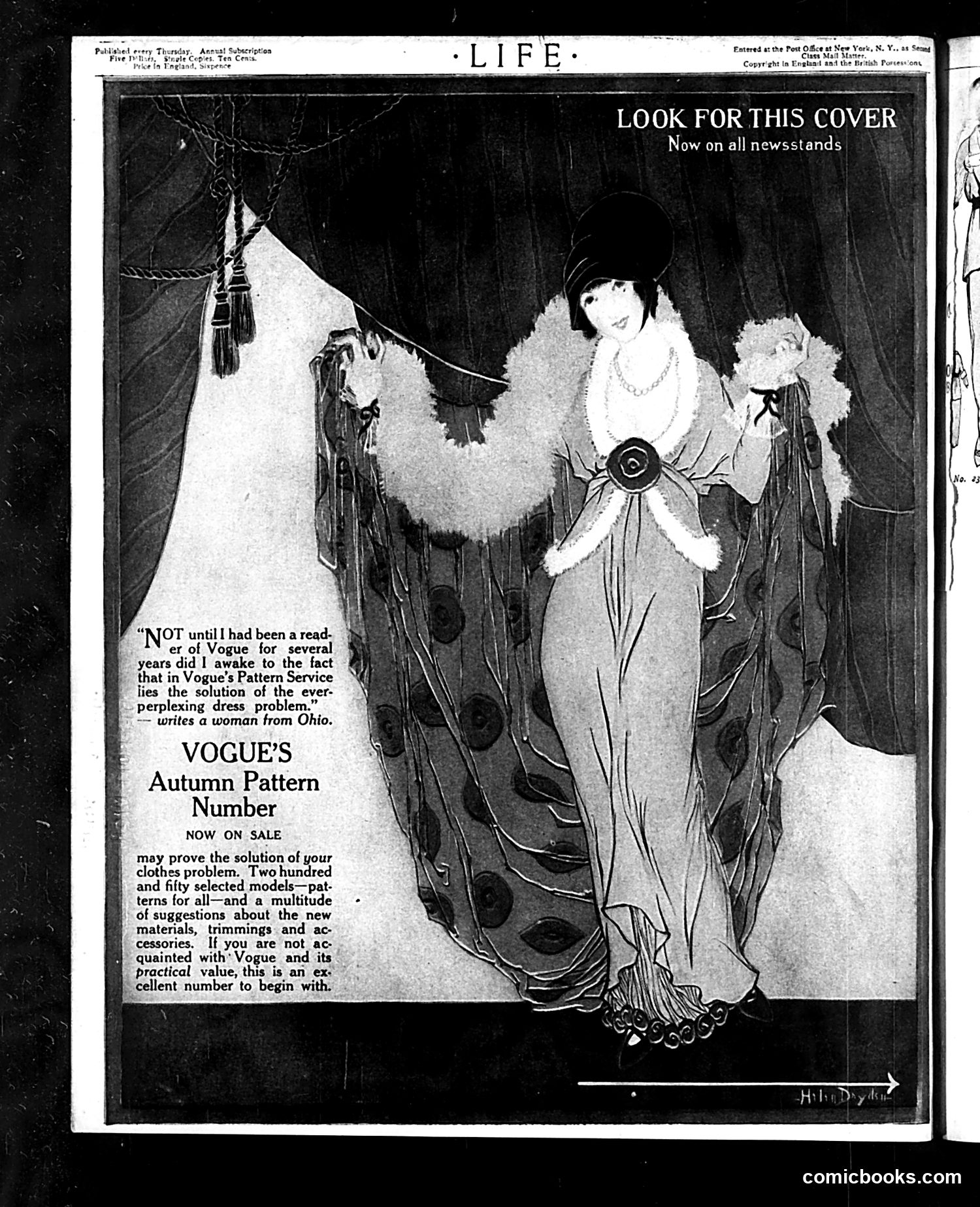
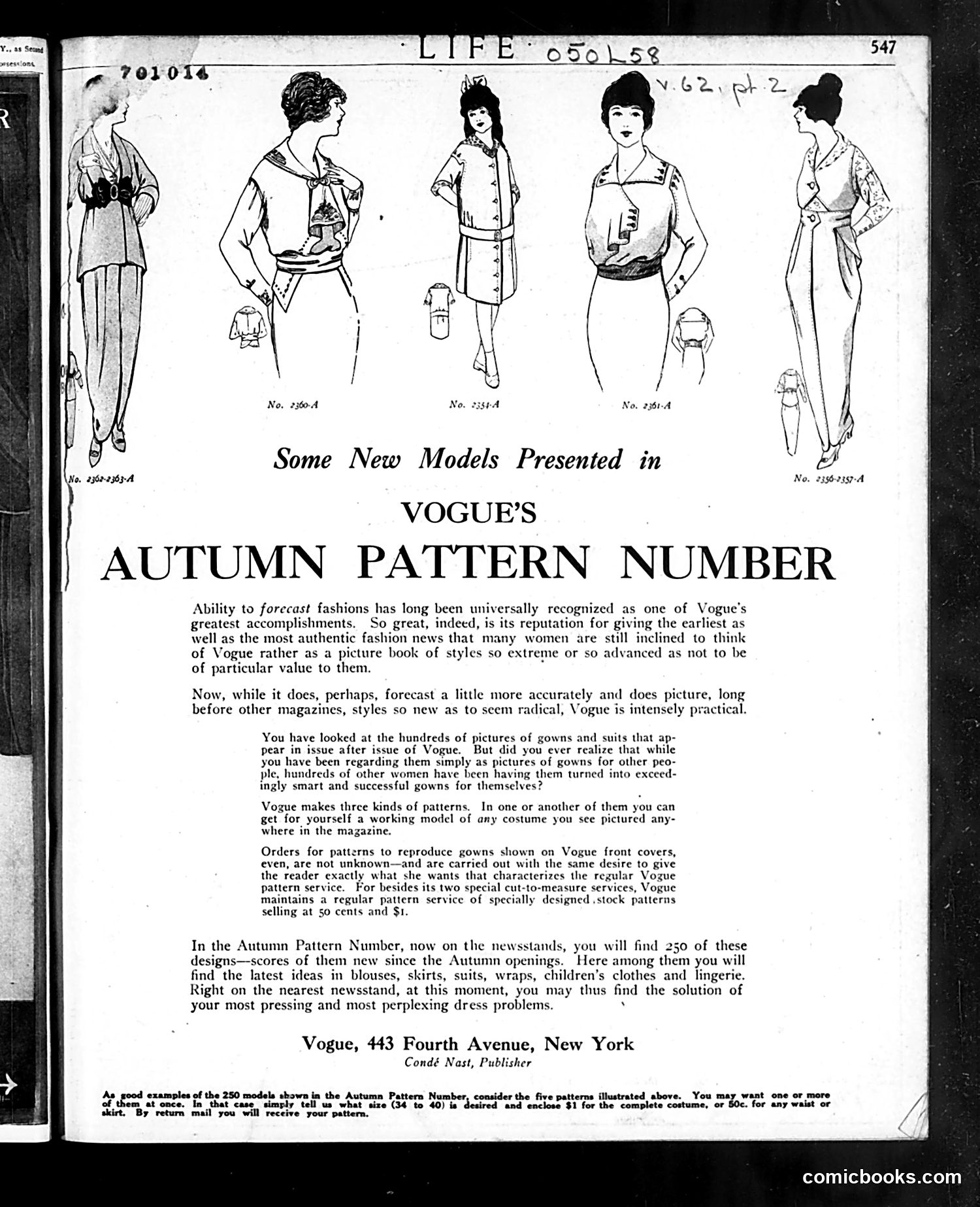
This page is primarily **advertising, not satire or political commentary**. It's a Vogue pattern service advertisement from Life magazine's cover. The image shows a stylishly dressed woman in 1920s fashion—a beaded dress with fur trim and a cloche hat—displayed among dress forms and sewing materials. The accompanying text features a testimonial from an Ohio reader praising Vogue's Pattern Service for solving "the ever-perplexing dress problem." The advertisement emphasizes that Vogue's Autumn Pattern Number offers "two hundred and fifty selected models" and guidance on materials, trimmings, and accessories for home dressmaking. This reflects the era's fashion accessibility—allowing middle-class women to recreate fashionable designs at home through mail-order patterns rather than expensive dressmakers.
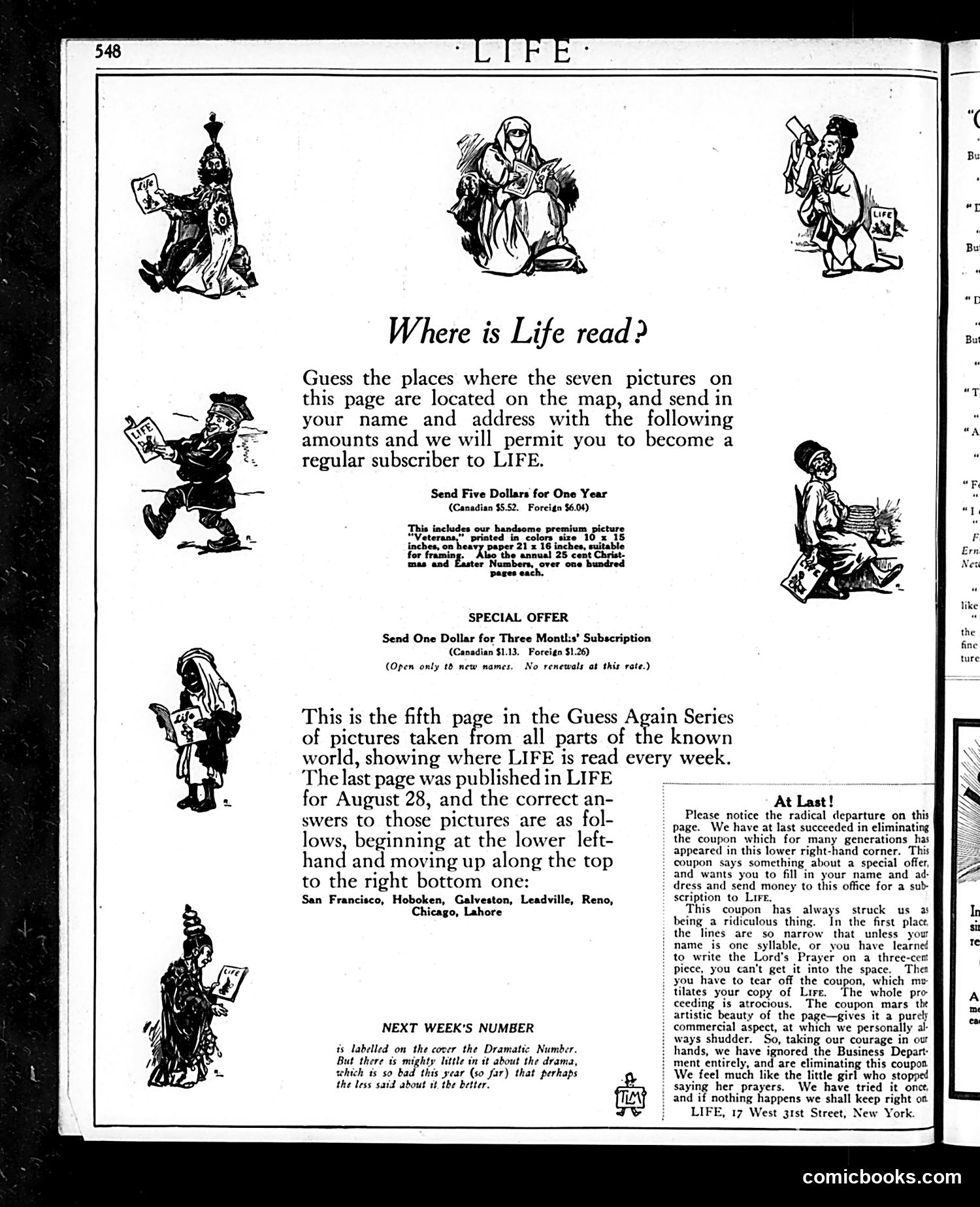
This page is primarily **advertising and subscription promotion** for Life magazine, not political satire. The "Where is Life read?" contest features seven illustrated characters in different cultural costumes (appearing to represent various nationalities/regions), positioned around text describing a guessing game. Readers were asked to match these seven pictures to locations on a map—identifying places where Life magazine circulates globally. The contest offered subscription incentives: $5 for one year or $1 for a three-month trial. A sidebar announces next week's "Dramatic Number" issue and includes a small satirical comment about Life's legendary narrow typesetting and a coupon design so cramped that readers struggle to fit their name and address. The actual content is primarily **commercial rather than political commentary**.
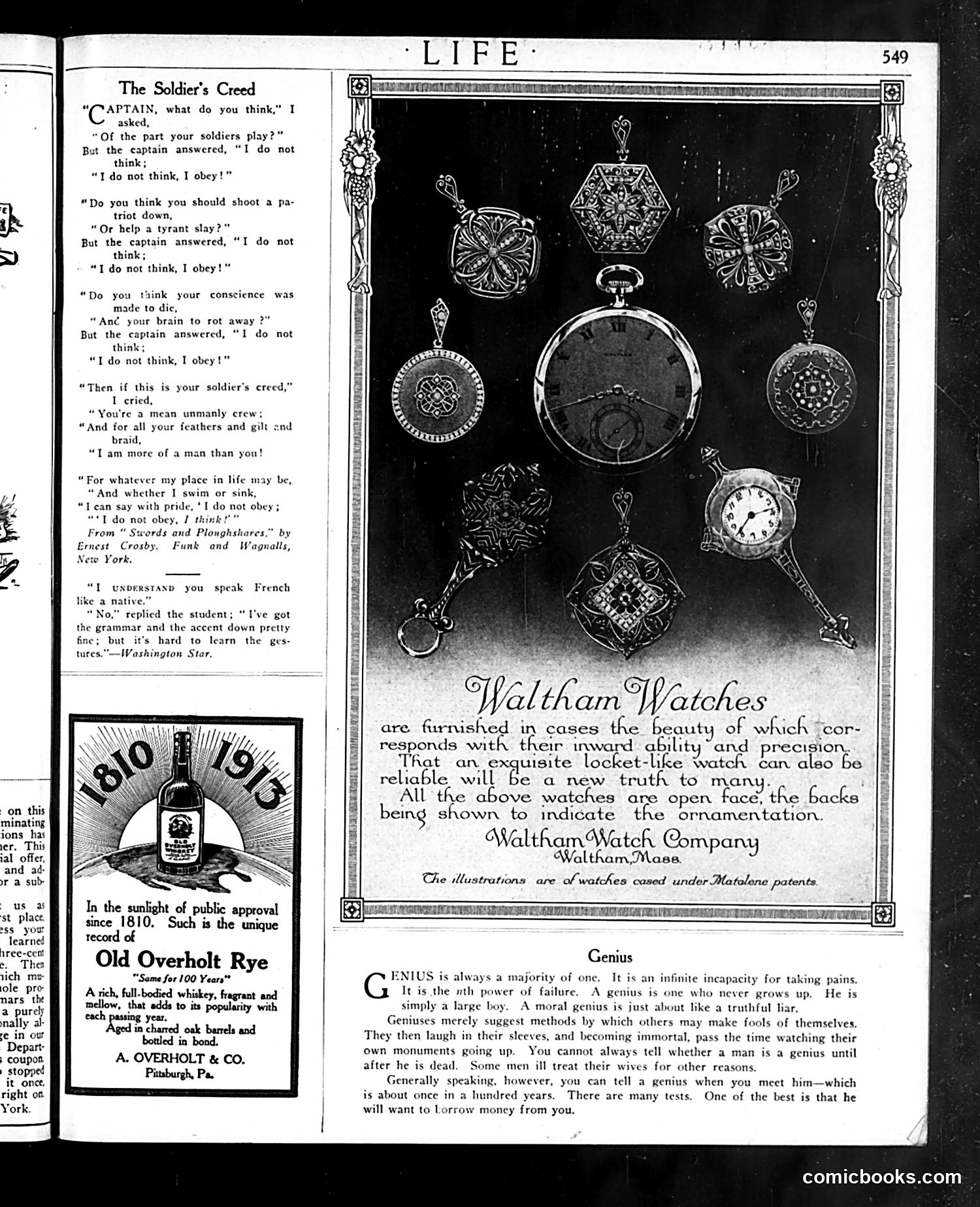
This page contains three distinct elements: 1. **"The Soldier's Creed"** (left column): A poem by Ernest Crosby emphasizing individual conscience over blind obedience. A soldier declares "I do not think, I obey!"—capturing early 20th-century debates about military authority versus personal morality. 2. **Old Overholt Rye advertisement** (lower left): Marketing whiskey with a patriotic 1810-1895 timeline, appealing to American tradition and longevity. 3. **Waltham Watches advertisement** (right side): Displaying ornate pocket watches with decorative cases, emphasizing craftsmanship and precision engineering as luxury goods. 4. **"Genius"** (lower right): A brief satirical essay defining genius as moral and intellectual superiority, suggesting society often mistakes wealth or luck for actual talent. The page mixes social commentary with period advertising.
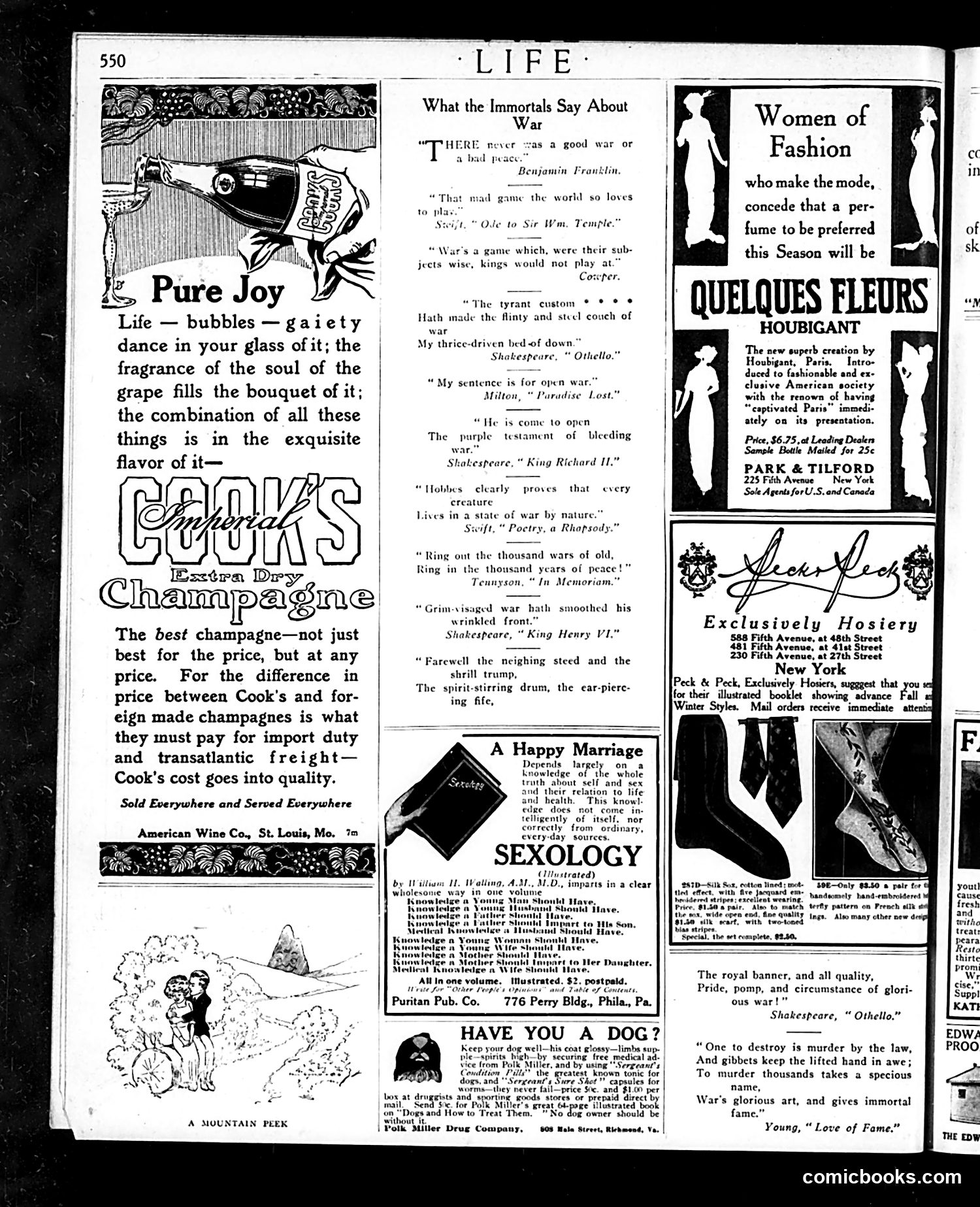
This page is primarily **advertising and miscellaneous content** rather than political satire. The advertisements include Cook's champagne (emphasizing quality over price), "Quelques Fleurs" perfume marketed to fashionable American society, hosiery from Peck & Peck, and a book called "Sexology" promising marital guidance. The only cartoon is "A Mountain Flea" (bottom left)—a whimsical illustration without clear political meaning. The center column, "What the Immortals Say About War," compiles classical and literary quotes on warfare (Shakespeare, Milton, Benjamin Franklin). This appears designed as wartime content, likely from World War I era based on the gravity of the selections, though no specific conflict is named. The overall page reflects early-20th-century consumer culture and literary sophistication.
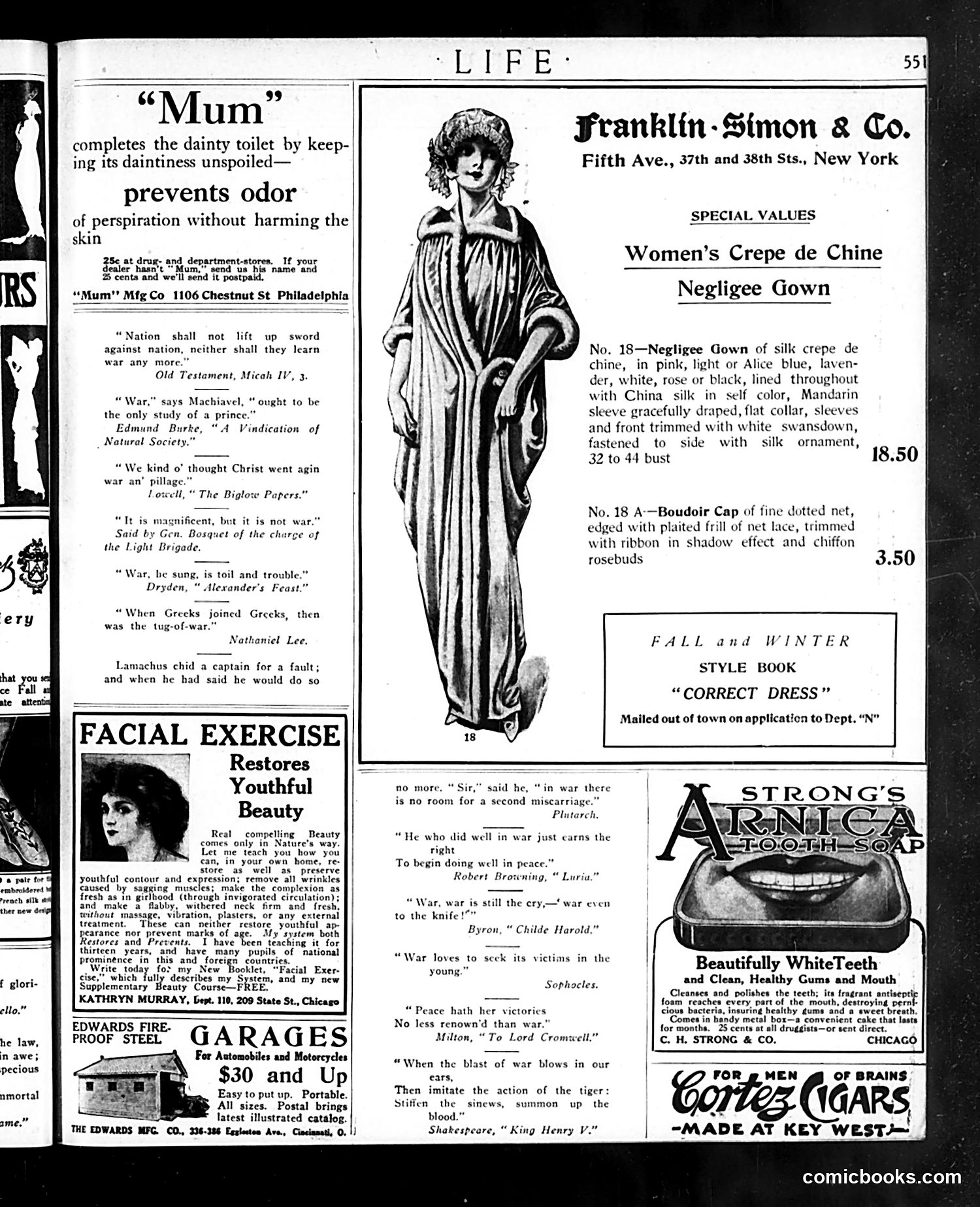
This page is **primarily advertising** with some editorial content. The left side features ads for "Mum" deodorant and facial exercise treatments, interspersed with war-related quotations (from Machiavelli, Burke, and classical sources). The right side advertises Franklin-Simon & Co. women's clothing and Strong's Arnica Tooth Soap, with a decorative illustration of a negligee gown. The war quotations appear sardonic—juxtaposing grand historical statements about warfare with mundane beauty and hygiene products. This reflects **Life magazine's satirical approach**: highlighting the incongruity between serious matters (war) and consumer culture's trivialization of them. The page lacks explicit political cartoons or caricatures. Instead, satire emerges through **editorial placement**—pairing wartime philosophy with frivolous consumer goods, suggesting commentary on American society's commercialism during wartime.
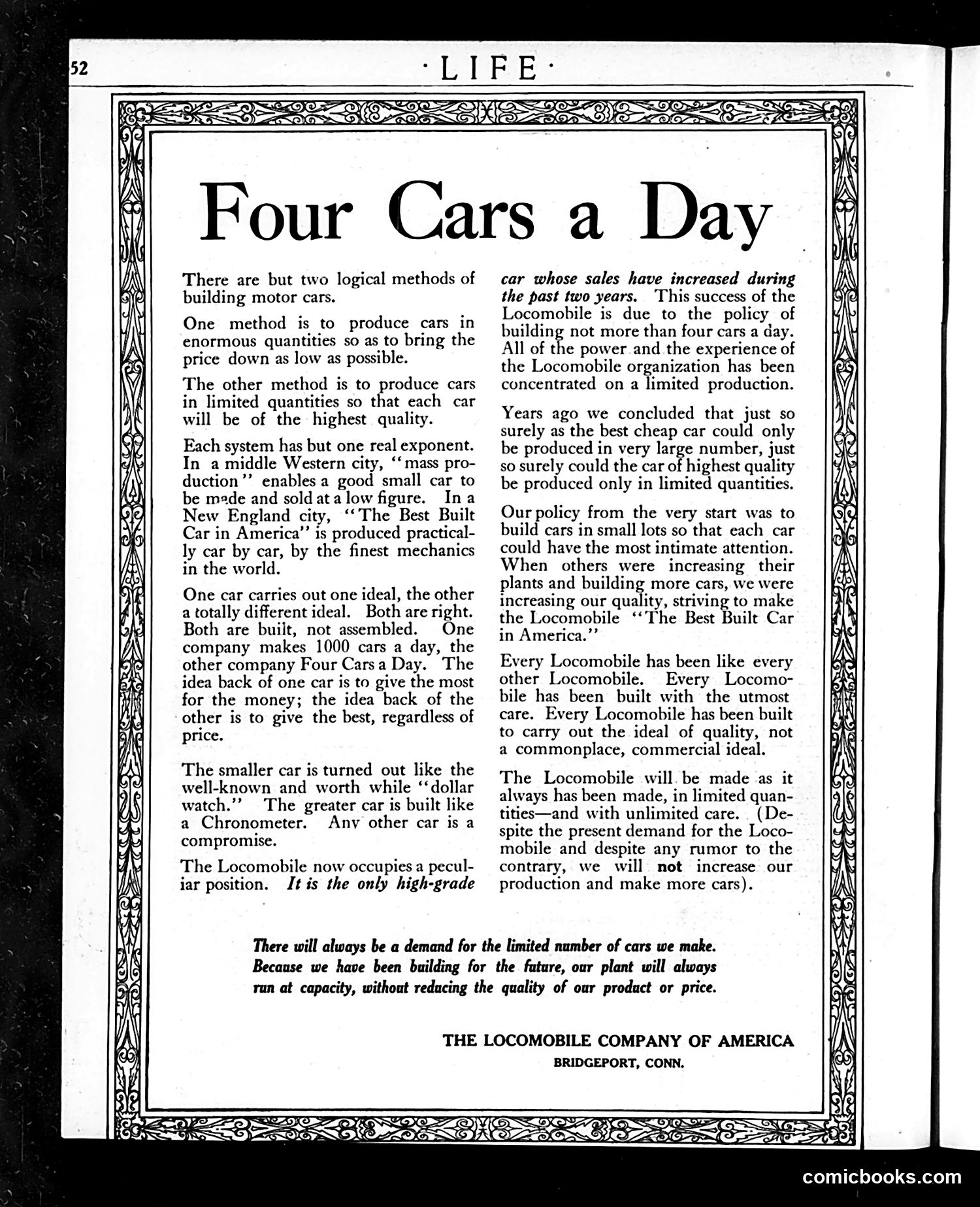
This is a **full-page advertisement** for The Locomobile Company of America, not satirical content. The ad presents a business philosophy contrasting two manufacturing approaches: mass production (1000 cars daily) versus limited production emphasizing quality. Locomobile positions itself in the second category, claiming to be "The Best Built Car in America." The text argues their strategy of producing only four cars daily allows superior craftsmanship compared to competitors pursuing volume. Locomobile claims each vehicle receives individual attention and represents the highest quality, like a "Chronometer" rather than a "dollar watch." The advertisement reassures potential buyers that despite demand, Locomobile will maintain limited production and quality standards rather than expand manufacturing. This reflects early 1900s automotive industry debates about production philosophy.
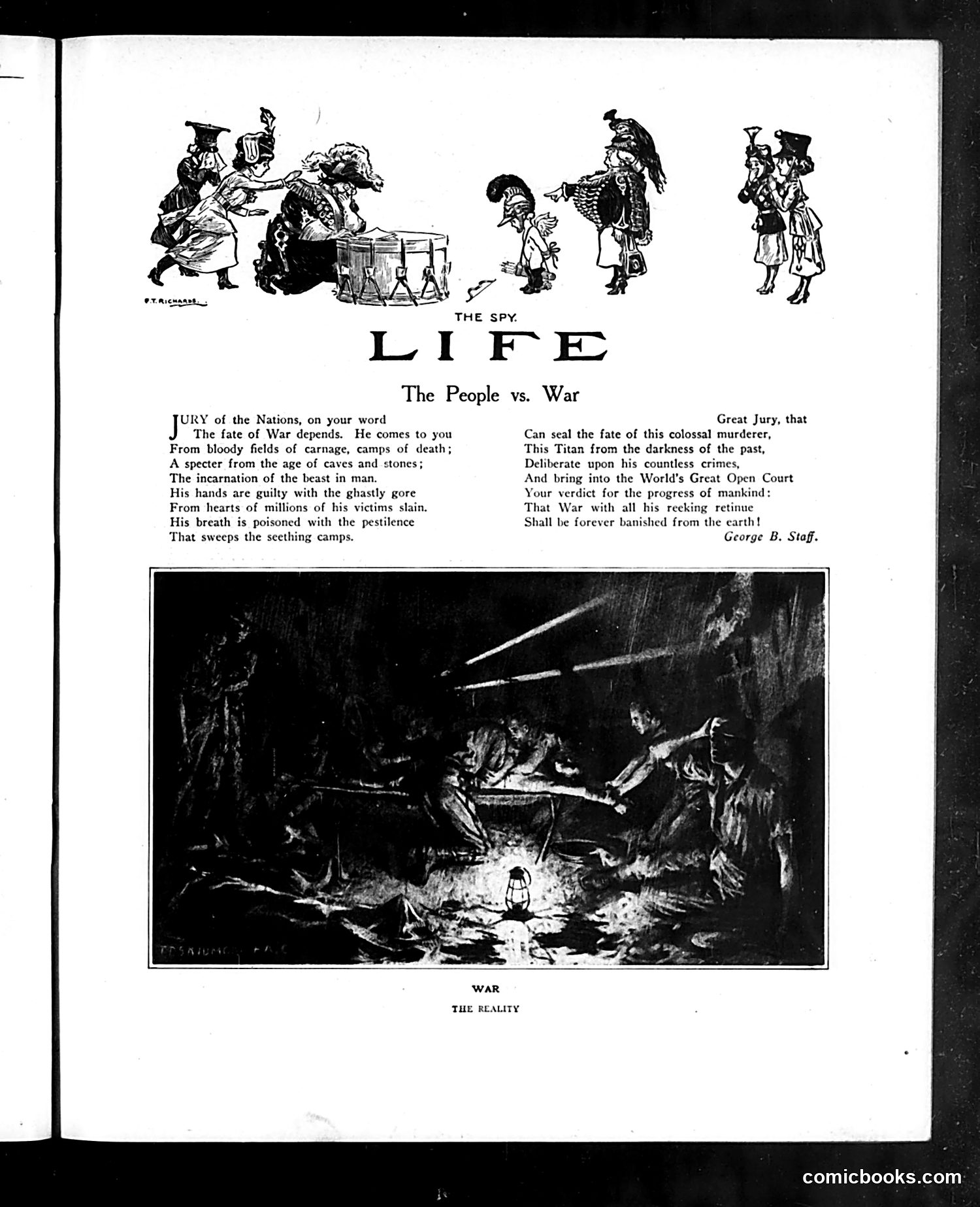
This page presents anti-war propaganda, likely from World War I. The title illustrates the contrast between "The Spy" (espionage/military intrigue shown in the small cartoons above) and "Life" (the magazine's editorial perspective). The poem by George B. Staff condemns War as a criminal defendant, summoning a "Great Jury" to prosecute War for murder and crimes against humanity. It references "bloody fields of carnage" and victims' suffering, arguing War should be "banished from the earth." The dark illustration below labeled "War—The Reality" depicts soldiers in a trench under bombardment—a stark, nightmarish vision contrasting with romanticized war narratives. This juxtaposition makes the satire's point: war's actual horror versus how it's publicly portrayed.
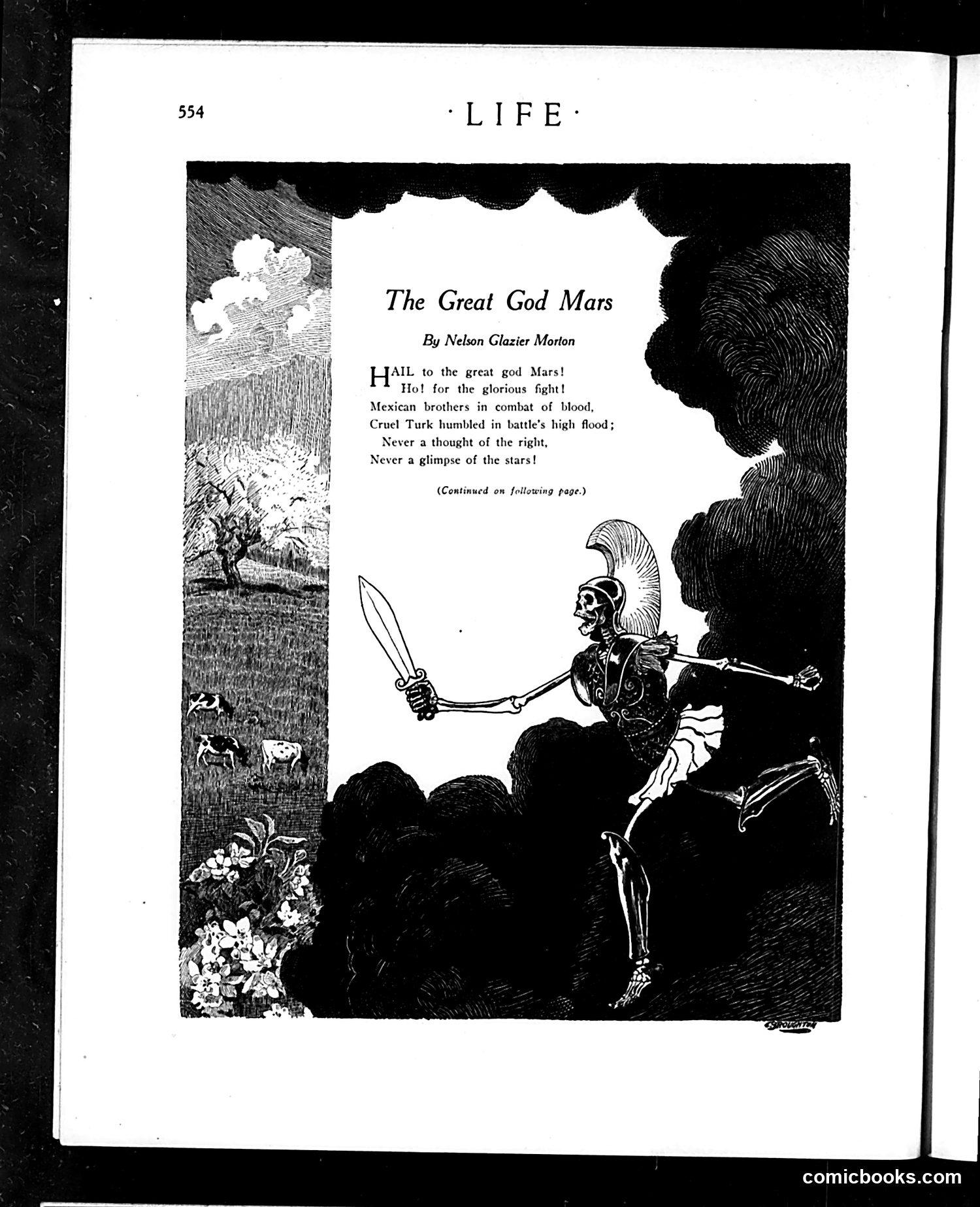
This satirical poem and illustration appear to critique military glorification and warfare. The skeletal figure of Mars (the Roman god of war) is depicted as a grinning skeleton wearing a plumed military helmet and wielding a sword and rifle. He towers over a pastoral landscape visible in the left panel. The poem's opening invocation—"HAIL to the great god Mars! Ho! for the glorious fight!"—uses ironic language to mock societies that worship military conquest. The reference to "Mexican brothers in combat of blood" and "Cruel Turk humbled in battle's high flood" suggests this critiques the romanticization of actual contemporary conflicts. The skeleton imagery transforms the god of war into a memento mori, emphasizing that warfare ultimately produces only death.
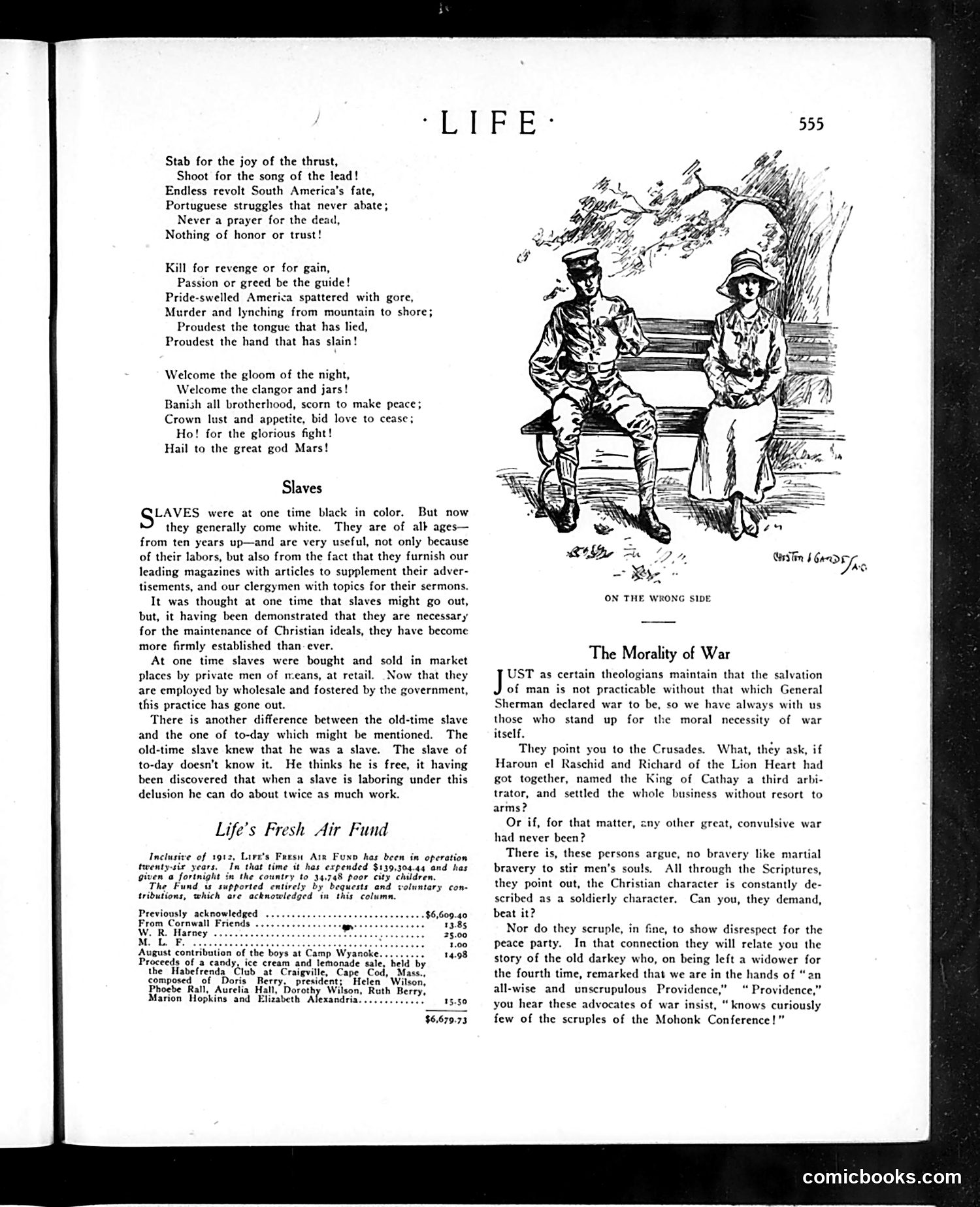
The cartoon depicts two soldiers sitting together on what appears to be a fortification or trench. The caption "ON THE WRONG SIDE" suggests ironic commentary on military positioning or allegiance. The accompanying article "The Morality of War" argues against pacifist and Christian objections to warfare. It references historical crusades and famous military figures (Haroun el Raschid, Richard the Lionheart) to claim martial bravery is inherently noble and scripturally justified. The cartoon likely satirizes this pro-war stance by showing soldiers in a compromised or morally questionable position—"the wrong side" possibly meaning they're fighting for an unjust cause despite the article's claims that war is always morally defensible. The juxtaposition criticizes warmongering rhetoric.
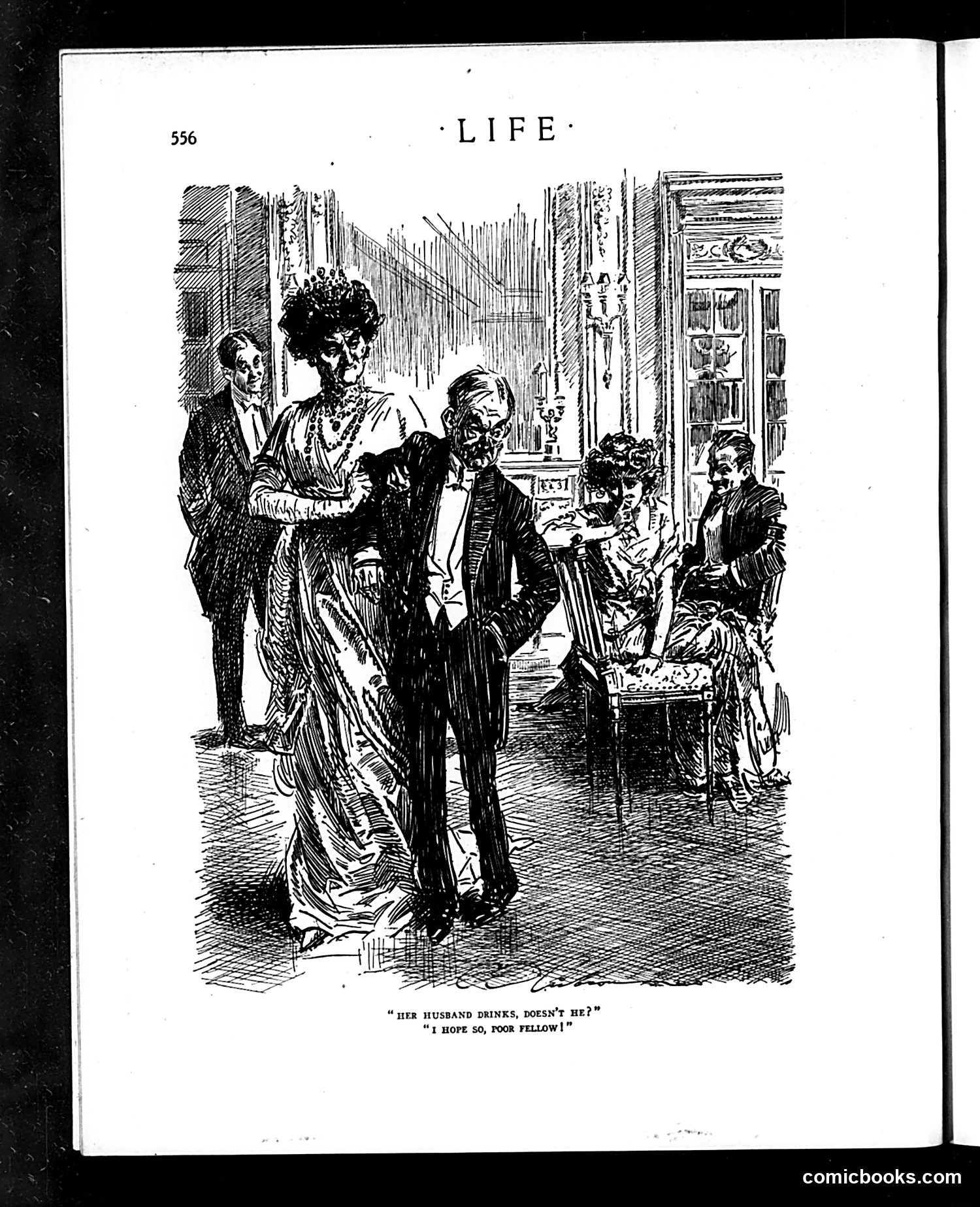
This page presents a single satirical illustration from Life magazine's "LIFE" section. The cartoon depicts an indoor social scene—likely a Victorian-era parlor or drawing room—with multiple well-dressed figures in formal attire. The caption reads: "HER HUSBAND DRINKS, DOESN'T HE?" followed by the response "I HOPE SO, POOR FELLOW!" The satire targets social gossip and hypocrisy. A woman appears to be making a damning observation about another woman's husband's drinking habits, while the response suggests resigned, sympathetic acceptance—implying the husband has good reason to drink, perhaps due to marital difficulties. The joke mocks both the catty nature of society gossip and the underlying admission that the marriage itself might be unbearable.
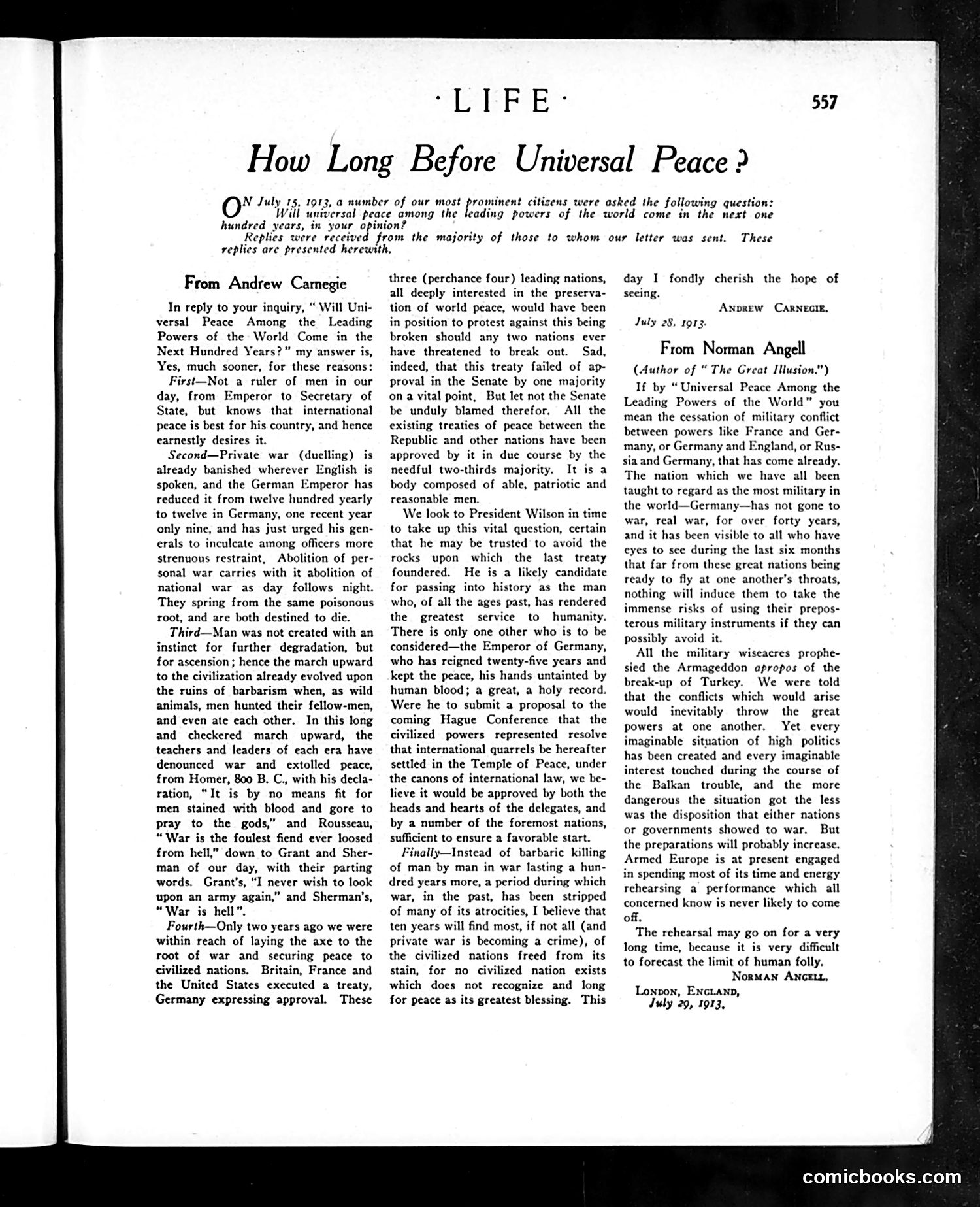
This page presents responses from prominent citizens to a timely question about achieving global peace. **Andrew Carnegie** argues for optimism, citing recent treaties and deploring private war (dueling). He credits Emperor Wilhelm II with maintaining peace through restraint. **Norman Angell** (author of "The Great Illusion") offers skepticism, arguing that despite noble intentions, military powers like Germany remain unwilling to risk war. He predicts armed Europe will continue rehearsing for conflict indefinitely, making the timeline for universal peace unknowable. The contrast reflects pre-WWI anxiety: optimistic industrialists versus intellectuals warning that European militarism made catastrophe inevitable—a tension resolved just one year later.
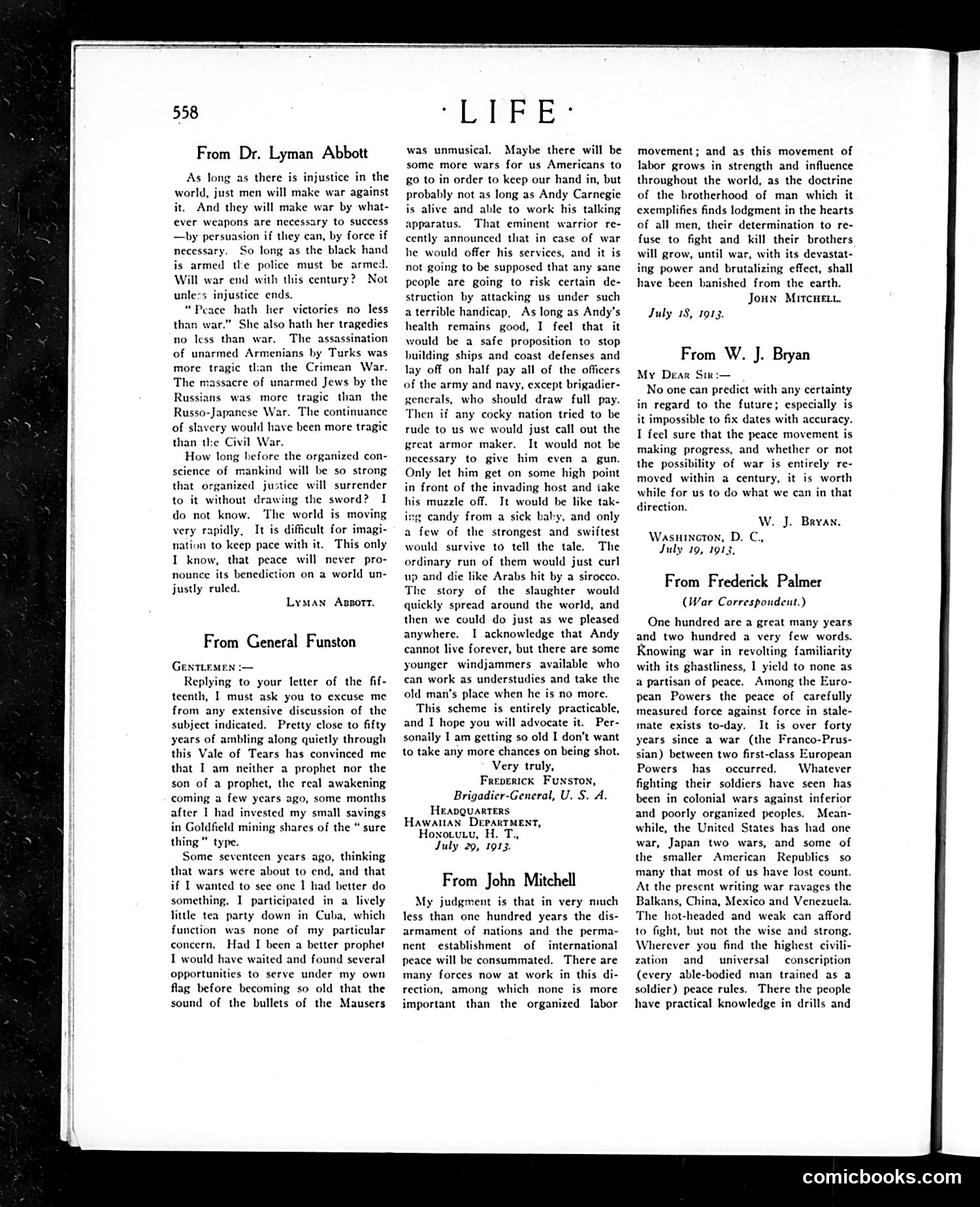
This page contains letters to the editor from *Life* magazine, dated July 1913. The contributors—Dr. Lyman Abbott, General Funston, W.J. Bryan, John Mitchell, and Frederick Palmer—discuss war, peace, and labor issues of the era. Key themes include: Abbott's argument for defensive military preparedness; Funston's proposal to employ unemployed men in military service rather than risk armed conflict; Bryan's cautious stance on predicting peace; Mitchell's optimism about labor's role in establishing international peace; and Palmer's observations on global military conflicts. The letters reflect Progressive-era debates over militarism, pacifism, labor organization, and America's role in international affairs—topics dominating public discourse during the prewar period before U.S. entry into World War I in 1917.
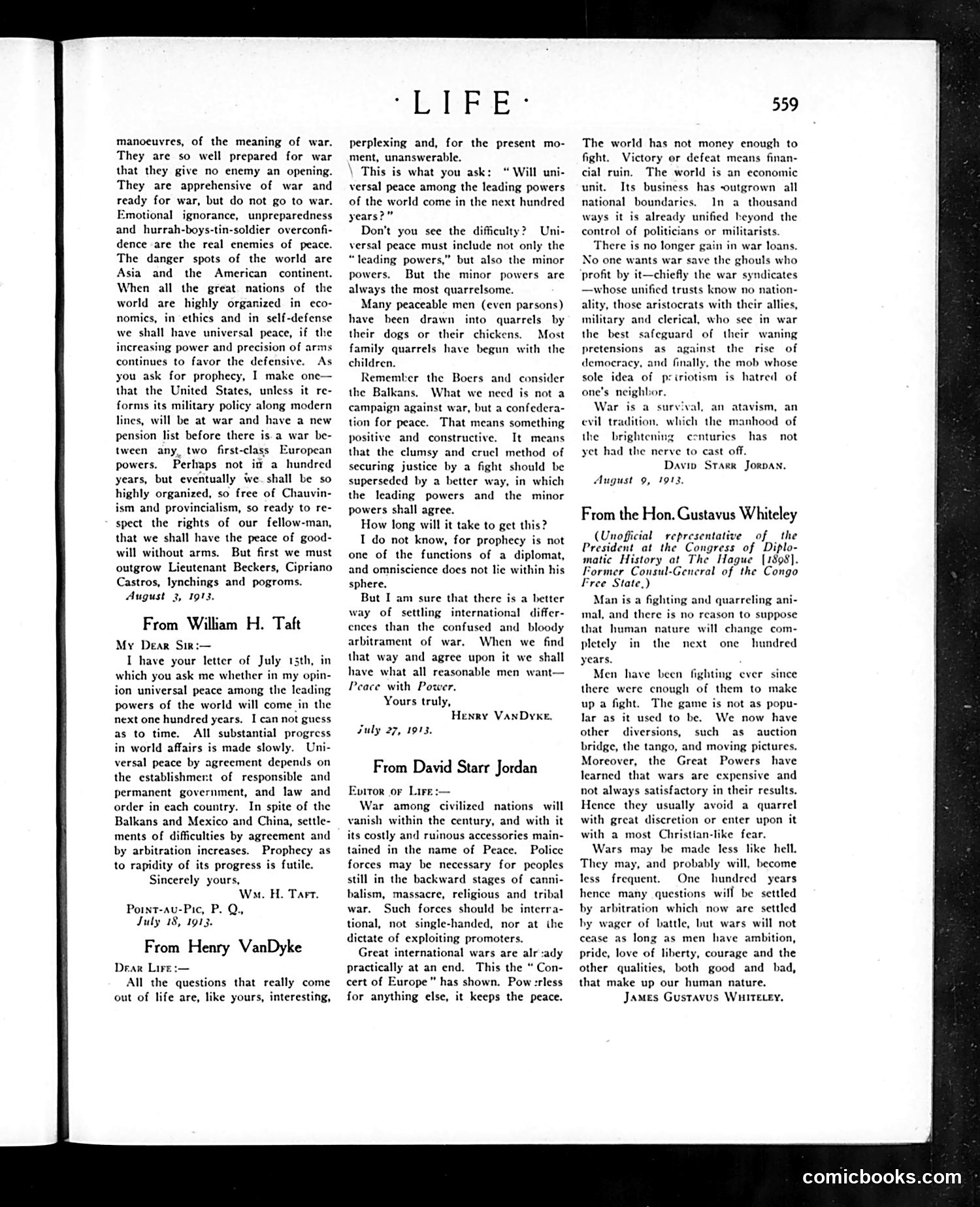
This page contains letters from prominent American figures debating whether universal peace among world powers will occur within a century. The contributors—former President William H. Taft, poet Henry VanDyke, and biologist David Starr Jordan—represent different perspectives on this question. **The satire's context**: Written just before World War I, these earnest, optimistic predictions about inevitable peace appear darkly ironic in retrospect. The writers cite examples of conflict (Balkans, Mexico, China) as manageable problems that arbitration and organization will solve. **Key figures**: Taft emphasizes military preparedness and legal order; VanDyke uses homely metaphors (dogs and chickens causing family quarrels) to explain how minor powers destabilize peace; Jordan predicts war's disappearance through civilization's progress. The page reveals pre-war progressive faith in rational solutions to international conflict—a faith soon shattered by events.
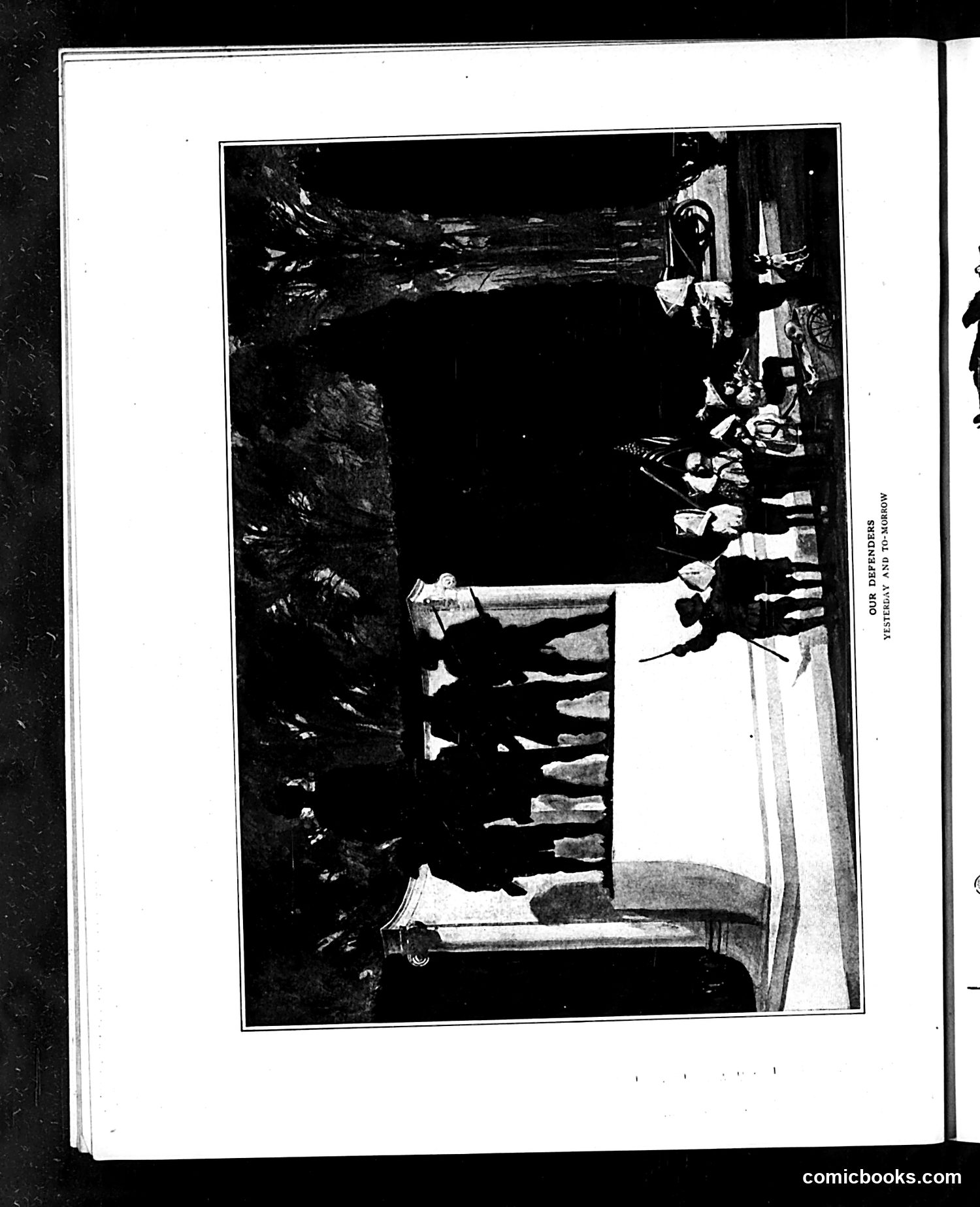
This appears to be a page from Life magazine showing a black and white photograph that's rotated 90 degrees, making it difficult to read clearly. The OCR text is largely corrupted symbols and fragments ("2 m a a z a & Fy a"), providing no readable context. The caption reads "YESTERDAY AND T[OMORROW]" (text cut off), suggesting a before-and-after comparison or historical contrast theme. However, without legible text or a clear view of the image content, I cannot identify specific figures, caricatures, or the satirical point being made. The image quality and rotation prevent me from determining what social or political commentary this page contains. To properly analyze this cartoon, a clearer, correctly-oriented image or complete caption text would be necessary.
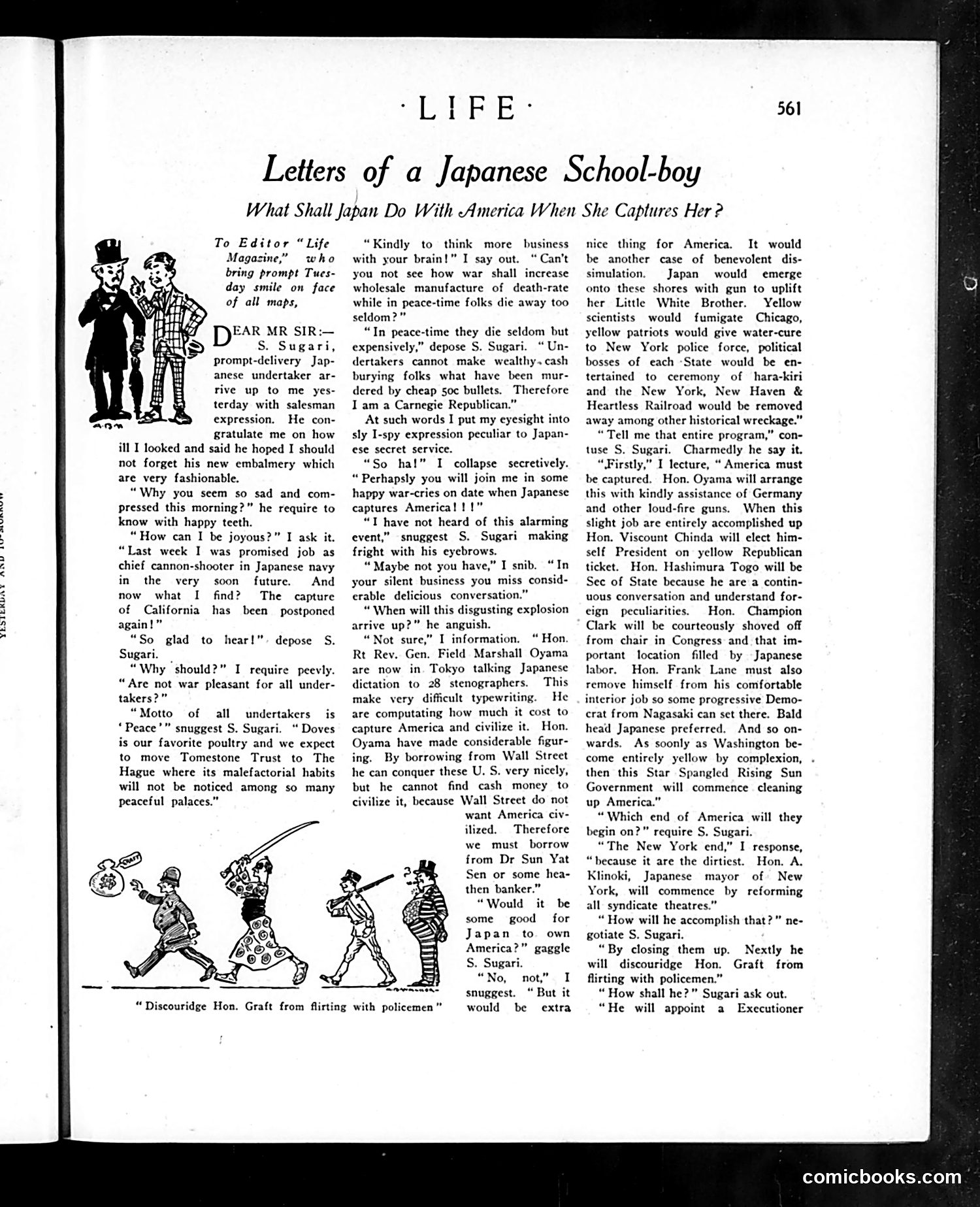
This satirical piece mocks contemporary anxieties about Japanese military expansion through a comedic letter format. A Japanese schoolboy writes to *Life* magazine about Japan's supposed plans to "capture America." The humor relies on: 1. **Broken English**: The boy's fractured syntax ("Why should?" "are very fashionable") exaggerates the speaker as foreign and ridiculous, making his imperial boasts absurd. 2. **Absurd scenarios**: The undertaker character, discussion of borrowing from Wall Street to "civilize" America, and plans to appoint Japanese officials as U.S. President mock the grandiosity of Japanese military ambitions. 3. **Contemporary anxieties**: The piece reflects real early-1900s American fears of Japanese military power (likely post-Russo-Japanese War), while simultaneously ridiculing those fears as paranoid fantasy. 4. **Self-deprecating "benevolent" colonialism**: The "water-cure" and other references satirize imperialist justifications for invasion. The cartoons below show martial figures in exaggerated postures, reinforcing the mock-serious tone about Japan's supposed threat to America.
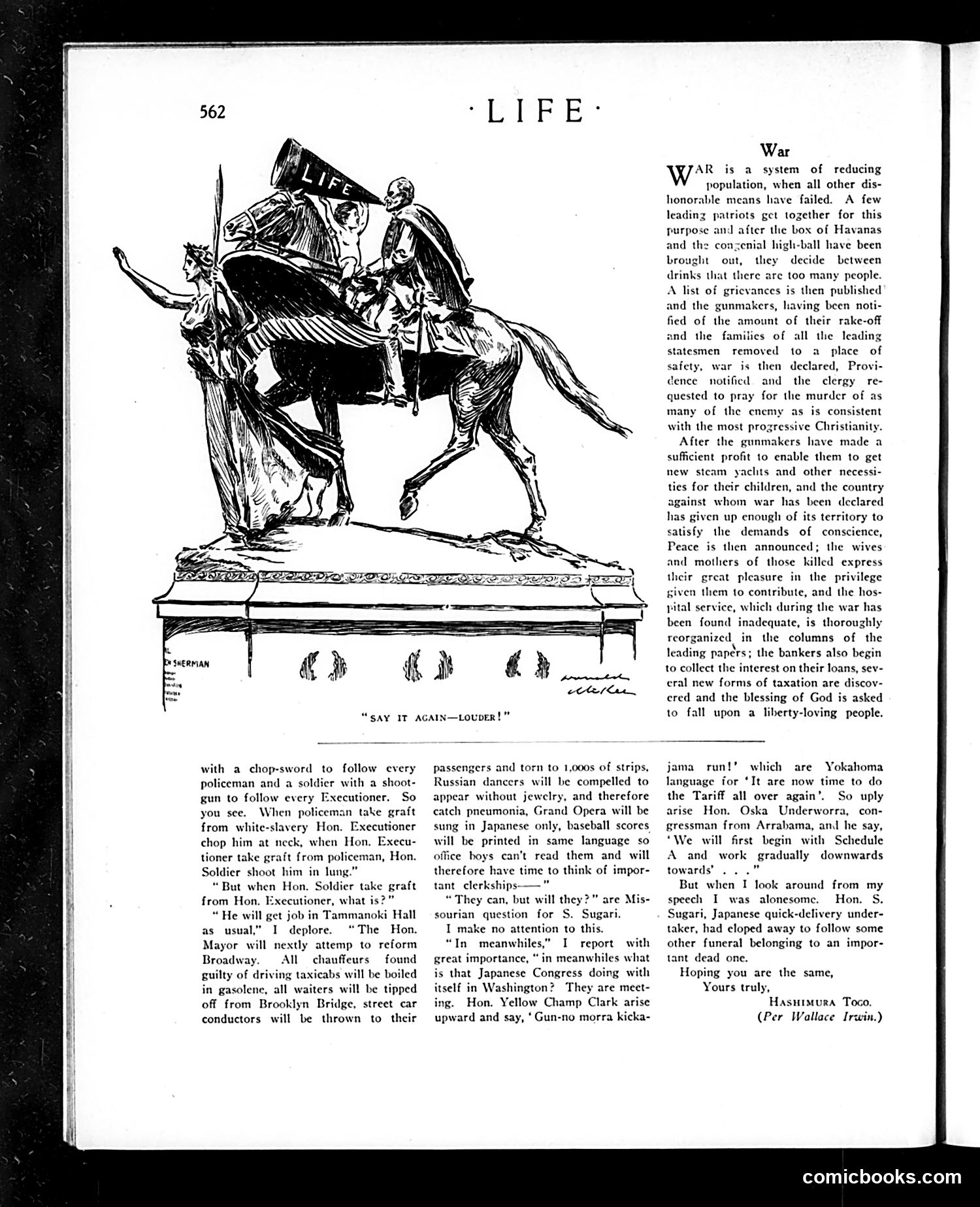
This page contains satirical commentary on two topics: **"War" (right column):** A cynical definition-essay defining war as population reduction when "all other dishonorable means have failed." It mocks the entire war apparatus: politicians manufacture grievances, gunmakers profit, clergy pray for enemy deaths, and afterward banks collect war loans while "the blessing of God is asked to fall upon a liberty-loving people." The satire targets hypocrisy in American militarism and capitalism. **Left section:** A humorous dialogue (by Wallace Irwin) featuring a Japanese character named S. Sugari discussing American and Japanese politics in broken English. It satirizes Tammany Hall corruption, Broadway reform proposals, and contemporary Congressional debates—likely referencing Speaker "Champ" Clark and tariff discussions. The jokes depend on ethnic stereotyping and malapropisms typical of early 20th-century American humor. **"Say It Again—Louder!" (cartoon caption):** References the camel statue's "Say It Again" pose, likely commenting on repetitive political rhetoric.
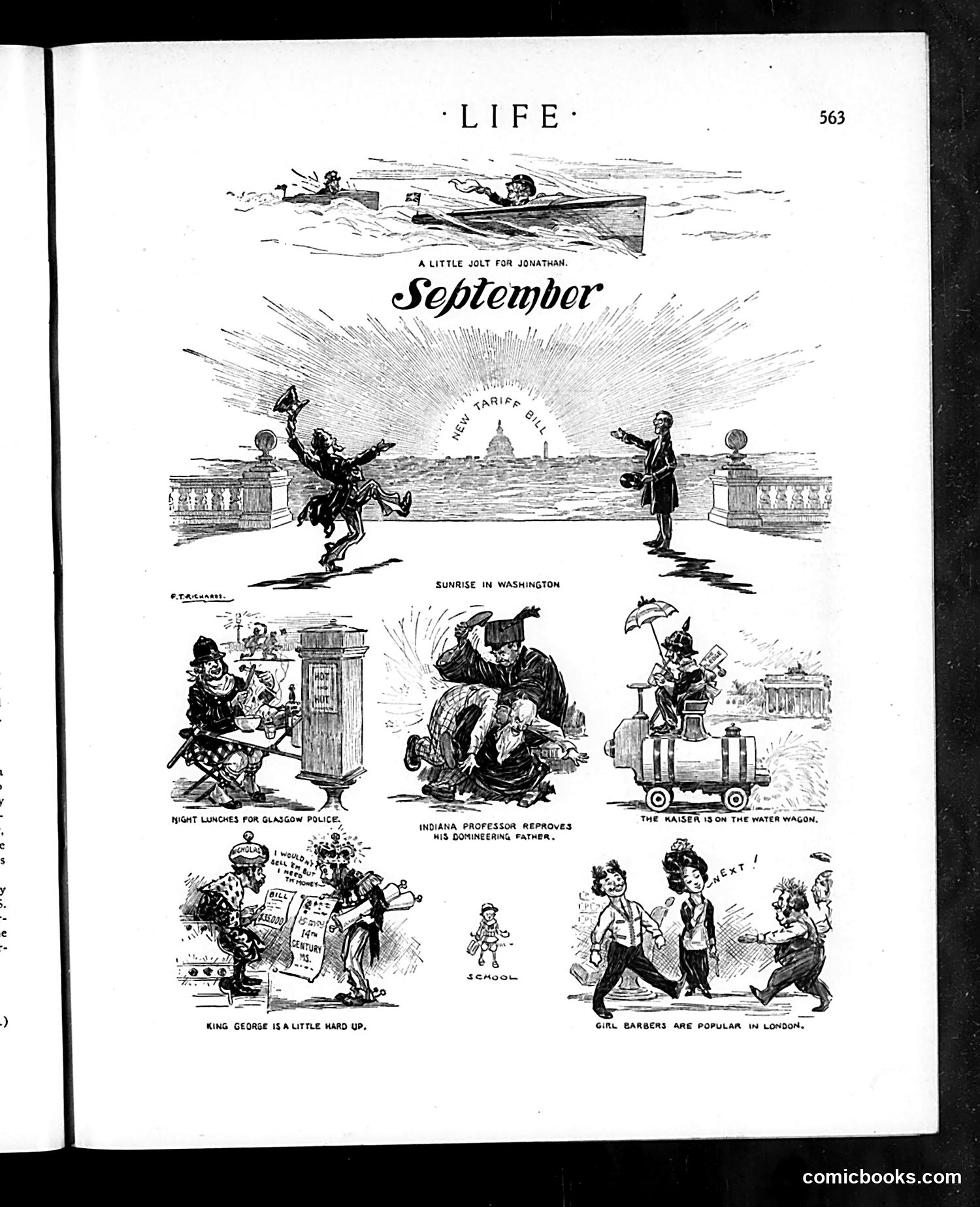
This page contains six separate satirical cartoons commenting on contemporary issues: **Top cartoon** ("A Little Jolt for Jonathan"): Depicts a figure in water being startled, likely political commentary on America. **Main illustration**: Shows a figure on a rearing horse labeled "NEW TARIFF BILL" confronting a standing figure—satirizing Theodore Roosevelt's tariff policies and their political shock. **Bottom cartoons** address various topics: Glasgow police night shifts, an Indiana professor's family conflict, the Kaiser's military situation ("water wagon"), King George's financial troubles, and London's employment of female barbers during WWI labor shortages. The page reflects early 20th-century American and British concerns: trade policy, military conflicts, royal finances, and wartime social changes. The satirical tone targets political leaders and social developments of the era.
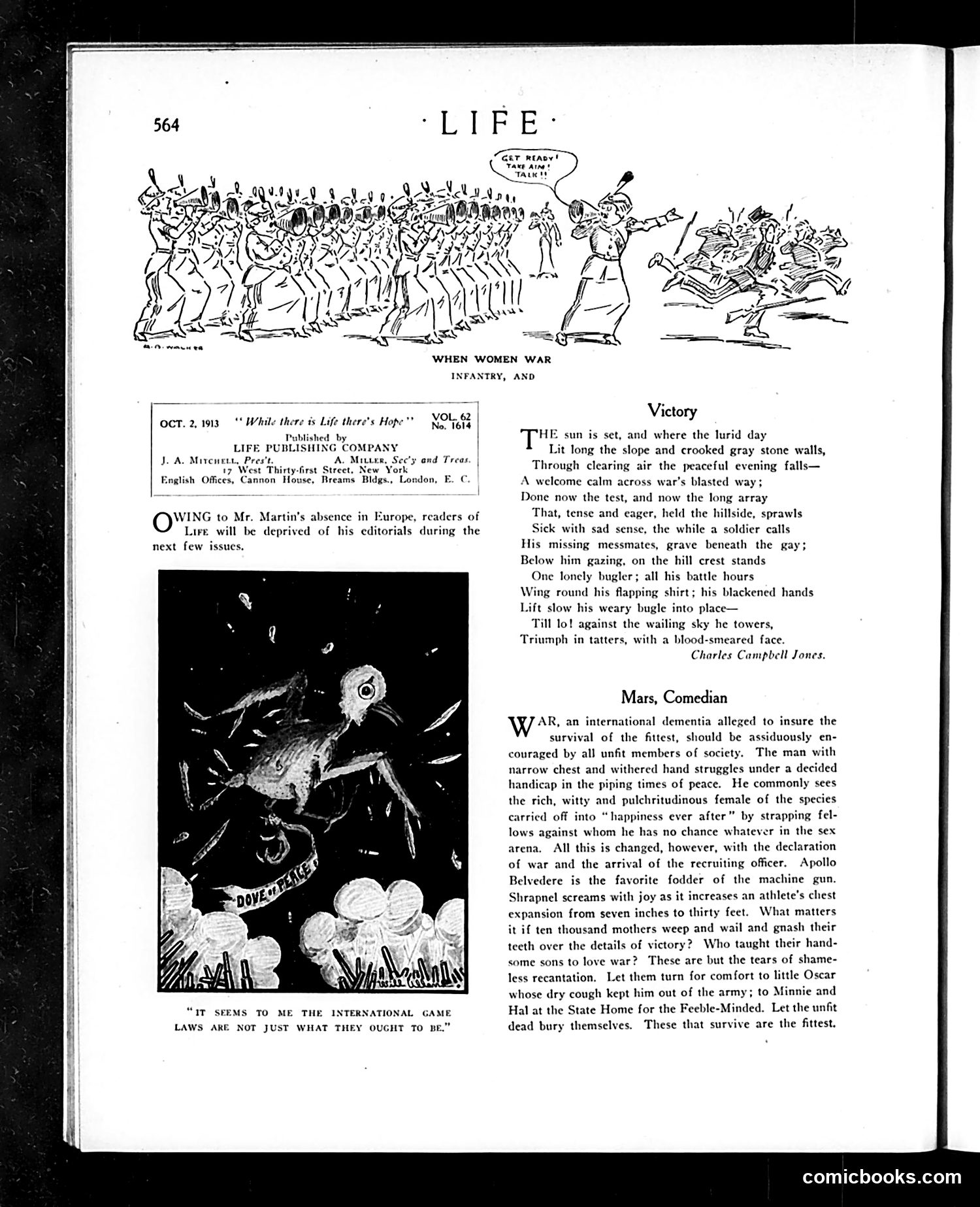
The top cartoon depicts "When Women War Infantry"—a satirical fantasy showing women as soldiers marching in formation while their commander shouts orders. The joke mocks the idea of female combat troops, treating it as absurd comedy. The accompanying poem "Victory" by Charles Campbell Jones presents a sentimental battlefield scene: a lone bugler at dusk, commemorating fallen soldiers with dignity. The article "Mars, Comedian" offers bitter social satire about war's effect on natural selection. It argues that war inverts peacetime's "survival of the fittest"—physically weak men (like "Oscar" with his dry cough) stay home while strong, athletic men die in machine-gun fire. The piece sarcastically suggests mothers should celebrate their handsome sons' deaths as eugenic victory, and that the weak should "bury themselves." This is dark commentary on how war contradicts Social Darwinist ideology popular at the time, and likely responds to WWI's massive casualties (the war had begun three months earlier).
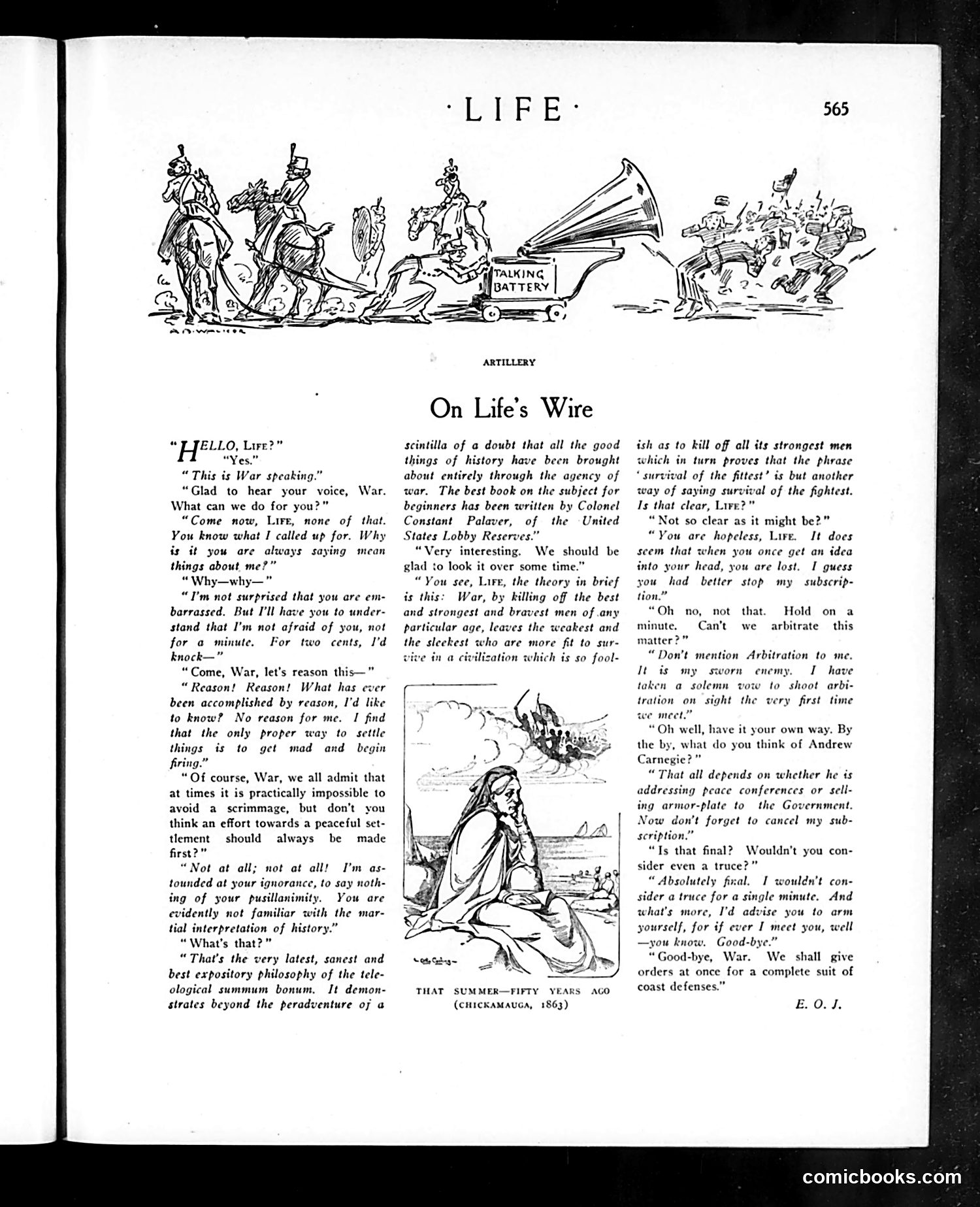
This is a satirical dialogue between "Life" (the magazine/public opinion) and personified "War," depicted as a bullying, unreasonable character. The piece mocks pro-war ideology and militarism. **Key satirical targets:** - **War's philosophy**: The cartoon ridicules the "martial interpretation of history"—the notion that warfare drives civilization forward and that killing off a nation's strongest men somehow strengthens society (a twisted version of "survival of the fittest"). - **Colonel Constant Palaver**: Likely a fictional stand-in for actual pro-war military theorists or lobbyists pushing this ideology. - **Andrew Carnegie**: The steel magnate is mocked as hypocritical—simultaneously funding peace conferences while profiting from selling armor-plate to governments preparing for war. - **War's intransigence**: War refuses arbitration and reason, insisting only on violence—satirizing how military interests reject diplomatic solutions. The illustration references the 1863 Chickamauga battle (American Civil War), grounding the critique in historical carnage. The satire suggests that militaristic thinking, though claiming historical justification, is fundamentally illogical and destructive.
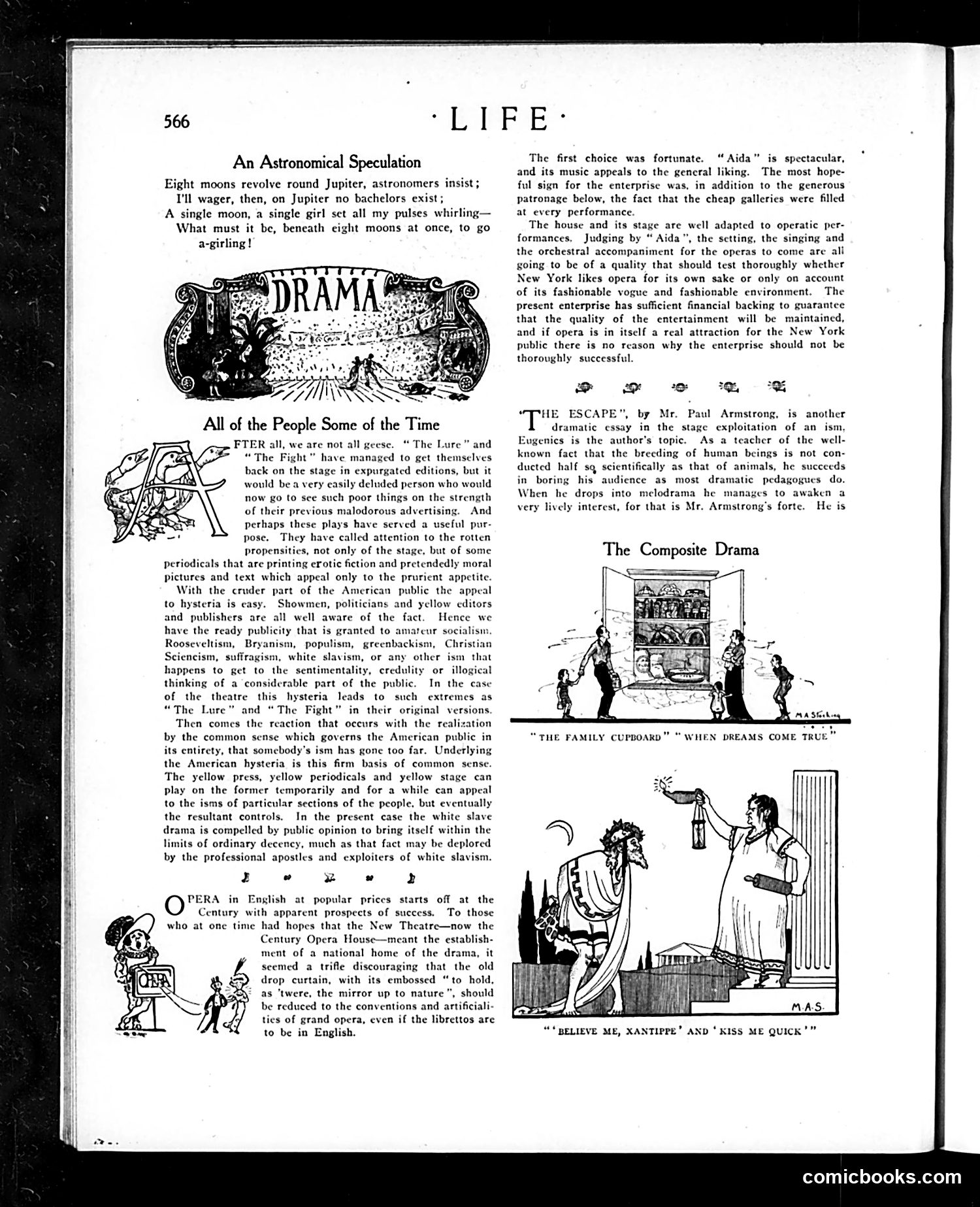
This page contains satirical commentary on American theater and public taste circa early 1900s. **"An Astronomical Speculation"**: A light joke imagining Jupiter's eight moons as evidence bachelors cannot exist there—because one moon (woman) already drives men crazy. **"All of the People Some of the Time"**: The main article critiques sensationalist theater and yellow journalism. It references two plays—"The Lure" and "The Fight"—that gained notoriety through lurid advertising about "white slavery" (human trafficking). The author argues that while these plays initially exploited public hysteria about moral corruption, American common sense eventually reasserted itself, forcing the plays to be "expurgated" (cleaned up). The piece mocks how politicians, publishers, and showmen deliberately stoke public fear around trendy causes (Rooseveltism, suffragism, Christian Science) to manipulate audiences, but notes this emotional manipulation eventually fails when rational judgment returns. **"The Composite Drama"**: Brief theater reviews praising the Century Opera House's production of *Aida*, noting it attracts both wealthy patrons and working-class gallery audiences.
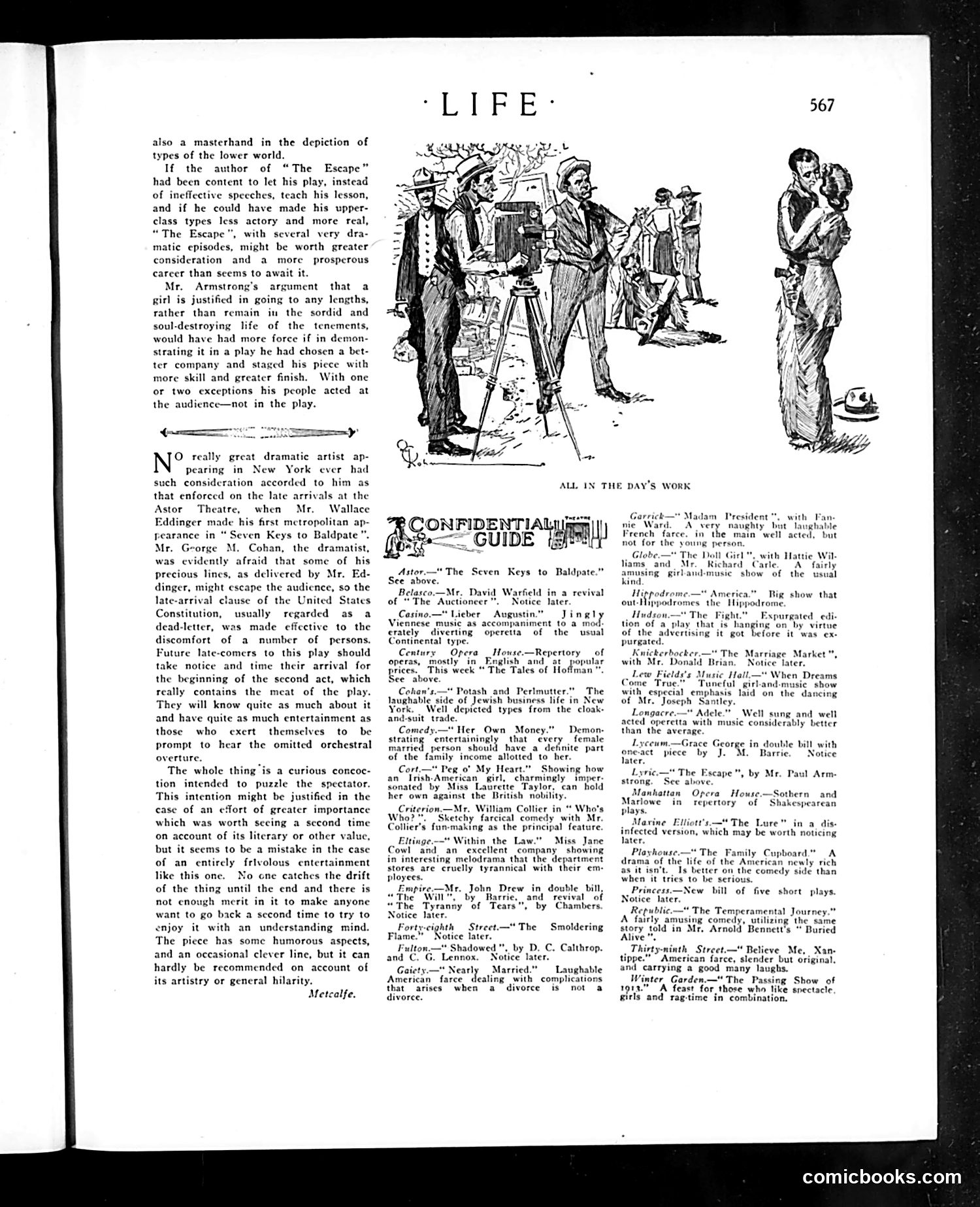
This page contains theater reviews by critic Metcalfe, covering Broadway productions from what appears to be the early 1910s. The main illustrated article critiques "Seven Keys to Baldpate" at the Astor Theatre, starring Wallace Eddinger in a play by George M. Cohan. The sketch titled "All in the Day's Work" depicts street scenes—likely illustrating urban life or working-class characters referenced in the theatrical reviews. The satire targets theatrical pretension: Metcalfe mocks Cohan's decision to block late arrivals (invoking the "late-arrival clause of the United States Constitution" sarcastically), suggesting the playwright feared audiences would miss his "precious lines." He critiques the play as a "frivolous entertainment" lacking sufficient merit to warrant multiple viewings, with only occasional clever moments among generally weak material. The accompanying theater guide reviews other productions, including Jewish immigrant comedies and melodramas—popular entertainment genres of the period reflecting New York's diverse immigrant populations.
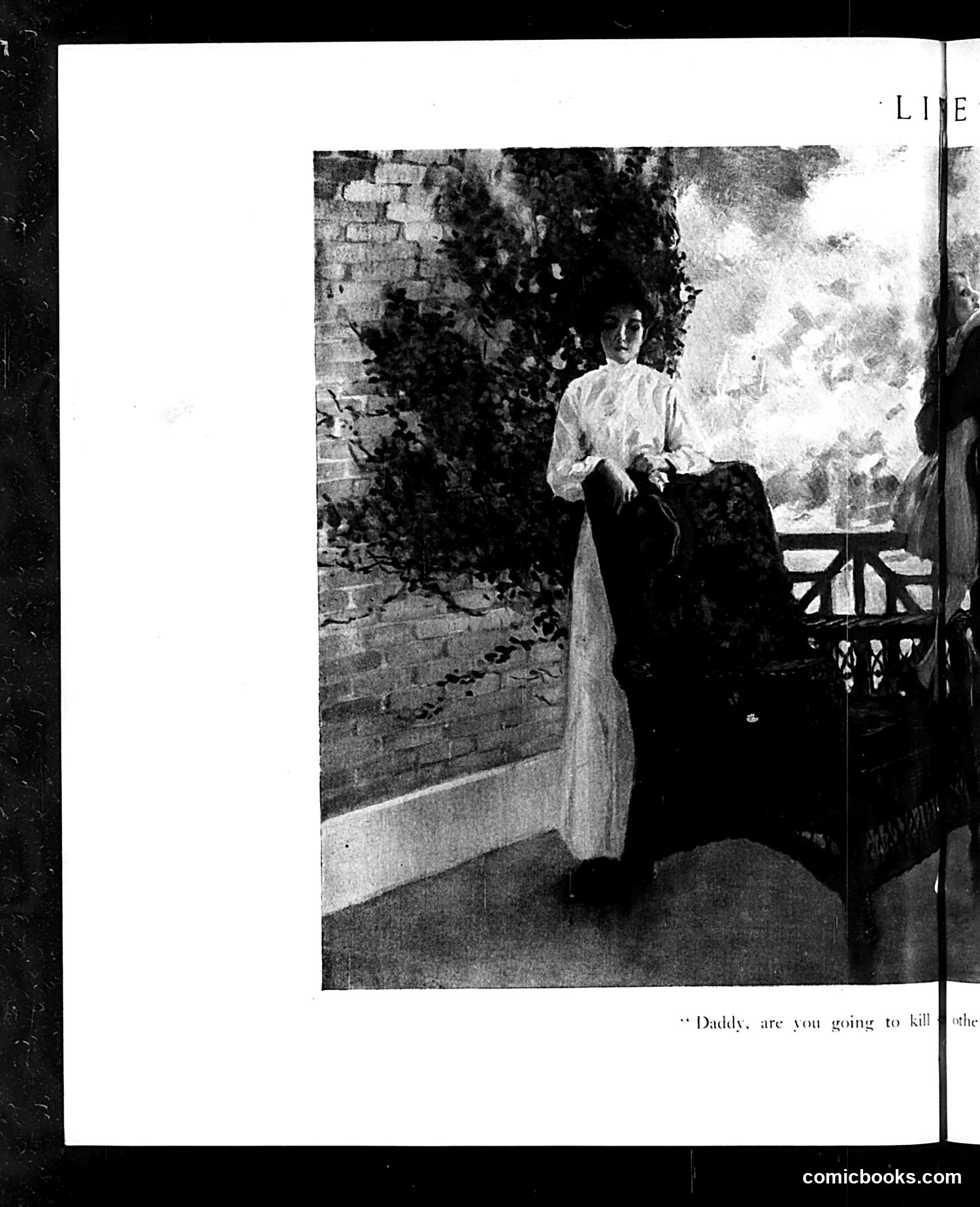
This page appears to be from a dramatic scene or story illustration in *Life* magazine, showing a woman in period dress (white blouse, dark skirt) standing on a balcony or terrace with ivy-covered walls behind her. The caption—"Daddy, are you going to kill"—is incomplete, suggesting this is mid-narrative. Without the full text, the exact context is unclear, though the dramatic staging and serious tone suggest this depicts a tense domestic or melodramatic moment rather than satire or political commentary. The image quality and artistic style are consistent with early-to-mid 20th century magazine illustration. Without additional context or complete dialogue, the specific meaning and any satirical intent remain uncertain.
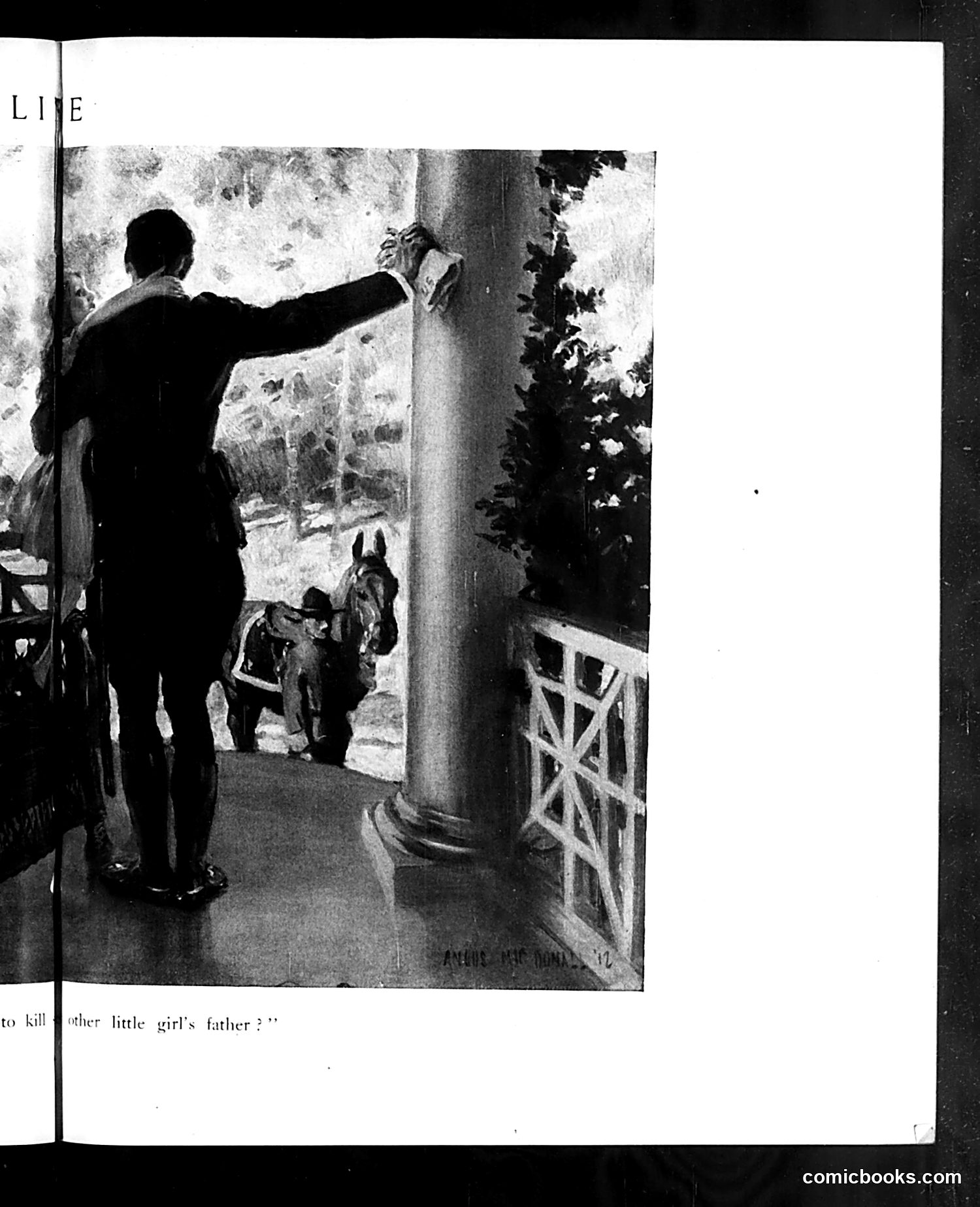
This page from *Life* magazine shows a black-and-white photograph of a man in formal attire standing at a doorway, arm extended outward. A small child and what appears to be a toy horse are visible nearby. The visible text fragment reads "to kill other little girl's father?" Without additional context or caption, the specific satire is unclear. The image appears to document a domestic or social scene, possibly depicting a awkward or comedic moment. The text fragment suggests dark humor—possibly satirizing period attitudes about violence, fatherhood, or social conduct—but without the complete caption, article context, or publication date, the precise political or social reference cannot be confidently determined. The archival nature and photographic style suggest early-to-mid 20th century.
This page showcases Life's 1914 contest asking readers to write about war in 500 words or less. The winning entry, "War!" by James Logan Mosby of Oklahoma, personifies war as a destructive force—conceived in "passion, hatred, envy and greed," indifferent to age or virtue, leaving "burning homes" and "raging hell" in its wake. Mosby's essay condemns war's dehumanizing effects: it makes puppets of leaders, fosters fanaticism, wastes resources, and perpetuates itself because selfish leaders exploit the masses. The rhetoric is explicitly anti-war, portraying military conflict as inherently immoral and parasitic. Also included is "Enigma," a riddle poem identifying "Hell" with war—darkly humorous given the timing. This contest likely reflects American anxieties about World War I, which began in Europe in 1914 before U.S. involvement in 1917.
This page presents **opposing satirical arguments about war**, a common Life magazine format of the era. **Left column (Robert A. Bachmann):** Cynically critiques war as driven by **corporate profit motives**—shipyards, steel mills, and munitions manufacturers need war to maintain production. Press agents manufacture hysteria to mobilize masses. The satire culminates in mocking soldiers as "faithful in his ignorance, unreasoning in his obedience," sacrificing themselves while older, wealthier men profit. **Right column (Frank Emerich):** Offers **mock praise** for war's supposed benefits: stimulating invention, patriotism, charity, and finance. The irony accumulates with absurd claims (war "improves the breed of men" by killing them off; posterity pays the bills). **Context:** This reflects WWI-era American debate over military-industrial interests and whether war serves national defense or capitalist profit. Both columns use **heavy irony and sarcasm** to expose hypocrisy—one attacks corporate greed, the other attacks nationalist justifications. The juxtaposition invites readers to recognize war's true costs. No cartoons appear visible on this page.
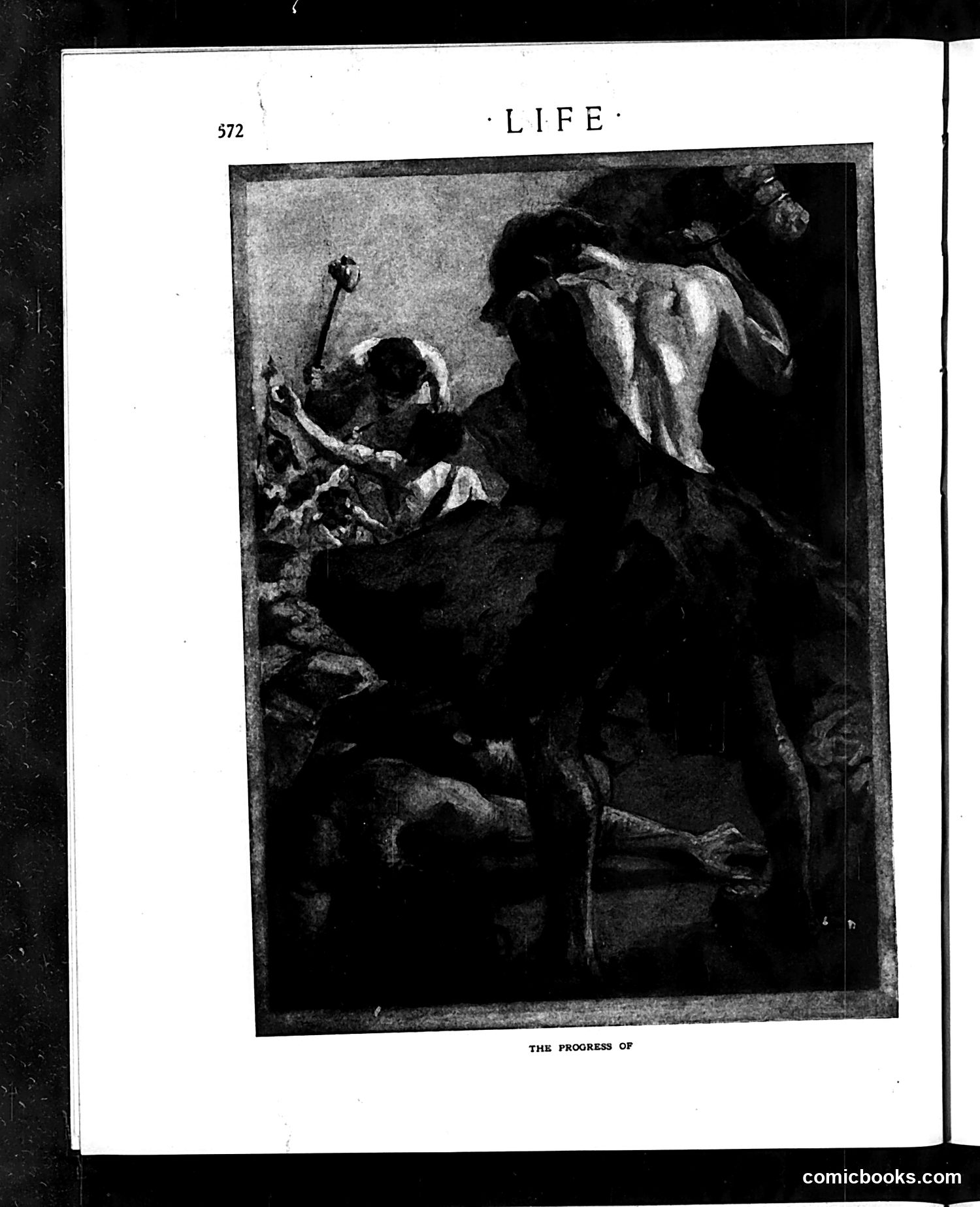
This appears to be the beginning of a satirical illustrated series titled "The Progress of," though the complete title is cut off. The dark, dramatic engraving shows multiple figures in classical or allegorical style—featuring what appears to be cherubs or putti alongside adult figures in dramatic poses, suggesting themes of civilization, morality, or human development. Without the full caption or subsequent pages, the exact satirical target remains unclear. However, *Life* magazine typically used such allegorical imagery to mock social progress, human pretension, or contemporary moral/political developments. The classical artistic style combined with *Life's* satirical approach suggests this may be lampooning claims of civilizational advancement or critiquing some aspect of American society. The specific figures and their identities cannot be determined from this page alone.
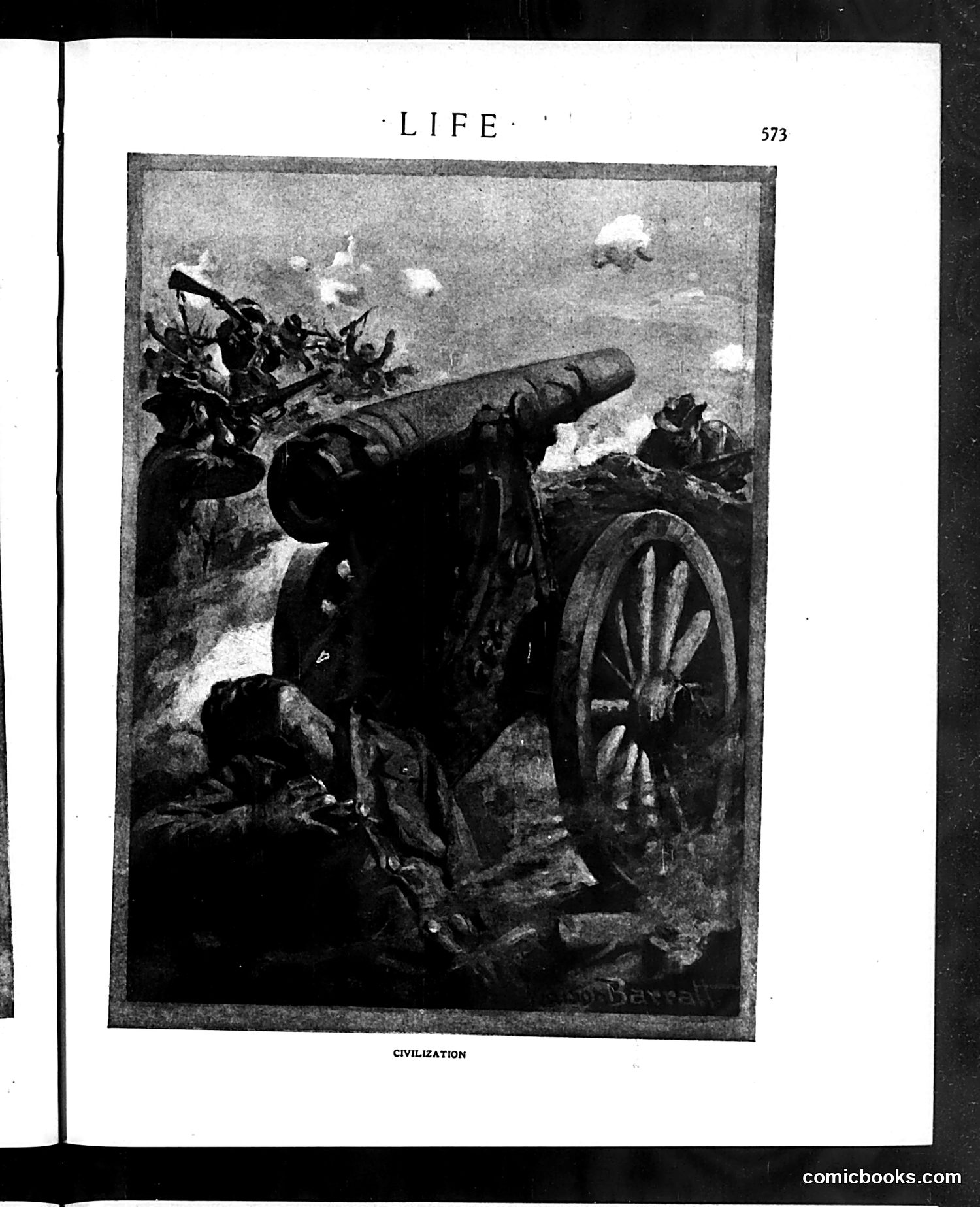
This page from *Life* magazine presents a satirical image titled "Civilization." The illustration depicts soldiers operating a large cannon mounted on wheels, with explosions and smoke visible in the background landscape. The composition juxtaposes the raw destructive power of modern artillery against the concept of "civilization" itself. The satire appears to critique how industrial societies rationalize warfare as progress or civilized behavior. By labeling this scene of military violence as "Civilization," the cartoonist mocks the contradiction between claims of advanced society and the brutal realities of mechanized warfare. This likely reflects early 20th-century anxieties about industrial-scale conflict and questions about whether technological advancement genuinely represented human progress or merely enabled greater destruction.
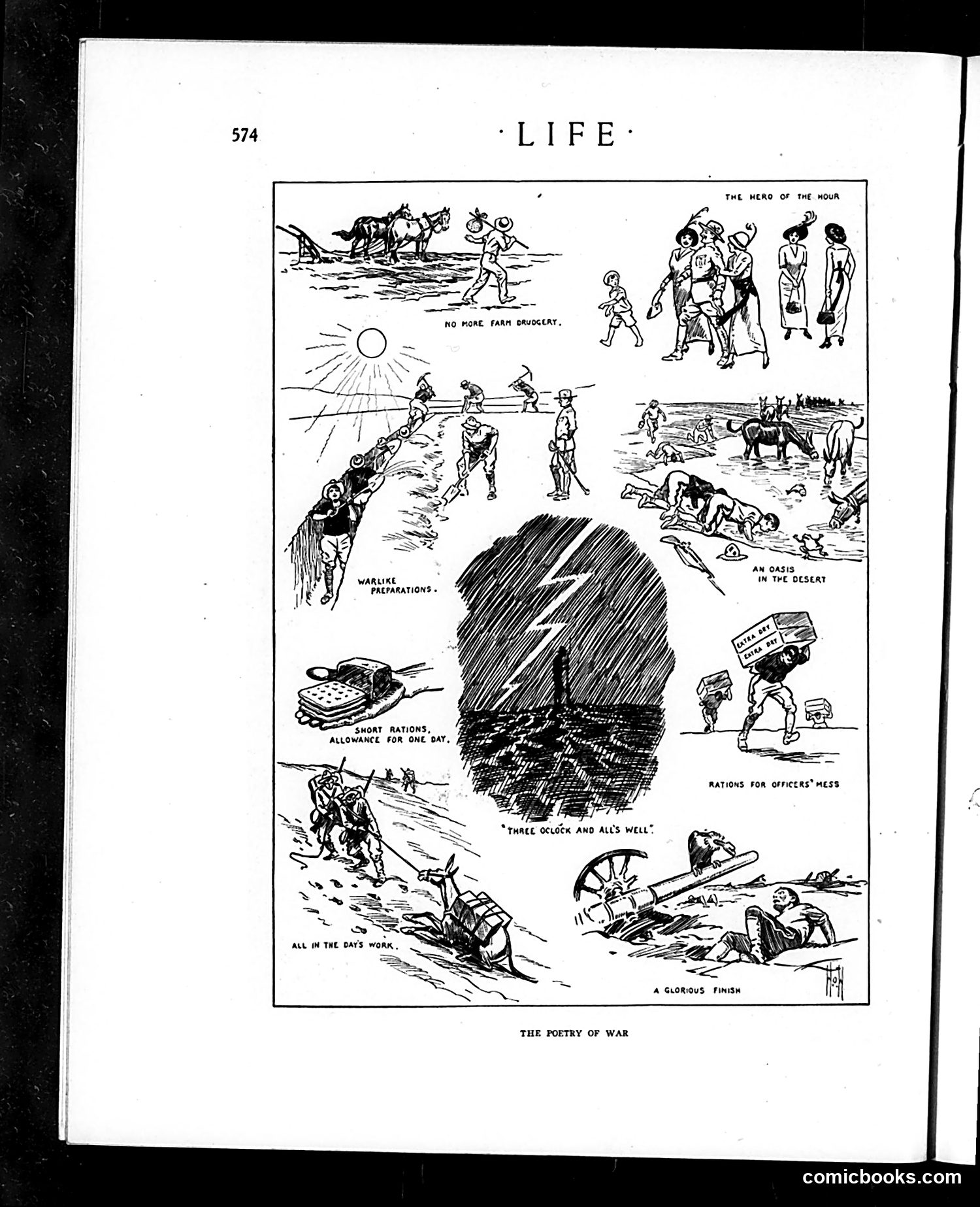
This satirical Life magazine page mocks the romanticized language surrounding World War I through darkly humorous vignettes. The title itself is ironic—juxtaposing "poetry" with brutal war realities. The central large illustration depicts a skull, emphasizing death's omnipresence. Surrounding panels show soldiers enduring hardship: "No more farm drudgery" (forced military labor), "Warlike preparations" (exhausting drills), meager "short rations," desert conditions ("An oasis in the desert"), and finally "A glorious finish" (death/destruction). The cartoon critiques military recruitment propaganda that glamorized service, presenting war as escape from civilian drudgery. Instead, the artist reveals it as organized suffering—hunger, exhaustion, and mortality. The juxtaposition of heroic framing language with grotesque realities creates bitter satire typical of WWI-era anti-war sentiment.
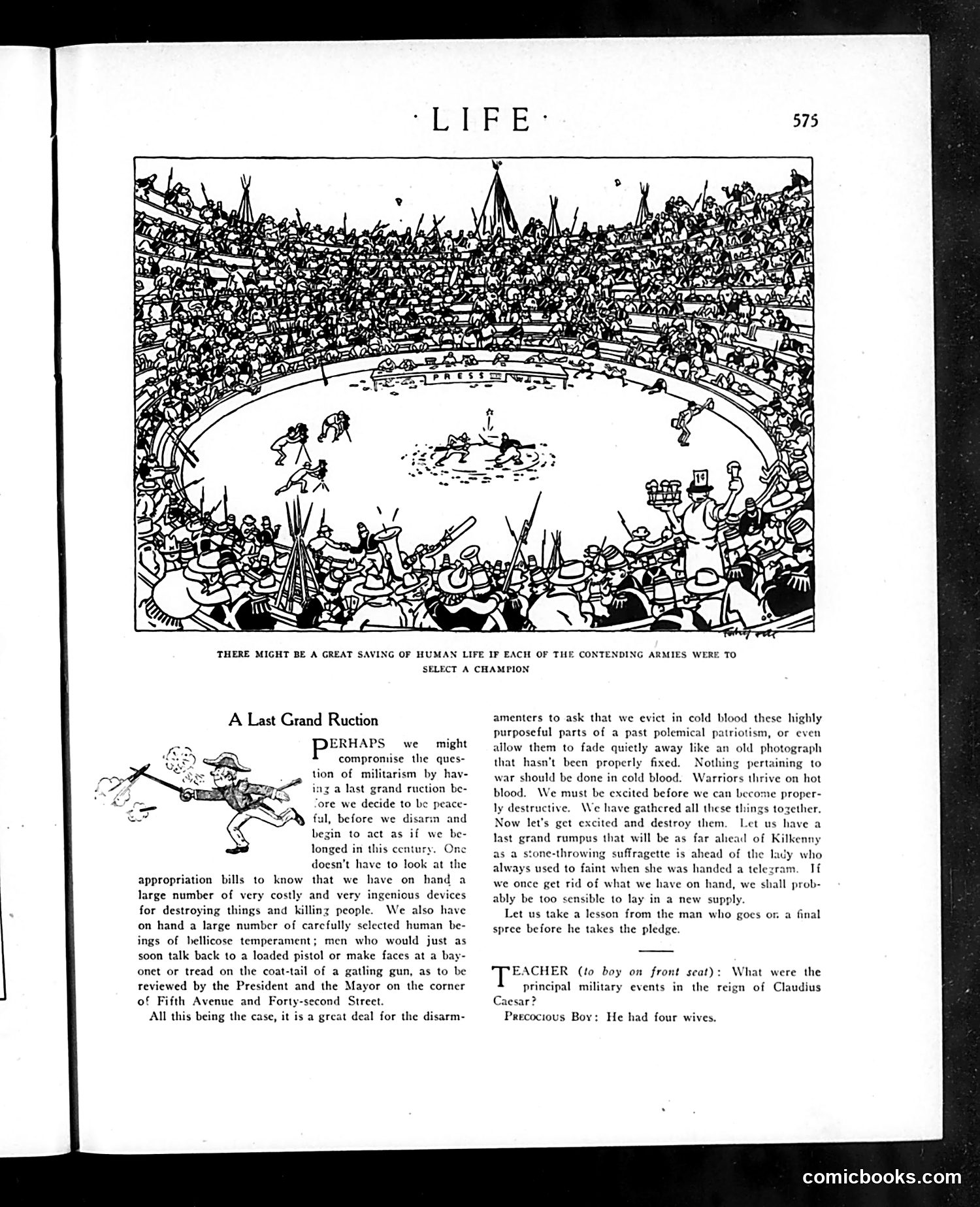
The cartoon depicts a Roman amphitheater where two armies face each other, with a caption proposing that instead of warfare, each side select a single champion to fight—a "great saving of human life." The accompanying article, titled "A Last Grand Ruction," sarcastically argues for one final massive military spectacle before disarmament. It mocks militarism by suggesting America has accumulated expensive weapons and aggressive soldiers that shouldn't be "evicted in cold blood"—warriors need excitement. The author proposes a grand final "rumpus" to use up existing military resources before pursuing peace, comparing it to someone taking "a final spree before he takes the pledge." The closing joke about Claudius Caesar's four wives is unrelated humor, possibly suggesting that historical questions have frivolous answers. **Context**: This satirizes early 20th-century disarmament debates and military spending, using absurdist logic to critique both militarism and pacifist arguments about weapons disposal.
This is satirical anti-war fiction contrasting two scenes from wartime Bucharest. **Reel I** depicts working-class soldiers marching to war amid patriotic fervor. Through dialogue, Endicof exposes the bitter irony: soldiers claim to defend their "homes" (rented rooms), "rights" (the right to work if jobs exist), and "privileges" (freedom to choose where they labor). Their wives and children aren't even present—they're in factories and fields working for wealthy owners. The satire is brutal: soldiers sacrifice "worthless, trivial lives" to protect the "good, kind, generous masters" who barely sustain them. **Reel II** shifts to the King's palace, where the luxuriously dressed Minister of War sits as the admired "greatest patriot"—the stark contrast highlighting who benefits from war while workers die. The piece is socialist critique: war rhetoric masks class exploitation. Soldiers aren't defending abstract national ideals but rather the economic system that impoverishes them, while aristocrats and industrialists remain safe and celebrated.
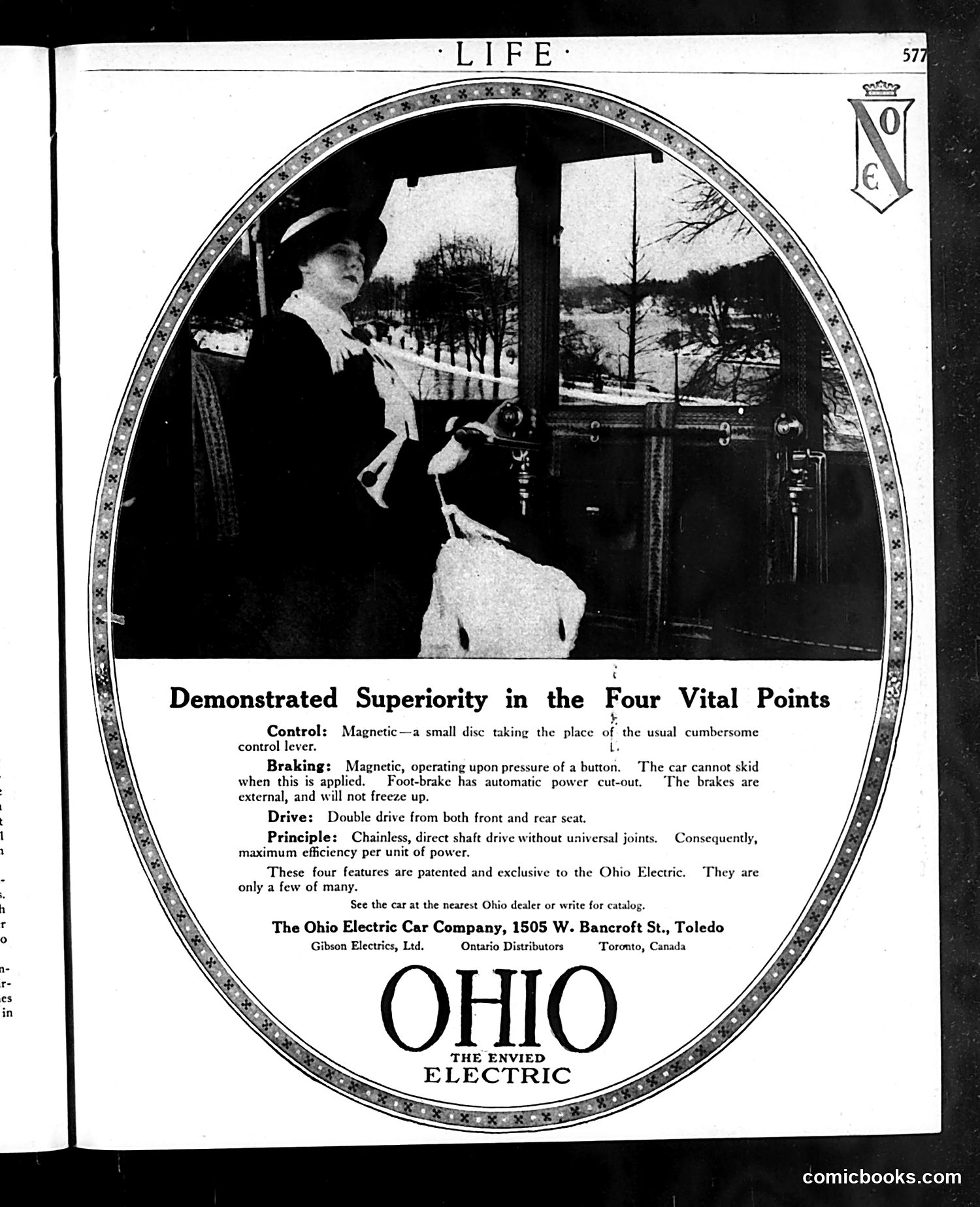
This is **not satire or political content** — it's a straightforward automobile advertisement from Life magazine (page 577). The image shows a well-dressed woman operating an Ohio Electric Car, positioned at a window overlooking a landscape. The ad emphasizes four technological features: magnetic control (replacing traditional levers), magnetic braking with safety features, dual front-and-rear drive capability, and chainless shaft drive for efficiency. All are claimed as "patented and exclusive." This represents early 1900s automotive marketing, when electric vehicles competed seriously with gasoline cars. The refined female figure suggests these cars appealed to affluent, educated consumers. The term "envied" in the tagline implies social status and desirability. There is no satirical commentary here — Life functioned partly as a commercial magazine accepting advertisements alongside editorial content.
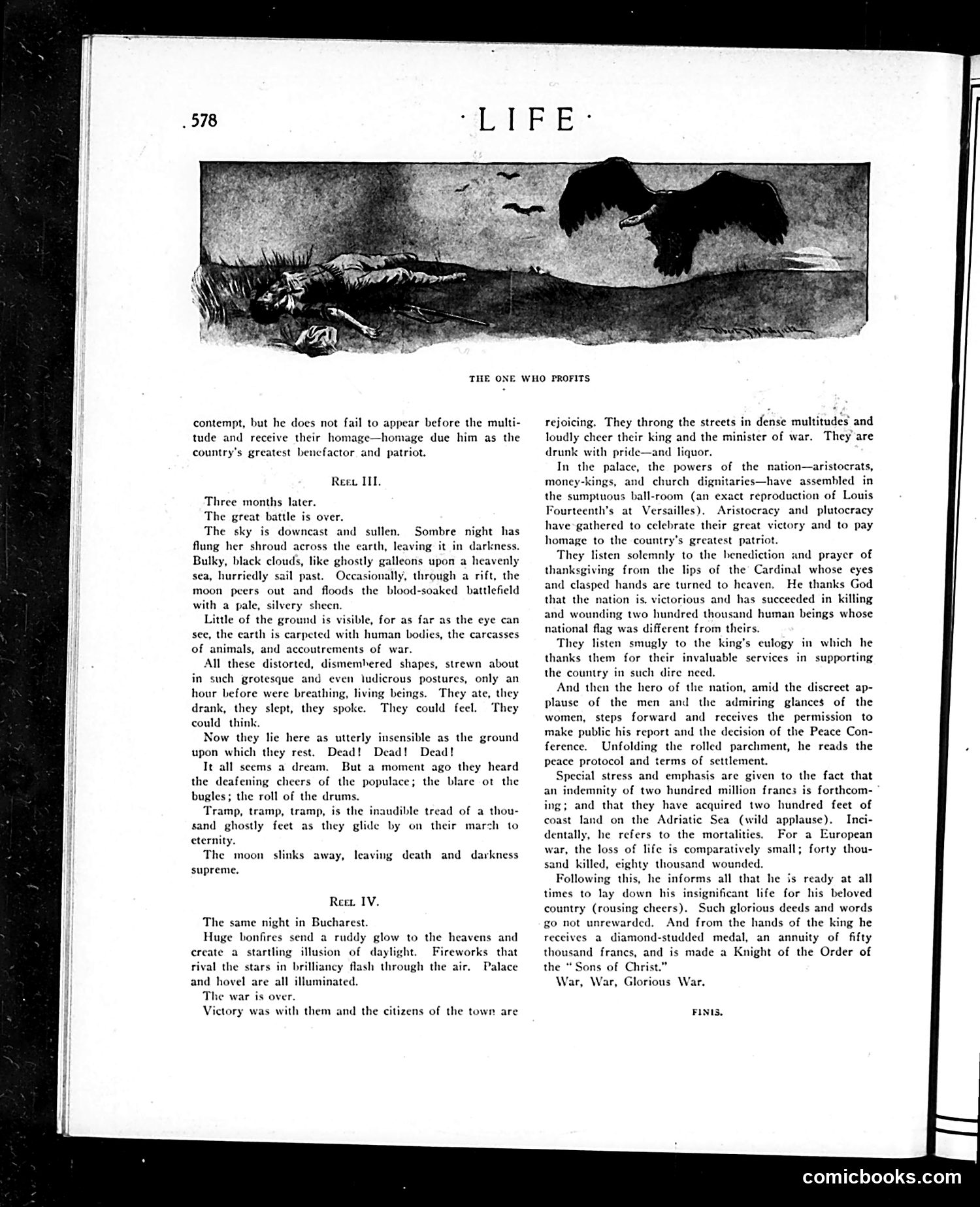
This piece satirizes the hypocrisy of celebrating military victory while ignoring its human cost. The stark illustration contrasts two scenes: a battlefield strewn with corpses under moonlight, versus a palace celebration in Bucharest where aristocrats, clergy, and politicians toast their "greatest patriot." The satire's point: while ordinary soldiers lie dead (40,000 killed, 80,000 wounded), the nation's elite gather to honor a general who receives medals and money. The text emphasizes their callous detachment—the Cardinal thanks God for killing foreign soldiers; the king praises those who enabled war; the general boasts of territorial gains (Adriatic coast) and financial indemnities (200 million francs). "The One Who Profits" asks: who actually benefits from war? Not the dead, but the powerful who accumulate wealth, land, and glory while others sacrifice everything. The piece critiques how war's true human devastation is obscured by nationalist celebration.
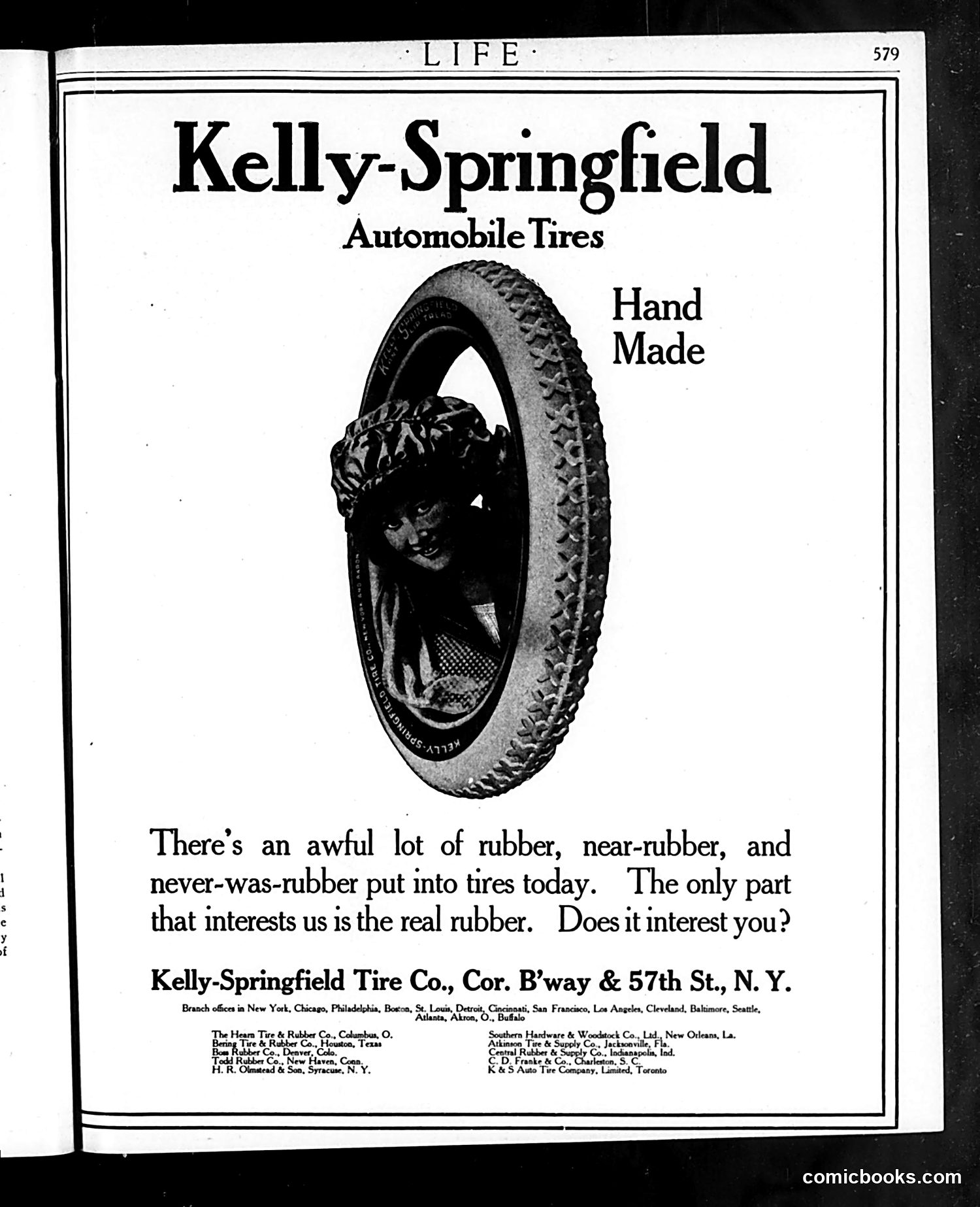
This is a **product advertisement**, not political satire. The page promotes Kelly-Springfield automobile tires through a straightforward marketing argument about material quality. The ad's central claim criticizes competitors' practices: manufacturers were allegedly using inferior substitutes—"near-rubber" and "never-was-rubber"—in tire production to cut costs. Kelly-Springfield positions itself as the ethical alternative, emphasizing their use of genuine rubber. The image shows a tire with what appears to be a classical female head or bust visible through the center, likely a brand logo or decorative emblem meant to convey quality and craftsmanship (the "Hand Made" claim reinforces this). For modern readers: this reflects early 20th-century consumer anxieties about product authenticity and manufacturing standards during an era with minimal regulation.
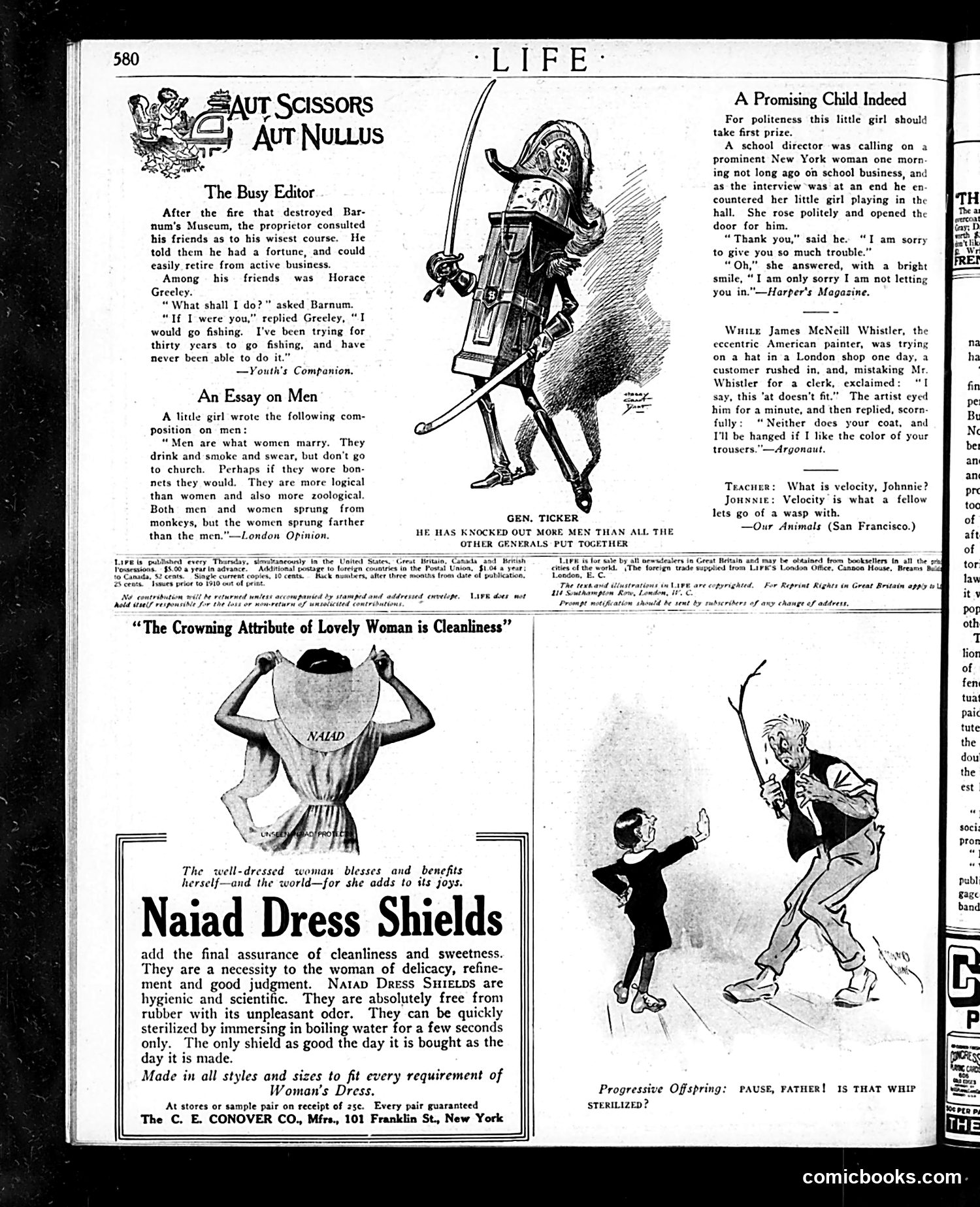
This page contains several satirical pieces typical of early 20th-century American humor: **"Aut Scissors Aut Nullus"** presents brief anecdotes mocking prominent figures—notably advice from Horace Greeley to P.T. Barnum about retirement, suggesting Greeley himself has been unable to escape his work life despite decades of effort. **"An Essay on Men"** reprints a child's supposedly innocent composition claiming men are "more logical" and "more zoological" than women, who "sprung farther from monkeys." The satire lies in presenting this as childish wisdom that actually exposes absurd Victorian gender assumptions. **"Gen. Ticker"** cartoon depicts a military figure engaged in combat, captioned that he's "knocked out more men than all the other generals put together"—unclear without fuller context. The **Naiad Dress Shields advertisement** parodies period anxieties about female "cleanliness," using medical-scientific language to market undergarment accessories while reinforcing idealized femininity. Scattered anecdotes mock politeness, including the Whistler story where the painter insults a customer's appearance after being mistaken for a clerk.
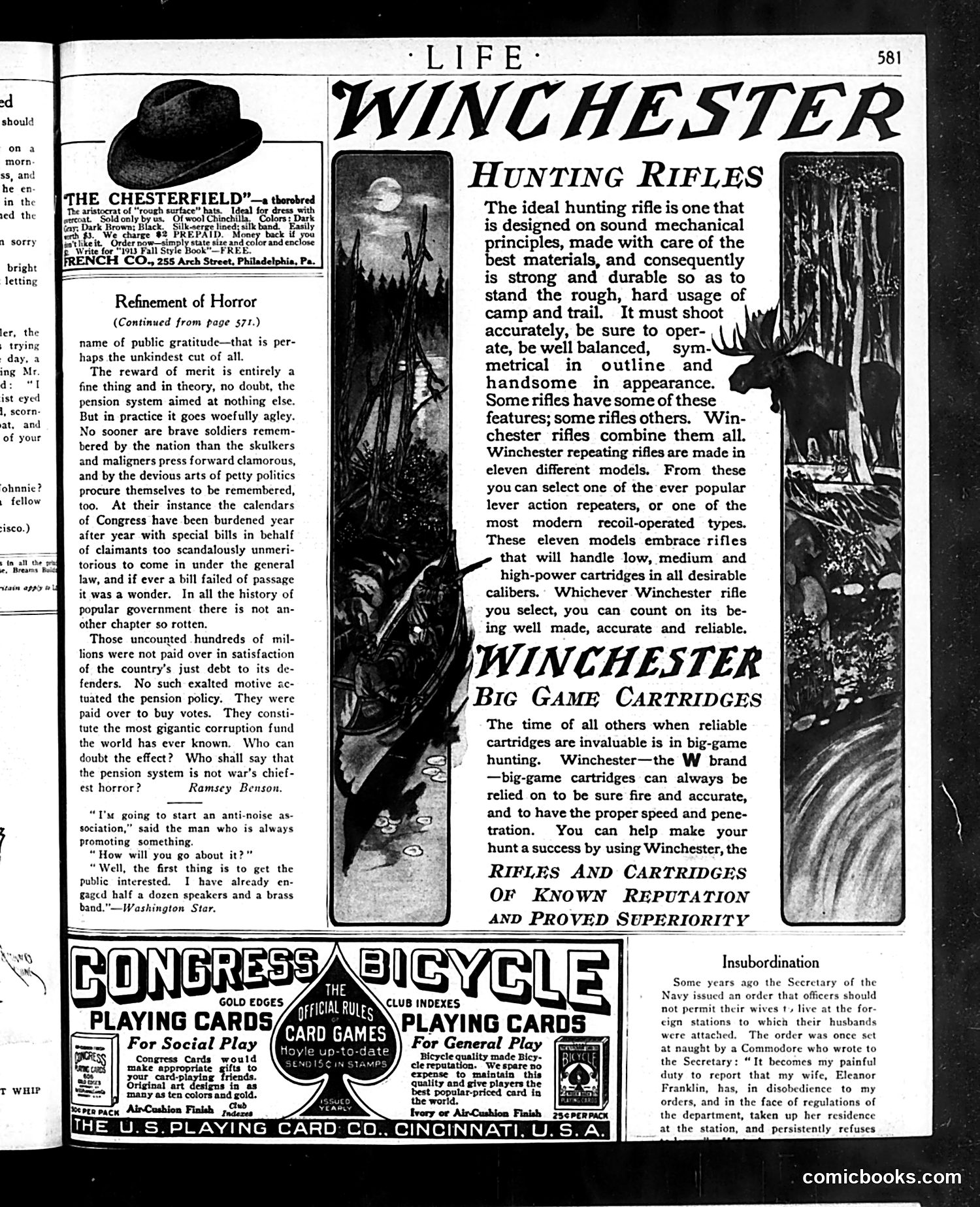
This page contains primarily **advertisements and opinion pieces**, not political cartoons. The main content is an article titled "Refinement of Horror" (continued from page 571) by Ramsey Benson, criticizing the **U.S. pension system for Civil War veterans**. Benson argues that while pensions were justified as reward for military service, they became corrupted by politicians awarding special bills to undeserving claimants to buy votes. He calls the pension fund "the most gigantic corruption fund the world has ever known" and "war's chief-est horror"—suggesting misuse of public funds damaged the nation more than combat itself. The page also features substantial **Winchester hunting rifle and ammunition advertisements**, occupying roughly half the space. A brief anecdote at bottom, "Insubordination," humorously describes a Navy Commodore defying the Secretary's order forbidding officers' wives at foreign stations—depicting military bureaucratic tension. The Chesterfield hat advertisement appears at top left.
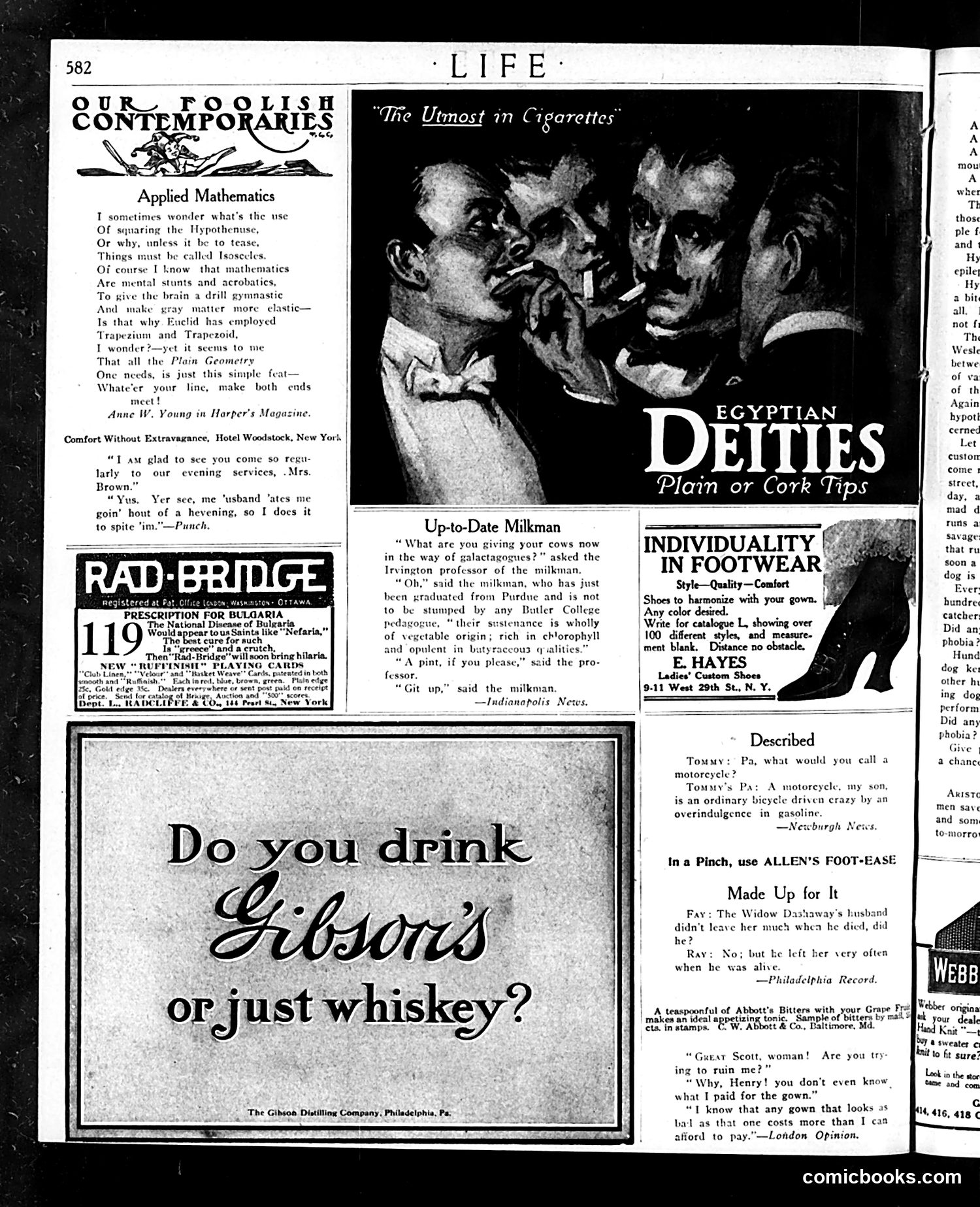
This page is primarily **advertising and humor content** rather than political satire. The main elements: **"Our Foolish Contemporaries"** presents light satirical verses mocking applied mathematics—the joke being that complex geometric theorems seem useless for practical life. **The large Gibson's whiskey advertisement** is straightforward product promotion with no satirical intent. **Scattered humor pieces** include: - A joke about a woman attending church services to escape her husband - A college professor's exchange with a milkman about cow feed (playing on academic pretension) - A father's sarcastic response to his son's motorcycle - A husband angry about his wife's expensive dress **The "Egyptian Deities" and "Individuality in Footwear"** sections are standard commercial advertising. The page reflects *Life's* typical 1920s mix of gentle domestic humor and commercials—poking fun at marriage, class differences, and modern pretension rather than addressing serious political issues. No specific historical figures or events are referenced.
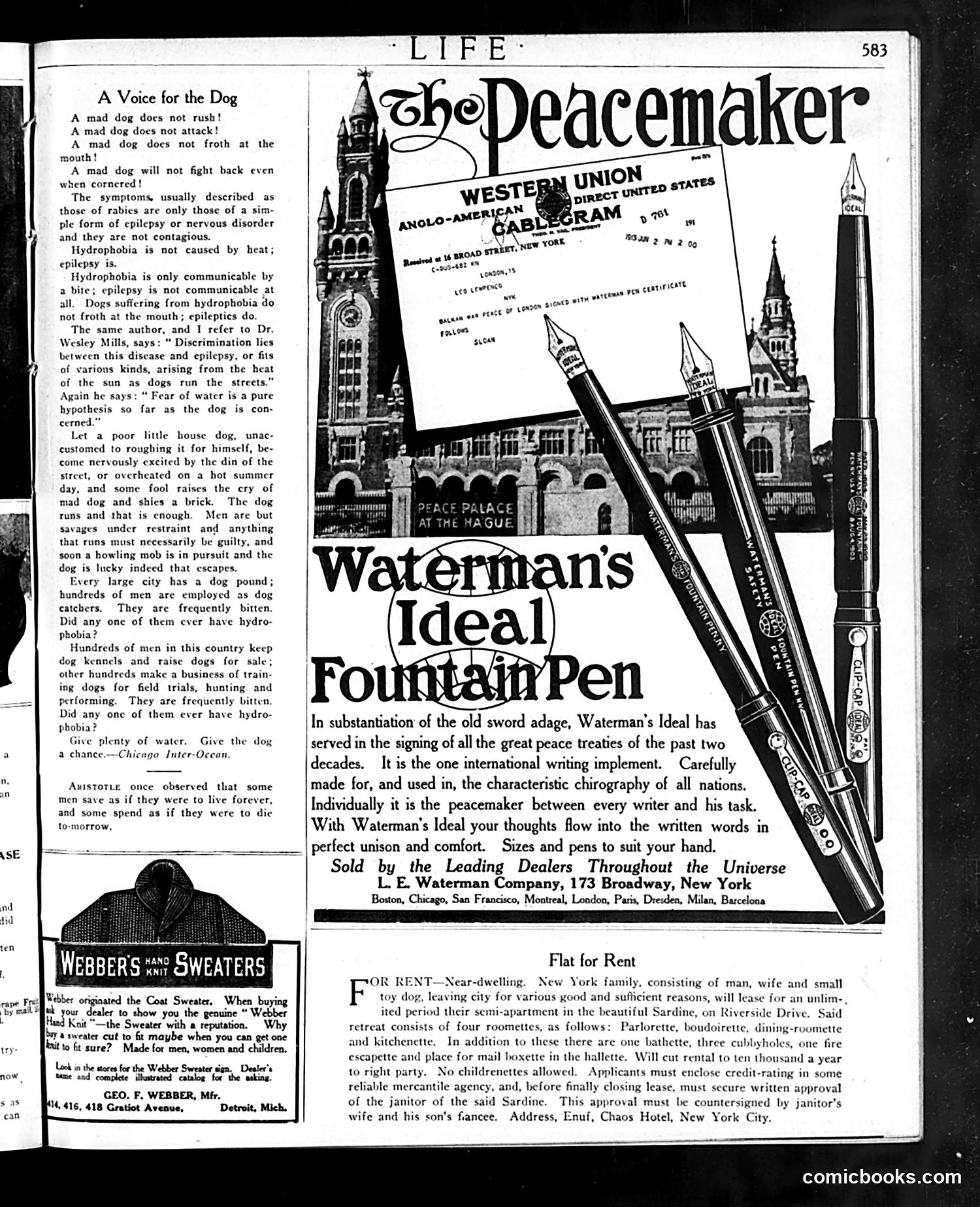
**"A Voice for the Dog"** (left column): An educational article debunking myths about rabies in dogs. It argues that "mad dog" behavior—frothing, aggression, fear of water—actually reflects epilepsy or heat-induced nervous disorders, not hydrophobia. The piece cites Dr. Wesley Mills to distinguish between these conditions and notes that dog catchers and breeders frequently bitten never contract rabies, suggesting public panic about rabid dogs is irrational. This reflects Progressive Era scientific skepticism toward folk beliefs. **"The Peacemaker" Advertisement** (center): A Waterman's Ideal fountain pen advertisement claims the pen was used to sign major peace treaties over two decades—likely referencing treaties ending World War I and earlier conflicts. The image shows cathedral towers (possibly The Hague Peace Palace), positioning the pen as an instrument of international diplomacy. **"Flat for Rent" (bottom)**: A satirical classified ad listing a Manhattan apartment with absurdly diminished room names ("Parlorette," "cubbyholes," "mailboxette")—mocking New York City's notoriously small, expensive apartments while parodying the pretentious naming conventions used to market them.
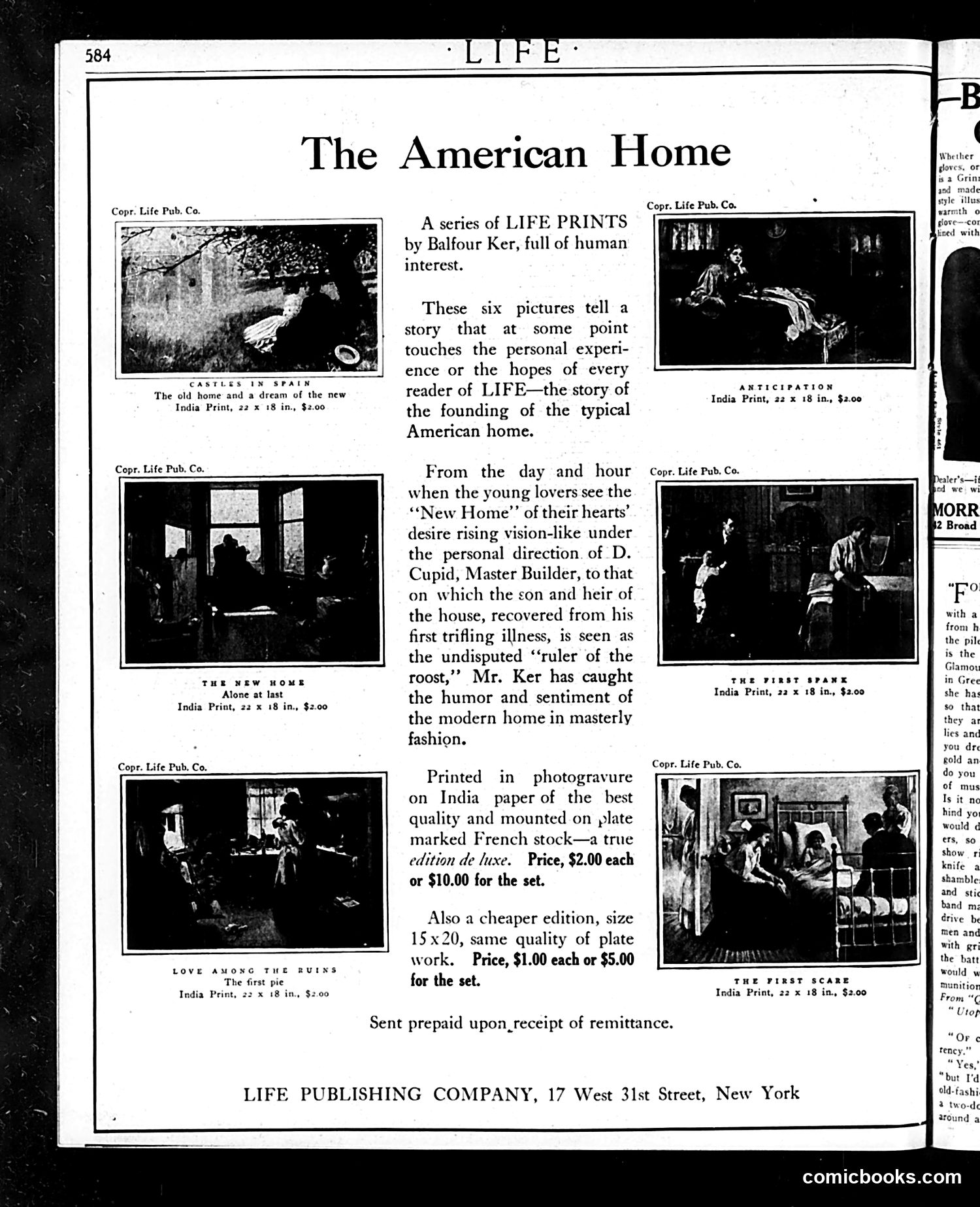
This is primarily an **advertisement**, not a satirical cartoon. Life Publishing Company is selling a six-print series by artist Balfour Ker depicting the "typical American home" narrative. The prints tell a sentimental story: young lovers envision their dream home under "Cupid, Master Builder's" direction, then experience domestic life's realities—including scenes titled "The New Home," "Anticipation," "The First Spank," and "Love Among the Ruins." The gentle humor appears aimed at middle-class aspirations and domestic life's contradictions: romantic ideals versus messy reality (a child's first illness, discipline required). Rather than harsh satire, it's nostalgic Americana playing on readers' personal experiences and hopes. The prints were sold in deluxe ($2.00 each/$10.00 set) and cheaper editions ($1.00/$5.00), targeting broad audiences. This represents Life magazine's commercial expansion into home décor products for American households.
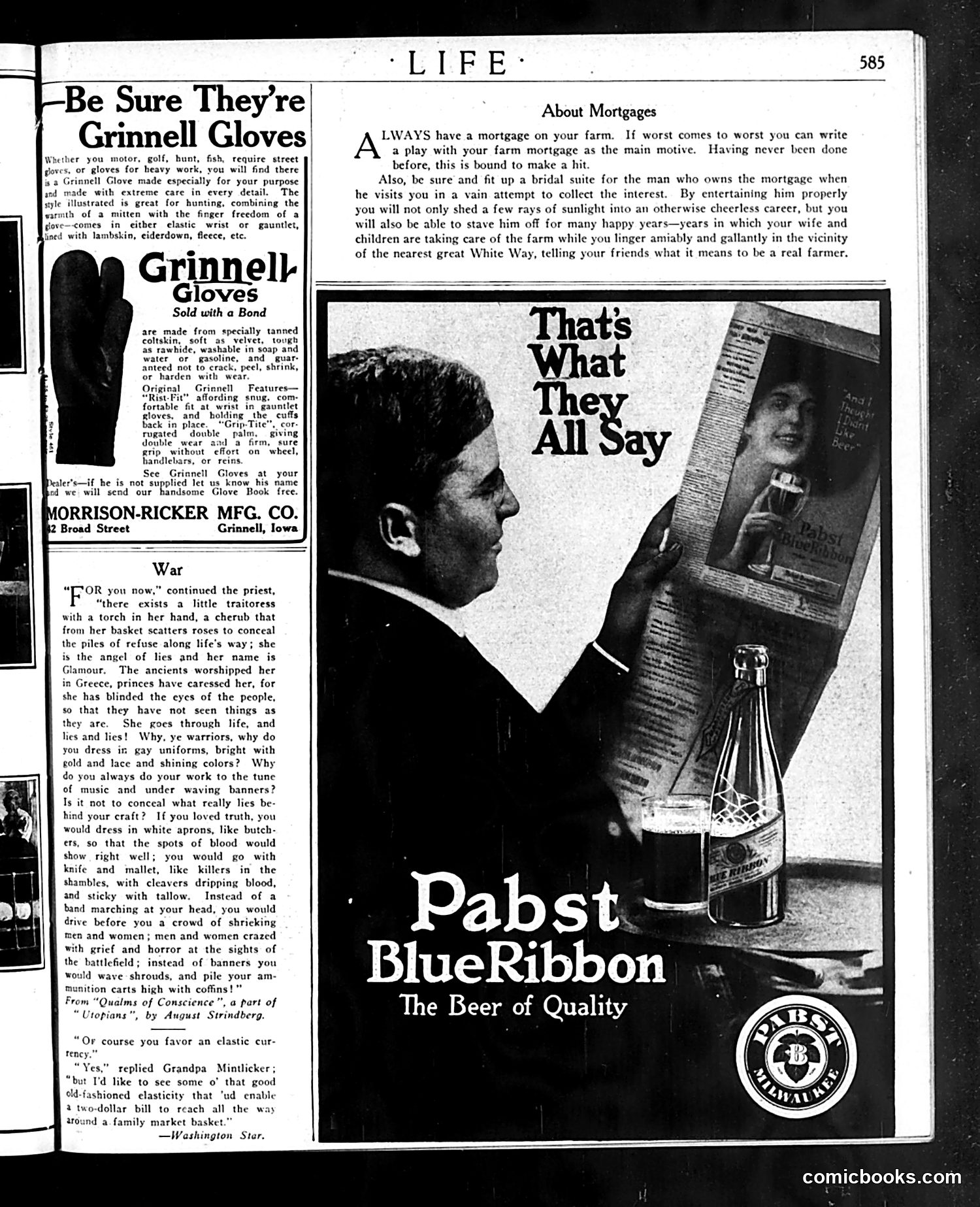
This page contains three distinct pieces: a **Grinnell Gloves advertisement** (left), a **satirical article on farm mortgages** (top right), and a **Pabst Blue Ribbon beer advertisement** (large center-right). The mortgage piece is social satire mocking rural farmers' precarious financial situations. It ironically advises farmers to maintain mortgages and entertain their creditors with hospitality—essentially suggesting farmers should wine-and-dine the very people foreclosing on them while neglecting their own farms. The joke targets both farmers' vulnerability and the exploitative mortgage system. The excerpt from August Strindberg's "Utopians" is anti-war commentary criticizing militaristic pageantry (uniforms, music, banners) as deceptive concealment of war's brutal reality—blood, death, grief. It argues honesty would require displaying these horrors openly. The Grinnell Gloves and Pabst ads are straightforward period advertising, though the Pabst features a testimonial format common to early 20th-century marketing.
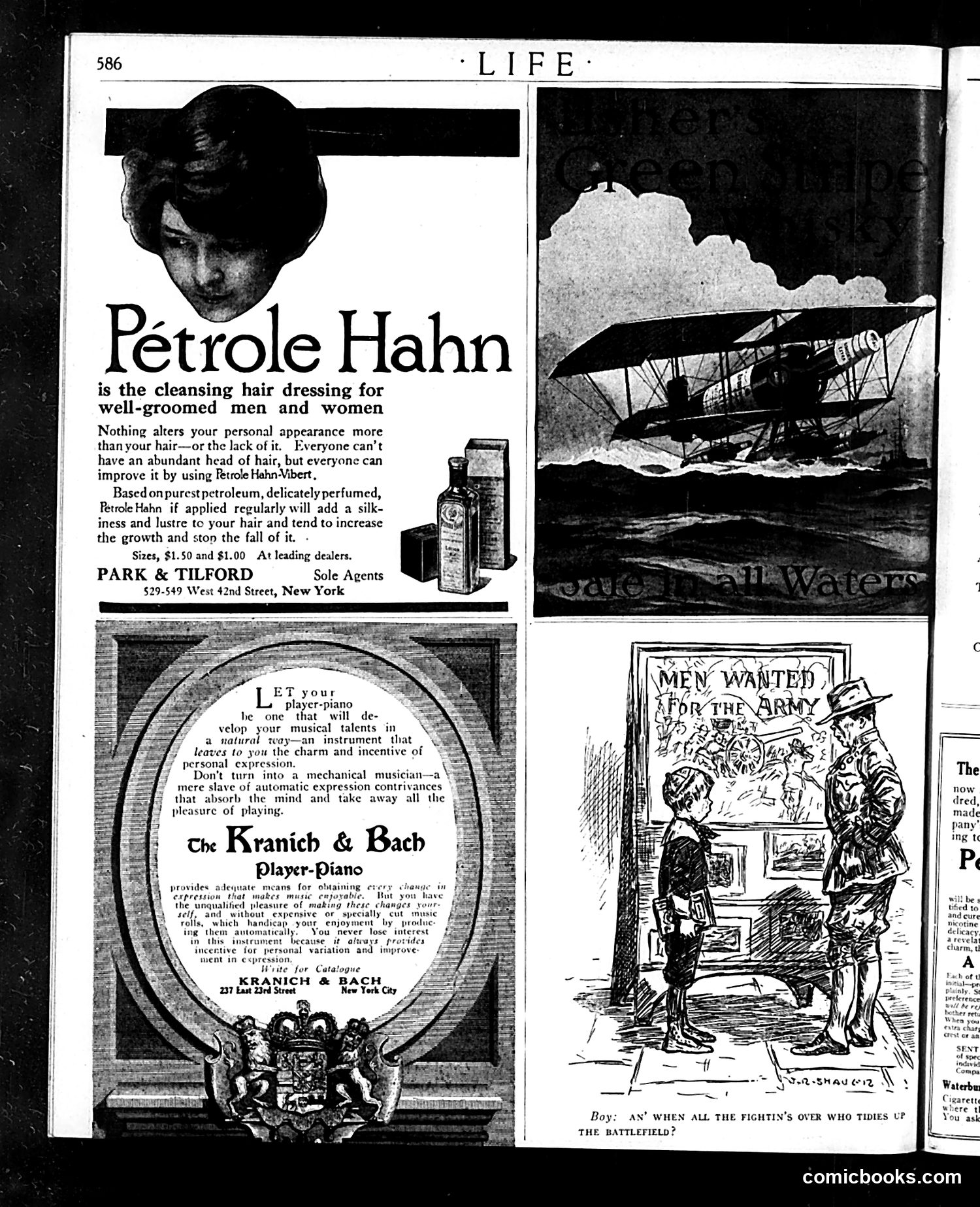
This page consists primarily of **advertisements** for consumer products (Pétrole Hahn hair dressing, Kranich & Bach player-pianos) aimed at middle-class readers. The notable content is a **small cartoon** at bottom right captioned: "An' when all the fightin's over who tidies up the battlefield?" A young boy asks a uniformed soldier this question, likely referencing WWI cleanup and reconstruction efforts. The cartoon's humor derives from **innocent naivety**—the boy's practical, childlike question contrasts with adult military concerns. It implicitly satirizes the unglamorous reality of war: while soldiers fight, someone must handle the gruesome aftermath. The timing (Life was published during WWI) suggests commentary on war's hidden costs beyond combat itself. The "Men Wanted for the Army" recruitment poster visible in the cartoon reinforces the wartime context.
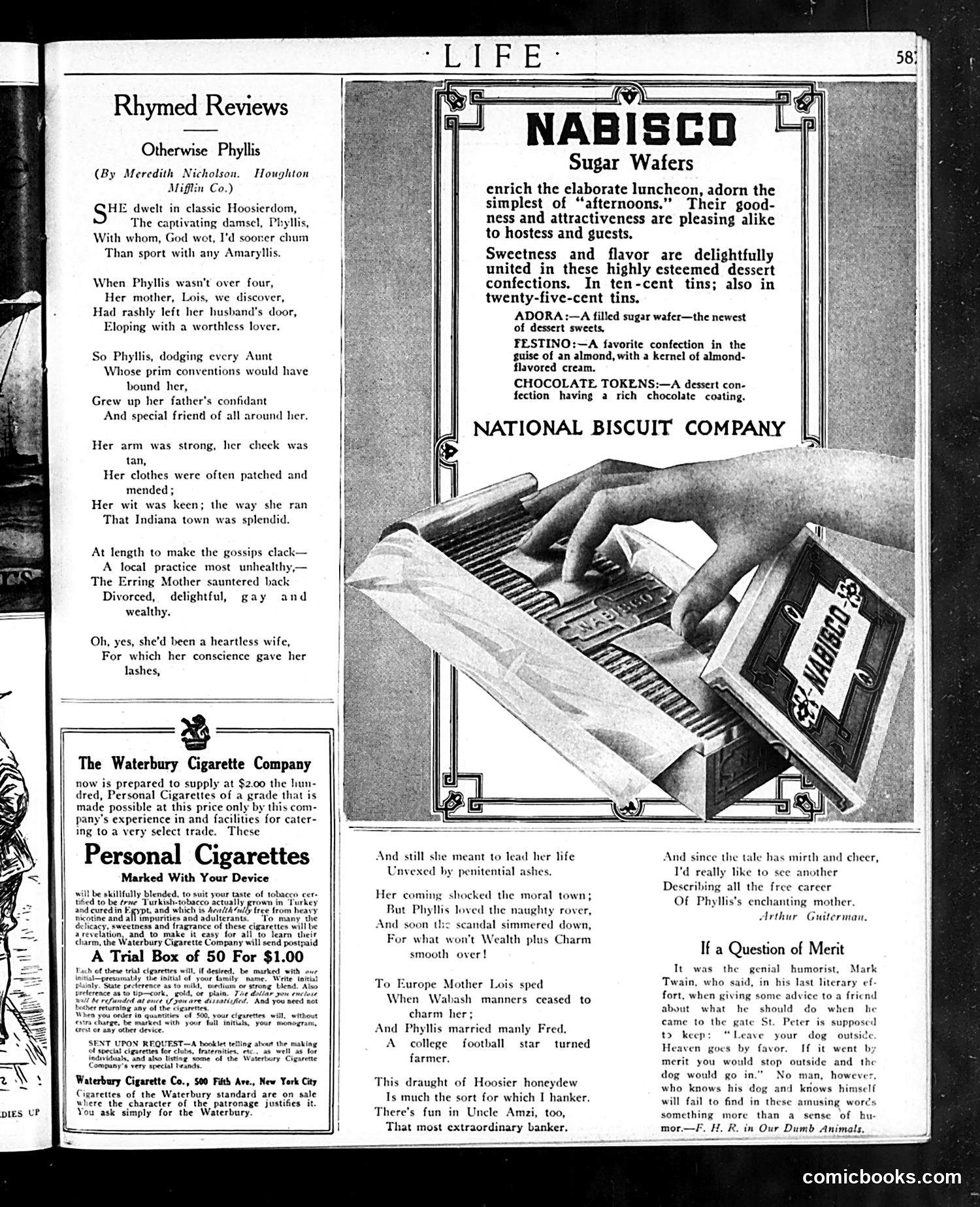
This page is primarily **advertising and literary content** rather than political cartoons. The main feature is a **book review in verse** of "Otherwise Phyllis" by Meredith Nicholson—a story about an Indiana woman raised by her father after her mother abandoned the family. The poem describes Phyllis's strong character and later shock when her divorced, wealthy mother returns to town seeking reconciliation. The narrative emphasizes themes of morality, scandal, and social redemption through wealth. **Advertisements dominate**: Nabisco Sugar Wafers, Waterbury Cigarettes (offering personalized cigarettes), and a humorous closing piece by Mark Twain about merit versus divine favor (a mild social commentary). **For modern readers**: The page reflects early 20th-century concerns with female respectability, divorce stigma, and how wealth could overcome social scandal—while casually promoting cigarettes as luxury goods. There are no political cartoons here; it's a snapshot of period advertising and literature.
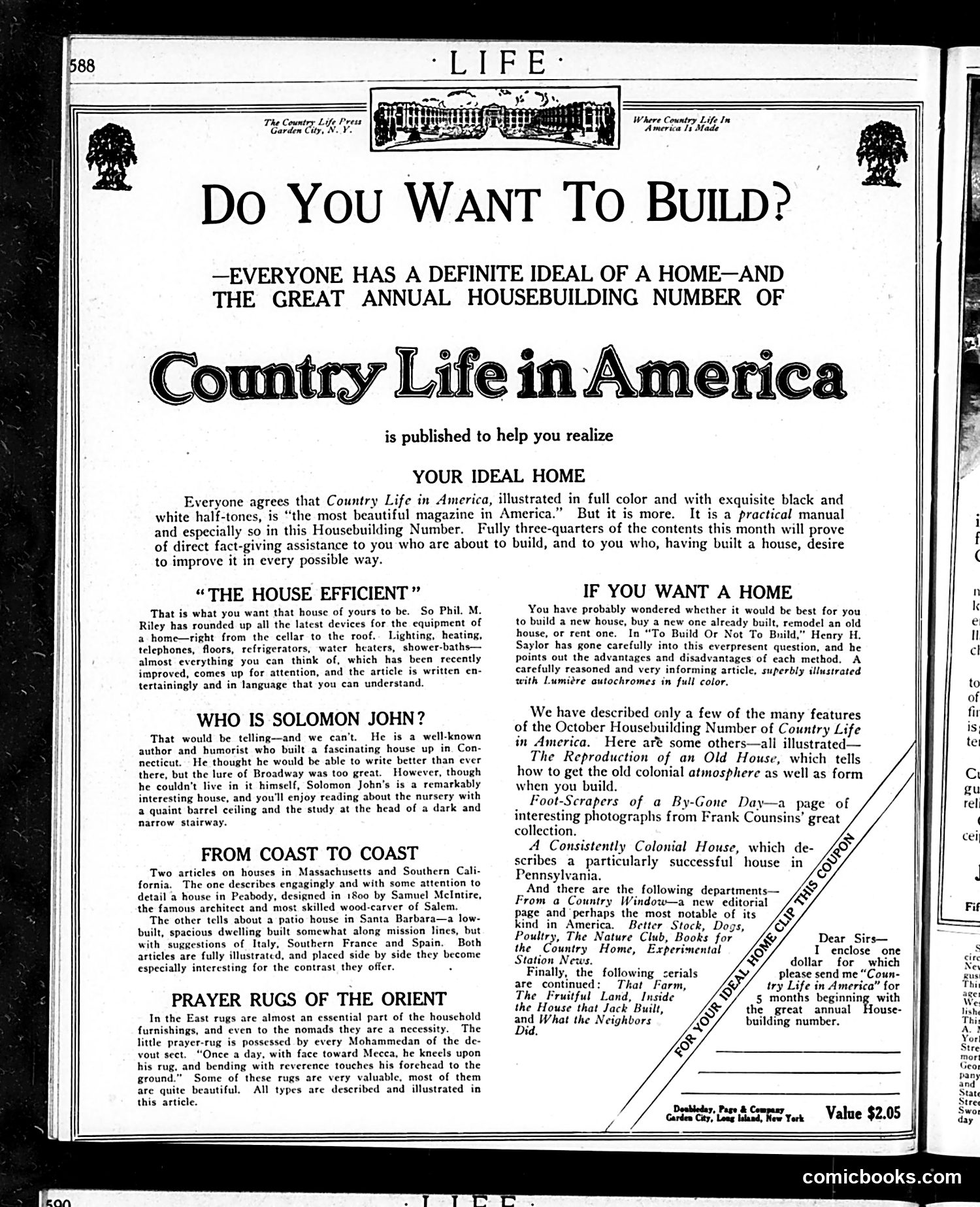
This is primarily a **promotional advertisement** for *Country Life in America* magazine's "Housebuilding Number" issue—not a political cartoon or satire. The page markets a special issue focused on residential architecture and home design, pitched to early 20th-century Americans interested in building or improving homes. It highlights practical features: "The House Efficient" (modern home technology like heating, plumbing, and lighting), profiles of interesting houses from various regions, and design articles on colonial architecture and oriental rugs. Notable is the reference to "Solomon John," described as a well-known Connecticut author/humorist who built a house but couldn't resist returning to Broadway—likely a satirical jab at urban intellectuals' inability to commit to rural life despite romantic ideals about country living. The magazine positions itself as both beautiful ("most beautiful magazine in America") and practically useful—a consumer guide for an aspirational middle-class audience.
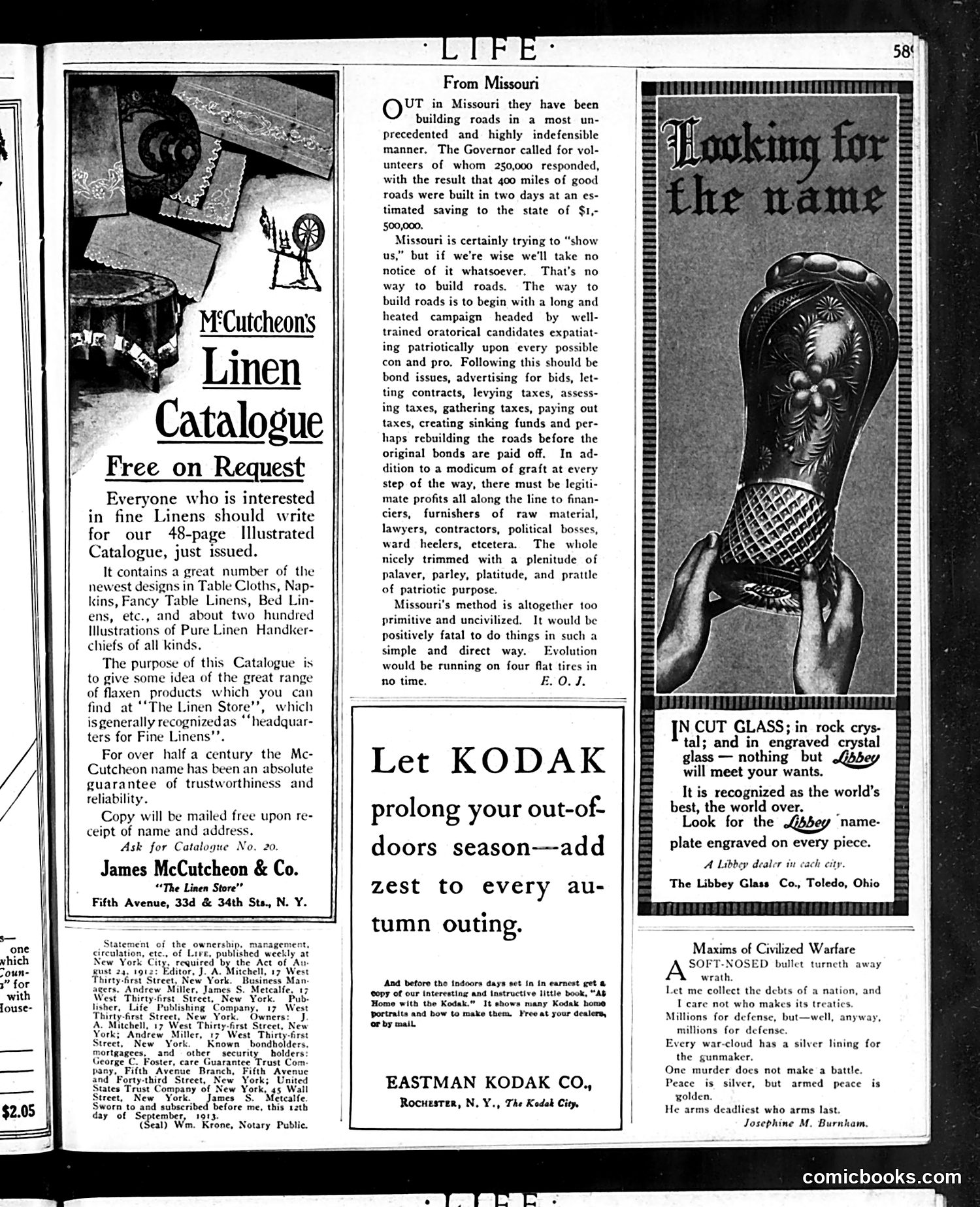
This page is primarily **advertising with one satirical editorial piece**. The main content is a commentary titled "From Missouri" mocking road-building bureaucracy. **The Satire:** The piece ridicules the inefficient American system of public works projects. Missouri's Governor mobilized 250,000 volunteers who built 400 miles of roads in two days, saving $1.5 million—a remarkably efficient result. Life's satirist (signed E.O.J.) sarcastically argues this is *wrong*. Proper road-building requires: lengthy political campaigns, bond issues, competitive bidding, multiple tax levies, bureaucratic delays, and crucially, **graft and profit-skimming at every stage** for financiers, contractors, and "ward heelers" (political operatives). **The Point:** This is sharp criticism of systemic corruption in early 1900s American infrastructure projects. The satire exposes how entrenched interests—politicians, contractors, lawyers—deliberately complicate straightforward public works to extract wealth. Missouri's direct, honest approach threatens this profitable machinery, hence the sarcastic disapproval. The remainder of the page contains ads for McCutcheon's linens, Kodak cameras, and Libbey glassware.
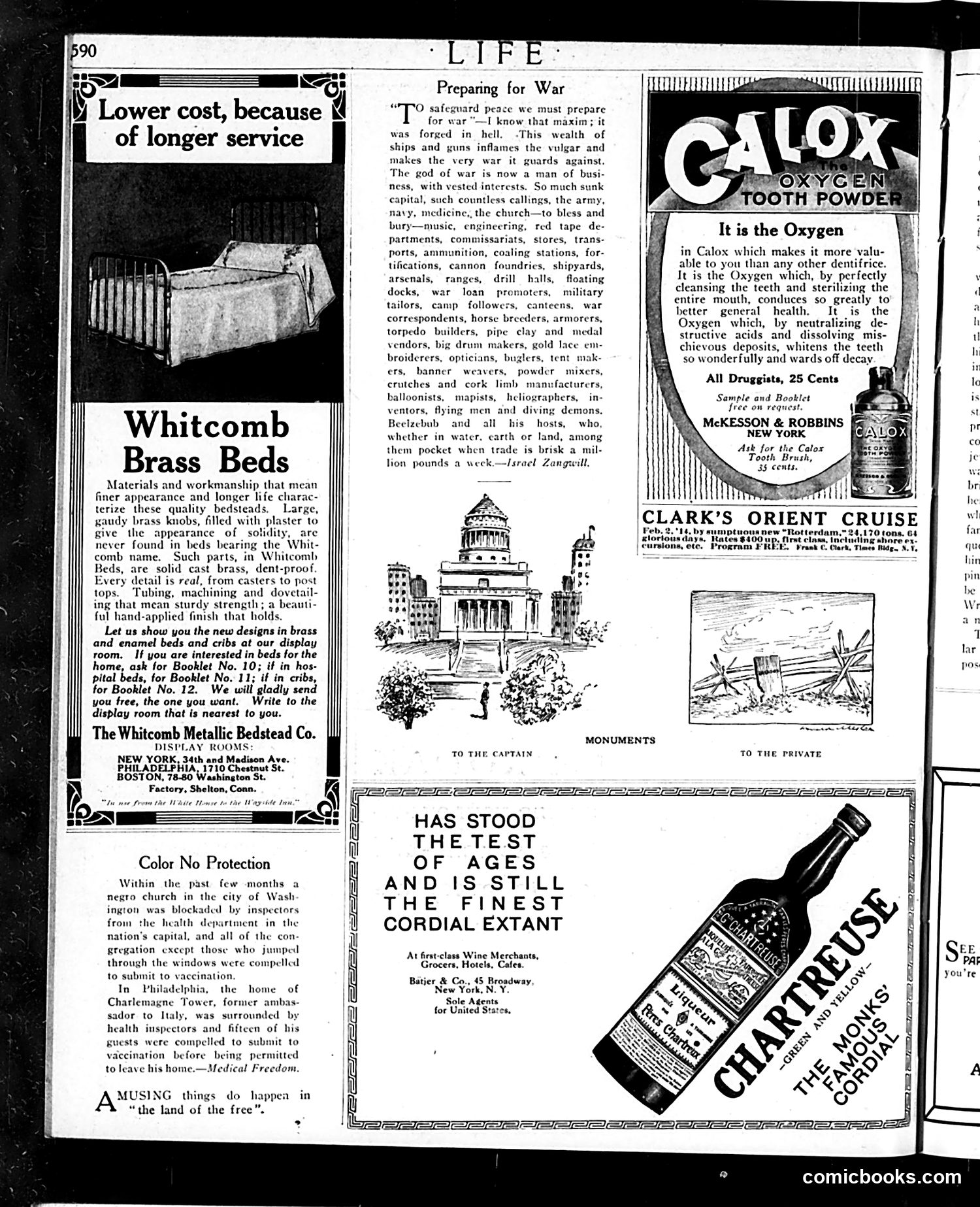
This page is primarily **advertisements and opinion pieces**, not political cartoons. The main content includes: **"Color No Protection"** — A satirical commentary on compulsory vaccination during the early 20th century. The piece mocks government overreach by describing how health inspectors forcibly vaccinated congregants at a Black church in Washington, D.C., and guests at a diplomat's Philadelphia home. The headline suggests the piece is critiquing how even social status ("Color") offered no protection from state medical mandates. **"Preparing for War"** — A lengthy, bitter anti-war essay (attributed to Israel Zangwill) attacking the military-industrial complex. It argues that preparation for war actually causes war, and catalogs the profiteers—military contractors, manufacturers, tailors, clergy—who benefit from conflict. The surrounding ads (Whitcomb brass beds, Calox tooth powder, and a cruise line) are standard commercial content. Both opinion pieces reflect **early-20th-century progressive anxieties**: suspicion of government overreach and critique of capitalist war profiteering—themes common in pre-WWI radical publications.
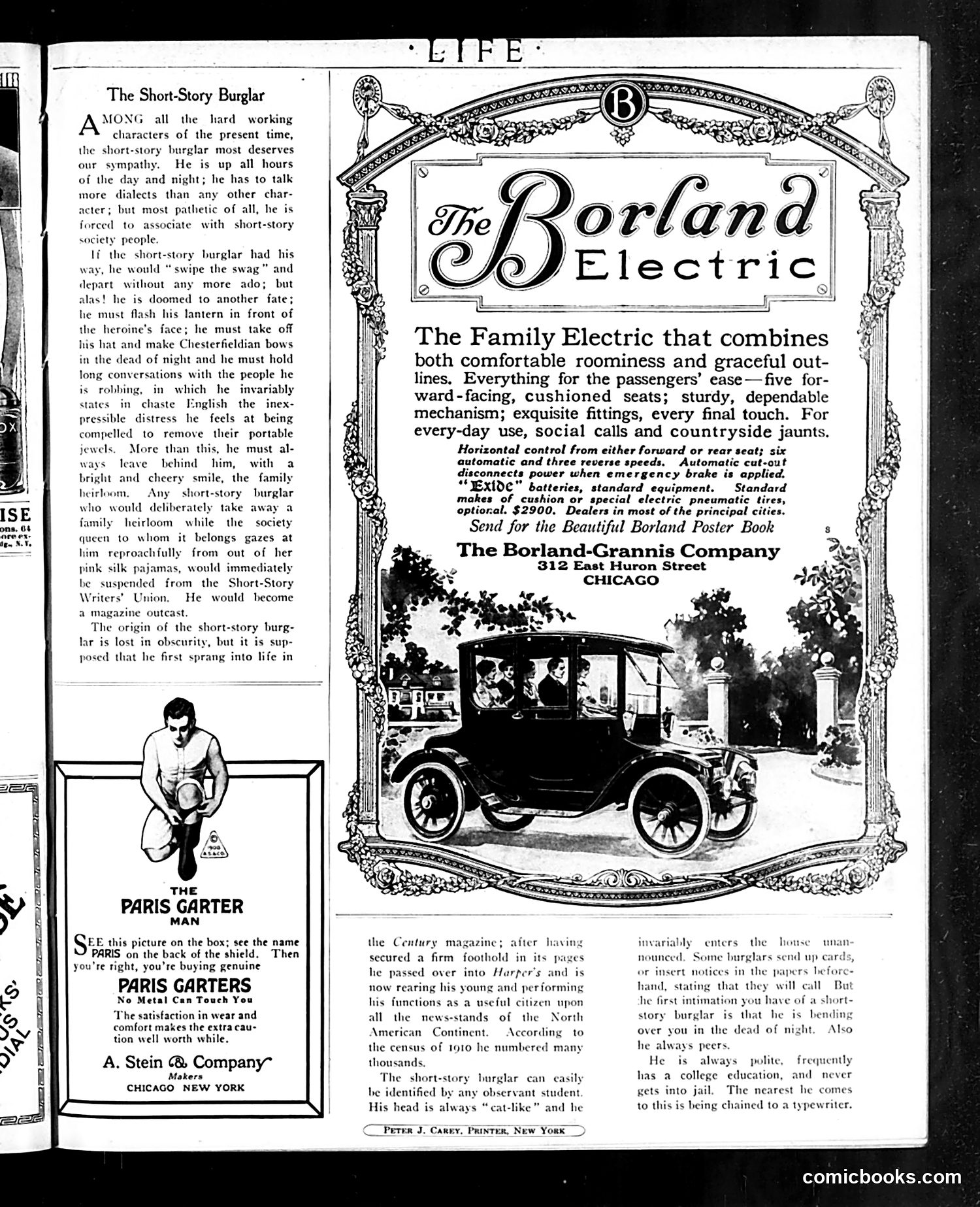
This satirical article mocks a specific literary trope: the genteel burglar character common in early 20th-century magazine fiction. The author critiques how short-story writers portray criminals with unrealistic politeness and restraint. The piece lampoons these fictional burglars for their absurd behavior—they must flash lanterns at heroines, remove hats, speak in proper English, apologize for stealing, and *deliberately leave behind family heirlooms* out of respect for weeping society women in pink pajamas. The satire suggests this character type originated in *Century* magazine and spread through *Harper's*. The author mocks that these "burglars" are so educated and polite they never actually commit real crimes—their worst fate is being "chained to a typewriter" as characters in stories. It's a tongue-in-cheek critique of unrealistic, sentimentalized criminal characters in popular magazine literature of the era.
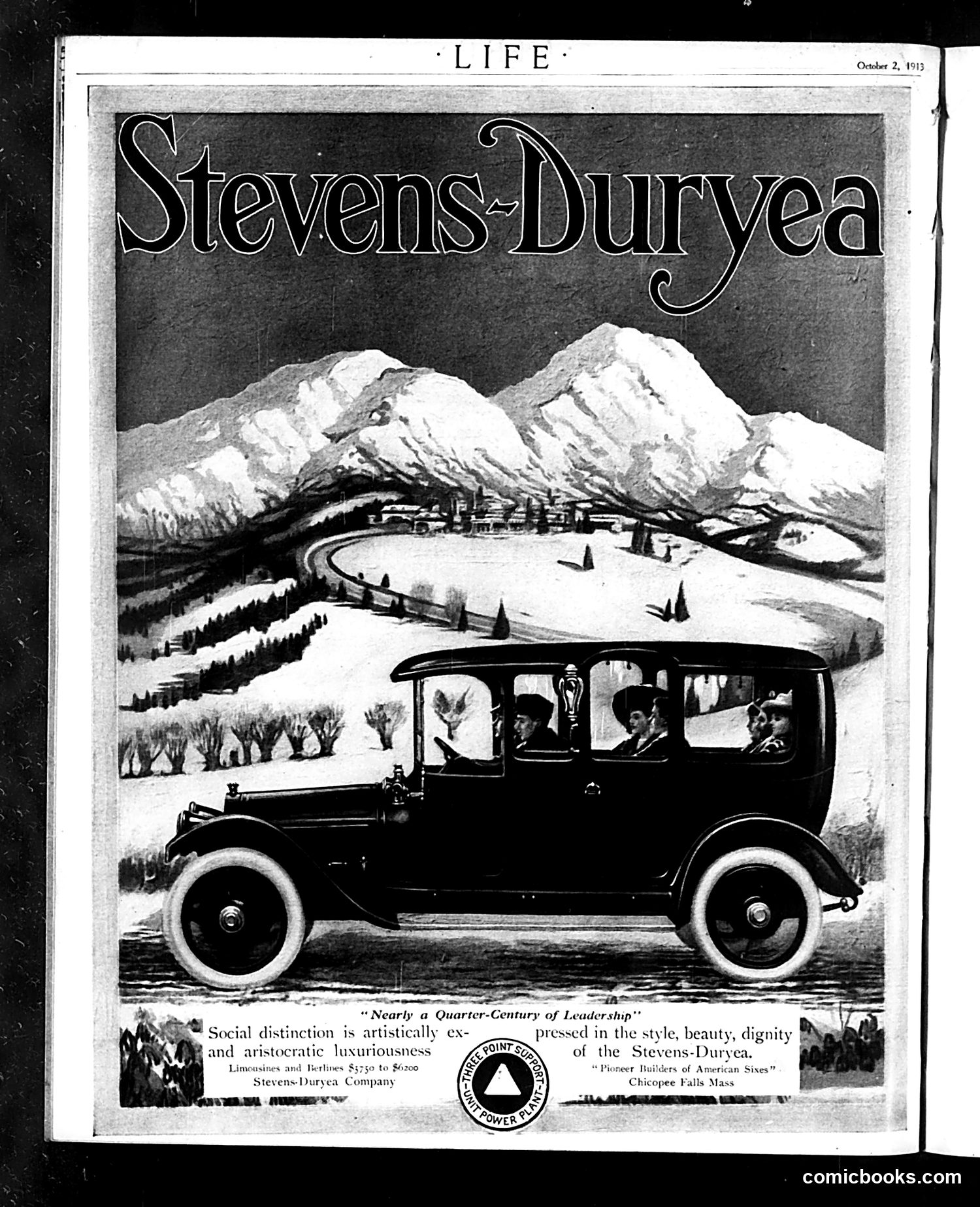
This is a **automobile advertisement**, not political satire. The page from *Life* magazine (October 2, 1913) promotes the Stevens-Duryea motorcar, claiming "Nearly a Quarter-Century of Leadership" in the luxury vehicle market. The ad depicts a well-dressed family in an elegant sedan, positioned against a scenic mountain landscape with snow-capped peaks. The imagery emphasizes **social status and refined taste**—suggesting that owning a Stevens-Duryea conveys "social distinction" and "artistic" elegance. The tagline describes the car as representing "style, beauty, dignity and aristocratic luxuriousness," targeting wealthy Americans who viewed automobiles as status symbols. The company was based in Chicopee Falls, Massachusetts. This reflects the early automotive era when cars were luxury goods for the affluent, not mass-market transportation.