
Life, 1913-10-02 · page 22 of 48
Life — October 2, 1913 — page 22: what you’re looking at
What you’re looking at
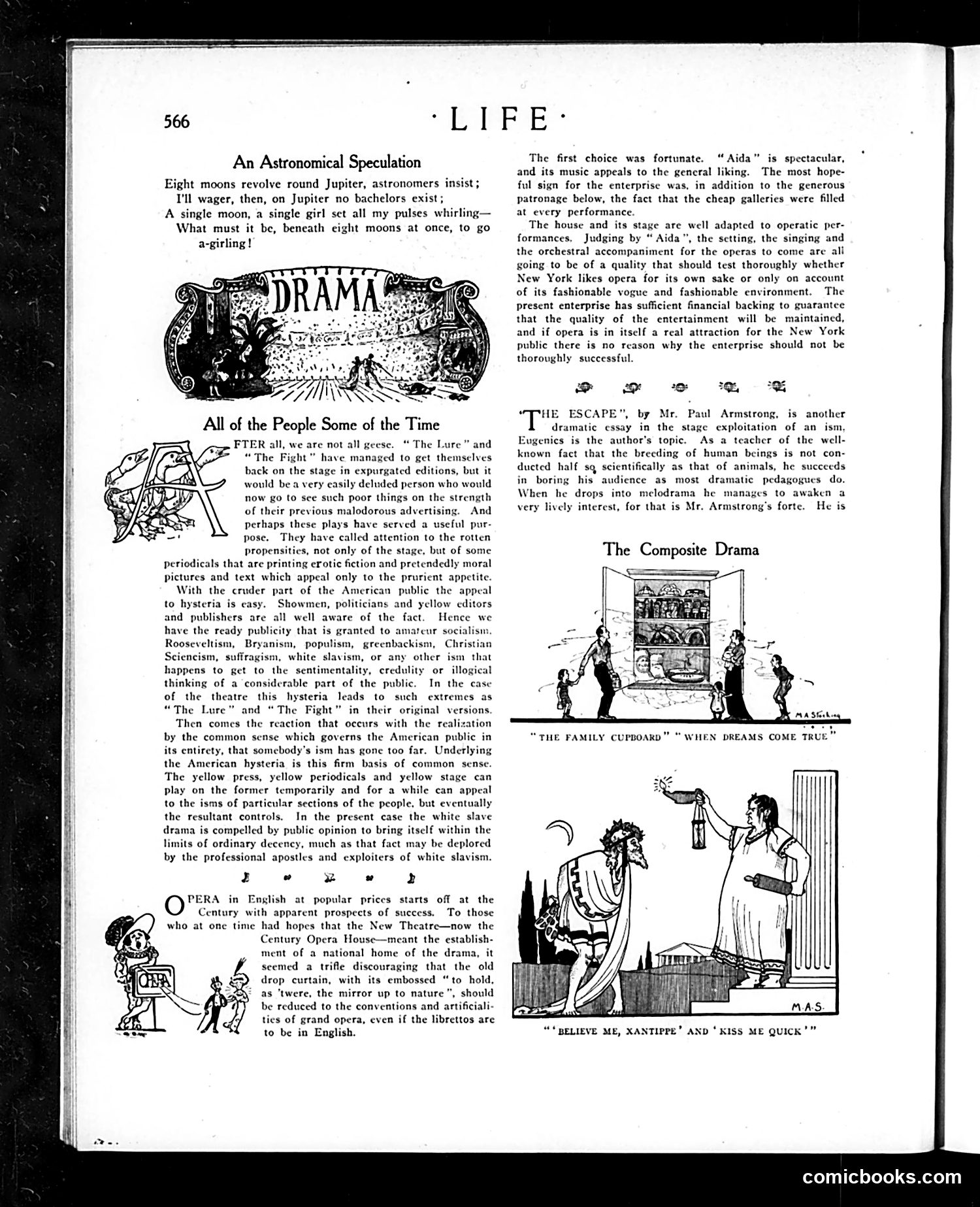
This page contains satirical commentary on American theater and public taste circa early 1900s. **"An Astronomical Speculation"**: A light joke imagining Jupiter's eight moons as evidence bachelors cannot exist there—because one moon (woman) already drives men crazy. **"All of the People Some of the Time"**: The main article critiques sensationalist theater and yellow journalism. It references two plays—"The Lure" and "The Fight"—that gained notoriety through lurid advertising about "white slavery" (human trafficking). The author argues that while these plays initially exploited public hysteria about moral corruption, American common sense eventually reasserted itself, forcing the plays to be "expurgated" (cleaned up). The piece mocks how politicians, publishers, and showmen deliberately stoke public fear around trendy causes (Rooseveltism, suffragism, Christian Science) to manipulate audiences, but notes this emotional manipulation eventually fails when rational judgment returns. **"The Composite Drama"**: Brief theater reviews praising the Century Opera House's production of *Aida*, noting it attracts both wealthy patrons and working-class gallery audiences.
📄 Transcribed text from this page (OCR, searchable)
Machine-transcribed from the original scan — historical spelling and the odd misread are preserved.
sae Saeeer “PE * An Astronomical Speculation Eight moons revolve round Jupiter, astronomers insist; I'll wager, then, on Jupiter no bachelors exist; A single moon, a single girl set all my pulses whirling— What must it be, beneath eight moons at once, to go a-girling! All of the People Some of the Time FTER all, we are not all geese. “ The Lure” and “The Fight ave managed to get themselves back on the stage in expurgated editions, but it would bea very easily deluded person who would now go to see such poor things on the strength of their previous malodorous advertising. And perhaps these plays have served a useful pur- pose, They have called attention to the rotten Propensities, not only of the stage, but of some periodicals that are printing erotic fiction and pretendedly moral pictures and text which appeal only to the prurient appetite. With the cruder part of the American public the appeal to hysteria is casy. Showmen, politicians and yellow editors and publishers are all well aware of the fact. Hence we have the ready publicity that is granted to amateur socialism. Rooseveltism, Bryanism, populism, greenbackism, Christ Sciencism, suffragism, white slavism, or any other isn happens to get to the sentimentality, credulity or illogi thinking of a considerable part of the public. In the case of the theatre this hysteria leads to such extremes as “The Lure” and “The Fight" in their original versions. Then comes the reaction that occurs with the realization by the common sense which governs the American public in its entirety, that somebody's ism has gone too far. Underlying the American hysteria is this firm basis of common sense. The yellow press, yellow periodicals and yellow stage can play on the former temporarily and for a while can appeal to the isms of particular sections of the people, but eventually the resultant controls. In the present case the white slave drama is compelled by public opinion to bring itself within the limits of ordinary decency, much as that fact may be deplored by the professional apostles and exploiters of white slavism. z ° ze cd 2 A in English at popular prices starts off at the Century with apparent prospects of success. To those who at one time had hopes that the New Theatre—now the Century Opera House—meant the establish- ment of a national home of the drama, it seemed a trifle discouraging that the old drop curtain, with its embossed “to hold, as ‘twere, the mirror up to nature”, should be reduced to the conventions and artificiali- ties of grand opera, even if the librettos are to be in English. The first choice was fortunate. “Aida” is spectacular, and its music appeals to the gencral liking. The most hope- ful sign for the enterprise was, in addition to the generous patronage below, the fact that the cheap galleries were filled at every performance. The house and its stage are well adapted to operatic per- formances. Judging by “ Aida”, the sctting, the singing and the orchestral accompaniment for the operas to come are all going to be of a quality that should test thoroughly whether New York likes opera for its own sake or only on account of its fashionable vogue and fashionable environment. The present enterprise has sufficient financial backing to guarantee that the quality of the entertainment will be maintained, and if opera is in itself a real attraction for the New York public there is no reason why the enterprise should not be thoroughly successful. a & 7 ESCAPE", by Mr. Paul Armstrong, is another dramatic essay in the stage exploitation of an ism, Eugenics is the author's topic. As a teacher of the well- known fact that the breeding of human beings is not con- ducted half sq scientifically as that of animals, he succeeds in boring his audience as most dramatic pedagogues do. When he drops into melodrama he manages to awaken a very lively interest, for that is Mr. Armstrong's forte. He is The Composite Drama “THE FAMILY CUPBOARD” “ WHEN DREAMS COME TRUE” “* BELIEVE ME, XANTIPPE’ AND ‘KISS ME QUICK comicbooks.com