
Life, 1913-10-02 · page 44 of 48
Life — October 2, 1913 — page 44: what you’re looking at
What you’re looking at
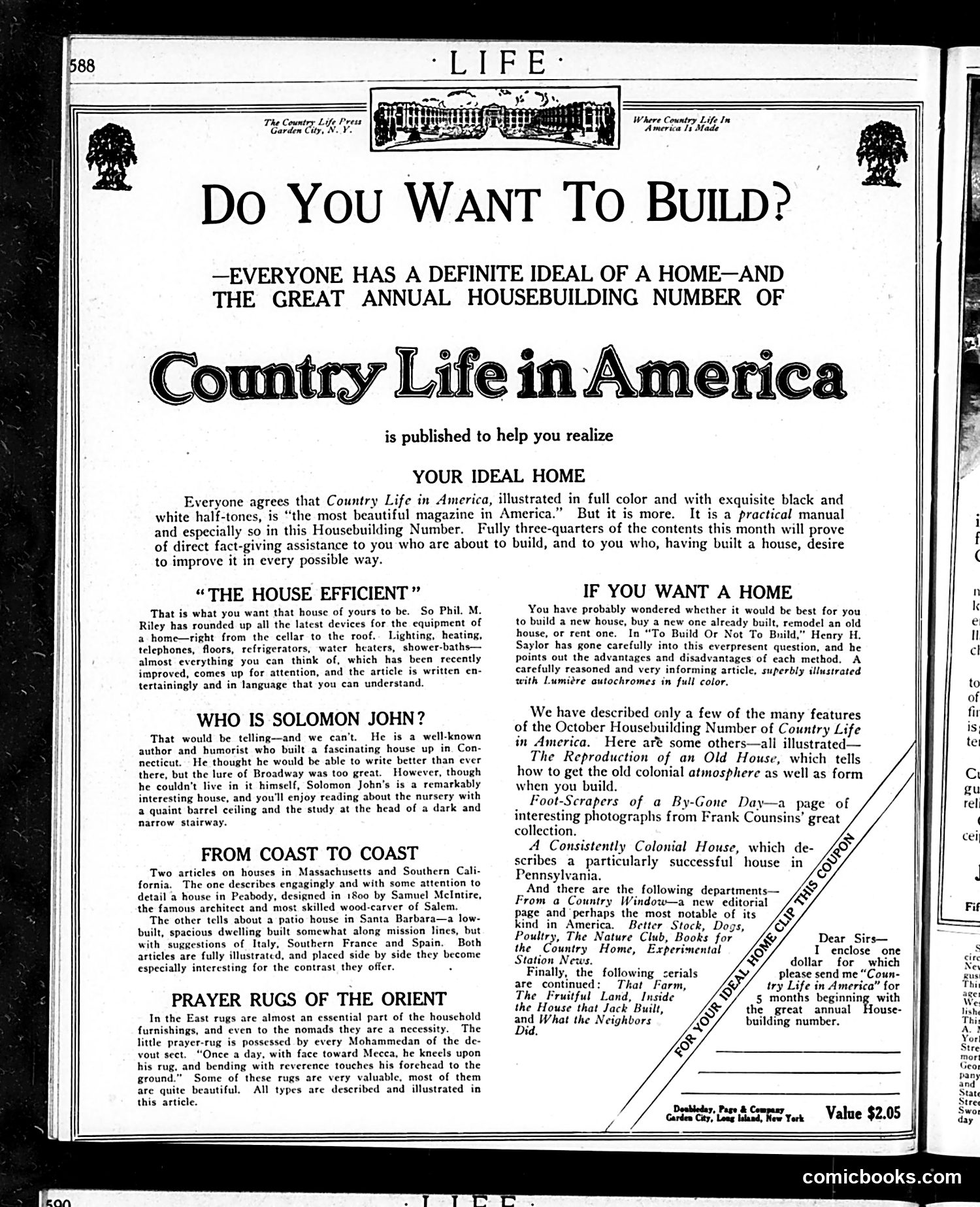
This is primarily a **promotional advertisement** for *Country Life in America* magazine's "Housebuilding Number" issue—not a political cartoon or satire. The page markets a special issue focused on residential architecture and home design, pitched to early 20th-century Americans interested in building or improving homes. It highlights practical features: "The House Efficient" (modern home technology like heating, plumbing, and lighting), profiles of interesting houses from various regions, and design articles on colonial architecture and oriental rugs. Notable is the reference to "Solomon John," described as a well-known Connecticut author/humorist who built a house but couldn't resist returning to Broadway—likely a satirical jab at urban intellectuals' inability to commit to rural life despite romantic ideals about country living. The magazine positions itself as both beautiful ("most beautiful magazine in America") and practically useful—a consumer guide for an aspirational middle-class audience.
📄 Transcribed text from this page (OCR, searchable)
Machine-transcribed from the original scan — historical spelling and the odd misread are preserved.
The Country Life Press besten Cag NF Do YOU WANT To BUILD? —EVERYONE HAS A DEFINITE IDEAL OF A HOME—AND THE GREAT ANNUAL HOUSEBUILDING NUMBER OF untry Life in America is published to help you realize YOUR IDEAL HOME Everyone agrees that Country Life in America, illustrated in full color and with exquisite black and white half-tones, is “the most beautiful magazine in America.” But it is more. It is a practical manual and especially so in this Housebuilding Number. Fully three-quarters of the contents this month will prove of direct fact-giving assistance to you who are about to build, and to you who, having built a house, desire to improve it in every possible way. “THE HOUSE EFFICIENT” That is what you want that house of yours to be. So Phil. M. Riley has rounded up all the latest devices for the equipment of a home—right from the cellar to the roof. Lighting, heating, telephones, floors, refrigerators, water heaters, shower-baths— almost everything you can think of, which has been recently improved, comes up for attention, and the article is written en- tertainingly and in language that you can understand. WHO IS SOLOMON JOHN? That would be telling—and we can’t. He is a well-known author and humorist who built a fascinating house up in Con- necticut. He thought he would be able to write better than ever there, but the lure of Broadway was too great. However, though he couldn't live in it himself, Solomon John’s is a remarkably interesting house, and you'll enjoy reading about the nursery with a quaint barrel ceiling and the study at the head of a dark and narrow stairway. FROM COAST TO COAST Two articles on houses in Massachusetts and Southern Cali- fornia. The one describes engagingly and with some attention to detail a house in Peabody, designed in 1800 by Samuel McIntire, the famous architect and most skilled wood-carver of Salem. The other tells about a patio house in Santa Barbara—a low- built, spacious dwelling built somewhat along mission lines, but with suggestions of Italy, Southern France and Spain. Both articles are fully illustrated, and placed side by side they become especially interesting for the contrast they offer. : PRAYER RUGS OF THE ORIENT In the East rugs are almost an essential part of the household furnishings, and even to the nomads they are a necessity. The little prayer-rug is possessed by every Mohammedan of the de- vout sect. “Once a day, with face toward Mecca, he kneels upon his rug, and bending with reverence touches his forchead to the ground.” Some of these rugs are very valuable, most of them are quite beautiful. All types are described and illustrated in this article. IF YOU WANT A HOME You have probably wondered whether it would be best for you to build a new house, buy a new one already built, remodel an old house, or rent one. In “To Build Or Not To Build,” Henry H. Saylor has gone carefully into this everpresent question, and he points out the advantages and disadvantages of each method. A carefully reasoned and very informing article, superbly illustrated with Lumiere autochromes in full color. We have described only a few of the many features of the October Housebuilding Number of Country Life in America, Here art some others—all illustrated— The Reproduction of an Old House, which tells how to get the old colonial atmosphere as well as form when you build. _ Foot-Scrapers of a By-Gone Day—a page of interesting photographs from Frank Counsins’ great collection. A Consistently Colonial House, which de- Oo’ scribes a particularly successful house in > Pennsylvania. C And there are the following departments— 4% From a Country Window—a new editorial CJ page and perhaps the most notable of its /@ kind in America. Better Stock, Dogs, SY, Poultry, The Nature Club, Books for Ye the Country Home, Experimental hey I enclose one dollar for which Please send me “Coun- try Life in America” for 5 months beginning. with the great annual jouse- building number. Station News. Finally, the following cerials yy, are continued: That. Farm, Ly The Fruitful Land, Inside iy the House that Jack Built, SJ and What the Neighbors id. Deableday, a Carden Ce eas Rew York Value $2.05 | comicbooks.com