
Life, 1913-10-02 · page 27 of 48
Life — October 2, 1913 — page 27: what you’re looking at
What you’re looking at
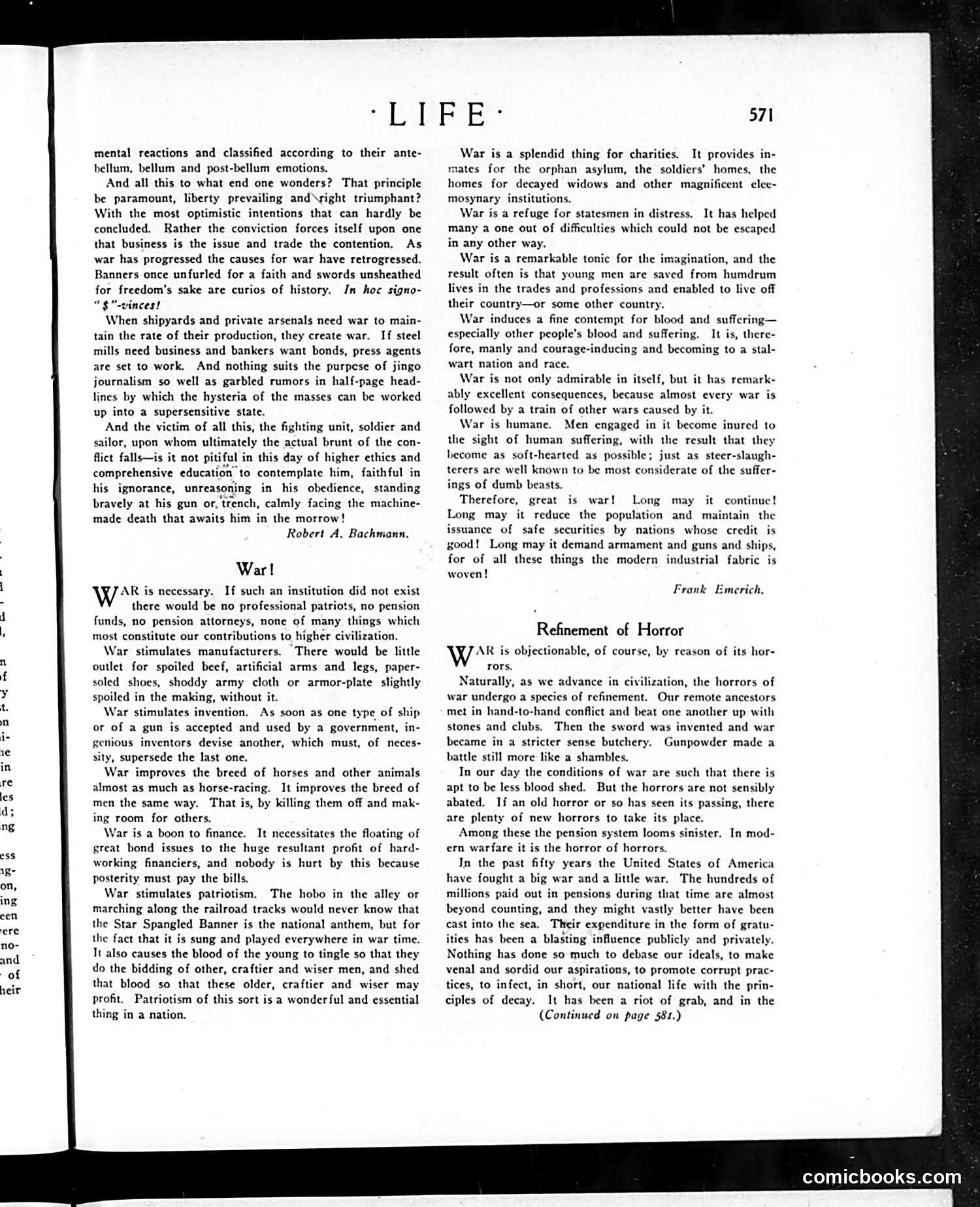
This page presents **opposing satirical arguments about war**, a common Life magazine format of the era. **Left column (Robert A. Bachmann):** Cynically critiques war as driven by **corporate profit motives**—shipyards, steel mills, and munitions manufacturers need war to maintain production. Press agents manufacture hysteria to mobilize masses. The satire culminates in mocking soldiers as "faithful in his ignorance, unreasoning in his obedience," sacrificing themselves while older, wealthier men profit. **Right column (Frank Emerich):** Offers **mock praise** for war's supposed benefits: stimulating invention, patriotism, charity, and finance. The irony accumulates with absurd claims (war "improves the breed of men" by killing them off; posterity pays the bills). **Context:** This reflects WWI-era American debate over military-industrial interests and whether war serves national defense or capitalist profit. Both columns use **heavy irony and sarcasm** to expose hypocrisy—one attacks corporate greed, the other attacks nationalist justifications. The juxtaposition invites readers to recognize war's true costs. No cartoons appear visible on this page.
📄 Transcribed text from this page (OCR, searchable)
Machine-transcribed from the original scan — historical spelling and the odd misread are preserved.
“LIFE: 571 mental reactions and classified according to their ante- bellum, bellum and post-bellum emotions. And all this to what end one wonders? That principle be paramount, liberty prevailing and\sight triumphant? With the most optimistic intentions that can hardly be concluded. Rather the conviction forces itself upon one that business is the issue and trade the contention, As war has progressed the causes for war have retrogressed. Banners once unfurled for a faith and swords unsheathed for freedom’s sake are curios of history. In hoc signo- “$"-vinces! When shipyards and private arsenals need war to main- tain the rate of their production, they create war. If steel mills need business and bankers want bonds, press agents are set to work. And nothing suits the purpese of jingo journalism so well as garbled rumors in half-page head- lines by which the hysteria of the masses can be worked up into a supersensitive state. And the victim of all this, the fighting unit, soldier and sailor, upon whom ultimately the actual brunt of the con- flict falls—is it not pitiful in this day of higher ethics and comprehensive education to contemplate him, faithful in his ignorance, unreasoning in his obedience, standing bravely at his gun or, trench, calmly facing the machine- made death that awaits him in the morrow! Robert A. Bachmann. War! wk is necessary. If such an institution did not exist there would be no professional patriots, no pension funds, no pension attorneys, none of many things which most constitute our contributions to higher civilization. War stimulates manufacturers. There would be little outlet for spoiled beef, artificial arms and legs, paper- soled shoes, shoddy army cloth or armor-plate slightly spoiled in the making, without it. War stimulates invention. As soon as one type of ship or of a gun is accepted and used by a government, in- genious inventors devise another, which must, of neces- sity, supersede the last one. War improves the breed of horses and other animals almost as much as horse-racing. It improves the breed of men the same way. That is, by killing them off and mak- ing room for others. War is a boon to finance. It necessitates the floating of great bond issues to the huge resultant profit of hard- working financiers, and nobody is hurt by this because posterity must pay the bills. War stimulates patriotism. The hobo in the alley or marching along the railroad tracks would never know that the Star Spangled Banner is the national anthem, but for the fact that it is sung and played everywhere in war time. It also causes the blood of the young to tingle so that they do the bidding of other, craftier and wiser men, and shed that blood so that these older, craftier and wiser may Profit. Patriotism of this sort is a wonderful and essential thing in a nation. War is a splendid thing for charities. It provides in- mates for the orphan asylum, the soldiers’ homes, the homes for decayed widows and other magnificent elee- mosynary institutions. War is a refuge for statesmen in distress. It has helped many a one out of difficulties which could not be escaped in any other way. War is a remarkable tonic for the imagination, and the result often is that young men are saved from humdrum lives in the trades and professions and enabled to live off their country—or some other country. War induces a fine contempt for blood and suffering— especially other people’s blood and suffering. It is, there- fore, manly and courage-inducing and becoming to a stal- wart nation and race. War is not only admirable in itself, but it has remark- ably excellent consequences, because almost every war is followed by a train of other wars caused by War is humane. Men engaged in it become inured to the sight of human suffering, with the result that they Lecome as soft-hearted as possible; just as steer-slaugh- terers are well known to be most considerate of the suffer- ings of dumb beasts. Therefore, great is war! Long may it continuc! Long may it reduce the population and maintain the issuance of safe securities by nations whose credit is good! Long may it demand armament and guns and ships, for of all these things the modern industrial fabric is woven! Refinement of Horror wr is objectionable, of course, by reason of its hor- rors. Naturally, as we advance in civilization, the horrors of war undergo a species of refinement. Our remote ancestors met in hand-to-hand conflict and beat one another up with stones and clubs. Then the sword was invented and war became in a stricter sense butchery. Gunpowder made a battle still more like a shambles. In our day the conditions of war are such that there is apt to be less blood shed. But the horrors are not sensibly abated. If an old horror or so has seen its passing, there are plenty of new horrors to take its place. Among these the pension system looms sinister. In mod- ern warfare it is the horror of horrors. In the past fifty years the United States of America have fought a big war and a little war. The hundreds of millions paid out in pensions during that time are almost beyond counting, and they might vastly better have been cast into the sea, Their expenditure in the form of gratu- ities has been a blasting influence publicly and privately. Nothing has done so much to debase our ideals, to make venal and sordid our aspirations, to promote corrupt prac- tices, to infect, in short, our national life with the prin- ciples of decay. It has been a riot of grab, and in the (Continued on page 581.) comicbooks.com