
Life, 1913-10-02 · page 13 of 48
Life — October 2, 1913 — page 13: what you’re looking at
What you’re looking at
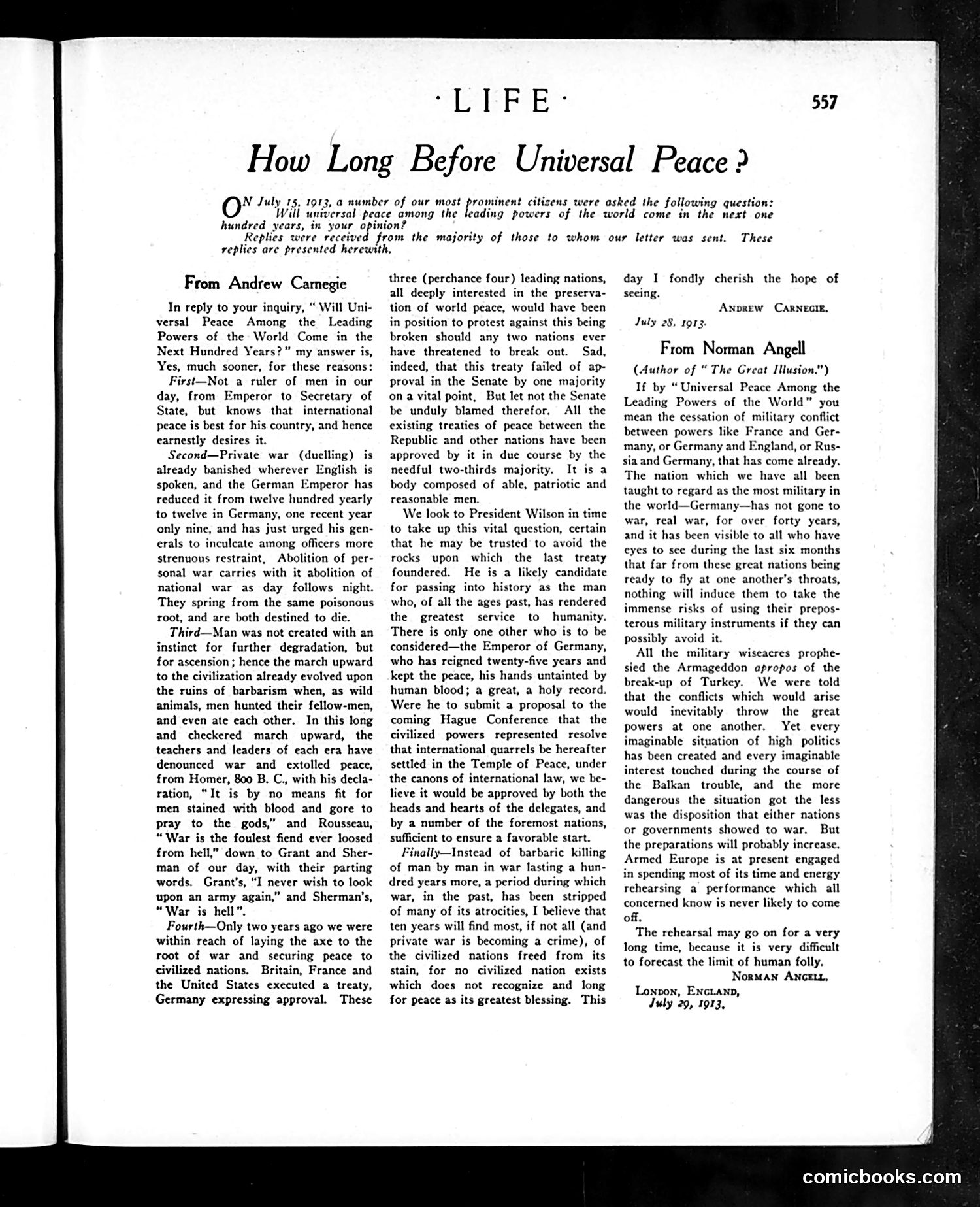
This page presents responses from prominent citizens to a timely question about achieving global peace. **Andrew Carnegie** argues for optimism, citing recent treaties and deploring private war (dueling). He credits Emperor Wilhelm II with maintaining peace through restraint. **Norman Angell** (author of "The Great Illusion") offers skepticism, arguing that despite noble intentions, military powers like Germany remain unwilling to risk war. He predicts armed Europe will continue rehearsing for conflict indefinitely, making the timeline for universal peace unknowable. The contrast reflects pre-WWI anxiety: optimistic industrialists versus intellectuals warning that European militarism made catastrophe inevitable—a tension resolved just one year later.
📄 Transcribed text from this page (OCR, searchable)
Machine-transcribed from the original scan — historical spelling and the odd misread are preserved.
EE How Long Before Universal Peace ? oO” July 15, 1913, a number of our most rominent citizens were asked the following question: Will universal peace among the leading powers of the world come in the next one hundred years, in your opinion? Replies were receive from the majority of those to whom our letter was sent. replies are presented herewith. From Andrew Camegie In reply to your inquiry, “ Will Uni- versal Peace Among the Leading Powers of the World Come in the Next Hundred Years?” my answer is, Yes, much sooner, for these reasons: First—Not a ruler of men in our day, from Emperor to Secretary of State, but knows that international peace is best for his country, and hence earnestly desires it. Second—Private war (duelling) is already banished wherever English is spoken, and the German Emperor has reduced it from twelve hundred yearly to twelve in Germany, one recent year only nine, and has just urged his gen- erals to inculcate among officers more strenuous restraint, Abolition of per- sonal war carries with it abolition of national war as day follows night. They spring from the same poisonous root, and are both destined to die. Third—Man was not created with an instinct for further degradation, but for ascension ; hence the march upward to the civilization already evolved upon the ruins of barbarism when, as wild animals, men hunted their fellow-men, and even ate each other. In this long and checkered march upward, the teachers and leaders of each era have denounced war and extolled peace, from Homer, 800 B. C., with his decla- ration, “It is by no means fit for men stained with blood and gore to pray to the gods,” and Rousseau, “War is the foulest fiend ever loosed from hell,” down to Grant and Sher- man of our day, with their parting words. Grant’s, “I never wish to look upon an army again,” and Sherman's, “War is hell”. Fourth—Only two years ago we were within reach of laying the axe to the root of war and securing peace to civilized nations. Britain, France and the United States executed a treaty, Germany expressing approval. These three (perchance four) leading nations, all deeply interested in the preserva- tion of world peace, would have been in position to protest against this being broken should any two nations ever have threatened to break out. Sad, indeed, that this treaty failed of ap- proval in the Senate by one majority on a vital point, But let not the Senate be unduly blamed therefor. All the existing treaties of peace between the Republic and other nations have been approved by it in due course by the needful two-thirds majority. It is a body composed of able, patriotic and reasonable men. We look to President Wilson in time to take up this vital question, certain that he may be trusted to avoid the rocks upon which the last treaty foundered. He is a likely candidate for passing into history as the man who, of all the ages past, has rendered the greatest service to humanity. There is only one other who is to be considered—the Emperor of Germany, who has reigned twenty-five years and kept the peace, his hands untainted by human blood; a great, a holy record. Were he to submit a proposal to the coming Hague Conference that the civilized powers represented resolve that international quarrels be hereafter settled in the Temple of Peace, under the canons of international law, we be- lieve it would be approved by both the heads and hearts of the delegates, and by a number of the foremost nations, sufficient to ensure a favorable start. Finally—Instead of barbaric killing of man by man in war lasting a hun- dred years more, a period during which war, in the past, has been stripped of many of its atrocities, I believe that ten years will find most, if not all (and private war is becoming a crime), of the civilized nations freed from its stain, for no civilized nation exists which does not recognize and long for peace as its greatest blessing. This These day I fondly cherish the hope of seeing. Anprew CARNEGIE. July 28, 1913. From Norman Angell (Author of “ The Great Illusion.") If by “Universal Peace Among the Leading Powers of the World" you mean the cessation of military conflict between powers like France and Ger- many, or Germany and England, or Rus- sia and Germany, that has come already. The nation which we have all been taught to regard as the most military in the world—Germany—has not gone to war, real war, for over forty years, and it has been visible to all who have eyes to see during the last six months that far from these great nations being ready to fly at one another's throats, nothing will induce them to take the immense risks of using their prepos- terous military instruments if they can possibly avoid it. All the military wiseacres prophe- sied the Armageddon apropos of the break-up of Turkey. We were told that the conflicts which would arise would inevitably throw the great powers at one another. Yet every imaginable situation of high politics has been created and every imaginable interest touched during the course of the Balkan trouble, and the more dangerous the situation got the less was the disposition that either nations or governments showed to war. But the preparations will probably increase. Armed Europe is at present engaged in spending most of its time and energy rehearsing a performance which all concerned know is never likely to come off, The rehearsal may go on for a very long time, because it is very difficult to forecast the limit of human folly. Norman ANcELL. Lonpon, ENGLAND, July 29, 1913, comicbooks.com