
Life, 1913-10-02 · page 32 of 48
Life — October 2, 1913 — page 32: what you’re looking at
What you’re looking at
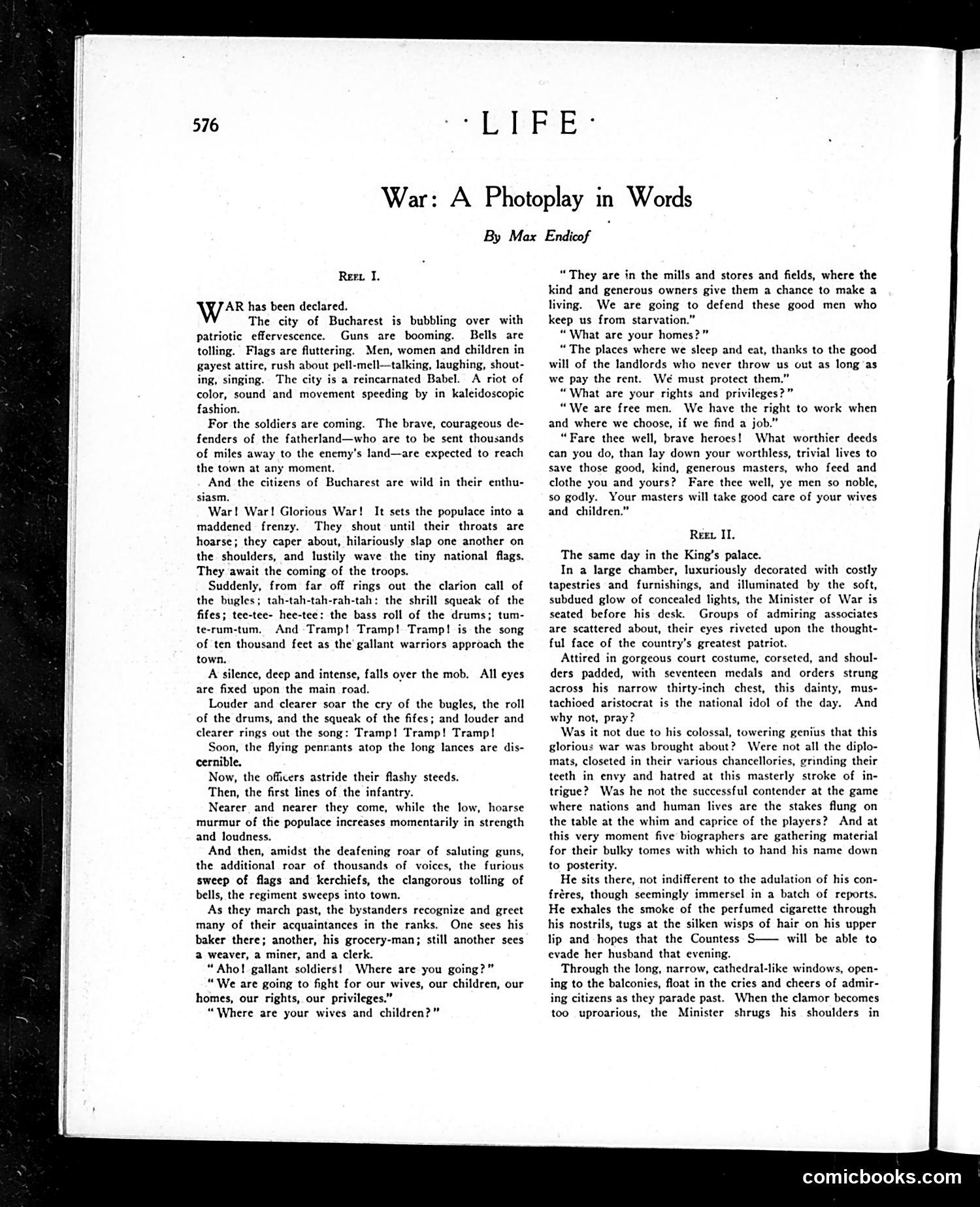
This is satirical anti-war fiction contrasting two scenes from wartime Bucharest. **Reel I** depicts working-class soldiers marching to war amid patriotic fervor. Through dialogue, Endicof exposes the bitter irony: soldiers claim to defend their "homes" (rented rooms), "rights" (the right to work if jobs exist), and "privileges" (freedom to choose where they labor). Their wives and children aren't even present—they're in factories and fields working for wealthy owners. The satire is brutal: soldiers sacrifice "worthless, trivial lives" to protect the "good, kind, generous masters" who barely sustain them. **Reel II** shifts to the King's palace, where the luxuriously dressed Minister of War sits as the admired "greatest patriot"—the stark contrast highlighting who benefits from war while workers die. The piece is socialist critique: war rhetoric masks class exploitation. Soldiers aren't defending abstract national ideals but rather the economic system that impoverishes them, while aristocrats and industrialists remain safe and celebrated.
📄 Transcribed text from this page (OCR, searchable)
Machine-transcribed from the original scan — historical spelling and the odd misread are preserved.
“ETRE War: A Photoplay in Words By Max Endicof Reex I. ‘AR has been declared. The city of Bucharest is bubbling over with patriotic effervescence. Guns are booming. Bells are tolling. Flags are fluttering. Men, women and children in gayest attire, rush about pell-mell—talking, laughing, shout- ing, singing. The city is a reincarnated Babel. A riot of color, sound and movement speeding by in kaleidoscopic fashion. For the soldiers are coming. The brave, courageous de- fenders of the fatherland—who are to be sent thousands of miles away to the enemy’s land—are expected to reach the town at any moment. And the citizens of Bucharest are wild in their enthu- siasm. War! War! Glorious War! It sets the populace into a maddened frenzy. They shout until their throats are hoarse; they caper about, hilariously slap one another on the shoulders, and lustily wave the tiny national flags. They await the coming of the troops. Suddenly, from far off rings out the clarion call of the bugles; tah-tah-tah-rah-tah: the shrill squeak of the fifes; tee-tee- hee-tee: the bass roll of the drums; tum- te-rum-tum. And Tramp! Tramp! Tramp! is the song of ten thousand feet as the gallant warriors approach the town, A silence, deep and intense, falls over the mob. All eyes are fixed upon the main road. Louder and clearer soar the cry of the bugles, the roll of the drums, and the squeak of the fifes; and louder and clearer rings out the song: Tramp! Tramp! Tramp! Soon, the flying pennants atop the long lances are dis- cernible. Now, the officers astride their flashy steeds. Then, the first lines of the infantry. Nearer and nearer they come, while the low, hoarse murmur of the populace increases momentarily in strength and loudness. And then, amidst the deafening roar of saluting guns, the additional roar of thousands of voices, the furious sweep of flags and kerchiefs, the clangorous tolling of bells, the regiment sweeps into town. As they march past, the bystanders recognize and greet many of their acquaintances in the ranks. One sees his baker there; another, his grocery-man; still another sees a weaver, a miner, and a clerk. “Aho! gallant soldiers!) Where are you going?” “We are going to fight for our wives, our children, our homes, our rights, our privileges.” “Where are your wives and children?” “They are in the mills and stores and fields, where the kind and generous owners give them a chance to make a living. We are going to defend these good men who keep us from starvation.” “What are your homes?” “The places where we sleep and eat, thanks to the good will of the landlords who never throw us out as long as we pay the rent. We must protect them.” “What are your rights and privileges?” “We are free men. We have the right to work when and where we choose, if we find a job.” “Fare thee well, brave heroes! What worthier deeds can you do, than lay down your worthless, trivial lives to save those good, kind, generous masters, who feed and clothe you and yours? Fare thee well, ye men so noble, so godly. Your masters will take good care of your wives and children.” Reet II, The same day in the King’s palace. In a large chamber, luxuriously decorated with costly tapestries and furnishings, and illuminated by the soft, subdued glow of concealed lights, the Minister of War is seated before his desk. Groups of admiring associates are scattered about, their eyes riveted upon the thought- ful face of the country’s greatest patriot. Attired in gorgeous court costume, corseted, and shoul- ders padded, with seventeen medals and orders strung across his narrow thirty-inch chest, this dainty, mus- tachioed aristocrat is the national idol of the day. And why not, pray? Was it not due to his colossal, towering genius that this glorious war was brought about? Were not all the diplo- mats, closeted in their various chancellories, grinding their teeth in envy and hatred at this masterly stroke of in- trigue? Was he not the successful contender at the game where nations and human lives are the stakes flung on the table at the whim and caprice of the players? And at this very moment five biographers are gathering material for their bulky tomes with which to hand his name down to posterity. He sits there, not indifferent to the adulation of his con- fréres, though seemingly immersel in a batch of reports. He exhales the smoke of the perfumed cigarette through his nostrils, tugs at the silken wisps of hair on his upper lip and hopes that the Countess S—— will be able to evade her husband that evening. Through the long, narrow, cathedral-like windows, open- ing to the balconies, float in the cries and cheers of admir- ing citizens as they parade past. When the clamor becomes too uproarious, the Minister shrugs his shoulders in comicbooks.com