
Life, 1913-10-02 · page 23 of 48
Life — October 2, 1913 — page 23: what you’re looking at
What you’re looking at
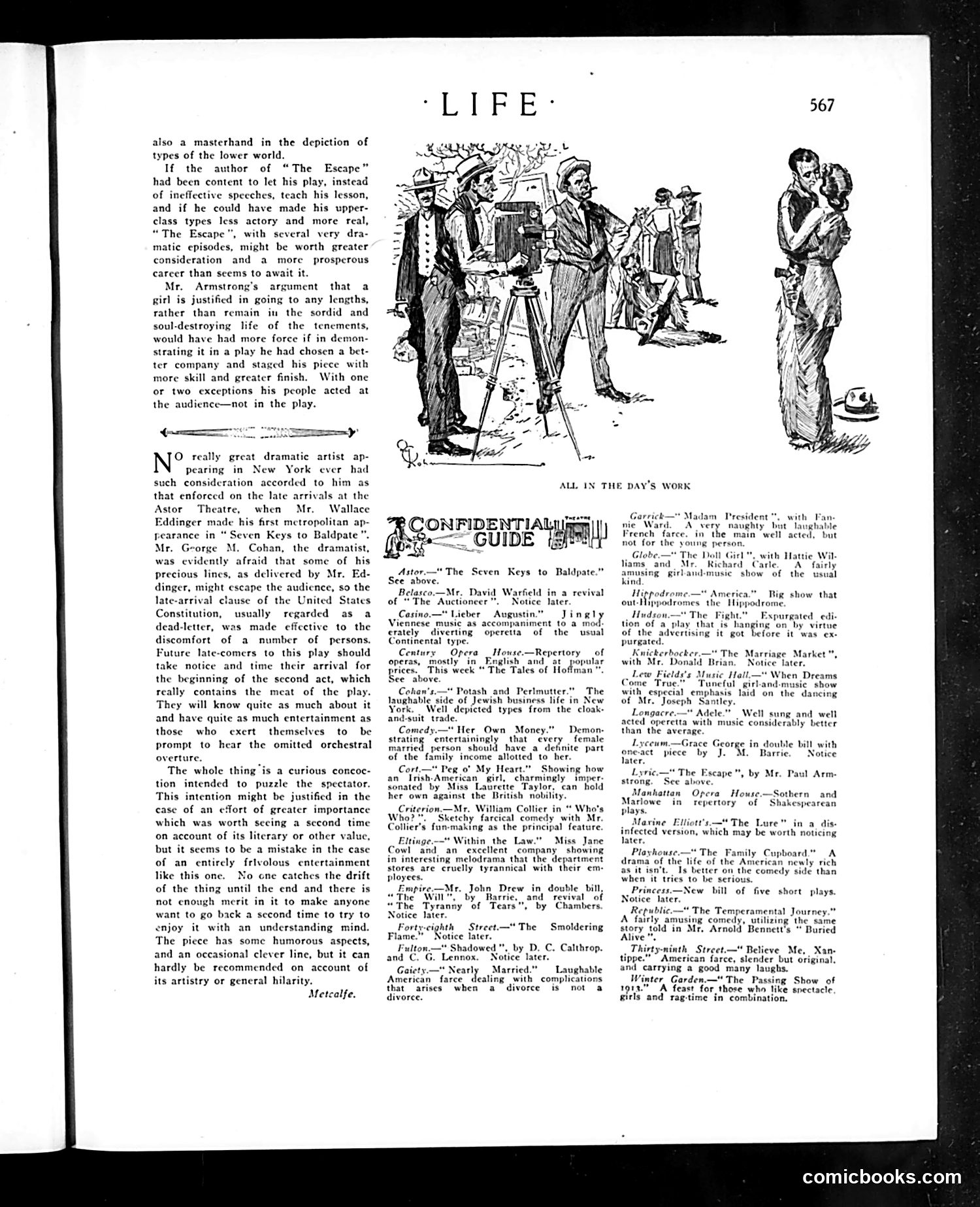
This page contains theater reviews by critic Metcalfe, covering Broadway productions from what appears to be the early 1910s. The main illustrated article critiques "Seven Keys to Baldpate" at the Astor Theatre, starring Wallace Eddinger in a play by George M. Cohan. The sketch titled "All in the Day's Work" depicts street scenes—likely illustrating urban life or working-class characters referenced in the theatrical reviews. The satire targets theatrical pretension: Metcalfe mocks Cohan's decision to block late arrivals (invoking the "late-arrival clause of the United States Constitution" sarcastically), suggesting the playwright feared audiences would miss his "precious lines." He critiques the play as a "frivolous entertainment" lacking sufficient merit to warrant multiple viewings, with only occasional clever moments among generally weak material. The accompanying theater guide reviews other productions, including Jewish immigrant comedies and melodramas—popular entertainment genres of the period reflecting New York's diverse immigrant populations.
📄 Transcribed text from this page (OCR, searchable)
Machine-transcribed from the original scan — historical spelling and the odd misread are preserved.
also a masterhand in the depiction of ypes of the lower world. If the author of “The Escape” had been content to let his play, instead of ineffective speeches, teach his lesson, and if he could have made his upper- class types less actory and more real, “The Escape”, with several very dra- matic episodes, might be worth greater consideration and a more prosperous carcer than scems to await it. Mr. Armstrong's argument that a girl is justified in going to any lengths, rather than remain iu the sordid and soul-destroying life of the tenements, would have had more force if in demon- strating it in a play he had chosen a bet- ter company and staged his piece with more skill and greater finish, With one or two exceptions his people acted at the audience—not in the play. ——_ O really great dramatic artist ap- pearing in New York ever had such consideration accorded to him as that enforced on the late arrivals at the Astor Theatre, when Mr. Wallace Eddinger made his first metropolitan ap- pearance in “Seven Keys to Baldpate ”. Mr. George M, Cohan, the dramatist, was evidently afraid that some of his Precious lines, as delivered by Mr. Ed- dinger, might escape the audience, so the late-arrival clause of the United States Constitution, usually regarded as a dead-letter, was made effective to the discomfort of a number of persons. Future late-comers to this play should take notice and time their arrival for the beginning of the second act, which really contains the meat of the play. They will know quite as much about it and have quite as much entertainment as those who exert themselves to be prompt to hear the omitted orchestral overture. The whole thing is a curious concoc- tion intended to puzzle the spectator. This intention might be justified in the case of an eHort of greater importance which was worth secing a second time on account of its literary or other value, but it seems to be a mistake in the case of an entirely frivolous entertainment like this one. No one catches the drift of the thing until the end and there is not enough merit in it to make anyone want to go back a sccond time to try to enjoy it with an understanding mind. The piece has some humorous aspects, and an occasional clever line, but it can hardly be recommended on account of its artistry or general hilarity. Metcalfe. ALL IN THE DAY'S CONFIDENTI Pant "GUIDE Leet! Astor.—" The Seven Keys to Baldpate. See above. Belasco.—Mr. David Warfield in a revival of “The Auctioneer”. Notice later. Casino.—" Lieber Augustin.” Jing! Viennese musie as accompaniment t9 a mod: erately diverting operetta of the usual Continental type. Century Opera _Honse.—Repertory of operas, mostly in English and at popular prices. This week “ The Tales of Hoffman See above. Cohen's. tash and Perlmutter.” The laughable side of Jewish business life in New York. Well depicted types from the cloak- and-suit trade. Comedy.—" Her Own Money.” Demon- Strating entertainingly that every female married person should have a definite part of the family income allotted to her. Cort.—"* Peg o' My Heart.” Showing how an Insh-American girl, charmingly imper. sonated by Miss Laurette Taylor, can hold her own against the British nobility. Criterion.—Mr. William Collier in “ Who's Who?". | Sketchy farcical comedy with Mr. Collier's fun-making as the principal feature. Eltinge——" Within the Law.” Miss Jane Cowl and an excellent company showing in interesting melodrama that the department stores are cruelly tyrannical with their em- ployees. Empire-—Mr. John Drew in double bill, “The Will", by Barrie, and revival of “The Tyranny of Tears”, by Chambers. Notice later. Forty-cighth — Street— The Flame.” Notice late: Fulto hadowed", by D. C. Calthrop. and C. G. Lennox. Notice later. Gaicty—" Nearly Married.” Laughable American farce dealing with complications that arises. when a divorce is not a divorce. Smoldering work Garrick ‘ nie Ward. ughty 3 le French fare nain well acted, but not for the young person Globe.—" The Doll Girl, with Hattie Wil- liams and Mr. Richard Carle. A fairly K girland show of the usual resident ” out-Hippodromes th Hudson.—" The argated edi- tion of a play th ging on by virtue of the advertising it got before it was ex: purgated: Knickerbocker.—" The Marriage Market". Mr. Donald Brian. ww Fi Come True." Rig show that Hippodrome, * When Dreams tuneful gitl-and-music show with especial emphasis laid on the dancing of Mr. Joseph Santley Longacre.—* Adele.” Well sun acted operetta with music conside than the average. and well bly better um.—Grace George in double bill with act piece by J. M. Barrie, Notice rie." The Escape", by Mr. Paul Arm: ig. See above. Manhattan Opera Howse.—Sothern Marlowe in repertory of plays. Marine Elliott's." The Lure" in infected vers later. Playhouse.—" The Family Cupboard." A drama of the life of the American newly rich as it isn't. Is better on the comedy side than when it tries to be serious. Princess.—New bill of five Notice later. Republic.—" The Temperamental Journey.” A fairly amusing comedy, utilizing the same Story told in Mr, Arnold’ Bennett's “ Buried Alive”. _ Thirty-ninth Street.—" Believe Me, Xan tippe."" American farce, slender but original. and carrying a good many laughs. Winter Garden.—" The Passing Show of 1913." A feast for those who Ii girls and ragtime in combina and Shakespearean a dis- . which may be worth noticing short plays. comicbooks.com