
Life, 1913-10-02 · page 14 of 48
Life — October 2, 1913 — page 14: what you’re looking at
What you’re looking at
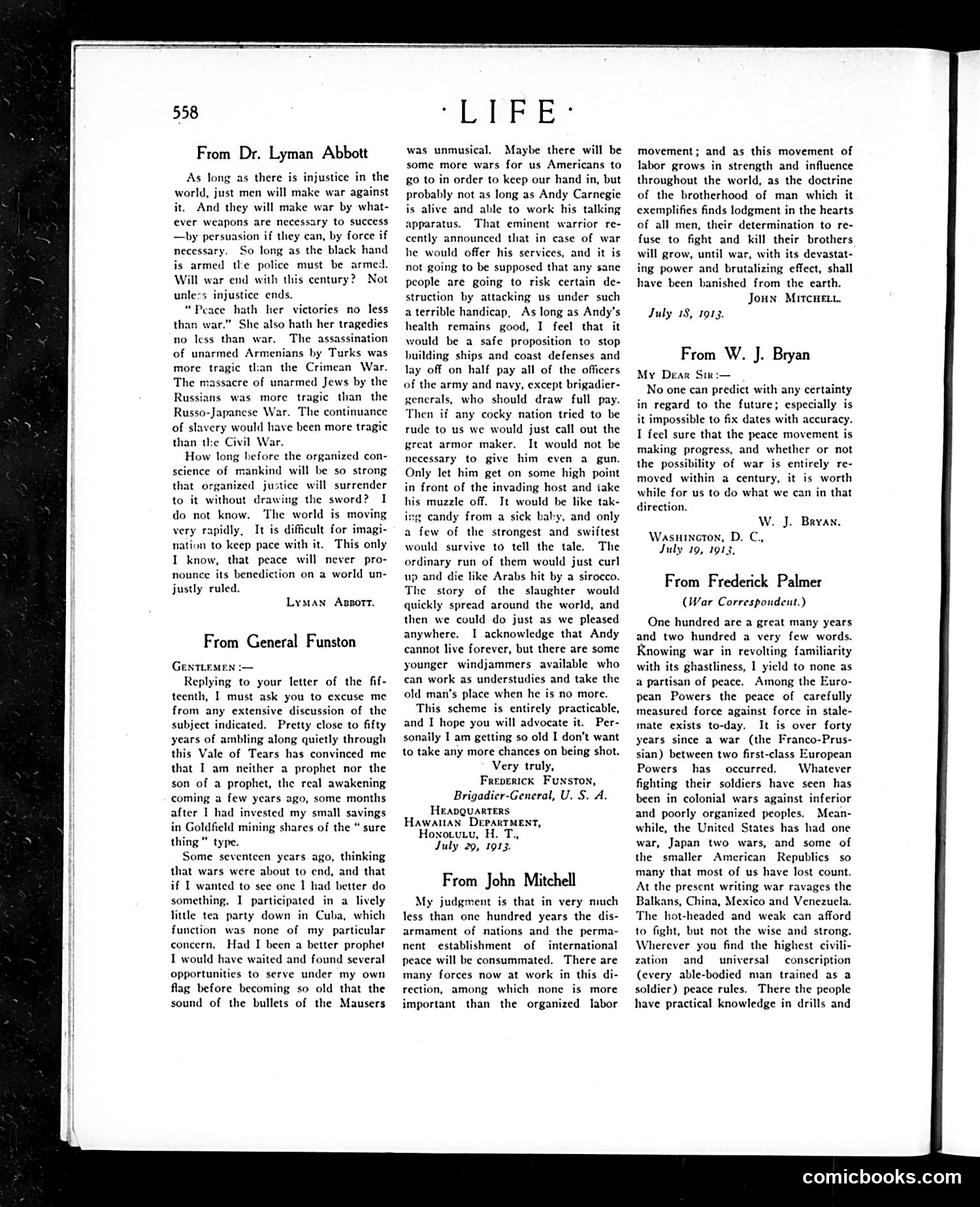
This page contains letters to the editor from *Life* magazine, dated July 1913. The contributors—Dr. Lyman Abbott, General Funston, W.J. Bryan, John Mitchell, and Frederick Palmer—discuss war, peace, and labor issues of the era. Key themes include: Abbott's argument for defensive military preparedness; Funston's proposal to employ unemployed men in military service rather than risk armed conflict; Bryan's cautious stance on predicting peace; Mitchell's optimism about labor's role in establishing international peace; and Palmer's observations on global military conflicts. The letters reflect Progressive-era debates over militarism, pacifism, labor organization, and America's role in international affairs—topics dominating public discourse during the prewar period before U.S. entry into World War I in 1917.
📄 Transcribed text from this page (OCR, searchable)
Machine-transcribed from the original scan — historical spelling and the odd misread are preserved.
From Dr. Lyman Abbott As long as there is injustice in the world, just men will make war against it. And they will make war by what- ever weapons are necessary to success —by persuasion if they can, by force if necessary. So long as the black hand is armed the police must be armed. Will war end with this century? Not unless injustice ends. “Peace hath her victories no less than war.” She also hath her tragedies no less than war. The assassination of unarmed Armenians by Turks was more tragic than the Crimean War. The massacre of unarmed Jews by the Russians was more tragic than the Russo-Japanese War. The continuance of slavery would have been more tragic than the Civil War. How long before the organized con- science of mankind will be so strong that organized justice will surrender to it without drawing the sword? I do not know. The world is moving very rapidly, It is difficult for imagi- nation to keep pace with it. This only I know, that peace will never pro- nounce its benediction on a world un- justly ruled. Lysan Apsort. From General Funston Replying to your letter of the fif- teenth, I must ask you to excuse me from any extensive discussion of the subject indicated. Pretty close to fifty years of ambling along quietly through this Vale of Tears has convinced me that I am neither a prophet nor the son of a prophet, the real awakening coming a few years ago, some months after I had invested my small savings in Goldfield mining shares of the “ sure thing” type. Some seventeen years ago, thinking that wars were about to end, and that if I wanted to see one I had better do something, I participated in a lively little tea party down in Cuba, which function was none of my particular concern. Had I been a better prophet I would have waited and found several opportunities to serve under my own flag before becoming so old that the sound of the bullets of the Mausers “EEE E> was unmusical. Maybe there will be some more wars for us Americans to go to in order to keep our hand in, but probably not as long as Andy Carnegie is alive and able to work his talking apparatus. That eminent warrior re- cently announced that in case of war he would offer his services, and it is not going to be supposed that any sane people are going to risk certain de- struction by attacking us under such a terrible handicap, As long as Andy’s health remains good, I feel that it would be a safe proposition to stop building ships and coast defenses and lay off on half pay all of the officers of the army and navy, except brigadier- generals, who should draw full pay. Then if any cocky nation tried to be rude to us we would just call out the great armor maker. It would not be necessary to give him even a gun. Only let him get on some high point in front of the invading host and take his muzzle off. It would be like tak- ng candy from a sick baby, and only a few of the strongest and swiftest would survive to tell the tale. The ordinary run of them would just curl up and die like Arabs hit by a sirocco. The story of the slaughter would quickly spread around the world, and then we could do just as we pleased anywhere. I acknowledge that Andy cannot live forever, but there are some younger windjammers available who can work as understudies and take the old man’s place when he is no more. This scheme is entirely practicable, and I hope you will advocate it. Per- sonaily I am getting so old I don’t want to take any more chances on being shot. Very truly, Freverick Funston, Brigadier-General, U. S. A. HEADQUARTERS Hawatran DerartMent, Honocutu, H. T., July 29, 1913. From John Mitchell My judgment is that in very much less than one hundred years the dis- armament of nations and the perma- nent establishment of international peace will be consummated. There are many forces now at work in this di- rection, among which none is more important than the organized labor movement; and as this movement of labor grows in strength and influence throughout the world, as the doctrine of the brotherhood of man which it exemplifies finds lodgment in the hearts of all men, their determination to re- fuse to fight and kill their brothers will grow, until war, with its devastat- ing power and brutalizing effect, shall have been banished from the earth. Joun Mitcnent. July 18, 1913. From W. J. Bryan My Dear Sir:— No one can predict with any certainty in regard to the future; especially is it impossible to fix dates with accuracy. I feel sure that the peace movement is making progress, and whether or not the possibility of war is entirely re- moved within a century, it is worth while for us to do what we can in that direction. W. J. Bryan. aincTON, D. C., 19, 1913, From Frederick Palmer (War Correspondent.) Wa: Jul; One hundred are a great many years and two hundred a very few words. Knowing war in revolting familiarity with its ghastliness, I yield to none as a partisan of peace. Among the Euro- pean Powers the peace of carefully measured force against force in stale- mate exists to-day. It is over forty years since a war (the Franco-Prus- sian) between two first-class European Powers has occurred. Whatever fighting their soldiers have seen has been in colonial wars against inferior and poorly organized peoples. Mean- while, the United States has had one war, Japan two wars, and some of the smaller American Republics so many that most of us have lost count. At the present writing war ravages the Balkans, China, Mexico and Venezuela. The hot-headed and weak can afford to fight, but not the wise and stron; Wherever you find the highest civil zation and universal conscription (every able-bodied man trained as a soldier) peace rules. There the people have practical knowledge in drills and comicbooks.com