
Life, 1913-10-02 · page 15 of 48
Life — October 2, 1913 — page 15: what you’re looking at
What you’re looking at
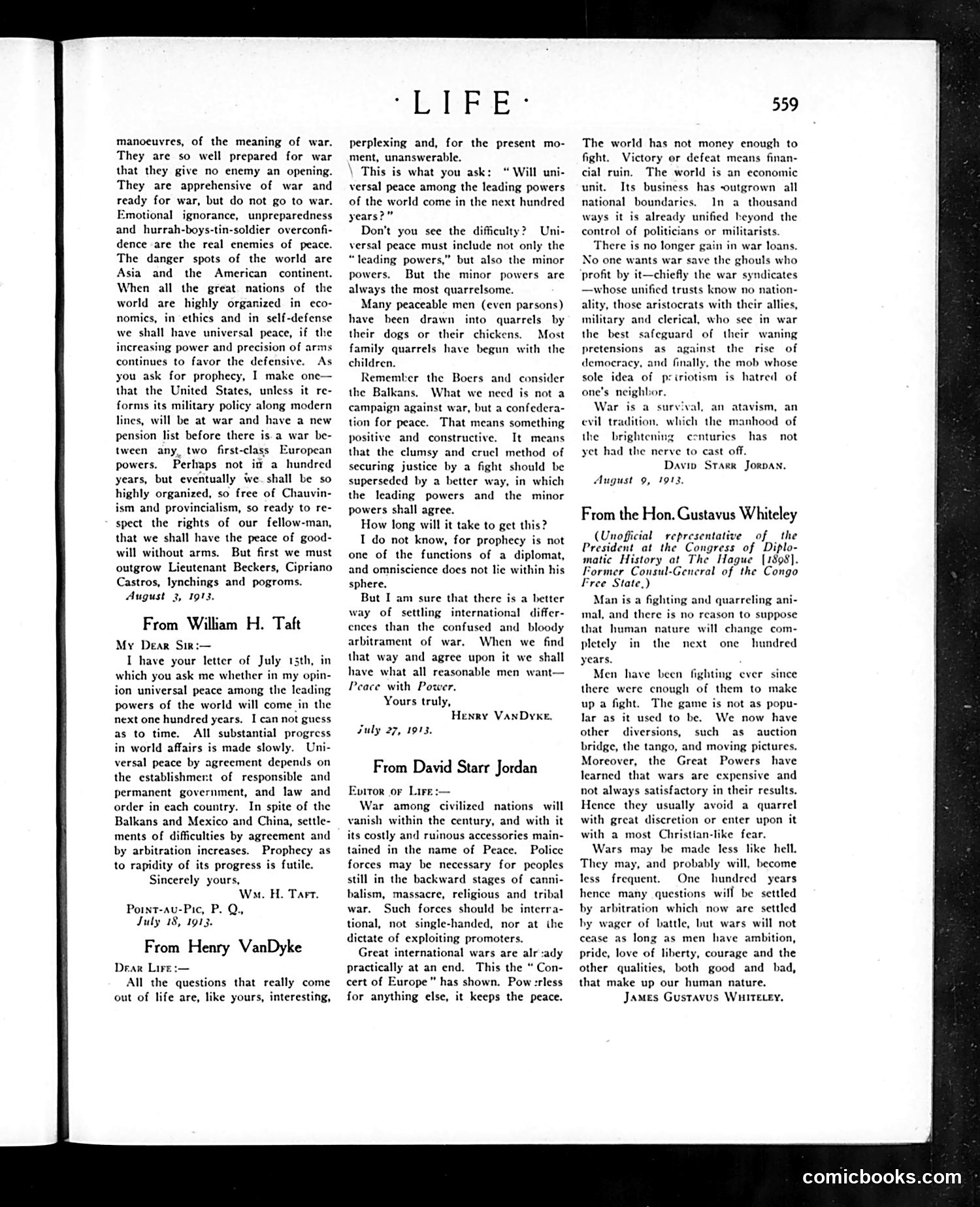
This page contains letters from prominent American figures debating whether universal peace among world powers will occur within a century. The contributors—former President William H. Taft, poet Henry VanDyke, and biologist David Starr Jordan—represent different perspectives on this question. **The satire's context**: Written just before World War I, these earnest, optimistic predictions about inevitable peace appear darkly ironic in retrospect. The writers cite examples of conflict (Balkans, Mexico, China) as manageable problems that arbitration and organization will solve. **Key figures**: Taft emphasizes military preparedness and legal order; VanDyke uses homely metaphors (dogs and chickens causing family quarrels) to explain how minor powers destabilize peace; Jordan predicts war's disappearance through civilization's progress. The page reveals pre-war progressive faith in rational solutions to international conflict—a faith soon shattered by events.
📄 Transcribed text from this page (OCR, searchable)
Machine-transcribed from the original scan — historical spelling and the odd misread are preserved.
manoeuvres, of the meaning of war. They are so well prepared for war that they give no enemy an opening. They are apprehensive of war and ready for war, but do not go to war. Emotional ignorance, unpreparedness and hurrah-boys-tin-soldier overconfi- dence are the real enemies of peace. The danger spots of the world are Asia and the American continent. When all the great nations of the world are highly organized in eco- nomics, in ethics and in self-defense we shall have universal peace, if the increasing power and precision of arms continues to favor the defensive. you ask for prophecy, I make one— that the United States, unless it re- forms its military policy along modern lines, will be at war and have a new pension list before there is.a war be- tween any, two first-class European powers. Perhaps not in a hundred years, but eventually ie. shall be so highly organized, so free of Chauvin- ism and provincialism, so ready to re- spect the rights of our fellow-man, that we shall have the peace of good- will without arms. But first we must outgrow Lieutenant Beckers, Cipriano Castros, lynchings and pogroms. August 3, 1913. From William H. Taft My Dear Sir:— I have your letter of July 13th, in which you ask me whether in my opin- ion universal peace among the leading powers of the world will come in the next one hundred years. I can not guess as to time. All substantial progress in world affairs is made slowly. Uni- versal peace by agreement depends on the establishment of responsible and permanent government, and law and order in each country. In spite of the Balkans and Mexico and China, settle- ments of difficulties by agreement and by arbitration increases. Prophecy as to rapidity of its progress is futile. Sincerely yours, Wat. H. Tart. Pornt-au-Pic, P. Q., July 18, 1913. From Henry VanDyke Dear Lire :— All the questions that really come out of life are, like yours, interesting, “sEIERES: perplexing and, for the present mo- ment, unanswerable. This is what you ask: “ Will uni- versal peace among the leading powers of the world come in the next hundred years?” Don’t you see the difficulty? Uni- versal peace must include not only the “leading powers,” but also the minor powers, But the minor powers are always the most quarrelsome. Many peaceable men (even parsons) have been drawn into quarrels by their dogs or their chickens. Most family quarrels have begun with the children. Remember the Boers and consider the Balkans, What we necd is not a campaign against war, but a confedera- tion for peace. That means something positive and constructive. It means that the clumsy and cruel method of securing justice by a fight should be superseded by a better way, in which the leading powers and the minor powers shall agree. How long will it take to get this? I do not know, for prophecy is not one of the functions of a diplomat, and omniscience does not lie within his sphere. But I am sure that there is a better way of settling international differ- ences than the confused and bloody arbitrament of war. When we find that way and agree upon it we shall have what all reasonable men want— Peace with Power. Yours truly, Henry VanDyxe. July 27, 1913. From David Starr Jordan Evrtor or Lire :— War among civilized nations will vanish within the century, and with it its costly and ruinous accessories main- tained in the name of Peace. Police forces may be necessary for peoples still in the backward stages of canni- balism, massacre, religious and tribal war. Such forces should be interra- tional, not single-handed, nor at the dictate of exploiting promoters. Great international wars are alr :ady practically at an end. This the “ Con- cert of Europe" has shown. Pow :rless for anything else, it keeps the peace. 559 The world has not money enough to fight. Victory or defeat means finan- cial ruin. The world is an economic unit. Its business has outgrown all national boundaries. In a thousand ways it is already unified beyond the control of politicians or militarists. There is no longer gain in war loans. No one wants war save the ghouls who profit by it—chiefly the war syndicates —whose unified trusts know no nation- ality, those aristocrats with their allies, military and clerical, who see in war the best safeguard of their waning pretensions as against the rise of democracy, and finally, the mob whose sole idea of pririotism is hatred of one’s neighbor. War is a survival, an atavism, an evil tradition, which the manhood of the brightening centuries has not yet had the nerve to cast off. Davin Stark Jorpan. August 9, 1913. From the Hon. Gustavus Whiteley (Unoficial representative of the President at the Congress of Diplo- matic History at The Hague [1898]. Former Consul-General of the Congo Free State.) Man is a fighting and quarreling ani- mal, and there is no reason to suppose that human nature will change com- pletely in the next one hundred years. Men have been fighting ever since there were cnough of them to make up a fight. The game is not as popu- lar as it used to be. We now have other diversions, such as auction bridge, the tango, and moving pictures. Moreover, the Great Powers have learned that wars are expensive and not always satisfactory in their results. Hence they usually avoid a quarrel with great discretion or enter upon it with a most Christian-like fear. Wars may be made less like hell. They may, and probably will, become less frequent. One hundred years hence many questions will be settled by arbitration which now are settled hy wager of battle, but wars will not cease as long as men have ambition, pride, love of liberty, courage and the other qualities, both good and bad, that make up our human nature. James Gustavus Wurtetey, comicbooks.com