
Life, 1913-10-02 · page 34 of 48
Life — October 2, 1913 — page 34: what you’re looking at
What you’re looking at
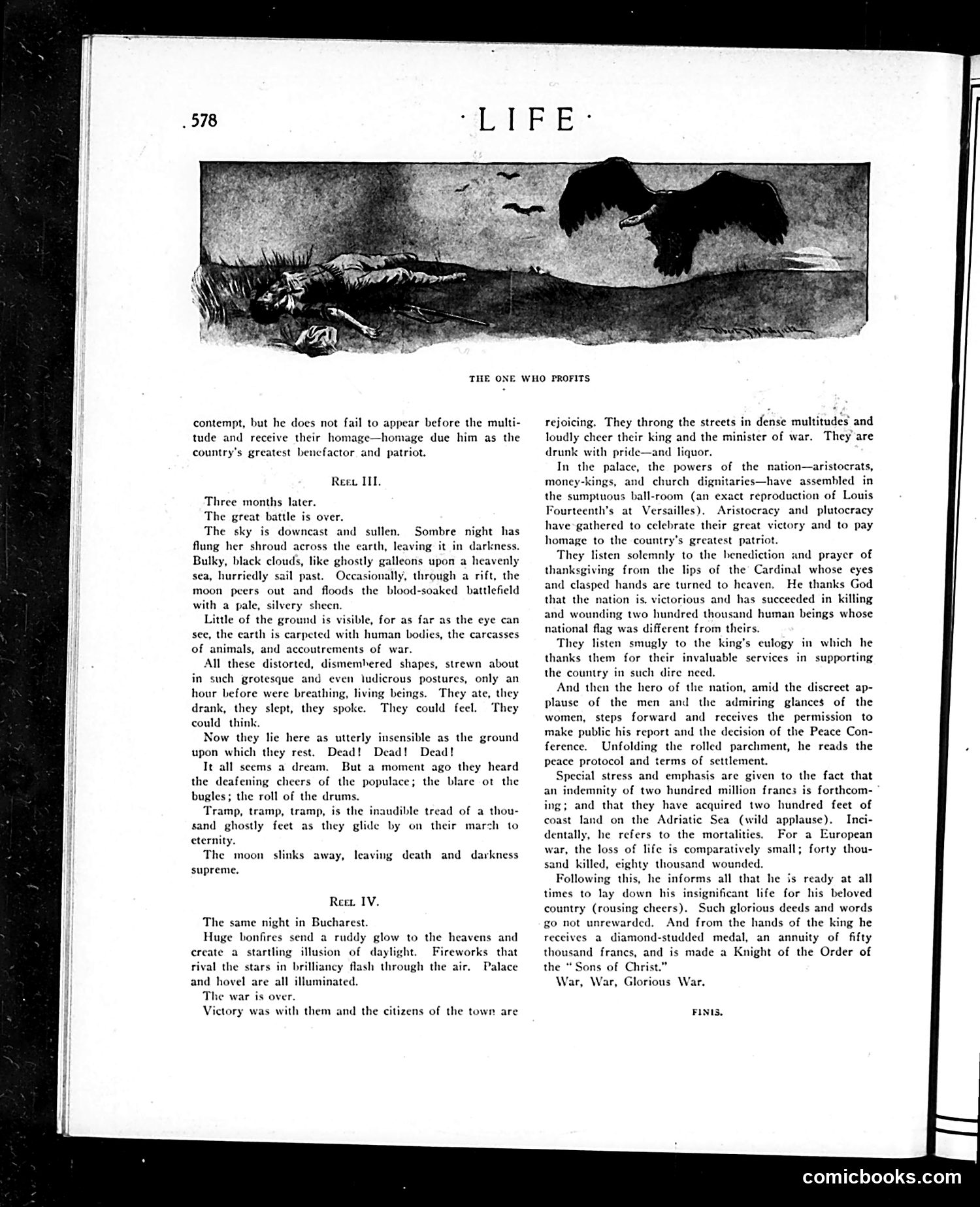
This piece satirizes the hypocrisy of celebrating military victory while ignoring its human cost. The stark illustration contrasts two scenes: a battlefield strewn with corpses under moonlight, versus a palace celebration in Bucharest where aristocrats, clergy, and politicians toast their "greatest patriot." The satire's point: while ordinary soldiers lie dead (40,000 killed, 80,000 wounded), the nation's elite gather to honor a general who receives medals and money. The text emphasizes their callous detachment—the Cardinal thanks God for killing foreign soldiers; the king praises those who enabled war; the general boasts of territorial gains (Adriatic coast) and financial indemnities (200 million francs). "The One Who Profits" asks: who actually benefits from war? Not the dead, but the powerful who accumulate wealth, land, and glory while others sacrifice everything. The piece critiques how war's true human devastation is obscured by nationalist celebration.
📄 Transcribed text from this page (OCR, searchable)
Machine-transcribed from the original scan — historical spelling and the odd misread are preserved.
THE ONE WHO PROFITS contempt, but he does not fail to appear before the multi- tude and receive their homage—homage due him as the country’s greatest benefactor and patriot. Reet IL, Three months later. The great battle is over. The sky is downcast and sullen. Sombre night has flung her shroud across the earth, leaving it in darkness. Bulky, black clouds, like ghostly galleons upon a heavenly sea, hurriedly sail past. Occasionally, through a rift, the moon peers out and floods the blood-soaked battlefield with a pale, silvery sheen. Little of the ground is visible, for as far as the eye can see, the carth is carpeted with human bodies, the carcasses of animals, and accoutrements of war. All these distorted, dismembered shapes, strewn about in such grotesque and even ludicrous postures, only an hour before were breathing, living beings. They ate, they drank, they slept, they spoke. They could feel. They could think. Now they lie here as utterly insensible as the ground upon which they rest. Dead! Dead! Dead! Tt all seems a dream. But a moment ago they heard the deafening cheers of the populace; the blare ot the bugles; the roll of the drums. Tramp, tramp, tramp, is the inaudible tread of a thou- sand ghostly feet as they glide by on their march to eternity. The moon slinks away, leaving death and darkness supreme. Reet 1V. The same night in Bucharest. Huge bonfires send a ruddy glow to the heavens and create a startling illusion of daylight. Fireworks that rival the stars in brilliancy flash through the air. Palace and hovel are all illuminated. The war is over. Victory was with them and the citizens of the town are rejoicing. They throng the streets in dense multitudes and loudly cheer their king and the minister of war. They are drunk with pride—and liquor. In the palace, the powers of the nation—aristocrats, money-kings, and church dignitaries—have assembled in the sumptuous ball-room (an exact reproduction of Louis Fourteenth’s at Versailles). Aristocracy and plutocracy have gathered to celebrate their great victory and to pay homage to the country’s greatest patriot. They listen solemnly to the henediction and prayer of thanksgiving from the lips of the Cardinal whose eyes and clasped hands are turned to heaven. He thanks God that the nation is. victorious and has succeeded in killing and wounding two hundred thousand human beings whose national flag was different from theirs. They listen smugly to the king’s eulogy in which he thanks them for their invaluable services in supporting the country in such dire need. And then the hero of the nation, amid the discreet ap- plause of the men and the admiring glances of the women, steps forward and receives the permission to make public his report and the decision of the Peace Con- ference. Unfolding the rolled parchment, he reads the peace protocol and terms of settlement. Special stress and emphasis are given to the fact that an indemnity of two hundred million frances is forthcom- ing; and that they have acquired two hundred feet of coast land on the Adriatic Sea (wild applause). Inci- dentally, he refers to the mortalities. For a European war, the loss of life is comparatively small; forty thou- sand killed, eighty thousand wounded. Following this, he informs all that he is ready at all times to lay down his insignificant life for his beloved country (rousing cheers). Such glorious deeds and words go not unrewarded. And from the hands of the king he receives a diamond-studded medal, an annuity of fifty thousand francs, and is made a Knight of the Order of the “Sons of Christ. War, War, Glorious War. FINIS. comicbooks.com