
A complete issue · 52 pages · 1913
Life — April 17, 1913
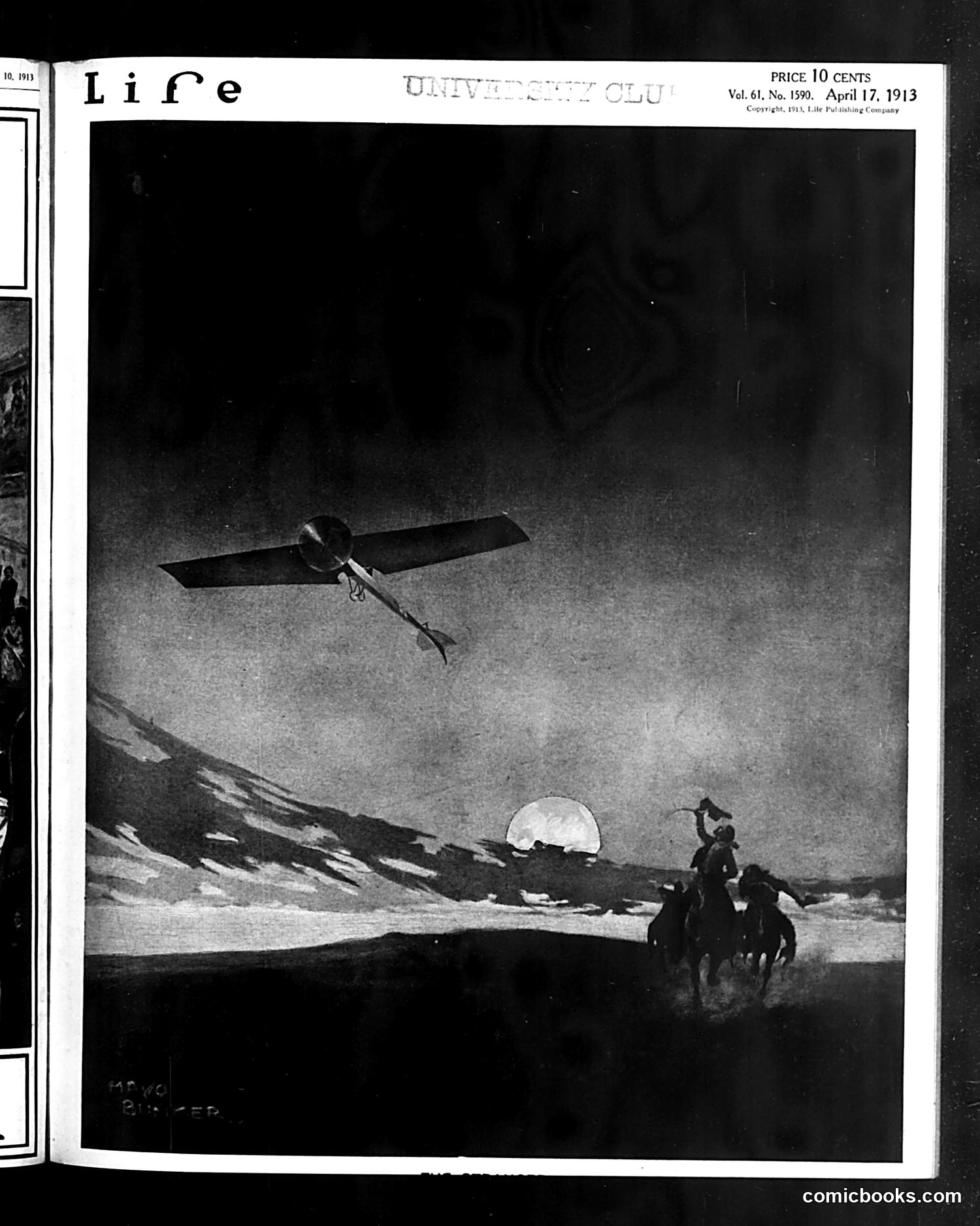
This April 17, 1913 *Life* cover appears to be a futuristic or speculative illustration rather than political satire. It depicts an early airplane flying overhead while figures on horseback (likely representing traditional/conventional modes of transportation or society) observe from below against a desert landscape with a large moon. The image likely satirizes the rapid technological change of the era—the contrast between modern aviation and old-fashioned horse travel suggests commentary on how quickly society was being transformed by new inventions. In 1913, powered flight was still novel (only 10 years after the Wright brothers), making airplane imagery particularly striking for magazine covers aimed at commenting on contemporary progress and social change. The exact satirical point remains unclear without accompanying text.
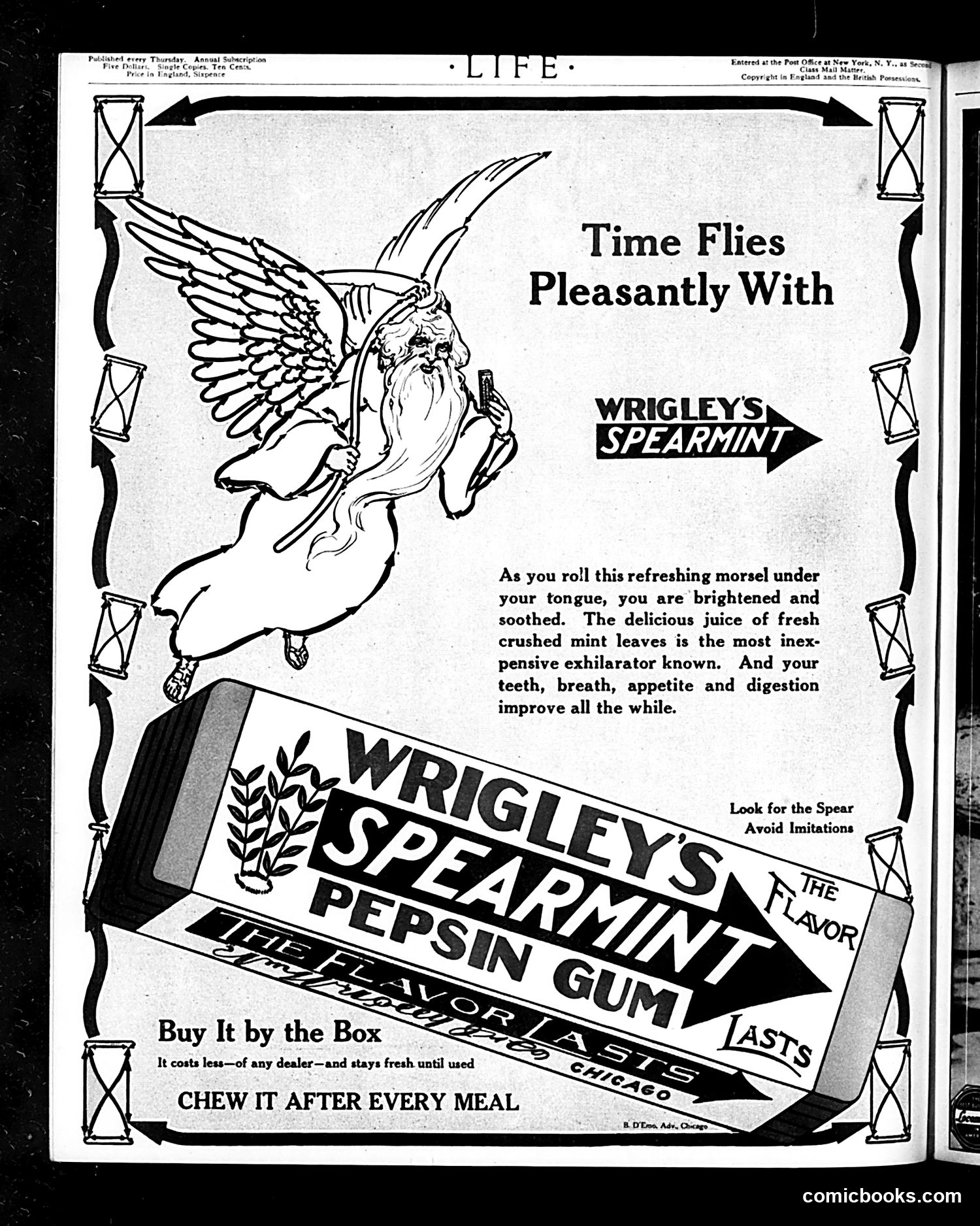
This is a straightforward **product advertisement**, not political satire. The page promotes Wrigley's Spearmint chewing gum using a whimsical illustration of Father Time (identifiable by his winged form, long beard, and traditional hourglasses) to convey the slogan "Time Flies Pleasantly With Wrigley's Spearmint." The ad claims the gum's fresh mint leaves provide inexpensive oral refreshment that improves teeth, breath, appetite, and digestion. The classical Father Time figure is a conventional marketing device meant to suggest the product makes time pass enjoyably. The advertisement recommends buying gum "by the Box" and chewing after meals—standard early 20th-century promotional messaging with no political content.
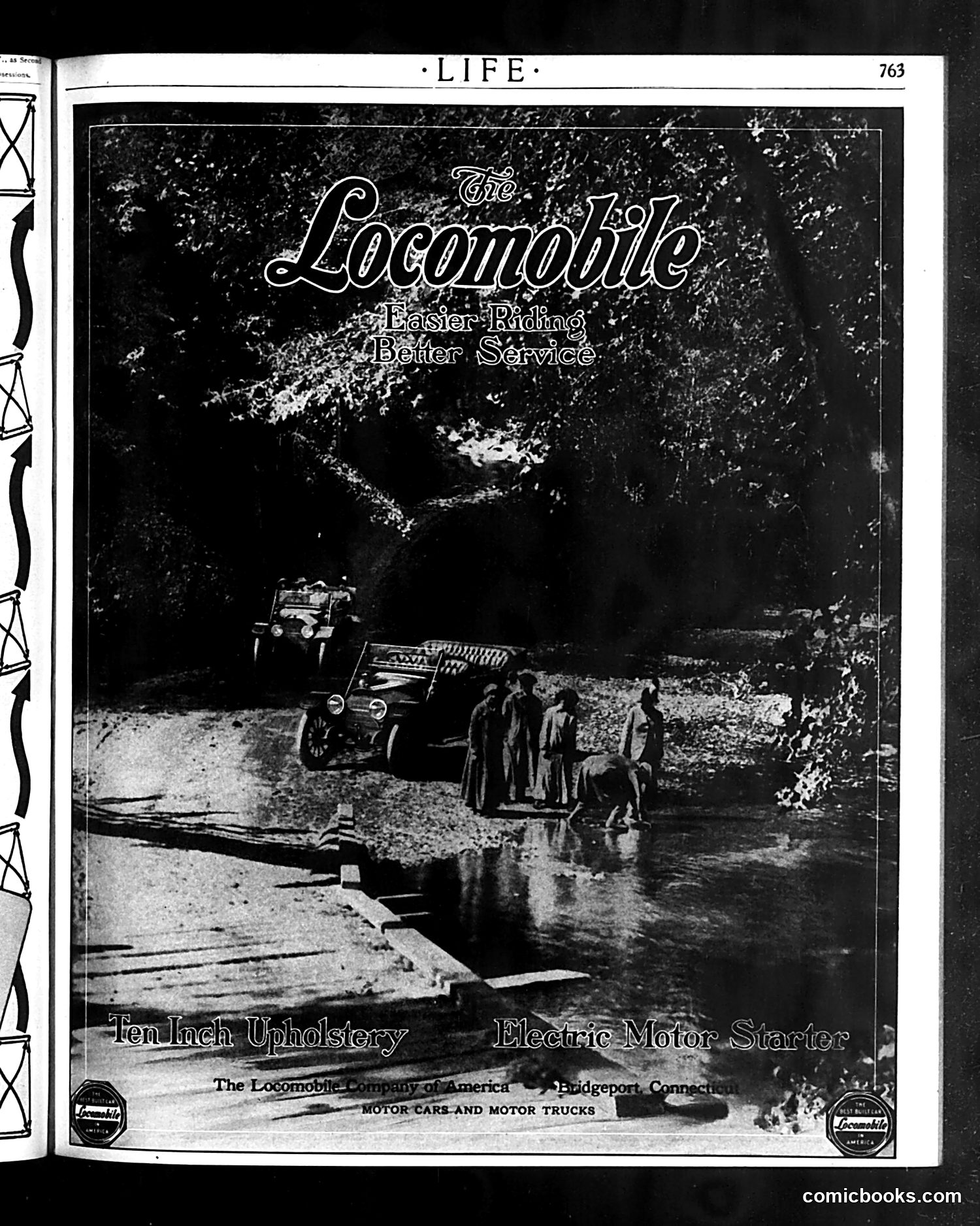
This page is primarily an **advertisement** for the Locomobile automobile, not political satire. The ad appears in *Life* magazine (page 763) and promotes the Locomobile brand with the slogan "Easier Riding, Better Service." The image shows an early automobile (appears to be from the 1910s-1920s era) stopped at what looks like a rural stream or ford crossing, with several figures and possibly another vehicle nearby. The ad emphasizes practical features: "Ten Inch Upholstery" and "Electric Motor Starter"—selling points for comfort and modern convenience to potential buyers. The Locomobile Company was based in Bridgeport, Connecticut. This represents straightforward product marketing rather than political commentary or satire.
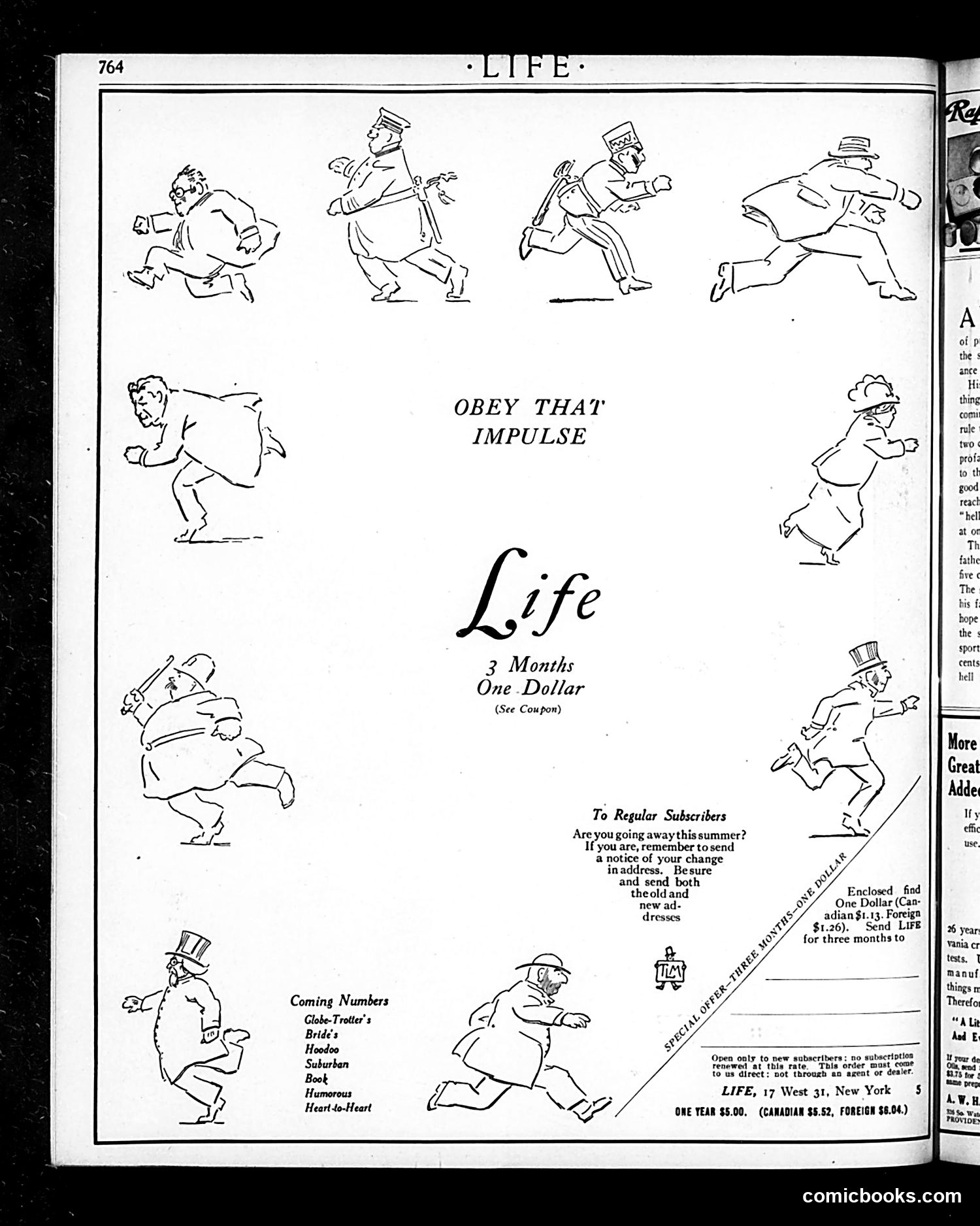
This is primarily an **advertisement page** for Life magazine's subscription, not a political cartoon. The page features eight cartoon figures in various poses of hurried movement—running, leaping, and gesticulating wildly—arranged around the centered text "OBEY THAT IMPULSE." The recurring theme appears to be **impulsive action**: the exaggerated, comedic drawings suggest people being driven by sudden urges or instincts to move, chase, or flee. The satirical point seems gentle—poking fun at human nature's tendency toward spontaneous behavior. The page promotes a 3-month subscription for one dollar, includes coming issues listings ("Bride's Hosiery," "Humorous Heart-to-Heart"), and subscriber notices about summer address changes. The artwork style is typical of early 20th-century satirical illustration, emphasizing physical comedy through caricature.
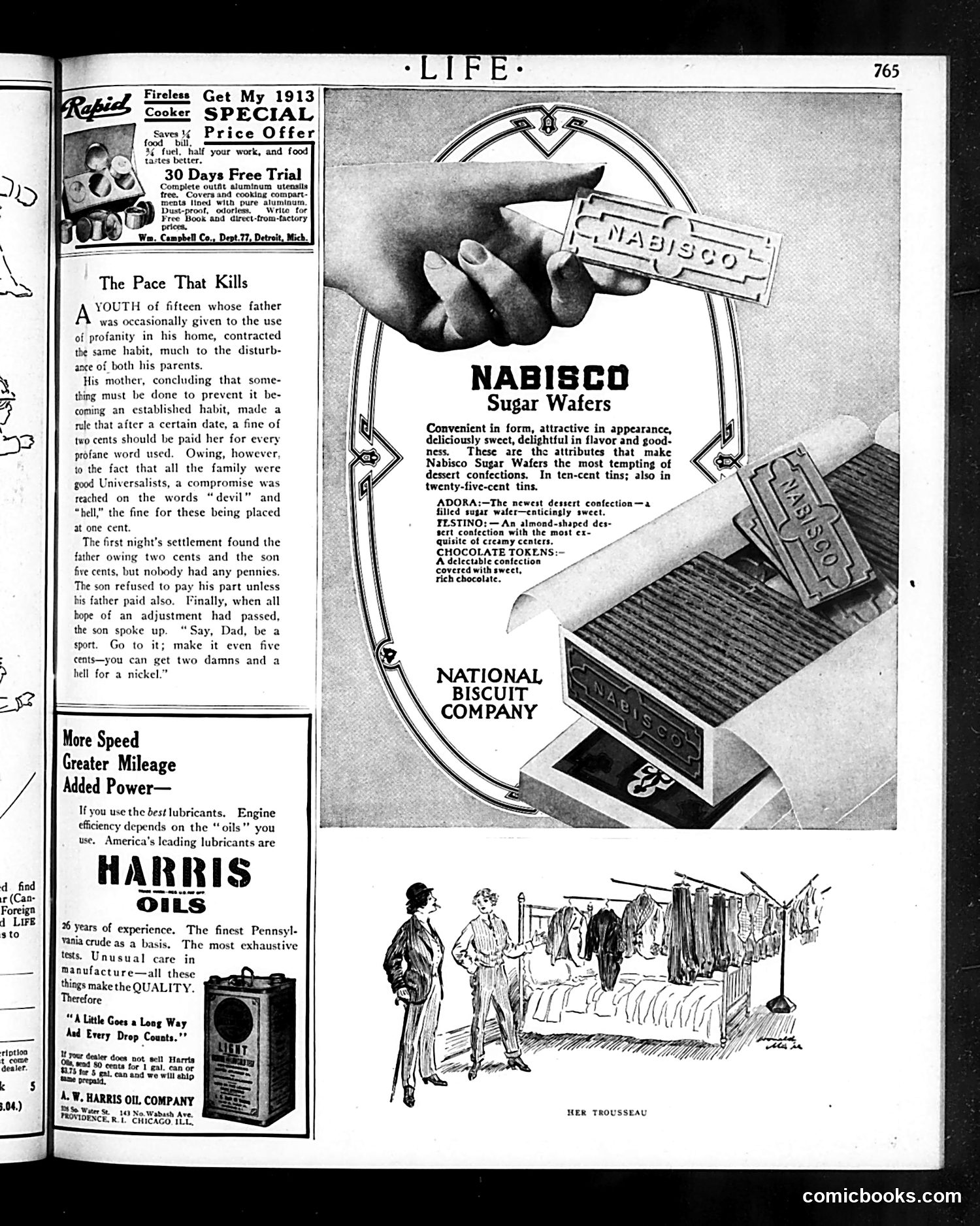
This LIFE magazine page (765) is primarily **advertising-heavy**, dominated by product promotions rather than satirical content. The main cartoon, titled "HER TROUSSEAU," depicts a couple observing laundry hanging on a clothesline—likely illustrating domestic life and marriage preparations. The modest, domestic subject matter reflects early 20th-century gender roles. The page features ads for: - **Napisco Sugar Wafers** (National Biscuit Company) - **Harris Oils** (lubricants for engines) - **Fireless Cooker** (a 30-day trial offer) The article "The Pace That Kills" discusses a youth contracting profanity from his father, presenting a moral lesson rather than political satire. This appears to be a typical magazine page blending light domestic humor with commercial advertising typical of the era.
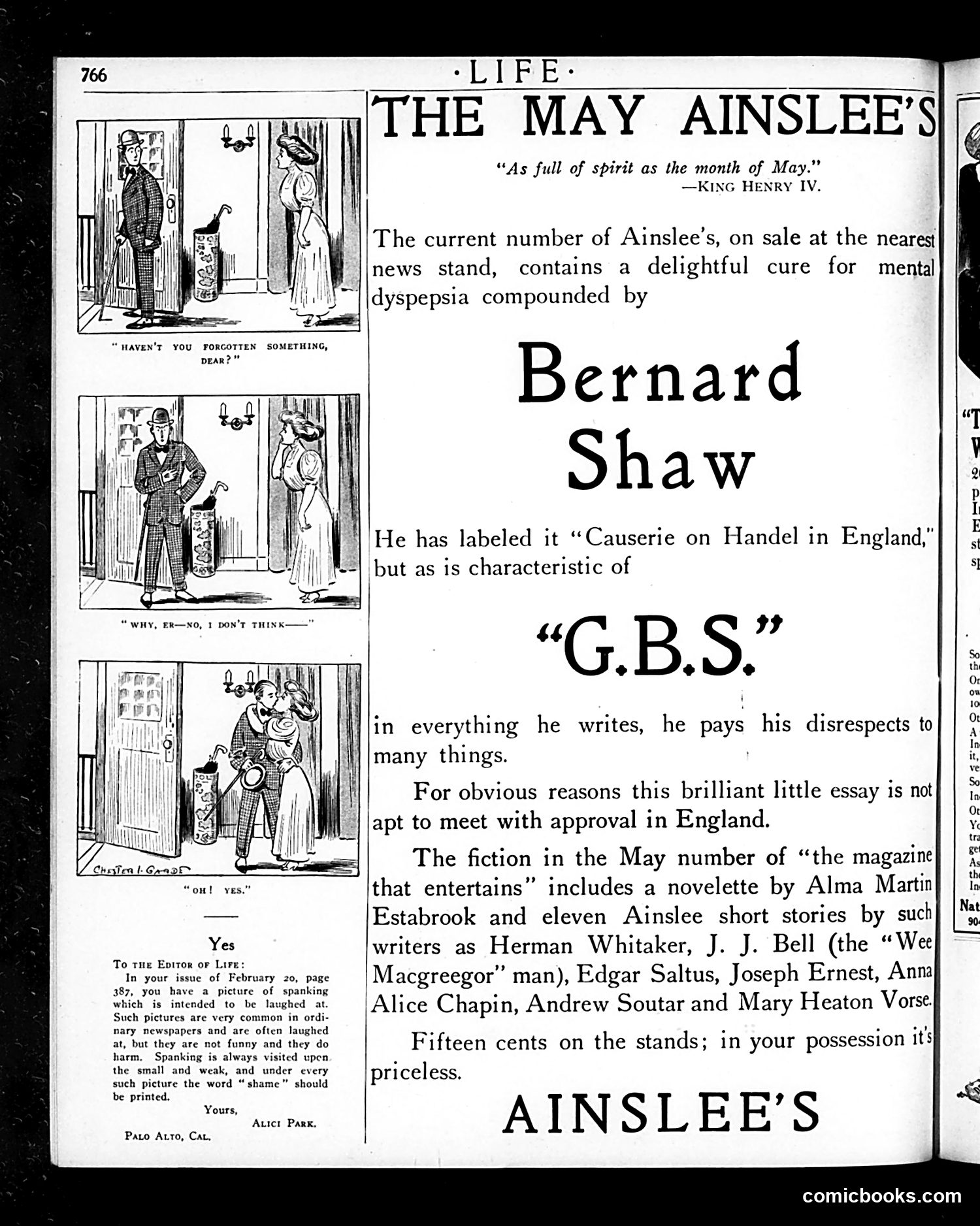
This page is primarily **advertising for Ainslee's Magazine**, not a political cartoon. The three small comic strips on the left illustrate a domestic scene where a husband appears to be leaving home, with his wife asking "Haven't you forgotten something, dear?" He responds "Why, er—no, I don't think—" and finally says "Oh! Yes." The humor is a genteel marital joke: the wife is reminding her forgetful husband of something (likely a kiss or affectionate goodbye), playing on early 20th-century domestic stereotypes about absent-minded husbands. The main text promotes Bernard Shaw's essay "G.B.S." and other May issue content, noting the essay critiques England—"not apt to meet with approval in England." This is straightforward magazine promotion, not political satire.
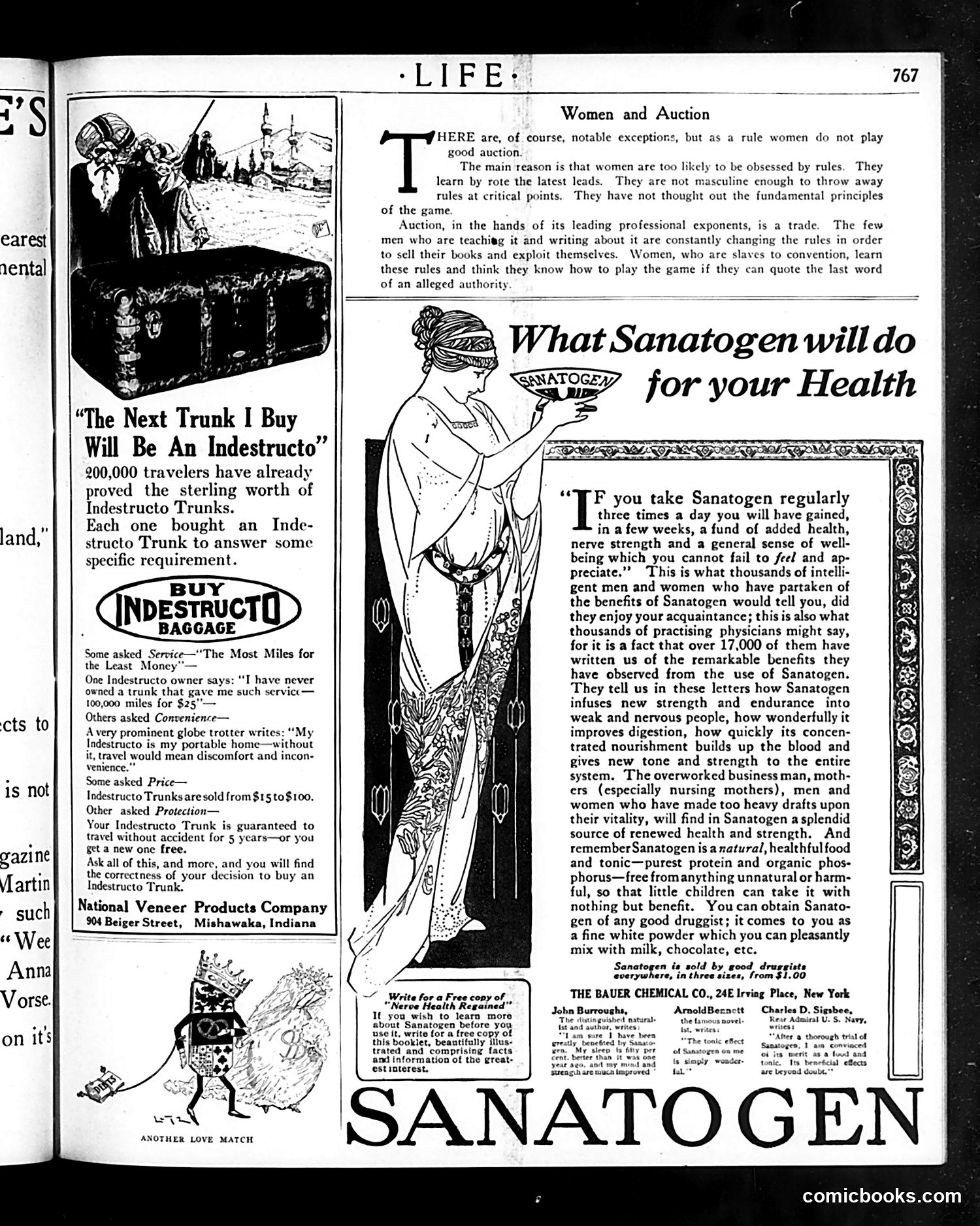
This page contains two distinct elements: **Left side:** An advertisement for Indestructo Baggage/trunks, featuring a traveler with luggage and testimonials about durability and value. **Right side:** A satirical article titled "Women and Auction" critiques women's participation in auction bidding. The text argues women lack understanding of auction rules and strategy, relying instead on convention and quoting "authority." It presents this as a gendered limitation—men who auction professionally understand it as a "trade," while women are "slaves to convention." **Below:** A full-page advertisement for Sanatogen, a health supplement marketed to women, nursing mothers, and the overworked, claiming to restore strength and vitality. The ad features testimonials from medical professionals endorsing its benefits. The satire and product ads reflect early 20th-century assumptions about women's competence and vulnerability to health marketing.
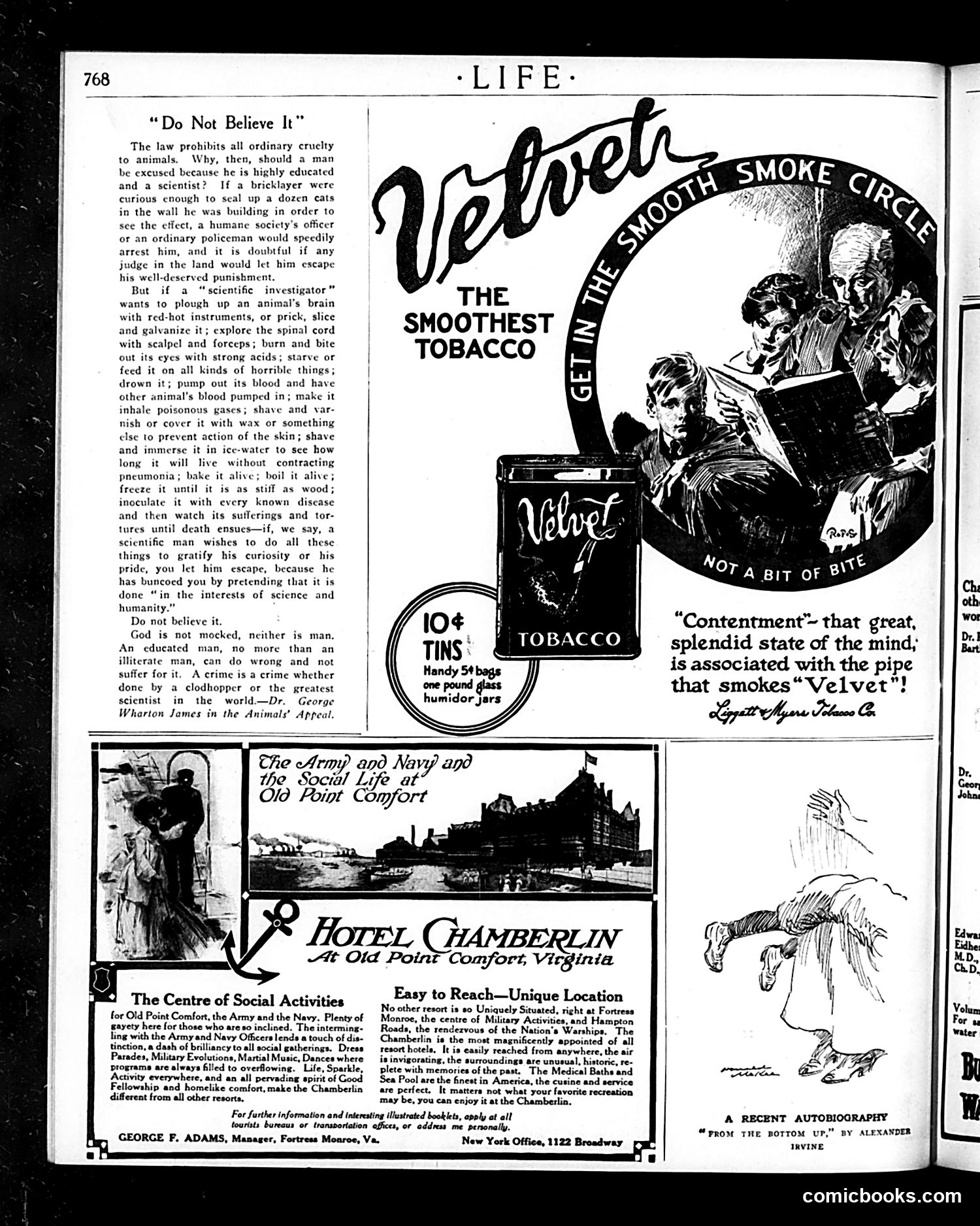
This page contains a **satirical article titled "Do Not Believe It"** alongside tobacco advertising. The article, attributed to Dr. George Wharton James in *The Animals' Appeal*, mocks the notion that animal cruelty can be justified through "scientific investigation." The piece sarcastically catalogs horrific experiments (burning, scalping, poisoning animals) supposedly done in science's name, then declares such cruelty unjustifiable regardless of educational pretense. The irony is sharp: the page simultaneously runs a **Velvet Tobacco advertisement** claiming the product offers "contentment"—a jarring juxtaposition between condemning exploitation and promoting a consumer good. Below is a hotel advertisement. The satire appears to critique both scientific rationalization of harm and commercial messaging's hollow promises.
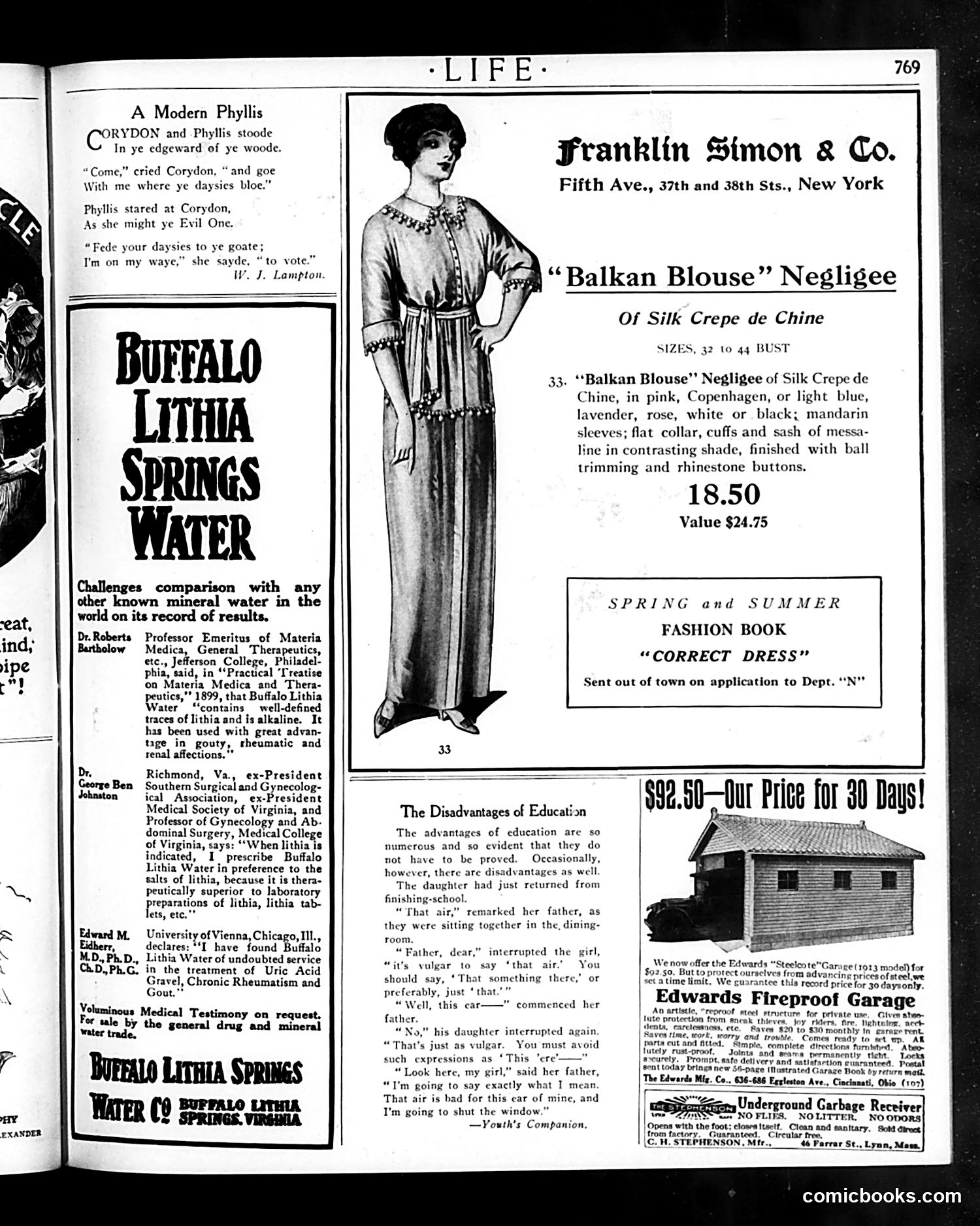
This page is primarily **advertising and fiction**, not political satire. The top features "A Modern Phyllis"—a narrative poem about a woman named Phyllis who rejects her suitor Corydon, telling him she's going to vote instead. This appears to reference women's suffrage (voting rights), a contemporary social issue. The poem's structure mimics classical pastoral literature while updating it with modern feminist concerns. The main advertisements include Buffalo Lithia Springs Water (with medical endorsements) and a "Balkan Blouse" negligee from Franklin Simon & Co. A short story excerpt titled "The Disadvantages of Education" occupies the lower section, along with ads for garages and underground receivers. The page reflects early 20th-century consumer culture and emerging discussions about women's roles.
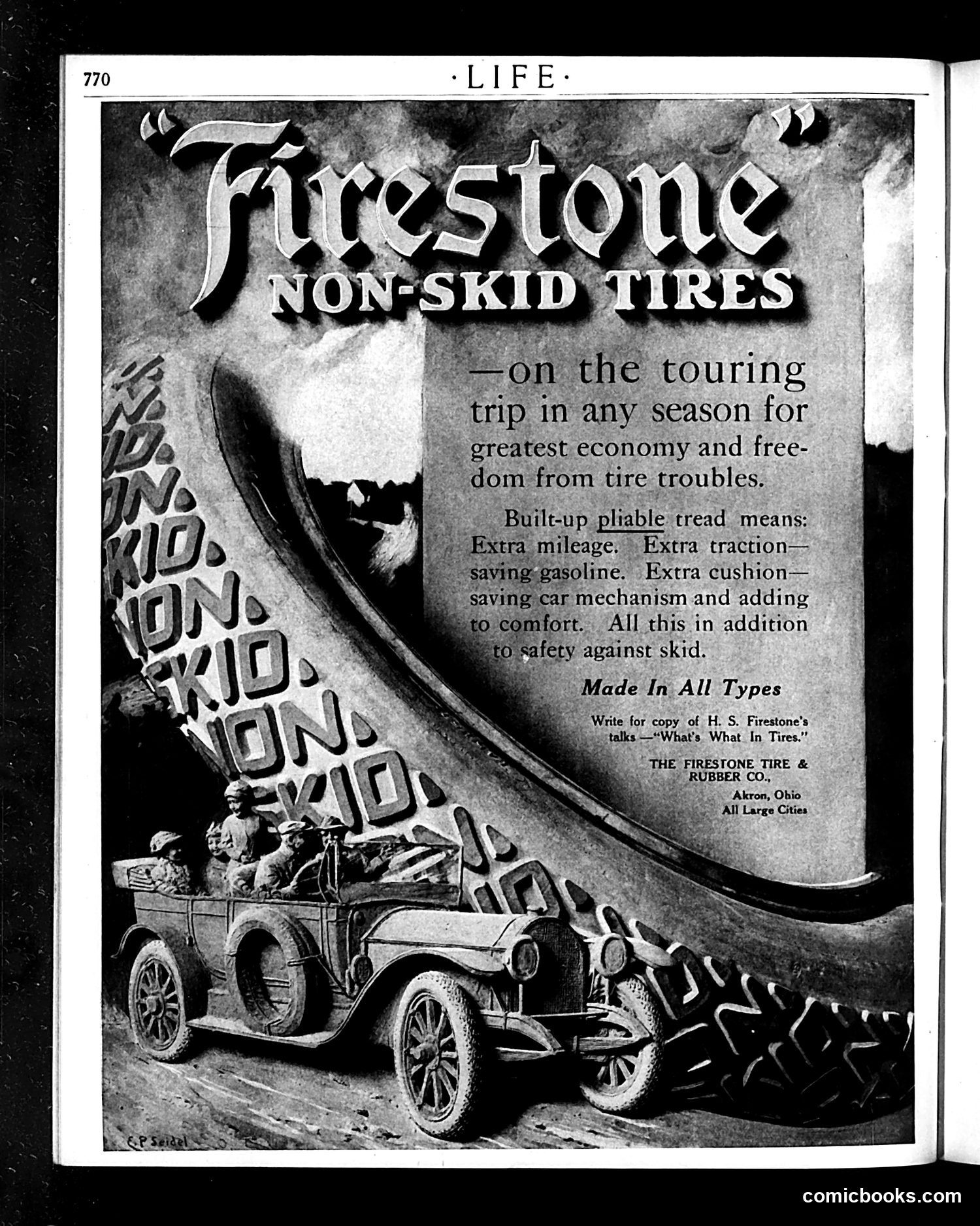
This is a **Firestone Tire advertisement**, not political satire. The page shows a vintage car driving beneath an enormous tire, with text emphasizing Firestone's "Non-Skid Tires." The ad's appeal is practical rather than satirical: it promises "extra mileage," "extra traction," and "safety against skid" for touring trips. The dramatic visual—an oversized tire looming above the vehicle—is meant to convey the product's importance and reliability. The company name and location (Akron, Ohio) appear at bottom, along with an offer to write for H.S. Firestone's educational talks titled "What's What in Tires." This represents early automotive advertising targeting leisure travelers, when tire quality was a genuine safety concern for motorists.
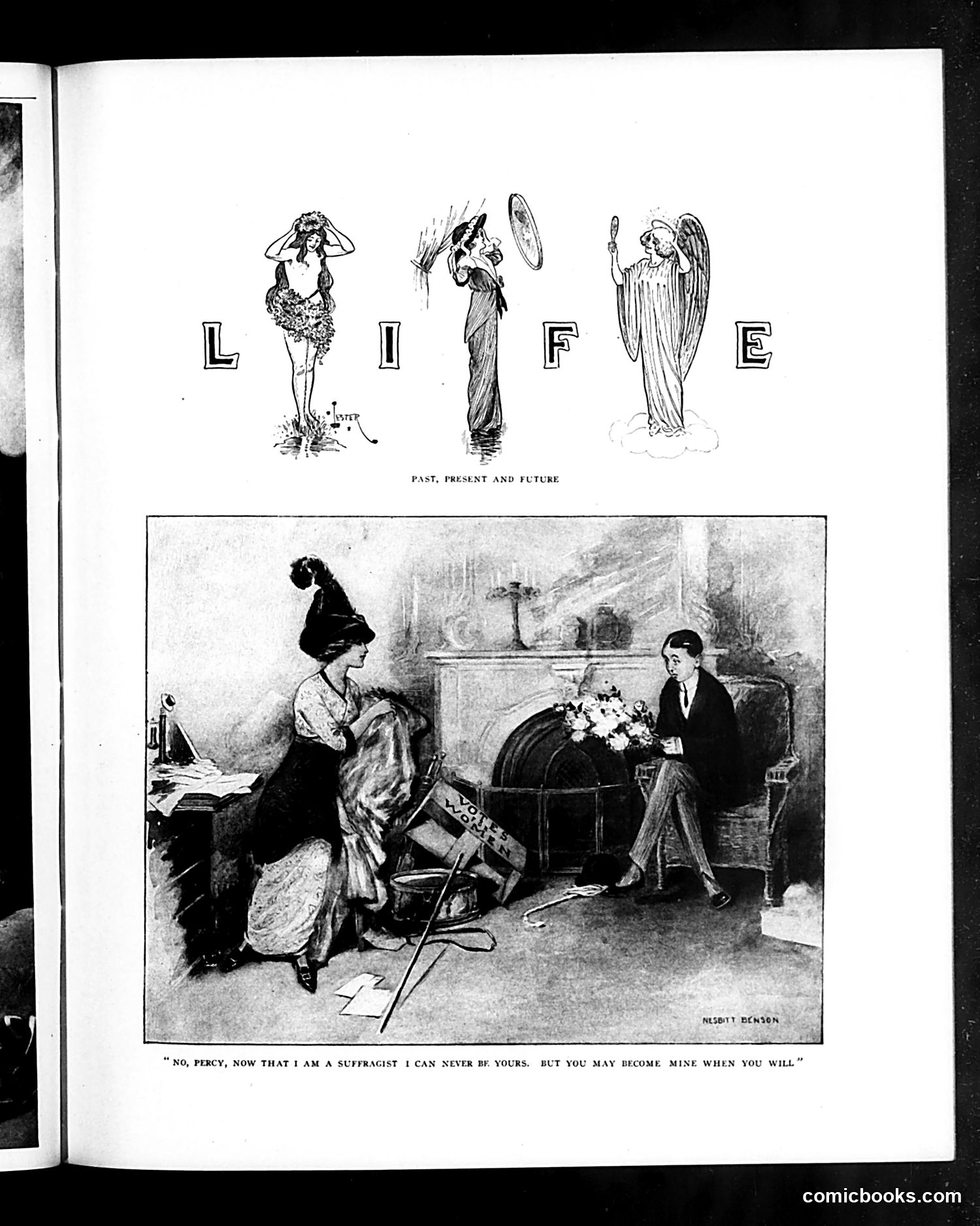
**Title and Theme:** "LIFE: Past, Present and Future" — illustrated by three figures representing life stages (a young woman, a middle-aged person, and an angel). **Main Cartoon:** The illustration depicts a conversation between two women in what appears to be a domestic setting. One woman, seated and wearing fashionable clothing, tells a man (labeled "Percy"): "No, Percy, now that I am a suffragist I can never be yours. But you may become mine when you will." **Satirical Point:** This cartoon mocks women's suffrage activism by suggesting that female suffragists would demand control over men in romantic relationships. The joke plays on anxieties about women's independence and power-seeking, portraying suffragism as threatening traditional male dominance in courtship and marriage.
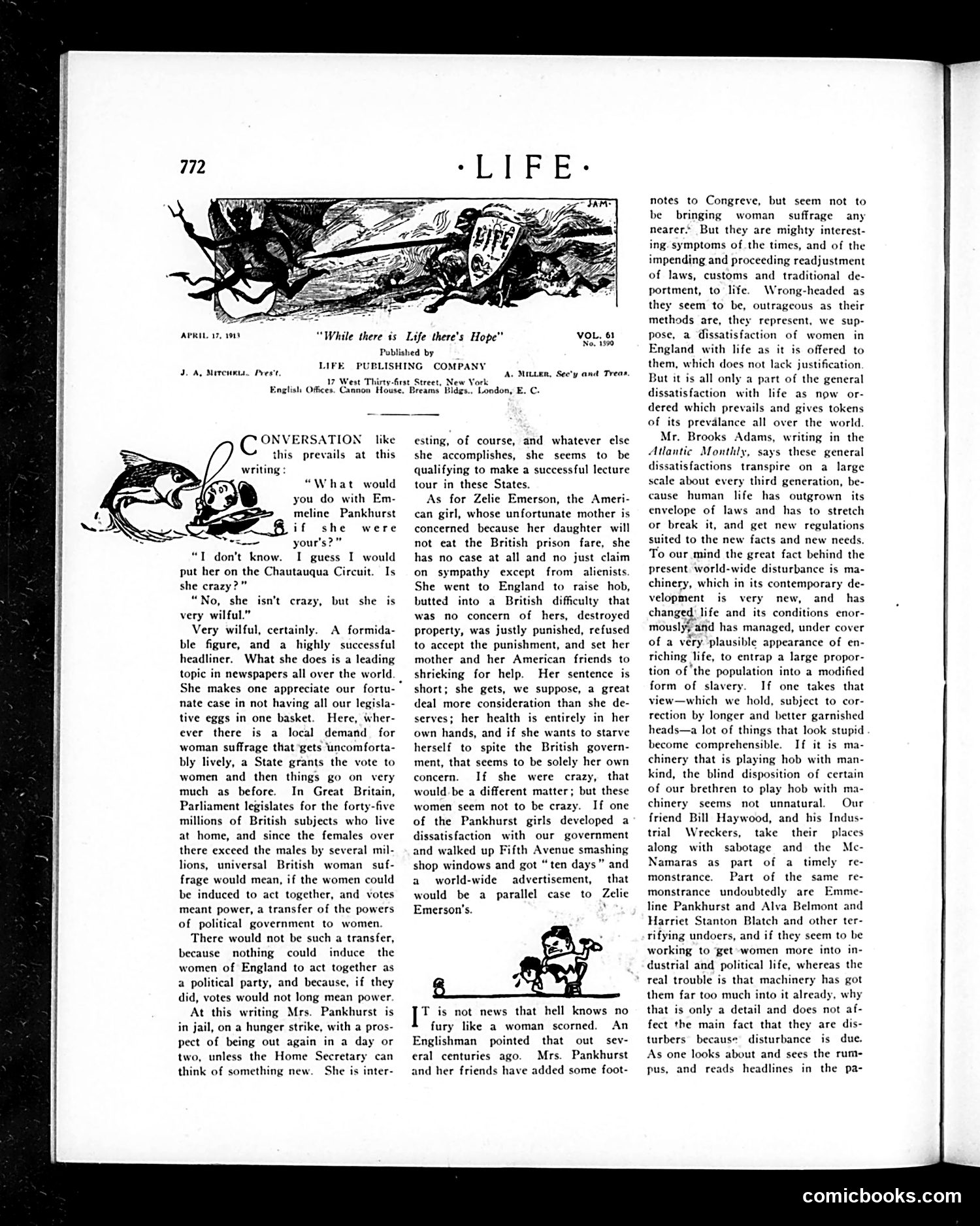
The page features a satirical article addressing women's suffrage and political activism. The main text discusses **Emmeline Pankhurst**, the British suffragist leader, who is at that moment imprisoned in jail on a hunger strike—a tactic mentioned as imminent in the article. The opening illustration ("While there is Life there's Hope") depicts a classical female allegorical figure, likely representing either Liberty or Life itself. The article's central "Conversation" section debates whether giving women the vote would be revolutionary. The author argues that contrary to fears, women's suffrage wouldn't fundamentally destabilize British political institutions, though it would represent a significant democratic expansion. The satire critiques both anti-suffrage fears as exaggerated and some militant suffragists' methods as counterproductive to their cause.
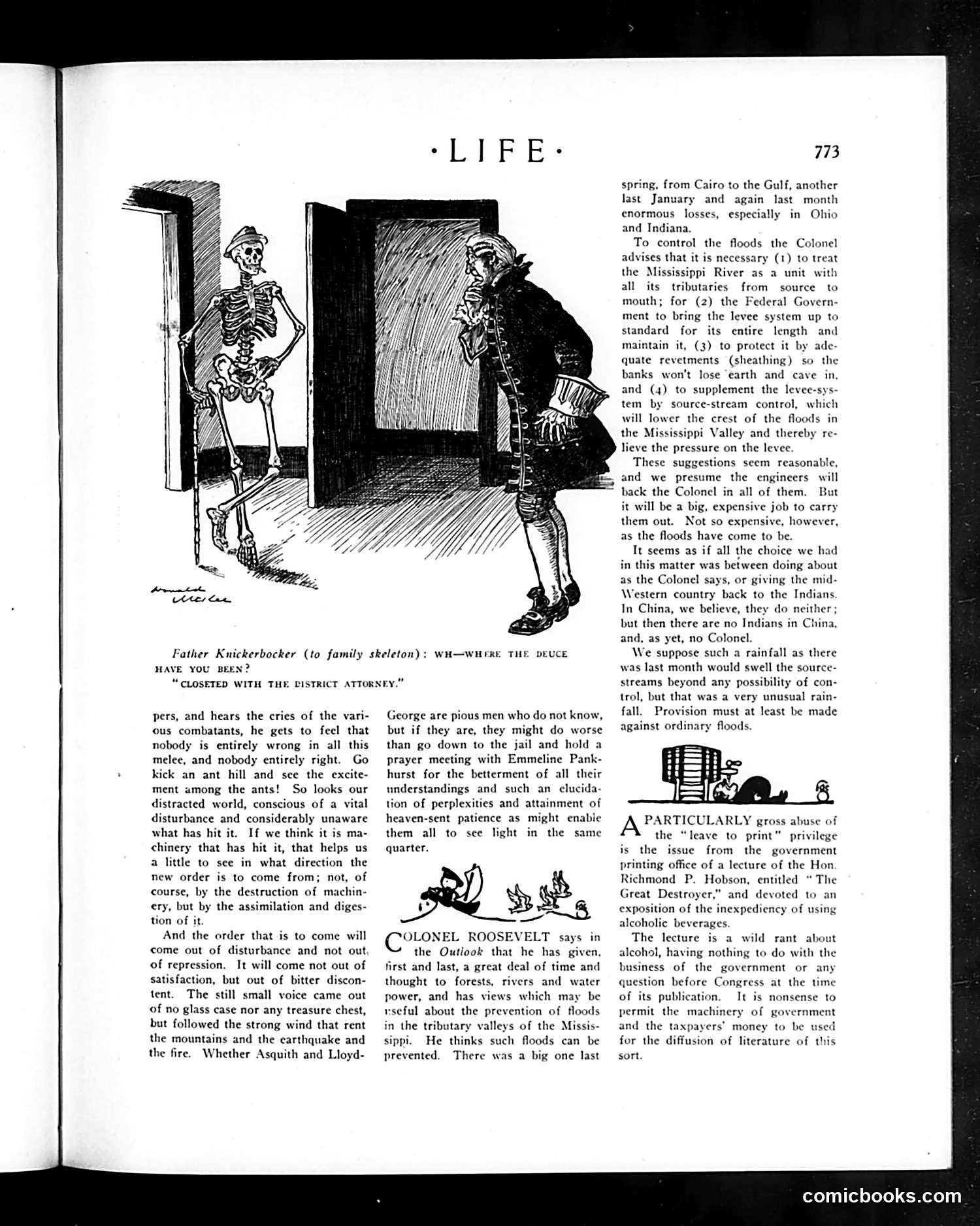
The cartoon depicts **Father Knickerbocker** (a personification of New York City, shown as a skeleton) confronting a military officer labeled as representing the district attorney. The caption reads: "WHERE THE DEUCE HAVE YOU CLOSETED WITH THE DISTRICT ATTORNEY?" The joke appears to satirize government corruption or backroom political dealings in New York City. Father Knickerbocker—traditionally a symbol of New York—is portrayed as skeletal and dying, suggesting the city is being weakened or destroyed by secret collusions between military/official figures and legal authorities. The accompanying article discusses Colonel Roosevelt's flood-control proposals for the Mississippi River, mixing this serious policy content with the cartoon's commentary on municipal misgovernment and institutional failure.
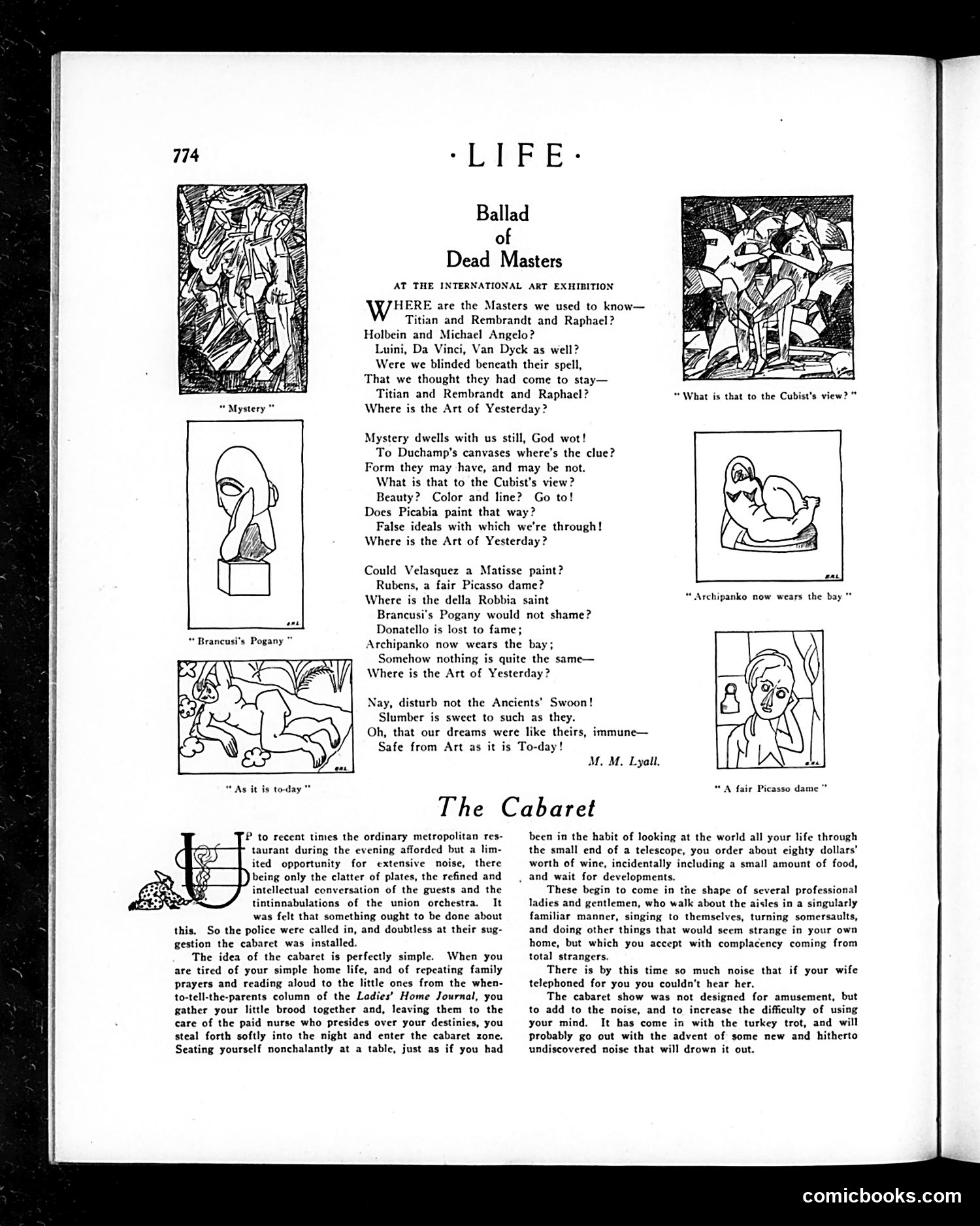
This page satirizes early 20th-century modernist art and nightlife culture. **"Ballad of Dead Masters"** mocks the International Art Exhibition's obsession with avant-garde movements. The poem by M.M. Lyall questions whether famous old masters (Titan, Rembrandt, Raphael, da Vinci) would recognize modern art. References to Cubism, Picasso, Matisse, and Brancusi suggest these contemporary artists represent a radical break from tradition. The ballad's refrain "Where is the Art of Yesterday?" expresses nostalgia and bewilderment at modernism's dominance. **"The Cabaret"** describes the noisy, chaotic atmosphere of urban entertainment venues—an escape for urbanites seeking relief from ordinary domestic life, though the noise and strangers make it an acquired taste. Both pieces reflect tension between traditional and modern aesthetics in 1910s-era culture.
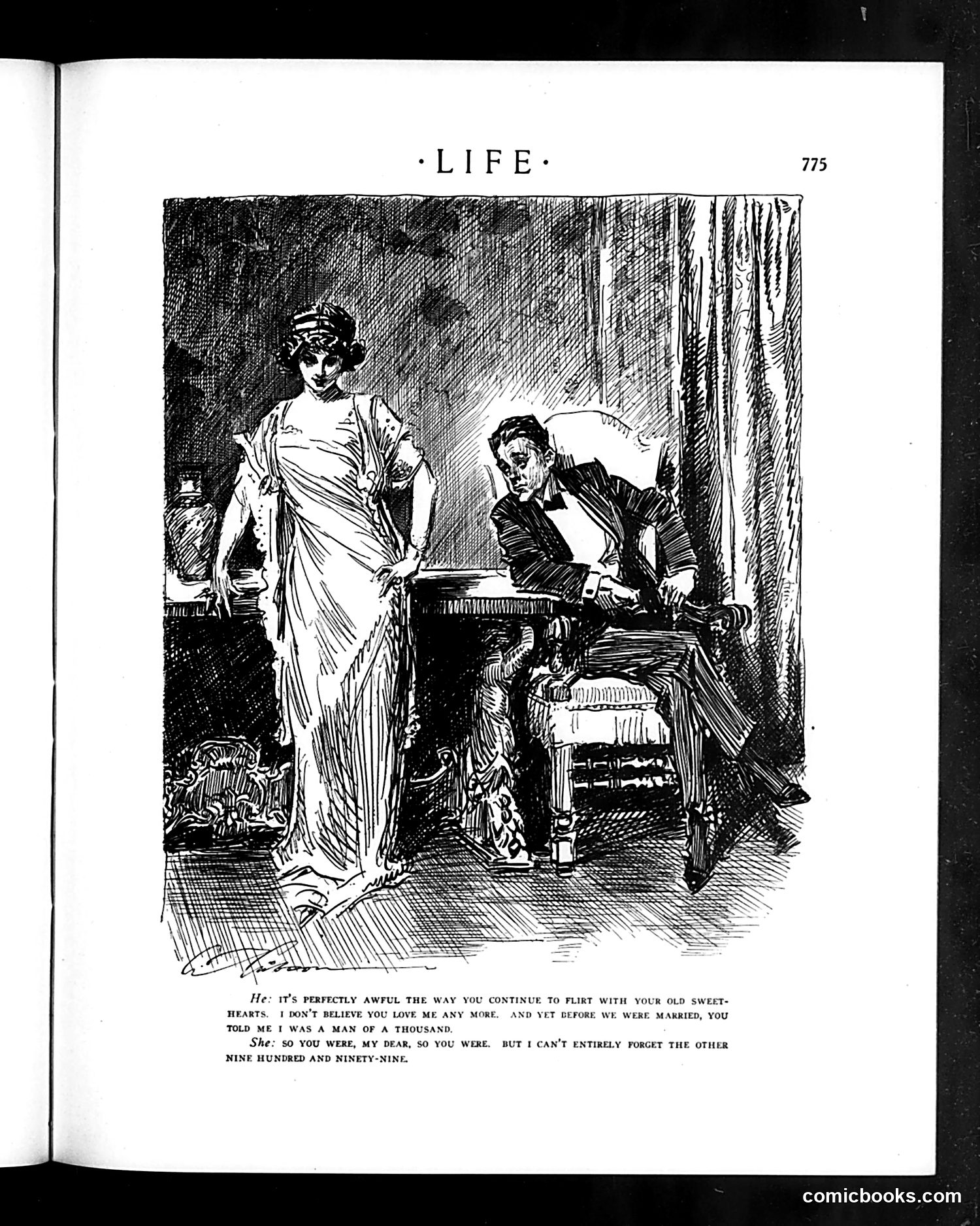
This is a domestic humor illustration depicting a marital quarrel. A man accuses his wife of flirting with former sweethearts, claiming she no longer loves him despite having called him "a man of a thousand" before marriage. The wife's response contains the joke's punch line: she admits he *was* such a man—but she can't forget the other 999 men she knew. The satire mocks both parties: the husband's wounded vanity about his supposed uniqueness, and the wife's implied promiscuity before marriage. This reflects early-20th-century humor about marriage disillusionment and gender relations, where women's romantic pasts were fair game for ridicule. The sophisticated line-drawing style and witty dialogue are characteristic of Life magazine's satirical approach to middle-class domestic life.
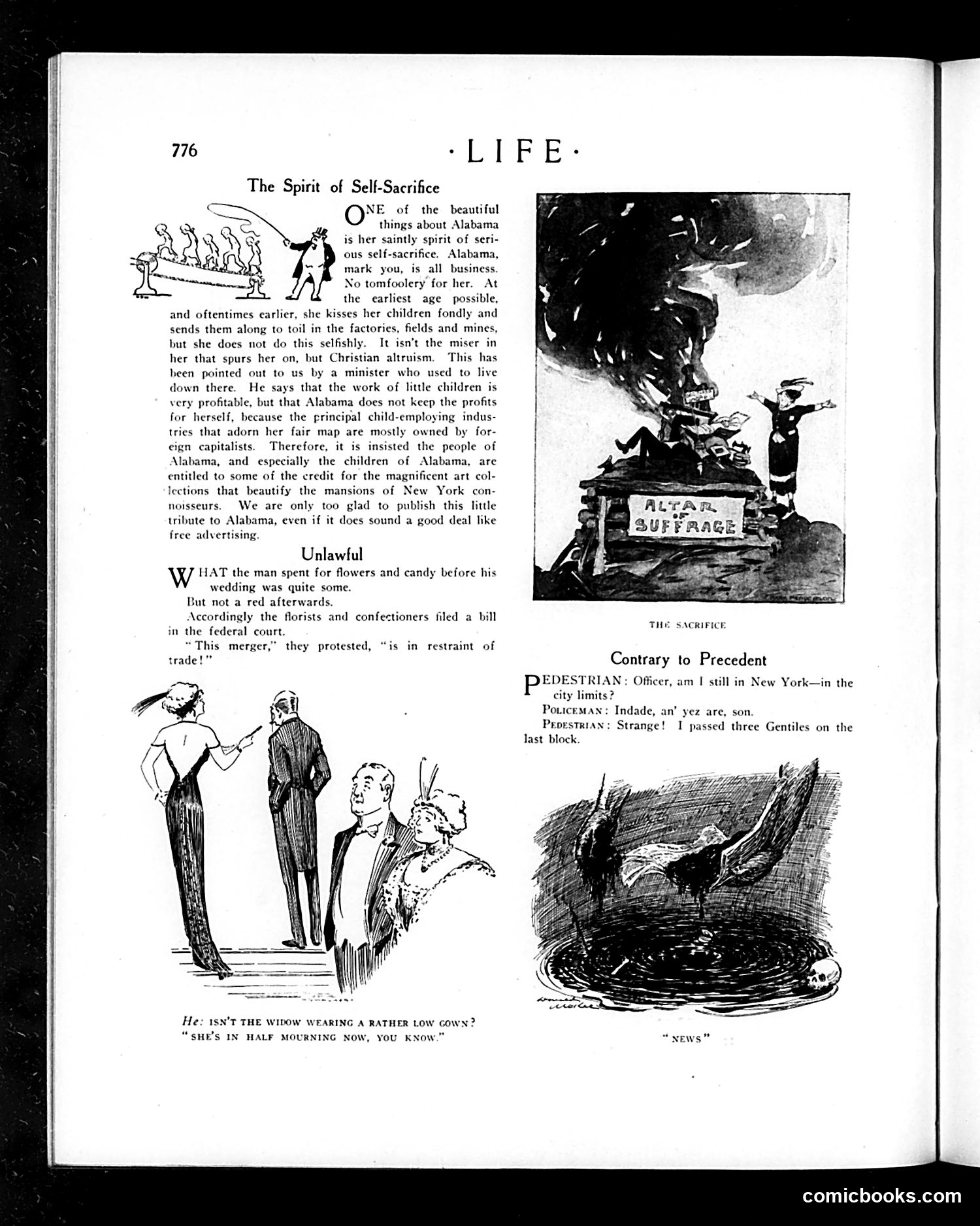
**"The Spirit of Self-Sacrifice"** mocks Alabama's exploitation of child labor. The text sarcastically praises the state's "Christian altruism" in sending children to factories and mines, then reveals the joke: Alabama doesn't profit because foreign capitalists own these industries. The satire cuts both ways—condemning child labor while ridiculing how wealth extracted from poor workers enriches New York elites' art collections. **"Unlawful"** jokes about florists and confectioners suing over a "merger"—a groom who spent lavishly before marriage but nothing after, treating matrimony as a hostile business takeover that eliminates their customer. **"Contrary to Precedent"** presents a crude ethnic joke: a pedestrian asks a policeman if he's still in New York, surprised to see three "Gentiles" (non-Jews), implying New York's Lower East Side was predominantly Jewish immigrant. The "joke" relies on stereotyping neighborhood demographics.
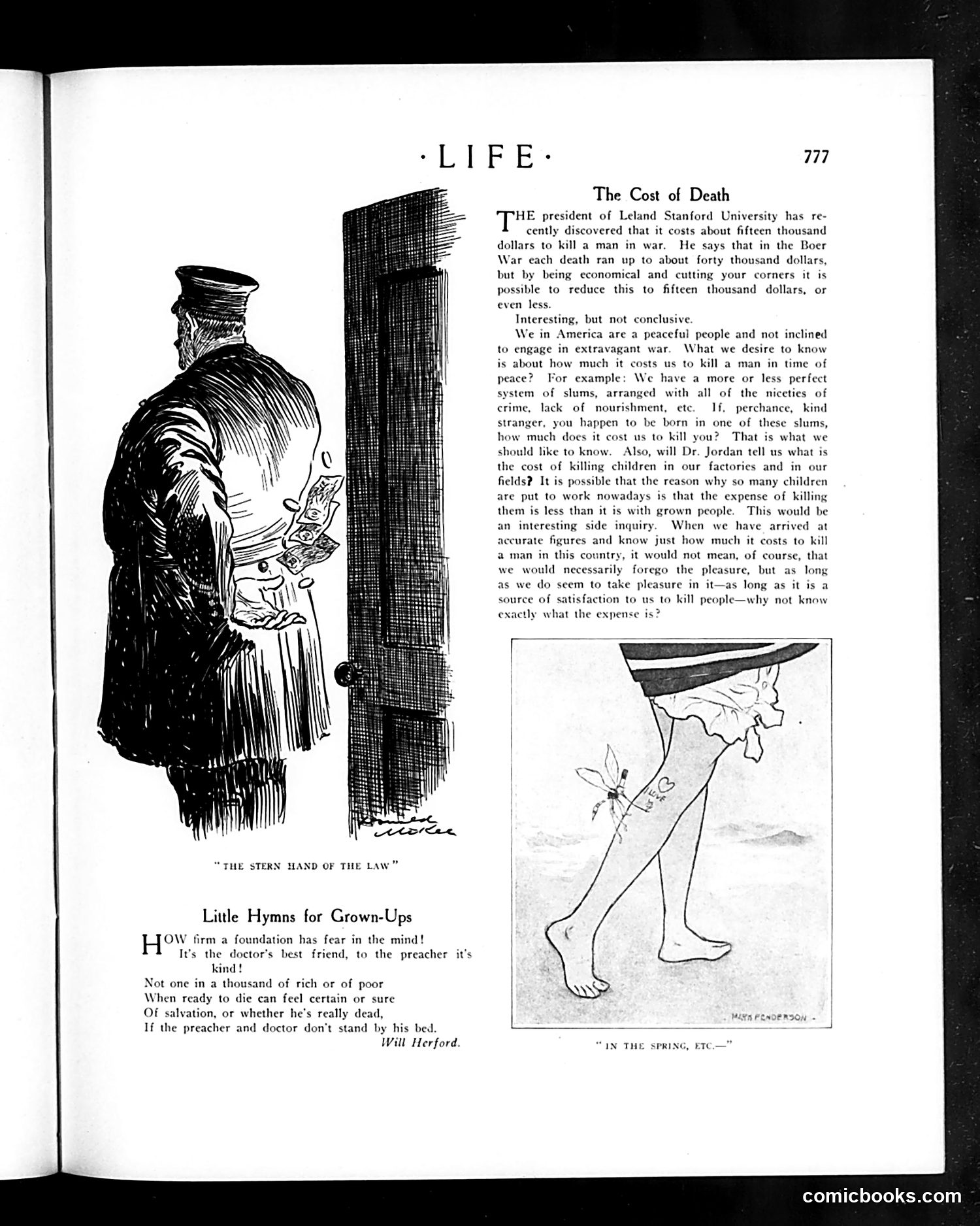
**Main Article: "The Cost of Death"** This satirical piece critiques the Stanford University president's calculation that war kills cost $15,000 per death. The author pivots sharply to expose American hypocrisy: while condemning war's expense, America cheaply kills its own poor through systemic neglect—slums, malnutrition, child factory labor. The bitter irony suggests these domestic deaths are even more economical than battlefield ones, yet receive no moral outcry. **Left Cartoon: "The Stern Hand of the Law"** A police officer or judge figure stands beside a prison tower, holding money. This likely represents judicial/law enforcement corruption or the financial machinery of the justice system exploiting the poor. **Right Cartoon: "In the Spring, Etc."** A barefoot, impoverished child in tattered clothing. Paired with the main article's discussion of child labor deaths, this visualizes the human cost of industrial exploitation. **Overall message:** American society condemns foreign war deaths while ignoring—even profiting from—the preventable deaths of its poorest citizens.
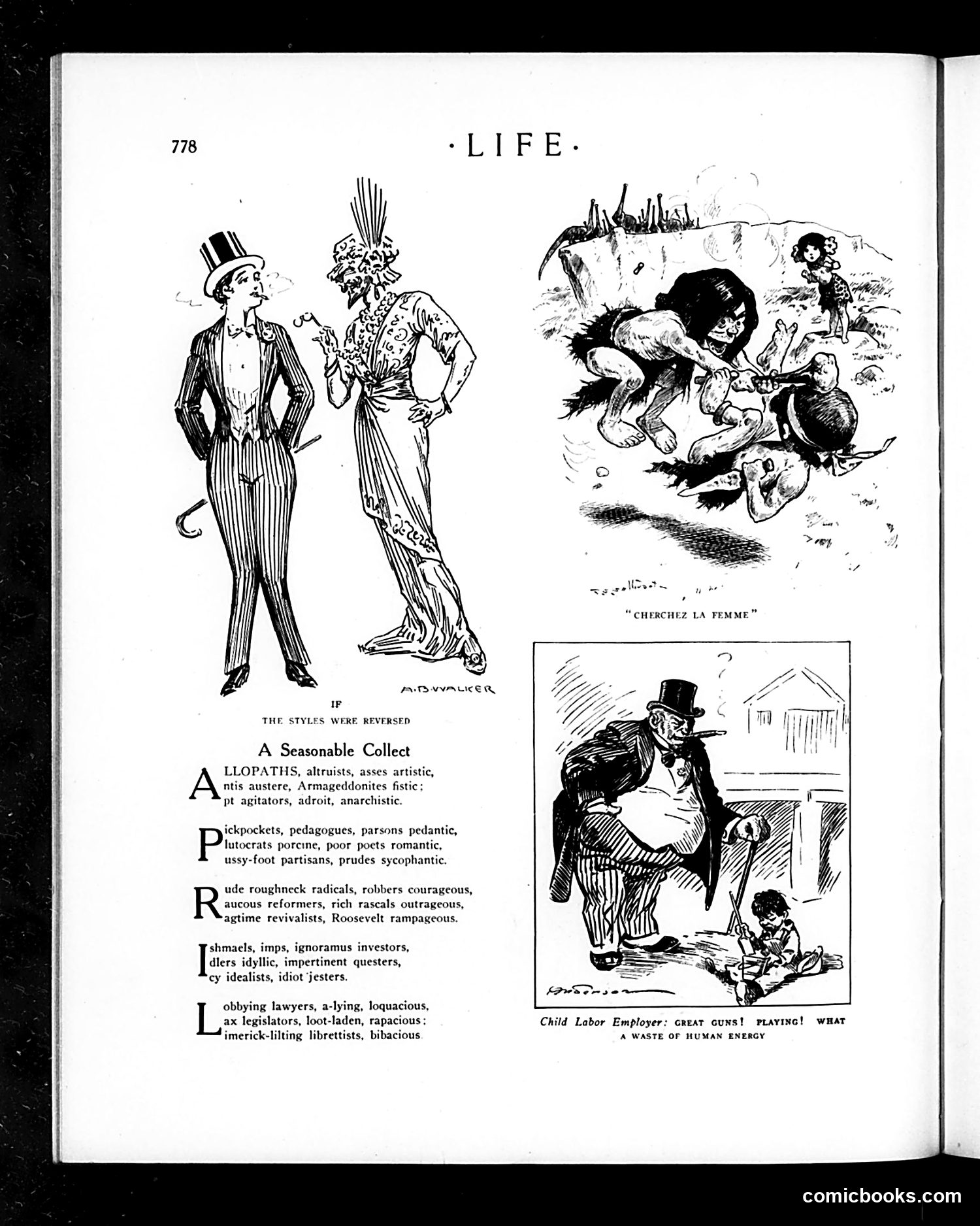
**Top Left ("The Styles Were Reversed"):** Two fashionable figures illustrate gender role reversal—the man wears a top hat and monocle while adopting a feminine pose; the woman stands in masculine posture wearing an ornate gown. This mocks contemporary anxieties about changing gender norms, likely referencing the early 20th-century "New Woman" movement and women's suffrage activism. **Top Right ("Cherchez la Femme"):** A chaotic scene of children playing violently appears to depict street urchins or working-class youth engaged in rough play. **Bottom ("Child Labor Employer"):** A well-dressed man with a cigar instructs children to play with guns, calling it "a waste of human energy." This savage satire criticizes child labor exploitation and military militarism—the employer profits from children's labor while treating their potential for play/development as expendable. **"Seasonable Collect":** This acrostic poem satirizes various social types and political figures contemporary to the publication, mocking reformers, radicals, politicians, and lawyers indiscriminately.
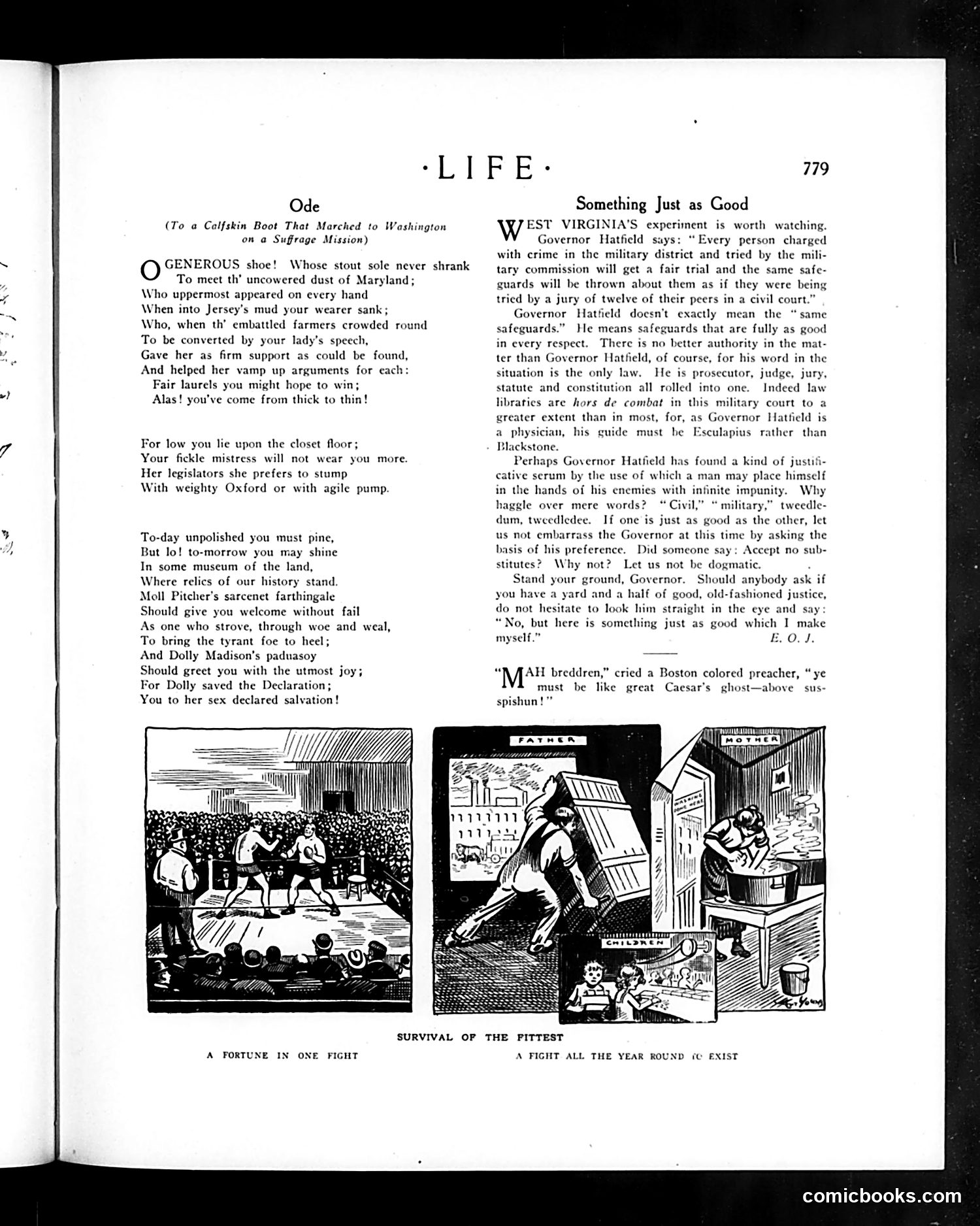
This page satirizes women's suffrage activism through two distinct pieces: **"Ode to a Calfskin Boot"** mocks a suffragette's worn shoe that marched in Washington demonstrations. The poem humorously elevates this humble boot to historical artifact status, comparing it to relics like Dolly Madison's clothing. The joke: a woman's shoe—discarded and worthless after the campaign—becomes her only legacy, suggesting the futility of women's political activism. **"Something Just as Good"** critiques West Virginia Governor Hatfield's military court system. The editorial sardonically praises his claim that military trials provide justice "just as good" as civilian courts, despite his serving as prosecutor, judge, and jury simultaneously—an obvious absurdity. The closing anecdote about a Boston preacher's malapropism ("above suspishun") reinforces the mockery of inferior substitutes masquerading as adequate. **The cartoon** titled "Survival of the Fittest" (bottom) appears to illustrate street fighting or boxing—its specific reference unclear without additional context. The page overall ridicules both women's political ambitions and arbitrary government authority.
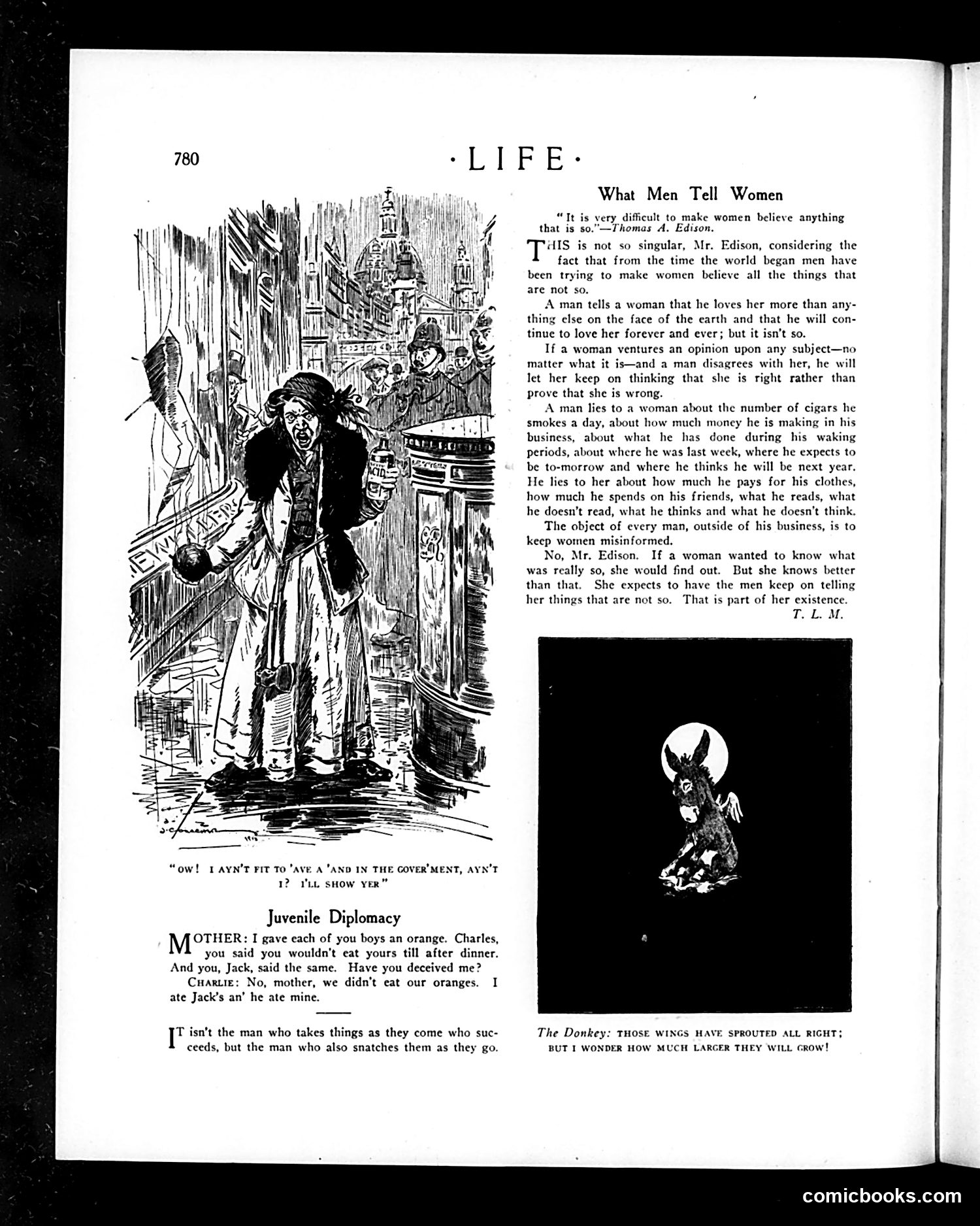
This page satirizes male dishonesty toward women, attributed to Thomas Edison's claim that women find truth difficult to believe. **Main Cartoon**: Shows a man in an urban setting with the caption "ow! I ain't fit to 'ave a 'and in the gover'ment, ain't I? I'll show yer"—likely depicting a working-class man's boastful claims, illustrating the text's theme that men routinely lie about their accomplishments, finances, and activities. **The Satire**: The accompanying essay argues men systematically deceive women—about love, money, smoking habits, spending, and opinions—not because women naively believe lies, but because women *expect* and *accept* this deception as normal relationship dynamics. It's a critique of both male dishonesty and female complicity. **"Juvenile Diplomacy"**: A brief joke where boys cleverly avoid breaking their promise by trading oranges rather than eating their own. **"The Donkey"**: A separate illustration with unclear satirical intent from this context alone. The overall tone is tongue-in-cheek social commentary on gender relations and honesty.
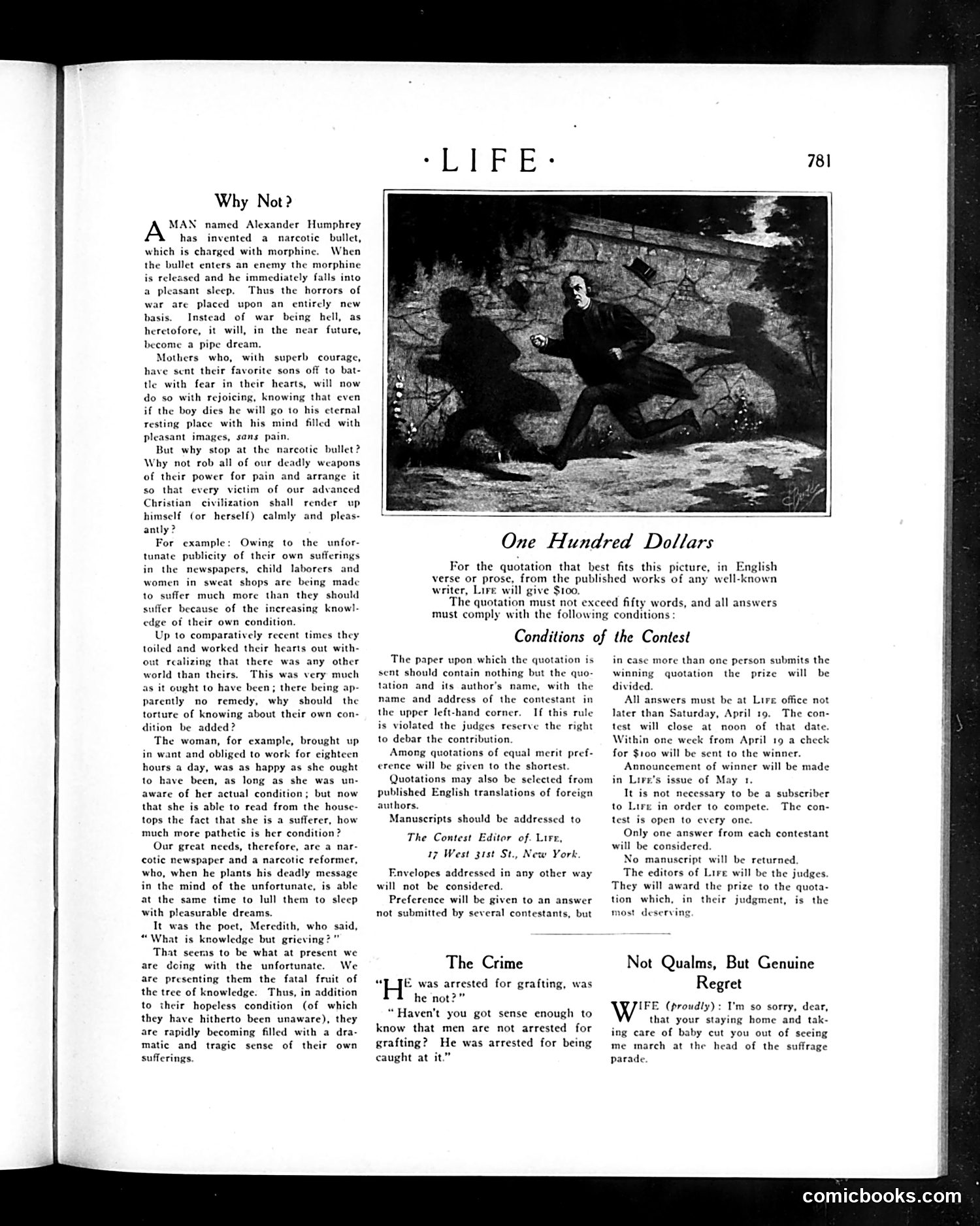
This *Life* magazine page contains satirical social commentary, not a political cartoon. The main essay "Why Not?" uses dark irony to critique complacency about suffering. It proposes Alexander Humphrey's fictional "narcotic bullet"—which puts enemies to sleep rather than killing them—as absurd proof that society should anesthetize the disadvantaged instead of helping them. The author argues that ignorance made child laborers and sweatshop workers "happy," so why burden them with knowledge of their exploitation? By presenting this logic to its logical conclusion, the piece mocks those who oppose reform, suggesting that those who want to maintain the status quo might as well advocate literal narcotics. The photograph captioned "One Hundred Dollars" appears to show people in conversation but lacks clear context. Below, "The Crime" presents a brief joke about arrested grafters (corrupt officials): the punchline is that men aren't punished for *grafting itself*, only for being caught doing it—satirizing institutional corruption's acceptance.
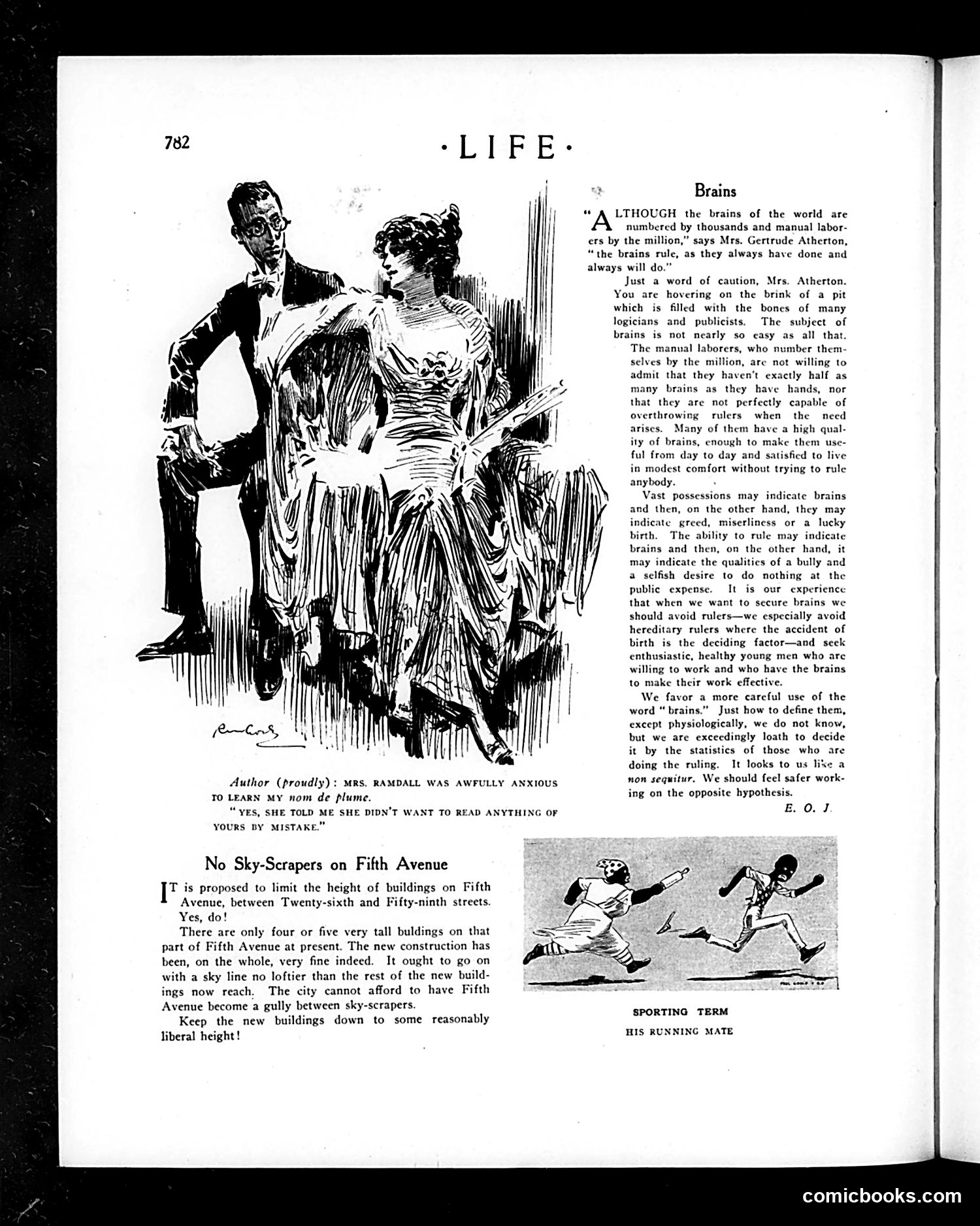
This page contains three separate editorial pieces satirizing early 20th-century American society. **"Brains"** critiques writer Gertrude Atherton's claim that educated elites naturally rule. The accompanying cartoon (by R. Cesare) shows a well-dressed man and fashionable woman, likely representing the upper class making such arguments. The editorial sardonically counters that manual laborers possess adequate intelligence and capacity to overthrow rulers when needed—that wealth and power don't necessarily indicate superior intellect, but may instead reflect greed or inherited advantage. It argues against judging intelligence by who currently holds power. **"No Sky-Scrapers on Fifth Avenue"** advocates limiting building heights on Fifth Avenue (Manhattan's prestigious thoroughfare) to preserve the street's architectural character and prevent it becoming a "gully between sky-scrapers." **"His Running Mate"** (bottom right cartoon) shows two baseball players mid-action, captioned as a sports joke unrelated to the political content above.
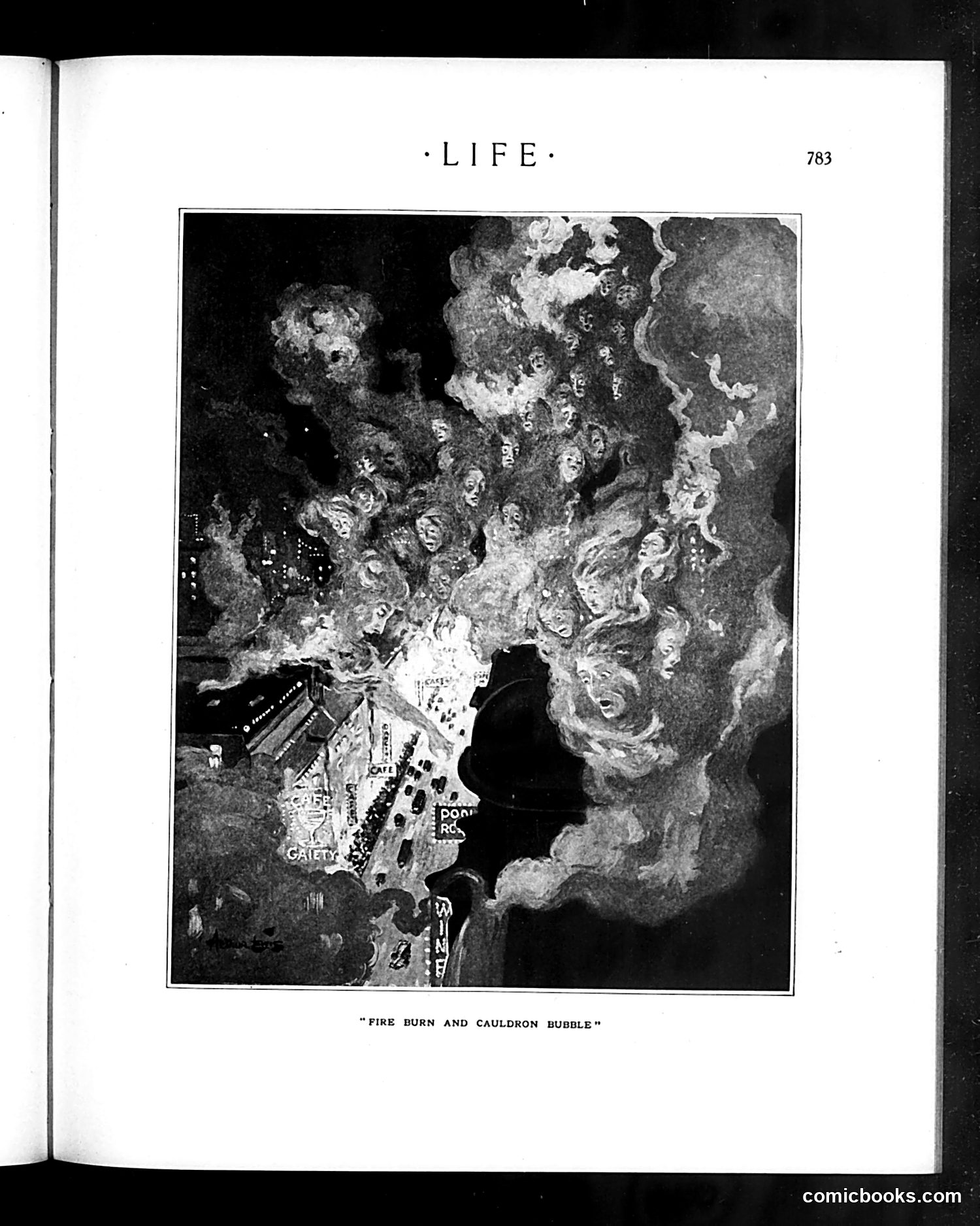
This illustration references Shakespeare's *Macbeth*, specifically the witches' incantation from Act IV. The image depicts a supernatural scene with swirling smoke and numerous faces emerging from flames and vapors around a central cauldron—visualizing the witches' magical brew. The caption's literary allusion suggests this is likely political satire, using the witchcraft imagery to represent some form of conspiratorial scheming or dark plotting. The faces visible in the smoke could represent political figures or social groups, though without additional context from the magazine's date and surrounding articles, I cannot identify specific individuals or determine which political situation is being satirized. The gothic, dramatic style emphasizes the menace or chaos being depicted.
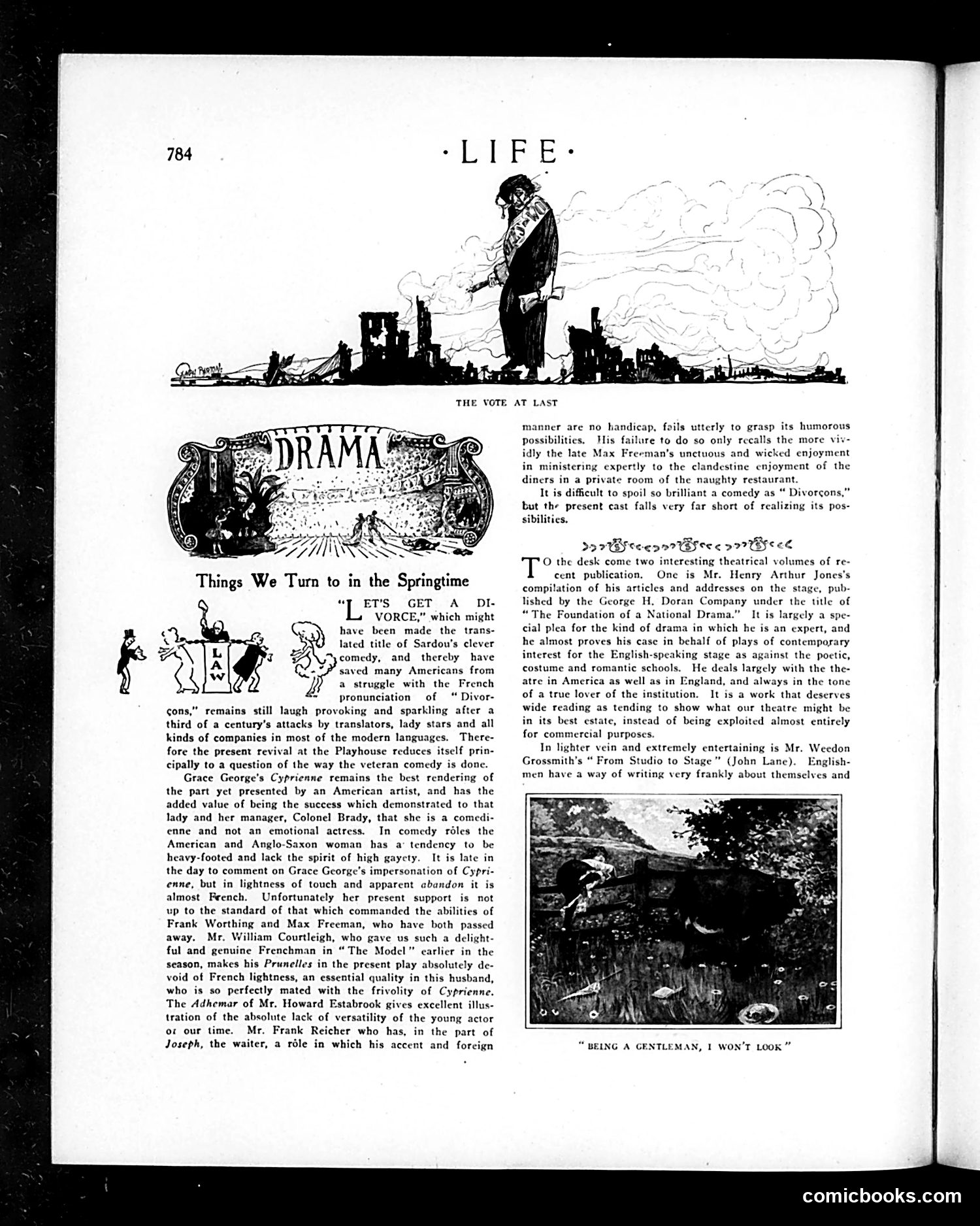
**"The Vote at Last"** (top illustration): This silhouette depicts a large figure casting a ballot over a destroyed industrial landscape—likely referencing women's suffrage. The image suggests the momentous political change represented by women gaining voting rights, shown against ruins symbolizing the upheaval or societal transformation this caused. **"Things We Turn to in the Springtime"**: This section reviews theatrical productions, particularly a revival of the French comedy "Divorçons" ("Let's Get a Divorce"). The critique evaluates the cast's performance, notably praising Grace George's French-style comedic lightness while faulting other actors—particularly William Courtleigh and Frank Reicher—for lacking the requisite sophistication and "French gaiety" the farce demands. The text also briefly mentions two theatrical books by Henry Arthur Jones and Weedon Grossmith about drama and stagecraft. The page reflects early 20th-century American theater culture, where French comedies were popular springtime entertainment, and where performers' ability to capture continental sophistication was a measure of theatrical success.
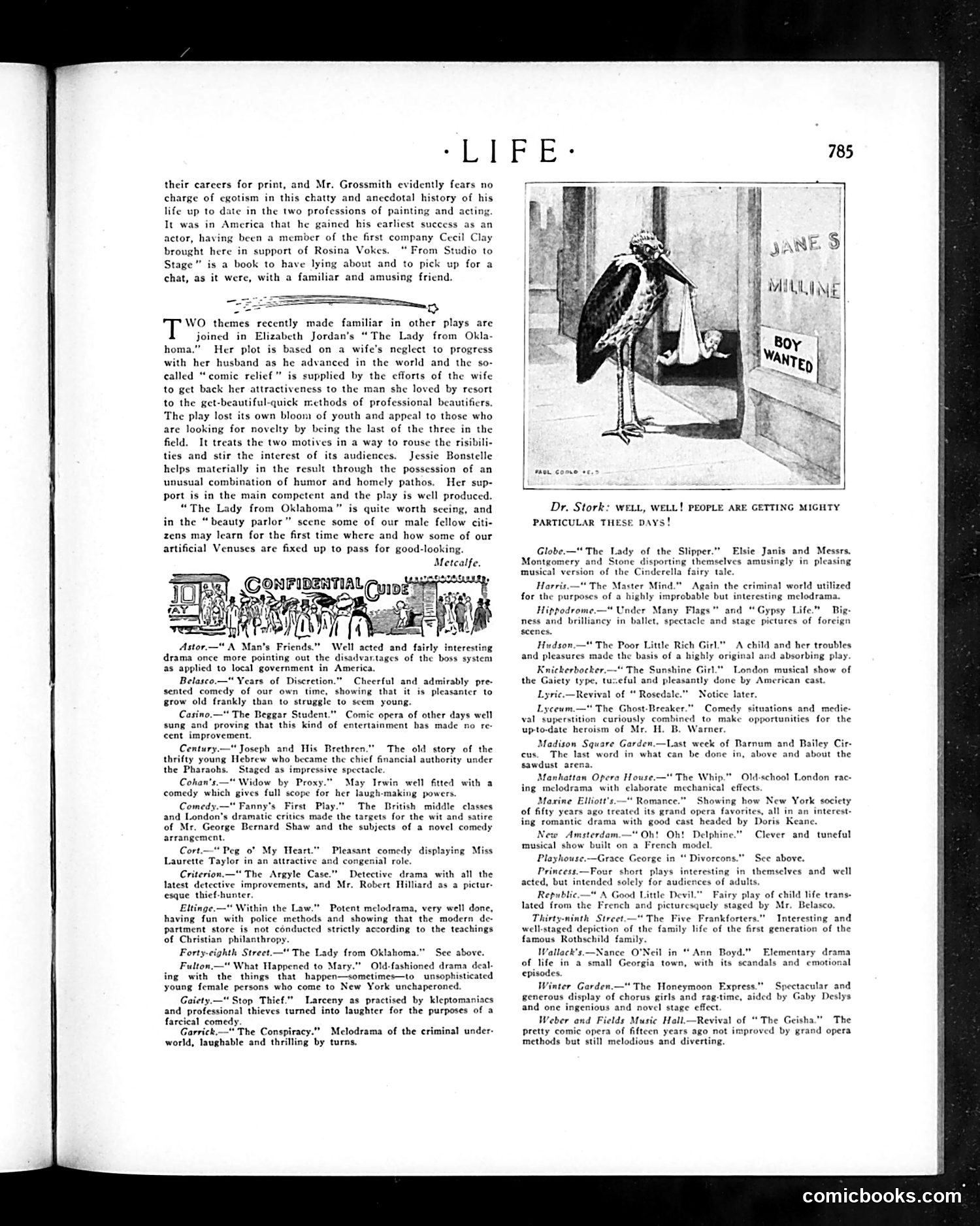
The page is primarily a **theater review section** listing Broadway productions with brief critical assessments. The small cartoon at top right depicts a stork (the "Dr. Stork" caption reference) carrying a baby, with a sign reading "Boy Wanted" and another reading "Jane's Milline[ry]"—likely a visual pun about a business needing help or a woman seeking a child. The reviews cover contemporary plays like "The Lady from Oklahoma" (which receives detailed discussion in the text column), addressing typical early-20th-century theatrical themes: marriage troubles, beauty culture, class conflict, and melodrama. **The satire is social rather than political**: the reviews mock audiences' appetite for sentimental plots and predictable storylines, while the stork cartoon appears to be a lighthearted domestic joke—possibly suggesting a millinery shop owner needs assistance, or playing on period anxieties about unmarried women or childlessness. The page reflects 1910s American theater criticism and popular entertainment priorities.
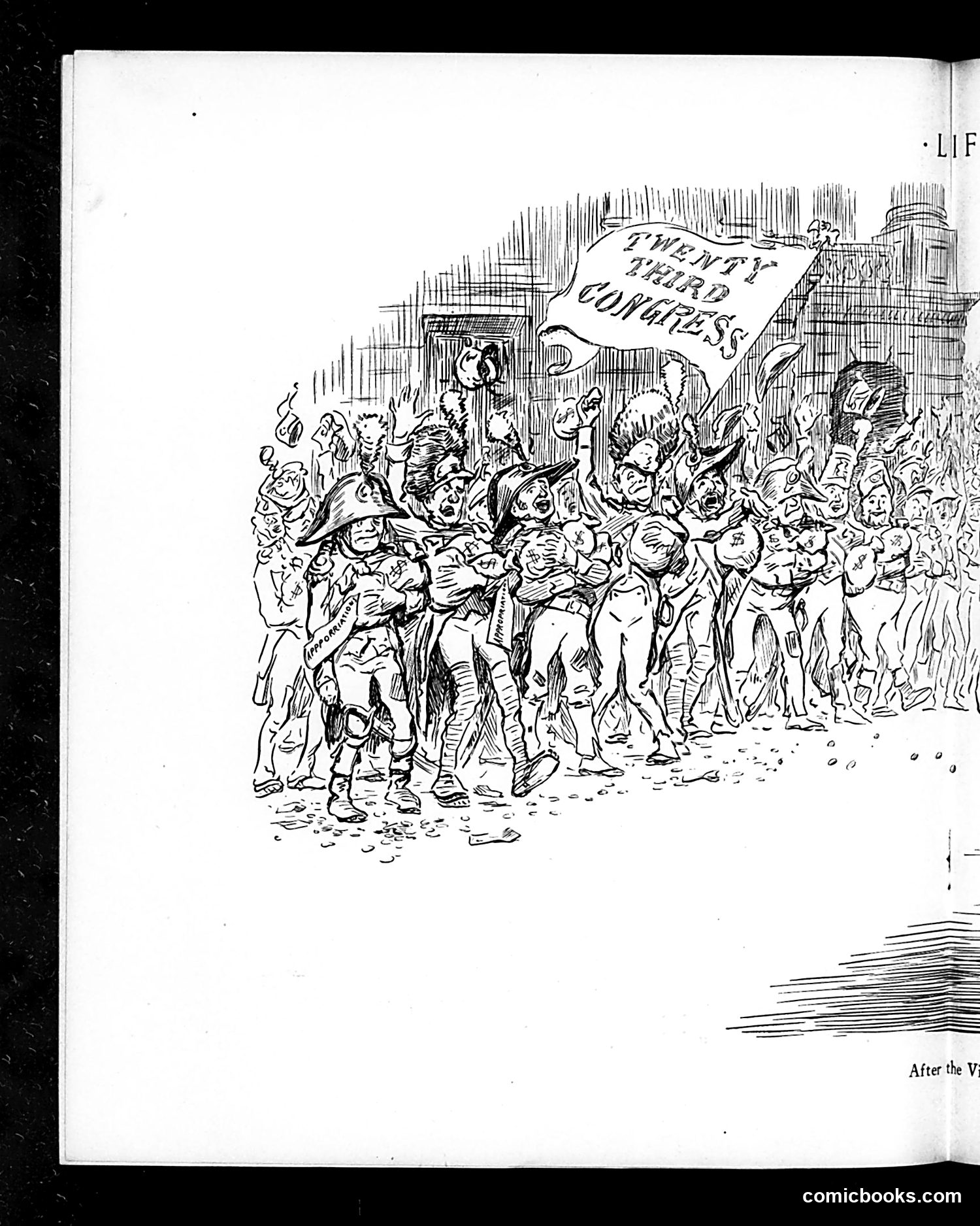
This is a satirical cartoon from *Life* magazine depicting a chaotic street scene with a large crowd of soldiers or military figures marching while carrying a banner reading "TWENTY-THIRD CONGRESS." The image appears to be **political satire about Congressional representation or military involvement in politics**, though the exact historical moment is unclear from the visible text (which is partially cut off with "After the V..."). The crowded, disorderly nature of the procession—with exaggerated expressions and physical comedy in the drawing style—suggests mockery of Congress itself, possibly depicting it as a chaotic mob rather than a dignified governing body. The military dress of the figures may reference **militarism in politics** or a specific historical moment when military concerns dominated Congressional proceedings, but without the full caption, the precise target remains uncertain.
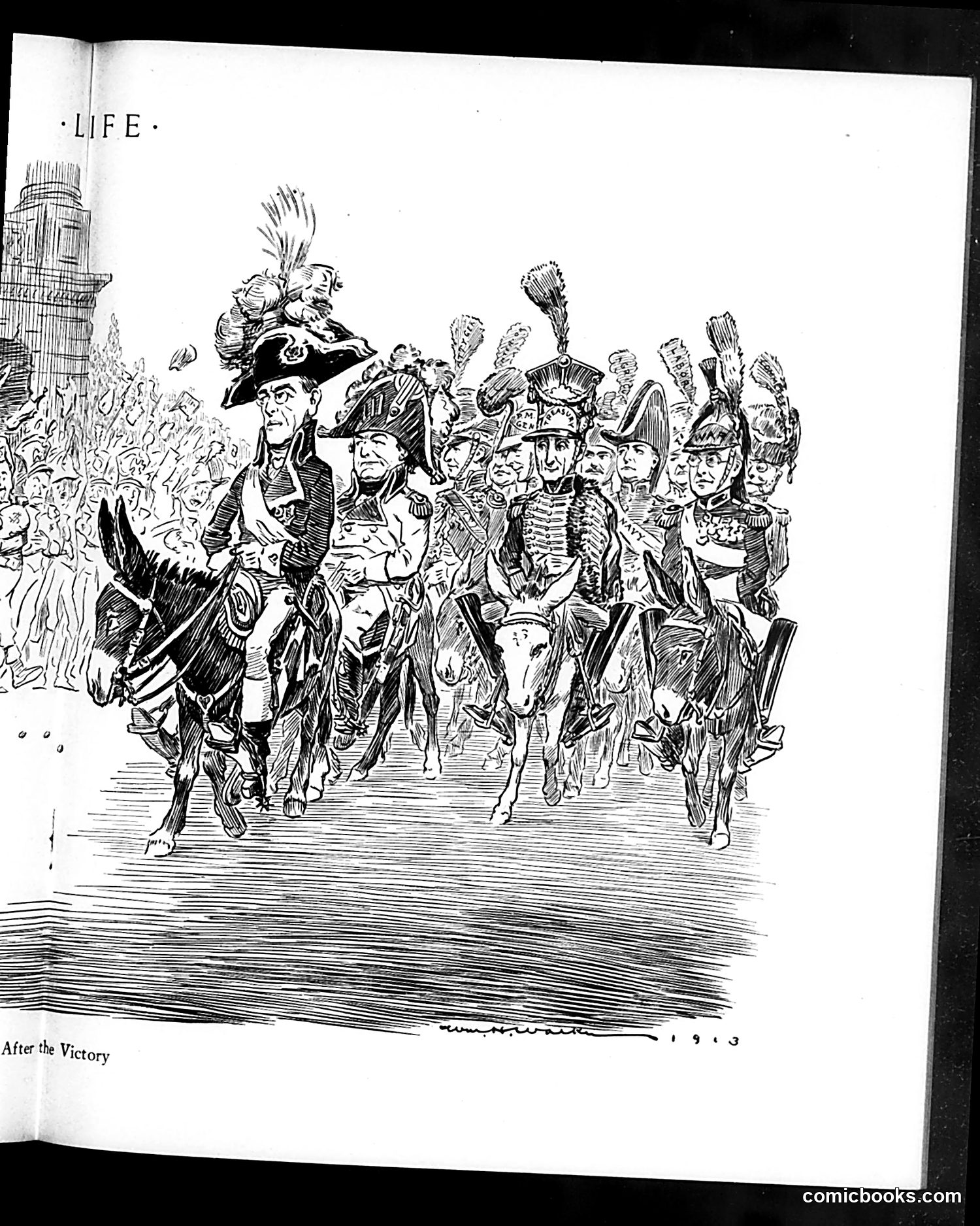
This political cartoon depicts a military procession of uniformed officers on horseback, viewed from behind as they ride away from a crowd (visible as hatching on the left). The title "After the Victory" suggests this illustrates a moment following a military triumph. The cartoon appears to satirize military leadership or command structure, showing elaborately uniformed officers with distinctive bicorn hats and decorative regalia. The exaggerated styling and procession composition suggests mockery of military pomp and pageantry, possibly critiquing how leaders celebrate or capitalize on battlefield success. Without a visible date or artist signature, the specific historical military victory referenced remains unclear, though the uniform styles suggest early 19th-century European warfare context.
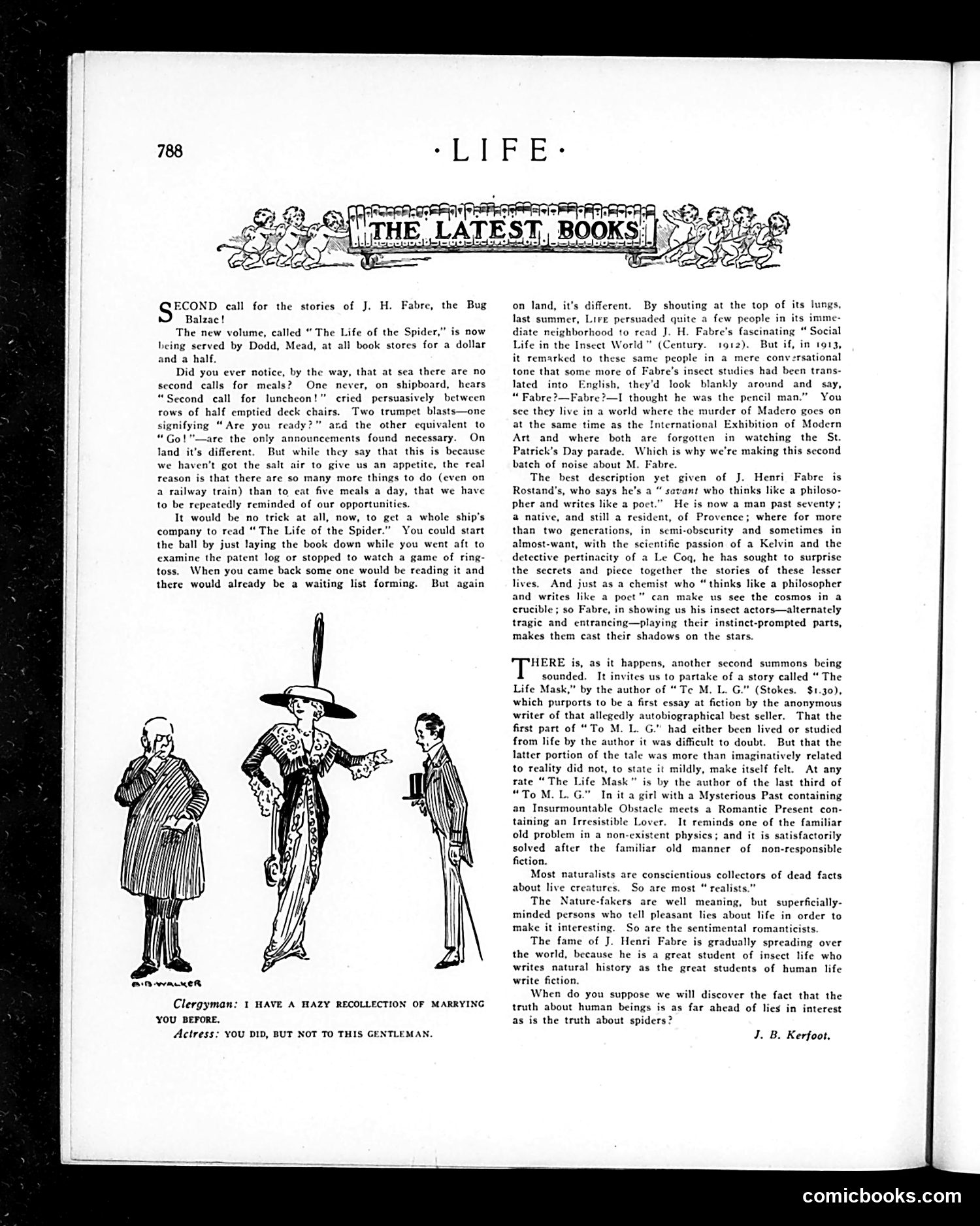
This page reviews recent books, primarily J. H. Fabre's "The Life of the Spider." The article uses a clever conceit: it compares promoting books on land versus at sea, noting that ships announce meals with trumpet blasts requiring no repetition, while land-dwellers need constant reminders due to competing distractions. Life is humorously making a "second call" for Fabre's work. The small cartoon by Cesare Walker depicts a clergyman telling an actress he recalls marrying her before. She replies she did marry him—but not to the gentleman present, implying either infidelity or a previous husband. This is a joke about marriage confusion or adultery. The page also briefly reviews "The Life Mask," a novel by the anonymous author of the bestseller "To M.L.G.," which apparently contained melodramatic plot devices typical of popular fiction.
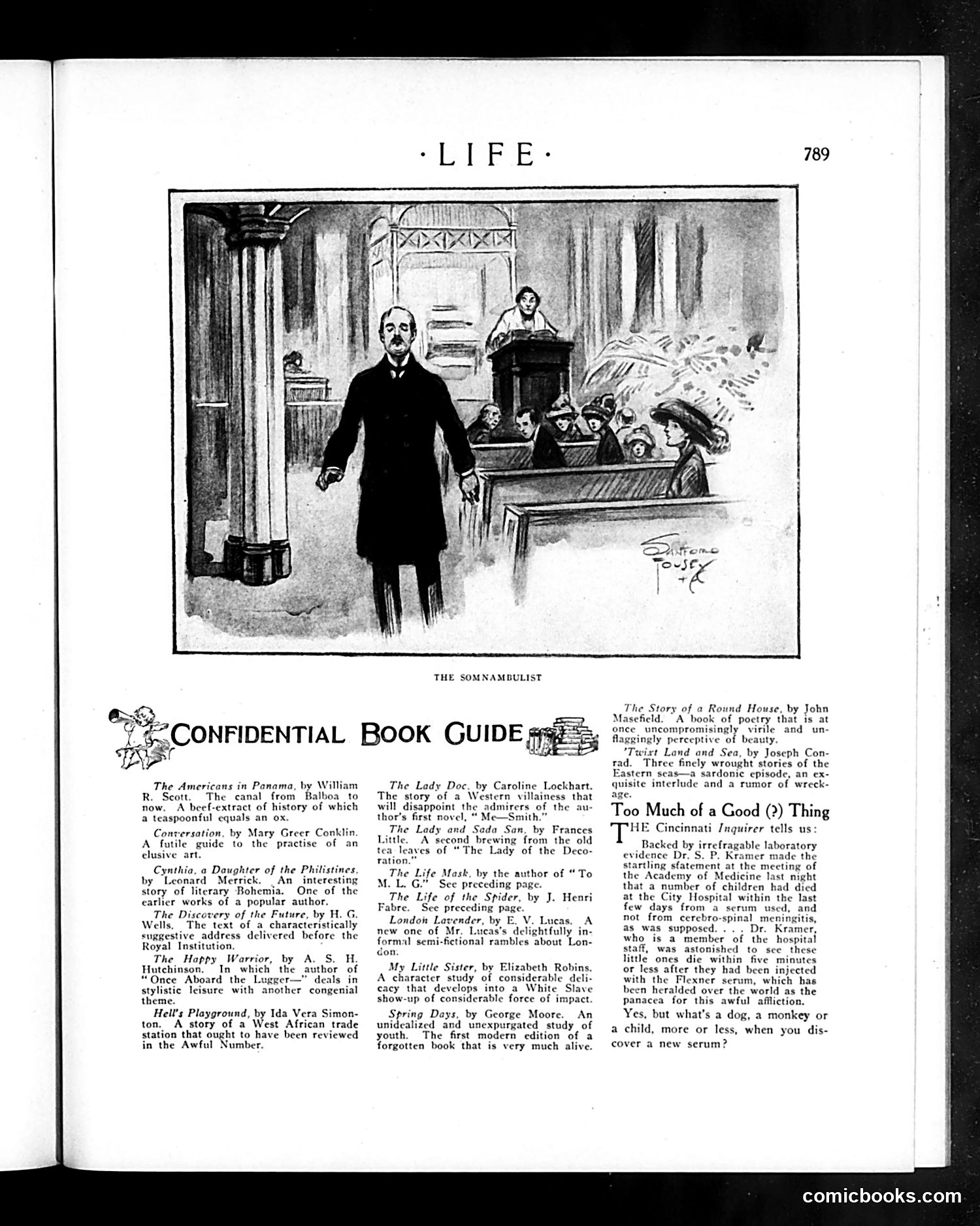
The cartoon depicts a courtroom scene where a man in dark clothing stands before a judge's bench. The title "The Somnambulist" (sleepwalker) suggests the joke: the figure appears to be sleepwalking through legal proceedings—literally unconscious or unaware during his trial. The satire targets people who mechanically go through serious situations without genuine engagement or consciousness of what's happening. In the context of a legal trial, it mocks either defendants who seem oblivious to their own jeopardy, or more broadly, the performative nature of courtroom rituals where participants play roles without real awareness. The accompanying "Confidential Book Guide" is a book review section, making this page primarily literary content with an illustrative cartoon.
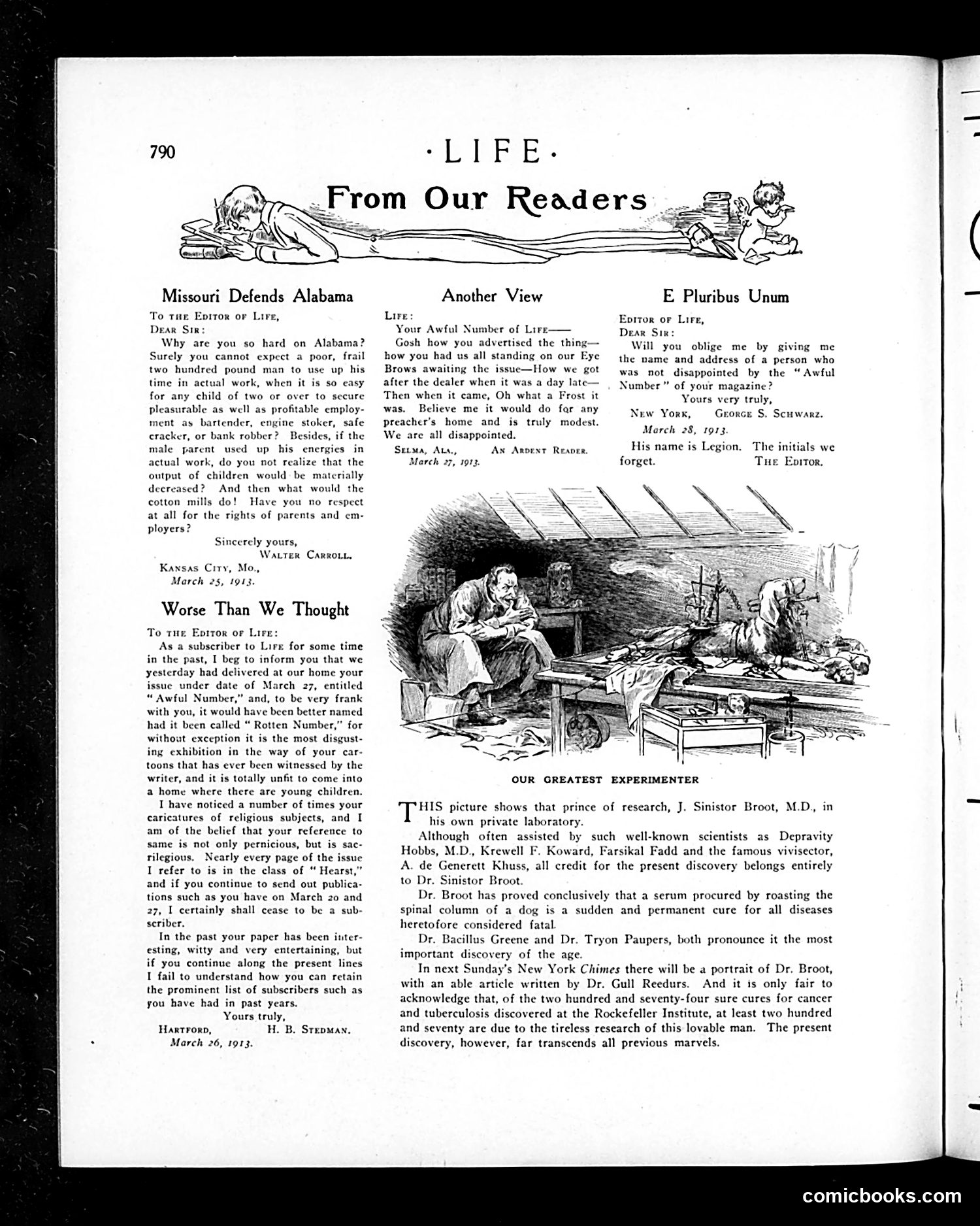
This page features reader letters mocking Life's controversial "Awful Number" issue from March 27, 1913. The letters sarcastically defend Life's satirical content: one writer ironically justifies child labor in Alabama mills, another complains the issue is too risqué for homes with children, and a third notes that *everyone* was disappointed—implying Life's satire was universally recognized as biting. The cartoon "Our Greatest Experimenter" satirizes medical pseudoscience and quack doctors. Dr. "Sinistor Broot" (clearly a fabricated name suggesting "sinister brute") claims to have discovered miraculous cures through absurd methods. The accompanying text mocks contemporary medical charlatanism and the Rockefeller Institute's claimed disease cures, suggesting scientific claims of the era were often exaggerated or fraudulent. The satirical naming of his assistants—"Depravity Hobbs," "Farsikal Fadd"—reinforces the mockery of dubious medical practitioners.
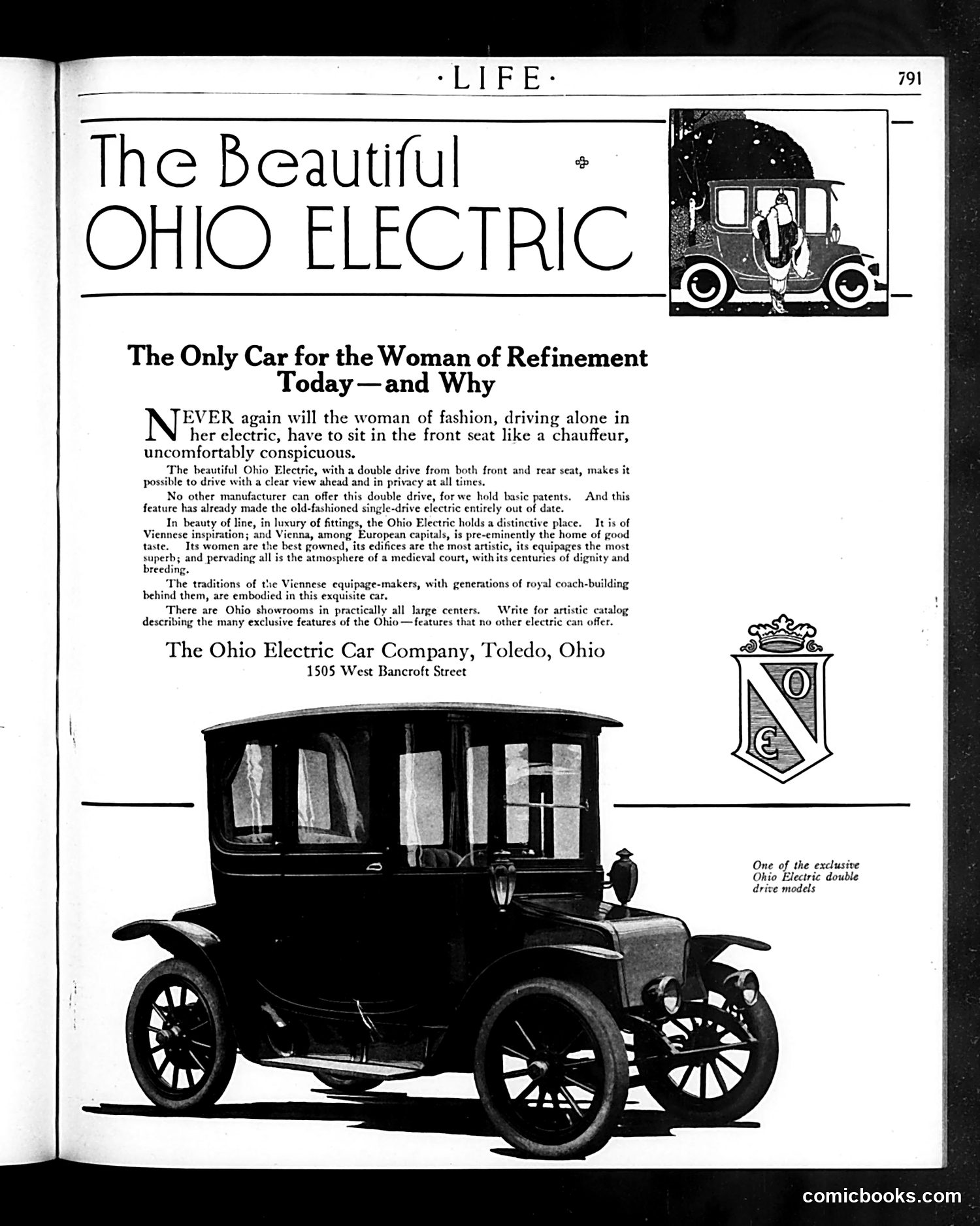
This is **not satire or a cartoon**, but rather a straightforward advertisement for the Ohio Electric automobile, presented in *Life* magazine (which was primarily a humor/satire publication but accepted ads). The ad targets affluent women, marketing the car's "double drive" feature—allowing a woman driver to operate the vehicle from either front or rear seat, eliminating the need to sit visibly in the driver's seat like a chauffeur. This reflects early-20th-century class anxieties: wealthy women could maintain appearances of being passengers while actually controlling the vehicle. The advertisement emphasizes luxury, European refinement (invoking Vienna), and exclusivity through "basic patents." The double-drive feature is presented as a social advantage rather than a practical innovation—addressing concerns about a woman's public visibility while driving, a still-novel activity for upper-class women of the era.
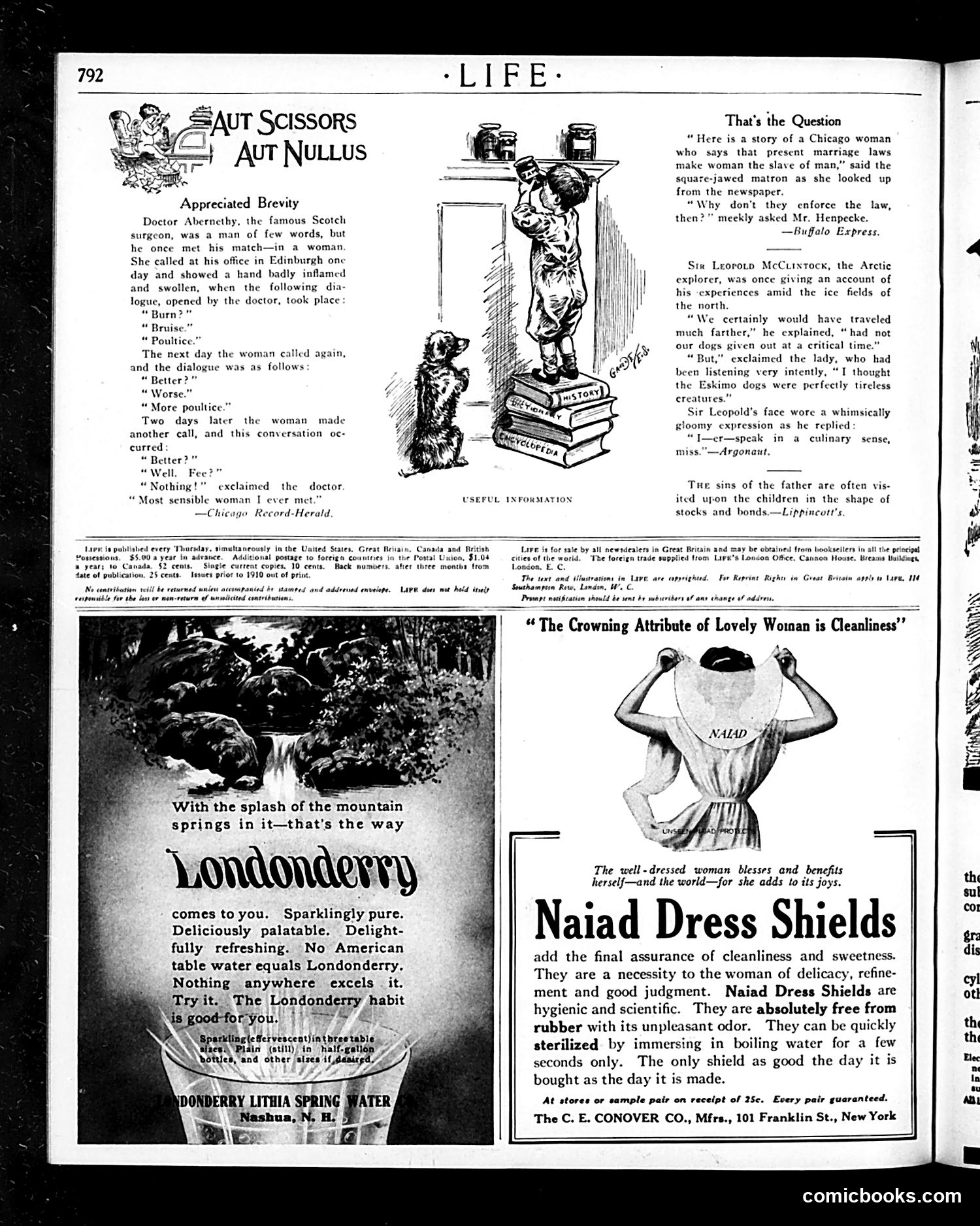
This page contains several brief humorous anecdotes and period advertisements rather than political cartoons. **"Aut Scissors/Aut Nullus" section:** Three short jokes satirizing gender dynamics and social awkwardness: - A Scottish surgeon's witty exchange with a talkative woman patient, celebrating her brevity - A Chicago woman advocating for marriage law reform while her henpecked husband ("Mr. Henpecke") timidly questions enforcement - An Arctic explorer's dark joke: when claiming sled dogs "gave out," he meant literally—they were eaten, not exhausted **The satire targets:** Male nervousness around women's rights advocates (the henpecked husband trope); Victorian-era proprieties and misunderstandings (the "culinary sense" euphemism). **Advertisements:** Londonderry spring water and Naiad Dress Shields (underarm protection garments). The Naiad ad's messaging about cleanliness as "the crowning attribute of lovely woman" reflects period anxieties about feminine hygiene and propriety. The page is primarily entertainment and advertising rather than serious political commentary.
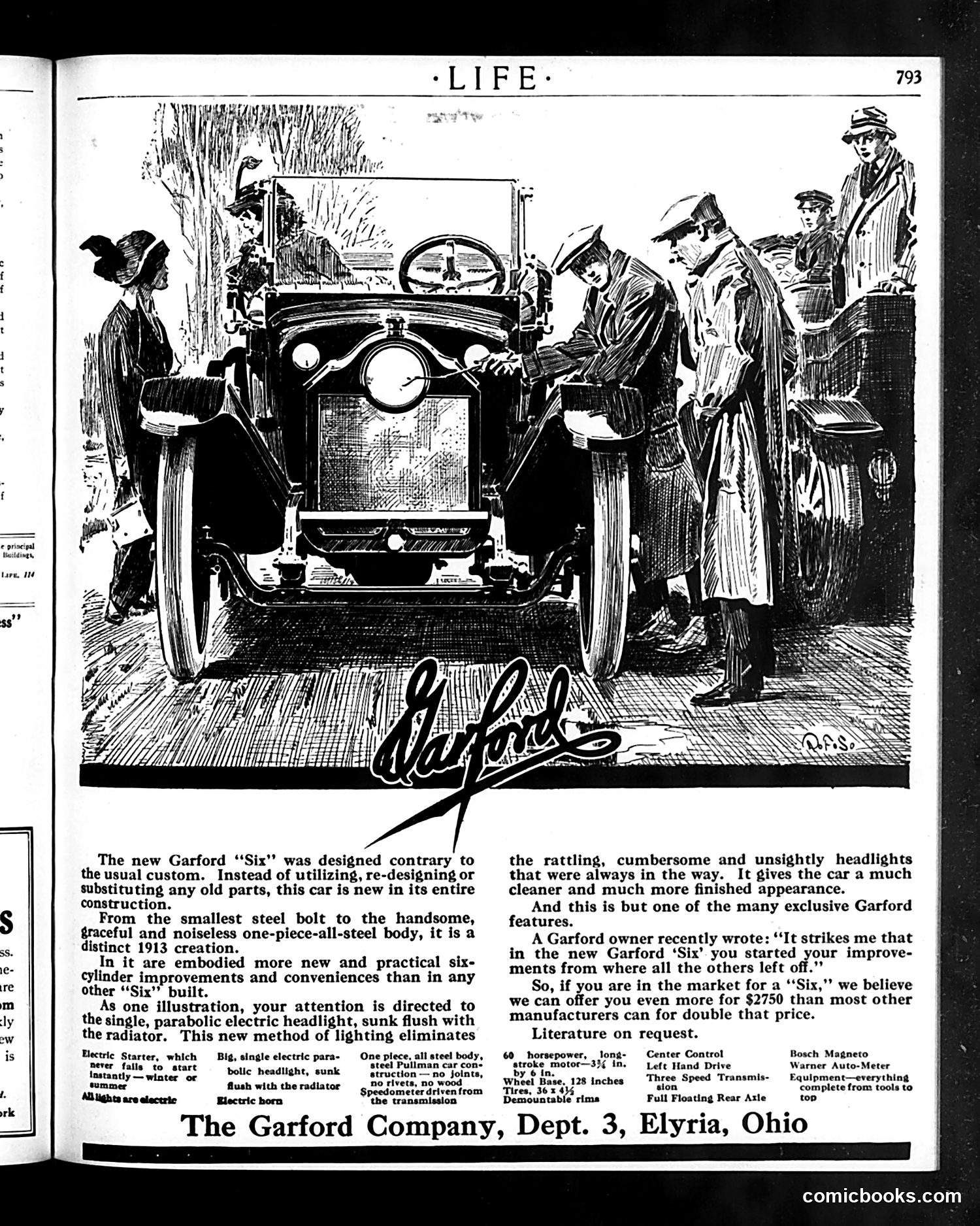
This page is primarily a **product advertisement**, not political satire. It promotes the Garford "Six" automobile, manufactured in Elyria, Ohio, circa 1913. The illustration depicts well-dressed men and a woman examining the car, emphasizing its modern design and craftsmanship. The advertisement's key selling point is that the vehicle represents entirely new construction rather than recycled parts from older models—a significant claim in early automotive manufacturing when standardization was limited. Notable features highlighted include an integrated electric headlight, electric starter, electric horn, and an all-steel body. The text includes a testimonial from a satisfied owner claiming Garford's innovations surpassed competitors' offerings at half the price of luxury vehicles. This reflects the rapid automotive innovation of the 1910s, when manufacturers competed on technological advancement and design sophistication for an emerging middle-to-upper-class market.
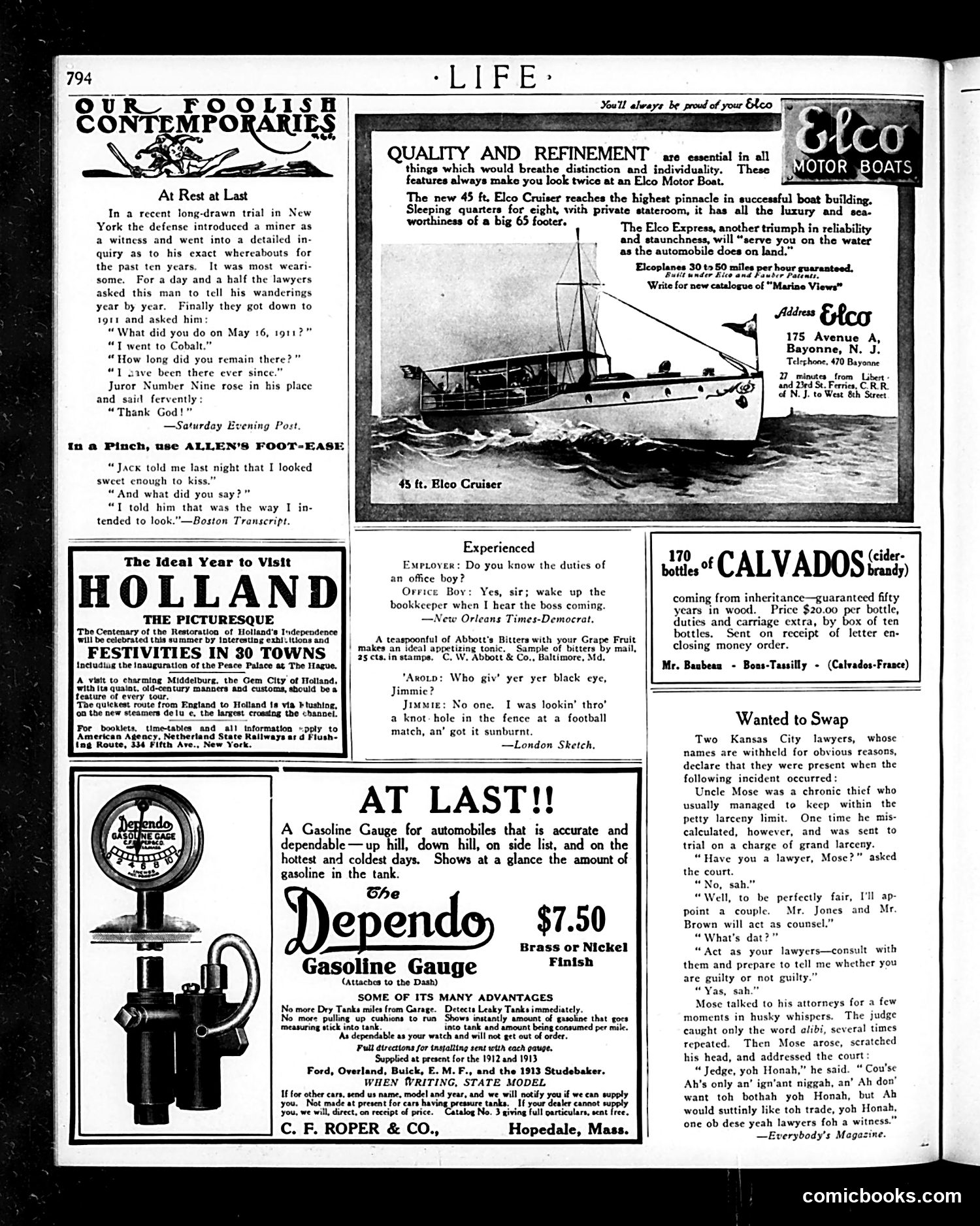
This page is primarily **advertisements and humor columns**, not political satire. The "Our Foolish Contemporaries" section collects brief jokes from other publications—mostly workplace humor and dating quips typical of 1910s magazines. The main content includes: **"At Rest at Last"**: A joke about a lawyer exhaustively questioning a witness about his whereabouts over ten years. When the witness finally says he's been in one location since 1911, a juror stands up and says "Thank God!"—expressing relief the tedious testimony is over. **Advertisements**: The page features motor boats (Elco brand), gasoline gauges, and liquor (Calvados brandy)—standard consumer products of the era. **"Wanted to Swap"**: A humorous anecdote about two Kansas City lawyers who were present when a chronic thief named Uncle Mose was charged with grand larceny, turning the tables by calling him as a character witness. No significant political figures or events are referenced. The satire is gentle workplace and domestic humor, reflecting early 20th-century magazine conventions.
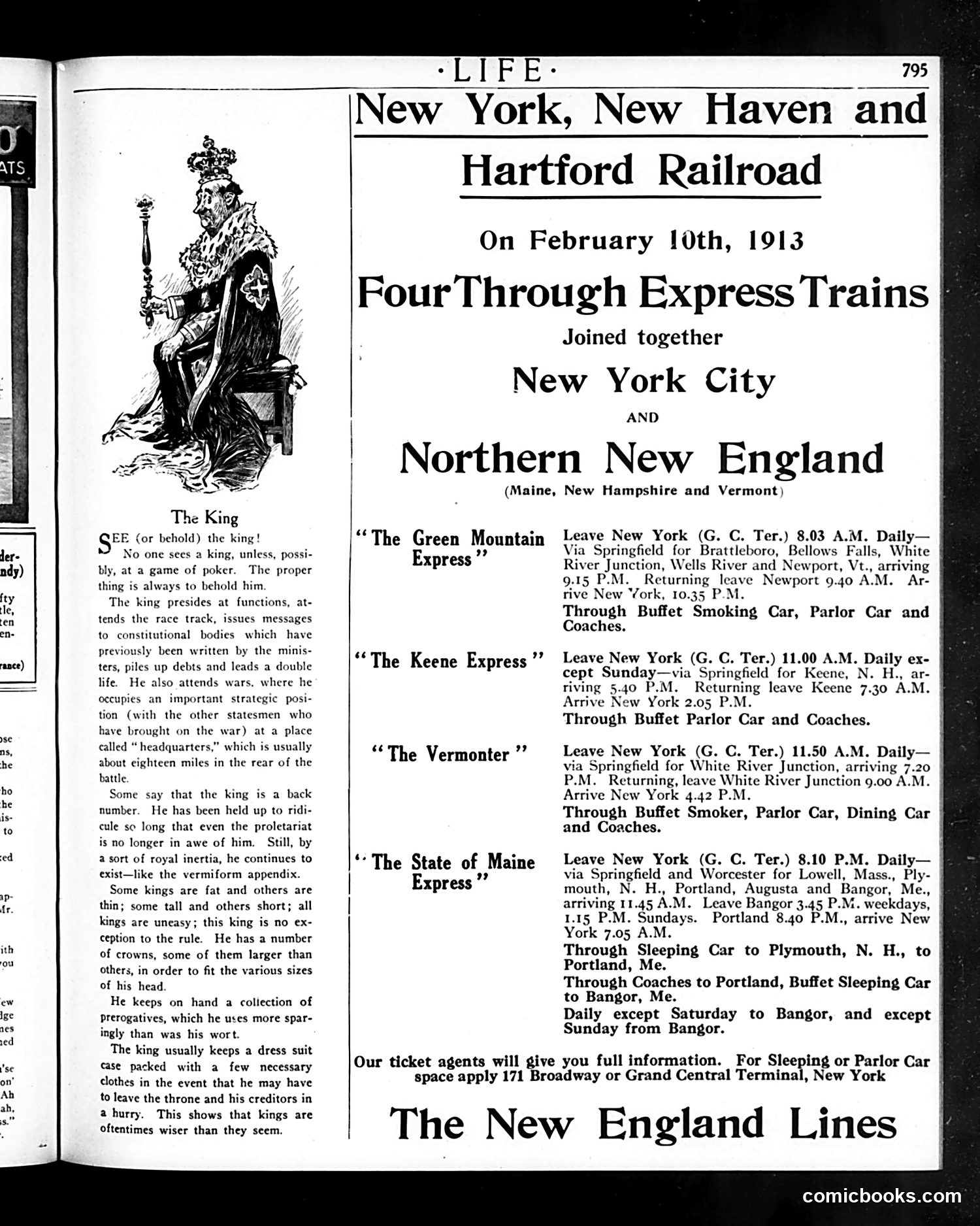
This page presents a satirical essay mocking European monarchy, likely responding to early 20th-century debates about the relevance of kings in modern democratic societies. The illustration shows a crowned figure in royal regalia—a generic representation of kingship rather than any specific monarch. The satire argues that kings are obsolete "back numbers" maintained by institutional inertia rather than actual power or respect. Life ridicules their ceremonial functions, their strategic irrelevance in wars (positioned safely "eighteen miles in the rear"), their financial irresponsibility, and their constant anxiety. The essay compares monarchy to a "vermiform appendix"—a vestigial organ serving no purpose. The tone is dismissive: even the working class ("proletariat") no longer fears kings. The final joke—that kings wisely keep packed suitcases ready to flee—suggests their days are numbered. This reflects American Progressive-era skepticism toward European hereditary monarchy during a period of rising democratic and socialist movements.
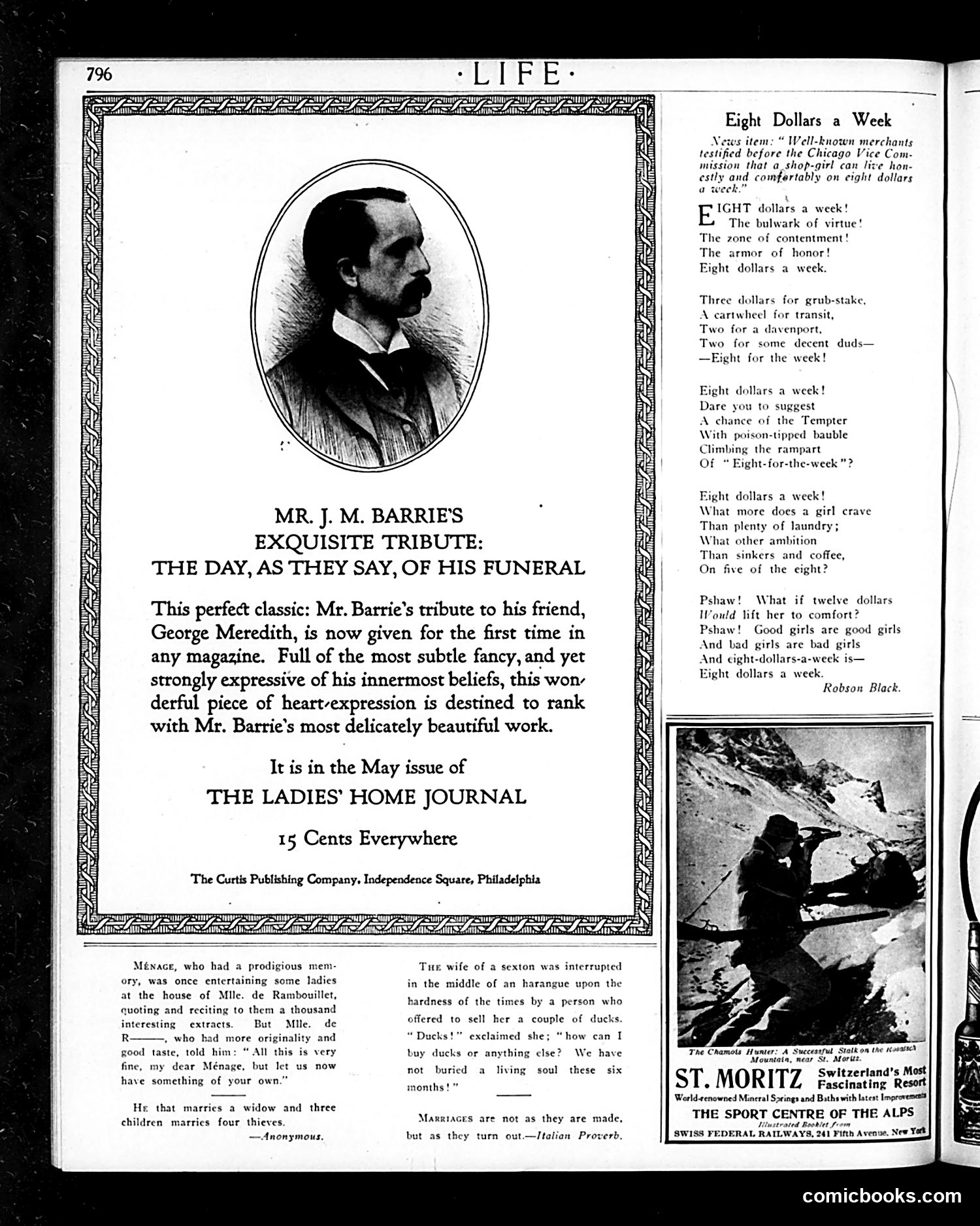
This page primarily advertises J.M. Barrie's tribute to George Meredith (a prominent Victorian author who died in 1909), promoting its publication in *The Ladies' Home Journal*. The satirical content appears in the poem "Eight Dollars a Week" by Robson Black. This piece mocks a Chicago Vice Commission's claim that shop-girls could live "honestly and comfortably" on eight dollars weekly—a poverty wage even then. Black's sarcasm exposes the absurdity: after deducting food ($3), transit ($1), and clothing ($2), nothing remains. The poem sardonically suggests girls earning so little face temptation toward vice, then cynically dismisses this concern with "good girls are good girls"—implying the claim itself is naive propaganda. The final jab at hypothetical twelve-dollar wages underscores that eight dollars is inadequate for genuine comfort or virtue. The satire targets not the workers but middle-class hypocrisy: wealthy merchants testifying that subsistence wages suffice, ignoring economic reality.
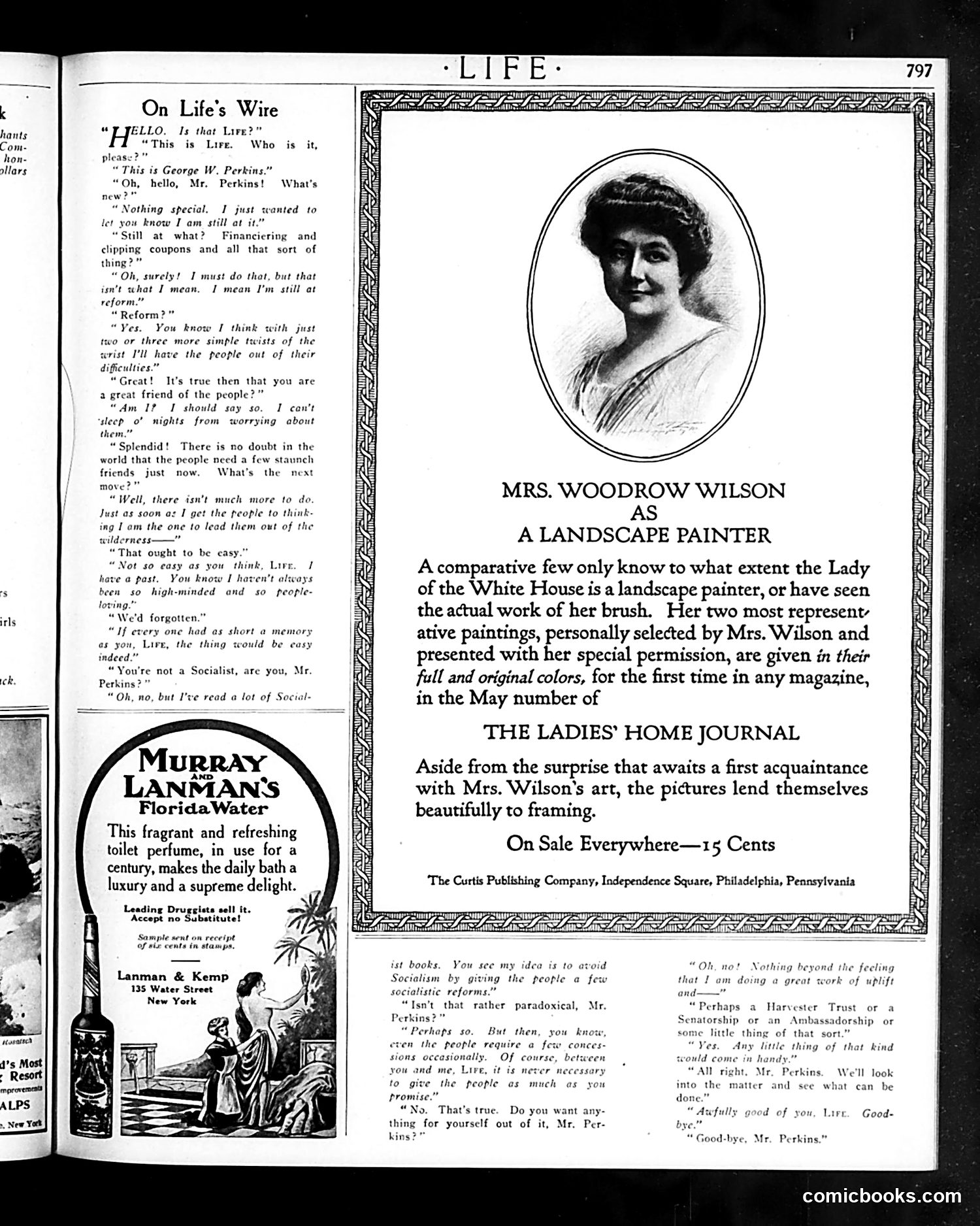
This page features a satirical dialogue between "Life" (the magazine's personified mascot) and **George W. Perkins**, a real historical figure—a financier and J.P. Morgan associate who styled himself as a progressive reformer. The joke exposes the hypocrisy of wealthy industrialists claiming to champion "the people" while pursuing self-interest. Perkins boasts he'll lead the public "out of the wilderness" through reform, yet admits he can't sleep worrying about them (performative concern). Life's character sardonically notes this paradox: Perkins wants to *avoid* socialism by granting minor concessions, while secretly angling for personal gain—a "Harvester Trust" or ambassadorship. The satire targets the era's "muckraking" critique of robber barons masquerading as philanthropists. Perkins's amnesia about his past financial dealings underscores the critique: his reform credentials are conveniently selective. The page also advertises Mrs. Woodrow Wilson's landscape paintings in *The Ladies' Home Journal*—period-appropriate content for this 1912-era magazine.
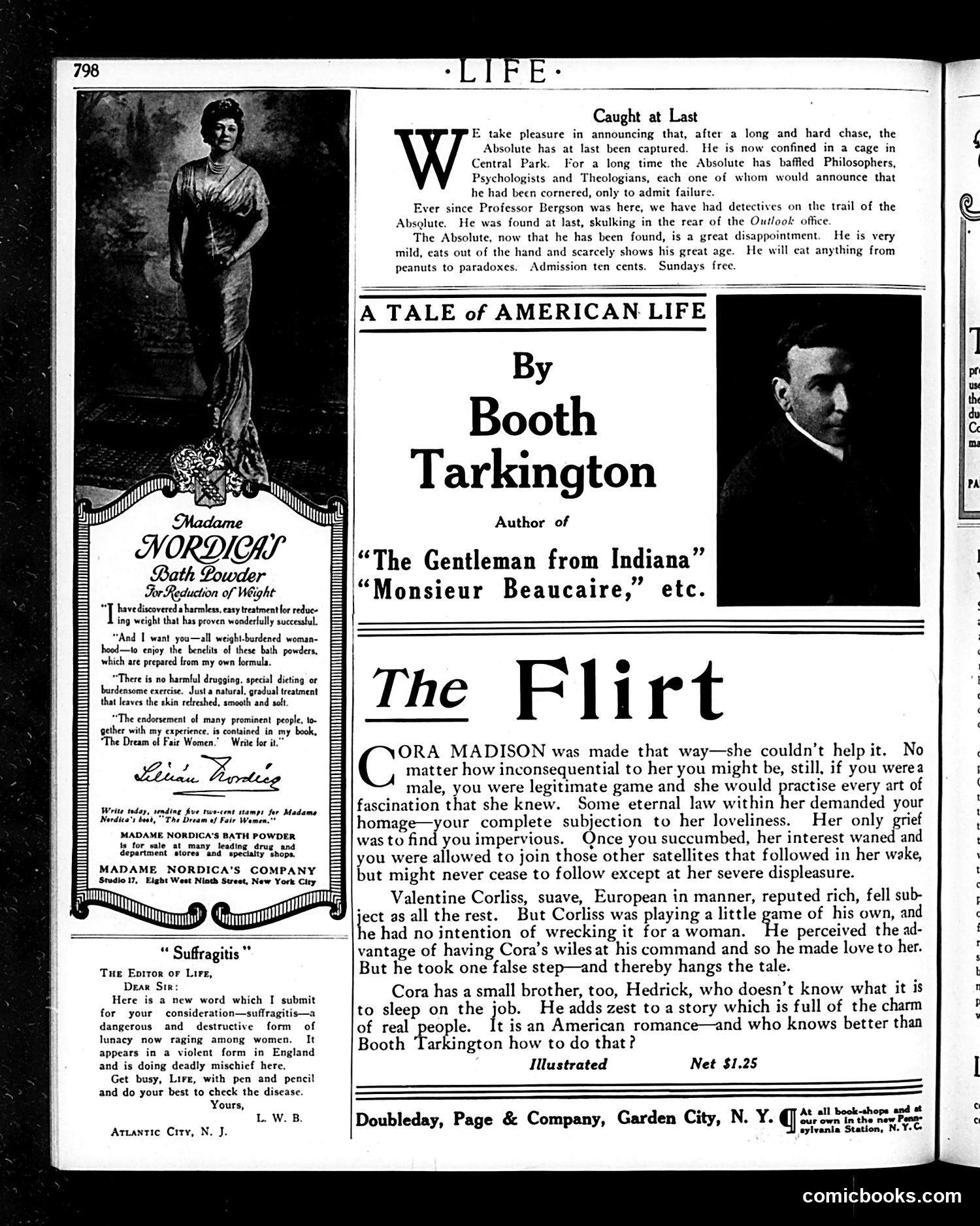
This page contains **satirical commentary and period advertising** rather than traditional political cartoons. ## Key Content: **"Suffragitis" Letter**: A reader sarcastically coins a term mocking women's suffrage as a "dangerous and destructive form of lunacy," claiming it's causing "deadly mischief" in England and America. Life publishes this to ridicule anti-suffrage attitudes—the magazine appears to support women's voting rights by making the opposition look absurd. **"Caught at Last"**: A humorous philosophical satire suggesting they've captured "the Absolute"—referencing Henri Bergson's abstract philosophical concept—now displayed in Central Park like a zoo animal. It mocks pretentious philosophical debate as ultimately meaningless. **Advertisements**: Madame Nordica's weight-reduction bath powder and Booth Tarkington's novel *The Flirt* occupy substantial space, typical of Life's revenue model. For modern readers: this reveals Life as a publication that mixed lightweight satire (mocking both suffrage opponents and abstract philosophy) with commercial advertising in an era before strict editorial/advertising separation.
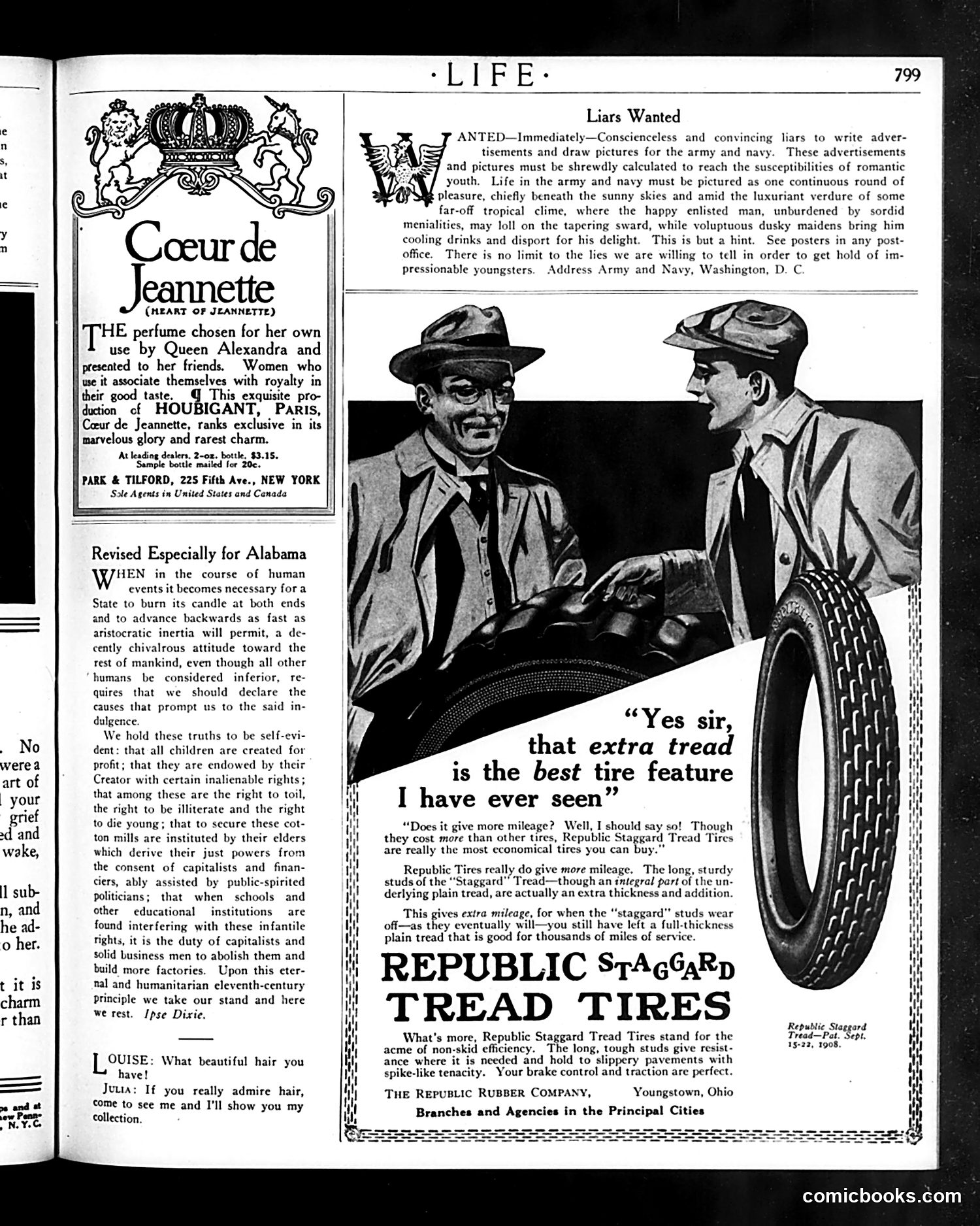
This page contains two major elements: **"Revised Especially for Alabama"** is a satirical political essay mocking Alabama's resistance to child labor laws and educational reform. Written as a mock Declaration of Independence, it sarcastically argues that children have "the right to be illiterate and the right to die young" and that factories should be protected from interference by schools. This attacks Alabama's industrial interests and their opposition to child welfare legislation—a major Progressive Era reform issue. **"Liars Wanted"** is a biting critique of military recruitment advertising. The ad parodies how the Army and Navy use romanticized imagery (tropical climates, leisure, "voluptuous dusky maidens") to deceive young men about military service, explicitly calling for "conscienceless liars" to create propaganda targeting "impressionable youngsters." This reflects anti-war and anti-militarism sentiment, likely from the World War I era. The page's advertisements (perfume, tires) are straightforward commercial content, unrelated to the satire.
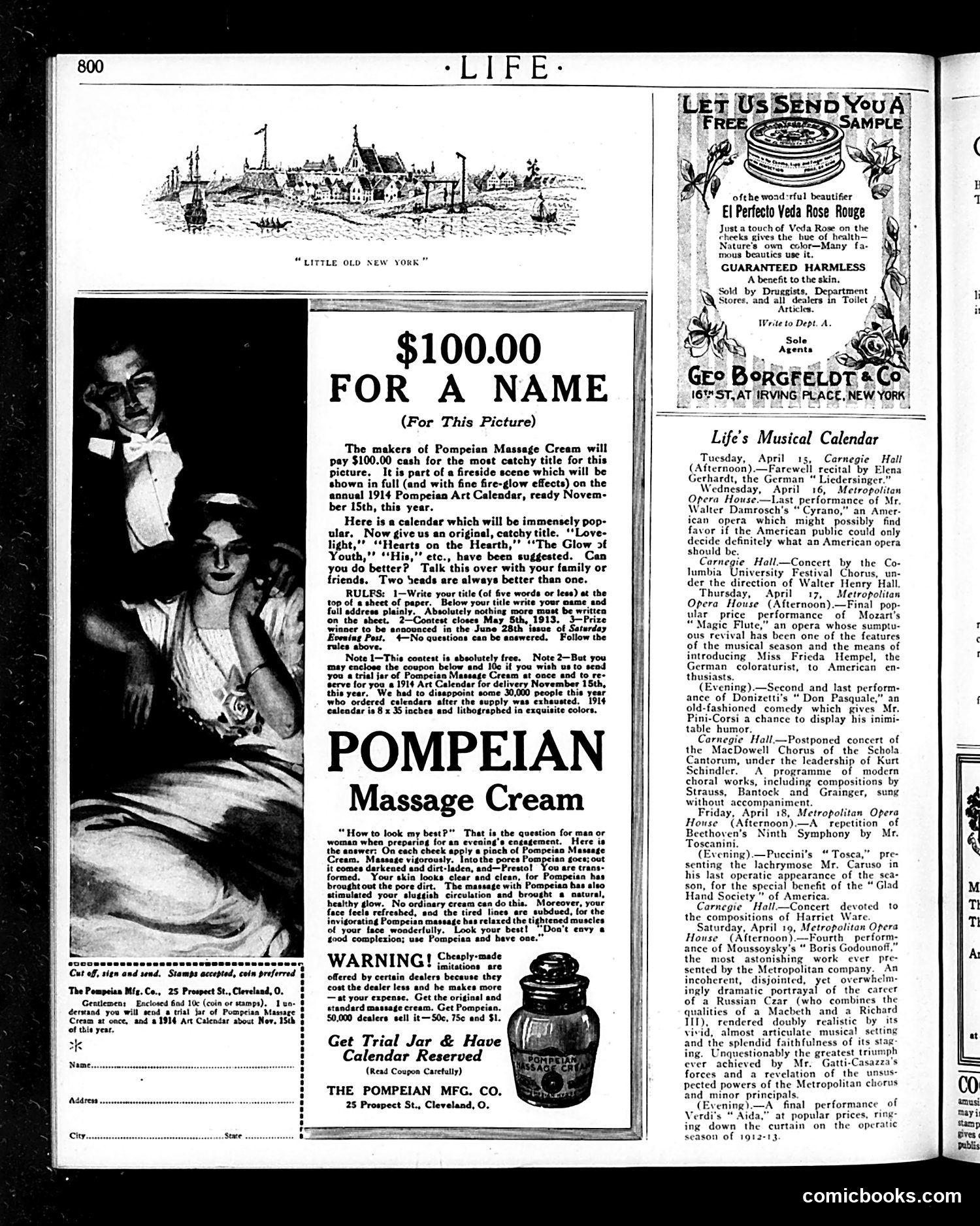
This page is primarily **advertising**, not satire or political commentary. The dominant content is a contest by Pompeian Massage Cream offering $100 for the catchiest title for an accompanying romantic fireside image (visible on the left). The photograph shows an intimate couple by a fireplace—likely meant to evoke romance and beauty. The contest invites readers to suggest titles like "Love-light" or "Hearts on the Hearth," playing on the image's sentimental appeal. The page also includes typical 1913 beauty product advertisements (Veda Rose Rouge) and a "Musical Calendar" listing upcoming Metropolitan Opera performances and concerts. **No political satire is present.** This is a straightforward early-20th-century women's magazine page mixing editorial content with marketing for beauty products—targeting female readers interested in self-improvement, cosmetics, and cultural events.
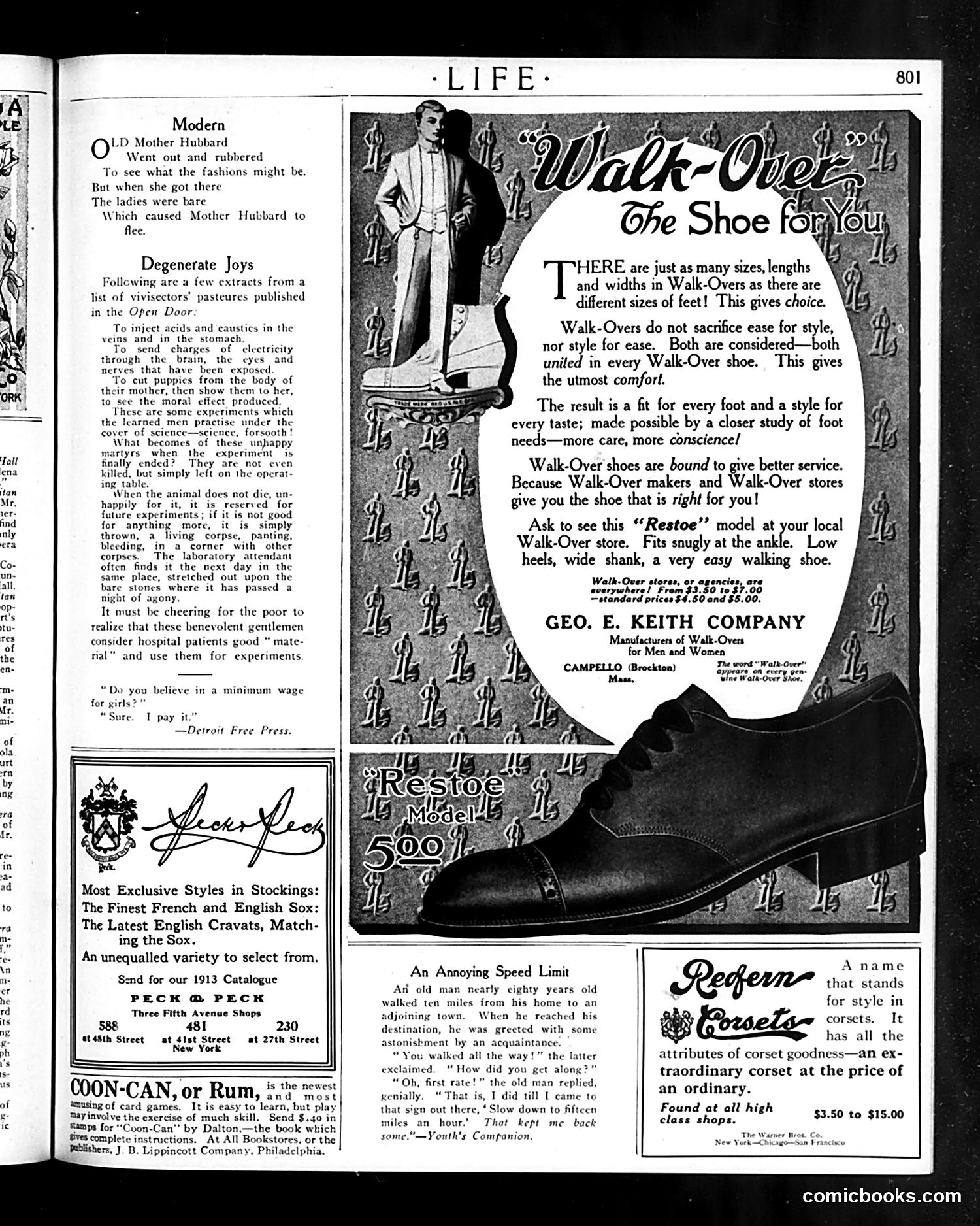
This page mixes satirical poetry, social commentary, and period advertisements typical of early 1900s *Life* magazine. **"Modern Mother Hubbard"** is a brief satirical poem about changing fashion—specifically women's increasingly bare or revealing clothing. It uses the nursery rhyme format to mock how shocked an old-fashioned woman (Mother Hubbard) would be at contemporary styles. **"Degenerate Joys"** criticizes unethical medical experimentation on animals, describing vivisection practices without anesthesia or humane treatment. The piece condemns both the cruelty and the use of poor hospital patients as experimental "material"—reflecting early-1900s anxieties about medical ethics. The page also includes standard period advertising (stockings, shoes, corsets) and a humor anecdote about a speed-limit sign. The overall tone reflects *Life*'s role as a publication combining social satire with consumer culture and light humor, aimed at educated middle-class readers concerned with modern morality and fashion.
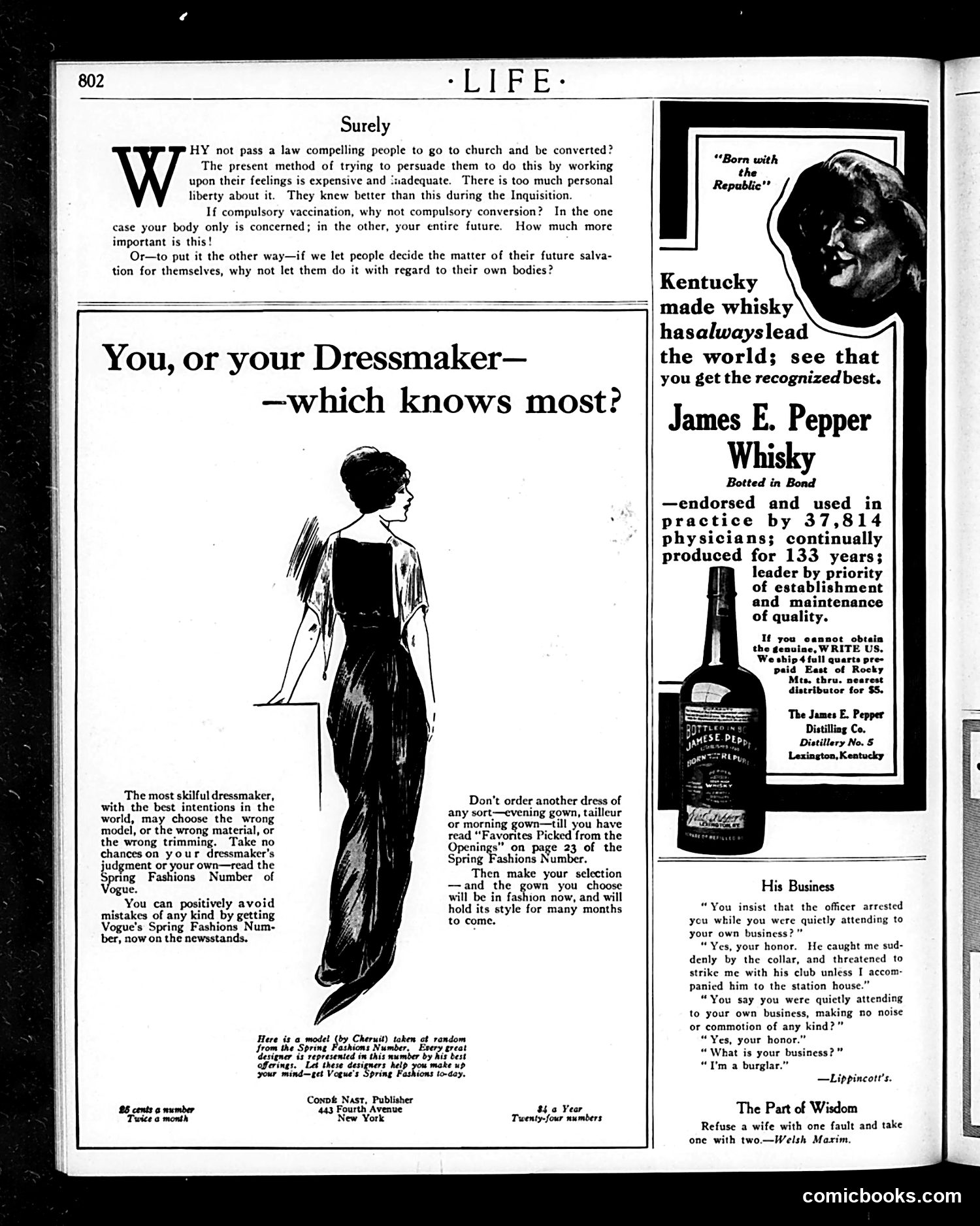
**Editorial/Satirical Section ("Surely"):** This opening piece uses ironic logic to critique government overreach. It argues that if society can mandate vaccination (controlling bodies), why not mandate religious conversion (controlling souls)? The rhetorical question invokes the Inquisition as a historical cautionary tale about forced religious compliance. The satire advocates for personal liberty—suggesting people should control both their bodies AND spiritual decisions—implicitly criticizing Prohibition-era paternalism and religious coercion. **Advertisements:** The page also contains period advertising: a Vogue fashion spread promoting spring dress patterns, and a James E. Pepper Whisky advertisement (ironic given Prohibition was ongoing). The whisky ad claims physician endorsement, typical of pre-FDA regulation marketing. **Humor Section ("His Business"):** A brief joke from Lippincott's magazine about a man arrested while "attending to his own business"—revealed to be burglary. The humor lies in the absurd literal interpretation of "minding one's business."
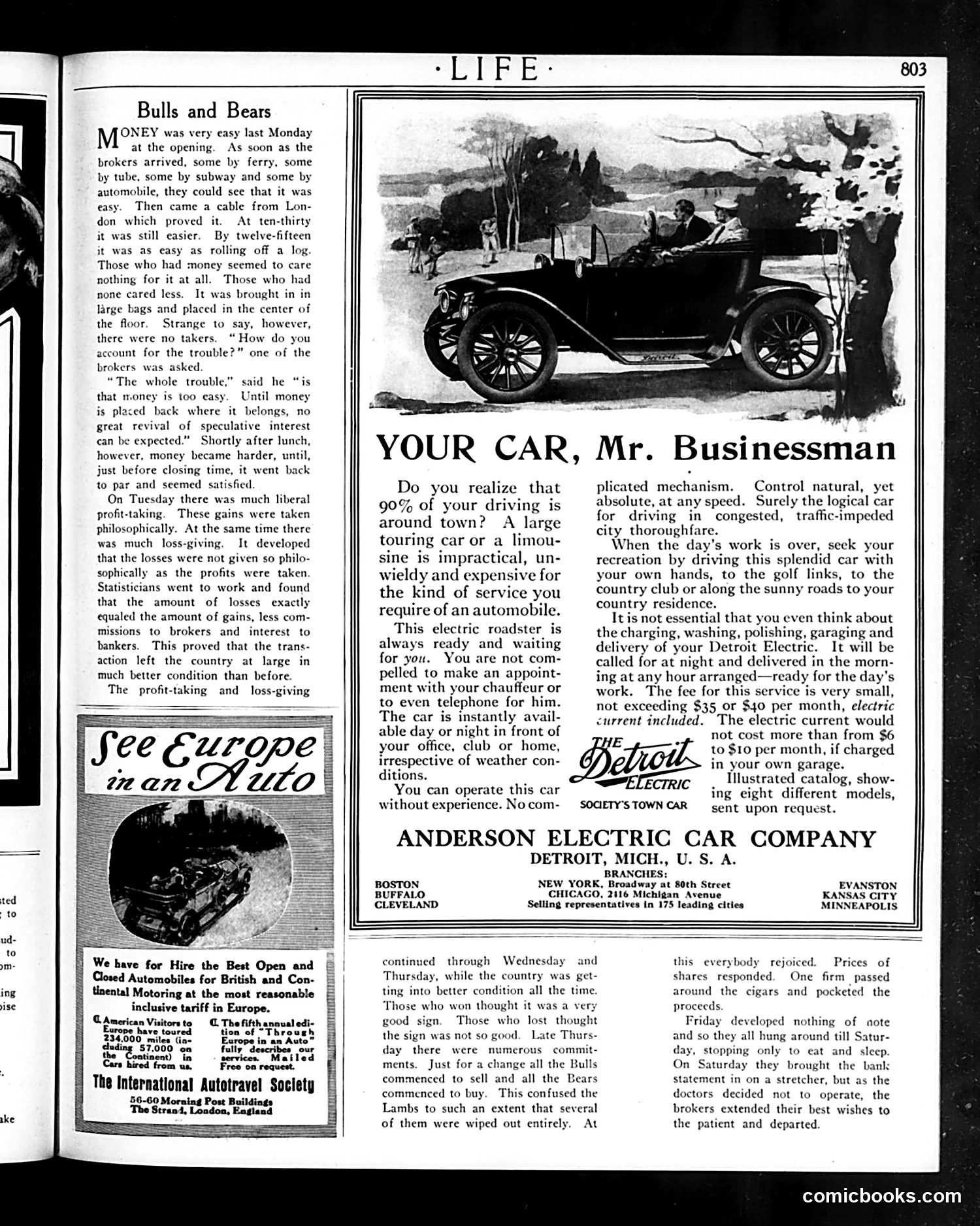
This satirical piece mocks the illogical behavior of stock brokers and speculators during volatile market conditions. The joke centers on a paradox: when money is "too easy" (abundant and cheap), no one wants it—there are "no takers." A broker explains that speculative interest only revives when money becomes scarce and "harder" to obtain. The satire critiques how market psychology operates inversely to rational economics. Investors obsess over gains and losses that mathematically cancel out (minus broker commissions), yet brokers celebrate this as beneficial to "the country at large"—absurd logic. The accompanying Anderson Electric Car advertisement represents the page's commercial content, targeting businessmen with practical urban transportation.
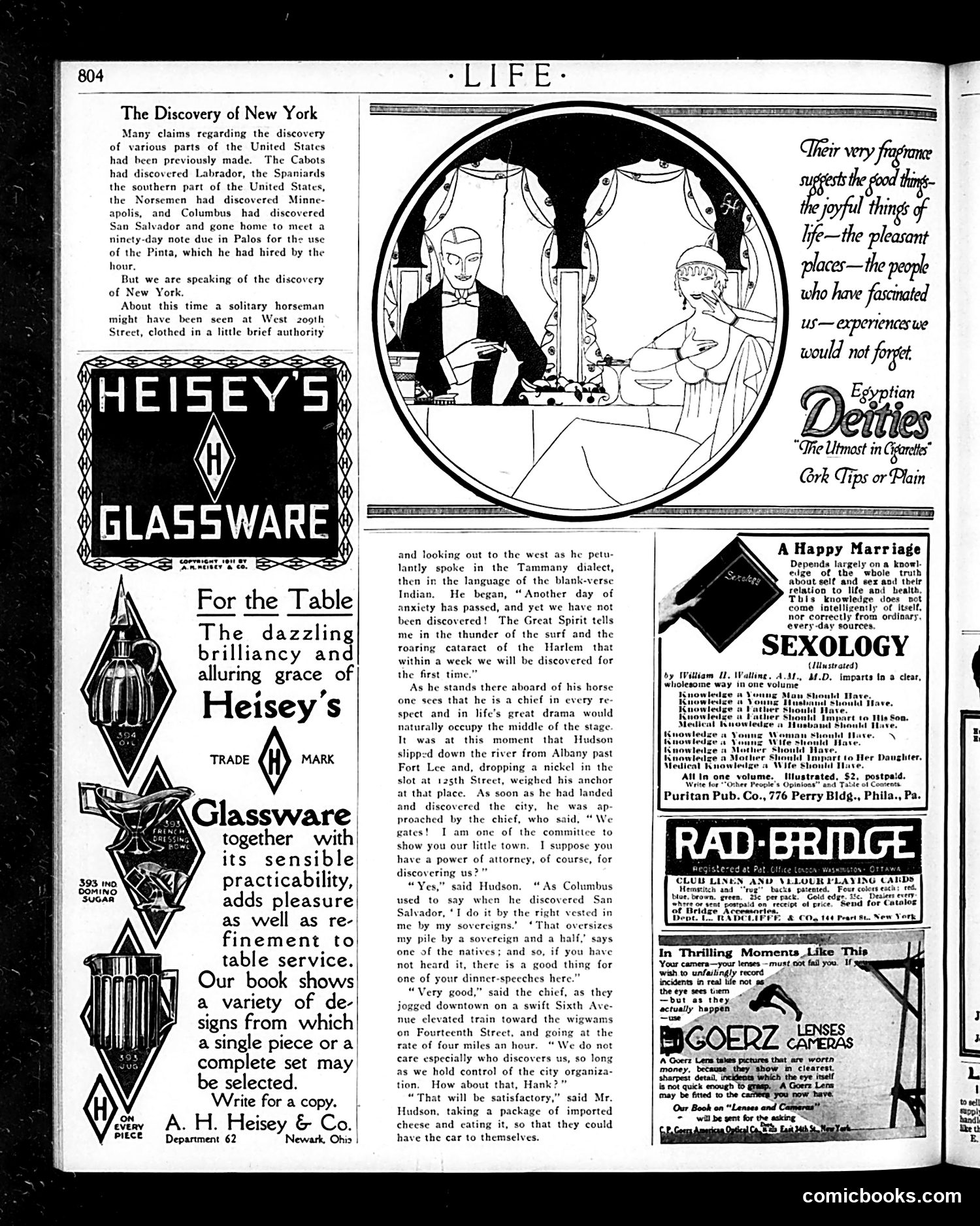
This is a satirical story (not a political cartoon) mocking the grandiose historical narratives around "discovery" in America. The humor centers on a Native American chief stationed at West 209th Street who complains that despite his tribe's presence, *they* haven't been "discovered" yet—treating European discovery as the defining moment of existence. When Henry Hudson arrives, the chief approaches him as a committee member eager to facilitate the "discovery," revealing Tammany Hall politics (the corrupt NYC political machine) embedded in indigenous relations. The satire deepens when Hudson casually eats imported cheese while the chief negotiates, suggesting European indifference and the transactional nature of colonial encounters. The joke: discovery narratives erase native presence. The chief ironically accepts that *political control* matters more than who "discovers" the city—a pointed commentary on how indigenous peoples were systematically excluded from power despite being there first. The page itself is mostly advertisements (Heisey glassware, books on marriage/sexology, camera lenses), typical of Life magazine's format.
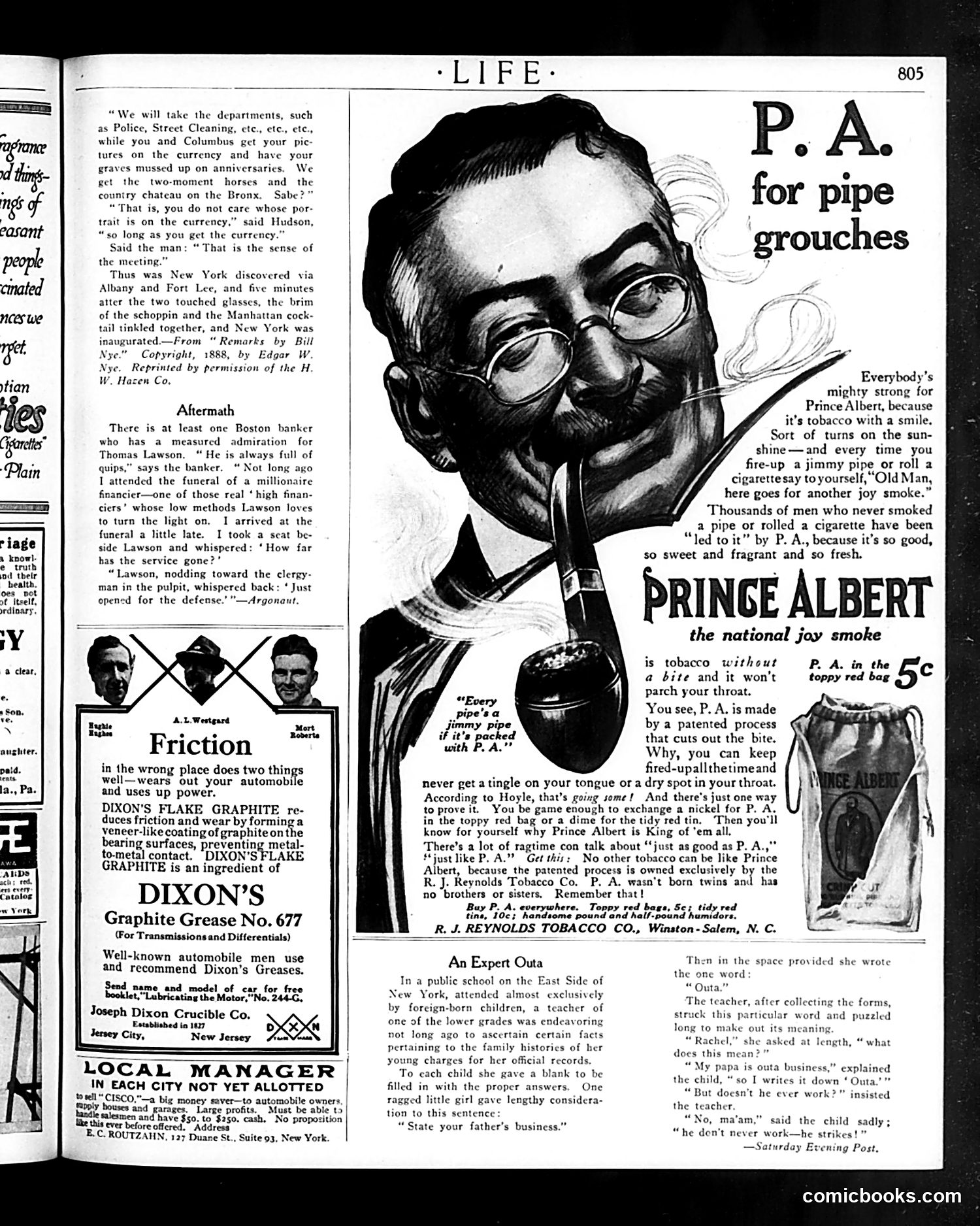
This page is primarily **advertising**, dominated by a large Prince Albert tobacco pipe advertisement featuring a jovial man smoking a pipe. The ad emphasizes that P.A. tobacco is mild ("without a bite") and won't parch the throat—selling points for 1920s consumers concerned about tobacco's harshness. The left side contains smaller editorial content: a humorous anecdote about New York's "discovery," a story mocking Thomas Lawson (likely the muckraking financier), and advertisements for Dixon's Graphite Grease and a "Cisco" automobile lubricant. **Historical context**: This represents early 20th-century magazine advertising when tobacco was openly promoted with health-adjacent claims (no dryness, freshness) rather than health warnings. The casual, masculine tone—"Old Man" addressing readers as fellow smokers—reflects pre-regulation attitudes toward smoking. The page lacks traditional political cartoons; instead, it's a mix of light social humor and commercial promotion typical of Life magazine's satirical-but-commercial business model.
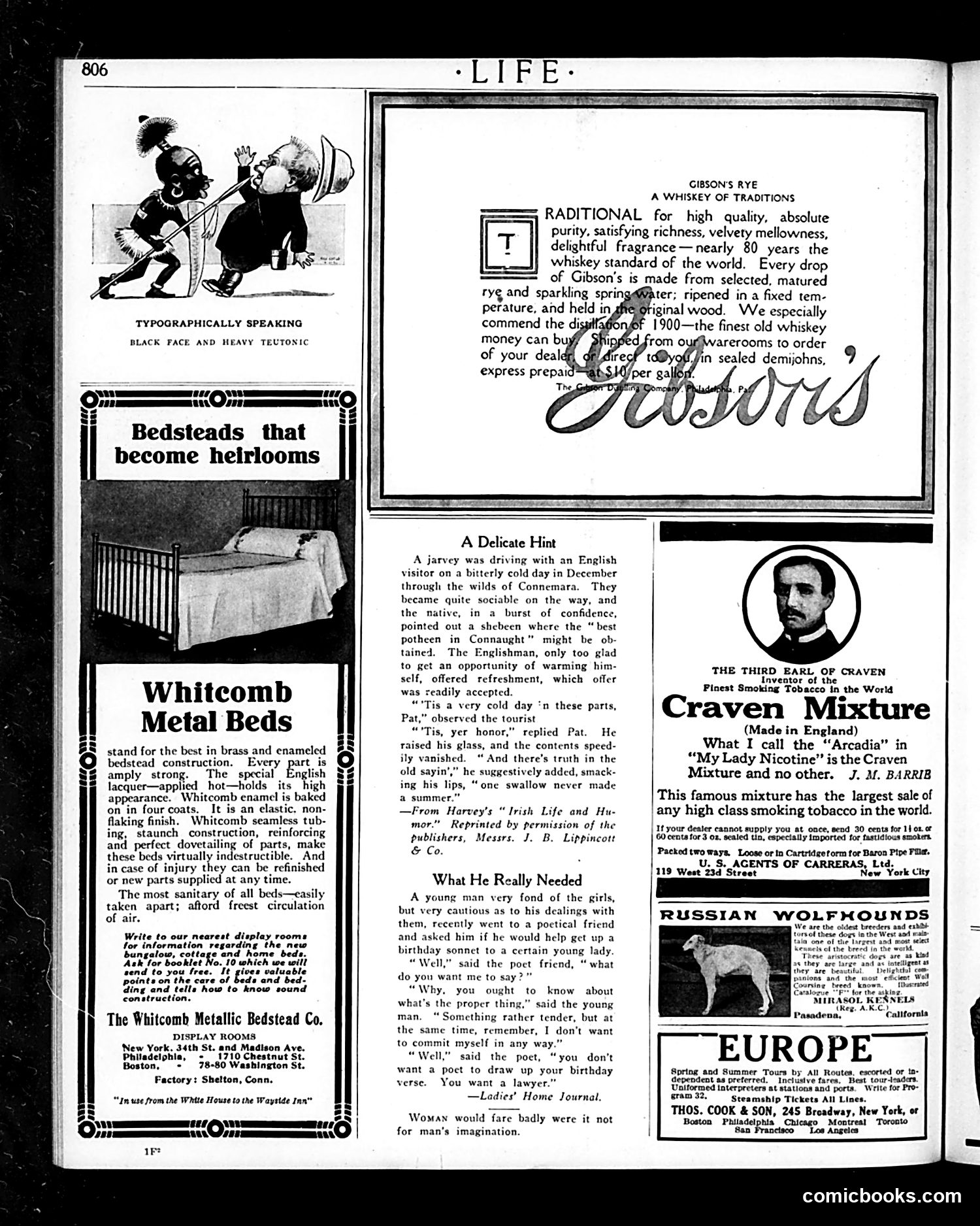
The cartoon titled "Typographically Speaking: Black Face and Heavy Teutonic" appears in the upper left—a racist caricature mocking immigrant and racial stereotypes. The figures are drawn in exaggerated, dehumanizing style typical of early 20th-century American satire that stereotyped both Black Americans and German immigrants ("Teutonic") through crude visual language. This represents the prejudiced editorial voice of *Life* magazine at the time. The page is primarily advertisements (bedsteads, whiskey, tobacco, travel) interspersed with humorous anecdotes—standard *Life* magazine content. The humor assumes readers would find amusement in ethnic/national stereotypes, particularly the "Irish" story featuring a Dublin character ("Pat") and the cautious young man seeking a poet's help. This content reflects deeply offensive attitudes that were mainstream in 1910s American publishing but would be universally condemned today.
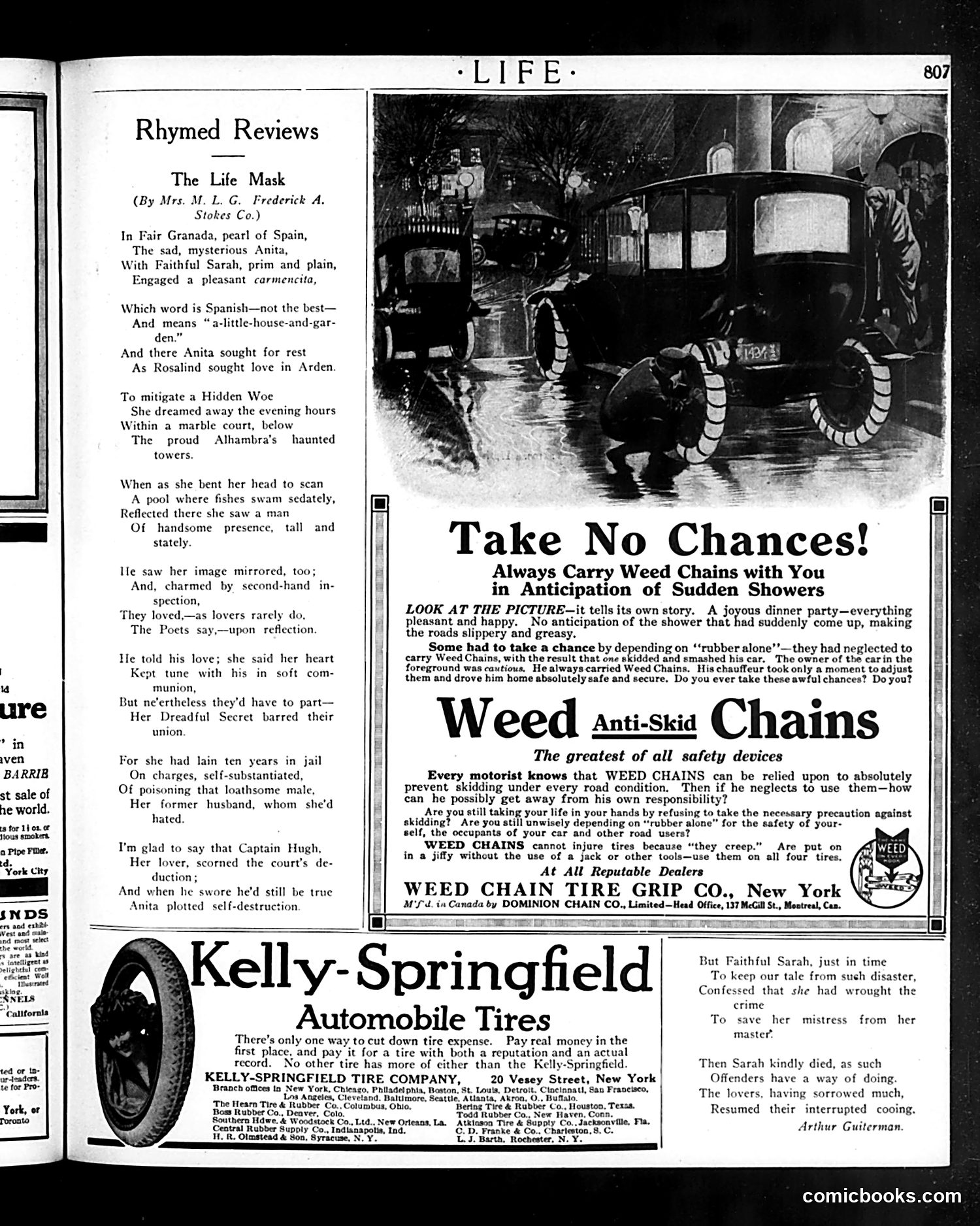
This page contains three distinct elements: **Left side**: A book review in verse of "The Life Mask," a novel set in Granada, Spain. The poem summarizes a romantic plot involving a woman named Anita who poisoned her abusive first husband and spent ten years in jail. She falls in love with Captain Hugh, reflected in a pool, but cannot marry him due to her criminal past. Her servant Sarah confesses to the crime instead and dies, resolving the conflict. The review presents this melodramatic plot with gentle mockery typical of Life magazine's literary criticism. **Right side**: Two advertisements. The prominent one promotes "Weed Chains"—tire chains for automobiles to prevent skidding on wet roads. It uses a dramatic before-and-after scenario: a dinner party where some guests neglected chains and crashed in sudden rain, while the cautious host used them and drove home safely. Below is a Kelly-Springfield tire advertisement. The page is primarily **advertising-driven**, with the book review occupying modest space. The satirical edge appears in the verse review's tongue-in-cheek treatment of melodramatic romance rather than in the advertisements themselves.
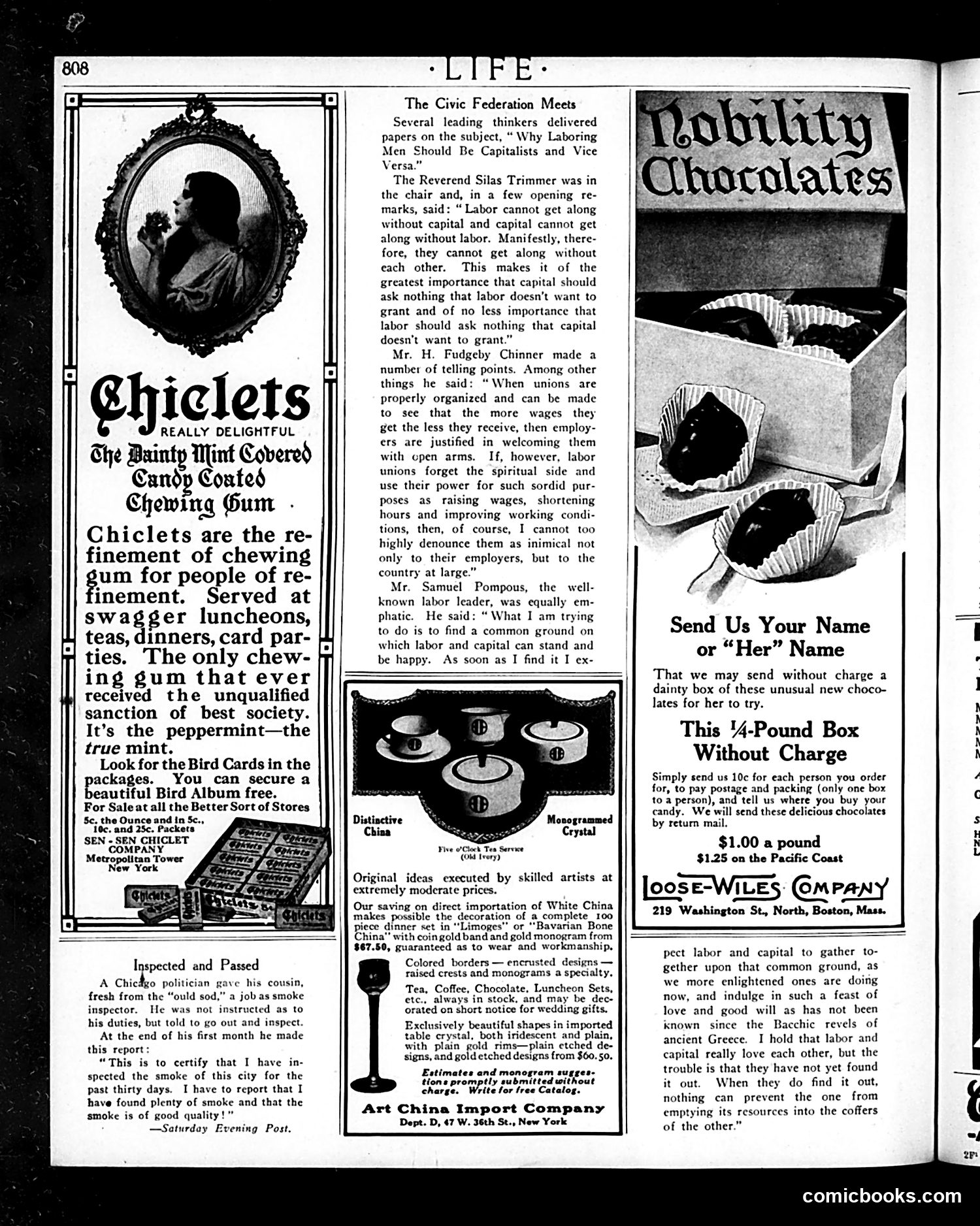
This page contains satirical commentary on labor-capital relations, disguised as a serious "Civic Federation" meeting report. The satire mocks both business leaders and labor representatives for their hollow rhetoric. **The Satire:** Reverend Trimmer opens with circular logic—labor and capital "cannot get along without each other," therefore both should ask nothing of the other. Mr. Chinner argues that when unions successfully raise wages, workers paradoxically receive "less," justifying employers welcoming them. Samuel Pompous (a labor leader) claims to seek "common ground" but the article cuts off mid-sentence, implying such ground doesn't exist. **The Point:** Life ridicules both sides of the labor debate for speaking in absurdities and contradictions while claiming reasonableness. The speakers appear sophisticated but their arguments are transparently illogical—a classic satirical technique exposing hypocrisy in public discourse. The page also includes period advertisements (Chiclets gum, china imports, chocolates) unrelated to the satire.
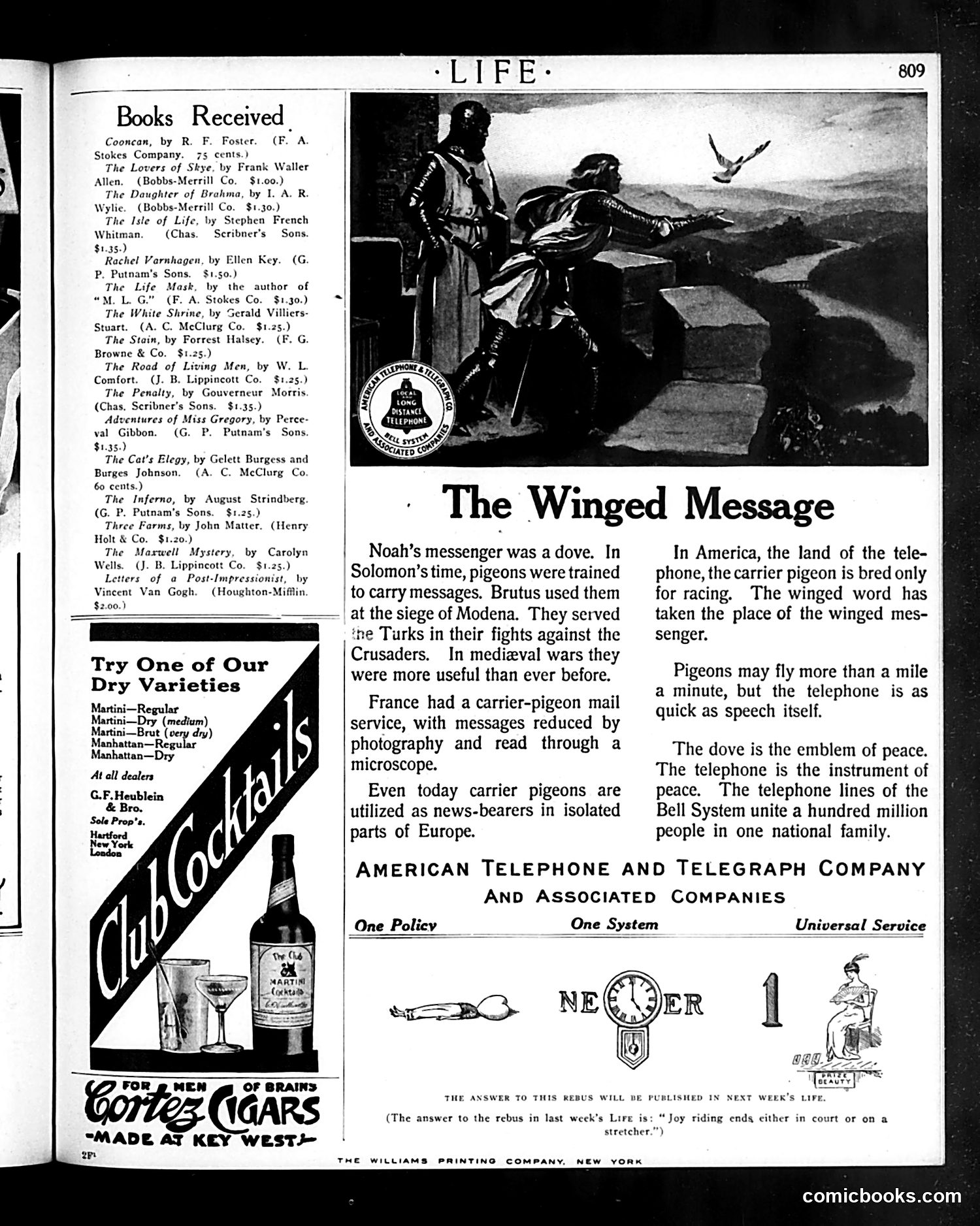
This is primarily an **AT&T corporate advertisement**, not satire. The main image depicts a medieval or classical figure with a dove, illustrating the historical use of carrier pigeons for communication. The text traces pigeons' messaging role from Biblical times through medieval warfare to modern France, then pivots to argue that **America has progressed beyond such primitive methods**. The advertisement's central argument: while other nations still rely on carrier pigeons, America's telephone technology (the "winged message" replaced by electric wires) achieves faster, superior communication. The phrase "the dove is the emblem of peace. The telephone is the instrument of peace" conflates communication technology with universal harmony—a common Progressive-era corporate messaging strategy claiming telephones unite the nation into "one national family." This reflects early 20th-century American technological optimism and AT&T's dominance messaging.
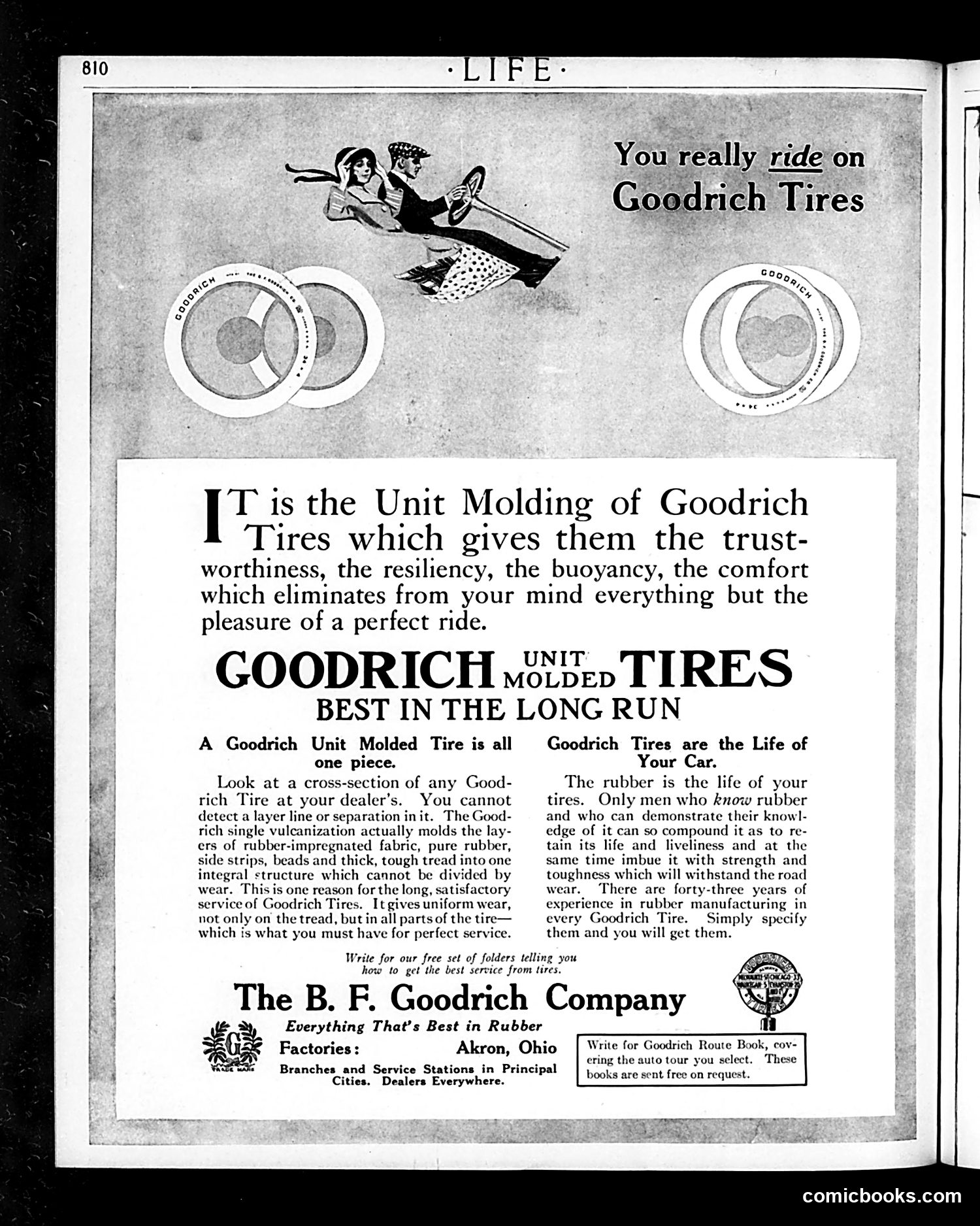
This is primarily a **tire advertisement**, not political satire. The page showcases the B.F. Goodrich Company's "Unit Molded" tire technology. The cartoon at top depicts a woman joyfully riding/flying, illustrating the advertiser's slogan "You really ride on Goodrich Tires"—a pun playing on both automotive travel and the sensation of a smooth, comfortable ride. The illustration emphasizes pleasure and effortlessness. The bulk of the page is marketing copy explaining the tire's construction: it's molded as one integral piece without layer separations, ensuring uniform wear and longevity. The company emphasizes its 43 years of rubber manufacturing expertise. The advertisement concludes with contact information for Goodrich's Akron, Ohio factory and nationwide dealer network. This represents early-20th-century automobile advertising, when tire quality was a significant consumer concern and manufacturers competed partly on technical specifications and brand reliability claims.
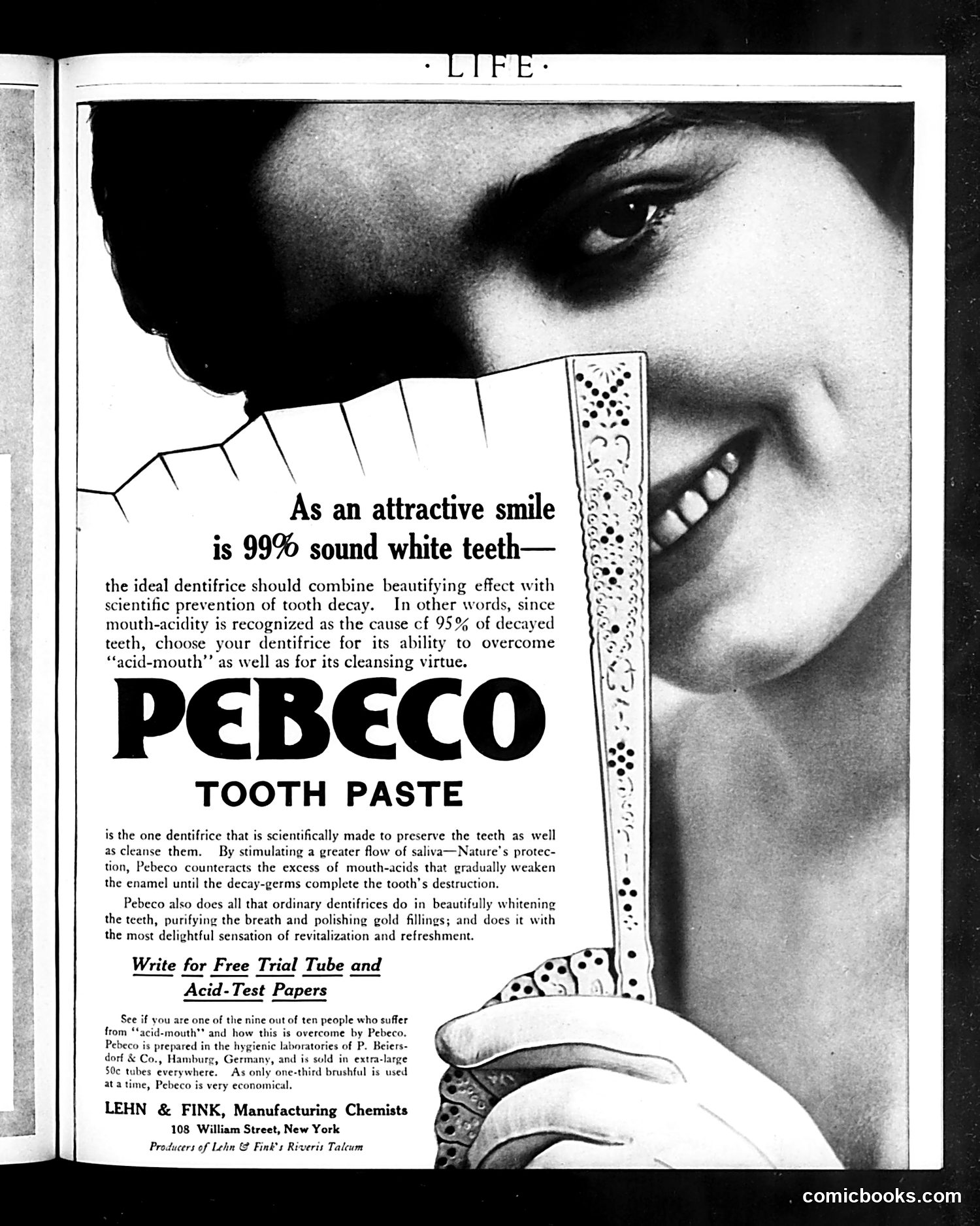
This is **not a cartoon or satire**—it's a straightforward commercial advertisement for Pebeco toothpaste, placed in *Life* magazine. The ad features a close-up photograph of a smiling woman's face, emphasizing white teeth. The marketing pitch claims Pebeco is superior because it addresses "acid-mouth"—the supposed scientific cause of 95% of tooth decay. By stimulating saliva flow, the product supposedly counteracts mouth acids. The ad employs early 20th-century advertising tactics: pseudoscientific claims, a call for a free trial with "acid-test papers," and appeals to both vanity (whitening) and health (decay prevention). The German manufacturer (P. Beiersdorf & Co.) and New York distributor (Lehn & Fink) suggest an imported, premium product. For modern readers, the notable element is the era's credulous acceptance of vague medical claims and the product's emphasis on "scientific" superiority without rigorous evidence by today's standards.
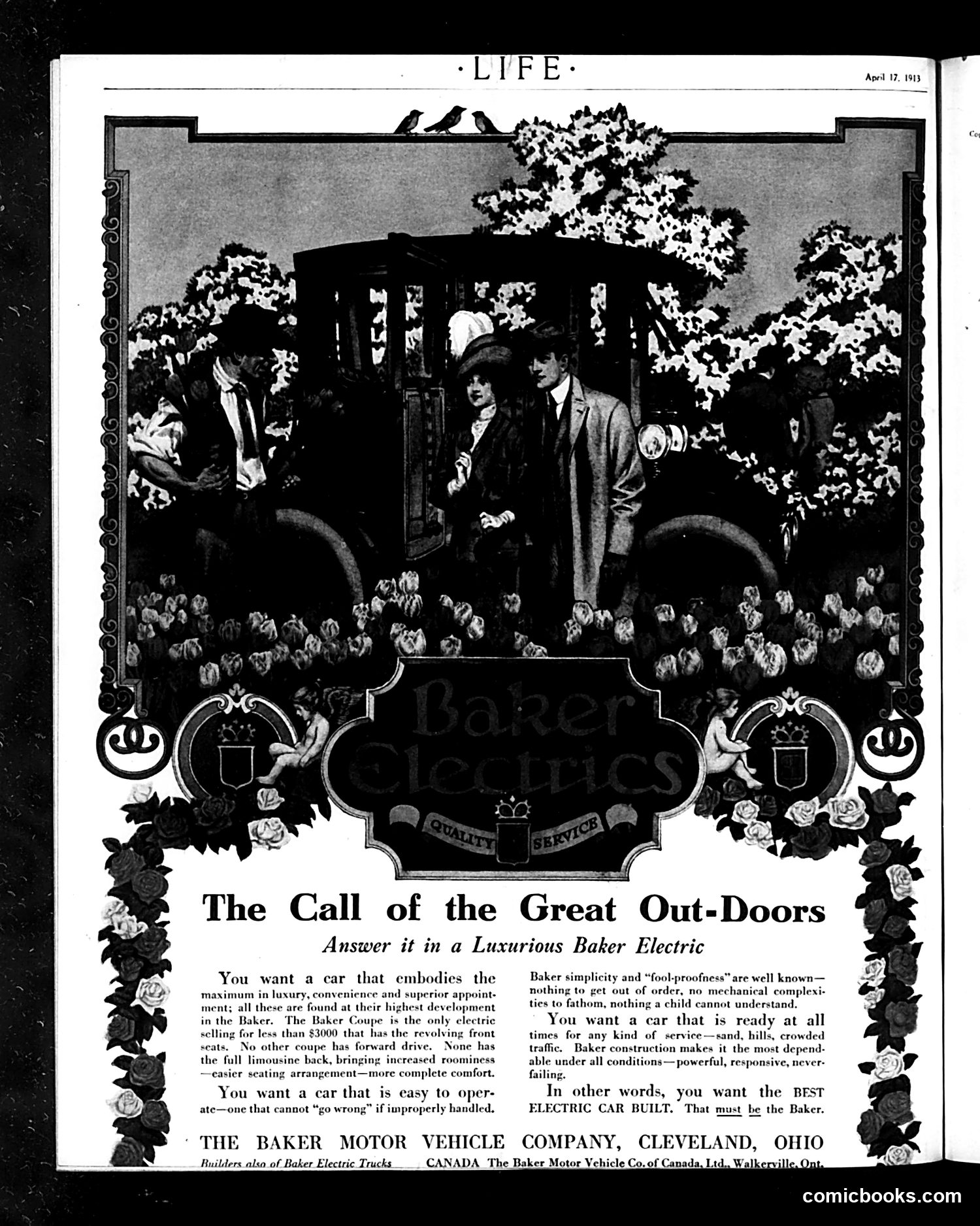
This is primarily an **advertisement, not political satire**. It's a 1913 Baker Electric Motor Company ad promoting their luxury electric automobiles. The illustration shows well-dressed people in an elegant electric car parked in a garden setting with flowering trees and blooming flowers. The imagery emphasizes comfort, luxury, and ease of operation—key selling points for electric cars of that era. The ad's text highlights the Baker Electric's advantages: reliability, comfort, ease of operation ("cannot go wrong"), and readiness for any service condition. The phrase "The Call of the Great Out-Doors" frames automobile ownership as answering nature's appeal. **Historical context**: In 1913, electric cars competed seriously with gasoline vehicles. They appealed to wealthy urban buyers (notably women) who valued quiet operation, cleanliness, and reliability over the mechanical complexity and maintenance demands of early gasoline engines. The elegant garden setting and well-appointed passengers reflect the car's positioning as a status symbol for the affluent.