
Life, 1913-04-17 · page 25 of 52
Life — April 17, 1913 — page 25: what you’re looking at
What you’re looking at
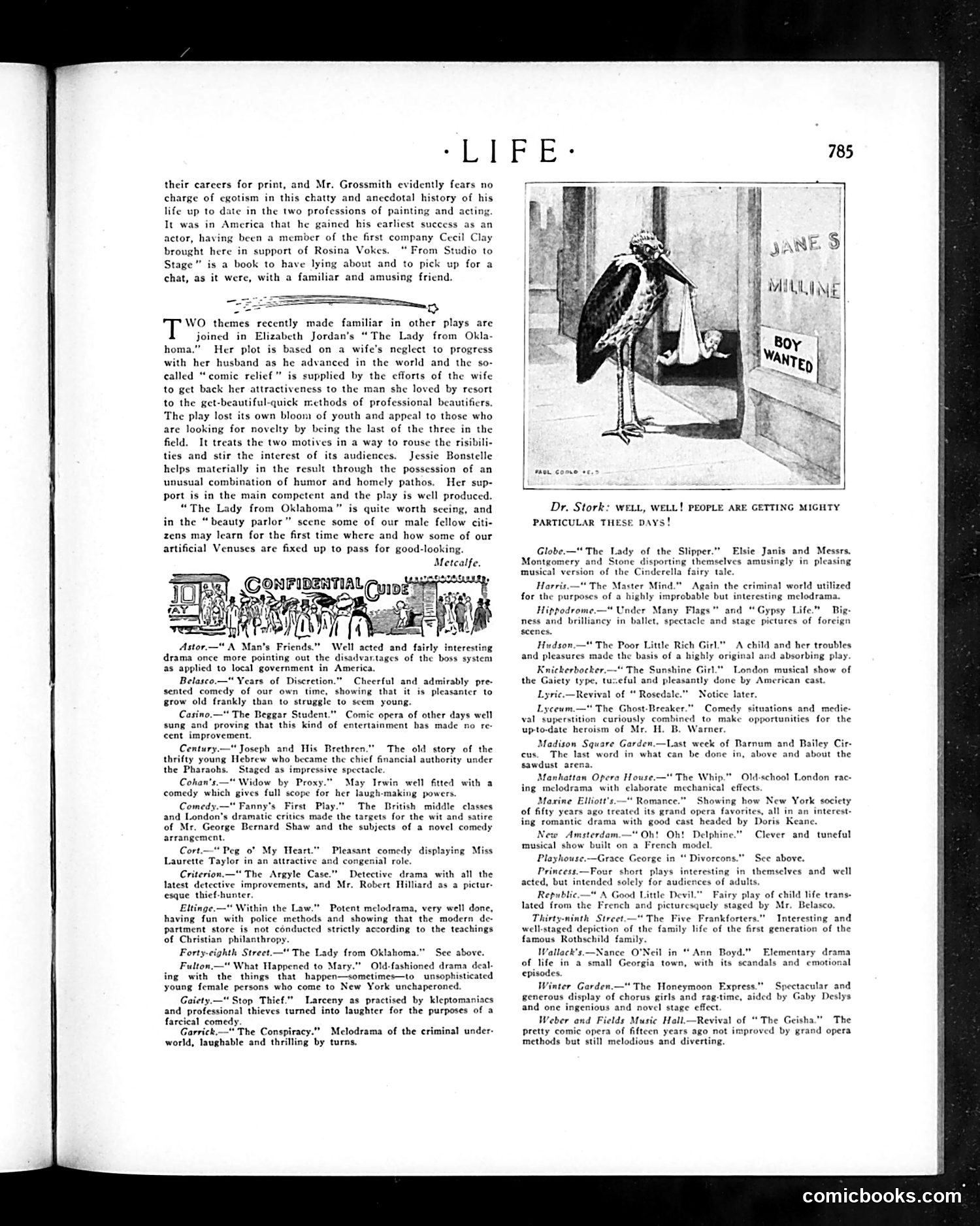
The page is primarily a **theater review section** listing Broadway productions with brief critical assessments. The small cartoon at top right depicts a stork (the "Dr. Stork" caption reference) carrying a baby, with a sign reading "Boy Wanted" and another reading "Jane's Milline[ry]"—likely a visual pun about a business needing help or a woman seeking a child. The reviews cover contemporary plays like "The Lady from Oklahoma" (which receives detailed discussion in the text column), addressing typical early-20th-century theatrical themes: marriage troubles, beauty culture, class conflict, and melodrama. **The satire is social rather than political**: the reviews mock audiences' appetite for sentimental plots and predictable storylines, while the stork cartoon appears to be a lighthearted domestic joke—possibly suggesting a millinery shop owner needs assistance, or playing on period anxieties about unmarried women or childlessness. The page reflects 1910s American theater criticism and popular entertainment priorities.
📄 Transcribed text from this page (OCR, searchable)
Machine-transcribed from the original scan — historical spelling and the odd misread are preserved.
‘LIFE their careers for print, and Mr. Grossmith evidently fears no charge of egotism in this chatty and anecdotal history of his life up to date in the two professions of painting and acting. It was in America that he gained his earliest success as an actor, having been a member of the first company Cecil Clay brought here in support of Rosina Vokes. “From Studio to Stage" is a book to have lying about and to pick up for a chat, as it were, with a familiar and amusing friend. ===, WO themes recently made familiar in other plays are joined in Elizabeth Jordan's “The Lady from Okla- homa.” Her plot is based on a wife’s neglect to progress with her husband as he advanced in the world and the so- called “comic relief” is supplied by the efforts of the wife to get back her attractiveness to the man she loved by resort to the get-beautiful-quick methods of professional beautifiers. The play lost its own bloom of youth and appeal to those who are looking for novelty by being the last of the three in the field. It treats the two motives in a way to rouse the risibili- ties and stir the interest of its audiences. Jessie Bonstelle helps materially in the result through the possession of an unusual combination of humor and homely pathos. Her sup- port is in the main competent and the play is well produced. “The Lady from Oklahoma” is quite worth seeing, and in the “beauty parlor” scene some of our male fellow citi- zens may learn for the first time where and how some of our artificial Venuses are fixed up to pass for good-looking. Metcalfe. “A Man's Friends.” Well acted and fairly interesting drama once more pointing out the disadvartages of the boss system as applied to local government in America. Belasco.—" Years of Discretion.” Cheerful and admirably pre- sented comedy of our own time, showing that it is pleasanter to grow old frankly than to struggle to seem young. Casino.—* The Beggar Student.” Comic opera of other days well sung and proving that this kind of entertainment bas made no re- cent improvement. Century.—" Joseph and His Brethren.” The old story of the thrifty young Hebrew who became the chief financial authority under the Pharaohs. Staged as impressive spectacle. Cohan's.—" Widow by Proxy.” May Irwin well fitted with a comedy which gives full scope for her laugh-making powers. Comedy.—" Fanny's First Play.” The British middle classes and London's dramatic critics made the targets for the wit and satire of Mr. George Bernard Shaw and the subjects of a novel comedy arrangement. Cort.—"* Peg o” My Heart.” Pleasant comedy displaying Miss Laurette Taylor in an attractive and congenial role. Criterion.—" The Argyle Case.” Detective drama with all the latest detective improvements, and Mr. Robert Hilliard as a pictur- esque thief-hunter. Eltinge.—" Within the Law." Potent melodrama, very well done, having fun with police methods and showing that the modern de- partment store is not conducted strictly according to the teachings of Christian philanthr Forty-cighth Street—" The Lady from Oklahoma.” See above. Fulton.—"" What Happened to Mary.” Old-fashioned drama_deal- ing with the things that happen—sometimes—to unsophisticated young female persons who come to New York unchaperoned. Gaiety.—" Stop Thief.” Larceny as practised by kleptomaniacs and professional thieves turned into laughter for the purposes of a farcical comedy. Garrick," The Conspiracy.” Melodrama of the criminal under- world, laughable and thrilling by turns. Dr. Stork: we.t, WELL! PEOPLE ARE GETTING MIGHTY PARTICULAR THESE DAY Globe.—" The Lady of the Slipper.” Elsie Janis and Messrs. Montgomery and Stone disporting themselves amusingly in pleasing musical version of the Cinderella fairy tale. Horris.—" The Master Mind.” Again the criminal world utilized for the purposes of a highly improbable but interesting melodrama. Hippodrome.—" Under Many Flags” and “Gypsy Life.” Big- ness and brilliancy in ballet, spectacle and stage pictures of foreign scenes. Hudson.— The Poor Little Rich Girl.” A child and her troubles and pleasures made the basis of a highly original and absorbing play Knickerbocker." The Sunshine Girl.” London musical show of the Gaiety type, tuneful and pleasantly done by American cast. Lyric.—Revival of “ Rosedale.” Notice later. Lyceum.—" The Ghost-Breaker.” Comedy situations and medie- val superstition curiously combined to make opportunities for the uptodate heroism of Mr. H. B. Warner Madison Square Garden.—Last week of Rarnum and Bailey Cir- cus, The last word in what can be done in, above and about the sawdust arena. Manhattan Opera House.—" The Whip.” Old-school London rac- ing melodrama with elaborate mechanical effects. Maxine Elliott's.—" Romance.” Showing how New York society of fifty years ago treated its grand opera favot all in an interest- ing romantic drama with good cast headed by Doris Keane. New Amsterdam.—" Oh! Oh! Delphine.” Clever and tuneful musical show built on a French model. Playhouse.—Grace George in “ Divorcons.” ce above. Princess.—Four short plays interesting in themselves and well acted, but intended solely for audiences of adults. Republic.—" A Good Little Devil." Fairy play of child life trans. lated from the French and picturesquely staged by Mr. Belasco, Thirty-ninth Street.—" The Five Frankforters.” Intere: well-staged depiction of the family life of the first generation of the famous Rothschild family. Wallack's.—Nance O'Neil in “ Ann Boyd." Elementary of life in a small Georgia town, with its scandals and emoti episodes. Winter Garden.—" The Honeymoon Express." Spectacular and generous display of chorus girls and rag-time, aided by Gab and one ingenious and novel stage effect Weber ond Fields Music Hall,—Revival of “The Geisha.” The pretty comic opera of fifteen years ago not improved by grand opera methods but still melodious and diverting. comicbooks.com