
Life, 1913-04-17 · page 29 of 52
Life — April 17, 1913 — page 29: what you’re looking at
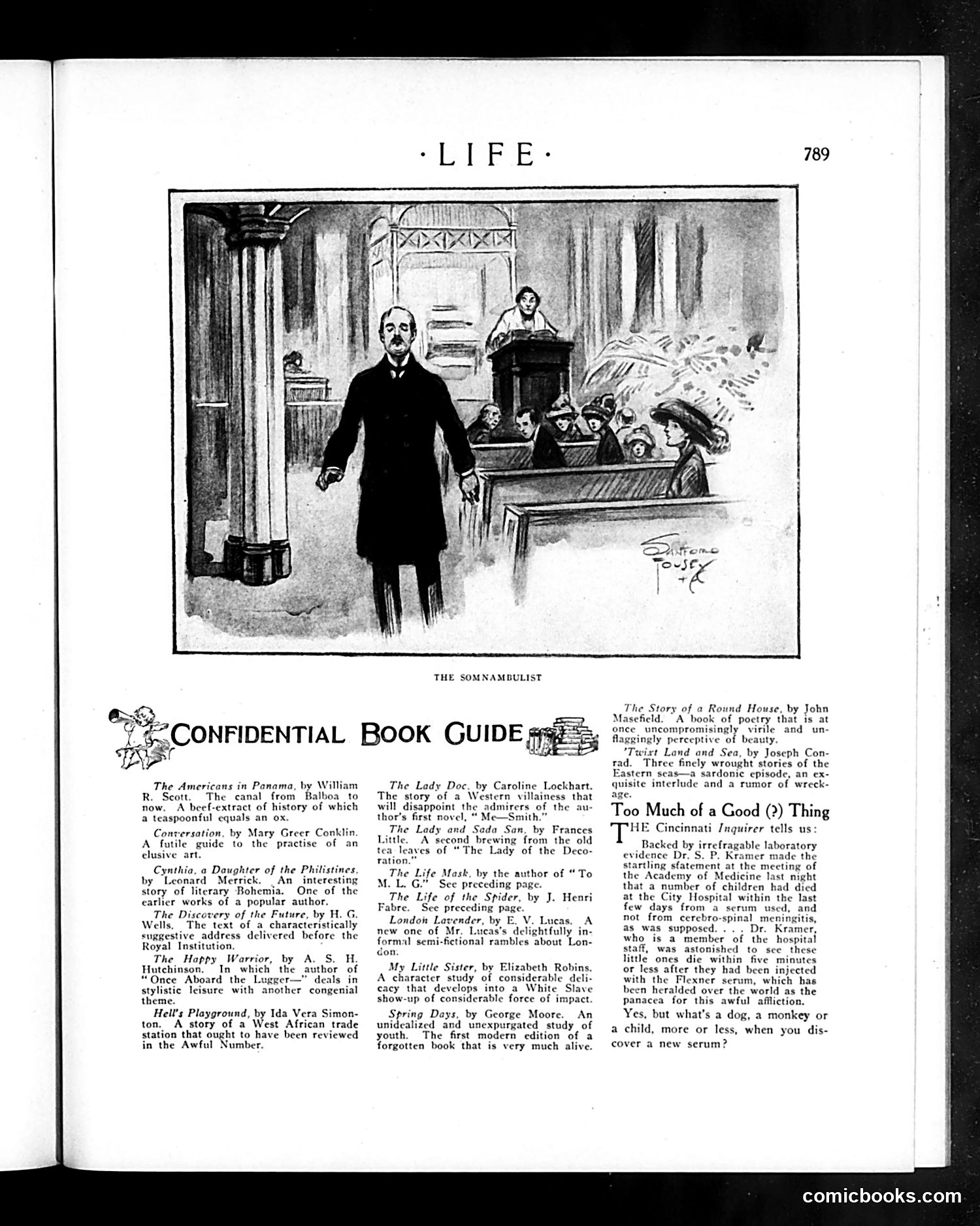
What you’re looking at
The cartoon depicts a courtroom scene where a man in dark clothing stands before a judge's bench. The title "The Somnambulist" (sleepwalker) suggests the joke: the figure appears to be sleepwalking through legal proceedings—literally unconscious or unaware during his trial. The satire targets people who mechanically go through serious situations without genuine engagement or consciousness of what's happening. In the context of a legal trial, it mocks either defendants who seem oblivious to their own jeopardy, or more broadly, the performative nature of courtroom rituals where participants play roles without real awareness. The accompanying "Confidential Book Guide" is a book review section, making this page primarily literary content with an illustrative cartoon.
📄 Transcribed text from this page (OCR, searchable)
Machine-transcribed from the original scan — historical spelling and the odd misread are preserved.
Vi Ace, BS The Americans in Panama, by William R. Scott. The canal from Balboa now. A beef-extract of history of which a teaspoonful equals an ox. Conversation, by Mary Greer Conklin. A futile guide to the practise of an elusive art. Cynthia, a Daughter of the Philistines by Leonard Merrick. An interesting story of literary Bohemia. One of the earlier works of a popular author. The Discovery of the Future, by H. G. Wells, The text of a characteristically suggestive address delivered before the Royal Institution. The Happy Warrior, by A. S. H. Hutchinson. In which’ the author of “Once Aboard the Lugger—" deals in stylistic leisure with another congenial theme. Hell’s Playground, by Ida Vera Simon- ton. A story of a West African trade station that ought to have been reviewed in the Awful Number. THE SOMNAMBULIST 4 CONFIDENTIAL BOOK GUIDE The Lady Doc. by Caroline Lockhart. The story of a Western villainess that will disappoint the admirers of the au- thor’s first novel, “ Me—Smith.”” The Lady and Seda San. by Frances Little. A second brewing from the old tea leaves of “The Lady of the Deco- ration.” The Life Mask, by the author of “To M. L. G.”" Sce preceding page. The Life of the Spider, by J. Henri Fabre. See preceding page. London Lavender, by E. V. Lucas. A new one of Mr. Lucas’s delightfully in f -fictional rambles about Lon- < My Little Sister, by Elizabeth Robins. A character study of considerable deli- cacy that develops into a White Slave show-up of considerable force of impact. Spring Days, by George Moore. An alized and unexpurgated study of youth. The first modern edition of a forgotten book that is very much alive. The Story of a Round House, by John Masefield. A book of poctry that is at once uncompromisingly virile and un- flaggingly perceptive of beauty. ‘Twist Land and Sea, by Joseph Con- rad. Three finely wrought stories of the Eastern seas—a sardonic episode, an ex- quisite interlude and a rumor of wreck- age. Too Much of a Good (?) Thing HE Cincinnati Inquirer tells us: Backed by irrefragable laboratory dence Dr. S. P. Kramer made the startling sfatement at the mecting of the Academy of Medicine last night that a number of children had died at the City Hospital within the last few days from a serum used, and not from cerebro-spinal meningitis, as was supposed... , Dr. Kramer, who is a member of the hospital staff, was astonished to sce these little ones die within five minutes or less after they had been injected with the Flexner serum, which has been heralded over the world as the panacea for this awful affliction. Yes, but what's a dog, a monkey or a child, more or less, when you dis- cover a new serum? comicbooks.com