
Life, 1913-04-17 · page 21 of 52
Life — April 17, 1913 — page 21: what you’re looking at
What you’re looking at
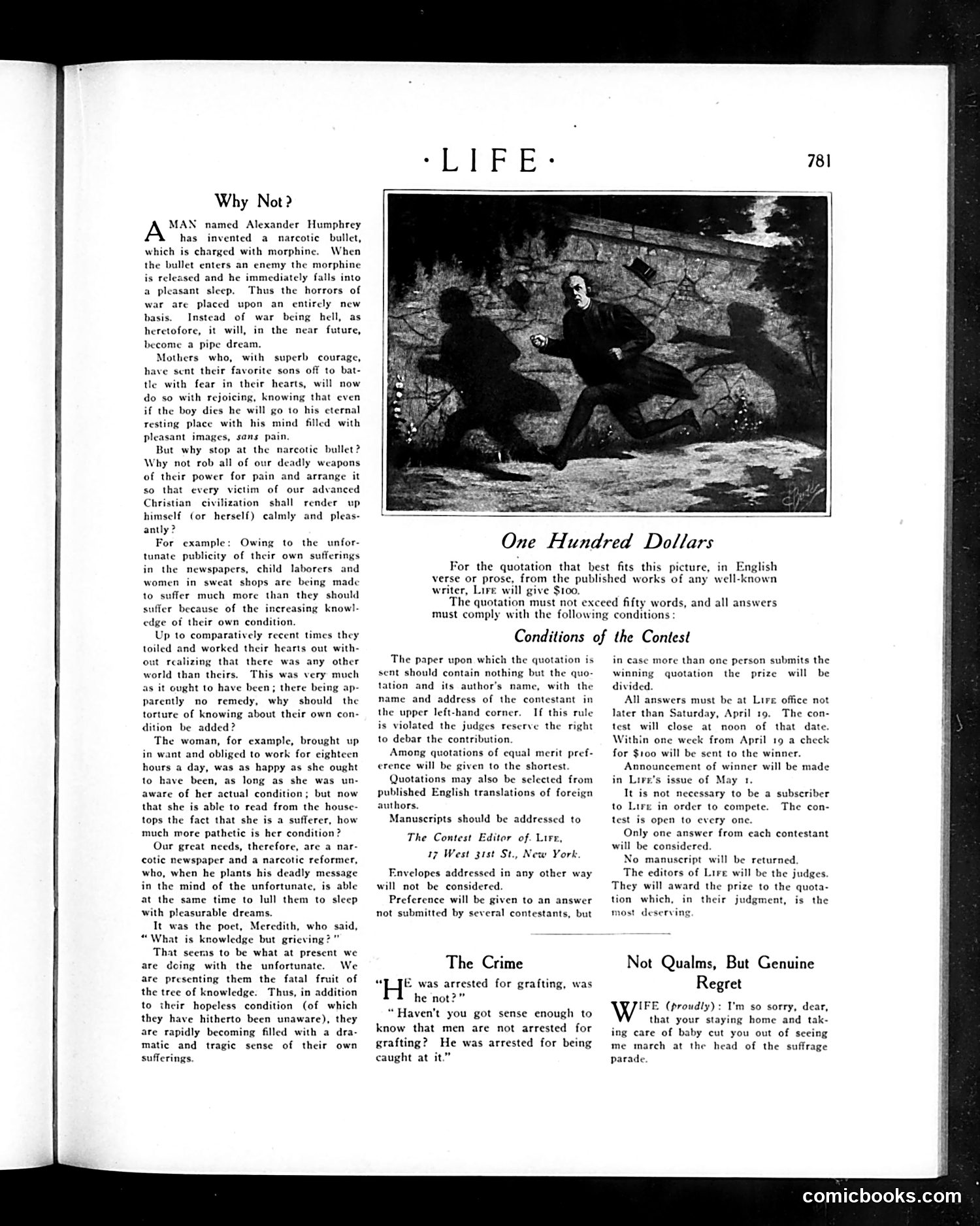
This *Life* magazine page contains satirical social commentary, not a political cartoon. The main essay "Why Not?" uses dark irony to critique complacency about suffering. It proposes Alexander Humphrey's fictional "narcotic bullet"—which puts enemies to sleep rather than killing them—as absurd proof that society should anesthetize the disadvantaged instead of helping them. The author argues that ignorance made child laborers and sweatshop workers "happy," so why burden them with knowledge of their exploitation? By presenting this logic to its logical conclusion, the piece mocks those who oppose reform, suggesting that those who want to maintain the status quo might as well advocate literal narcotics. The photograph captioned "One Hundred Dollars" appears to show people in conversation but lacks clear context. Below, "The Crime" presents a brief joke about arrested grafters (corrupt officials): the punchline is that men aren't punished for *grafting itself*, only for being caught doing it—satirizing institutional corruption's acceptance.
📄 Transcribed text from this page (OCR, searchable)
Machine-transcribed from the original scan — historical spelling and the odd misread are preserved.
Why Not? MAN named Alexander Humphrey has invented a narcotic bullet, which is charged with morphine. When the bullet enters an enemy the morphine is released and he immediately falls imto a pleasant sleep. Thus the horrors of war are placed upon an entirely new basis. Instead of war being hell, as heretofore, it will, in the near future, become a pipe dream. Mothers who, with superb courage, have sent their favorite sons off to bat- tle with fear in their hearts, will now do so with rejoicing, knowing that even if the boy dies he will go to his eternal resting place with his mind filled with pleasant images, sans pain. But why stop at the narcotic bullet? Why not rob all of our deadly weapons of their power for pain and arrange it so that every victim of our advanced Christian civilization shall render up himself (or herself) calmly and pleas- antly? For example: Owing to the unfor- tunate publicity of their own sufferings in the newspapers, child laborers and women in sweat shops are being madc to suffer much more than they should suffer because of the increasing knowl- edge of their own condition. Up to comparatively recent times they toiled and worked their hearts out with- out realizing that there was any other world than theirs. This was very much it ought to have been; there being ap- parently no remedy, why should the torture of knowing about their own con- dition be added? The woman, for example, brought up in want and obliged to work for eighteen hours a day, was as happy as she ought to have been, as long as she was un- aware of her actual condition; but now that she is able to read from the hous tops the fact that she is a sufferer, how much more pathetic is her condition ? Our great needs, therefore, are a nar- cotic newspaper and a narcotic reformer, who, when he plants his deadly message in the mind of the unfortunate, is able at the same time to lull them to sleep with pleasurable dreams. It was the poct, Meredith, who said, “What is knowledge but grieving?" That seems to be what at present we are doing with the unfortunate. We are presenting them the fatal fruit of the tree of knowledge. Thus, in addition to their hopeless condition (of which they ¢ hitherto been unaware), they are rapidly becoming filled with a dra- matic and tragic sense of their own sufferings. One Hundred Dollars For the quotation that best fits this picture, in English verse or prose, from the published works of any’ well-known writer, Lire will give $100. The quotation must not exceed fifty words, and all answers must comply with the following conditions : Conditions of the Contest The paper upon which the quotation is sent should contain nothing but the quo- tation and its author's name, with the name and address of the contestant in the upper left-hand corner. If this rule is violated the judges reserve the right to debar the contribution. Among quotations of equal merit pref- erence will be given to the shortest Quotations may also be selected from published English translations of foreign authors. Manuscripts should be addressed to The Contest Editor of. Lire, 17 West 31st St, New York Envelopes addressed in any other way will not be considered. Preference will be given to an answer not submitted by several contestants, but The Crime E was arrested for grafting, was he not?” “Haven't you got sense enough to know that men are not arrested for grafting? He was arrested for being caught at it.” in case more than one person submits the winning quotation the prize will be divided. All answers must be at Lire office not later than Saturday, April 19. The con- test will close at noon of that date. Within one week from April 19 a check for $100 will be sent to the winner. Announcement of winner will be made in Live's issue of May 1. It is not necessary to be a subscriber to Lire in order to compete. The con- test is open to every one. Only one answer from each contestant will be considered. No manuscript will be returned. The editors of Lire will be the judges. They will award the prize to the quota- tion which, in their judgment, is the most deserving. Not Qualms, But Genuine Regret IFE (proudly): I'm so sorry, dear, that your staying home and tak- ing care of baby cut you out of seeing me march at the head of the suffrage parade. comicbooks.com