
Life, 1913-04-17 · page 24 of 52
Life — April 17, 1913 — page 24: what you’re looking at
What you’re looking at
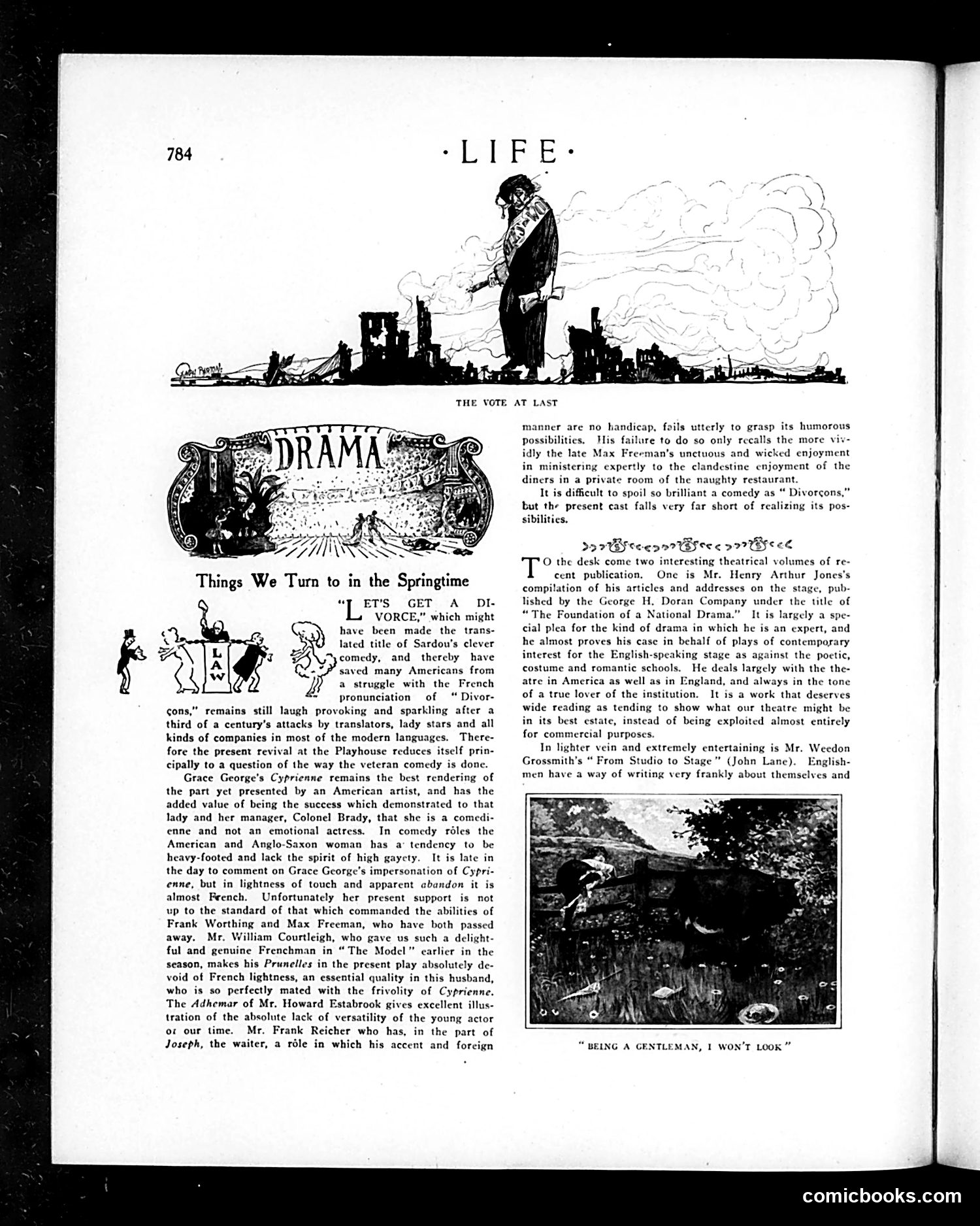
**"The Vote at Last"** (top illustration): This silhouette depicts a large figure casting a ballot over a destroyed industrial landscape—likely referencing women's suffrage. The image suggests the momentous political change represented by women gaining voting rights, shown against ruins symbolizing the upheaval or societal transformation this caused. **"Things We Turn to in the Springtime"**: This section reviews theatrical productions, particularly a revival of the French comedy "Divorçons" ("Let's Get a Divorce"). The critique evaluates the cast's performance, notably praising Grace George's French-style comedic lightness while faulting other actors—particularly William Courtleigh and Frank Reicher—for lacking the requisite sophistication and "French gaiety" the farce demands. The text also briefly mentions two theatrical books by Henry Arthur Jones and Weedon Grossmith about drama and stagecraft. The page reflects early 20th-century American theater culture, where French comedies were popular springtime entertainment, and where performers' ability to capture continental sophistication was a measure of theatrical success.
📄 Transcribed text from this page (OCR, searchable)
Machine-transcribed from the original scan — historical spelling and the odd misread are preserved.
THE VOTE AT LAST Things We Turn to in the Springtime “T ETS GET A DI- VORCE,” which might have been made the trans- lated title of Sardou’s clever Zz comedy, and thereby have & aved many Americans from Z a struggle with the French = pronunciation of “ Divor- cons,” remains still laugh provoking and sparkling after a third of a century's attacks by translators, lady stars and all kinds of companies in most of the modern languages. There- fore the present revival at the Playhouse reduces itself prin- cipally to a question of the way the veteran comedy is done. Grace George's Cyprienne remains the best rendering of the part yet presented by an American artist, and has the added value of being the success which demonstrated to that lady and her manager, Colonel Brady, that she is a comedi- enne and not an emotional actress. In comedy réles the American and Anglo-Saxon woman has a’ tendency to be heavy-footed and lack the spirit of high gaycty. It is late in the day to comment on Grace George's impersonation of Cypri- enne, but in lightness of touch and apparent abandon it is almost French. Unfortunately her present support is not up to the standard of that which commanded the abilities of Frank Worthing and Max Freeman, who have both passed away. Mr. William Courtleigh, who gave us such a delight- ful and genuine Frenchman in “The Model” earlier in the season, makes his Prunelles in the present play absolutely de- void of French lightness, an essential quality in this husband, who is so perfectly mated with the frivolity of Cyprienne. The Adhemar of Mr. Howard Estabrook gives excellent illus- tration of the absolute lack of versatility of the young actor ox our time, Mr. Frank Reicher who has, in the part of Joseph, the waiter, a rle in which his accent and foreign manner are no handicap, foils utterly to grasp its humorous possibilities, His failure to do so only recalls the more viv- idly the late Max Freeman’s unctuous and wicked enjoyment in ministering expertly to the clandestine enjoyment of the diners in a private room of the naughty restaurant. It is difficult to spoil so brilliant a comedy as “ Divorcons,” but the present cast falls very far short of realizing its pos- sibilities. 39 2U een o7 VES ee ¢ 277TH CE O the desk come two interesting theatrical volumes of re- cent publication, One is Mr. Henry Arthur Jones's compilation of his articles and addresses on the stage, pub- lished by the George H, Doran Company under the title of “The Foundation of a National Drama.” It is largely a spe- cial plea for the kind of drama in which he is an expert, and he almost proves his case in behalf of plays of contemporary interest for the English-speaking stage as against the poetic, costume and romantic schools. He deals largely with the the- atre in America as well as in England, and always in the tone of a true lover of the institution, It is a work that deserves wide reading as tending to show what our theatre might be in its best estate, instead of being exploited almost entirely for commercial purposes. In lighter vein and extremely entertaining is Mr. Weedon Grossmith's “ From Studio to Stage” (John Lane). English- men have a way of writing very frankly about themselves and “BEING A GENTLEMAN, 1 WON'T LOOK” comicbooks.com