
Life, 1913-04-17 · page 28 of 52
Life — April 17, 1913 — page 28: what you’re looking at
What you’re looking at
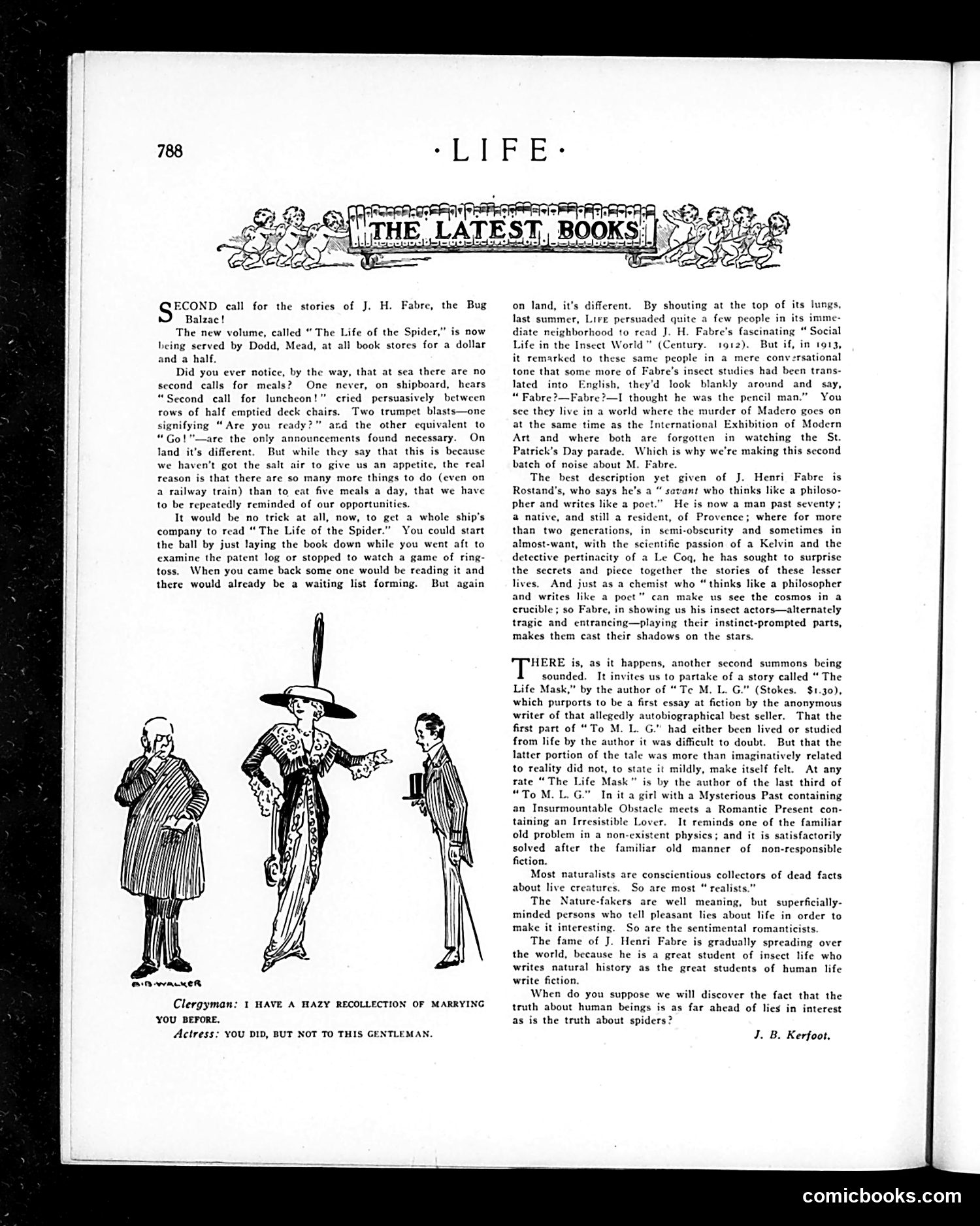
This page reviews recent books, primarily J. H. Fabre's "The Life of the Spider." The article uses a clever conceit: it compares promoting books on land versus at sea, noting that ships announce meals with trumpet blasts requiring no repetition, while land-dwellers need constant reminders due to competing distractions. Life is humorously making a "second call" for Fabre's work. The small cartoon by Cesare Walker depicts a clergyman telling an actress he recalls marrying her before. She replies she did marry him—but not to the gentleman present, implying either infidelity or a previous husband. This is a joke about marriage confusion or adultery. The page also briefly reviews "The Life Mask," a novel by the anonymous author of the bestseller "To M.L.G.," which apparently contained melodramatic plot devices typical of popular fiction.
📄 Transcribed text from this page (OCR, searchable)
Machine-transcribed from the original scan — historical spelling and the odd misread are preserved.
ECOND call for the stories of J. H. Fabre, the Bug Balzac! The new volume, called “ The Life of the Spider,” is now heing served by Dodd, Mead, at all book stores for a dollar and a half. Did you ever notice, by the way, that at sea there ate no second calls for meals? One never, on shipboard, hears “Second call for luncheon!” cried persuasively between rows of half emptied deck chairs. Two trumpet blasts—one nifying “Are you ready?” and the other equivalent to “Go!"—are the only announcements found necessary. On land it’s different. But while they say that this is because we haven't got the salt air to give us an appetite, the real reason is that there are so many more things to do (even on a railway train) than to eat five meals a day, that we have to be repeatedly reminded of our opportunities. It would be no trick at all, now, to get a whole ship's company to read “The Life of the Spider.” You could start the ball by just laying the book down while you went aft to examine the patent log or stopped to watch a game of ring- toss. When you came back some one would be reading it and there would already be a waiting list forming. But again ER wAKER Clergyman: 1 HAVE A HAZY RECOLLECTION OF MARRYING YOU BEFORE. Actress: YOU DID, BUT NOT TO THIS GENTLEMAN. on land, it’s different. By shouting at the top of its lung last summer, Lire persuaded quite a few people in its imm diate neighborhood to read J. H. Fabre’s fascinating “ Social Life in the Insect World” (Century. 1912). But if, in 1913, it remarked to these same people in a mere conversational tone that some more of Fabre’s insect studies had been trans- lated into English, they'd look blankly around and say, Fabre ?—Fabr. I thought he the pencil man.” You see they live in a world where the murder of Madero goes on at the same time as the International Exhibition of Modern Art and where both are forgotten in watching the St. Patrick's Day parade. Which is why we're making this second batch of noise about M. Fabre. The best description yet given of J. Henri Fabre is Rostand’s, who says he’s a “ savant who thinks like a philoso- pher and writes like a poet.” He is now a man past seventy; a native, and still a resident, of Provence; where for more than two gencrations, in semi-obscurity and sometimes in almost-want, with the scientific passion of a Kelvin and the detective pertinacity of a Le Coq, he has sought to surprise the secrets and piece together the stories of these lesser lives. And just as a chemist who “thinks like a philosopher and writes like a poet” can make us see the cosmos in a crucible ; so Fabre, in showing us his insect actors—alternately tragic and entrancing—playing their instinct-prompted parts, makes them cast their shadows on the stars. HERE is, as it happens, another second summons being sounded. It invites us to partake of a story called “ The Life Mask,” by the author of “Tc M. L. G.” (Stokes. $1.30), which purports to be a first essay at fiction by the anonymous writer of that allegedly autobiographical best seller. That the first part of “To M. L. G." had either been lived or studied from life by the author it was difficult to doubt. But that the latter portion of the tale was more than imaginatively related to reality did not, to state it mildly, make itself felt. At any rate “The Life Mask" is by the author of the last third of “To M.L.G.” In it a girl with a Mysterious Past containing an Insurmountable Obstacle meets a Romantic Present con- taining an Irresistible Lover. It reminds one of the familiar old problem in a non-existent physics; and it is satisfactorily solved after the familiar old manner of non-responsible fiction. Most naturalists are conscientious collectors of dead facts about live creatures. So are most “ realists.” The Nature-fakers are well meaning, but superficially- minded persons who tell pleasant lies about life in order to make it interesting. So are the sentimental romanticists. The fame of J. Henri Fabre is gradually spreading over the world, because he is a great student of insect life who writes natural history as the great students of human life write fiction. When do you suppose we will discover the fact that the truth about human beings is as far ahead of lies in interest as is the truth about spiders? J. B. Kerfoot. comicbooks.com