
Life, 1913-04-17 · page 17 of 52
Life — April 17, 1913 — page 17: what you’re looking at
What you’re looking at
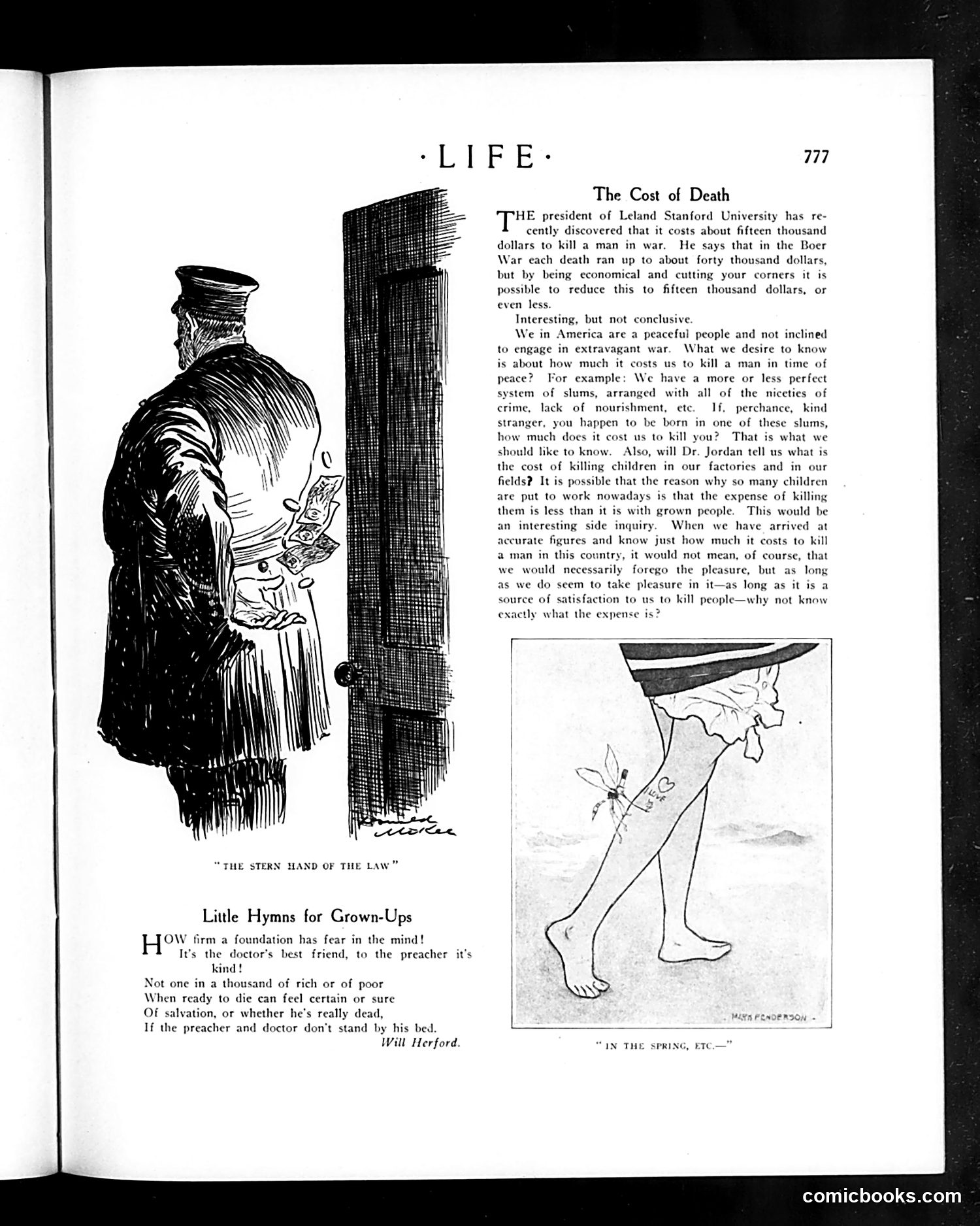
**Main Article: "The Cost of Death"** This satirical piece critiques the Stanford University president's calculation that war kills cost $15,000 per death. The author pivots sharply to expose American hypocrisy: while condemning war's expense, America cheaply kills its own poor through systemic neglect—slums, malnutrition, child factory labor. The bitter irony suggests these domestic deaths are even more economical than battlefield ones, yet receive no moral outcry. **Left Cartoon: "The Stern Hand of the Law"** A police officer or judge figure stands beside a prison tower, holding money. This likely represents judicial/law enforcement corruption or the financial machinery of the justice system exploiting the poor. **Right Cartoon: "In the Spring, Etc."** A barefoot, impoverished child in tattered clothing. Paired with the main article's discussion of child labor deaths, this visualizes the human cost of industrial exploitation. **Overall message:** American society condemns foreign war deaths while ignoring—even profiting from—the preventable deaths of its poorest citizens.
📄 Transcribed text from this page (OCR, searchable)
Machine-transcribed from the original scan — historical spelling and the odd misread are preserved.
777 The Cost of Death HE president of Leland Stanford University has re- cently discovered that it costs about fifteen thousand dollars to kill a man in war. He says that in the Boer War each death ran up to about forty thousand dollars, but by being economical and cutting your corners it is possible to reduce this to fifteen thousand dollars, or even less. Interesting, but not conclusive. We in America are a peaceful people and not inclined to engage in extravagant war. What we desire to know is about how much it costs us to kill a man in time of peace? For example: We have a more or less perfect system of slums, arranged with all of the niceties of crime, lack of nourishment, ete. If. perchance, kind stranger, you happen to be born in one of these slums, how much does it cost us to kill you? That is what we should like to know. Also, will Dr. Jordan tell us what is the cost of killing children in our factories and in our fields? It is possible that the reason why so many children are put to work nowadays is that the expense of killing them is less than it is with grown people. This would be an interesting side inquiry. When we have arrived at accurate figures and know just how much it costs to kill a man in this country, it would not mean, of course, that we would necessarily forego the pleasure, but as long as we do seem to take pleasure in it—as long as it is a source of satisfaction to us to kill people—why not know exactly what the expense is? [ “THE STERN HAND OF THE LAW” Little Hymns for Grown-Ups OW firm a foundation has fear in the mind! It's the doctor's best friend, to the preacher it’s kind! Not one in a thousand of rich or of poor When ready to die can feel certain or sure Of salvation, or whether he’s really dead, If the preacher and doctor don’t stand by his bed Will Herford. “IN THE SPRING, ETC—" comicbooks.com