
Life, 1913-04-17 · page 41 of 52
Life — April 17, 1913 — page 41: what you’re looking at
What you’re looking at
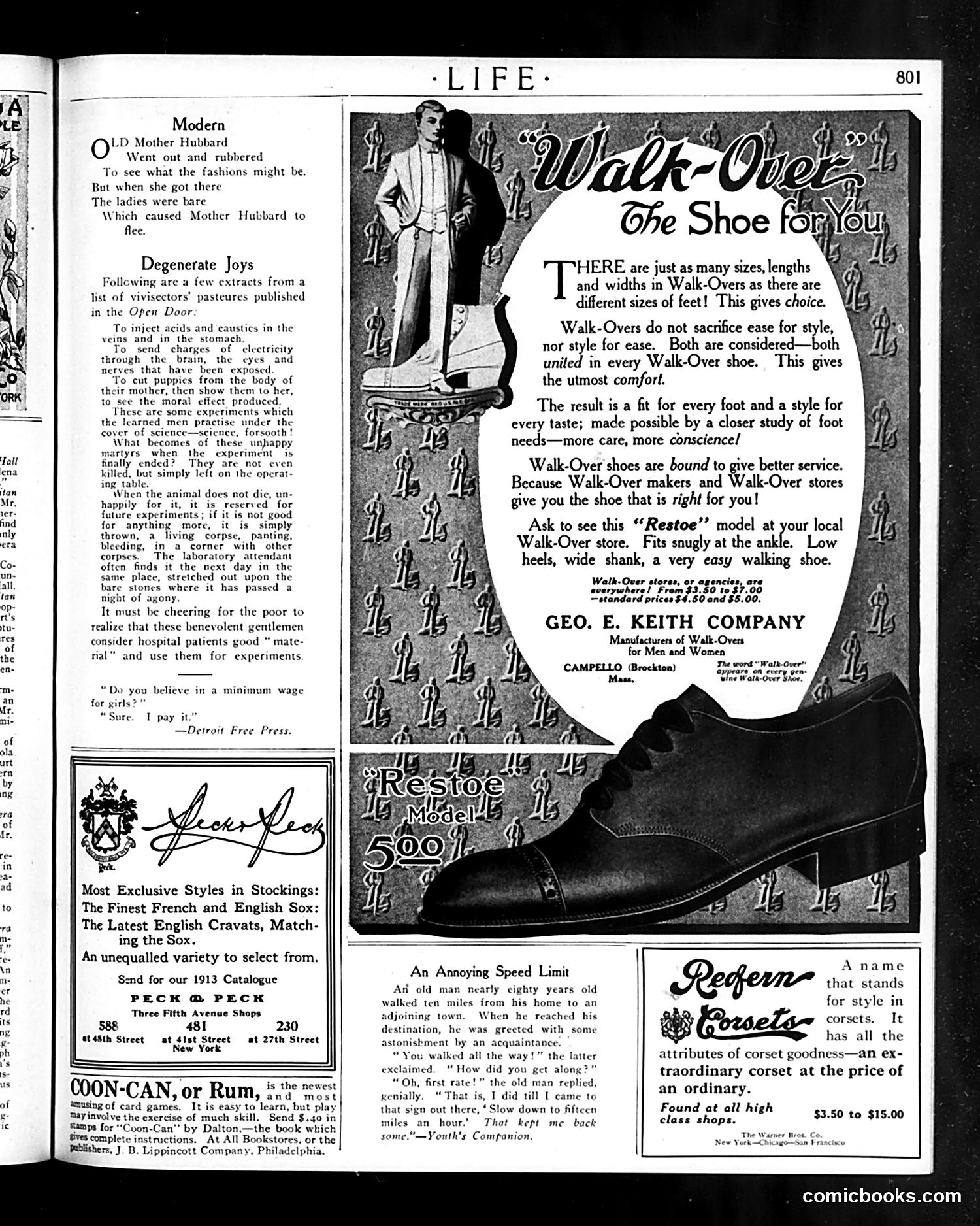
This page mixes satirical poetry, social commentary, and period advertisements typical of early 1900s *Life* magazine. **"Modern Mother Hubbard"** is a brief satirical poem about changing fashion—specifically women's increasingly bare or revealing clothing. It uses the nursery rhyme format to mock how shocked an old-fashioned woman (Mother Hubbard) would be at contemporary styles. **"Degenerate Joys"** criticizes unethical medical experimentation on animals, describing vivisection practices without anesthesia or humane treatment. The piece condemns both the cruelty and the use of poor hospital patients as experimental "material"—reflecting early-1900s anxieties about medical ethics. The page also includes standard period advertising (stockings, shoes, corsets) and a humor anecdote about a speed-limit sign. The overall tone reflects *Life*'s role as a publication combining social satire with consumer culture and light humor, aimed at educated middle-class readers concerned with modern morality and fashion.
📄 Transcribed text from this page (OCR, searchable)
Machine-transcribed from the original scan — historical spelling and the odd misread are preserved.
Modern LD Mother Hubbard Went out and rubbered To see what the fashions might be. But when she got there The ladies were bare Which caused Mother Hubbard to flee. Degenerate Joys ig are a few extracts from a ectors’ pasteures published in the Open Door To inject acids and caustics in the a omach, of clectricity through the brain, the cyes and nerves that have been exposed. To cut puppies from the body of their mother, then show them to her, to see the moral eff These ate some ex, the learned me cover of scien ef forsooth! What becomes of these unhappy martyrs when the experiment is finally ended? They are not even killed, but simply left on the operat- ing table. When the animal does not di happily for it, it is reserved’ for future experiments; if it is not good for anything more, it is simply thrown, a living corpse, panting, bleeding, in a corner with other corpses. The laboratory attendant often finds it the next day in the same place, stretched out upon the bare stones where it has passed a night of agony. It must be cheering for the poor to realize that these benevolent gentlemen consider hospital patients good “ mate- rial" and use them for experiments. “Do you believe in a minimum wage for girls?” “Sure. 1 pay it.” —Detroit Free Press. Most Exclusive Styles in Stockings: The Finest French and English Sox: | The Latest English Cravats, Match- ing the Sox. An unequalled variety to select from. Send for our 1913 Catalogue PECK @ PECK Three Fifth Avenue Shops 481 230 |] st 48th Street at 41st Street at 27th Street New York is the newest , ‘AN, or Run, *,.h° s**t Smusing of card games. It is easy to learn, but play Mayinvolve the exercise of much skill. Send $.40 in Samps for “Coon-Can" by Dalton,—the book which res compl instructions. At All Bookstores, or the Publishers, J. B. Lippincott Company, Philadelphia, HERE are just as many sizes, lengths and widths in Walk-Overs as there are different sizes of feet! This gives choice. Walk-Overs do not sacrifice ease for style, nor style for ease. Both are considered—both united in every Walk-Over shoe. This gives the utmost comfort. The result is a fit for every foot and a style for every taste; made possible by a closer study of foot needs—more care, more conscience! Walk-Over shoes are bound to give better service. Because Walk-Over makers and Walk-Over stores give you the shoe that is right for you! Ask to see this ““Restoe’’ model at your local Walk-Over store. Fits snugly at the ankle. Low heels, wide shank, a very easy walking shoe. Watk-Over stores, or agencies, are ‘rom $3.50 to $7.00 prices $4.50 and $5.00. GEO. E. KEITH COMPANY Manufacturers of Walk-Overs for Men and Women cord “Wal CAMPELLO (Brockton) posers on corre ome Mass, ‘lne Waln-Over Shor. An Annoying Speed Limit A name Ati old man nearly eighty years old that stands walked ten miles from his home to an | for style in adjoining town. When he reached his corsets. It destination, he was greeted with some aoe astoniskment by an acquaintance. has all the “You walked all the way!” the latter attributes of corset goodness—an ex- exclaimed. “How did you get along? '| traordinary corset at the price of “Oh, first rate!” the old man repli " genially, “That is, I did till I came to an ordinary. that sign out there, ‘Slow down to fifteen Found at all high miles an hour.’ That kept me back hi $3.50 to $15.00 some."—Youth's Companion, comicbooks.com