
Life, 1913-04-17 · page 12 of 52
Life — April 17, 1913 — page 12: what you’re looking at
What you’re looking at
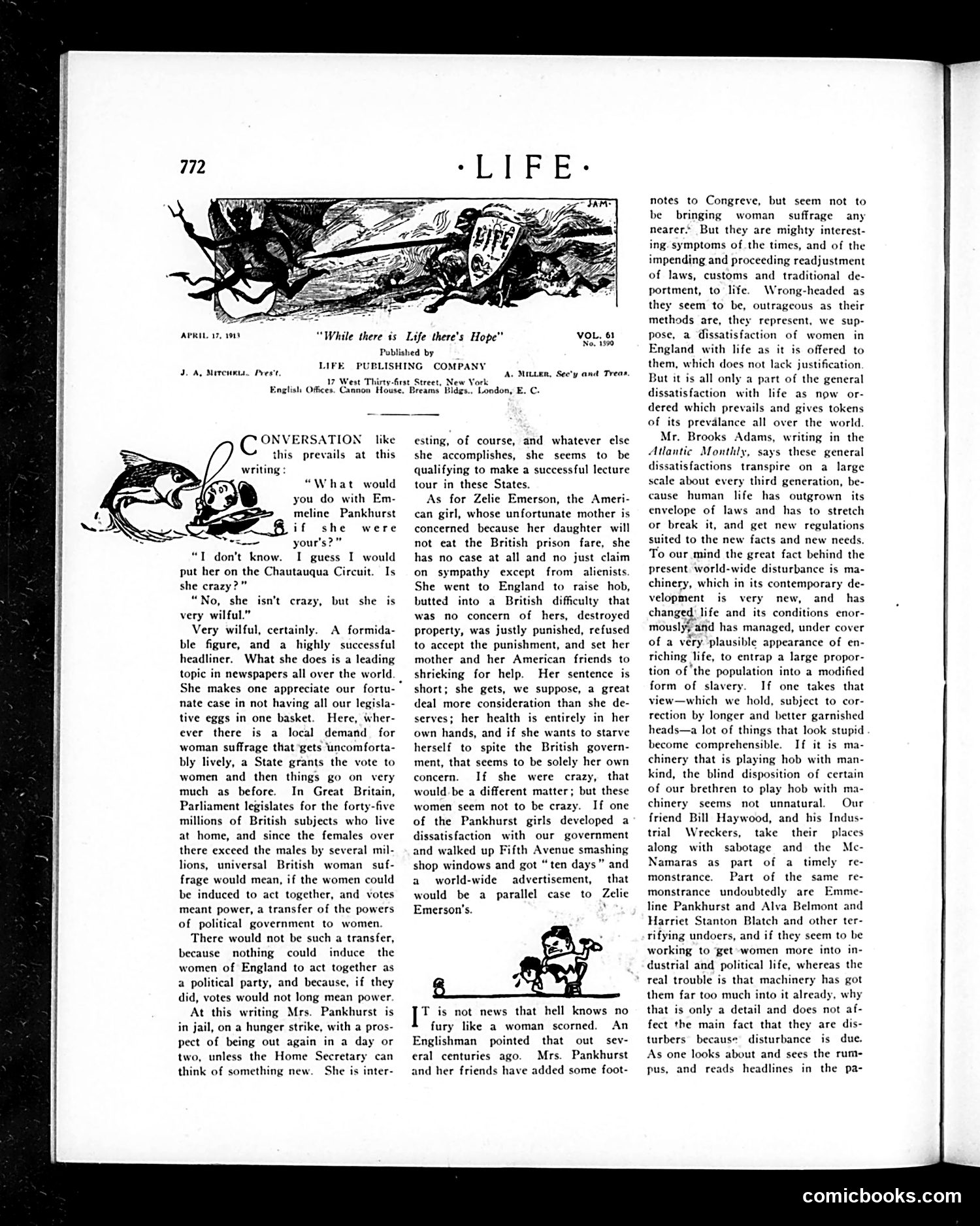
The page features a satirical article addressing women's suffrage and political activism. The main text discusses **Emmeline Pankhurst**, the British suffragist leader, who is at that moment imprisoned in jail on a hunger strike—a tactic mentioned as imminent in the article. The opening illustration ("While there is Life there's Hope") depicts a classical female allegorical figure, likely representing either Liberty or Life itself. The article's central "Conversation" section debates whether giving women the vote would be revolutionary. The author argues that contrary to fears, women's suffrage wouldn't fundamentally destabilize British political institutions, though it would represent a significant democratic expansion. The satire critiques both anti-suffrage fears as exaggerated and some militant suffragists' methods as counterproductive to their cause.
📄 Transcribed text from this page (OCR, searchable)
Machine-transcribed from the original scan — historical spelling and the odd misread are preserved.
17, 1918 “While there is Life there's Hope" Published by LIFE West Thirty. J. A, Merounis. Pres’ PUBLISHING COMPANY A. MILLER, See'y and Treas. st Street, New York English Offices. Cannon House. Breams’ Bldgs., London, like this ONVERSATION this prevails at writing : “What would you do with Em- meline Pankhurst if he were your's?" I guess I would “I don’t know. put her on the Chautauqua Circuit. Is she crazy?” “No, she isn’t crazy, but she is very wilful.” Very wilful, certainly. A formida- ble figure, and a highly successful headliner. What she does is a leading topic in newspapers all over the world She makes one appreciate our fortu- nate case in not having all our legis: tive eggs in one basket. Here, wher- ever there is a local demand for woman suffrage that gets uncomforta- bly lively, a State grants the vote to women and then things go on very much as before. In Great Britain, Parliament legislates for the forty-five millions of British subjects who live at home, and since the females over there exceed the males by several mil- lions, universal British woman suf- frage would mean, if the women could be induced to act together, and votes meant power, a transfer of the powers of political government to women. There would not be such a transfer, because nothing could induce the women of England to act together as a political party, and because, if they did, votes would not long mean power. At this writing Mrs. Pankhurst is in jail, on a hunger strike, with a pros- pect of being out again in a day or two, unless the Home Secretary can think of something new. She is inter- esting, of course, and whatever else she accomplishes, she seems to be qualifying to make a successful lecture tour in these States. As for Zelie Emerson, the Ameri- can girl, whose unfortunate mother is concerned because her daughter will not eat the British prison fare, she has no case at all and no just claim on sympathy except from alienists. She went to England to raise hob, butted into a British difficulty that was no concern of hers, destroyed property, was justly punished, refused to accept the punishment, and set her mother and her American friends to shrieking for help. Her sentence is short; she gets, we suppose, a great deal more consideration than she de- serves; her health is entirely in her own hands, and if she wants to starve herself to spite the British govern- ment, that seems to be solely her own concern. If she were crazy, that would be a different matter; but these women seem not to be crazy. If one of the Pankhurst girls developed a dissatisfaction with our government and walked up Fifth Avenue smashing shop windows and got “ten days” and a world-wide advertisement, that would be a parallel case to Zelie Emerson's. T is not news that hell knows no fury like a woman scorned. An Englishman pointed that out sev- eral centuries ago. Mrs. Pankhurst and her friends have added some foot- notes to Congreve, but seem not to be bringing woman suffrage any nearer But they are mighty interest- ing. symptoms of the times, and of the impending and proceeding readjustment of laws, customs and traditional de- portment, to life. Wrong-headed as they seem to be, outrageous as their methods are, they represent, we sup- pose, a dissatisfaction of women in England with life as it is offered to them, which does not lack justification. But it is all only a part of the general dissatisfaction with life as now or- dered which prevails and gives tokens of its prevdlance all over the world. Mr. Brooks Adams, writing in the Atlantic Monthly, says these general dissatisfactions transpire on a large scale about every third generation, be- cause human life has outgrown. its envelope of laws and has to stretch or break it, and get new regulations suited to the new facts and new needs. To our mind the great fact behind the present world-wide disturbance is ma- chinery, which in its contemporary de- velopment is very new, and has changed’ life and its conditions enor- mouslyy and has managed, under cover of a very plausible appearance of en- tiching life, to entrap a large propor- tion ofthe population into a modified form of slavery. If one takes that view—which we hold, subject to cor- rection by longer and better garnished heads—a lot of things that look stupid become comprehensible. If it is ma- chinery that is playing hob with man- kind, the blind disposition of certain of our brethren to play hob with ma- chinery seems not unnatural. Our friend Bill Haywood, and his Indus- trial Wreckers, take their places along with sabotage and the Mc- Namaras as part of a timely re- monstrance. Part of the same re- monstrance undoubtedly are Emme- line Pankhurst and Alva Belmont and Harriet Stanton Blatch and other ter- rifying undoers, and if they seem to be working to ‘get women more into in- dustrial and political life, whereas the real trouble is that machinery has got them far too much into it already, why that is only a detail and does not af- fect the main fact that they are dis- turbers because disturbance is due. As one looks about and sees the rum- pus, and reads headlines in the pa- comicbooks.com