
Life, 1913-04-17 · page 49 of 52
Life — April 17, 1913 — page 49: what you’re looking at
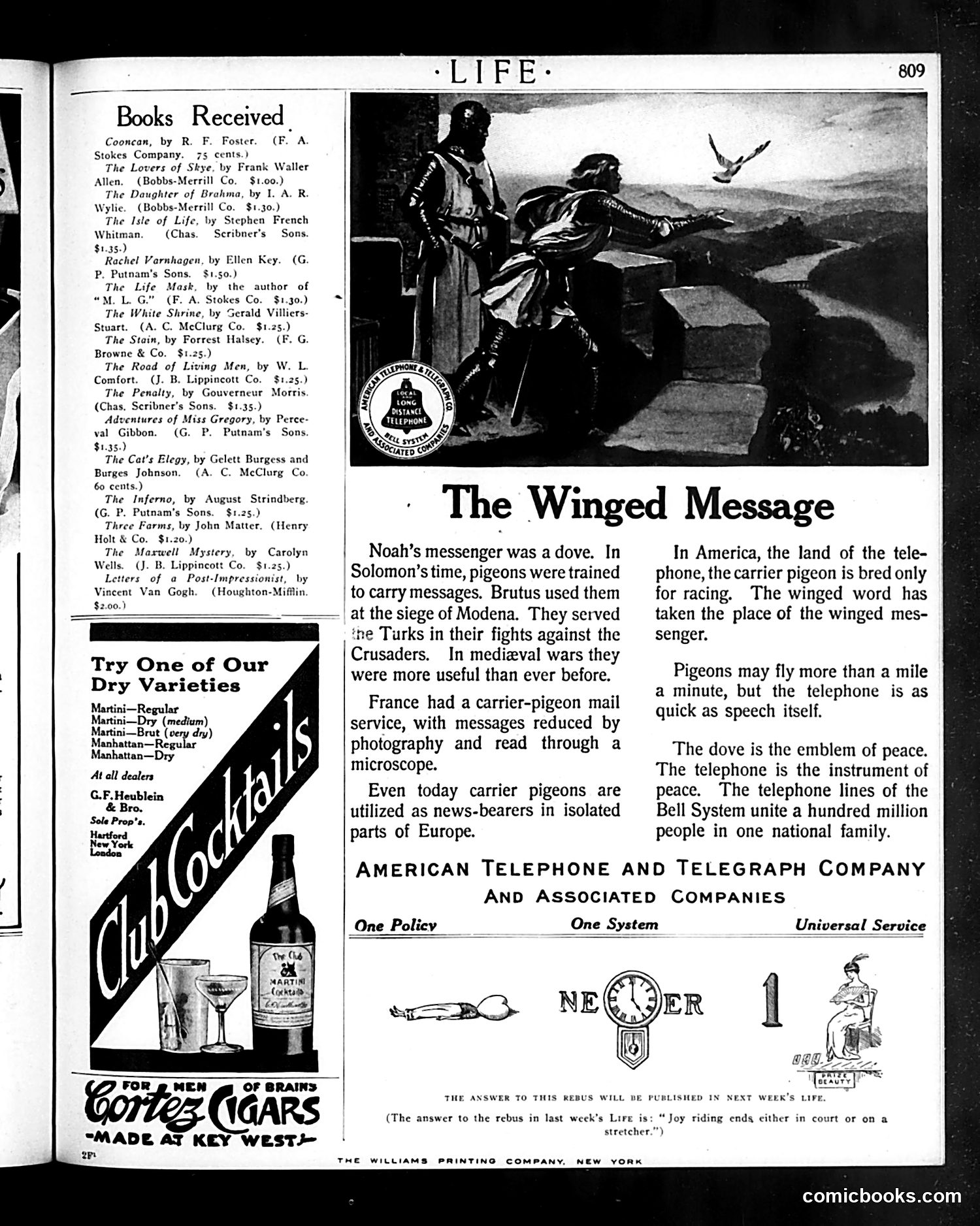
What you’re looking at
This is primarily an **AT&T corporate advertisement**, not satire. The main image depicts a medieval or classical figure with a dove, illustrating the historical use of carrier pigeons for communication. The text traces pigeons' messaging role from Biblical times through medieval warfare to modern France, then pivots to argue that **America has progressed beyond such primitive methods**. The advertisement's central argument: while other nations still rely on carrier pigeons, America's telephone technology (the "winged message" replaced by electric wires) achieves faster, superior communication. The phrase "the dove is the emblem of peace. The telephone is the instrument of peace" conflates communication technology with universal harmony—a common Progressive-era corporate messaging strategy claiming telephones unite the nation into "one national family." This reflects early 20th-century American technological optimism and AT&T's dominance messaging.
📄 Transcribed text from this page (OCR, searchable)
Machine-transcribed from the original scan — historical spelling and the odd misread are preserved.
Books Received. Cooncan, by R. F. Foster. (F. A. Stokes Company. 75 cents.) The Lovers of Skye, by Frank Waller Allen. (Bobbs-Merrill Co. $1.00.) The Daughter of Brahma, by I. A. R. Wylie. (Bobbs-Merrill Co. $1.30.) The Isle of Life, by Stephen French Whitman. (Chas. Scribner’s Sons. $1.35-) Rachel Varnhagen, by Ellen Key. (G. P. Putnam's Sons. $1.50.) The Mask, by the author of “ML. G.” (F. A. Stokes Co. $1.30.) The White Shrine, by Gerald Villiers- Stuart. (A. C. McClurg Co. $1.25.) The Stain, by Forrest Halsey. (F. G. Browne & Co. Comfort. (J. B. Lippincott Co. $1.25.) The Penalty, by Gouverneur Morris, (Chas. Scribner's Sons. $1.35.) Adventures of Miss Gregory, by Perce- val Gibbon. (G. P. Putnam's Sons. $1.35.) The Cat's Elegy, by Gelett Burgess and Burges Johnson. (A. C. McClurg Co, 60 cents.) The Inferno, by August Strindberg (G. P. Putnam's Sons. $1.25.) Three Farms, by John Matter, (Henry Holt & Co. $1.20.) The Maxwell Mystery, by Carolyn Wells. (J. B. Lippincott Co. $1.25.) Letters of a Post-Impressionist, by Vincent Van Gogh. (Houghton-Mifflin. $2.00.) Noah’s messenger was a dove. In Solomon’s time, pigeons were trained | to carry messages. Brutus used them Try One of Our Dry Varieties Lear A ana rtini—Brut (ves Manhattan Regular hattan—Dry At all dealers G.F.Heublein & Bro, at the siege of Modena. They served tne Turks in their fights against the Crusaders. In medizval wars they were more useful than ever before. France had a carrier-pigeon mail service, with messages reduced by photography and read through a microscope. Even today carrier pigeons are utilized as news-bearers in isolated parts of Europe. ' The Winged Message In America, the land of the tele- phone, the carrier pigeon is bred only for racing. The winged word has taken the place of the winged mes- senger. Pigeons may fly more than a mile a minute, but the telephone is as quick as speech itself. The dove is the emblem of peace. The telephone is the instrument of peace. The telephone lines of the Bell System unite a hundred million people in one national family. AMERICAN TELEPHONE AND TELEGRAPH COMPANY AND ASSOCIATED COMPANIES _One System One Policy Universal Service NEN OF BRAINS CIGARS “MADE AT KEY WEST bia THE ANSWER TO THIS REBUS WILL BE PUBLISHED IN NEXT WEEK'S LIFE (The answer to the rebus in last week's Lire is: “ Joy riding ends either in court or on a stretcher.”) THE WILLIAMS PRINTING COMPANY, NEW YORK comicbooks.com