
A complete issue · 48 pages · 1913
Life — February 6, 1913
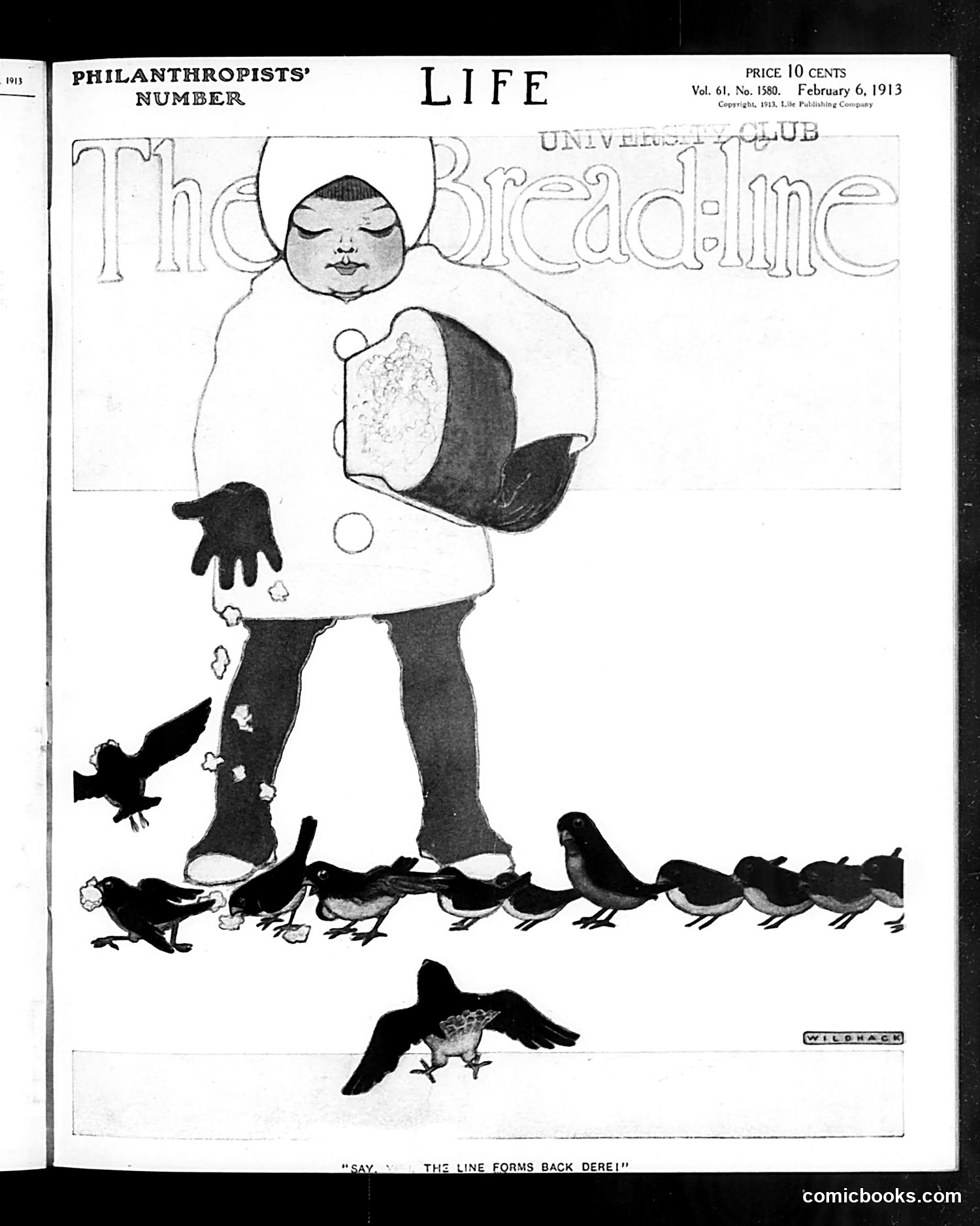
This is the cover of Life magazine's "Philanthropists' Number" from February 6, 1913. The cartoon satirizes wealthy philanthropists through the image of a large figure in winter clothing holding a bag of bread, surrounded by birds at ground level. The caption reads "Say—the line forms back here!" The satire suggests that wealthy donors present charity as benevolent and orderly, yet the crowded, desperate scramble of birds depicted here reveals the reality: charity dispensed to masses of needy people resembles animals competing for scraps rather than dignified assistance. The artist (signed "Cesare") critiques how philanthropists' public generosity obscures the inadequacy and demeaning nature of the aid provided. This reflects Progressive Era skepticism toward wealthy donors and suggests systemic poverty required more than charitable handouts.
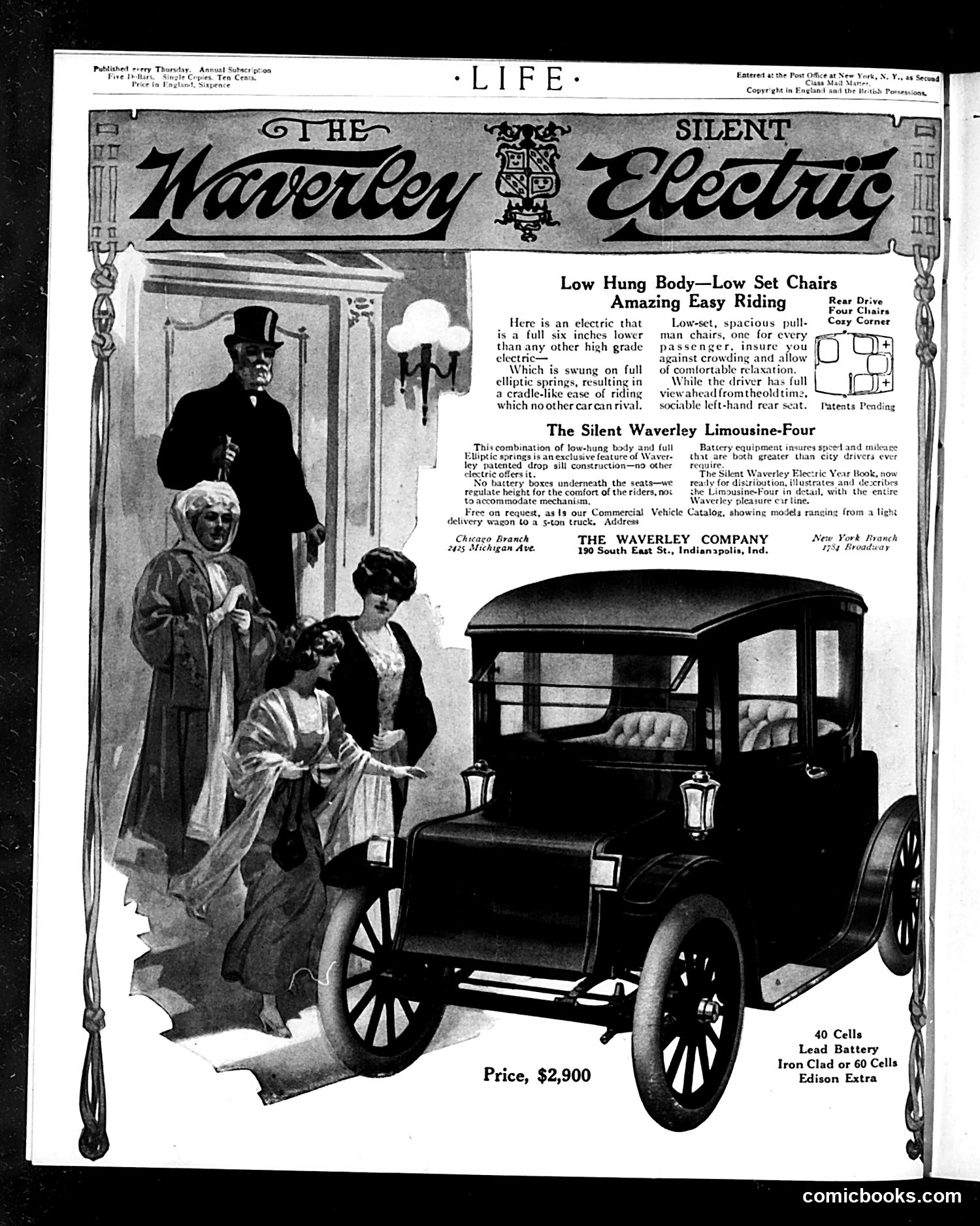
This page is **primarily an advertisement**, not a political cartoon. It promotes the Waverley Silent Electric automobile, priced at $2,900. The ad features a scene of elegantly dressed people (a man in a top hat and women in period dress) admiring or boarding the vehicle. The marketing emphasizes luxury features: low-hung body, easy riding, comfortable seating, and crucially, **silent operation** — a major selling point for early electric cars, which were quieter than gasoline engines. The text highlights the vehicle's sophisticated engineering, including exclusive elliptic springs and spacious interior. This targets wealthy, urban consumers seeking refined transportation. **Context for modern readers**: Electric vehicles were viable luxury options in the early 1900s before gasoline engines dominated. Quietness was a genuine advantage marketed to affluent buyers.
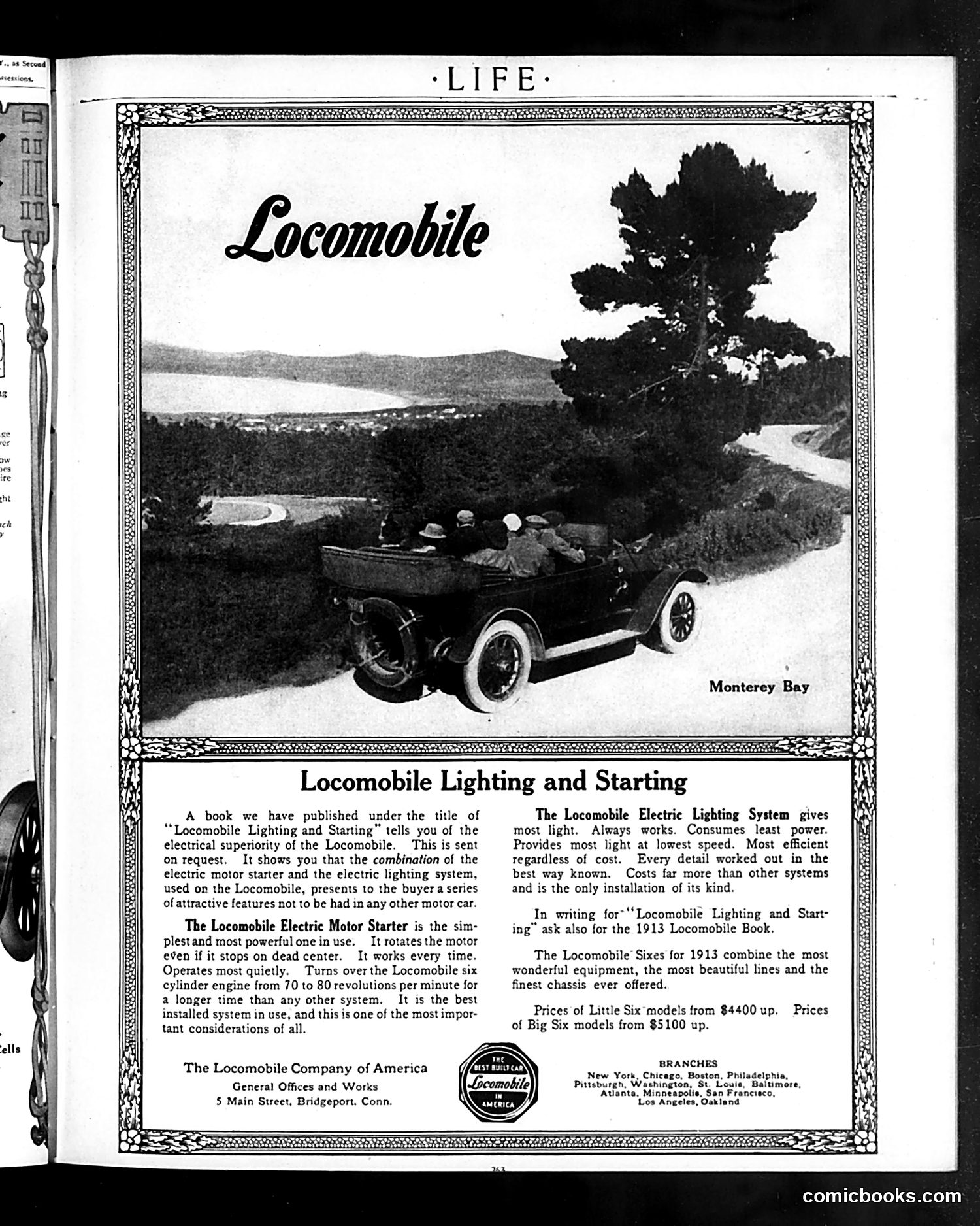
This page is **primarily an advertisement**, not satirical content. It promotes the Locomobile automobile, featuring a scenic photograph of the car traveling through Monterey Bay with passengers enjoying a coastal landscape. The ad emphasizes two technical innovations: the Locomobile's electric lighting system and electric motor starter—features presented as superior to competitors. The text highlights practical advantages: the starter works reliably, operates quietly, and functions even when the engine is off-center. Pricing information indicates Little Six models started at $4,400 and Big Six models at $5,100—expensive vehicles for the era, suggesting the Locomobile targeted wealthy consumers. The Locomobile Company of America lists offices in major cities, positioning itself as a nationally established luxury automobile manufacturer.
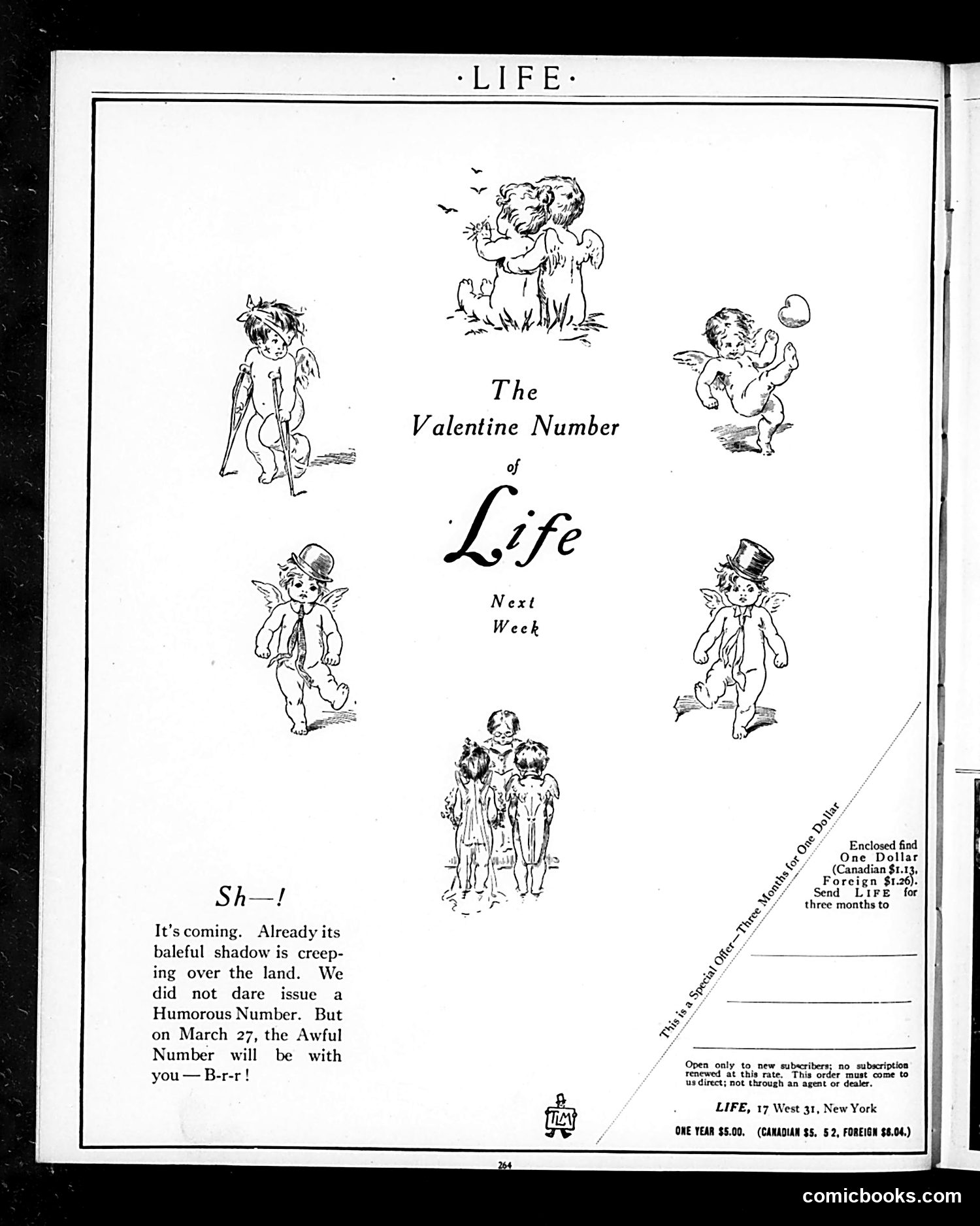
This page is primarily an **advertisement for Life magazine's Valentine's Day issue**, scheduled for the following week. The central text promises "The Valentine Number of Life Next Week." The illustration features six cherubs (cupids) in various playful poses scattered around the announcement. The small text at bottom left, labeled "Sh—!," references an upcoming "Awful Number" on March 27, employing onomatopoeia ("B-r-r!") to humorously suggest dread about whatever that issue will contain. The subscription information and pricing appear on the right side. This is essentially a **teaser advertisement** using cute cherub imagery to promote the Valentine's issue while hinting at contrasting editorial content to come later—a common marketing technique mixing sentimentality with anticipation of satirical content.
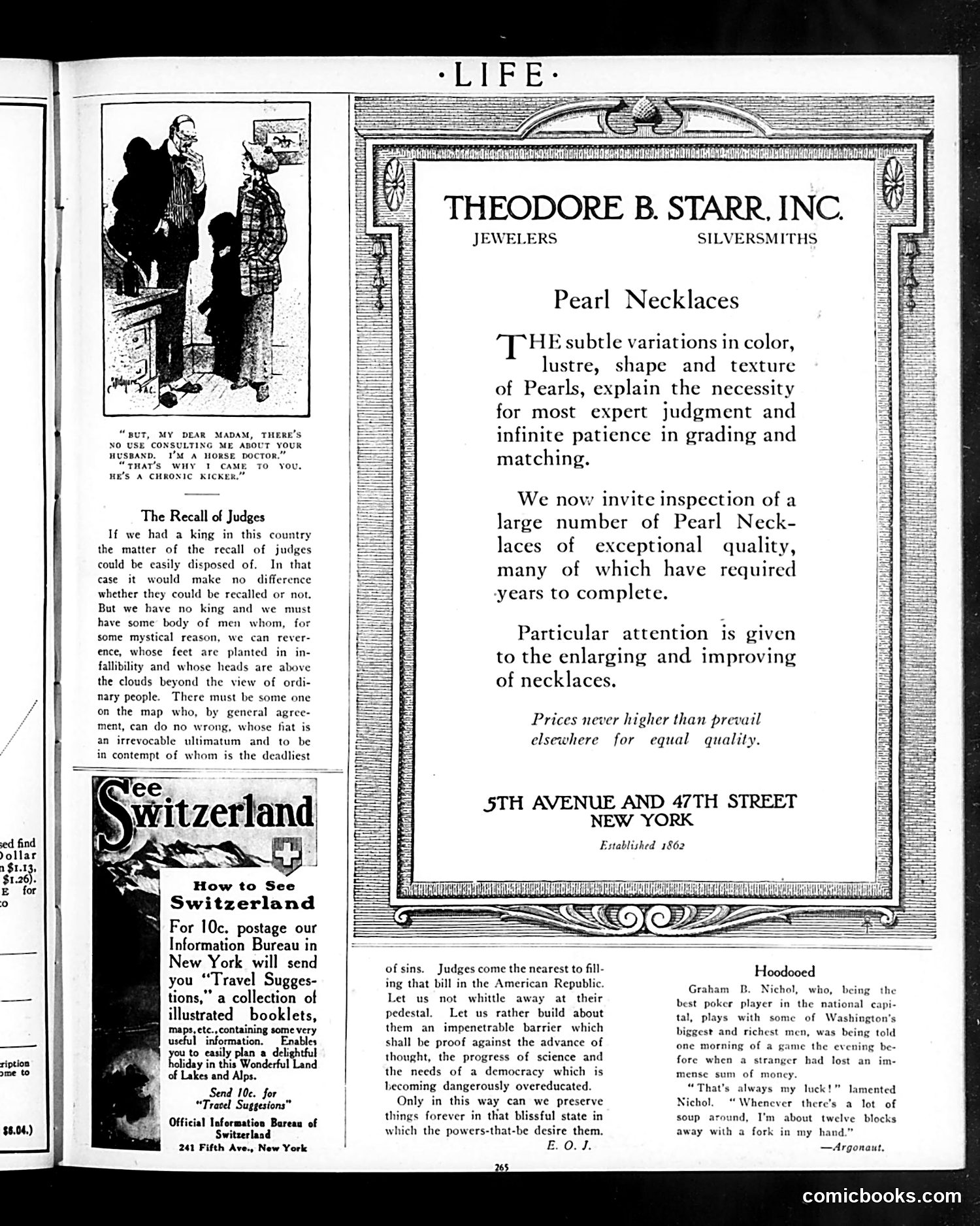
This page is primarily **advertising and editorial content** rather than political satire. The main cartoon (upper left) depicts a domestic scene with the caption about a husband who is "a chronic kicker"—a humorous commentary on marital complaint. This appears to be general social satire about domestic life rather than political commentary. The central content is a **Theodore B. Starr, Inc. advertisement** for pearl necklaces, emphasizing quality and craftsmanship. Below is an essay titled "The Recall of Judges" discussing judicial accountability and democratic governance—this represents the magazine's editorial perspective on political issues. The page also contains a **Switzerland tourism advertisement** offering travel guides. Overall, this is a typical early 20th-century magazine blend of humor, advertising, and civic commentary rather than sharp political satire.
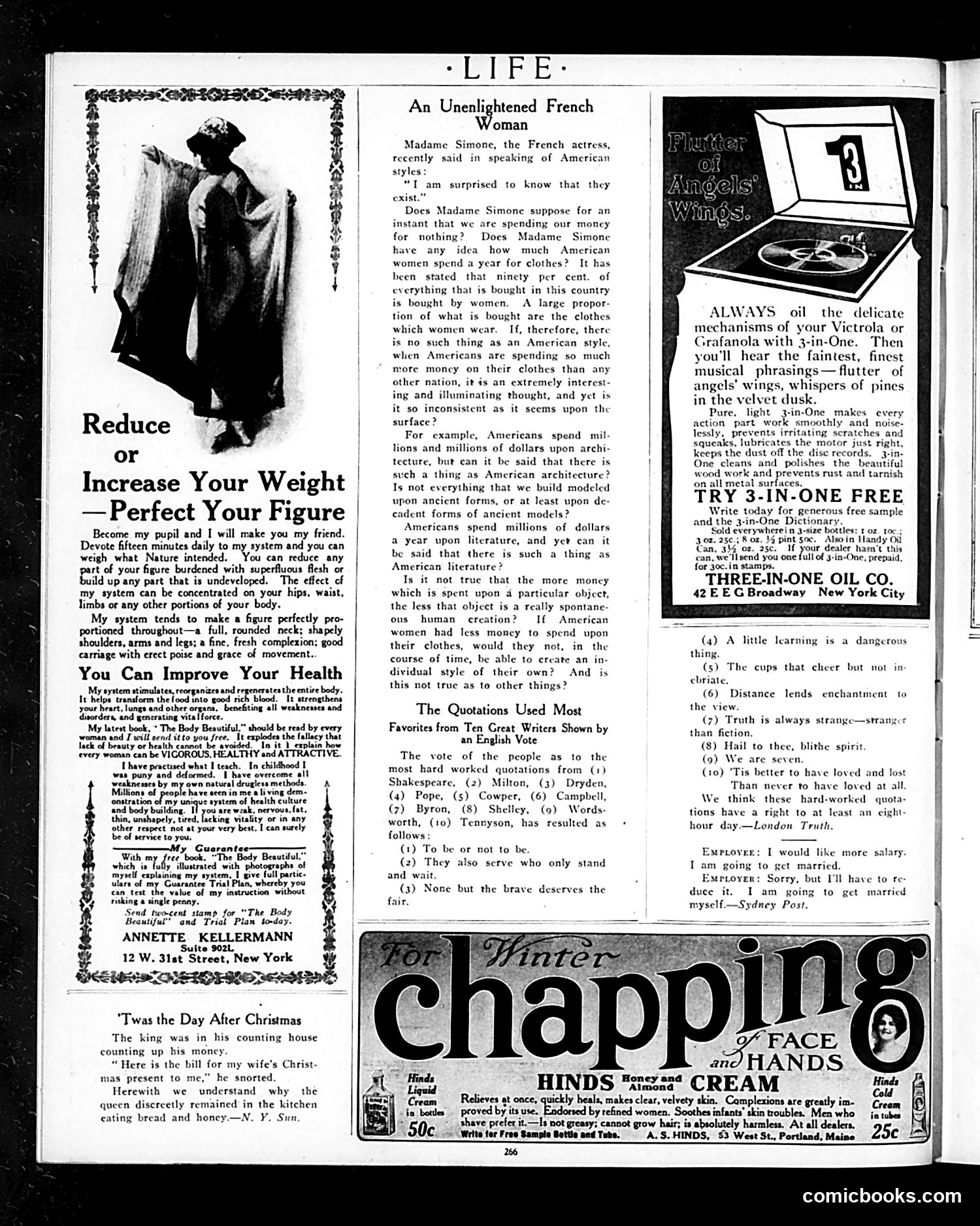
This page is primarily **advertising and miscellaneous content** rather than political satire. The main elements are: 1. **Left side**: An advertisement by Annette Kellermann promoting a weight-reduction/body-improvement system, featuring a silhouetted figure in draped clothing. 2. **Center**: An article titled "An Enlightened French Woman" critiquing American women's spending on clothing and fashion, contrasting it with European cultural investments. 3. **Right side**: Advertisements for a Victrola Grafonola phonograph and Hinds Honey and Almond Cream. 4. **Bottom**: A brief poem "'Twas the Day After Christmas" and a quotations feature about famous writers. The page reflects early 20th-century consumer culture anxieties about women's spending habits and beauty standards, but contains no identifiable political cartoons or caricatures requiring historical explanation.
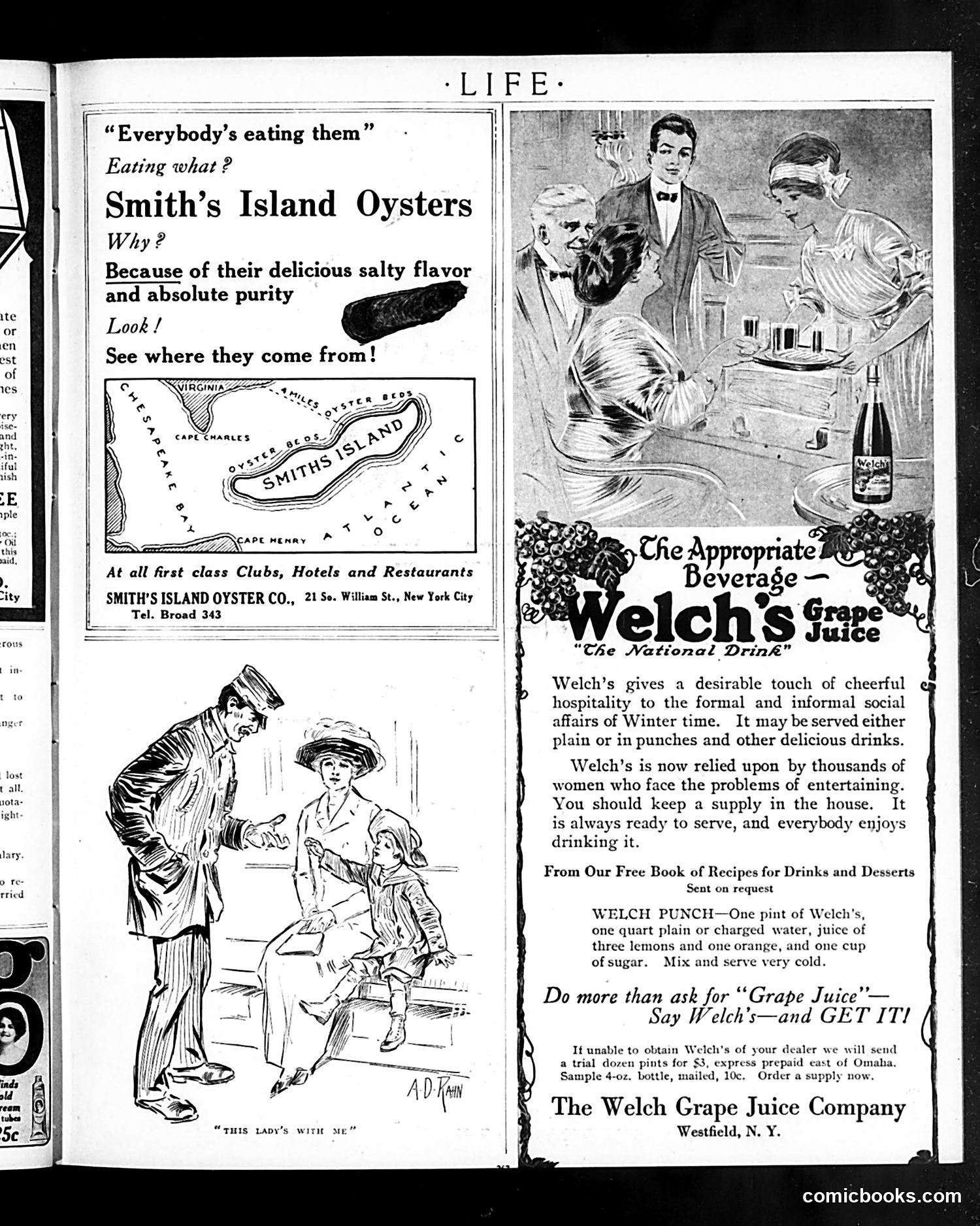
This page contains two advertisements with no satirical content or political cartoons. **Left side:** Smith's Island Oysters ad promoting oysters from Virginia's Smith's Island, with a map showing the location. It emphasizes "delicious salty flavor and absolute purity" and notes availability at "first class Clubs, Hotels and Restaurants." Below is a humorous illustration labeled "This Lady's With Me" showing a man and woman with a child, likely depicting social/dating scenarios. **Right side:** Welch's Grape Juice ad ("The National Drink") targeting women entertaining at home. It promotes serving the juice at formal and informal winter social gatherings, offering recipes and a mail-order option. Both ads reflect early 20th-century consumer culture and gender roles.
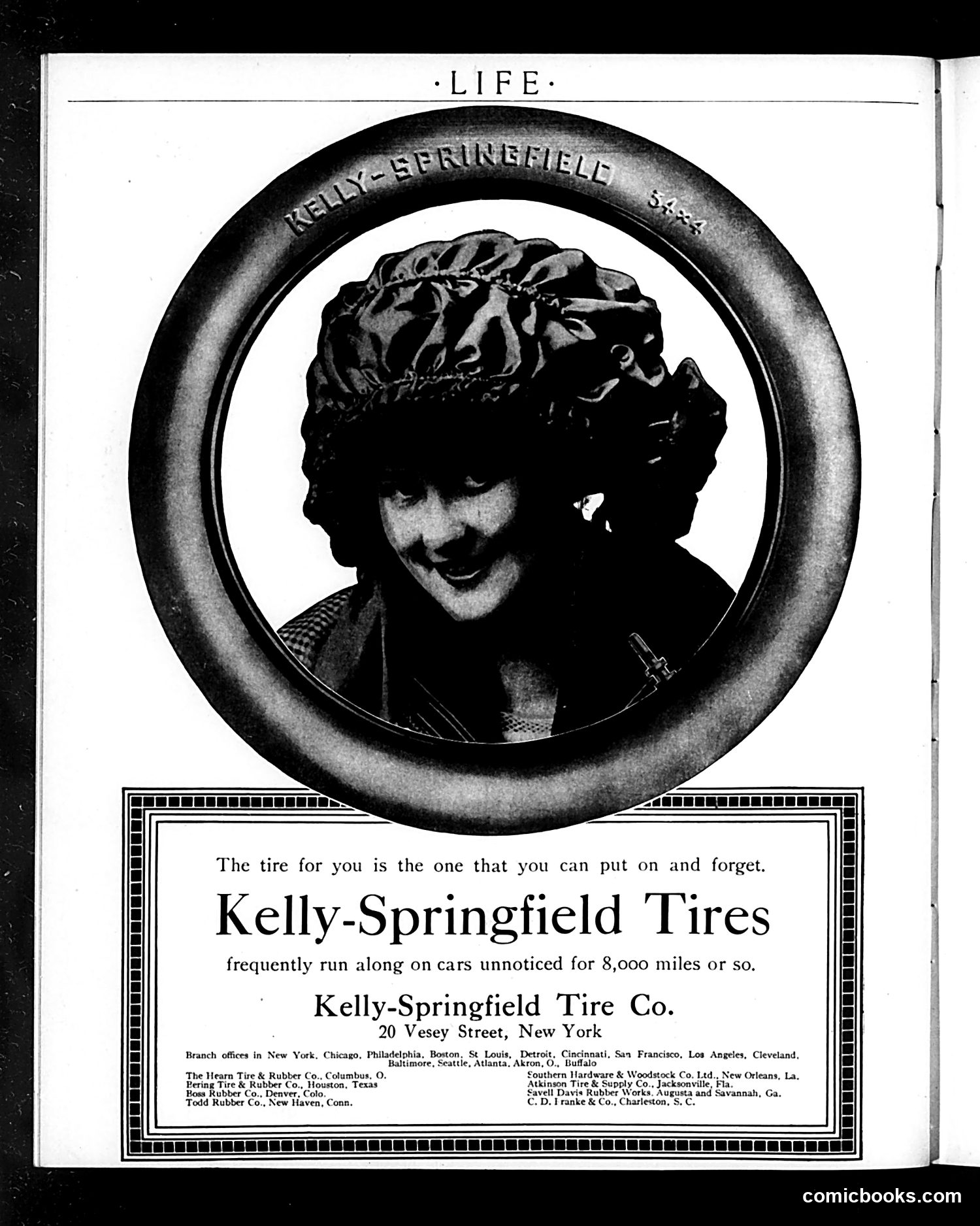
This is an **advertisement, not a political cartoon**. It appears in *Life* magazine and promotes Kelly-Springfield Tires. The ad features a portrait of a woman's face framed in a tire ring, with the slogan "The tire for you is the one that you can put on and forget." The message emphasizes durability—tires that run "unnoticed for 8,000 miles or so." The woman pictured is identified in the tire's border text as "KELLY-SPRINGFIELD" but her specific identity is unclear from the image alone. The ad uses her likeness as a brand ambassador, common in early 20th-century advertising. The company's headquarters was located at 20 Vesey Street, New York, with numerous branch offices listed nationally.
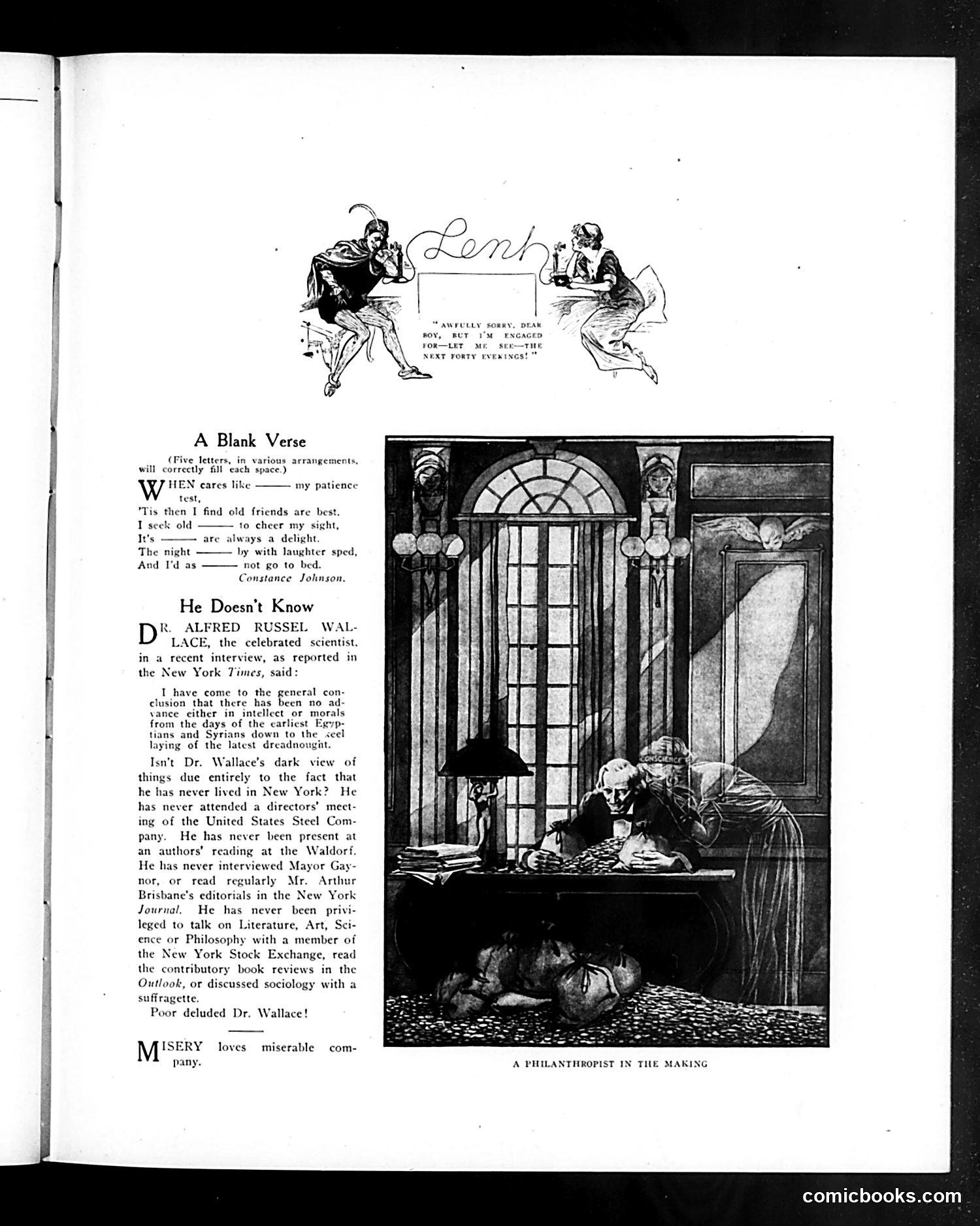
This page contains three distinct items: 1. **"A Blank Verse"** — A humorous poem by Constance Johnson about social etiquette, where the speaker prefers old friends to new social obligations, and would rather stay home than attend events. 2. **"He Doesn't Know"** — A satirical piece mocking Dr. Alfred Russel Wallace, the celebrated naturalist. The satire lists all the major New York cultural and intellectual institutions Wallace has never experienced—steel companies, author readings, mayoral politics, literature discussions, stock exchanges. The joke: despite being a world-renowned scientist, Wallace lacks exposure to American urban society and culture. 3. **"A Philanthropist in the Making"** — A dark illustration depicting a wealthy person observing poor people from an ornate window, captioning the image cynically.
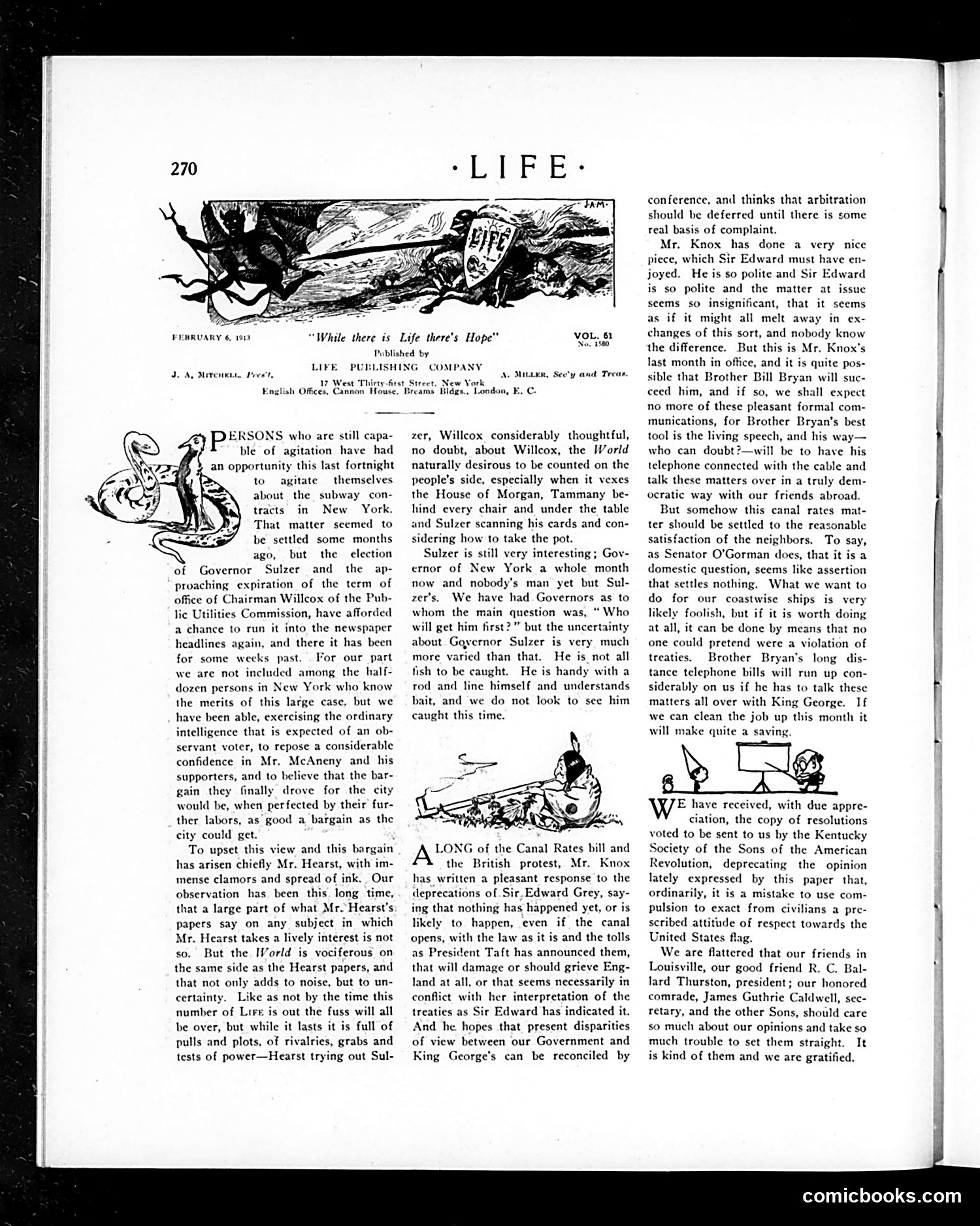
This February 6, 1913 page discusses Governor Sulzer of New York and the **Subways Contracts controversy**. The editorial criticizes Sulzer's handling of disputes between the city and contractors, suggesting he's being manipulated by Chairman Wilcox of the Public Utilities Commission. The cartoons appear to satirize the complex negotiations: one shows a figure struggling with entangled rope or pipes (likely representing the tangled subway contracts), another depicts someone in a boat, possibly illustrating being "lost" in bureaucratic complications. The text reveals tension between labor interests, business concerns, and political maneuvering during New York's early subway system expansion—a major issue where Governor Sulzer faced criticism for failing to decisively resolve contract disputes that affected workers and the city's infrastructure development.
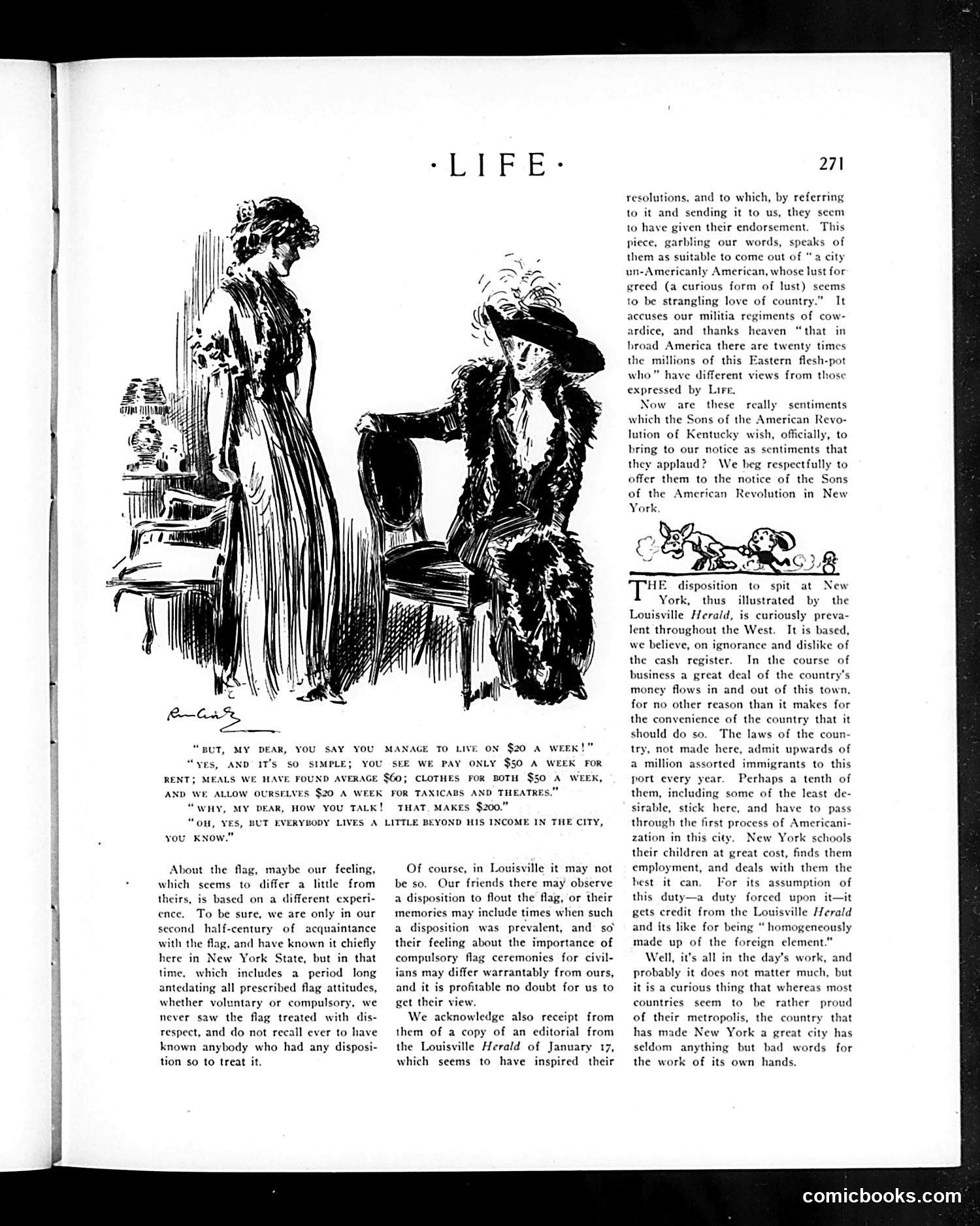
This cartoon satirizes wealth inequality in early 20th-century New York City. A fashionably dressed woman (appearing to represent the wealthy elite) listens as a man in worn clothing (representing the working poor) explains his budget: he manages to live on $20 weekly—$60 for rent, $50 for food and clothes, $20 for entertainment, totaling $200. The joke exposes the mathematical impossibility of his claim, highlighting the gap between what the poor actually earned and what they needed to survive. The accompanying text criticizes New York's reputation for attracting immigrants and the cash-register mentality of the city's commerce, contrasting it with more patriotic American values—a common Progressive-era critique of unchecked urban capitalism.
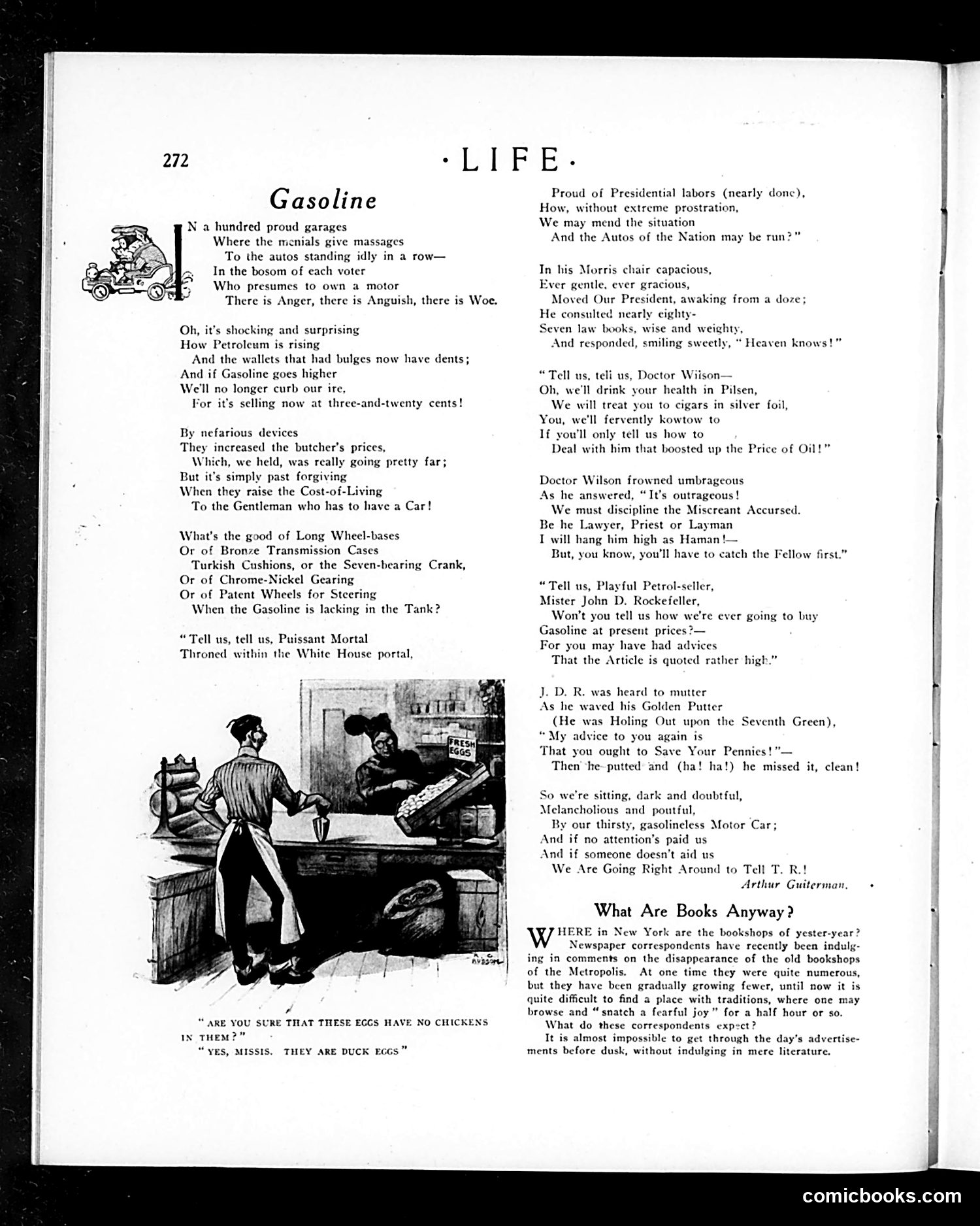
This page satirizes the rising cost of gasoline in early 20th-century America. The left side features a poem mocking how expensive fuel has become, complaining that "wallets that had bulges now have dents" and gas prices have reached "three-and-twenty cents." The illustration depicts a conversation between a woman and a man about the high cost of motor oil, with the caption: "ARE YOU SURE THAT THESE EGGS HAVE NO CHICKENS IN THEM?" / "YES, MISSIS. THEY ARE DUCK EGGS"—a joke about adulteration and fraud during an era of rising prices and consumer suspicion. The right side includes political verses addressing President Wilson and oil magnate John D. Rockefeller, linking the gasoline crisis to broader concerns about corporate greed and government responsibility during this inflationary period.
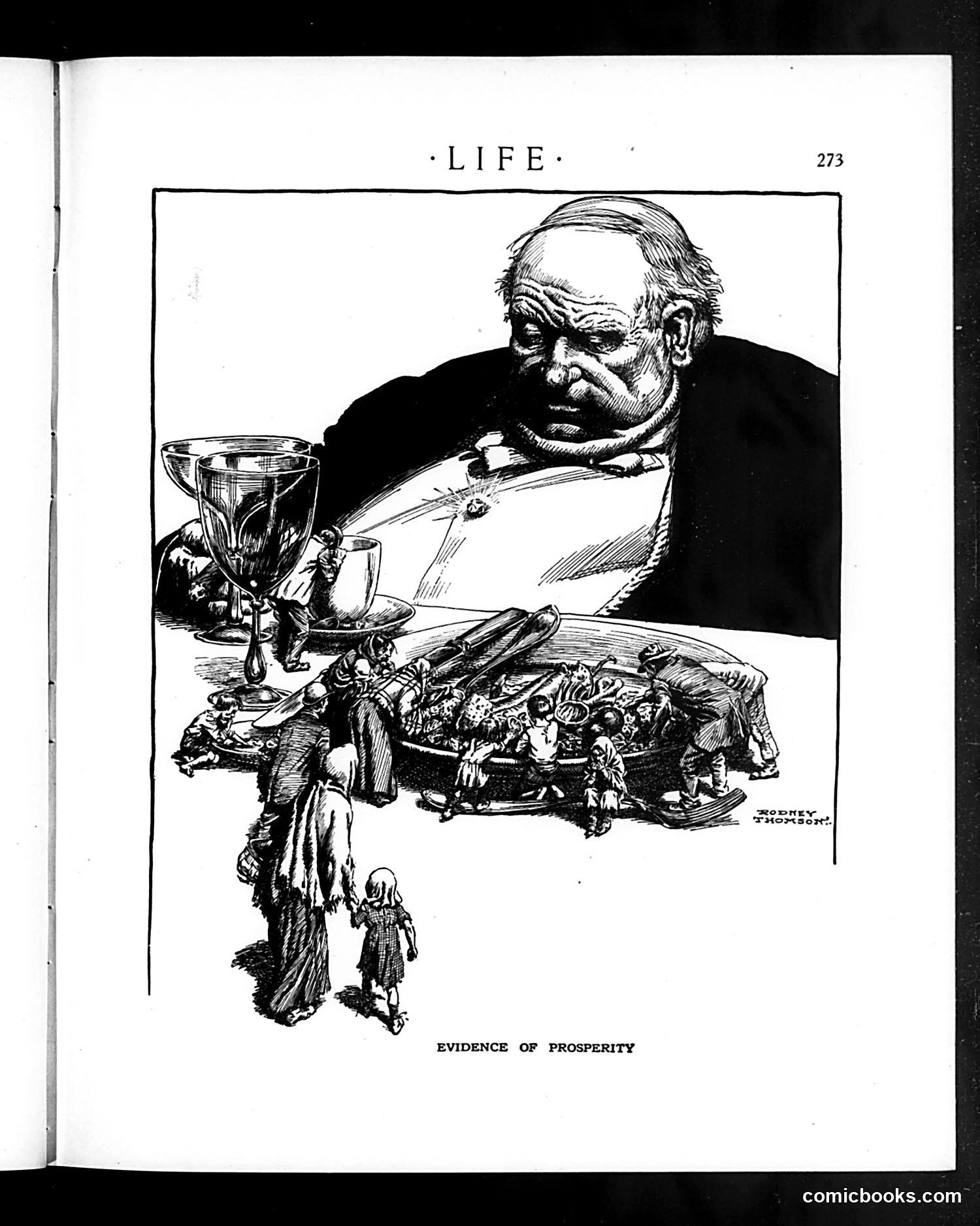
This satirical cartoon depicts a portly, well-fed older man lounging contentedly while enjoying luxuries—a goblet of wine, fine food, and what appears to be a cigar. Before him sits an elaborate table laden with weapons and military equipment. Below, impoverished figures (appearing to be a woman and child) gaze upward at this display of wealth. The satire critiques wealth inequality and the contrast between the rich and poor during a period of military buildup or conflict. The "evidence of prosperity" is ironic: while the wealthy elite enjoy comfort and indulgence, military spending and poverty affect ordinary people. The cartoon suggests that prosperity for the privileged comes at the expense of the vulnerable masses.
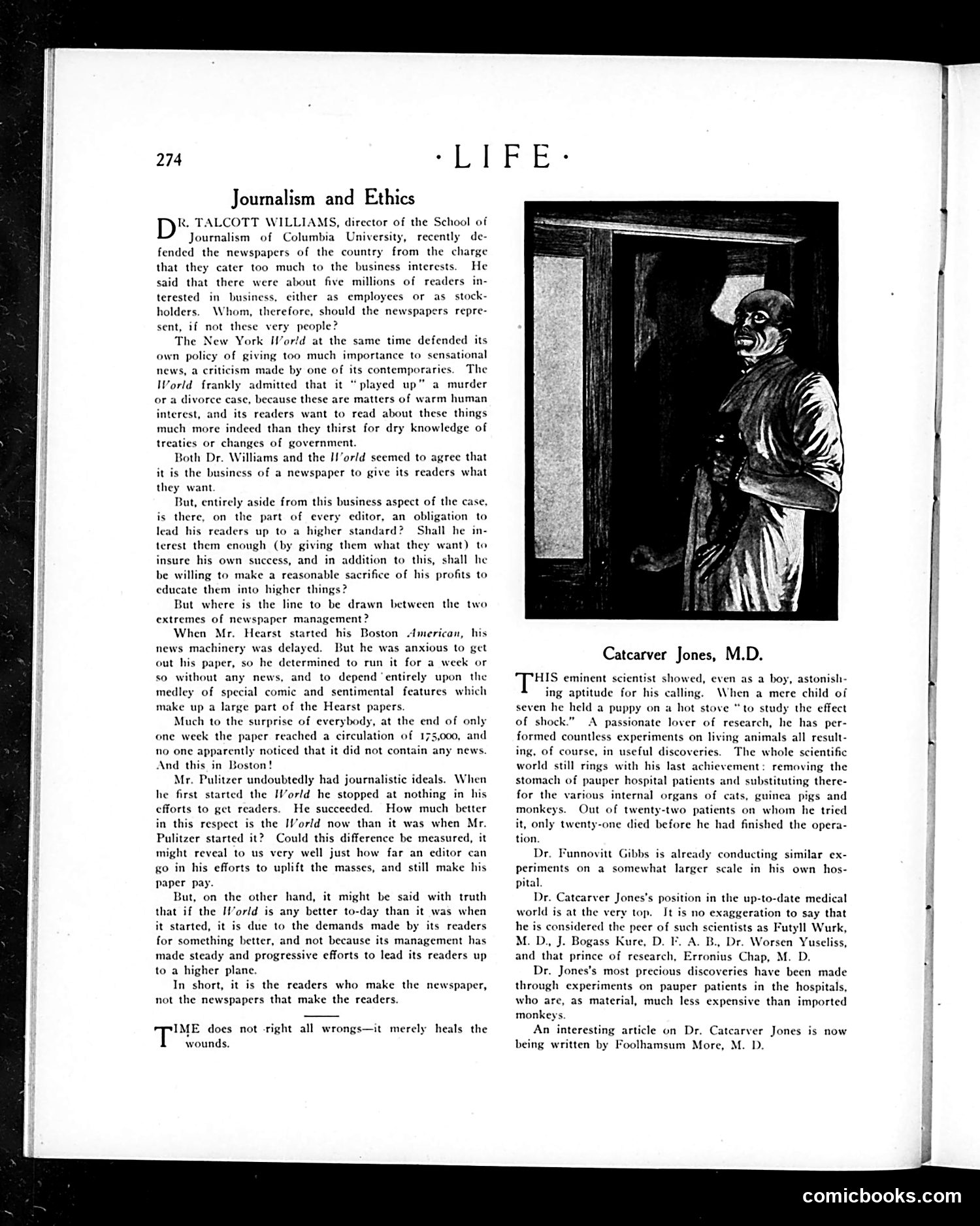
The illustration shows a skull-faced figure in medical attire, depicting **Dr. Catcarver Jones**, a real scientist praised in the accompanying text. The grotesque artistic style is intentional satire—the "death's head" appearance mocks sensationalized medical imagery rather than the doctor himself. The article celebrates Jones as an "eminent scientist" conducting vivisection experiments on animals (cats, guinea pigs, monkeys) to advance medical knowledge. The skull imagery sarcastically comments on public squeamishness about such research, while the text defends the practice as scientifically necessary and humane compared to human suffering. The page juxtaposes this with an earlier section on journalism ethics, suggesting both fields—medicine and news—must sometimes make uncomfortable choices for greater good.
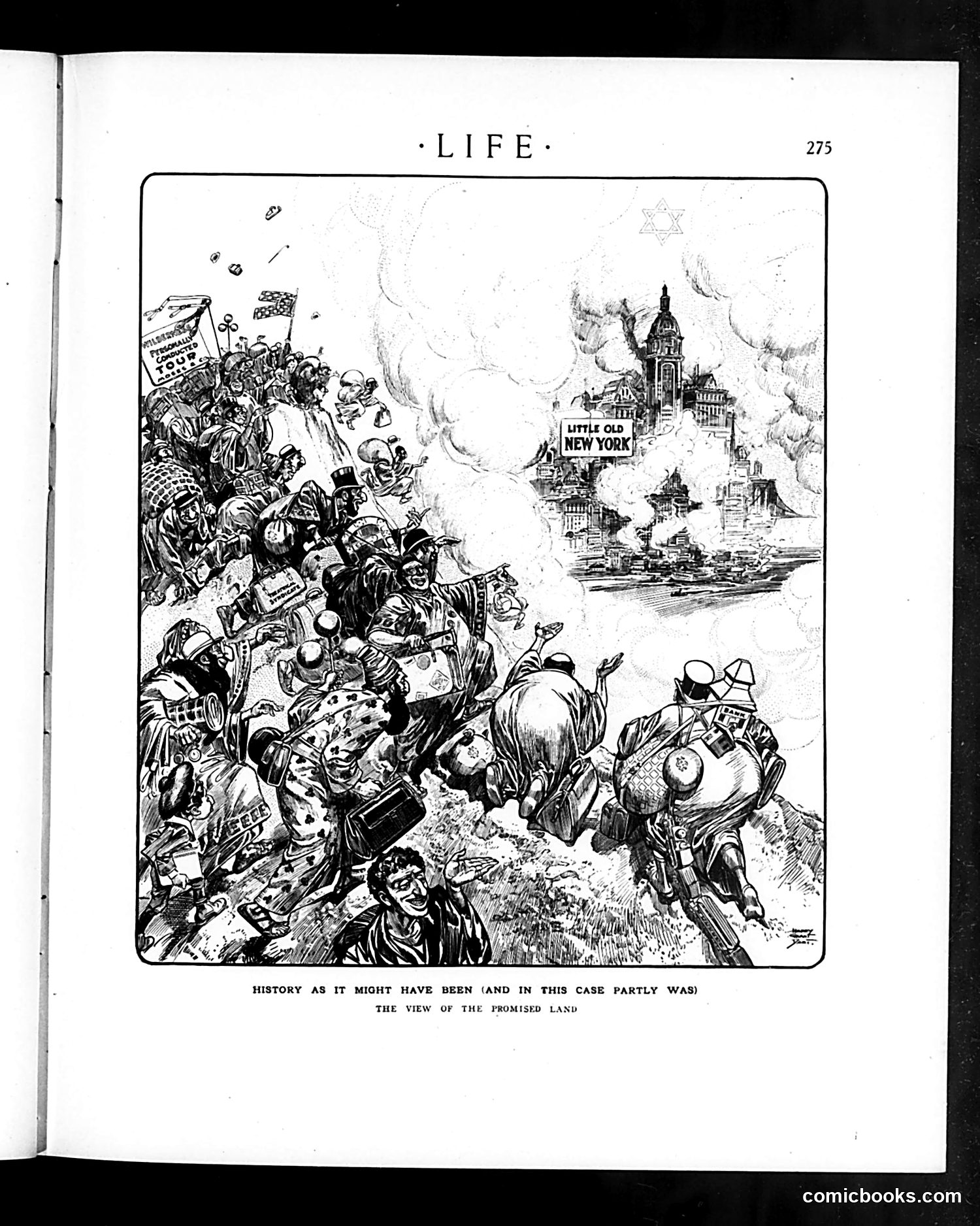
This political cartoon satirizes immigration to America, specifically Jewish immigration to New York. The left side depicts a chaotic, crowded mass of immigrants—identifiable by their varied dress, luggage, and flags—pressing forward in desperation. The right side shows "Little Old New York," depicted as an idealized, orderly cityscape with classical architecture. The caption's subtitle, "The View of the Promised Land," references both Biblical promised land imagery and the Jewish experience, suggesting irony: immigrants expected an orderly paradise but encountered urban chaos and crowding instead. The Star of David visible above reinforces the Jewish immigration context. The cartoon critiques either the immigrants themselves (portrayed as disorderly masses) or American society's failure to integrate them smoothly—the satire's target remains somewhat ambiguous from the image alone, though the tone suggests criticism of uncontrolled immigration.
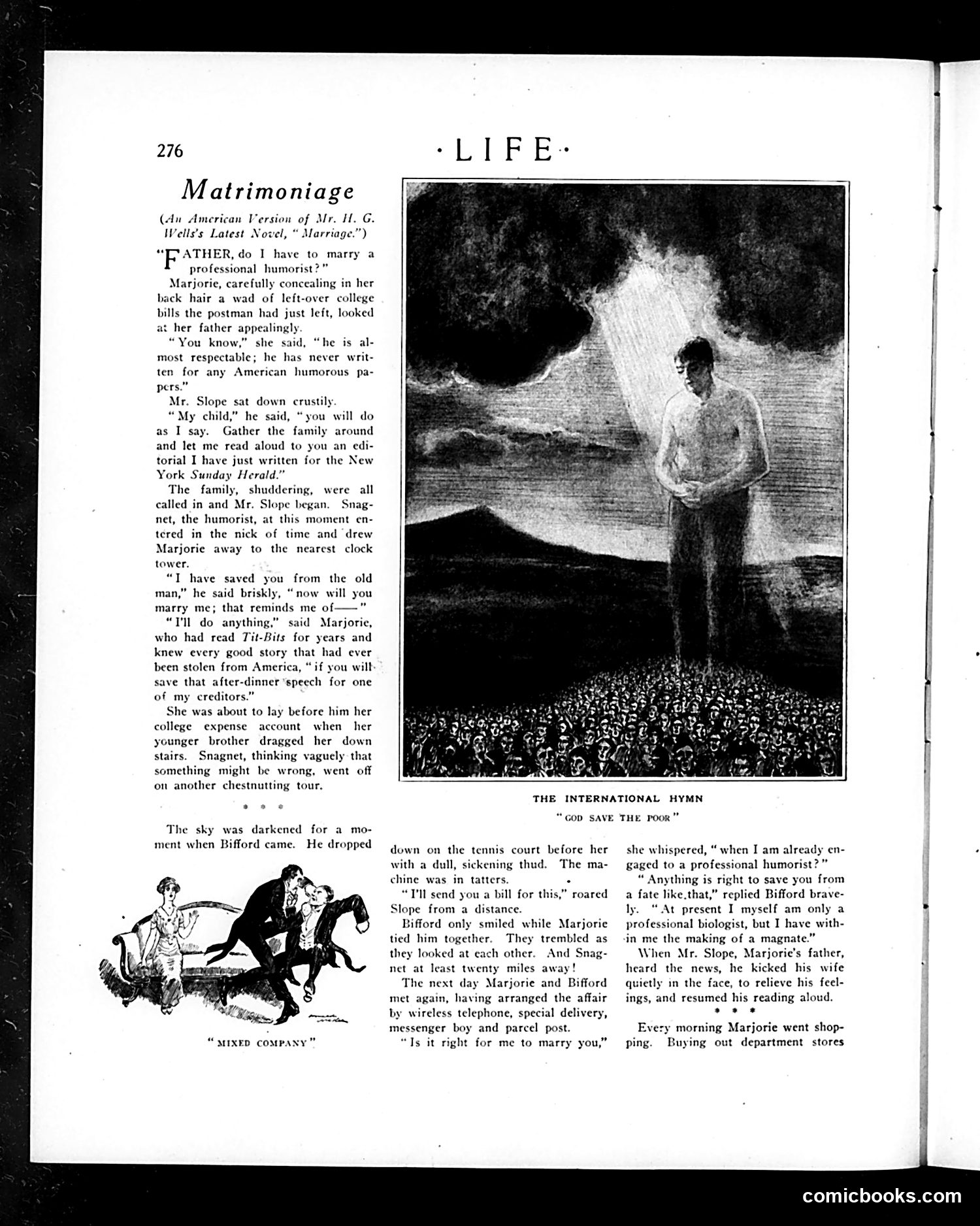
This story parodies H.G. Wells's novel *Marriage*, satirizing early 20th-century romantic conventions and professional pretension. **The setup**: Marjorie's father, Mr. Slope (an editor), wants her to marry Snagnet, a professional humorist. Marjorie reluctantly agrees, though she's actually attracted to Bifford, a "professional biologist" who crashes his airplane onto her tennis court. **The satire targets**: - The absurdity of marrying based on professional status rather than genuine feeling - Humorists and writers as shallow, self-aggrandizing figures (Snagnet constantly interrupts with jokes) - The period's obsession with career credentials as marriage material - Marjorie's pragmatism: she agrees to anything if it saves her from debt **The crude humor**: Mr. Slope's violent "relief" at learning the news (kicking his wife) typifies the crude comedy of the era, treating domestic violence as a punchline. The accompanying cartoon "Mixed Company" (lower left) appears to show chaotic social interaction, reinforcing the story's theme of matrimonial confusion.
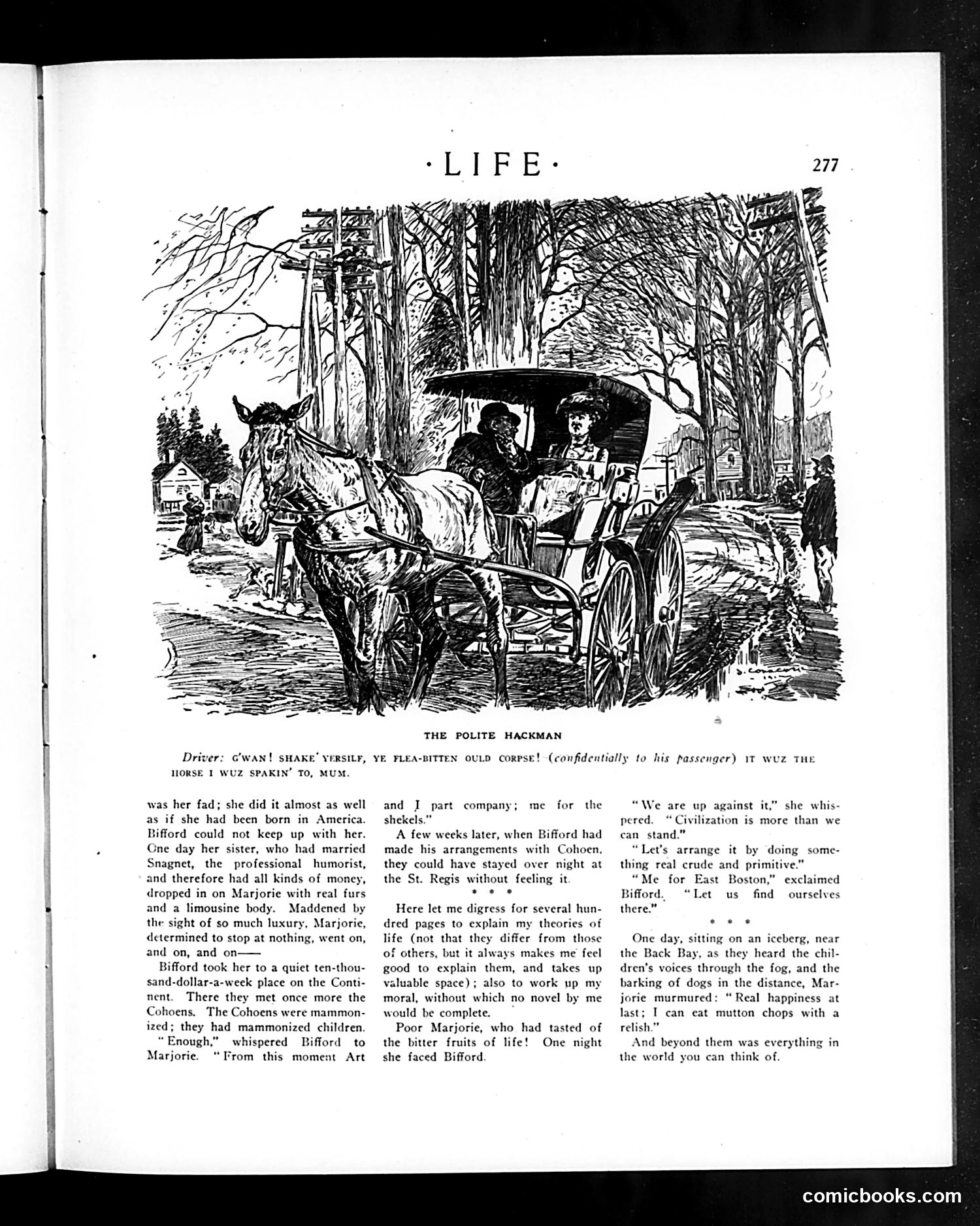
This cartoon satirizes Irish immigrant taxi drivers in early 1900s America. The humor relies on ethnic stereotyping: an Irish "hackman" (cab driver) with a thick accent insults his horse as a "flea-bitten ould corpse," then apologetically explains to his passenger (a refined woman) that he was actually addressing the *horse*, not her—implying working-class Irish men couldn't distinguish between animals and people, or lacked basic courtesy. The accompanying story excerpt appears unrelated, detailing a character named Marjorie pursuing wealth and luxury before seeking "primitive" happiness. Together, the page uses class and ethnic humor typical of Life magazine's satirical approach to American social hierarchies of the period.
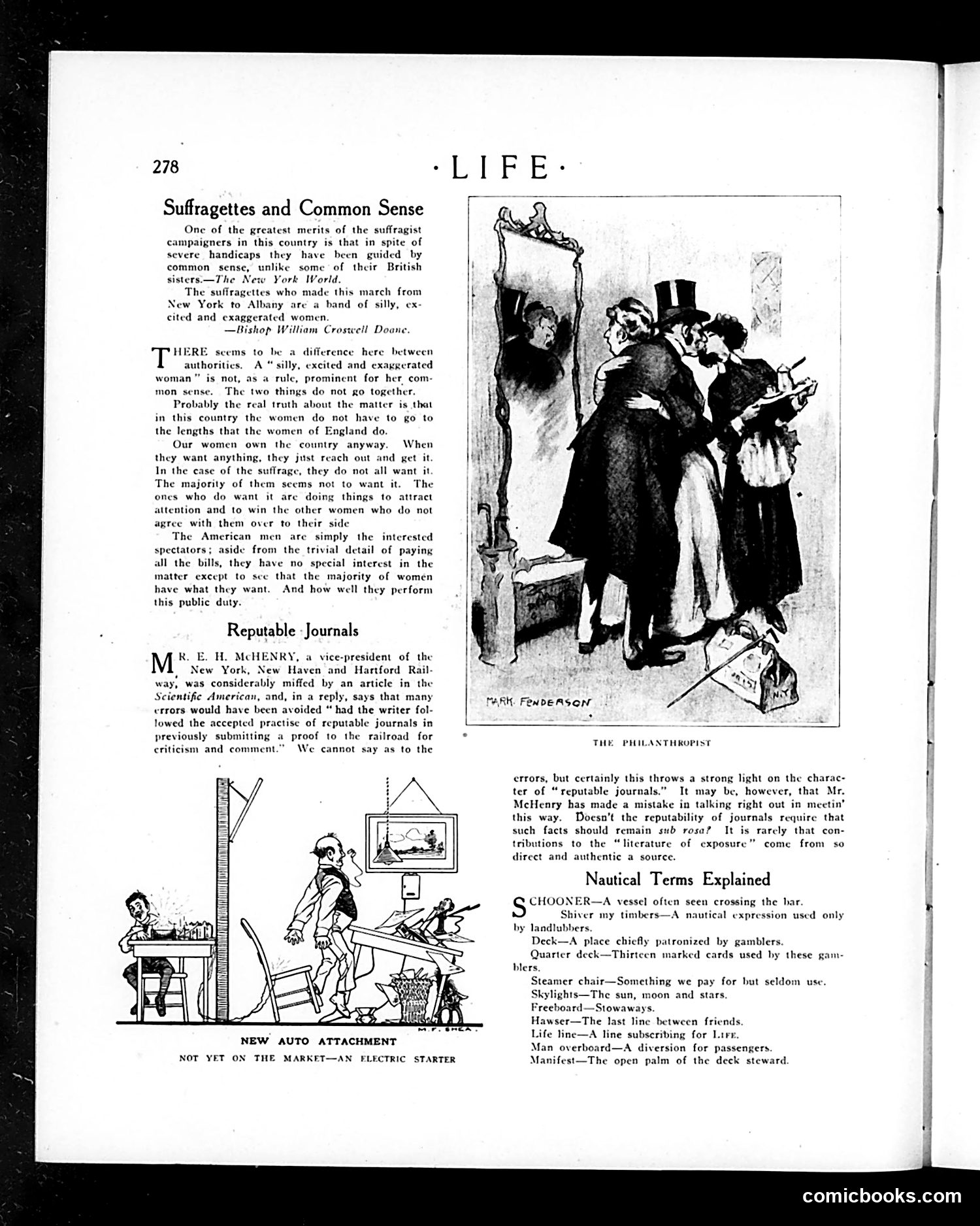
This page contains three distinct satirical pieces: **"Suffragettes and Common Sense"** critiques American suffrage advocates. The text quotes Bishop Doane calling female marchers "silly, exaggerated women," then argues this contradicts claims they use "common sense." Life's editors mock both positions: American women allegedly already control society through informal influence, so those demanding voting rights seem unnecessary. The piece dismisses suffragists as attention-seekers while patronizingly suggesting American men are "interested spectators" merely indulging women's whims. **"Reputable Journals"** satirizes railroad executive E.H. McHenry's complaint that *Scientific American* didn't let him preview critical articles before publication. Life ridicules the expectation that journals submit exposés to subjects for approval—implying this corrupts journalistic integrity. **"Nautical Terms Explained"** is pure wordplay humor, offering absurdist fake definitions of maritime terminology (e.g., "Deck—A place chiefly patronized by gamblers"). The cartoon titled "The Philanthropist" (by Pat Fairerson) depicts well-dressed men apparently soliciting or examining a street figure, likely commenting on performative charity.
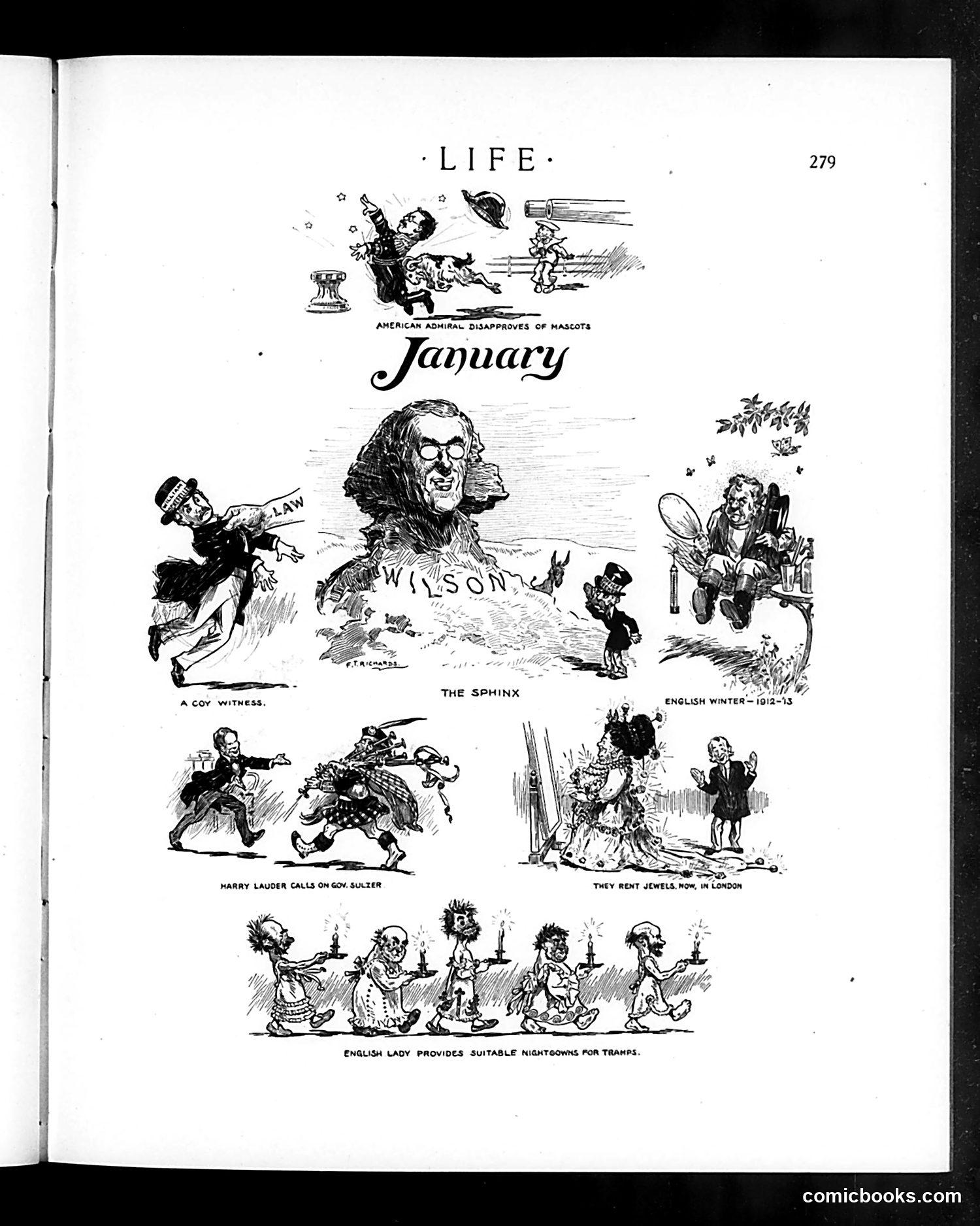
This page contains several satirical cartoons commenting on WWI-era events. "The Sphinx" features Wilson (likely President Woodrow Wilson) as an enigmatic figure surrounded by smaller characters representing various political pressures. "A Cow Witness" and "Harry Lauder Calls on Cow Slicker" appear to reference entertainment and possibly labor disputes. "They Rent Jewels Now in London" satirizes wartime financial desperation among British aristocracy. The bottom cartoon, "English Lady Provides Suitable Nightgowns for Tramps," mocks British upper-class charity efforts during wartime—suggesting wealthy women are providing inappropriate or absurdly impractical aid to homeless men, reflecting period anxieties about social upheaval during the war.
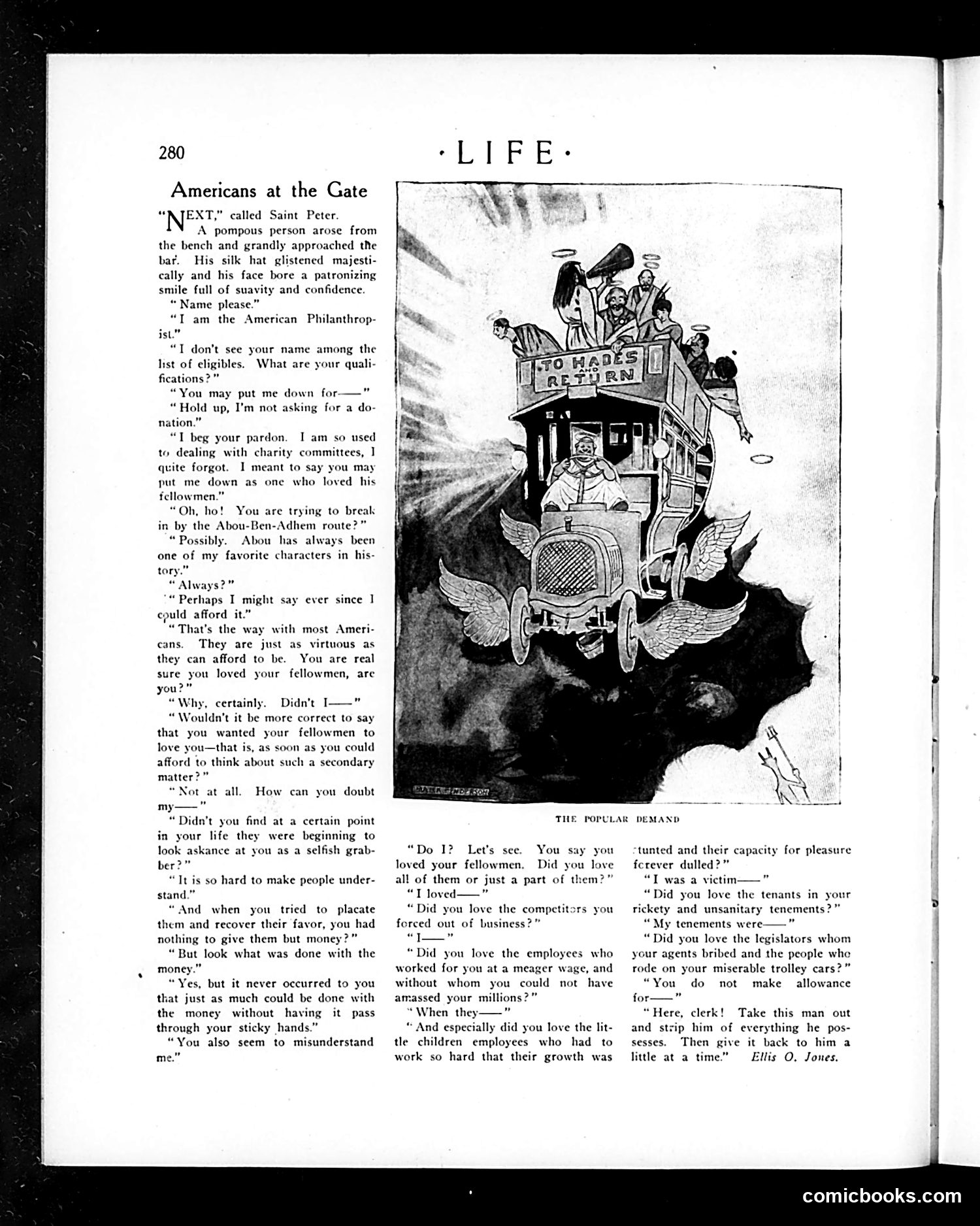
This cartoon depicts Saint Peter interrogating a wealthy American philanthropist at Heaven's gates. The satire attacks the moral bankruptcy of industrial-era wealth accumulation masked by charitable giving. The philanthropist claims to have "loved his fellowmen," but Saint Peter systematically exposes his hypocrisy: he loved competitors only after forcing them into bankruptcy, employees only after exploiting them at subsistence wages, child laborers whose development he stunted, tenants in squalid housing, and legislators he bribed. The philanthropist's charity is revealed as self-serving reputation-laundering—he only became "virtuous" once wealthy enough to afford it. The punchline strips him of his ill-gotten gains and returns them "a little at a time," suggesting moral restitution. This reflects Progressive-era criticism of Gilded Age robber barons whose philanthropic facades couldn't obscure their exploitation and corruption.
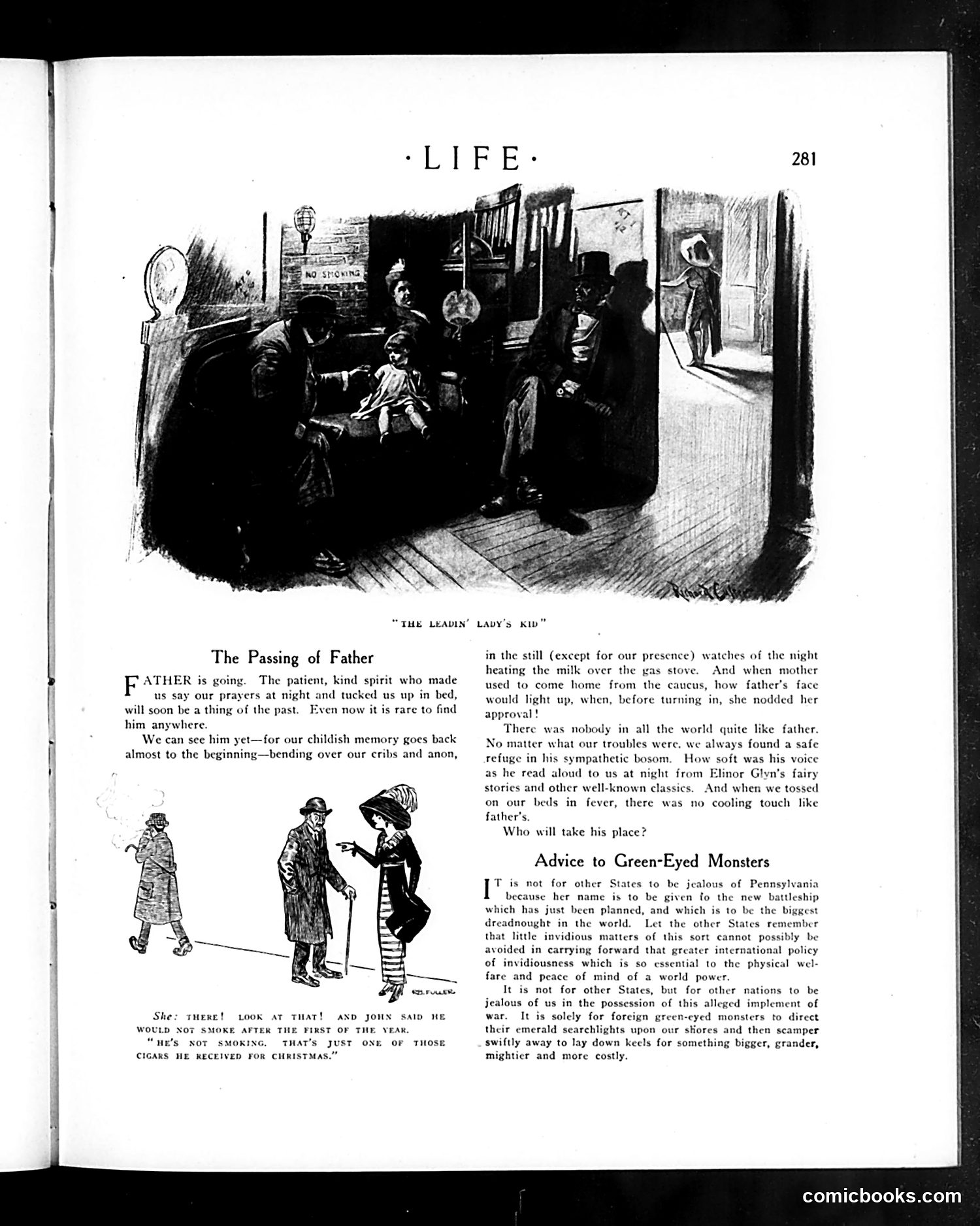
**"The Passing of Father"** is a nostalgic lament about the disappearance of the traditional Victorian patriarch. The article mourns that fathers no longer fulfill their historical roles—praying with children, heating milk at night, providing comfort during illness, and reading classics aloud. The tone suggests these domestic duties have become rare or obsolete, reflecting early 20th-century anxieties about changing family structures and masculinity. The accompanying cartoon shows a woman pointing out a man smoking a cigar, noting he promised not to smoke after New Year's—revealing the joke: fathers make resolutions they immediately break, exemplifying their unreliability or weakness. **"Advice to Green-Eyed Monsters"** is satirical commentary on naval rivalry and nationalism. It mocks American triumphalism by sarcastically endorsing jealousy between states over naming a new dreadnought battleship (USS Pennsylvania), then extends this to foreign nations. The satire critiques the arms race mentality and competitive nationalism driving military expansion.
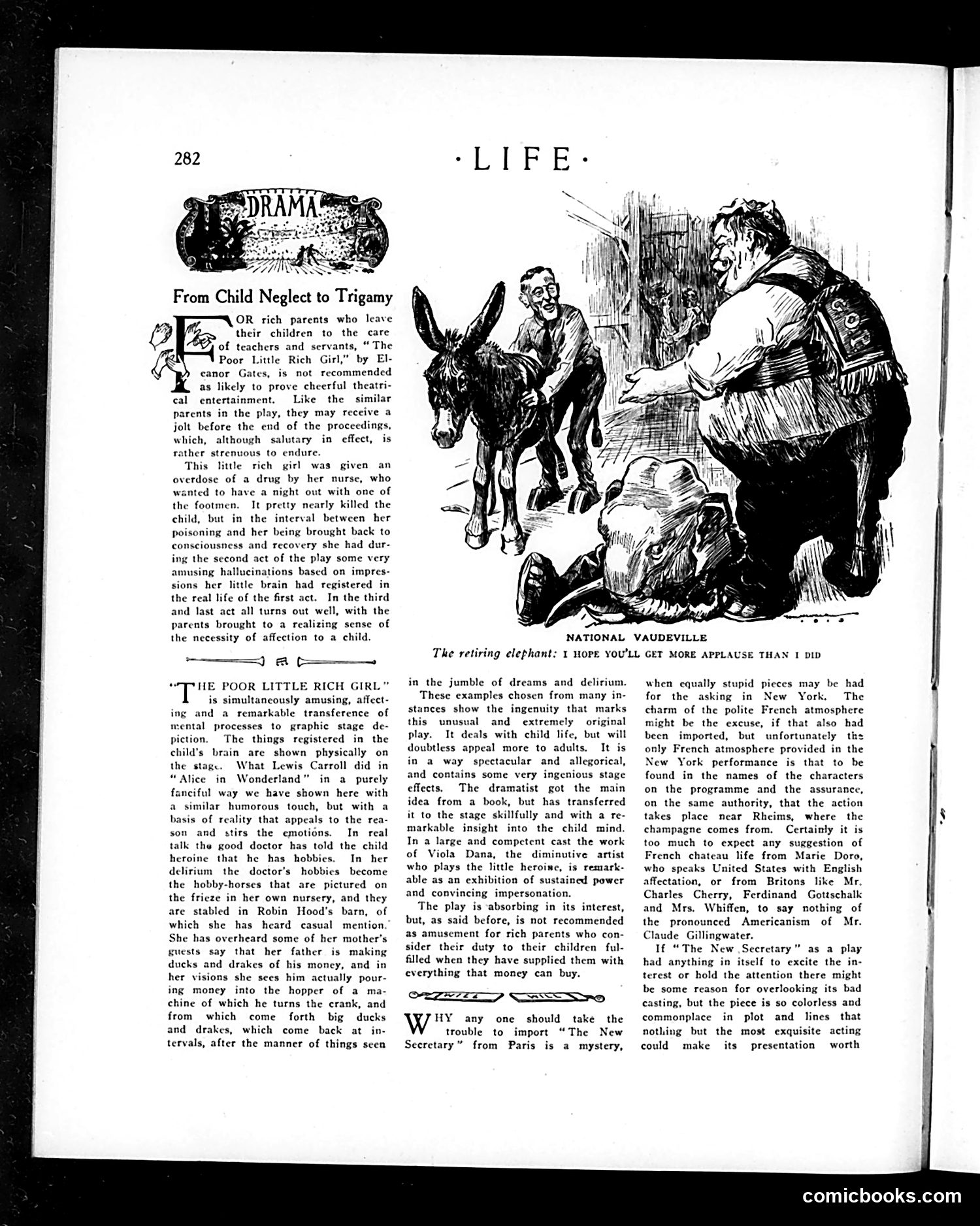
This page reviews **"The Poor Little Rich Girl,"** a stage play about child neglect among the wealthy. The satire targets rich parents who delegate childcare to servants and teachers, then face consequences when their negligence nearly kills their daughter through a nurse's drug overdose. The accompanying illustration labeled "National Vaudeville" shows an elephant addressing another performer, likely satirizing theatrical ego and competition for applause—a secondary jab at show business vanity. The play's innovation, per the critic, is depicting the child's drug-induced hallucinations through stagecraft: her father's financial recklessness becomes literal "ducks and drakes" (money wasted), and a doctor's hobbies become hobby-horses. This visual translation mirrors Lewis Carroll's *Alice in Wonderland*. The review is mixed—praising the theatrical ingenuity and lead actress Viola Dana's performance, but concluding the play serves as uncomfortable moral instruction for negligent wealthy parents, hardly "cheerful entertainment."
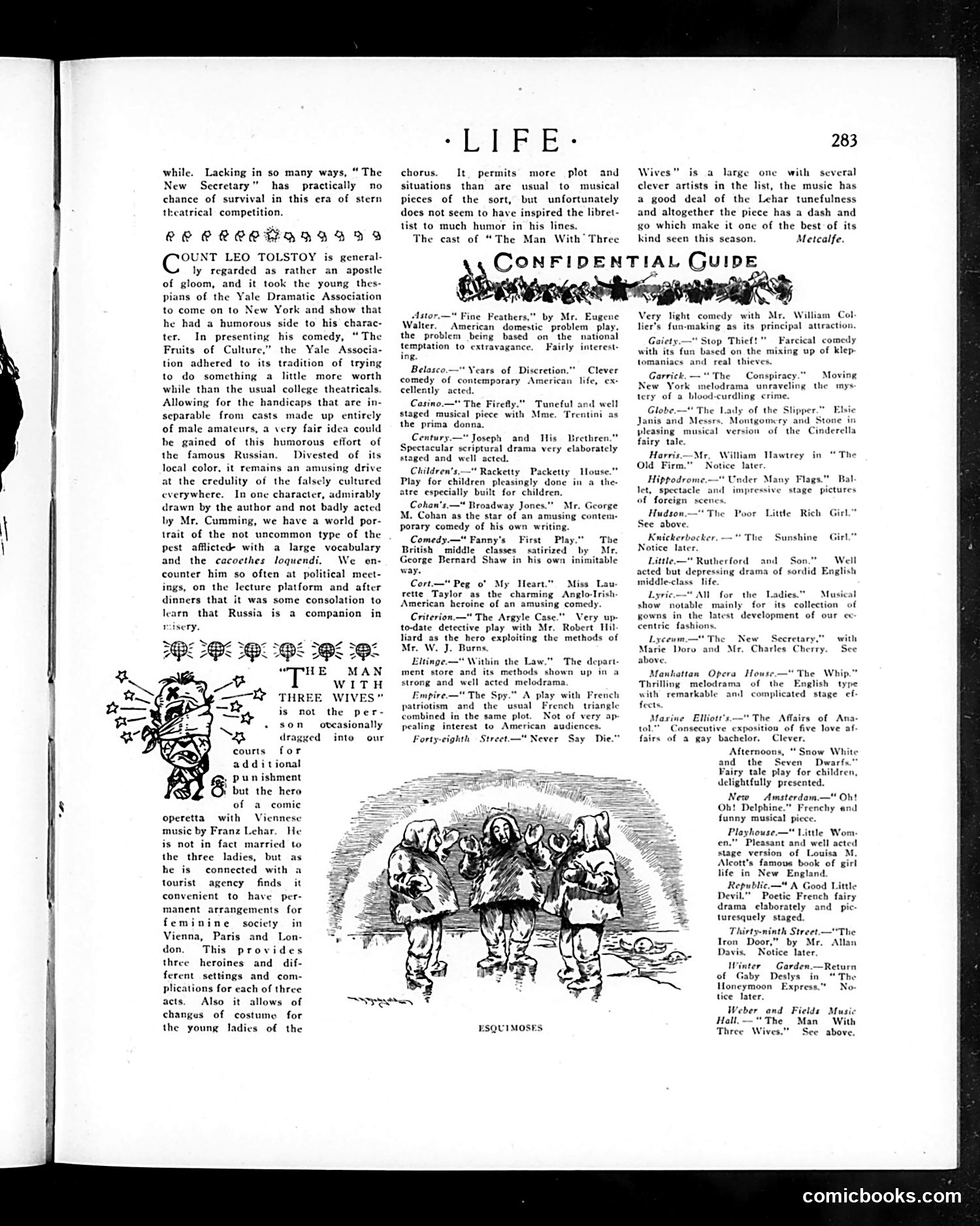
This page contains theater reviews and a cartoon titled "The Man With Three Wives." The cartoon depicts three Inuit/Eskimo figures (labeled "ESQUIMOSES") in a humorous scene, likely satirizing the operetta of the same name discussed in the text. The operetta, with Viennese music by Franz Lehár, is about a man connected to a tourist agency who maintains "permanent arrangements for feminine society" in Vienna, Paris, and London—essentially juggling three romantic partners across three cities. The text notes this allows for different settings, complications, and costume changes but criticizes the librettist's lack of humor. The cartoon's joke appears to juxtapose the sophisticated European romantic entanglements of the operetta with a crude, comedic image of Inuit people—likely reflecting early 20th-century attitudes that treated non-Western cultures as subjects of mockery. This represents period stereotyping typical of the era's satirical magazines.
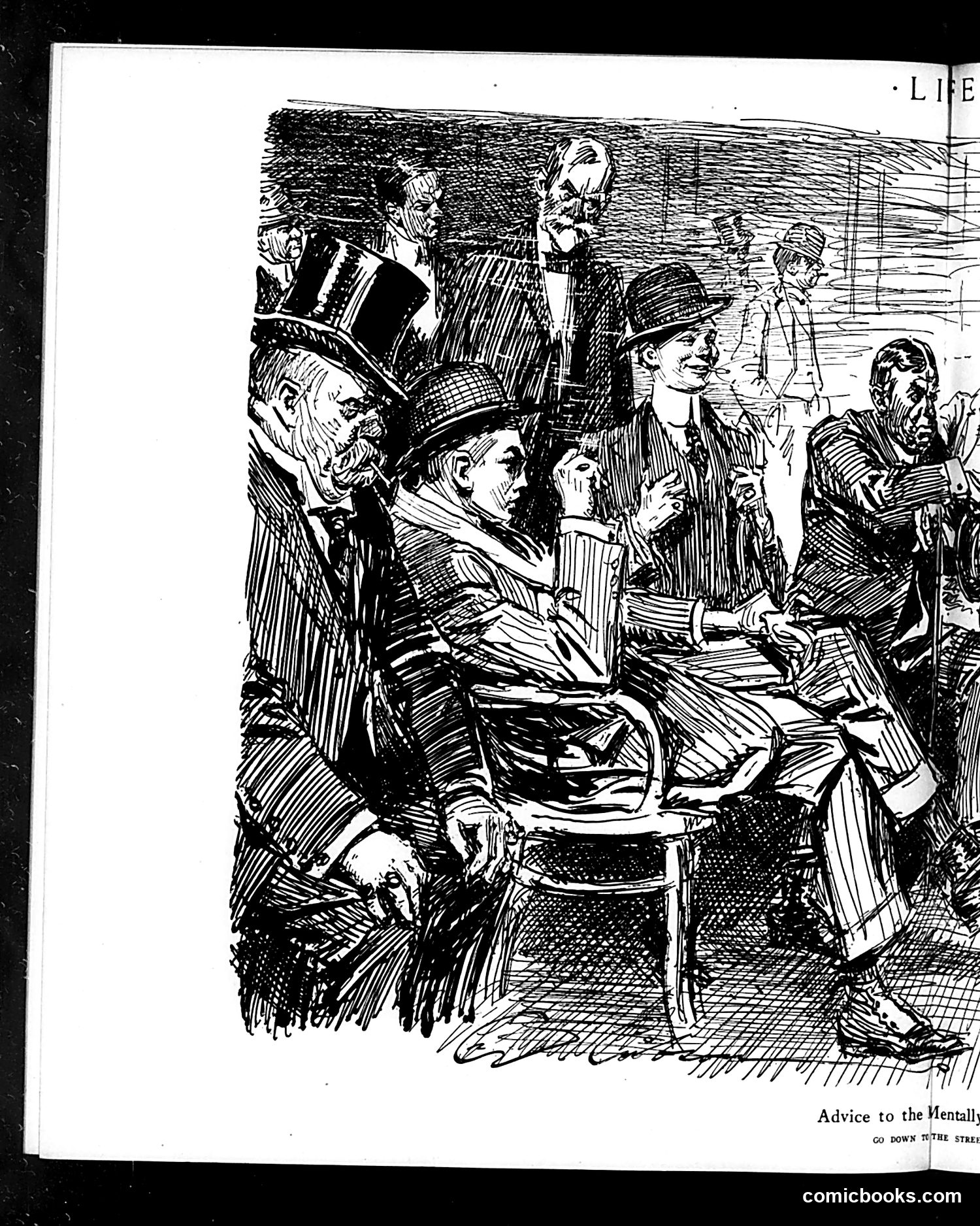
This page from *Life* magazine contains a political cartoon titled "Advice to the Mentally [Ill]" with the subtitle "GO DOWN TO THE STREET." The sketch depicts well-dressed, formally attired men in top hats and suits gathered around a seated figure—appearing to be a consultation or intervention scene. The caricatured faces and exaggerated features are typical of satirical illustration from the early-to-mid 20th century. The cartoon's message seems to satirize disconnected elites or mentally unwell individuals, suggesting they should "go down to the street"—implying they should engage with ordinary people or reality. The formal dress contrasts with this advice, suggesting hypocrisy or the absurdity of privileged people being out of touch. However, without clearer context about the specific historical moment, identifying particular figures is difficult. The exact satirical target remains unclear from the image alone.
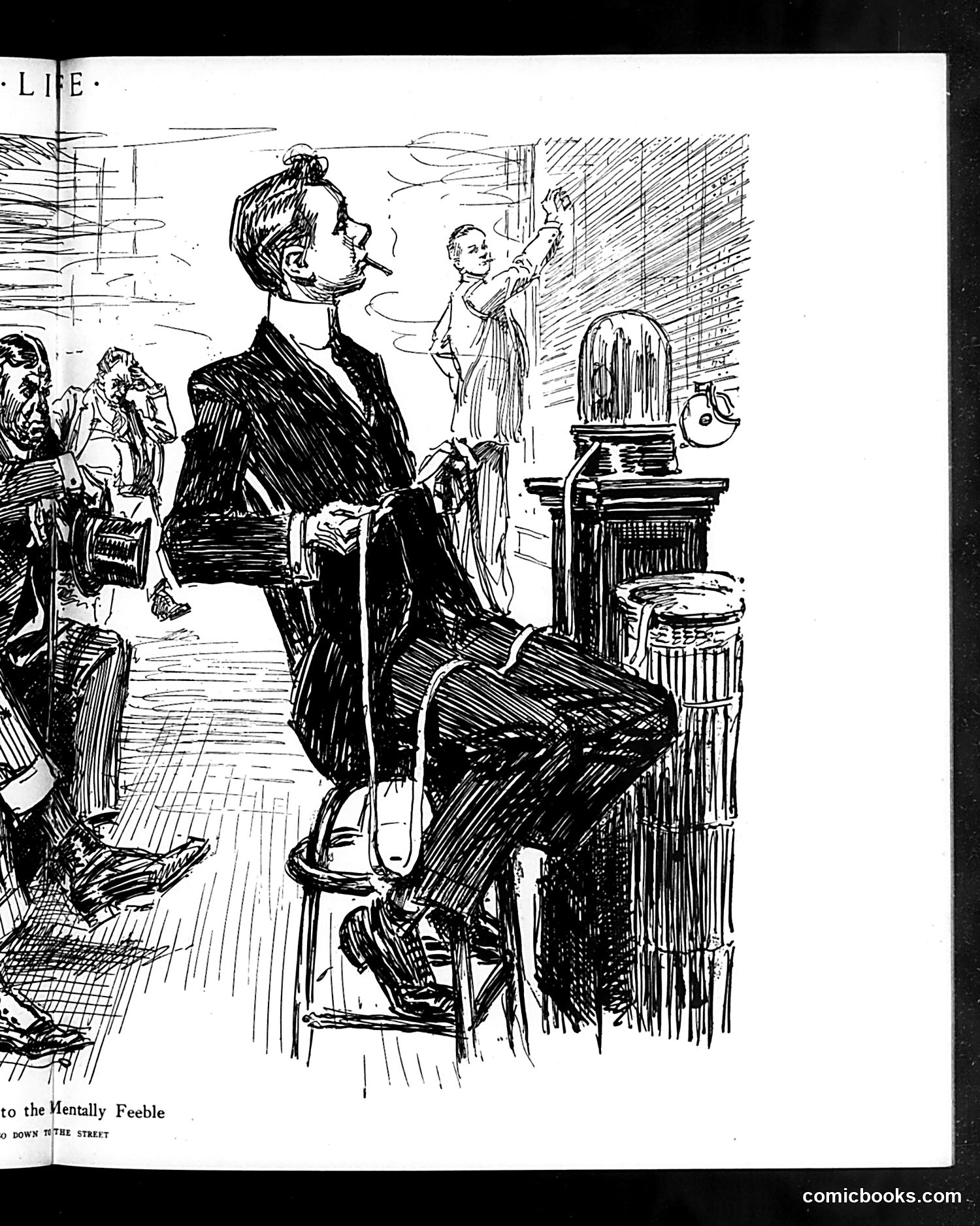
This appears to be a satirical illustration from Life magazine titled "to the Mentally Feeble" with a subtitle referencing "down [the] street" (OCR unclear). The cartoon depicts a well-dressed man in formal attire sitting prominently in the center, looking upward with an exaggerated expression. He's surrounded by other figures in what appears to be an interior space. The style and composition suggest social satire targeting intellectual pretension or gullibility. The exact reference is unclear without more context, but the title "to the Mentally Feeble" indicates the cartoon mocks people of limited intelligence or judgment. The prominent central figure's theatrical pose and setting suggest he may represent a con artist, charlatan, or demagogue appealing to credulous audiences—a common Life magazine subject. Without additional identifying information visible on the page, I cannot specify which historical figure or event this specifically references.
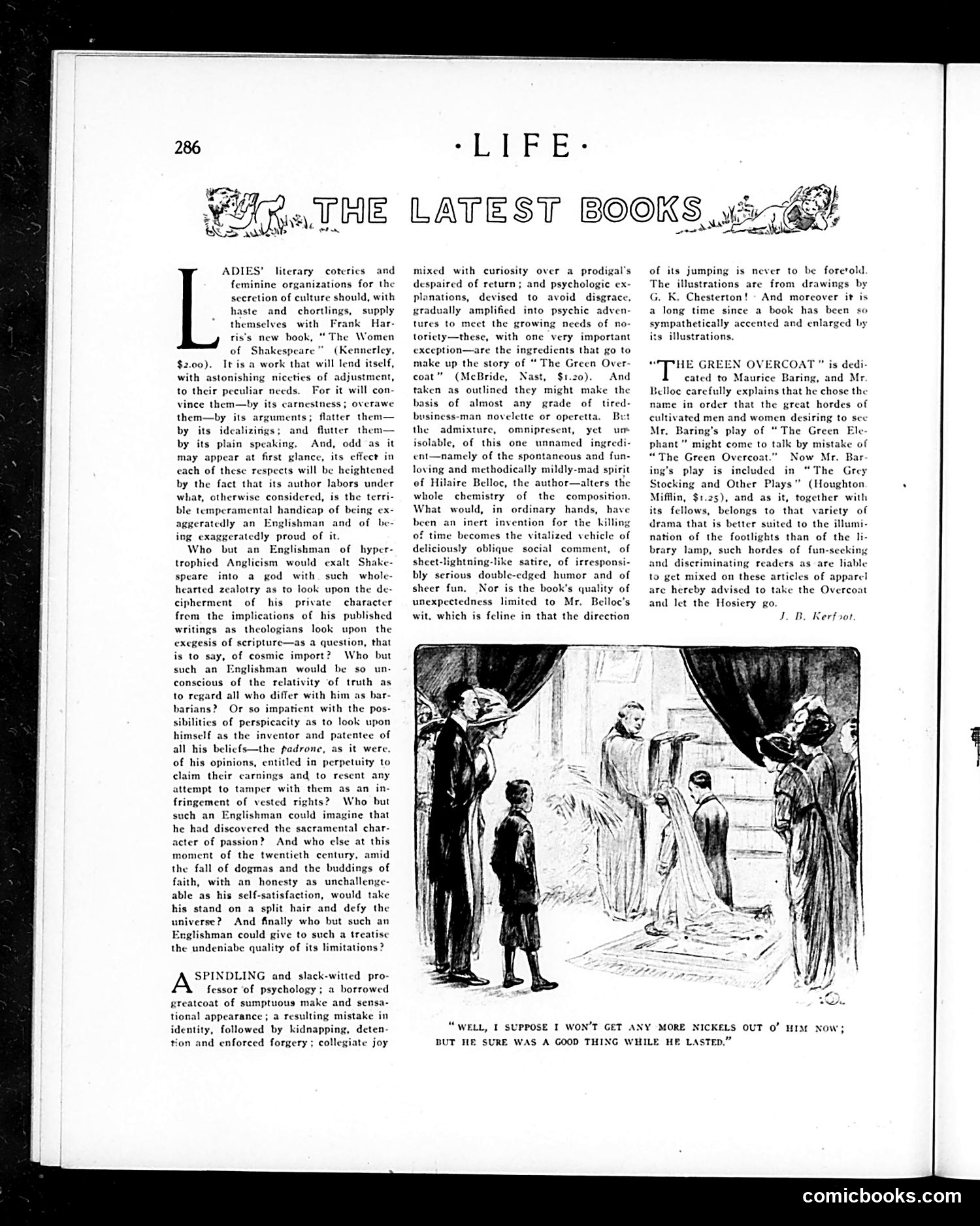
This page reviews two books: Frank Harris's "The Women of Shakespeare" and Hilaire Belloc's "The Green Overcoat." The text mockingly critiques Harris as an excessively proud Englishman whose reverence for Shakespeare borders on religious zealotry. The reviewer sarcastically suggests his pompous certainty about Shakespeare's character and his intolerance of differing opinions typify English arrogance—positioning Harris as someone who treats his literary interpretations as divinely ordained truth. By contrast, Belloc's novel is praised for its playful irreverence and sharp social satire delivered through humor rather than pompousness. The cartoon illustrates a scene from "The Green Overcoat," likely depicting the mistaken-identity plot involving the borrowed greatcoat. The satire contrasts two English literary figures: the self-important scholar versus the witty, humorous storyteller—suggesting that humor and levity serve truth better than humorless dogmatism. The review is fundamentally about intellectual pretension versus entertaining substance.
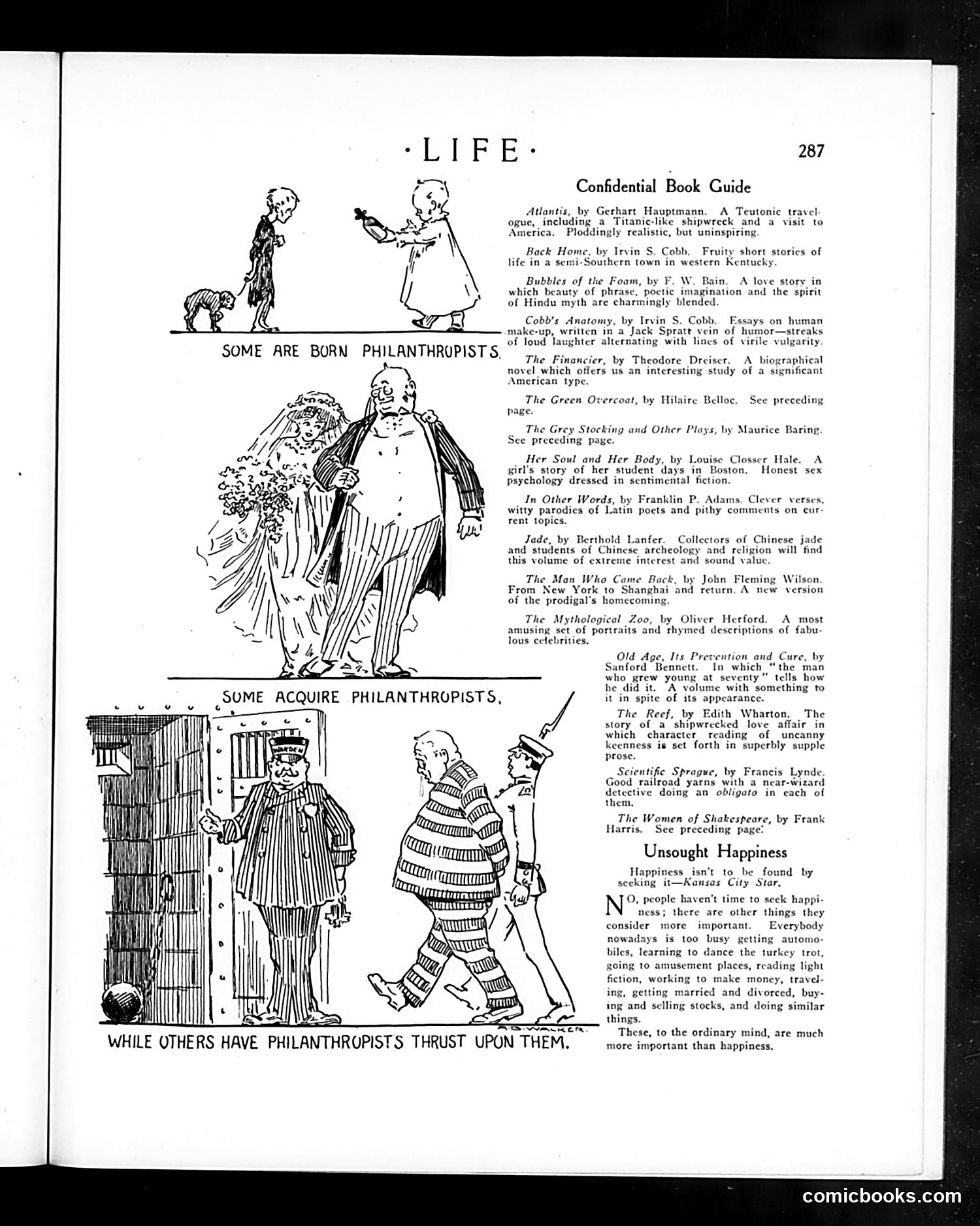
This page contains three interconnected cartoons mocking involuntary philanthropy. The captions suggest three categories: "Some Are Born Philanthropists" (depicting a naturally generous person), "Some Acquire Philanthropists" (showing wealthy individuals being solicited), and "While Others Have Philanthropists Thrust Upon Them" (depicting someone forced into charitable giving). The satire targets the social pressure and obligation surrounding philanthropy in the early 1900s—particularly how wealthy Americans faced constant demands to donate to causes, whether they wished to or not. The cartoons suggest that philanthropy wasn't always a matter of genuine choice or altruism, but rather social coercion and expectation placed upon the affluent. The accompanying essay "Unsought Happiness" reinforces this theme, arguing that modern people are too preoccupied with material pursuits (automobiles, entertainment, stocks) to seek genuine happiness—implying that forced charitable obligations further distract from meaningful living.
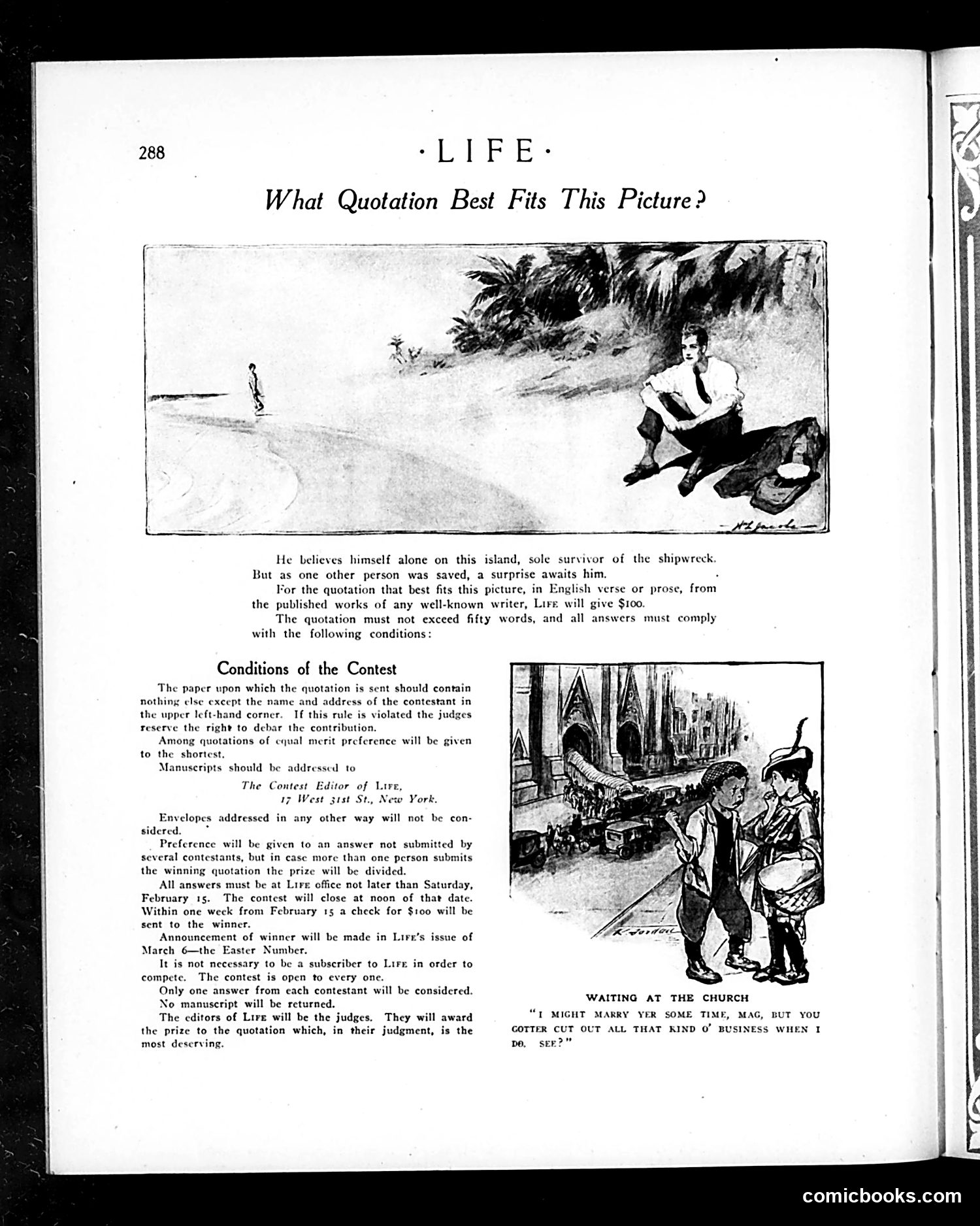
This page features a **quotation-matching contest** rather than political satire. The main illustration shows a castaway on an island spotting another survivor—a visual setup inviting readers to submit literary quotations that fit the scene. The contest offers $100 for the best quotation (under fifty words) from published works. The secondary cartoon, "Waiting at the Church," depicts a working-class couple in what appears to be a sentimental/comedic domestic scene. The man tells the woman he might marry her someday, but only if she stops her current behavior—a joke about male reluctance to commit, playing on period gender dynamics and class stereotypes. Both images reflect early 20th-century Life magazine's mix of literary contests and humor aimed at middle-class readers, with the second cartoon using the familiar "romance delayed" trope common to the era's popular humor.
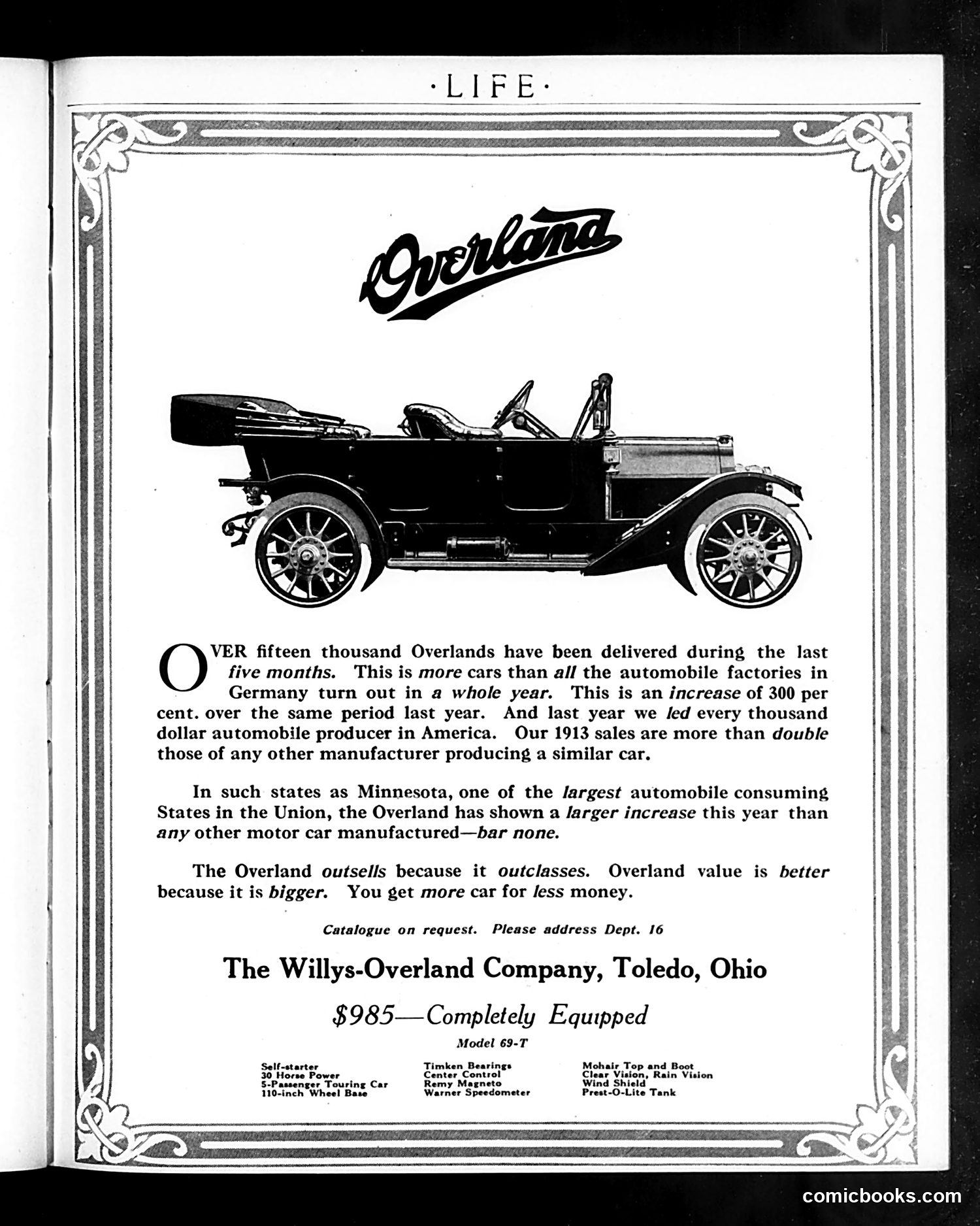
This is a straightforward automobile advertisement, not satire or political commentary. The Willys-Overland Company boasts about the Model 69-T's commercial success: 15,000 vehicles delivered in five months, outselling all German factories combined and doubling competitors' sales. The ad emphasizes value—a fully equipped touring car for $985, featuring modern conveniences (self-starter, electric lights, speedometer). Claims of market dominance, particularly in Minnesota, suggest aggressive marketing during the early automotive boom. For modern readers: this reflects the pre-WWI American industrial confidence and the "affordability revolution" Henry Ford pioneered. The car's price ($985 ≈ $32,000 today) positioned it as accessible middle-class transportation, while boasting engineering features that were then novel luxuries, not standard equipment.
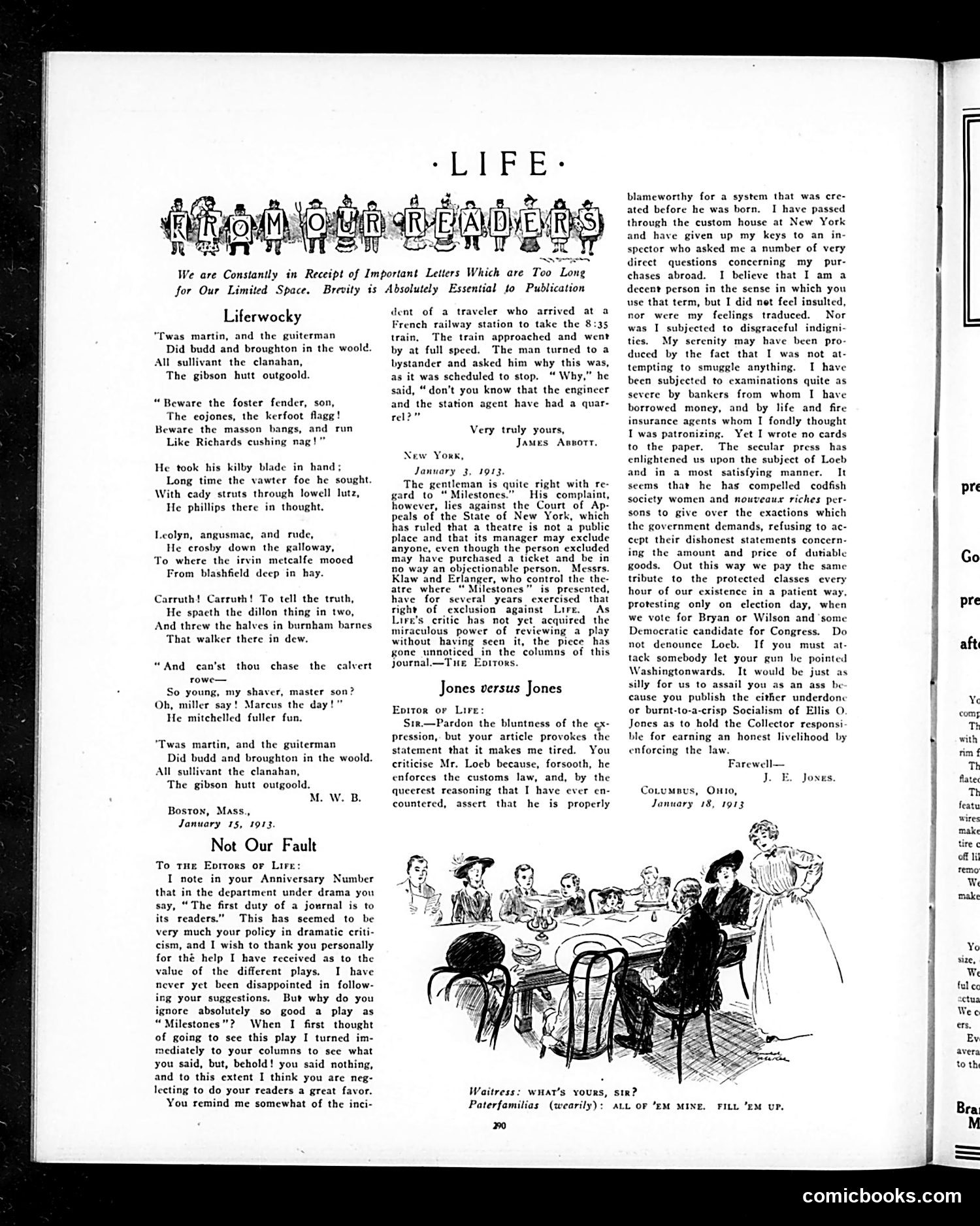
This page contains readers' letters to *Life* magazine's editors, a common feature. The main content includes: **"Liferwocky"**: A parody of Lewis Carroll's "Jabberwocky" using names of prominent American illustrators and artists (Martin, Gibson, Carruth, etc.) instead of nonsense words. It's literary satire aimed at *Life's* educated audience. **"Not Our Fault"**: A reader criticizes *Life* for ignoring the play "Milestones." The editors respond that they cannot review it because the theater owners (Klaw and Erlanger) have legally barred *Life's* critic from attending—citing a New York court ruling that theaters aren't public places. This reveals a real conflict between the entertainment industry and press freedom. **"Jones versus Jones"**: A reader defends customs enforcement against *Life's* implied criticism, arguing the officer shouldn't be blamed for enforcing existing laws. The cartoon (bottom) shows a waitress taking orders, with the caption "What's yours, sir? Poterfamilias (surlily): All of 'em mine. Fill 'em up"—domestic humor about a demanding husband.
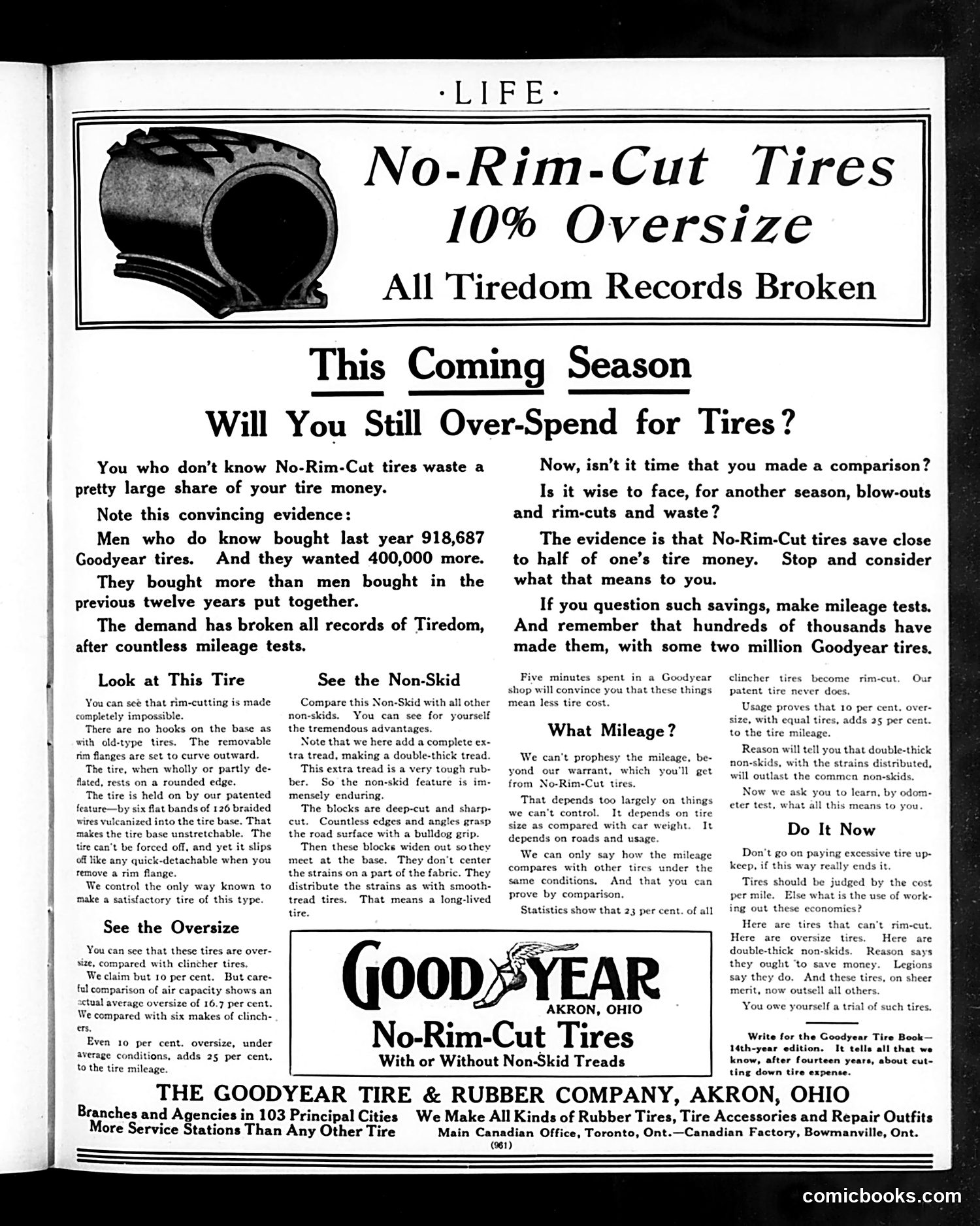
This is a **product advertisement**, not satire or political commentary. Goodyear promotes its "No-Rim-Cut" tires by claiming they solve a genuine problem: traditional clincher tires would cut the rim when deflated, causing costly damage. The ad's persuasive strategy appeals to consumer economics: it cites massive sales figures (918,687 tires sold last year) as proof of superiority, claims the tires last 25% longer, and argues they save "close to half of one's tire money." Technical diagrams show design features—removable rim flanges, braided wires, double-thick treads—intended to demonstrate engineering superiority over competitors. The headline "Will You Still Over-Spend for Tires?" creates rhetorical pressure, implying that not buying Goodyear represents wasteful spending. This represents standard early-20th-century advertising combining technical explanation with emotional persuasion.
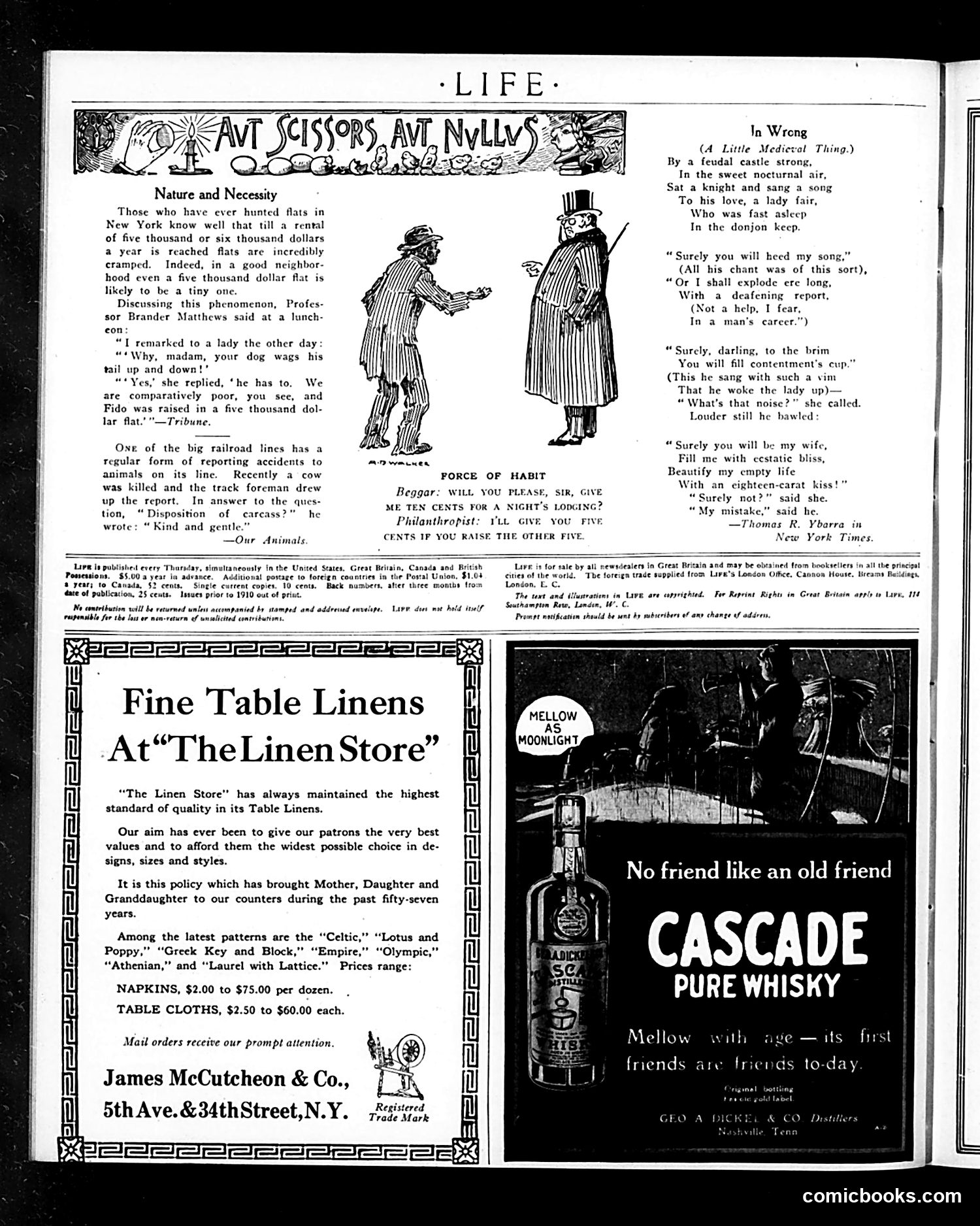
This page contains three distinct elements: **"Force of Habit" cartoon**: A beggar asks a philanthropist for ten cents for lodging. The philanthropist offers five cents if the beggar raises the other five—an absurd demand that mocks the beggar's poverty. The satire critiques how wealthy people sometimes make patronizing or impossible conditions when giving charity, revealing their lack of genuine compassion. **"In Wrong" poem**: A medieval knight serenades his sleeping lady love outside her tower, singing increasingly passionate declarations. She wakes annoyed by the noise, and he admits "My mistake"—a humorous take on romantic devotion gone wrong through sheer persistence and volume. **Advertisements**: The page includes ads for fine linens and Cascade Pure Whisky, typical period marketing. The humor relies on social commentary about class differences, charity, and romantic courtship conventions familiar to early 20th-century readers.
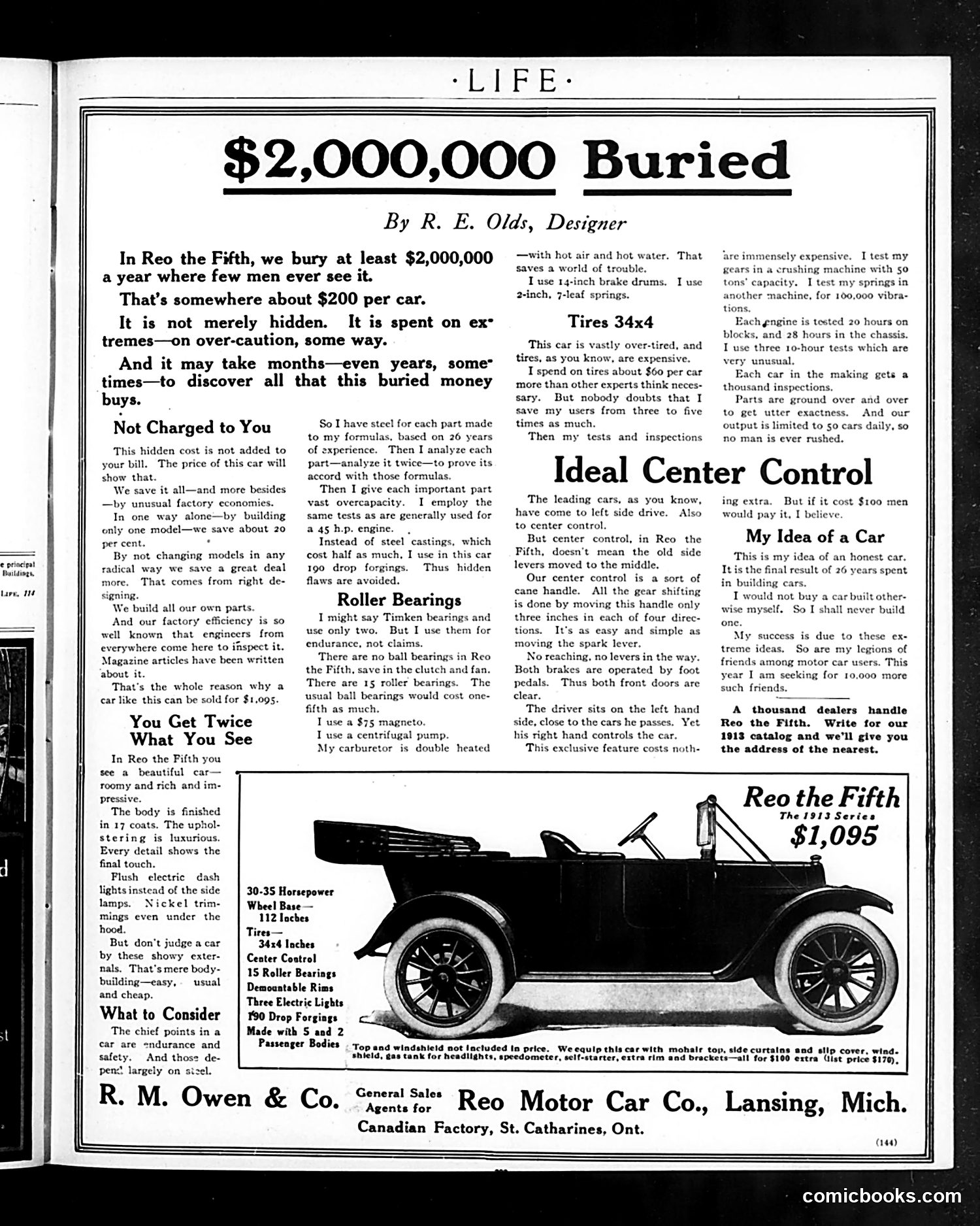
This is primarily a **car advertisement**, not satire or political commentary. R.E. Olds, designer of the Reo automobile, is making a straightforward pitch for the "Reo the Fifth" (priced at $1,095 in 1913). The article's central claim: the car contains "$2,000,000 buried" annually—hidden manufacturing costs not charged to buyers. Olds argues his factory's efficiency (building only one model, manufacturing own parts, conducting extensive testing) allows him to absorb quality expenses that competitors pass to customers. The "buried money" refers to over-engineering details invisible to buyers: 190 drop forgings instead of cheaper castings, 15 roller bearings, 17 paint coats, redundant testing protocols. Olds emphasizes durability and safety over flashy externals—arguing customers get "twice what you see." This reflects early 1900s automotive marketing: competing on engineering excellence and manufacturing innovation rather than style or speed.
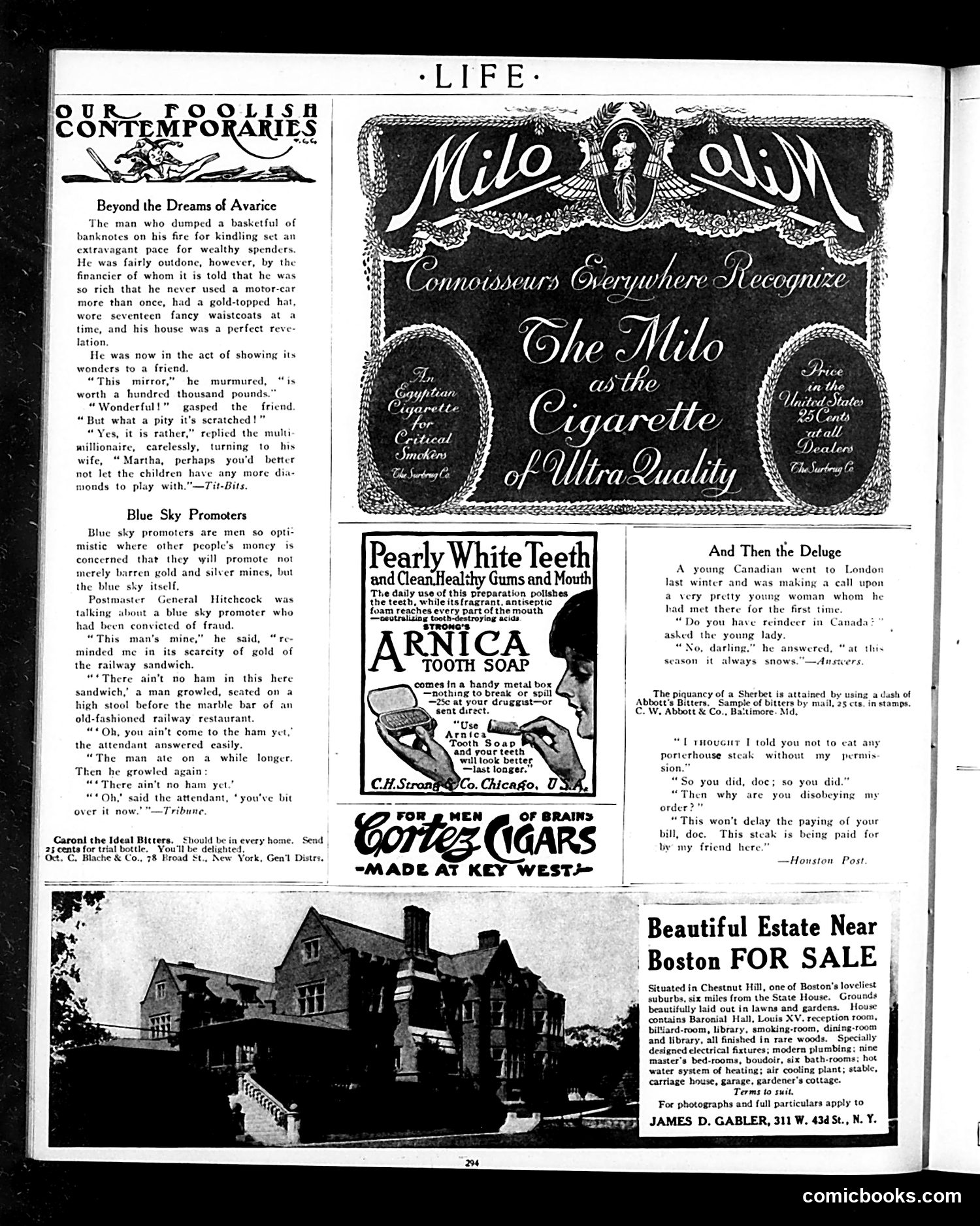
This page contains several brief satirical stories and advertisements typical of early 20th-century Life magazine. **Main Content:** The "Beyond the Dreams of Avarice" section mocks the ultra-wealthy through absurdist anecdotes—a financier so rich he owns a scratched mirror worth £100,000 and casually lets his children play with diamonds. The humor targets extreme wealth disconnect from reality. **"Blue Sky Promoters"** satirizes con artists who sell worthless schemes (even promoting "the blue sky itself"). Postmaster General Hitchcock is referenced as discussing a convicted fraud case, using the railway sandwich metaphor—like a ham sandwich with no ham, these schemes promise everything but deliver nothing. **Minor Anecdote:** A doctor-patient joke about eating steak without permission, relying on wordplay ("you did" / "you didn't"). **Advertisements** dominate the right side, promoting Milo cigarettes, Arnica tooth soap, and a Boston estate for sale—typical period product placement. The page primarily satirizes wealth inequality and financial fraud, common Life magazine themes.
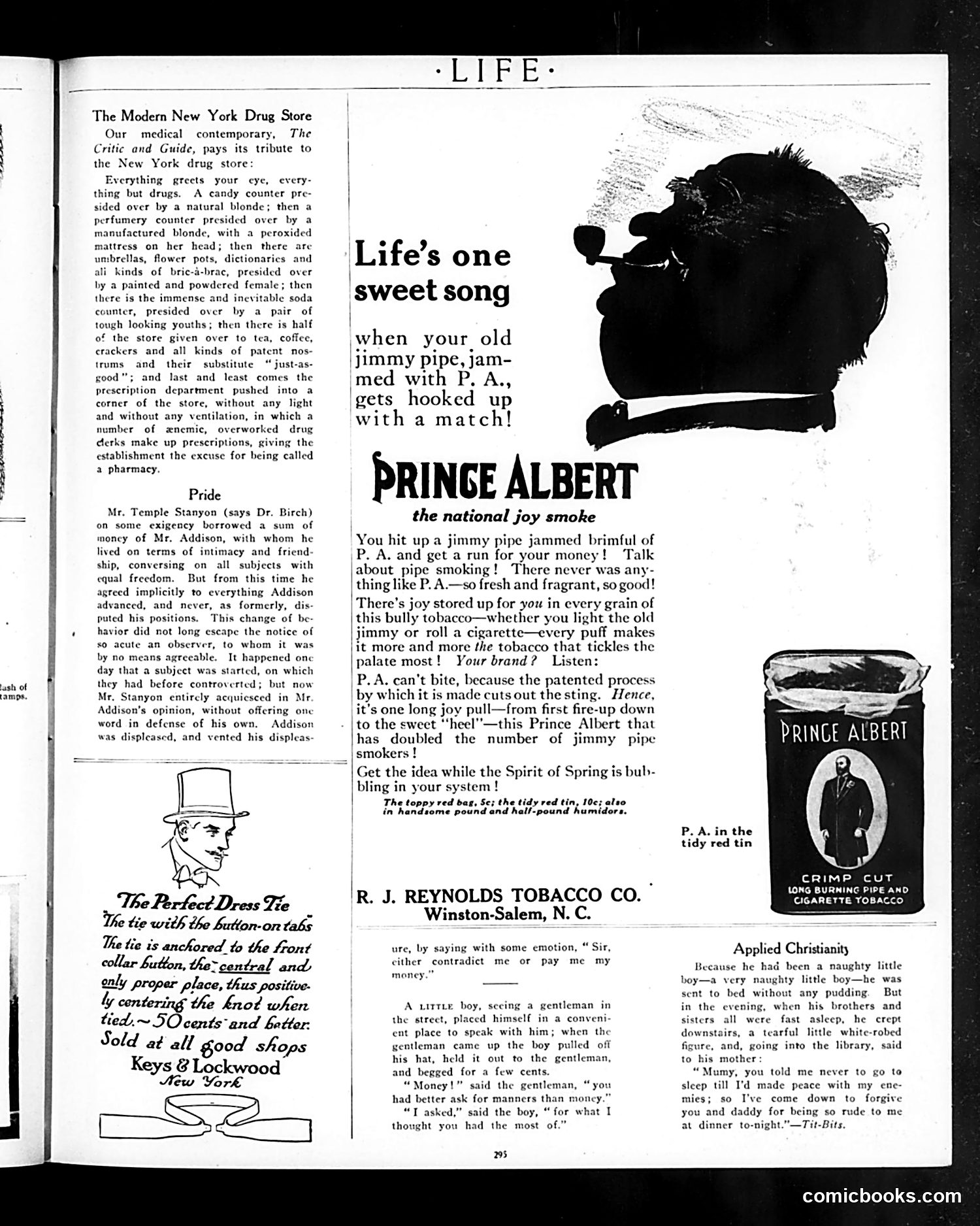
This page combines satirical commentary with period advertising (circa 1910s-1920s). **"The Modern New York Drug Store"** satirizes how American pharmacies had become general stores selling candy, perfume, soda, and sundries while relegating actual pharmacy work to a dark corner. The critique—citing a medical journal—mocks the commercialization of drugstores, where poorly-lit prescription departments staffed by overworked clerks became mere afterthoughts to profitable retail operations. **"Pride"** is a moral anecdote about Mr. Stanyon, who borrows money from Mr. Addison and subsequently stops disagreeing with him, suppressing his own opinions out of obligation. Addison angrily demands Stanyon either contradict him or repay the debt—asserting that intellectual honesty matters more than borrowed money. **Two shorter humorous tales** follow: one about a boy asking a gentleman for "manners" rather than money, claiming the gentleman has "the most of" that quality; another about a naughty boy sent to bed. The **Prince Albert tobacco advertisement** dominates the right side, using slang ("jimmy pipe") and claims about bite-free tobacco to market smoking.
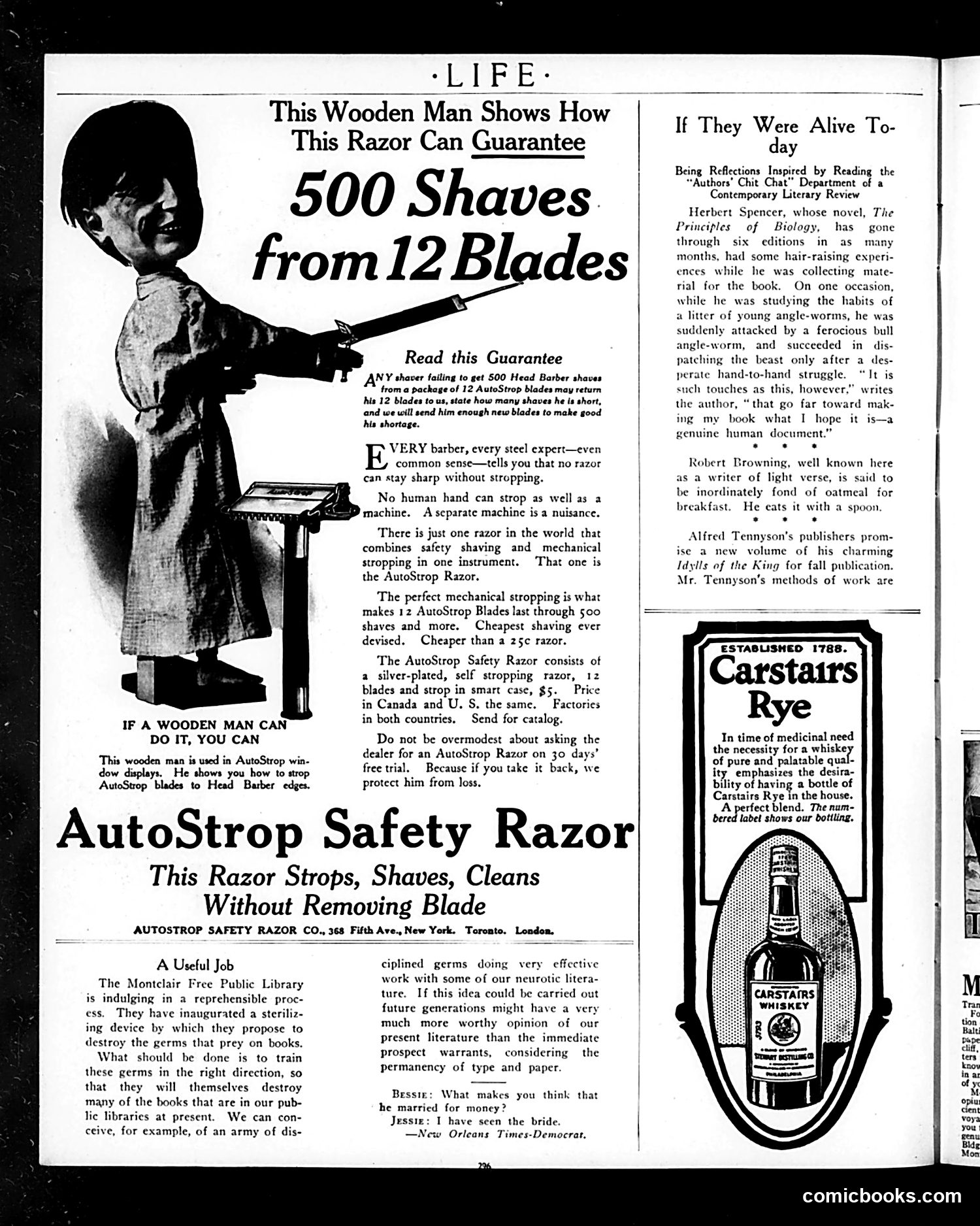
This page is primarily **advertising**, not political satire. The dominant content is a full-page AutoStrop Safety Razor advertisement featuring a wooden mannequin demonstrating the product's stropping mechanism. The ad's selling point is mechanical efficiency: the razor can allegedly deliver 500 shaves from 12 blades because it self-strops without manual hand-stropping, which the copy claims no human can do as well as a machine. The page includes minor humorous filler content typical of Life magazine: a brief satirical note about the Montclair Library's germ-sterilization efforts, and a "If They Were Alive Today" section that humorously reimagines famous authors (Herbert Spencer, Robert Browning, Alfred Tennyson) in contemporary contexts—Spencer wrestling a "ferocious bull angle-worm," Browning eating oatmeal with a spoon. These are gentle literary jokes rather than political commentary. The remainder advertises Carstairs Rye whiskey.
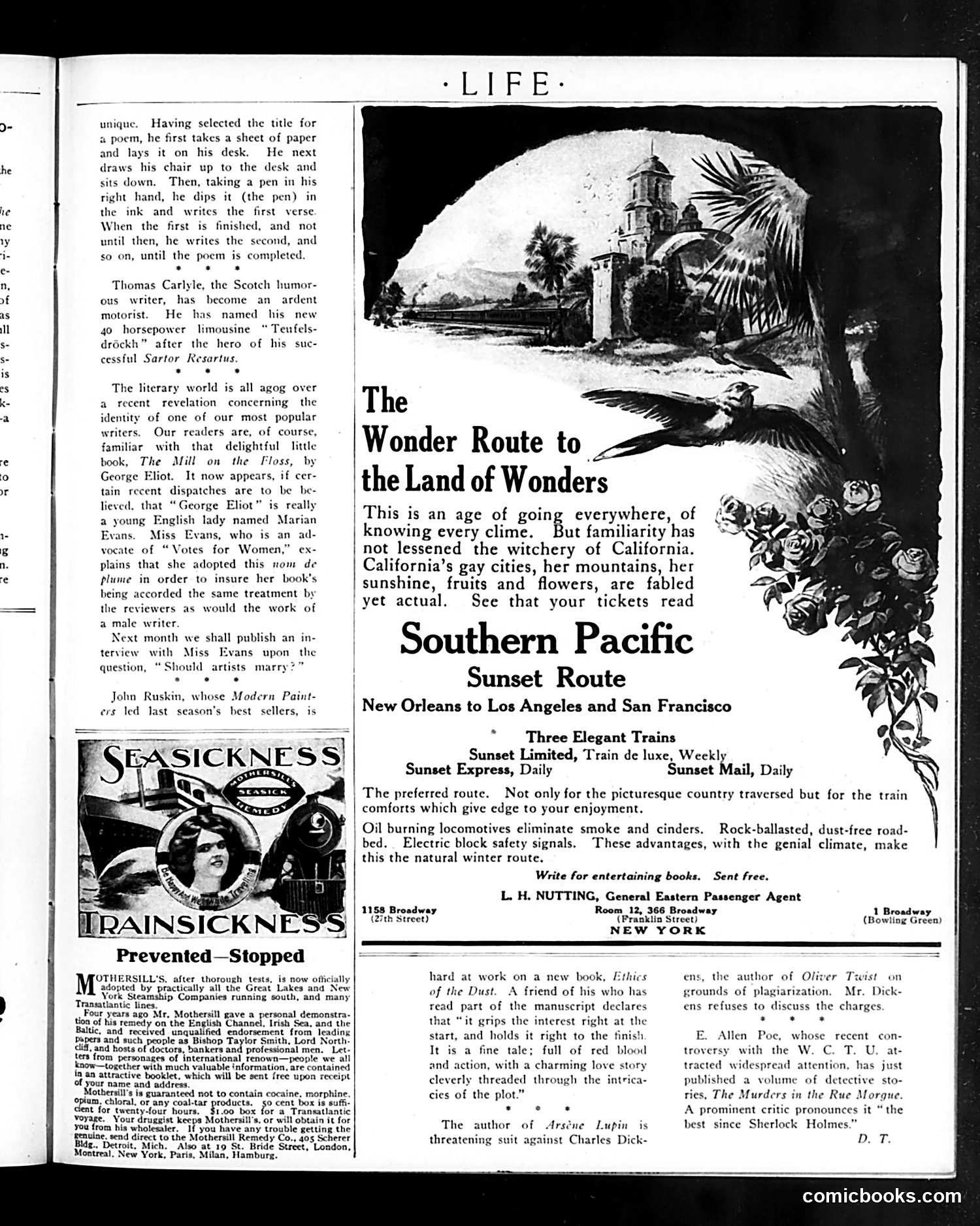
This page mixes literary gossip with period advertising. The left column discusses writing practices and literary figures—Thomas Carlyle adopting motorist culture, and a sensational "revelation" that "George Eliot" (the celebrated author of *The Mill on the Floss*) is actually Marian Evans, a woman. The text notes Evans adopted a male pseudonym to ensure reviewers treated her work with the same respect they'd give a male writer—a pointed commentary on Victorian gender bias in literary criticism. The page's main advertisement promotes the Southern Pacific "Sunset Route" train service to California, marketed as an exotic destination despite modern accessibility. A smaller ad hawks "Mothersill's" seasickness remedy, claiming endorsements from prominent figures. The satirical point: while society celebrates discovering "George Eliot's" true identity, the very need for such deception reveals entrenched prejudice against female authors.
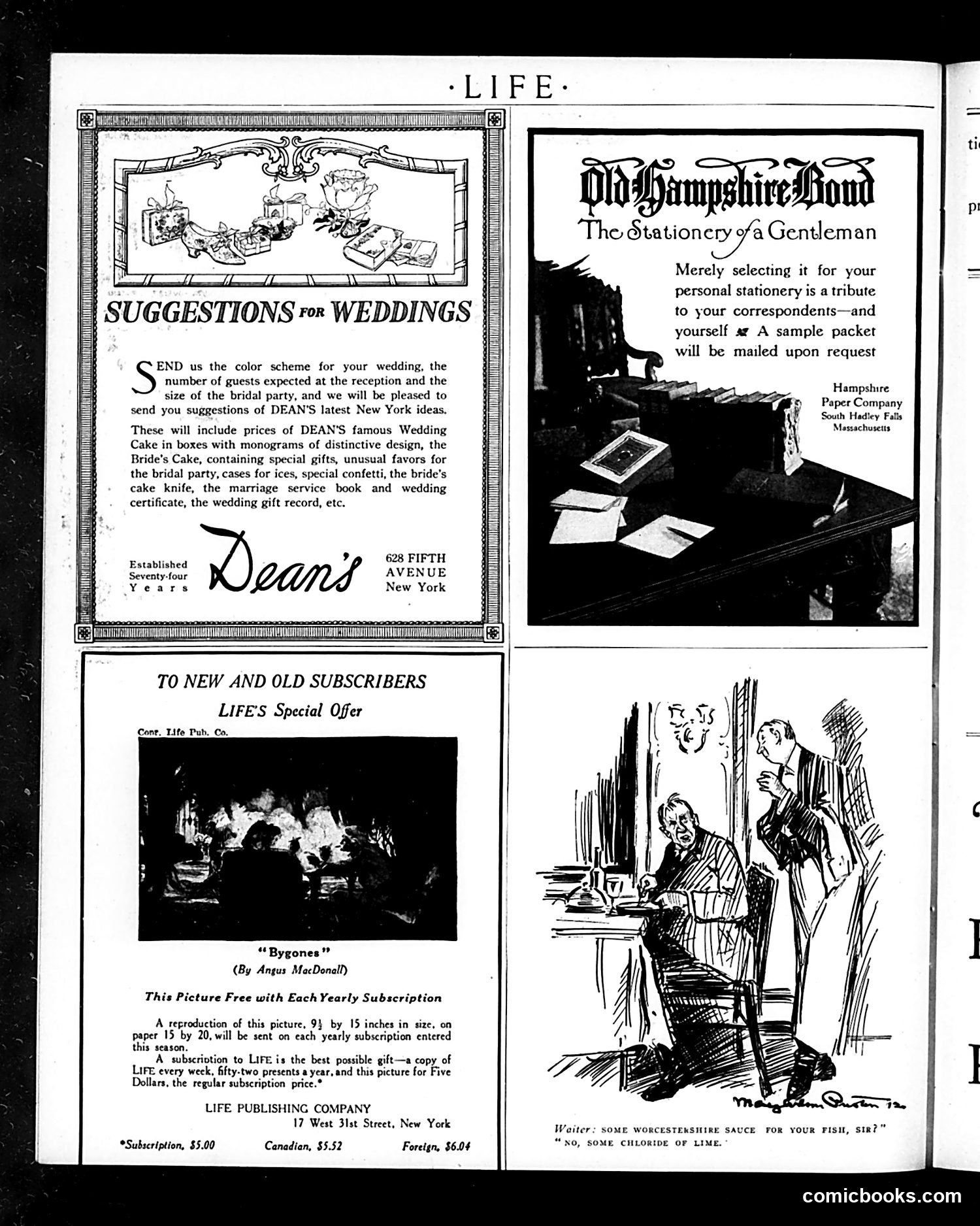
This page is primarily **advertising and subscription material** with one cartoon at bottom right. The cartoon by Angus MacDonall, titled "Waiter: some Worcestershire sauce for your fish, sir?" shows a dining scene where a waiter offers condiments to a diner. The diner's response—"No, some chloride of lime"—is the joke's punchline. Chloride of lime is a disinfectant/cleaning agent, not food. The satire suggests the fish is so poor quality or spoiled that it requires industrial-strength disinfection rather than seasoning. This is a commentary on either restaurant food quality or potentially on wartime food shortages and poor provisions (the reference to "lime" suggests possible period concerns about food safety/preservation). The page's primary content comprises **advertisements**: Dean's wedding services (top left), Hampshire Bond stationery (top right), and Life magazine's subscription offer featuring a reproduction of "Bygones" artwork (bottom left).
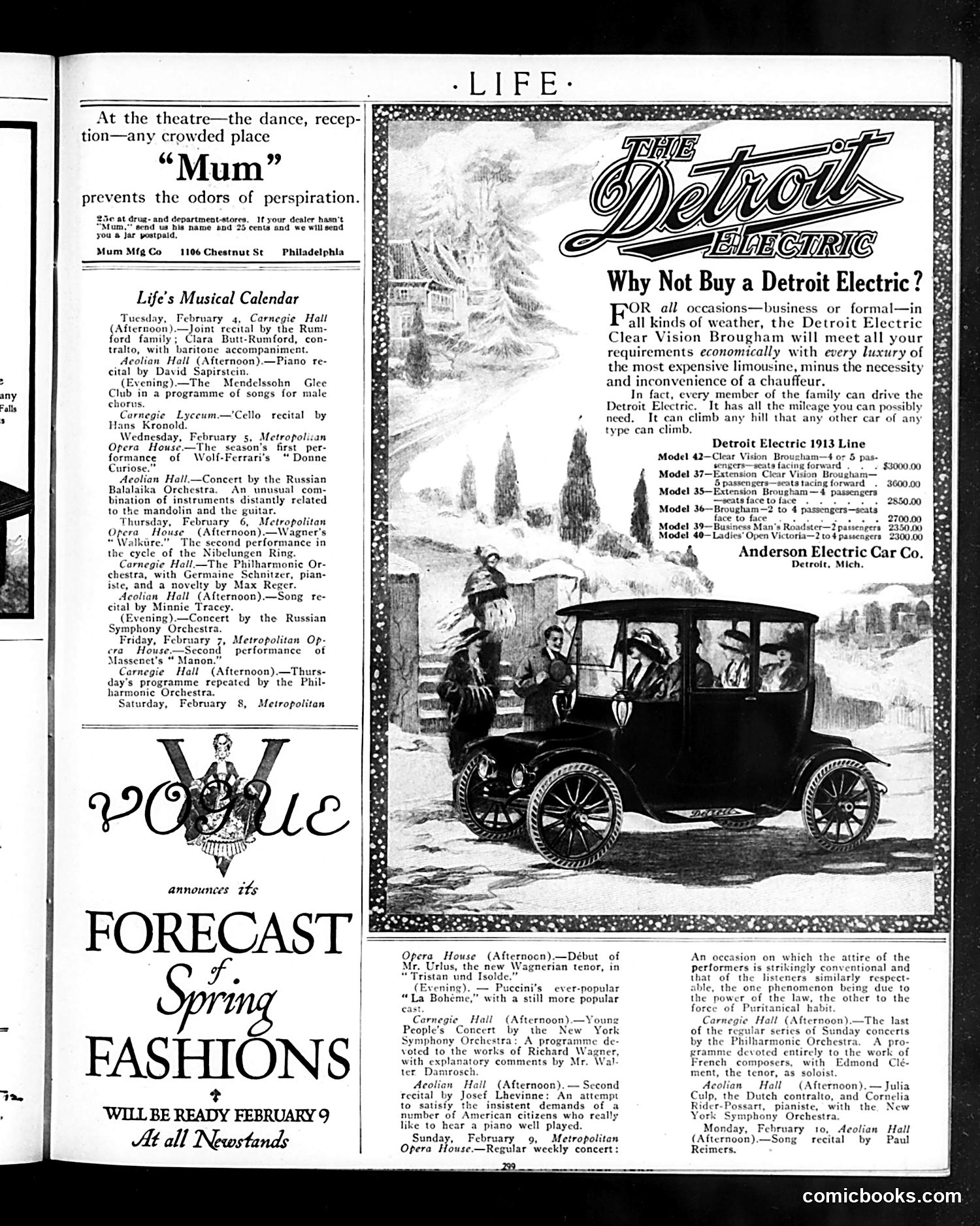
This page is primarily **advertising and entertainment listings**, not political satire. The main content consists of: 1. **"Mum" deodorant ad**: A straightforward product advertisement claiming to prevent perspiration odors at social venues—reflecting early 20th-century anxieties about bodily hygiene in public spaces. 2. **Detroit Electric automobile ad**: The dominant feature promotes electric cars as family vehicles, emphasizing they're easy to drive, reliable, and luxurious. The pitch targets women and families, suggesting electric cars are safer and more practical than gasoline vehicles—a significant marketing angle before gasoline engines dominated. 3. **Vogue fashion announcement** and **Life's Musical Calendar**: Listings for classical concerts and opera performances at venues like Carnegie Hall and the Metropolitan Opera. The page reflects 1913 society: concern with personal grooming, emerging automobile culture, and upper-class entertainment. There is no discernible political cartoon or satire present.
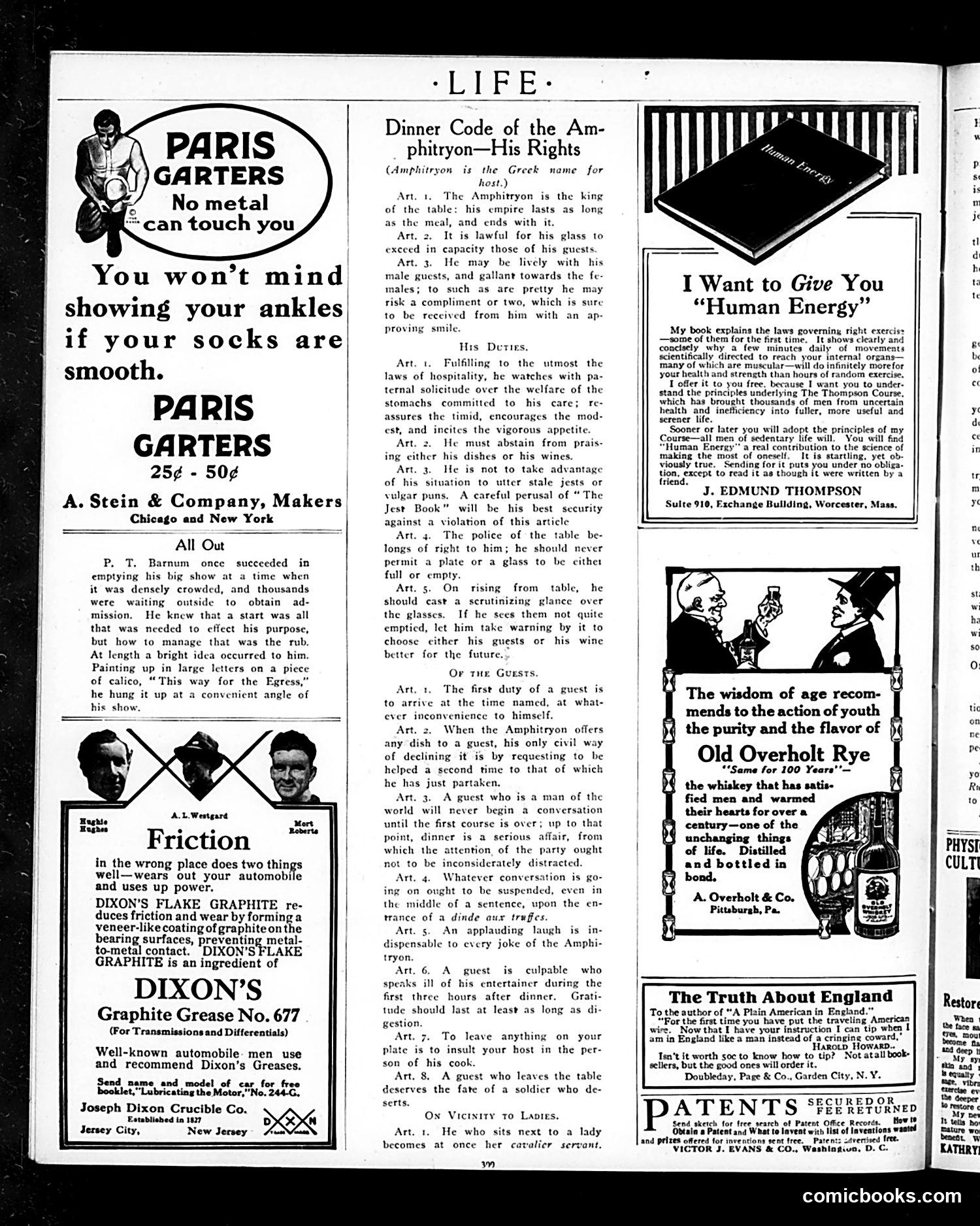
This page is primarily **advertisements and etiquette humor** rather than political satire. The main content presents a humorous "Dinner Code of the Amphitryon"—a mock-serious set of rules governing dinner host and guest behavior. The satire mocks rigid Victorian etiquette by treating dinner protocol with exaggerated formality, using pseudo-legal "Articles" to address absurd situations (like the host's glass being larger, or guests who laugh at the host's jokes). It's gentle social commentary on upper-class dining pretensions. The cartoons are lighter: one references P.T. Barnum's famous "Egress" hoax (tricking crowds by posting signs for a non-existent attraction), and another shows three men's faces labeled "Friction," illustrating friction in mechanical contexts for Dixon's Graphite Grease advertising. The page also advertises **Paris Garters** by emphasizing that wearing them allows women to show their ankles without embarrassment—a modest reference to early 20th-century fashion anxieties about female leg exposure. Overall: social satire through etiquette rules, combined with product advertisements.
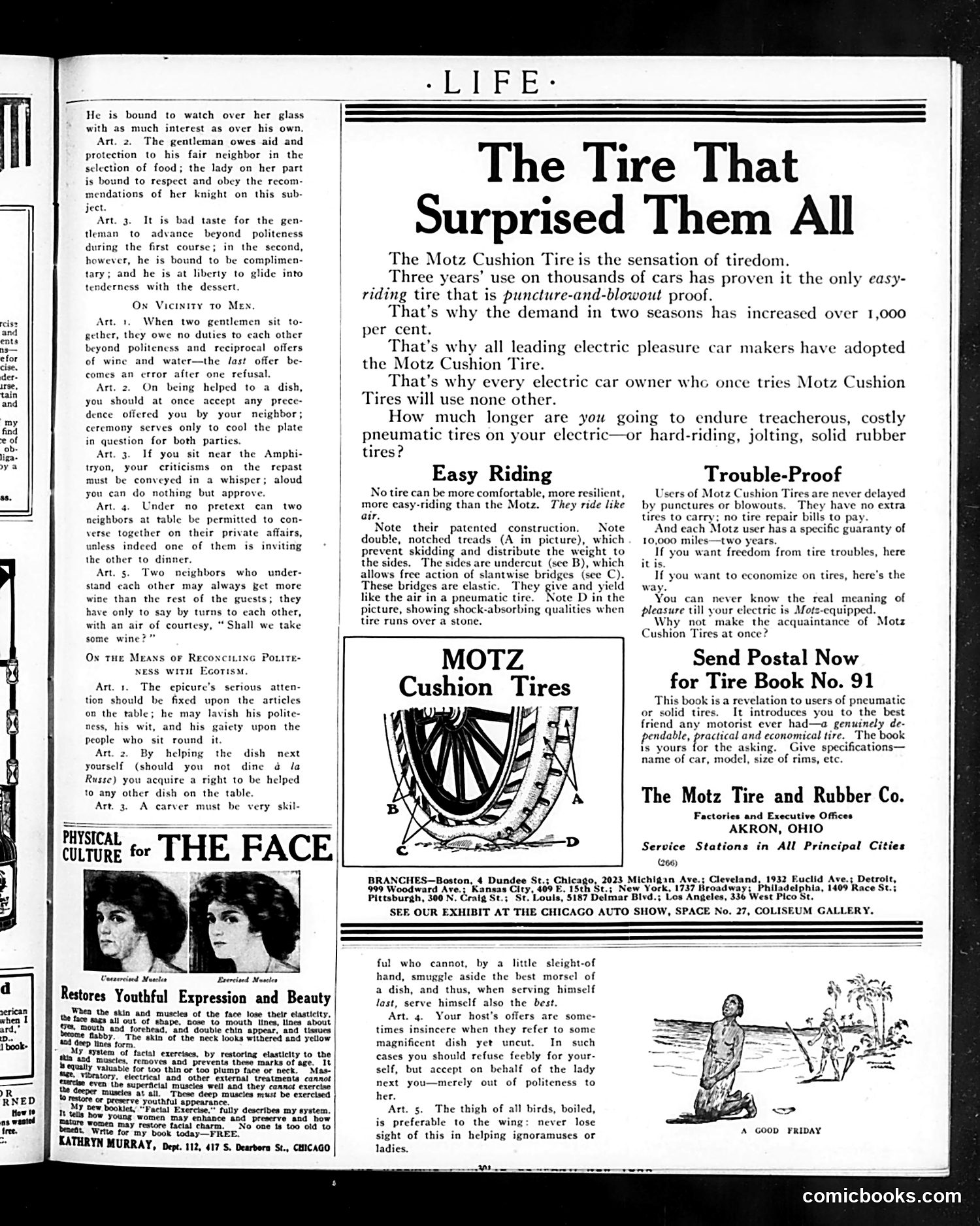
This page is primarily **advertising**, not satire or political commentary. The dominant content is a **Motz Cushion Tire advertisement** promoting a tire for electric automobiles (then a luxury item). The ad claims the tire is "puncture-and-blowout proof" and "easy-riding," with a technical diagram showing its patented design features (labeled A-D). The left column contains **etiquette rules** presented as formal "Articles"—satirizing rigid social conventions about dining and gentlemen's behavior. This is light social satire typical of *Life* magazine's era, mocking overly formal dining protocols (e.g., "ceremony serves only to cool the plate"). A small section on "Physical Culture for the Face" features before/after photographs of a woman's face, advertising a beauty treatment—typical period content. **Bottom right** shows an illustration titled "A Good Friday," depicting people outdoors, likely humorous content unrelated to religious observance. The page reflects early 20th-century concerns: automobile innovation, rigid social codes, and appearance-focused beauty culture.
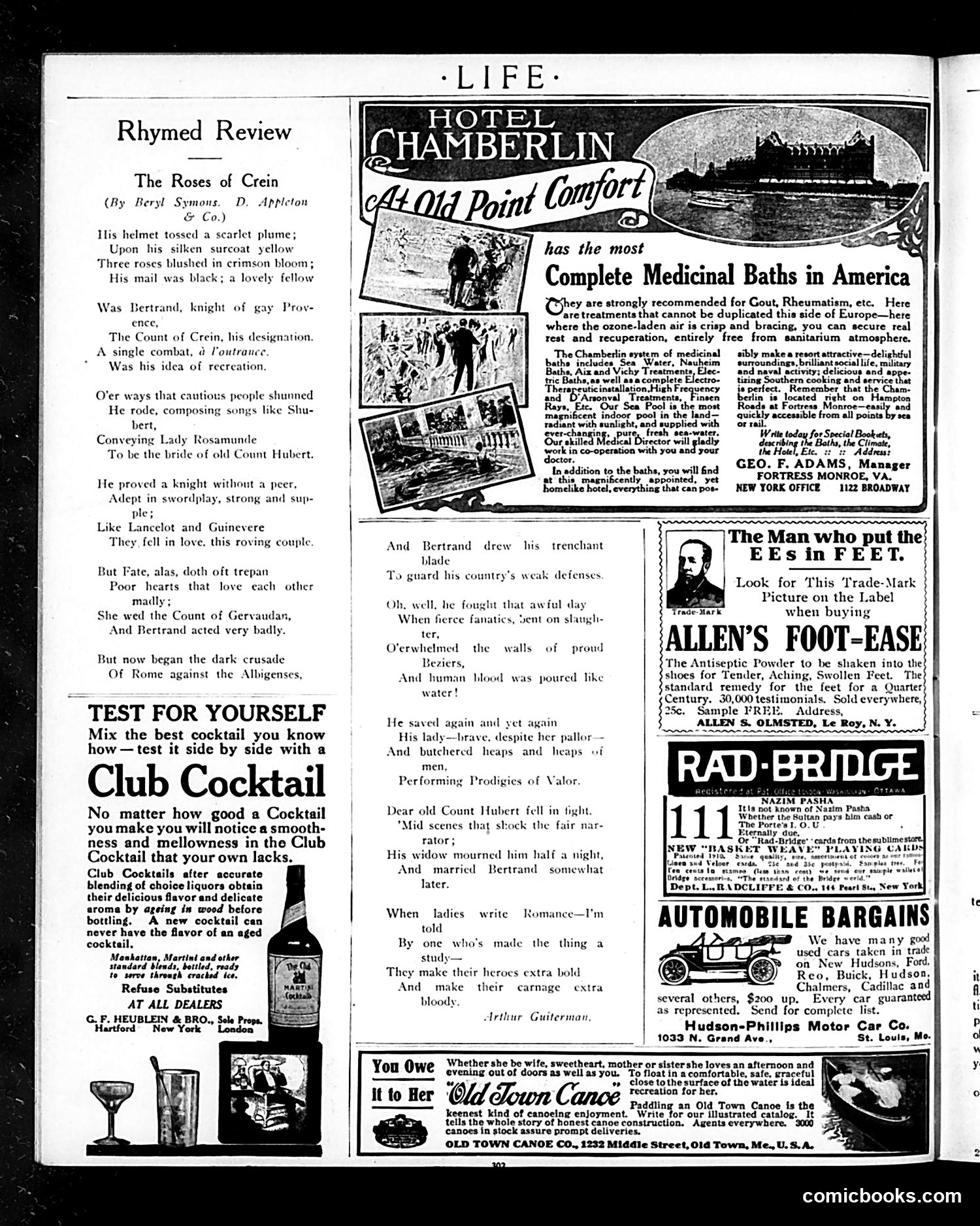
This page is primarily **advertising and book reviews**, not political commentary or satire. **"The Roses of Crein"** is a humorous poem *reviewing* a romantic novel about medieval knights and crusades. The satirical point appears light: poet Arthur Guiterman mocks romance novel conventions—specifically that authors make heroes "extra bold" and carnage "extra bloody" to appeal to readers. It's literary criticism wrapped in verse, not political satire. The page is dominated by **commercial advertisements**: Hotel Chamberlin's medicinal baths, Club Cocktail liquor, Allen's Foot-Ease powder, and other products. These were standard Life magazine content from this era (appears early 20th century based on typography and imagery). The "Test for Yourself" cocktail ad and other pitches use period marketing language emphasizing quality and superiority, typical of the era's commercial appeals. There are no identifiable political figures or contemporary events being satirized on this particular page.
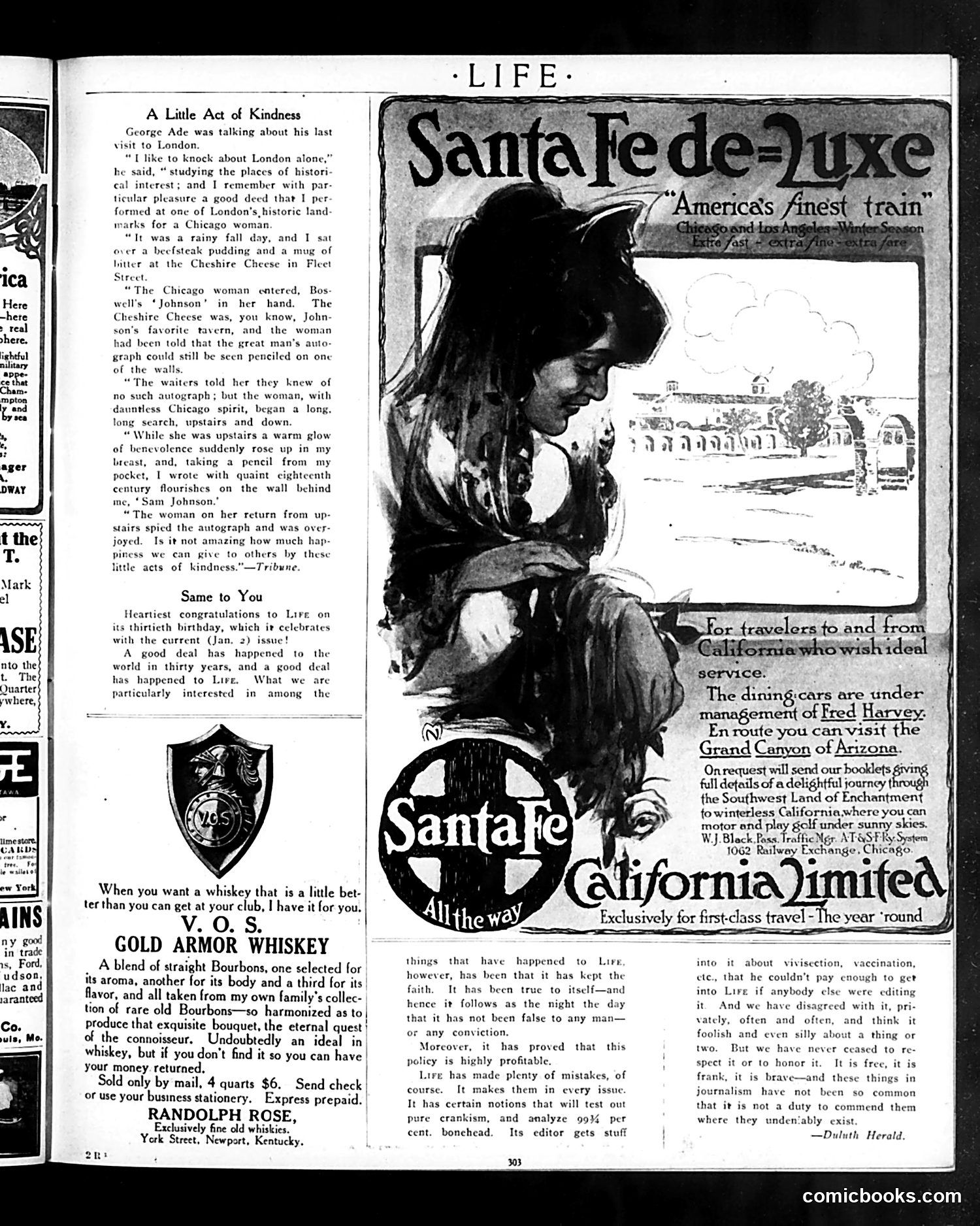
This page consists primarily of **advertisements and editorial content** rather than political cartoons. The main content is a humorous anecdote by writer George Ade about performing a small deception in London: he forged Samuel Johnson's signature on a wall at the historic Cheshire Cheese tavern to please a searching Chicago tourist. The joke satirizes American tourists' gullibility and earnestness while also gently mocking Ade's own mischievous kindness. The right side features a **Santa Fe Railroad advertisement** promoting luxury train travel to California with stops at the Grand Canyon. Below are ads for **Gold Armor Whiskey** and other products. A brief editorial note congratulates *Life* magazine on its 30th anniversary, mentioning the publication's editorial independence and occasional disagreements with readers—emphasizing its commitment to freedom and honesty. The page reflects early 20th-century American magazine culture: literary humor, luxury consumer goods, and railroad travel advertising.
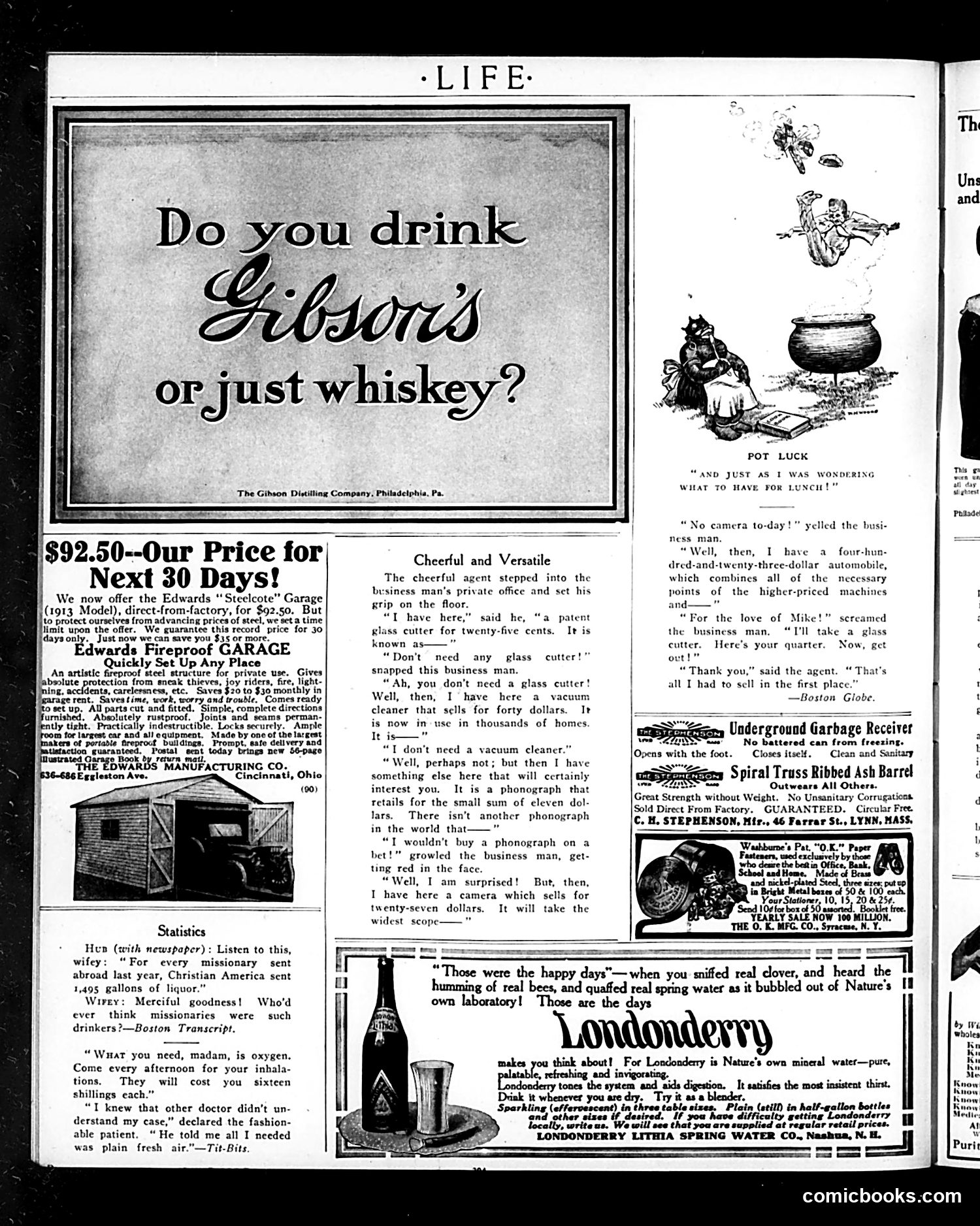
This page contains multiple satirical pieces typical of early 1900s Life magazine: **Main Cartoon ("Pot Luck"):** A leprechaun or Irish figure sits beside a large pot, expressing relief at finding lunch. The joke plays on Irish stereotypes and the phrase "pot luck." **"Cheerful and Versatile" Story:** A traveling salesman enters a businessman's office with various products (glass cutter, vacuum cleaner, phonograph, camera, automobile). After rejecting everything, the exasperated businessman finally buys the glass cutter just to end the pitch. The satire mocks both aggressive sales tactics and the businessman's irrationality. **"Statistics" Joke:** Contrasts missionaries sent abroad versus gallons of liquor sent to America, sarcastically suggesting Americans drink more than they evangelize—satire on American priorities and drinking culture. **Advertisements:** The page features garage sales and household products typical of 1910s marketing. **Londonderry Advertisement:** Promotes spring water as a natural, healthy alternative—contextually ironic given the liquor-focused content above. The overall tone reflects turn-of-century American satirical humor targeting commercialism, drinking habits, and sales culture.
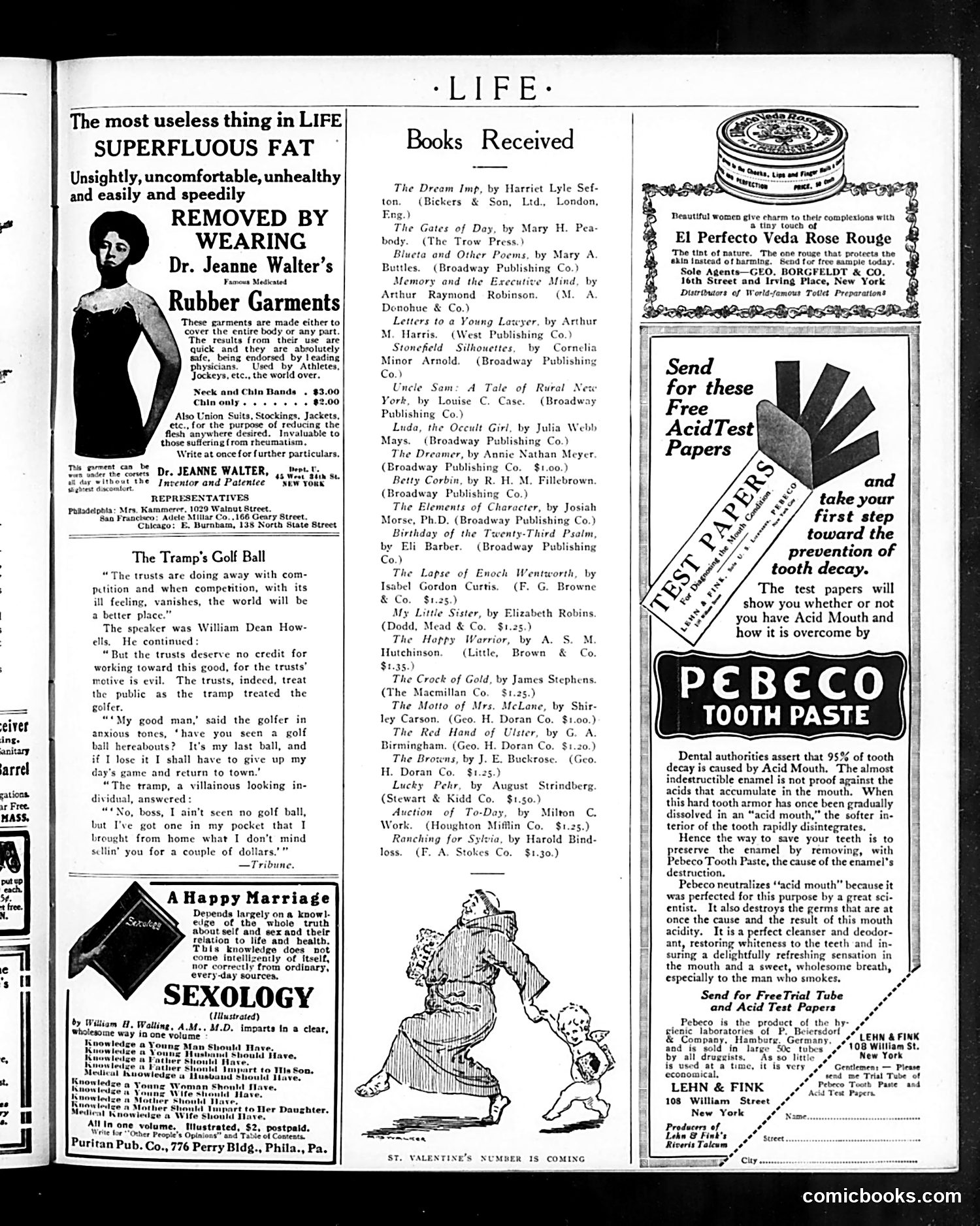
This page consists primarily of **advertisements and book listings**, not political satire. The main content includes: **"The Tramp's Golf Ball"**: A brief moral anecdote attributed to William Dean Howells criticizing trusts. A golfer loses his ball; a tramp offers to sell him one for two dollars—a dishonest transaction. Howells uses this as a metaphor: trusts eliminate competition not through virtue but through exploitation, treating the public like the tramp treats the golfer. **Other Content**: The page features ads for Dr. Jeanne Walter's rubber reducing garments (weight-loss wear), Pebeco toothpaste, and El Perfecto Veda Rose Rouge cosmetics. A "Books Received" section lists contemporary publications. **Context for Modern Readers**: This reflects early-1900s concerns about monopolistic trusts and corporate power in America—a major Progressive Era issue. The anecdote suggests trusts harm consumers through dishonest practices rather than legitimate competition. The page is primarily commercial rather than satirical.
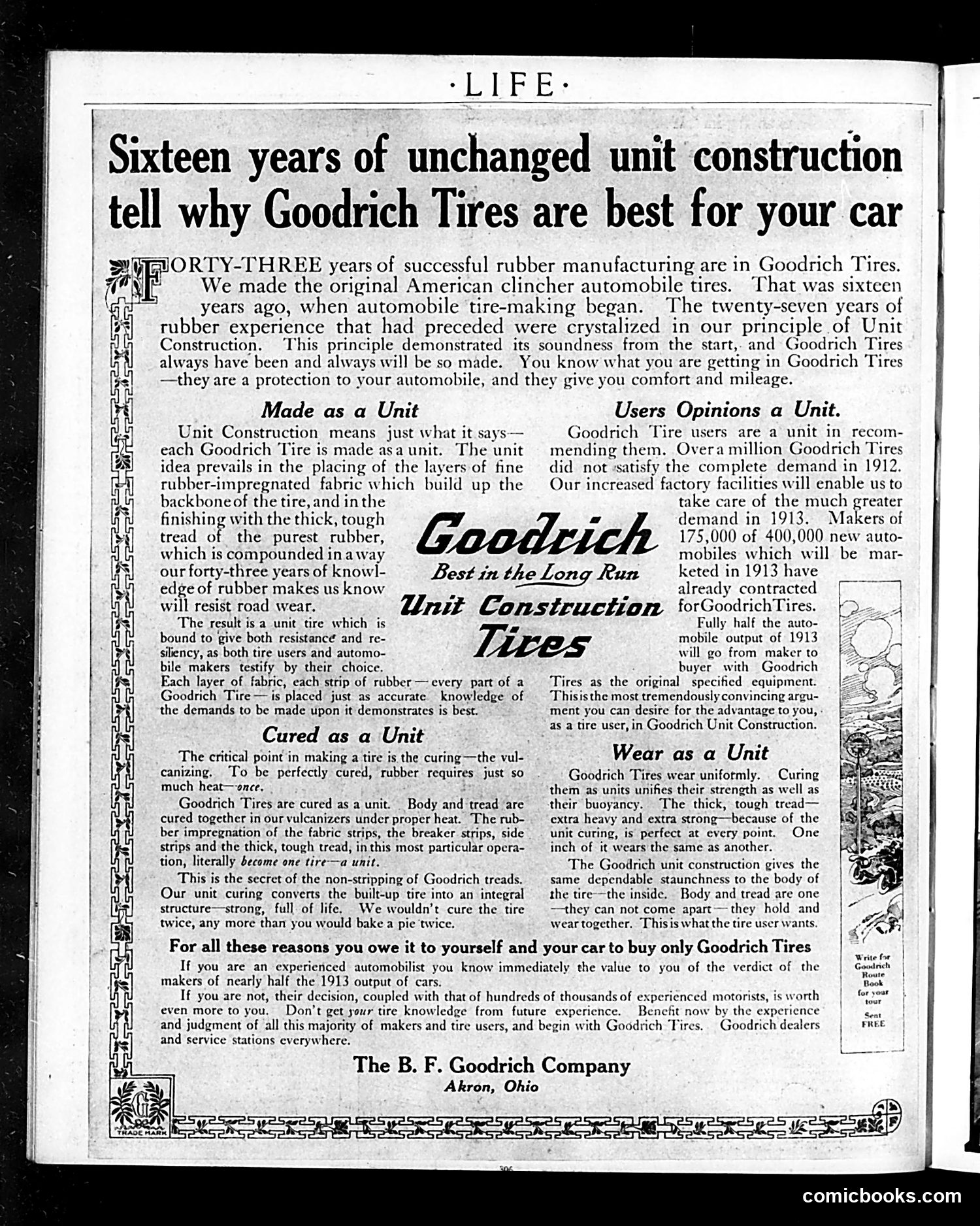
This is a **full-page advertisement for Goodrich Tires**, not satire or political content. It appears in *Life* magazine, which by this era (circa 1912-1913, based on references to 1913 automobile production) had become a general-interest publication carrying advertising alongside humor and commentary. The ad emphasizes Goodrich's manufacturing superiority through repeated emphasis on "Unit Construction"—the idea that tires are engineered as integrated wholes rather than assembled parts. The company claims 43 years of rubber expertise and notes that over one million Goodrich tires sold in 1912, with 175,000 of 400,000 new automobiles in 1913 coming equipped as original equipment. There is **no cartoon or satire here**—just corporate marketing leveraging manufacturing credibility and market dominance to persuade consumers. The "Users Opinions as a Unit" section presents testimonial-style claims about customer satisfaction and widespread adoption.
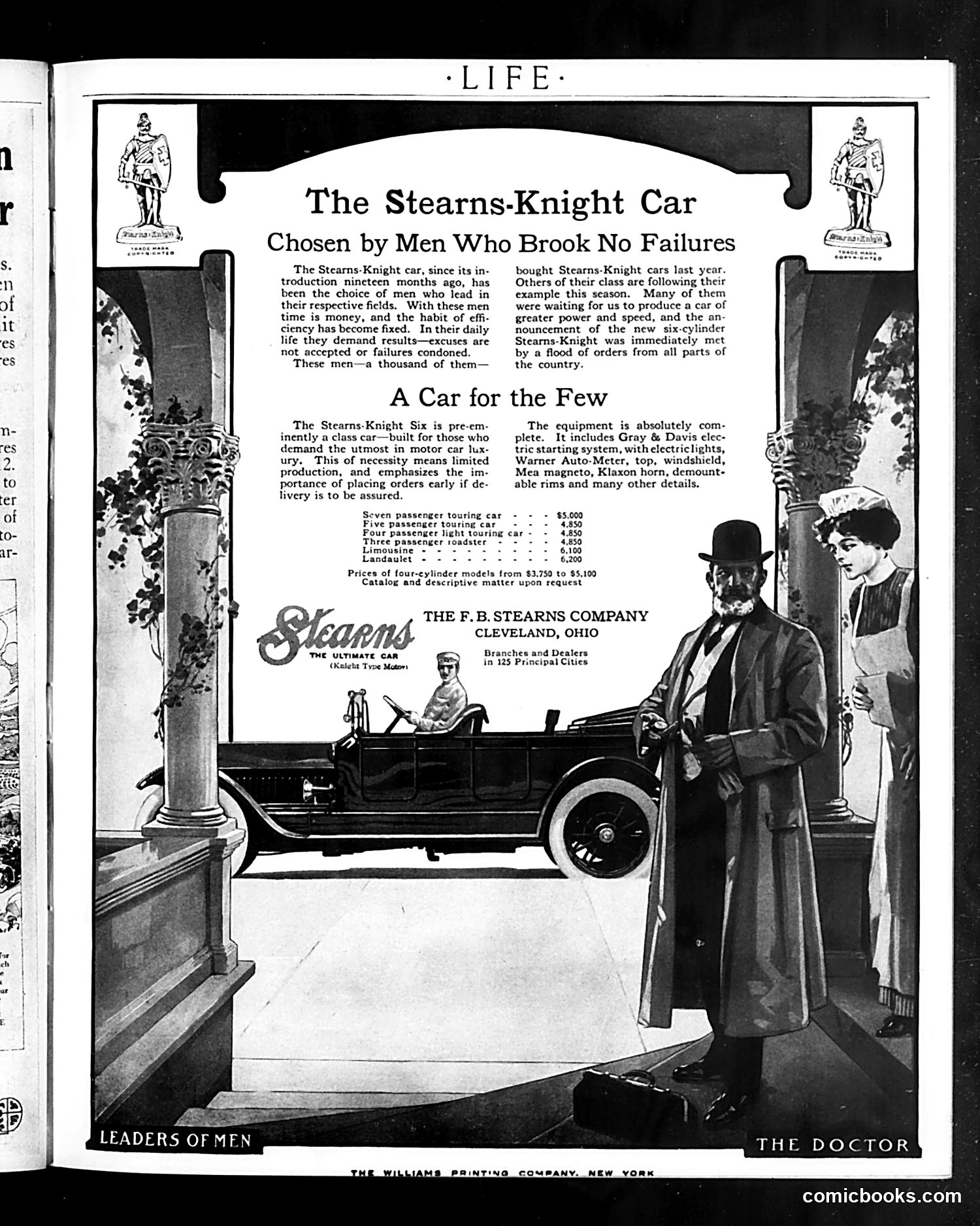
This is primarily a **luxury automobile advertisement**, not political satire. The page uses aspirational imagery to market the Stearns-Knight Six to wealthy, successful men. The two illustrated figures—labeled "LEADERS OF MEN" (left) and "THE DOCTOR" (right)—represent archetypes of accomplished professionals who demand reliability and quality. The advertisement's tagline, "Chosen by Men Who Brook No Failures," appeals to their need for dependable transportation matching their status and work demands. The copy emphasizes exclusivity ("a car for the few"), suggesting limited production and early ordering to create urgency among the affluent. References to features like "Gray & Davis electric starting system" appeal to men valuing practical luxury and technological advancement. The imagery of distinguished gentlemen in formal dress standing beside the automobile reinforces the product's positioning as aspirational luxury, not utilitarian transport. This reflects early 1910s marketing strategies targeting America's business and professional elite.
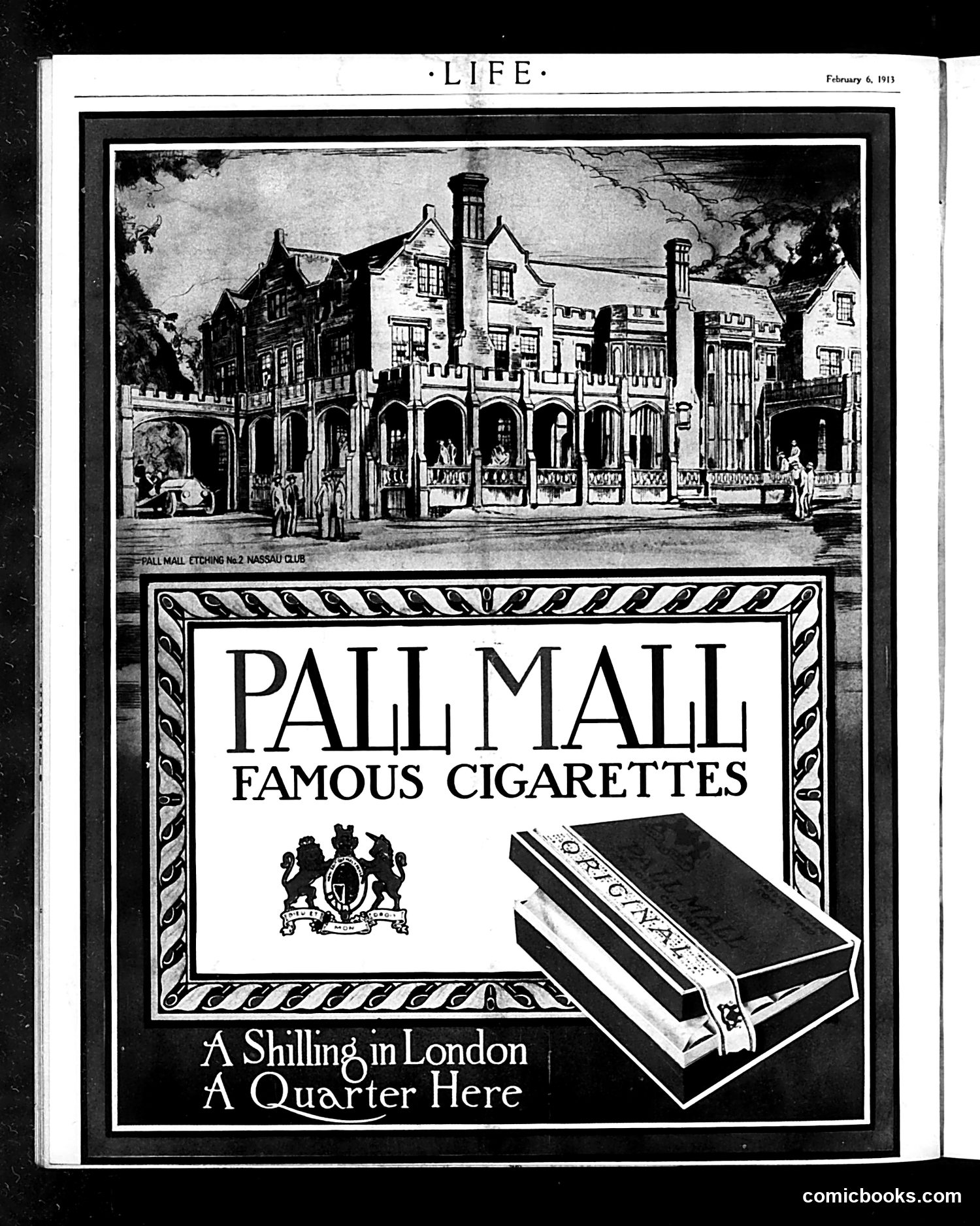
This is a **cigarette advertisement**, not a political cartoon. The page shows: - An architectural illustration of "Pall Mall Citying No.2 Nassau Club" — an ornate building with arches and towers - A product box for Pall Mall Famous Cigarettes with a coat of arms - Pricing text: "A Shilling in London / A Quarter Here" The ad's point is comparative pricing: Pall Mall cigarettes cost one shilling in London but only a quarter (25 cents) in America, suggesting good value for American consumers. This pricing appeal was common in early 1910s advertising when cigarettes were affordable luxury goods. There is no satire or political content — this is straightforward commercial advertising using an impressive building as branding imagery.