
Life, 1913-02-06 · page 11 of 48
Life — February 6, 1913 — page 11: what you’re looking at
What you’re looking at
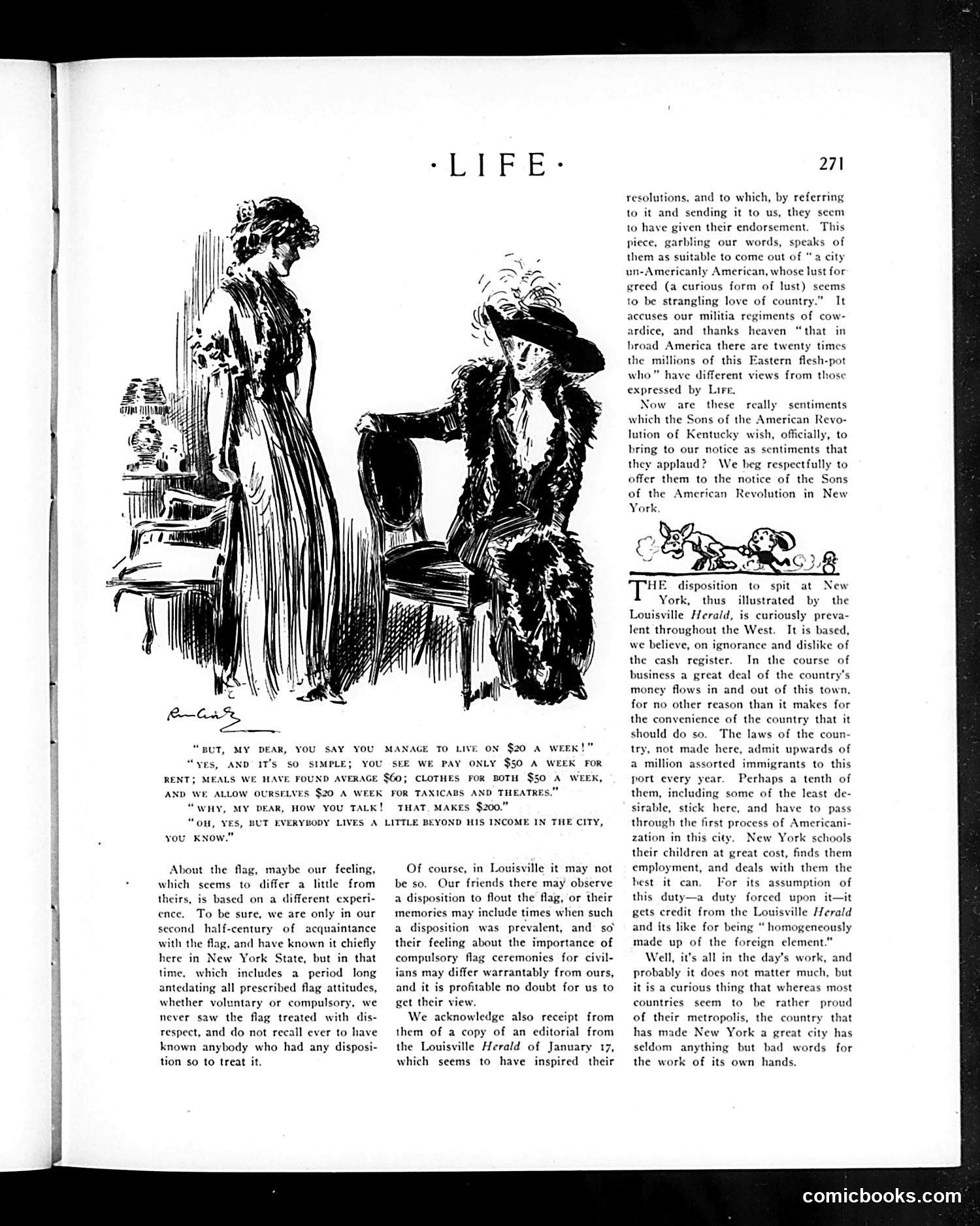
This cartoon satirizes wealth inequality in early 20th-century New York City. A fashionably dressed woman (appearing to represent the wealthy elite) listens as a man in worn clothing (representing the working poor) explains his budget: he manages to live on $20 weekly—$60 for rent, $50 for food and clothes, $20 for entertainment, totaling $200. The joke exposes the mathematical impossibility of his claim, highlighting the gap between what the poor actually earned and what they needed to survive. The accompanying text criticizes New York's reputation for attracting immigrants and the cash-register mentality of the city's commerce, contrasting it with more patriotic American values—a common Progressive-era critique of unchecked urban capitalism.
📄 Transcribed text from this page (OCR, searchable)
Machine-transcribed from the original scan — historical spelling and the odd misread are preserved.
“BUT, MY DEAR, YOU SAY YOU “YES, AND 1T’s SO SIMPLE; YOU RENT; MEALS WE MANAGE TO LIVE ON $20 A WEE! HAVE FOUND AVERAGE $60; CLOTHES FOR BOTH $50 A WEEK, WE PAY ONLY $50 A WEEK FOR AND WE ALLOW OURSELVES $20 A WEEK FOR TAXICABS AND THEATRES.” “WHY, MY DEAR, How you TALK! OW, YES, BUT EVERYBODY LIVES A ow.” you hout the flag, maybe our feeling, which seems to differ a little from theirs, is based on a different experi- ence. To be sure, we are only in our second half-century of acquaintance with the flag, and have known it chiefly here in New York State, but in that time, which includes a period long antedating all prescribed flag attitudes, whether voluntary or compulsory, we never saw the flag treated with dis- respect, and do not recall ever to have known anybody who had any disposi- tion so to treat it. THAT. MAK! s $200.” LITTLE BEYOND HIS INCOME IN THE CITY, Of course, in Louisville it may not be so. Our friends there may observe a disposition to flout the flag, or their memories may include times when such a disposition was prevalent, and so their feeling about the importance of compulsory flag ceremonies for civil- ians may differ warrantably from ours, and it is profitable no doubt for us to get their view. We acknowledge also receipt from them of a copy of an editorial from the Louisville Herald of January 17, which seems to have inspired their 271 resolutions, and to which, by referring to it and sending it to us, they seem to have given their endorsement. This piece, garbling our words, speaks of them as suitable to come out of “a city un-Americanly American, whose lust for greed (a curious form of lust) seems to be strangling love of country.” It accuses our militia regiments of cow- ardice, and thanks heaven “that in broad America there are twenty times the millions of this Eastern flesh-pot who” have different views from those expressed by Lire. nw are these really sentiments which the Sons of the American Revo- lution of Kentucky wish, officially, to bring to our notice as sentiments that they applaud? We beg respectfully to offer them to the notice of the Sons of the American Revolution in New HE disposition to s ew York, thus illustrated by the Louisville Herald, is curiously pre lent throughout the West. It is based, we believe, on ignorance and dislike of the cash register. In the course of business a great deal of the country’s money flows in and out of this town, for no other reason than it makes for the convenience of the country that it should do so. The laws of the coun- try, not made here, admit upwards of a million assorted immigrants to this port every year. Perhaps a tenth of them, including some of the least de- sirable, stick here, and have to pass through the first process of Americani- zation in this ci New York schools their children at great cost, finds them employment, and deals with them the hest it can. For its assumption of this duty—a duty forced upon it—it gets credit from the Louisville Herald and fts like for being “ homogeneously made up of the foreign element Well, it’s all in the day’s work, and probably it does not matter much, but it is a curious thing that whereas most countries seem to be rather proud of their metropolis, the country that has made New York a great city has seldom anything but bad words for the work of its own hands. comicbooks.com