
Life, 1913-02-06 · page 26 of 48
Life — February 6, 1913 — page 26: what you’re looking at
What you’re looking at
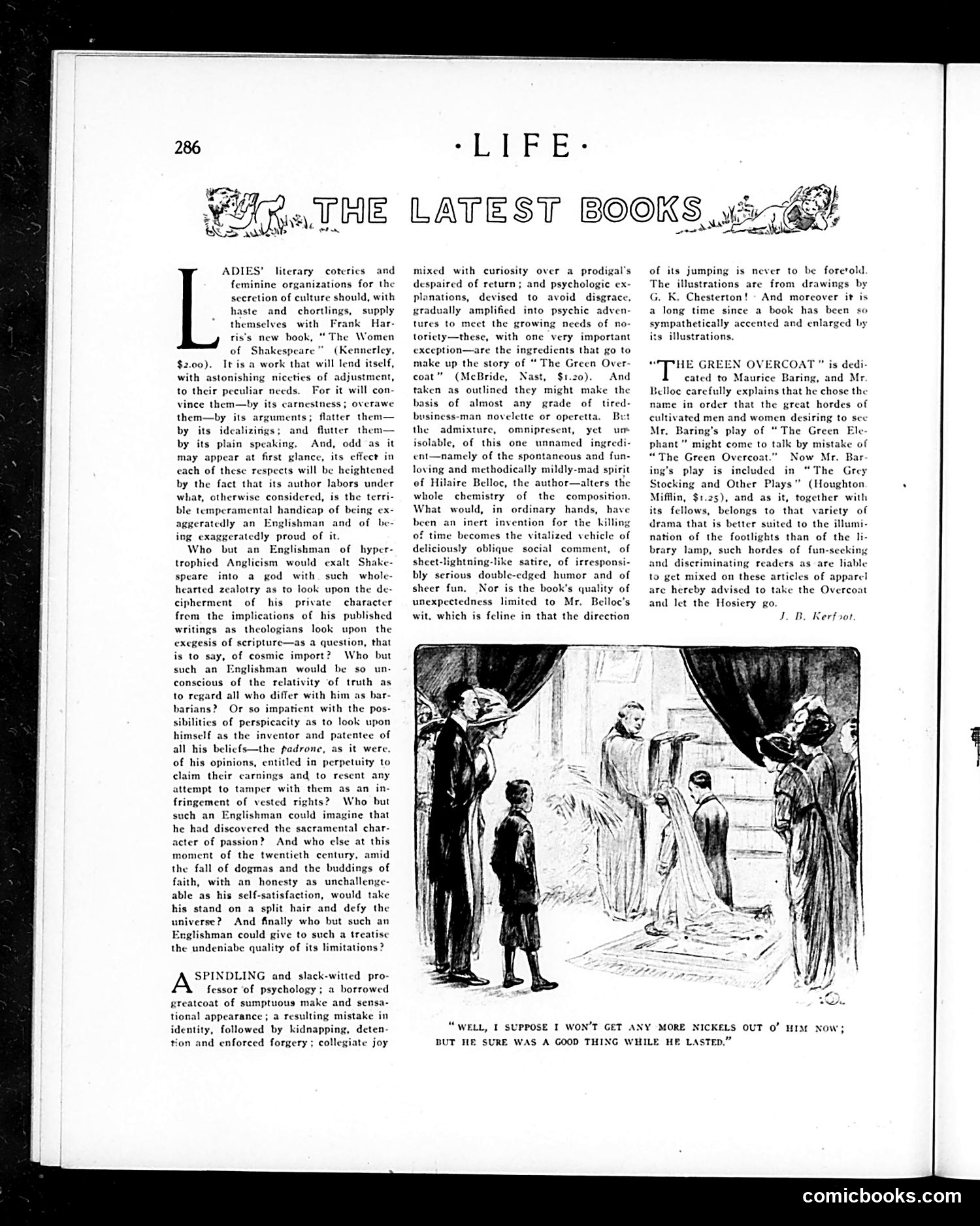
This page reviews two books: Frank Harris's "The Women of Shakespeare" and Hilaire Belloc's "The Green Overcoat." The text mockingly critiques Harris as an excessively proud Englishman whose reverence for Shakespeare borders on religious zealotry. The reviewer sarcastically suggests his pompous certainty about Shakespeare's character and his intolerance of differing opinions typify English arrogance—positioning Harris as someone who treats his literary interpretations as divinely ordained truth. By contrast, Belloc's novel is praised for its playful irreverence and sharp social satire delivered through humor rather than pompousness. The cartoon illustrates a scene from "The Green Overcoat," likely depicting the mistaken-identity plot involving the borrowed greatcoat. The satire contrasts two English literary figures: the self-important scholar versus the witty, humorous storyteller—suggesting that humor and levity serve truth better than humorless dogmatism. The review is fundamentally about intellectual pretension versus entertaining substance.
📄 Transcribed text from this page (OCR, searchable)
Machine-transcribed from the original scan — historical spelling and the odd misread are preserved.
“ literary coterics and feminine organizations for the sceretion of culture should, with haste and chortlings, supply themselves with Frank Har- ris’s new book, “The Women of Shakespeare” (Kennerley, $2.00). It is a work that will lend itself, with astonishing niceties of adjustment, to their peculiar needs. For it will con- vince them—by its carnestness; overaw them—by its arguments; flatter them— by its idcalizinigs; and futter by its plain speaking, And, odd as it may appear at first glance, its effect in cach of these respects will be heightened by the fact that its author labors under what, otherwise considered, is the terri- ble temperamental handicap of being ex- aggeratedly an Englishman and of be- ing exaggeratedly proud of it Who but an Englishman hyper- trophied Anglicism would exalt Shake- speare into a god with such whole- hearted zealotry as to look upon the de- cipherment of his private character from the implications of his published writings as theologians look upon the exegesis of scripture—as a question, that is to say, of cosmic import? Who but such an Englishman would be so un conscious of the relativity of truth as to regard all who differ with him as bar- barians? Or so impatient with the pos- sibilities of perspicacity as to look upon himself as the inventor and patentee of all his belicfs—the padrone, as it were, of his opinions, entitled in perpetuity to claim their carnings and to resent any attempt to tamper with them as an in- fringement of vested rights? Who but such an Englishman could imagine that he had discovered the sacramental char- acter of passion? And who else at this moment of the twentieth century, amid the fall of dogmas and the buddings of faith, with an honesty as unchallenge- able as his self-satisfaction, would take his stand on a split hair and defy the universe? And finally who but such an Englishman could give to such a treatise the undeniabe quality of its limitations? them— of SPINDLING and slack-witted pro- fessor ‘of psychology; a borrowed greatcoat of sumptuous make and sen: tional appearance ; a resulting mistake in identity, followed by kidnapping, deten- tion and enforced forgery ; collegiate joy oe Eat cil ea mixed with curiosity over a prodigal’s despaired of return; and psychologic © planations, devised to avoid disgrac gradually amplified into psychic adven- tures to meet the growing needs of no- toriety—these, with one very important exception—are the ingredients that go to make up the story of “The Green Over- coat” (McBride, Nast, $1.20). And taken as outlined they might make the basis of any grade of tired- business-man novelette or operetta. the admixture, omnipresent, yet isolable, of this one unnamed ingredi- ent—namely of the spontaneous and fun- loving and methodically mildly-mad spirit of Hilaire Belloc, the author—alters the whole chemistry of the composition. What would, ordinary hands, have been an inert invention for the killing of time becomes the vitalized vehicle of deliciously oblique social comment, of sheet-lightning-like satire, of irresponsi- bly serious double-edged humor and of sheer fun, Nor is the book’s quality of unexpectedness limited to Mr. Belloc’s wit, which is feline in that the direction almost une “WELL, I SUPPOSE I WON’T GET ANY BUT HE SURE WAS A GOOD THING WH THE LATEST BOOKS ws % of its jumping is never to be foretold. The illustrations are from drawings by G. K. Chesterton!» And moreover it is a long time since a book has been so sympathetically accented and enlarged by its illustrations. “OTHE GREEN OVERCOAT ” is dedi- cated to Maurice Baring, and Mr Belloc carefully explains that he chose the me in order that the great hordes of cultivated men and women desiring to sce Mr. Baring’s play of “The Gr phant” might come to talk by mistake of “The Green Overcoat.” Now Mr. Bar ing’s play is included in Grey Stocking and Other Plays” (Houghton Mifflin, $1.25), and as it, together with its fellows, belongs to that variety of drama that is better suited to the illumi- nation of the footlights than of the li- brary lamp, such hordes of fun-secking and discriminating readers as are liable to get mixed on these articles of apparel are hereby advised to take the Overcoat and let the Hosiery go. 3. Kerfoot MORE NICKELS OUT 0’ HIM NOW; ILE HE LASTED.” comicbooks.com