
Life, 1913-02-06 · page 14 of 48
Life — February 6, 1913 — page 14: what you’re looking at
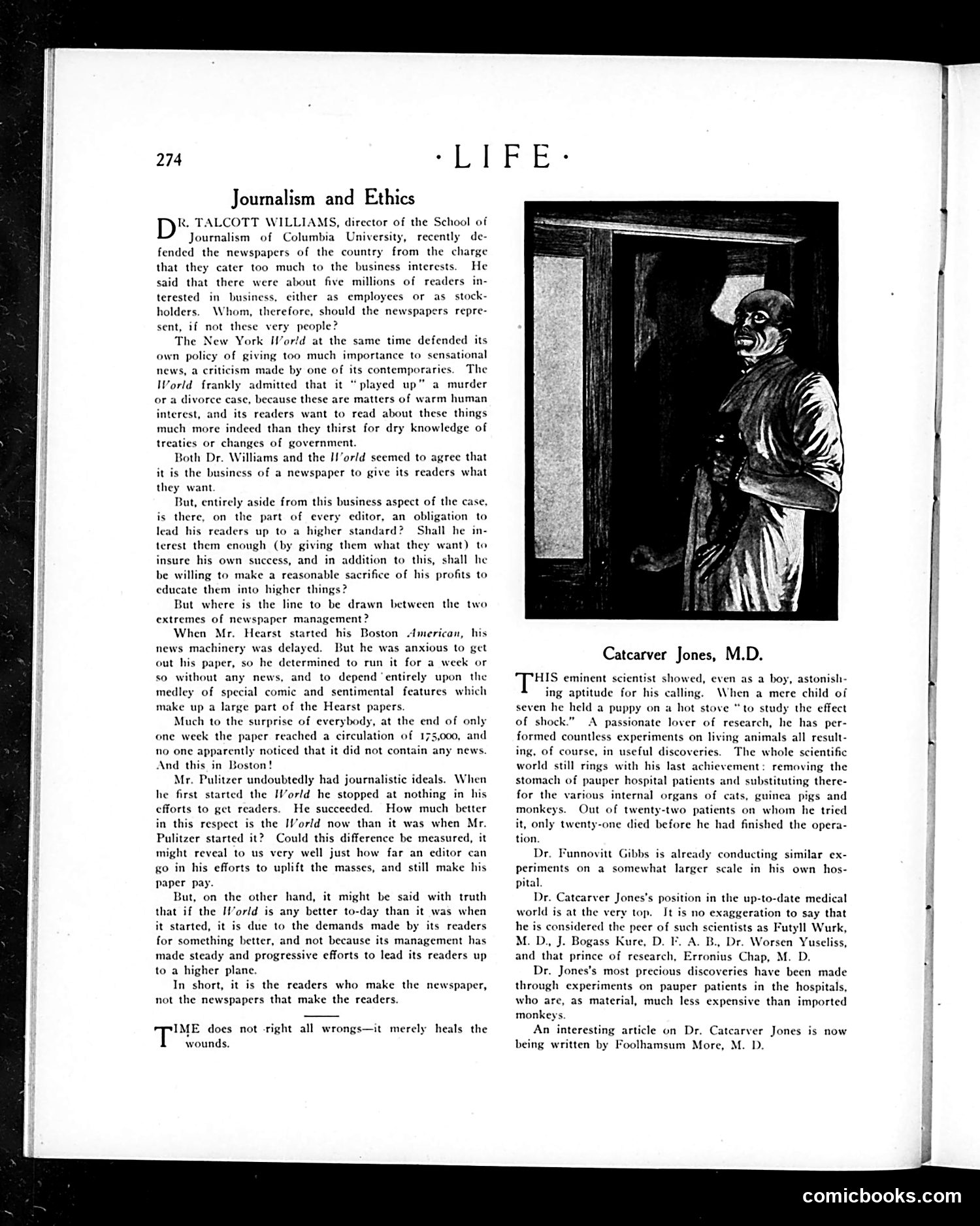
What you’re looking at
The illustration shows a skull-faced figure in medical attire, depicting **Dr. Catcarver Jones**, a real scientist praised in the accompanying text. The grotesque artistic style is intentional satire—the "death's head" appearance mocks sensationalized medical imagery rather than the doctor himself. The article celebrates Jones as an "eminent scientist" conducting vivisection experiments on animals (cats, guinea pigs, monkeys) to advance medical knowledge. The skull imagery sarcastically comments on public squeamishness about such research, while the text defends the practice as scientifically necessary and humane compared to human suffering. The page juxtaposes this with an earlier section on journalism ethics, suggesting both fields—medicine and news—must sometimes make uncomfortable choices for greater good.
📄 Transcribed text from this page (OCR, searchable)
Machine-transcribed from the original scan — historical spelling and the odd misread are preserved.
274 *-LIFE: Journalism and Ethics R, TALCOTT WILLIAMS, director of the School of Journalism of Columbia University, recently de- fended the newspapers of the country from the charge that they cater too much to the business interests. He said that there were about five millions of readers in- terested in business, either as employees or as_ stock- holders. Whom, therefore, should the newspapers repre- sent, if not these very people? The New York World at the same time defended its own policy of giving too much importance to sensational news, a criticism made by one of its contemporaries. The World frankly admitted that it “played up” a murder or a divorce case, because these are matters of warm human interest, and its readers want to read about these things much more indeed than they thirst for dry knowledge of treaties or changes of government. Both Dr. Williams and the H’orld seemed to agree that it is the business of a newspaper to give its readers what they want. But, entirely aside from this business aspect of the case, is there, on the part of every editor, an obligation to lead his readers up to a higher standard? Shall he in- terest them enough (by giving them what they want) to insure his own success, and in addition to this, shall he be willing to make a reasonable sacrifice of his profits to educate them into higher things? But where is the line to be drawn between the two extremes of newspaper management? When Mr. Hearst started his Boston American, his news machinery was delayed. But he was anxious to get out his paper, so he determined to run it for a week or so without any news, and to depend ‘entirely upon the medley of special comic and sentimental features which make up a large part of the Hearst papers. Much to the surprise of everybody, at the end of only one week the paper reached a circulation of 175,000, and no one apparently noticed that it did not contain any news. And this in Boston! Mr. Pulitzer undoubtedly had journalistic ideals. When he first started the World he stopped at nothing in his efforts to get readers. He succeeded. How much better in this respect is the orld now than it was when Mr. Pulitzer started it? Could this difference be measured, it might reveal to us very well just how far an editor can go in his efforts to uplift the masses, and still make his. paper pay. But, on the other hand, it might be said with truth that if the World is any better to-day than it was when it started, it is due to the demands made by its readers for something better, and not because its management has made steady and progressive efforts to lead its readers up to a higher plane. In short, it is the readers who make the newspaper, not the newspapers that make the readers. TM does not -right all wrongs—it merely heals the wounds. Catcarver Jones, M.D. HIS eminent scientist showed, even as a boy, astonish- ing aptitude for his calling. When a mere child of seven he held a puppy on a hot stove “to study the effect of shock.” A passionate lover of research, he has per- formed countless experiments on living animals all result- ing, of course, in useful discoveries. The whole scientific world still rings with his last achievement: removing the stomach of pauper hospital patients and substituting there- for the various internal organs of cats, guinea pigs and monkeys. Out of twenty-two patients on whom he tried it, only twenty-one died before he had finished the opera- tion. Dr. Funnovitt Gibbs is already conducting similar ex- periments on a somewhat larger scale in his own hos- pital, Dr. Catearver Jones's position in the up-to-date medical world is at the very top. IJt is no exaggeration to say that he is considered the peer of such scientists as Futyll Wurk, M. D., J. Bogass Kure, D. F. A. B., Dr. Worsen Yuseliss, and that prince of research, Erronius Chap, M. D. Dr. Jones's most precious discoveries have been made through experiments on pauper patients in the hospitals, who are, as material, much less expensive than imported monkeys An interesting article on Dr. Catcarver Jones is now being written by Foolhamsum More, M. D. comicbooks.com